Myrtle Circa 1927 Colorized

This is going to be a short one today.  Short and sweet.  I went back to work today after being off for close to eight months.  I didn’t realize how long it was until I went to write this post!  I don’t have nearly as much time to write these posts as I have had during my time off.  Plus, I had to go to safety training this afternoon.  If you have never done such a thing, it is brutal.  You have to sit and listen to a recording of some man talking about safety concerns when going into a plant.  And you need to pay attention closely, because you get tested on it and have to make a certain score.  But you can’t worry about that, because you have to pay attention to what he is saying as you try to keep your eyes open and follow along.  It made it a long day with a real-l-l-ly long afternoon.  I’m living the dream!  And it’s a safe one!

My maternal grandmother was Myrtle Sylvia Phenice when this photo was taken circa 1927. She is the one on the left holding the purse. This photo has been colorized.

But this post has nothing to do with all of that.  Last weekend I shared a photo of my paternal grandfather that I had colorized.  I used that as an update to a previous post because I had shared the black and white photo originally in my Man In Black post.  This time I’m posting a brand new photo.  It’s an old photo, but it’s a new one to me.  It was shared with me by my mom’s first cousin Julie.  Thanks, Julie, for sharing a photo of my Grandma Myrtle that I had never seen before.

I just happened to get this photo when I was in the middle of experimenting with the colorization feature I’ve been using lately.  So I thought I would go ahead and try it on Myrtle and her friends.  I like the way it came out.  It still looks like an old timey photo, just with a bit of color added to it.  It gives it a bit more life.  Of course, I edited it a little to fix some things I didn’t like about it.  It wants to put purplish/pink on people and it almost looks like bruising.

I was tempted to put some ‘normal’ looking hair on the boy in the photo, but I refrained.  I’m not sure what’s going on with that.  But my grandmother must have been fond of him.  She is leaning on him in a decidedly friendly way.  I don’t know who the identity of the other girl standing next to the boy.  She doesn’t look familiar to me.  But I’m almost certain that the girl on the far right is Edna Bucklin.  Edna was the younger sister of Fred Bucklin who would later marry Myrtle in 1930.  It seems that the Bucklin and Phenice families were pretty friendly with each other through the years.  They were in the same small community, and both of them had relatively large families.  I’ve shared several photos with individuals from both families in them.

I’m sure there are more.  But that will have to be at a later date.  I hope you enjoy this one now.

Four Years Gone

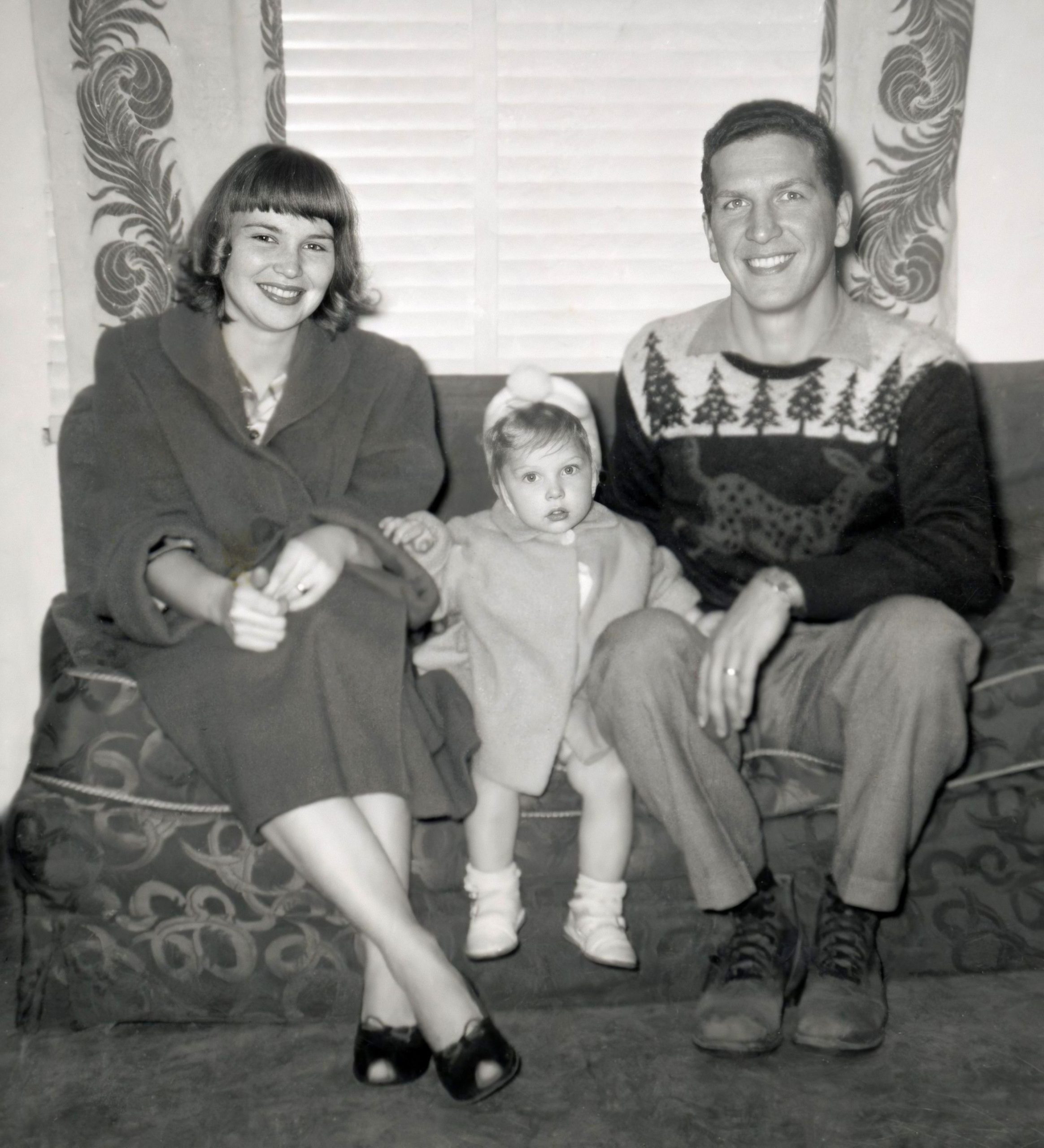
Betty, Jodie, and Bob Landry in January of 1955.

It has now been four years since the week that both of my parents died five days apart.  The anniversary of my mom’s death was two days ago and the anniversary of my dad’s death will be in three days.  Losing your parents in such a short time was rough.  It did seem appropriate that they had a joint funeral, since they had been happily married for 64 years.  Some people back then would say things like, “That’s kinda romantic, though.”  I have to say that at the time, there was nothing romantic about it to me.

They had been living in Assisted Living in Lake Charles, Louisiana, for two years and had grown very dependent on each other.  The main reason that they moved into Assisted Living is that my dad couldn’t keep up with my mom.  She was physically strong, but her memory was fading.  She could easily take a week’s worth of her medications on the same day and not realize it.  He was slowing down physically and finally took our advice to move out of their home.  We all thought it was for the best.

Three months before they died, my mom had a fall and broke her shoulder and her hip.  At the same time my dad became very weak with a few medical problems.  My mom’s physical problems got better, but my dad’s did not.  He had no energy and was extremely weak.  On that January 18th I got a call that he could be dying at any time.  Then later that night I got another call about my mom falling and hitting her head.  What actually happened is that she had a stroke and died the next morning.  My dad got progressively worse and died five days later.  Does that sound romantic?

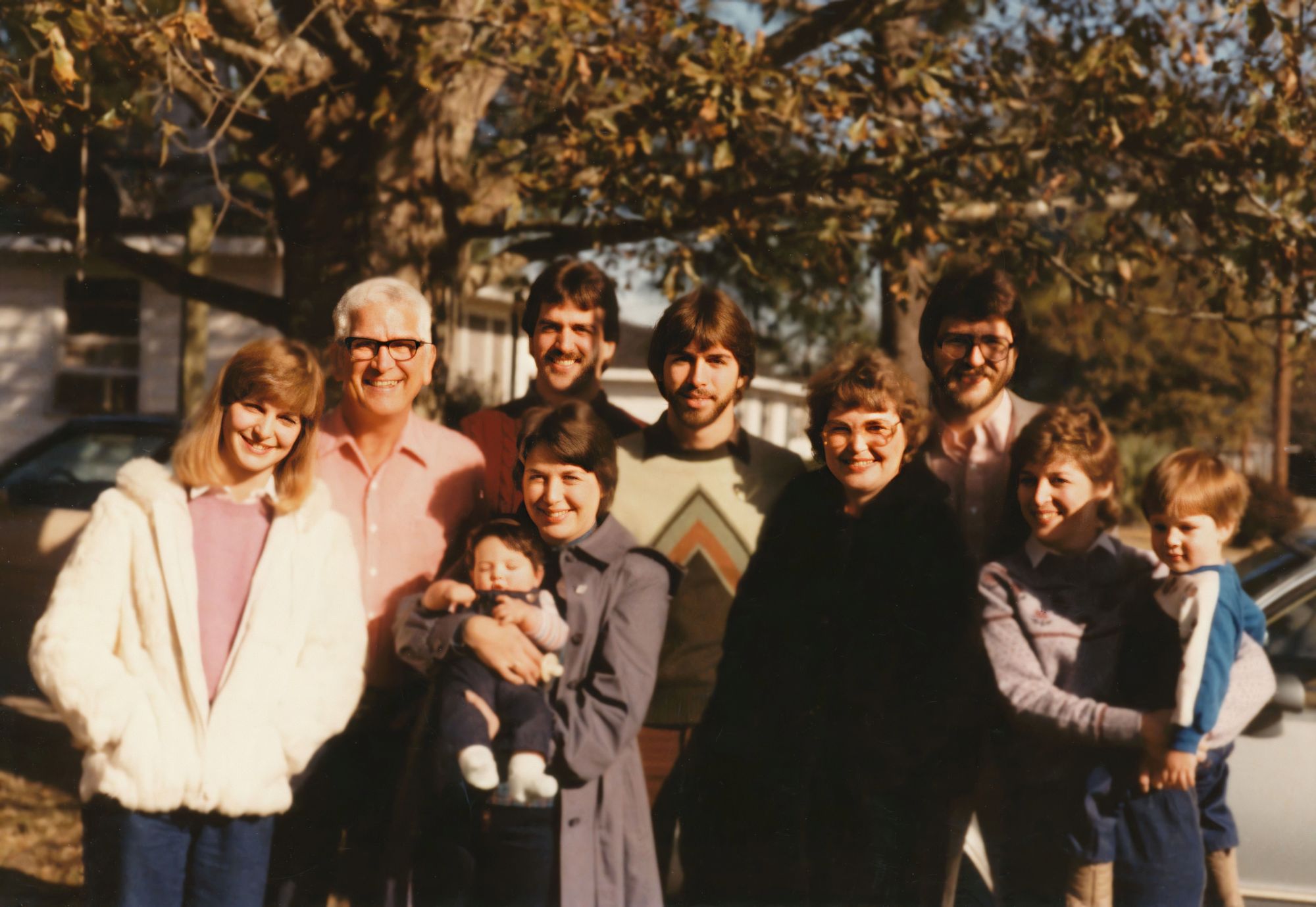
The Landry family in December of 1983 in Jennings, LA.

But now, I have to admit, the sting of it all has eased up a bit.  If I’m not thinking too much about it, I can agree that it was somewhat romantic.  Anybody that knew them knew that they loved each other.  It was pretty obvious.  My mom told me years ago that that was the most important thing for children to know – that their parents loved each other.  Since that’s what she believed to be important, I figure I’d post a few photos to show how that love expanded through the years.

The first photo is from January of 1955.  By this time, they had already welcomed little Jodie into their circle of love.  Don’t they look like a sweet little family?  Yes, you’re right!  They need more.  My brother Rob would be joining them in a few months.  But as I once said in a song I wrote for their 50th wedding anniversary, “Two would never do.”  They had Jodie in California and Rob was born in April 1955 in Albuquerque, New Mexico.  I don’t know when they moved there, so the photo was taken either in California or New Mexico.  The rest of us kids – Karen, Al, Van, and Jamie – were born in Lake Charles.

You can see all of us kids in the second photo, which was taken in 1983.  From left to right is Jamie, Bob, Karen, Rob, Betty, Al, and Jodie.  This was taken at their house at 758 Lucy Street.  The family is definitely growing, as you can see.  Jodie gave them their first grandchild Chris in 1981.  And Karen had little James just a few months before this photo was taken.  My parents certainly enjoyed their roles as grandparent.  They taught them to sing, to paint, to play ping pong, to make Pappy biscuits, to make liver pie sandwiches – the list goes on.  Chris and James were the first two of twelve grandchildren that they would get to know and love over the years.  We would lose Jodie in 1989.  Those who are greatly loved are greatly missed.

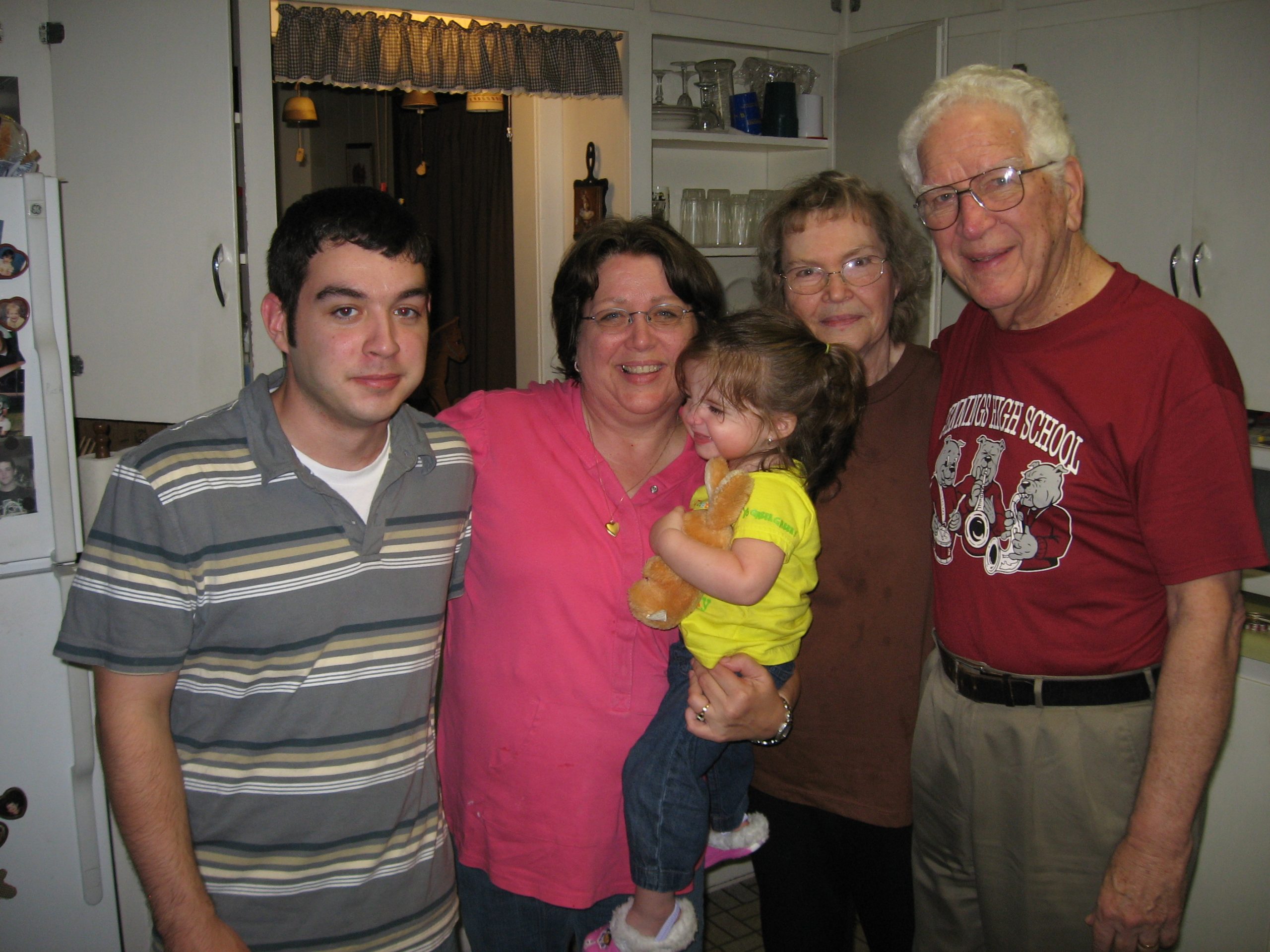
Four generations in 2008 – Bob and Betty with daughter Karen, grandson James, and great granddaughter Kelcie.

The last photo was taken on November 27, 2008.  It was also taken at 758 Lucy Street.  But this time little James in that last photo is now a father himself.  So now Bob and Betty were great grandparents and they still had enough love to share with that little one!  Great grandson Hudson showed up in 2013 and Henry showed up on my mom’s last birthday in 2016.  Two more little ones to love.  My mom was losing her memory by this point.  She loved those kids – when she was reminded of who they were.

And all of this came about because a little Hathaway country girl met a slightly older boy from the big city of Lake Charles and they fell in love.  That’s sounds a little more romantic.

Grandma Addie With a Big Ol’ Smile

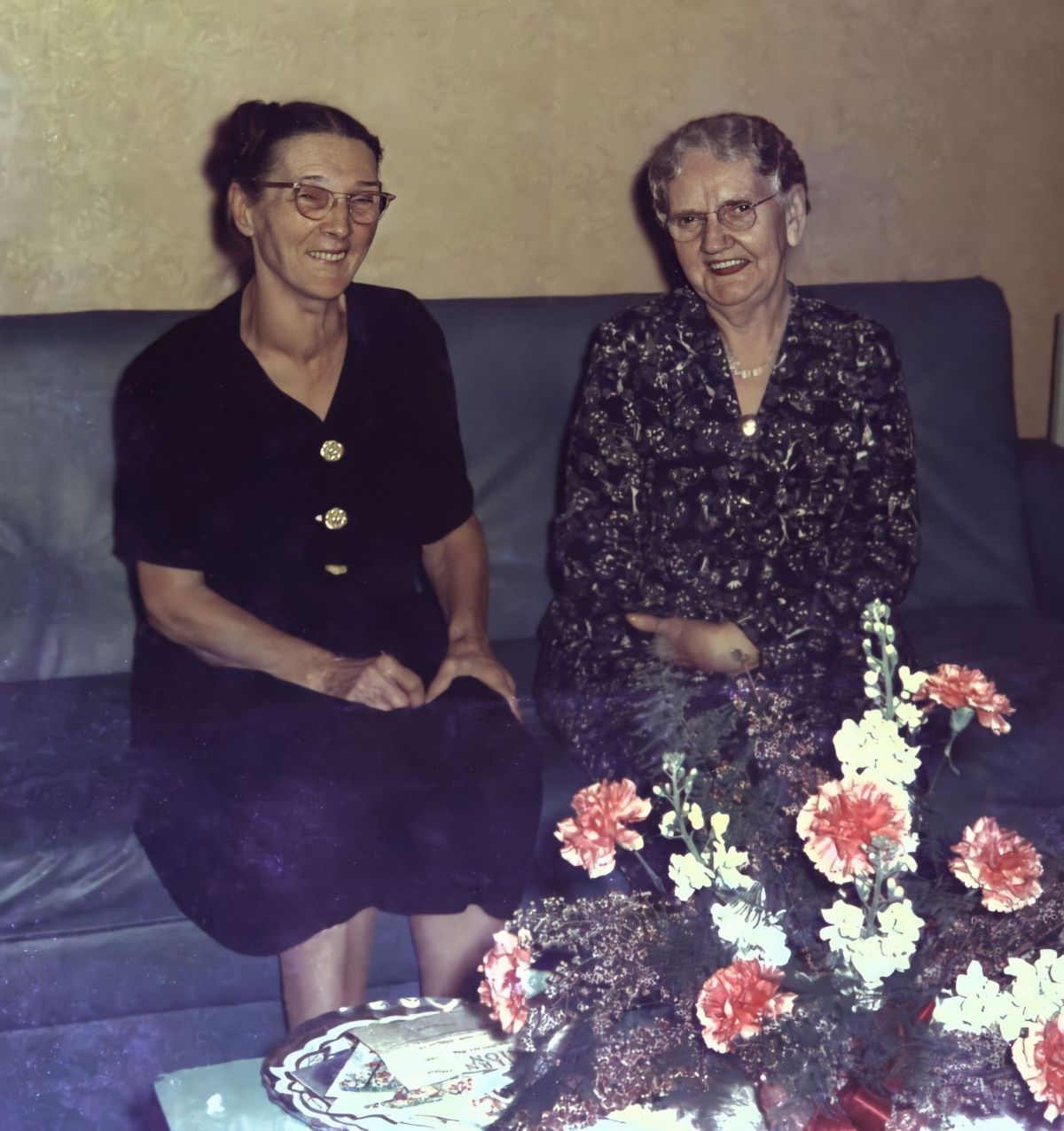
Addie May Hine Bucklin and Winnifred Talbott Welton in Elton, Louisiana, circa March 11, 1952. It was a birthday celebration for “Mrs. Weldon.”  (Photo has been edited.)

When I was thinking about what I would post today, I looked over the last few posts that I’ve written to see whose turn it is for the spotlight.  It was definitely my mom’s side of the family that was up for a turn.  And since the last one I did for my mom’s side was about the Keys family, I figured it was time for the Bucklin side.  And the Bucklin side includes my Grandpa Fred Bucklin’s mother Addie Hine Bucklin.

You all remember her, right?  She’s the one that I’ve made fun of on several occasions because she usually has a scowl on her face. (See here and here.)  It was lighthearted fun, of course.  Even though she looked very stern and a bit tough, I’ve only heard sweet stories about her.  Don’t judge a book by its cover.  So I like seeing this photo of my great grandmother having a good laugh with what looks like an old friend.

I actually worked on this photo this week for a completely different reason.  I was looking at Find a Grave and noticed there wasn’t a memorial (profile) for Selma Edessa Welton Havenar, who is the daughter of Winnifred.  We’re not related to the Havenar and Welton families, but we have some shared history.

I knew I had taken photos of her grave a few years ago and set up some memorials for other family members like her husband Guy Havenar.  Somehow I overlooked making one for Edessa Welton Havenar.  So I made one and started looking at the family a little more.  I noticed that she married Guy Havenar, whose mother was a Welton.  So I jumped into the rabbit hole of finding out how they were related.  Along the way I remembered these two photos and some of the writing on the back of them.  I figured out who they were talking about by looking at another tree on Ancestry.  I noticed the tree belonged to the great grandson of Winnifred.  So I decided to work on the photo and post it online for everyone to see.

Besides the shared history of both families living in Jefferson Davis Parish in southern Louisiana, there was a tradition of celebrating birthdays together with the two families. (See here, here, and here.)  Addie’s mother was Susan Stanbrough Hine and she was born on October 3, 1851.  We call her Grandma Sue.  The other person that shared Grandma Sue’s October 3 birth date was Winnifred’s sister-in-law Edessa Jane “Jennie” Welton Havenar.  In the old newspaper clippings that I’ve shared, they always just say something like, “Mrs. Hine and Mrs. Havenar are Celebrating Another Birthday.”  They started celebrating their birthdays with a joint celebration in 1906 and continued for at least 20 years.

Winnifred must have been fond of her sister-in-law, because it looks like her daughter was named after her.  And what makes it even more complicated is that both Edessa Jane “Jennie” Welton and Selma Edessa Welton both married a Havenar.  So to make it easier to tell who they were talking about, Edessa Jane was called Jennie and from what I figured out from the backs of these photos Selma Edessa was called Eddie.  But nothing stops the confusion when you see that Eddie married Jennie’s son Guy.  That’s right, she married her first cousin.  So her aunt became her mother-in-law.

Unedited photo of Addie May Hine Bucklin and Winnifred Agnes Talbott Welton at her daughter Selma Edessa “Eddie” Welton Havenar’s (married to Guy Havenar) home in Elton, Louisiana, on March 11, 1952. They were celebrating Winnifred’s 80th birthday.

It explains what was written on the backs of the photos.  Here’s a hint from me – never label someone on the back of the photo as “Mrs. Weldon.”  Use their full name.  Call her Winnifred Agnes Welton Havenar.  When I read “Eddie Havenar’s mother” when they talked about “Mrs. Weldon,” I tried to find a son named Edward for a Mrs. Weldon.  Seeing “Guy Havenar’s home” on the second one helped because I knew that Selma Edessa Welton was his wife.  So I figured Selma Edessa must be Eddie.  It also says that they were celebrating Mrs. Weldon’s birthday.  I was wondering why there were those nice pink carnations on the table.  Did I say pink?  Yes, I did.  It’s actually a color photo of Grandma Addie!  I don’t have many of those.

So the two families were celebrating a birthday again after almost fifty years of doing so.  The celebration was on June 16, 1952.  Or maybe the film was developed on that day.  Or maybe this reprint was made on that day.  This was long before our camera or phone automatically dates the photos we take.  I found that Winnifred’s birthday was on March 11 and that she lived in Minnesota.  I’m going to assume that she was down in Louisiana on her birthday, so these photos were taken on March 11, 1952, which was her 80th birthday!  It was definitely a day to celebrate with friends and flowers.

From Acadian to Cajun: Part 11 – The Ones That Didn’t Make it

It’s time to finish up my Acadian to Cajun series that I wrote throughout the year 2020.  I’ve covered all of the lines of my family that came to Louisiana from Acadie.  I’ve learned a lot while writing this series.  Before I started doing the research, I only knew that my family lines had been deported to Maryland and France.  I discovered that other family lines were deported to Connecticut, Pennsylvania, Virginia, and Massachusetts.  Some other family members had made their way to Ile St. Jean which was under French rule until 1758.  From those places, they made their way to England, France, and St. Domingue (Haiti) before arriving in Louisiana –  if they survived long enough. 

It’s time to talk about the ones that didn’t make it.  Obviously the ones that I descend from that didn’t make it were adults who had children already.  I didn’t talk about all of the family members who were affected by the Grand Derangement in the original installments.  Either I didn’t know about them or I didn’t want to overly complicate the stories at the time.  But they deserve a mention.
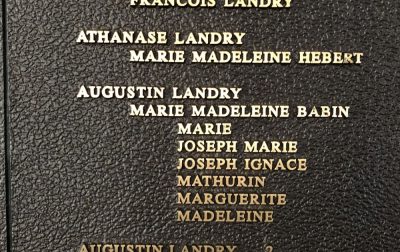
Installment 1 was about the extended families of Augustin Landry and Marie Madeleine Babin.

From Installment 1 of my Acadian to Cajun series, I’ve already talked about Pierre Landry.  He was the father of Augustin Landry who brought his family to Louisiana by way of Upper Marlboro, Maryland.  I talked about him in my post about Landry Grandfathers.  Augustin’s wife was Marie Magdelena Babin and her mother was Marguerite Bourg.  I talked about Marguerite in Installment 10.  But I didn’t talk about  Marguerite’s father Alexandre Bourg who was still alive at the time of the Grand Derangement. 

Can you imagine your whole life turning upside down  at the age of 84?  That’s what happened to Alexandre.  He moved to Ile St. Jean sometime in the early 1750s.  He was living with his daughter Anne and her husband Joseph LeBlanc in 1752 in Port Toulouse.  He somehow escaped being Exiled after the fall of Louisbourg in 1758.  He had been a royal notary for many years, so he may have still had some political connections on both the French and English sides of the conflict.  He was 87 years old at the time.  He was 89 years old when he died in 1760 in Richiboucton, New Brunswick, Canada.

Installment 2 covered the family of Antoine Breau and Marguerite Landry. Antoine’s mother Claire Trahan is listed below him. I could find no information about the ancestors of Marguerite Landry.

In Installment 2, I talked about the Charles Breaux family who was Exiled to Port Tobacco, Maryland, in 1755.  Charles died in Port Tobacco sometime around between 1763 and 1765.  His wife Claire Trahan made it to Louisiana where she lived a short while.  Claire’s mother was Marie Helene Pellerin and she was alive in 1755, but she was living in Ile St. Jean which was still under French rule.  She died August 27, 1756, at the age of 87.  She was my 7x great grandmother.

In Installment 3, I talked about the Pierre Breaux family.  Pierre was the brother of Charles Breaux.  Some of his family were also Exiled to Port Tobacco and Pierre died before 1763.  In the meantime his son Honore had been deported to Virginia and was sent on to England and France.  He eventually married Elizabeth LeBlanc.  She was the daughter of Victor LeBlanc and Marie Aucoin.  I talked about the tragic deaths of Marie, her parents, and two of her young children by her second husband Gregoire Maillet.
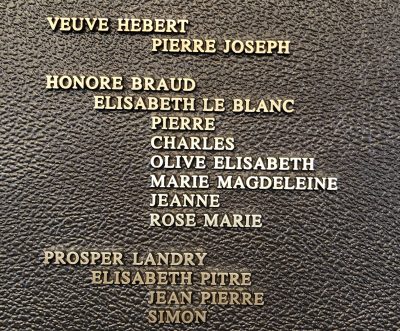
Installment 3 was about Honore Braud, Elisabeth Le Blanc, and their extended families

But I didn’t tell you anything about Victor LeBlanc’s family.  I doubt that anybody noticed because I was talking about so many people.  The other reason I didn’t write about it was that I wasn’t sure about his family.  When I looked around for information about him, I found different parents than what I had .  My dad had obtained that information from Acadian researcher Bona Arnsenault.  But recently more information was discovered that showed he was from a different family.  I needed time to “Let go of” his previous parents and make the changes. 

His parents were Pierre ‘dit Pinou’ LeBlanc (1685-1769) and Francoise Landry (1693-1767).  I descend from siblings of both of them, so there were no new lines to add to the tree.  Francoise was the sister of Pierre Landry who I mentioned earlier.  Pierre LeBlanc and Francoise Landry were Exiled to Shrewsbury, Massachusetts. They both showed up on a 1757 Census of Acadian Exiles, as well as another one conducted in 1763.  After the Seven Year War was over, many of the Acadian Exiles in Massachusetts decided to return to Canada.   Around May 17, 1767, Pierre and Francoise, along with the family of their daughter Angelique (married to Germaine Dupuis, the first cousin of my ancestor Joseph Dupuis from Installment 9), boarded the schooner Abigail bound for Quebec.  They arrived in Quebec on June 18.  Sadly, Francoise died a few months later on October 3, 1767, in Lavaltrie, Quebec, at the age of 74.  Pierre died on October 22, 1769, in Montreal at the age of 84.

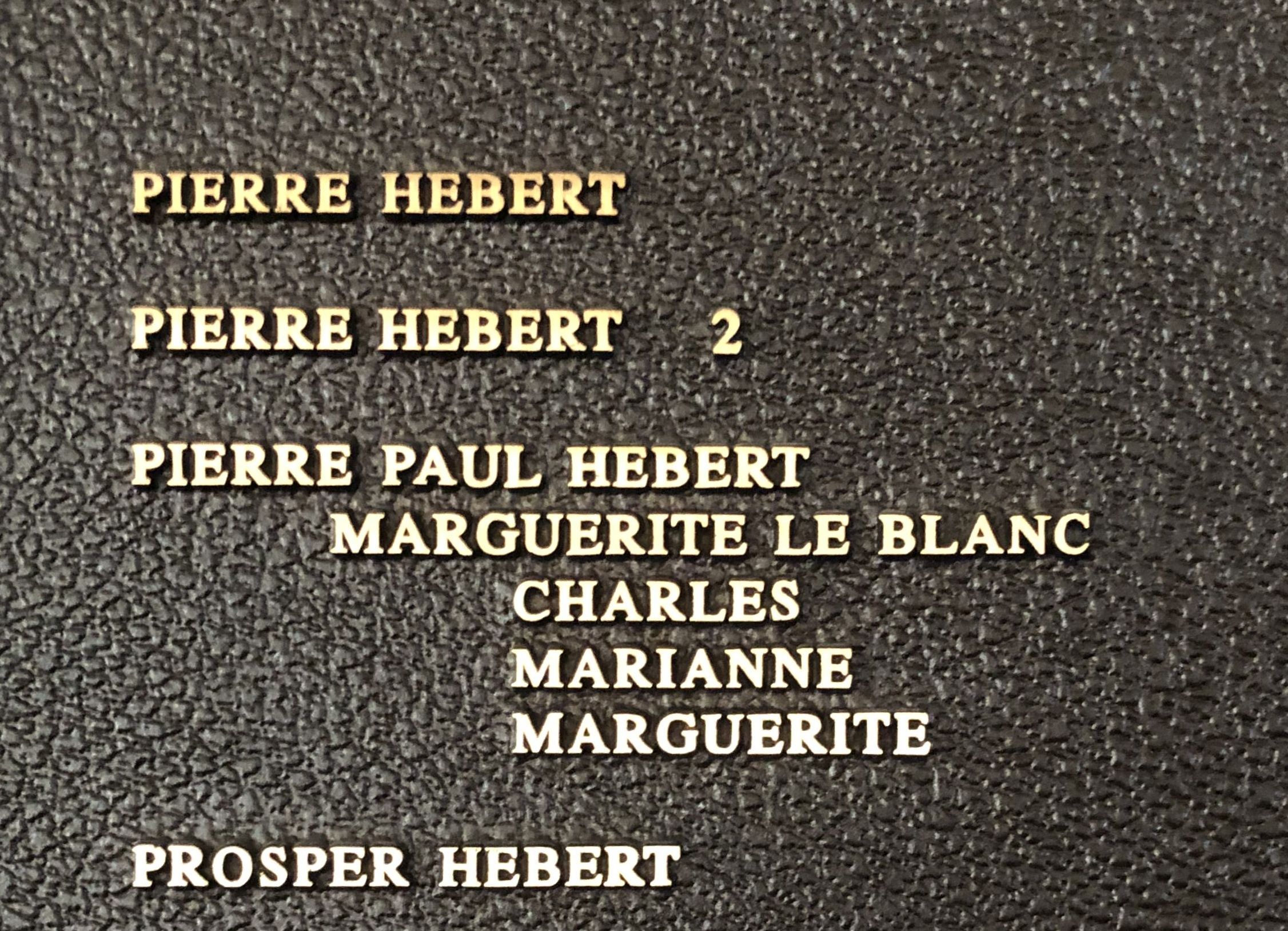
Pierre Paul Hebert’s and Marguerite LeBlanc’s families were discussed in Installment 4.

In Installment 4, we talked about the Hebert family.  They were Exiled to Georgetown, Maryland.  If you’re keeping track, my ancestors were deported to four locations in Maryland:  Upper Marlboro, Port Tobacco, Oxford, and Georgetown.  They seemed comparatively the safest places to be Exiled.  I could be biased since my ancestors survived being deported there.  We descend from survivors of catastrophes through the ages.  Just because a person is a Holocaust survivor doesn’t mean that they had an easy time of it.  And it’s not like they had a choice.

I mentioned in that installment that Marguerite LeBlanc (the wife of Pierre Paul Hebert) was the daughter of Antoine LeBlanc and Marie Babin.  I am a bit more sure of her parentage than back then and have found out more information about them.  To make things perfectly clear, I found out that Antoine LeBlanc and Victor LeBlanc were double first cousins.  That means that his father Antoine was the brother of Pierre ‘dit Pinou’ LeBlanc and his mother Anne Landry was the sister of Francoise Landry.  Antoine LeBlanc (the grandfather of Marguerite) died before the Grand Derangement in 1739 in Grand Pre, Acadie.  His wife Anne Landry (my ancestor) was Exiled to Massachusetts like her sister.  She also died in Quebec in 1767 like her sister.  Anne was 79 years old when she died.  The younger Antoine LeBlanc (father of Marguerite) died in 1744 at less than 40 years of age.  It is believed that his wife Marie Babin (my ancestor) was deported to Virginia, which is very unfortunate.  They were sent on to England where they were treated poorly.  Many of them suffered from smallpox and died.  It looks like Marie was one of those that died in 1756 in that group.

Installment 5 discussed the families of Joseph Bourg and Marie Magdelene Granger.

In Installment 5, I told you about the very tragic story of Magdelene Granger, my 6x great grandmother.  Her first marriage was to Alain Bujol.  They had two children together in Ile St. Jean, but were later deported in 1758 at the fall of Louisbourg.  She was the only survivor of her little family due to the circumstances of being Exiled.  I found out that her father Joseph Granger was alive at the time of the initial deportations in 1755.  I descend from his first wife Anne Richard who died in 1751.  Joseph remarried shortly after that (he was 54 years old) to a Marguerite Gautrot.  They had two sons before the deportations began.  Joseph’s family was deported  to Virginia. (cue the somber music) They were on a ship that arrived in England in June of 1756.  There was no sweet reunion for Joseph and Magdelene.  When she was married in 1760, Joseph is listed as deceased.  She is my inspiration for perseverance! 

Installments 6 and 7 were about the families of the brothers Etienne and Joseph Bugeaud. I descend from both of them.

In Installment 6, Joseph Bujol and Anne LeBlanc were sent into Exile with their family to Oxford, Maryland.  I bet you were relieved to hear that they weren’t sent to Virginia!  This history is so full of tragedies.  Thankfully this little family fared well during their time in Exile.  The family stayed intact and actually grew during their time in Maryland.  This wasn’t true for their extended families.  Anne’s mother Jeanne Bourgeois was Exiled to Cambridge, Massachusetts.  She arrived in December 1755 and it was the last that was heard of her.  Three of her children died in Liverpool, England, in 1756 and another one died in France in 1759.  Jeanne was probably not aware of their deaths since those events happened across the ocean.  We know that she had died before the 1763 Census at the age of about 70.

The story in Installment 7 was about Joseph Bujol’s brother Etienne and his wife Anne Forest.  Anne was another of those with a tragic story.  She lost her first husband during the Exile.  What I didn’t mention in that installment was the fate of her parents Pierre Forest and Madelaine Babin.  They were alive when the Grand Derangement began and they were deported to Weymouth, Massachusetts.  He died within the first year of Exile at the age of 62.  Madelaine shows up on the November 10, 1756, Census in Weymouth as a widow.  There are no records of her after that time.  So she probably died shortly after that before the age of 60.

Joseph and Etienne’s extended family was not Exiled during the initial deportations of 1756.  They had several younger brothers and sisters who moved to Ile St. Jean with their parents Joseph Bujol and Josette Landry.  They were there by the time of the Census of 1752.  So while Joseph the younger and Etienne were Exiled with their families in 1755, other family members were able to stay at Ile St. Jean until 1758.  It was at this point that Joseph the elder died.  Either he died prior to the deportation or as a result of it.  He was 59 years old.  Josette and some of her children fled north with the help of a son-in-law who was part of the Acadian militia.  They surrendered to the British and were held in Nova Scotia until the end of the Seven Year War.  They made their way to Quebec and settled there.  Josette eventually died on June 8, 1778, in Bonaventure, Quebec, at the age of 77.  She did not see her sons Joseph and Etienne during the last 22 years of her life.

So that’s it.  I previously covered the extended families of the ancestors I discussed in Installments 8, 9, and 10.  I don’t think I’ll ever think of the Grand Derangement or even Acadie in the same way ever again.  Hopefully I’ll always be aware of the difficulties my ancestors had to endure in order for me to be able to call myself a Cajun.  Even though those I mentioned in this post didn’t survive the Exile to make it to Louisiana, I will still consider them honorary Cajuns!  I think of it as a title of respect and they definitely deserve it.


For other installments of the “From Acadian to Cajun” series, click on the following links:

From Acadian to Cajun: Part 1 – Landry/Babin

From Acadian to Cajun: Part 2 – Breau/Trahan

From Acadian to Cajun: Part 3 – Braud/LeBlanc/Gauterot/Aucoin

From Acadian to Cajun: Part 4 – Hebert/Melanson

From Acadian to Cajun: Part 5 – Bourg/Granger

From Acadian to Cajun: Part 6 – Bujol/LeBlanc

From Acadian to Cajun: Part 7 – Foret/Bujol

From Acadian to Cajun: Part 8 – Hernandez/Babin

From Acadian to Cajun: Part 9 – Dupuis/Dugas

From Acadian to Cajun: Part 10 – Bourg/Babin/Landry