Amedee Bujol’s Tragic Death

Marie Amelie Belite Bujol was the daughter of Amedee Bujol.

I came across something this week that I had never noticed before.  On the profile for Amedee Bujol on FindaGrave, there was a photo attached of a newspaper article.  It had been there for four years, but I hadn’t noticed it.  I don’t examine every little detail of those profiles on a regular basis, so it can be easy to overlook something.  But this thing wasn’t insignificant!  It was information about how one of my ancestors had died in a rather tragic way.  That always makes a good story, right?

I shouldn’t talk about his death so flippantly, should I?  It’s serious business, especially when the circumstances are tragic.  It’s not the first time that I’ve been flippant about his death, either.  I’ve done it at least twice already.  But before I tell you about those, let me tell you of my connection to Amedee Bujol.  My father’s name was Bob Landry, and he was the son of Erie Patureau Landry.  She was my beloved Mee Maw, and her mother was Marie Therese Landry Patureau.  Marie Therese died at the age of 41 when Mee Maw was just 14 years old.  She was the oldest child of Trasimond Landry and Belite Bujol.  Belite was the daughter of Joseph Hubert Amedee Bujol and Anna Adele Landry.  She was born in 1843 in Brusly, Louisiana.
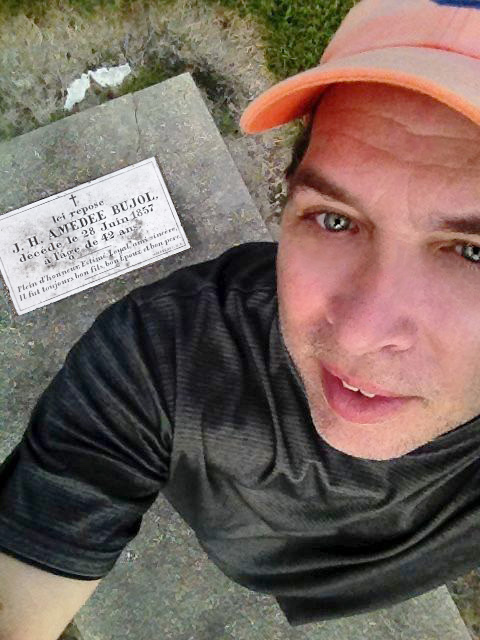
Selfie I took with Amedee’s grave in December of 2017 in the Brusly cemetery.

But Belite wasn’t the only daughter of Amedee and Adele.  Not by a long shot.  She was the third daughter.  She had no older brothers, and it wasn’t until she already had seven more younger sisters when she finally had a brother.  That son was born in May of 1856 and their father died in June of 1857.  I didn’t know how Amedee died, but I did know he died after having eleven children over a period of sixteen years.  So in a previous post I joked that he died the following year from exhaustion.   Anything for laugh at the expense of poor old Amedee.

Then a couple of years later I talked about him in another post.  In that one I suggested that Adele had strangled him when he suggested they try for another son!  She could have blamed it on postpartum depression.  Not really.  That wasn’t a thing back then and if she had killed him, surely we would have heard about that.  Two weeks after that post, someone on FindaGrave shared the information that talked about Amedee’s death.  It’s like they were trying to help me out, but I just didn’t notice.
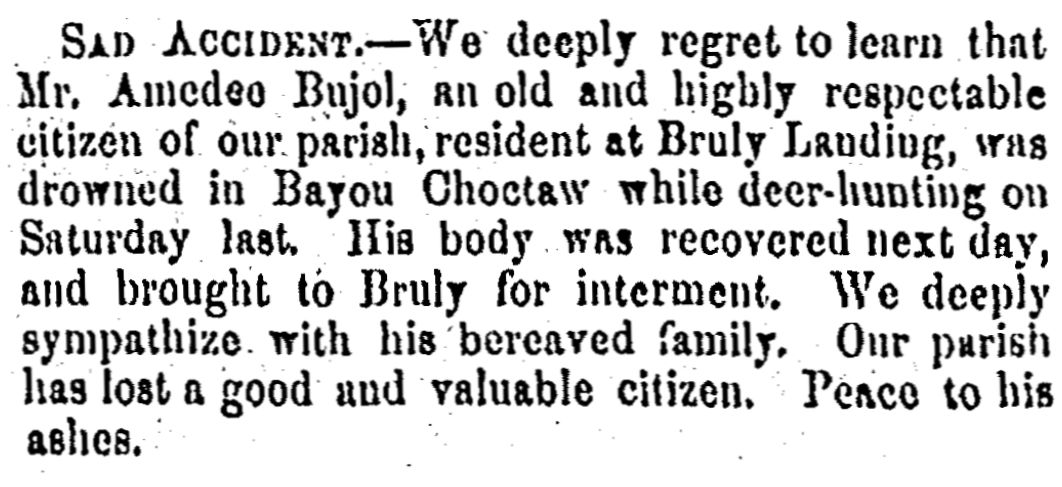
July 8, 1857, newspaper article about Amedee’s death. The Daily Advocate of Baton Rouge, Louisiana.

And now I have.  No more jokes in bad taste about his death.  You can see from the article that he had a tragic death.  It says that he is an old citizen of the parish, but he was only 41 years old at the time of his death.  That’s not old at all.

He lived in Brusly on a plantation on the Mississippi River at the time of his death.  He didn’t own much land, but he worked in combination with Joseph Auguste Leveque, who owned a considerable amount more.  Joseph Auguste was his mother’s (Marie Francoise Leveque) younger brother.  Not only that, at the time he was married to Adele’s younger sister Marguerite Landry.  His first wife had been Adele and Marguerite’s older sister Doralise.  Marguerite married Josephe Auguste after Doralise’s death.  I descend from the second marriage.

The plantation he lived on was to the west of the Mississippi River, and on the other side it led into a marshy area that was formed by Bayou Choctaw.  According to the article, Amedee had gone hunting one Saturday trying to score a deer.  It was probably something he had done all his life.  He was a Cajun living along the bayous of Southern Louisiana.  And usually when you find a deer hunter, they started hunting at a young age and have a passion for it.  They know about guns and ammunition, and in the place that he was living, they would know about boats as well.

But this time something different had happened.  The article doesn’t exactly say all of the details of what went wrong, yet we know that something went tragically wrong.  The 41-year-old father of ten young children drowned in Bayou Choctaw.  Was he alone when it happened?  Were there any hints of foul play?  It doesn’t say.  It just says that his body was recovered the following day and brought to Brusly for interment.  Traditionally that means burying somebody in the ground, but that last statement makes me question that assumption.  “Peace to his ashes.”  Does that mean he was cremated?  I don’t think so.  I think he was buried in that grave in Brusly.

That must have been a terrible shock for Adele, Belite, and the rest of the family.  Belite was a young teenage girl of 13 at the time of her father’s death.  The only grandfather she knew – Emmanuel Landry – had died three years earlier.  She had never known her Bujol grandfather.  Joseph Sylvestre Bujol had died in 1824 at the age of 36.  I don’t know how he died, and I will refrain from saying anything flippant about his death.  I’ll have to see if I can find anything more about any details. 

Belite still had her mom and her grandmother Francoise Leveque Bujol.  I suppose she also had her grandmother’s brother who was her uncle Joseph Auguste and her neighbor as well.  He seemed to play a big part in their lives.  He helped Adele with settling Amedee’s succession.  Their extended family was nearby and I’m sure they were supportive of one another.  It was a Landry family after all!
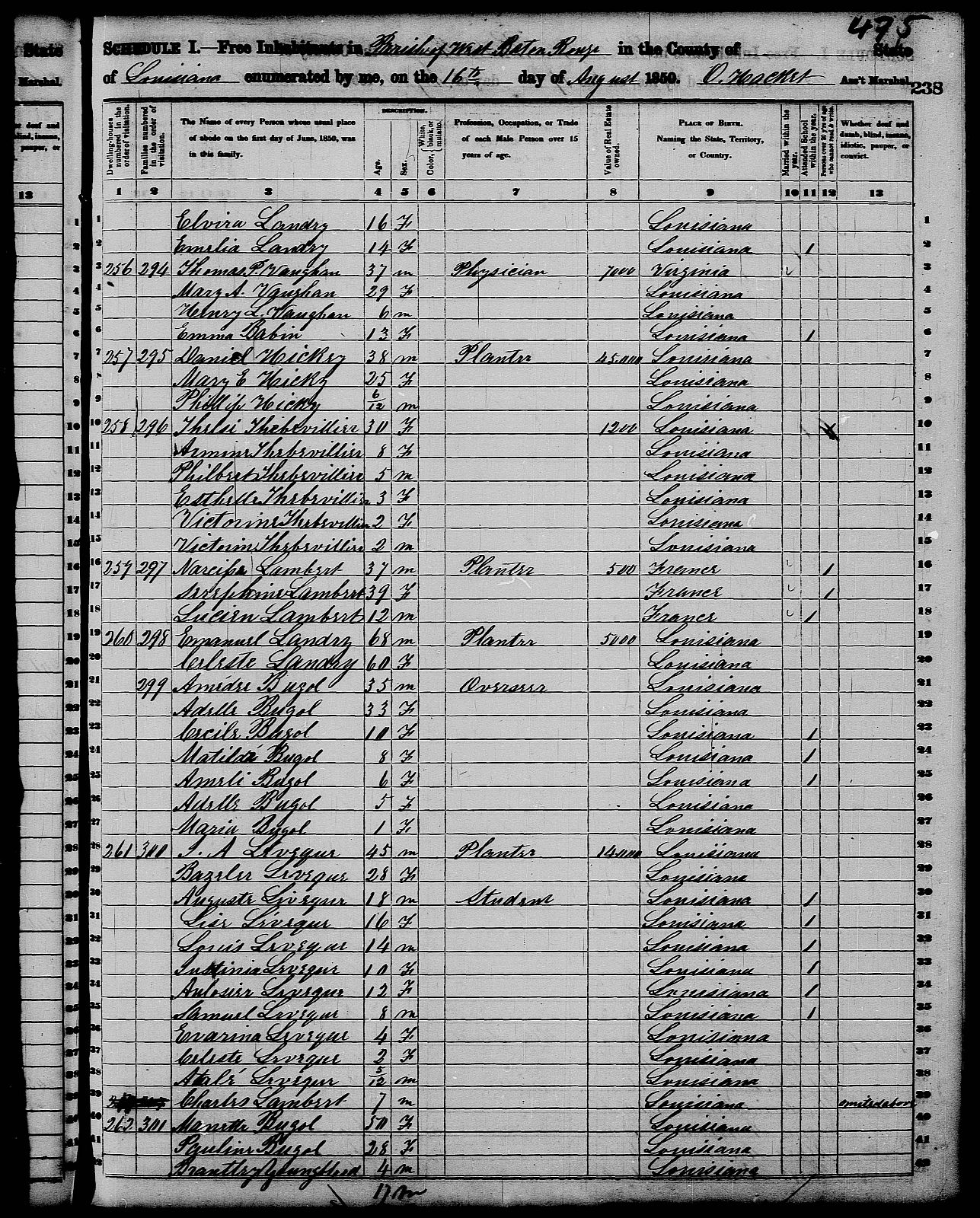
1850 Brusly Census page shows some family. It starts in the middle of the page with Adele’s parents Emmanuel and Celeste Landry, followed by Amedee and Adele’s family, then the family of Joseph Auguste Leveque and (Marguerite) Basilde Landry Leveque, and lastly Manette Bujol’s household. Manette was another name for Marie Francoise Leveque Bujol.


A Clearer Photo of Belite

I couldn’t think of anything to write about tonight.  Earlier I had an idea about posting a second photo of our family at NASA in 1969, since they just launched a manned spaceship to fly around the moon for the first time in over fifty years.  But when I got back home, I realized I had already posted that second photo.  So I jettisoned that idea.  When Chuck saw me struggling for an idea, he suggested I revisit a post from ten years ago.  That sounded fine to me.  I looked back ten years ago to the beginning of April, and I saw an old photo of my great great grandmother Marie Amelie “Belite” Bujol Landry Babin.

I couldn’t use that one, because I had only recently updated that photo with a newer version that I got from Box 301 in June of 2024.  At least I thought I had.  When I searched through the photos of Belite on my blog, there wasn’t a post with the new photo.  I had already edited the photo nicely and thought about posting it many times.  But evidently, I never did post it.  It’s a good thing I can search through my posts rather easily, because obviously I can’t remember every detail of every post I’ve written.  That’s actually one of the main reasons I write them, because I know I can’t remember all of the details that I discover.  And soon I need to get serious about putting some books together.

Marie Amelie “Belite” Bujol circa 1915.

This is the new and improved version of the old photo of Grandma Belite.  I’ve had three versions of the photo.  The first one I had must have been a Xerox copy of the old photo.  The second version was a washed-out looking scan with small, splattered spots across part of her face.  Those are hard to remove and keep the face looking accurate.  The end result was pretty good, but there weren’t as many details as there are on the newest version.

The newest version is so much better because I was able to scan an original old photo from Box 301.  That was an old box full of treasures stored in my Aunt Wana’s house.  Look at the details on this one.  You can see the wrinkles around her eyes and on her forehead.  The shape of her mouth is much clearer as well.  Both of her shoulders show up on this version of the cropped photo.  I had created a shoulder on the left side of the old photo to try to balance it.  It always looked fake to me, but the photo was unbalanced without it.  

You can also tell that she has either buttons or pinheads on her collar.  With all of the scratches and spots on the older photos, I got rid of them because I thought they didn’t belong there.  This photo shows that they did belong there.  It also shows her hair clearer.  You can see the gray hairs mixed in with the darker ones.  You can also see that her hair is not draping down her back.  It must be up in a bun, and behind her there is a shadow on the wall that at first glance looks like hair on her shoulder and back.  You can also see more details in the cloth of her clothes.  It is a much better photo all around.

Trasimond Landry circa 1861 in Brusly, Louisiana.

I still wonder what she looked like when she was younger.  In a description in a book about the Civil War, she was referred to as one of the beautiful daughters of the Veuve Bujol.  That would be Anne Adele Landry, the widow of Amedee Bujol.  Amedee had died in 1857, and Adele died in 1899.  Soon after the Civil War, Belite married the Brusly war hero Trasimond Landry.  Trasimond and Adele were half first cousins.  They had a common grandfather – Joseph Ignace Landry.  I only have one photo of Trasimond, and it is from 1861 when he joined the military.  He was just a young man.  He and Belite were married in1867 and I have never seen a photo of the wedding.  

So, I have several photos of Belite when she was older and only one of Trasimond when he was young.  But the technology of reverse-aging photos is just starting.  Now, it usually takes one photo and shows an interpretation of that photo with the person at a younger age.  Soon, it will take into account several photos of the person to get more accurate estimate of what that person would have looked like at a younger age.  Then I would be able to create a wedding photo of Trasimond and Belite!  Would that be wrong?  My answer is, “Yes, it is, but I’d still like to see it!”  

In the meantime, I’d prefer it if an old forgotten photo of that wedding would be discovered in someone’s attic.  It could happen.  Just look at this photo.

Patureau and Landry Families in 1921

The Landry and Patureau family in Lafayette, Louisiana in 1921.

I got this photo from Box 301 in June of 2024.  Box 301 Collection was a box that was in my Aunt Wana’s attic for many years.  We don’t know how many years, because it was discovered about ten years after her death.  Some attics are just dusty with nothing of value in them.  Aunt Wana’s attic was a treasure trove for old photos.  Both Box 301 Collection and the Tin Can Collection are from that.  I’m hoping more treasures will be found in other cousin’s attics and/or homes.  And of course, I hope they would be willing to share them with me.  I would be sharing with them if the reverse were true.

I recognize this event in the history of my dad’s family.  Other photos were taken on the same day with various groupings of family members.  Since they were all wearing the same clothes, it’s pretty easy to determine that it was the same event.  That event was the baptism of my dad’s first cousin in 1921 in Lafayette, Louisiana.  My dad was Robert Joseph Landry, Jr. and his first cousin was Therese Wynhoven Mouton.  They were known by various names.  My dad was known as Bob, Bobbie, Pluto, and Pappy.  His cousin was known as Therese, Tez, or Wynie. 

They were cousins because their mothers were sisters.  Those sisters are sitting in the forefront of this photo with little Tez.  Tez was the first grandchild of the Patureau family.  She was the daughter of Emma Patureau Mouton who is holding her here.  Her father was Toby Mouton.  He is the tallest person in this photo.  Emma was the oldest child of Vincent Maximilian Patureau and Marie Therese Landry Patureau.  Max is on the right edge of the photo.  Not that you would be able to tell, but that looks like him and the suit he was wearing that day.  I’m not sure if I took a bad photo of this photo.  He might be showing up in the original photo, and I didn’t get it all.  Maybe my cousin can help me out with that.  Marie Therese Landry Patureau is not in the photo because she passed away in 1909.

My wonderful grandmother is sitting next to her sister Emma.  Her name was Germaine Erie Patureau, but she usually went by Erie.  But she was known to us cousins as Mee Maw.  She was the best.  Of course we could be a bit prejudiced.  I’m sure all of her sisters and brothers were wonderful people as well.  This was the year that my grandparents got married.  Erie Patureau married Rob Landry in November of 1921.  All the rest of the people in the photo are relatives of theirs.

Standing on the left in the photo is Zim Landry Landry.  She’s a Landry that married another Landry, but she was around a 3rd cousin to my grandfather.  She’s in the photo because she was married to my grandfather’s older brother Joe Landry.  He’s standing next to Zim and a little behind her.  Another Landry brother is in the background in the middle of the photo.  That was Louis or Louie Landry.  He was married to Clemence Babin, who was Marie Therese Landry Patureau’s half-sister.  Clem is in front of him and she is looking around the head of one of the Patureau sisters.  That sister is the youngest one that survived to adulthood.  Her name was Sylvie Patureau and she married Son Marionneaux from Plaquemine.  They lived in Plaquemine and many family members still live in that area.  I don’t know what that big round thing on her dress is.  When I look at it, it makes me think a child is standing in front of her.

The next Patureau sister (with a noticeable necklace on) is Marie Therese Patureau.  That is a popular name in the Landry and Patureau families.  To differentiate her, she was always known as Bee.  To the right of Bee is one of the older sisters Lydwin.  She was known as Win and she never married.  Everyone always seemed to say really nice things about her.  I think she was very giving and loving with the family.  And finally we get to one of the Patureau brothers.  I know that younger brother Vincent was at this event because he was in another photo.  He may be the person cut off on the left edge of the photo.  Again, I hope I didn’t leave off someone inadvertently.  I must be more careful.  But you can see older brother Rome on the right with the thin tie.  He was younger than Emma, but older than Win.  He’s standing next to one of the most important family members of the group.

When I’m looking at her now with her arms crossed, I get the feeling that she’s saying, “Don’t forget about me, young man!  I’ve been waiting patiently for you to acknowledge that I’m even in this photo.”  Sorry, Grandma Belite, we definitely don’t want to forget about you.  Grandma Belite is my great great grandmother Marie Amelie “Belite” Bujol Landry Babin.  Her maiden name is the not-so-common Acadian name of Bujol.  She was known as one of the beautiful daughters of the Widow Bujol.  She was married twice.  Her first marriage occurred shortly after the Civil War in Brusly, Louisiana, when she married the local war hero Trasimond Landry.  Their first daughter was Marie Therese Landry, later known as Patureau.  After Trasimond died at a somewhat young age, Belite married her second husband Magloire Babin.  They were the parents of Clemence Babin, later known as Landry.

I think that ties everyone together quite nicely.  It’s a nice photo of the combined Landry and Patureau families.


The Boudreaux Matriarch Was Michelle Aucoin

The topic of my post tonight was decided early this morning when I looked at my Facebook feed.  You probably aren’t surprised that I am a member of many genealogy groups on FB.  It’s what I do.  There are old photo groups, DNA groups, blogging groups, and different heritage groups.  Being a Landry, I am a member of a few Acadian groups.  They’re my people!  So I was really excited to see that the birth certificate of one of the founders of Acadie has been discovered.

Everybody knows that the Acadians originated in France.  But there haven’t been that many original documents found for those original immigrants who came to the New World about four hundred years ago.  They were some of the earliest Europeans that chose to uproot their lives and start anew in the Americas.  Many researchers through the years have been looking to find documents that can give us more information about these people.

I know my dad spent more than forty years researching our family.  He knew who Michelle Aucoin was.  She showed up in his family tree twice.  In his information, he had her parents listed as Martin Aucoin and Marie Salle.  Marie Salle was married to Martin Aucoin, but she was his second wife.  He had Michelle’s birth listed as 1618 probably in France.  But he had a few people listed as having an estimated birth year of 1618.  Both Rene l’Aine Landry and his sister Antoinette Landry were shown in his records with that year.  I remember asking him if they were twins.  He kind of chuckled and said that the dates were just estimates.  They didn’t know who was older, but they were close to the same age.  Or maybe they were twins.  It wasn’t known.

1620 baptism record of Michelle Aucoin in LaRochelle, France

So it’s exciting when one of those old documents is discovered.  I would have been super excited if I had been the one to find that old baptismal record.  Though if I had run across it, I would have had difficulty telling what it was.  It was in cursive French, and it was written over 400 years ago!  

I don’t know what the first two lines say.  I don’t think it shows the date as most baptismal records do.  (8/2/2025 – Yes! It does!  It says the twenty-ninth day of the month of January!)  The third line starts with the word for baptism or baptize.  The third line has the good stuff.  It says, “Michelle fille de (daughter of) Martin Aucoin/et du (and of) Barbe Minguet…”  It goes on to list the parrain and marraine (godparents).

So Barbe Minguet was definitely the mother of Michelle.  Not Marie Salle or an earlier wife of Martin Aucoin.  Michelle’s younger sister Jeanne’s baptismal record had been found previously, and she has the same parents.  She was ten years younger, so there had been speculation that Michelle might have been the product of an earlier marriage.  The date for Michelle’s baptism was January 29, 1620, and it took place near LaRochelle, France.  It was found by fellow Acadian and researcher Jim Cyr.

Michelle Aucoin was married to Michel Boudrot (1601-1690).  His exact birth date is not known, but he was a bit older than Michelle.  They had ten children together and all of the Acadian and Cajun Boudreaux families descend from these children.  One of them was a daughter named Marguerite (1648-1718) who married Francois Bourg (1644-1684), a son of Antoinette Landry and Antoine Bourg.  Marguerite and Francois had a son named Alexandre Bourg (1671-1760).  I’m sure when little Alexandre was a child, Michelle would remind him that she was the younger grandmother.  She might have said something like, “Your other grandmother was born in 1618.  I wasn’t born until two years later!”  It’s funny how two years can seem like a lot at certain ages in your life.

1695 signature of Alexandre Bourg

Alexandre probably wasn’t too concerned with the ages of his grandmothers.  He grew up and married Marguerite Melanson (1676-1744).  They had fifteen children together.  He was a judge and a notary, so he was educated.  Just being able to write his name was enough to put him a step ahead of many of his fellow citizens of Acadie.  He was well-respected and worked with both the English and the French during the turmoils that occurred between the countries during his life.  That didn’t protect him during the Grand Derangement when he had to flee his home when he was in his eighties.

I descend from Alexandre and Marguerite’s daughter Marie Marguerite Bourg (1701-1767) and her husband Jean Babin (1689-1755 or so).  They were the parents of Marie Magdelena Babin (1725-1814).   These two generations were also greatly affected by the Grand Derangement.  Marguerite and Jean were sent out in Exile somewhere.  Jean died at some point, but Marguerite ended up eventually in Louisiana.  She was reunited with daughter Magdelena Babin and her family, which included her husband Augustin Landry (1719-1781) and son Joseph Ignatius Landry (1753-1806).  They were the ones that brought our Landry line to Louisiana in 1767.

Joseph Ignatius Landry married Scholastique Breaux (1751-1785) in 1776.  Joseph and Scholastique had one daughter and four sons.  I descend from their son Joseph Emmanuel Landry (1781-1854).   His daughters are ancestors of my Leveque and Bujol cousins.  After Scholastique died in 1785, Joseph Ignatius remarried to Olive Elizabeth Braud (1769-1819).  They had six sons together.  I also descend from two of these – Narcisse (1796-1876) and Elie Onezime (1800-1837).  Elie Onezime’s daughter Marie Emma brought about all of the Patureau cousins I have out there.

I descend from Narcisse the most directly through his youngest son Simon Alcide Joseph Landry (1845-1917).  Alcide was the father of Robert Joseph Landry, Sr.  He was married to Germaine Erie Patureau and they were the parents of my dad Bob Landry.  So there you have it.  The connection to me all the way down from Michelle Aucoin born around January 29, 1620 in LaRochelle, France.  My what a long 405-year journey that was!


Family Christmas 100 Years Ago

When I was thinking about what I’d write about today, I kept being pulled toward posting our family recording of “The Carol of the Star” that I shared three years ago.  But when I sat down to write, I had to find a photo to share as well.  It wasn’t long before I saw the photos of the Christmas of 1923.  I couldn’t pass up on a 100-year anniversary story!  I’ve shared a few photos from that memorable Christmas previously, but I haven’t shared all of them.  So that settled that.

Grandma Amelie + the men who spent her last Christmas with her in 1923

The first photo I remember seeing from the Christmas of 1923 was a slide that came from my dad’s collection.  Someone had written on the cardboard frame of the slide and it said, “Grandma Amelie + women who spent the last Christmas with her 1923.”  I figured it was my great great grandmother Amelie Bujol, who had been married to Trasimond Landry.  He was a Civil War hero from Brusly and the two of them married after the Civil War.  I think there are some letters that she wrote to him during the war.  I really need to look into that more.  I have not put forth enough effort in finding out what is out there.  Amelie, or Belite as I like to call her, and Trasimond’s first child was Marie Therese Landry and I descend from her and her husband Vincent Maximilian Patureau. One of the seven daughters of Marie Therese and Max was Germaine Erie Patureau.  She was my paternal grandmother.  She was married to Robert Joseph Landry, Sr. and their son Robert Joseph Jr. was my dad.  I knew them as Mee Maw, Pee Paw, and Daddy.

Back to the photo of Grandma Amelie + women.  When I read that label, for some reason I thought it was a photo of Grandma Belite with some women she went on a retreat with.  But really, what 80-year-old woman goes on a retreat the month before she dies?  Of course, she didn’t know she was going to die the next month, but you know what I mean.  I later found more photos of the event and identification of the people in the photos.  They are all family members on my dad’s side of the family who are closely connected to Grandma Belite.  It was taken in Lafayette, Louisiana.  Maybe if I had seen the photo of Amelie + the men, I might have realized right away that she was posing with family members.  I think I would have known Grampa Max back then.  I’m much more familiar with these faces now, aren’t you?  Surely you noticed Grampa Max on the far left of this photo!

Grandpa Max was married to Grandma Belite’s oldest daughter, but besides that, he was biologically related to her as well.  Max Patureau’s mother was Marie Emma Landry, the daughter of Elie Onesime Landry.  Belite Bujol’s mother was Anna Adele Landry, the daughter of Joseph Emmanuel Landry.  Onesime and Emmanuel were half-brothers, so that makes Max and Belite half second cousins through Joseph Ignatius Landry.  I’ve said before that they were related, but didn’t explain how.  So now you know!

Also in the photo is Vincent Patureau, who is standing between his father Max and his grandmother Belite. Behind Vincent and Belite is Anthony Joseph “Toby” Mouton.  He’s not related to Belite, but he was married to her oldest granddaughter Emma Patureau.  The other tall man in the back is Belite’s son-in-law Louis Joseph Peter Landry.  He was married to Belite’s daughter from her second husband Pierre Magloire Babin – Clemence Babin.  They were known as Uncle Louie and Aunt Clem.  Uncle Louie was one of Pee Paw’s older brothers.  The three boys on the right of the photo are the sons of Louie and Clem.  Their names are Ethelbert “Bert”, Henry Louis “H.L.”, and Thornwell Fay “Fay”.

I really like those old photos from that Christmas 100 years ago.  And even though Mee Maw was not in the photos, she cherished them and took care of them.  Otherwise we wouldn’t have them to look at now.  That’s because these are the people who made her Christmas memories special from her early years.  It’s all about family.

Merry Christmas for the new ’23.

Landry Sisters and Cousins

Two months ago I was talking about my great great grandmother Marie Emma Landry (married to Ferdinand Patureau) and her four Landry first cousins that I descend from.  They all lived in Brusly, Louisiana, in the mid 1800s, so they probably were all pretty close to each other.  I’ve probably talked more about her cousins who were the sons of her Uncle Narcisse Landry (married to Marie Carmelite Hebert).  That would be brothers Trasimond and Alcide who both fought in the Civil War for the Confederacy.  I’ve shared photos of both of them.  I only have one photo of each of them.

The other cousins that I haven’t talked as much about were the daughters of Joseph Emmanuel “Manuel” Landry and his wife Clarice Celeste Bruneteau.  Those sisters would be Adele and Basalite.  I’ve had a photo of Basalite for a while.  I shared it a few years ago.  It’s the only one I had of her.  I don’t have any photos of Adele, even though she lived well into the time of photography.  So with five Landry cousins that I descend from, I only have one of each of four of them. 

Marguerite Basalite Landry (1821-1902)

At least that’s what I had before I discovered the Tyrrell Historical Library’s Pierre Ferdinand Patureau Collection in Beaumont, Texas.  Of course there was a photo of Emma Landry, she was married to a Patureau.  Actually there are two photos of Emma in that collection.  I’m still working on the other photo from that collection.  It will eventually be shared.  But today I am sharing a photo with you from that collection that might be one of the Landry cousins that I talked about.  Let’s talk more about that family.

Manuel and Celeste Landry had six children – Manuel Dorville, Rosalia, Jean Baptiste, Clarissa Doralise, Anna Adele, and Marguerite Basalite.  I don’t have a record of any children from the first three children.  Dorville and Rosalia lived to be adults, but I see no records of marriages or children.  Jean Baptiste only lived to the age of eleven.  Doralise was married to Joseph August Leveque and they had six children.  Now I descend from Joseph Auguste Leveque (another ancestor that I only have one photo of!) but from his second wife.  Those first six children of his were half aunts and uncles.  But they were also cousins because his second wife was none other than Doralise’s baby sister Basalite Landry. I descend from Joseph Auguste and Basalite’s daughter Marie Celeste.  She was married to her mother’s cousin Alcide Landry.

Marie Celeste Leveque Landry is daughter of Marguerite.

The other sister that I descend from is Adele Landry.  She was married to Joseph Hubert Amedee Bujol in 1839.  Over the next thirteen years Adele gave birth to ten daughters.  Finally they had a son in 1856.  Amedee died in 1857.  I’m not sure how he died, but it could have been that Adele strangled him when he mentioned that they should try to have one more son!  No!  I’m sure if that had been the case, we would have heard about it. But Amedee did die in 1857, which is why Adele is listed as a widow during the time of the Civil War.  It was shortly after the war that her daughter Marie Amelie “Belite” married one of the local heroes from the war.  She married Adele’s first cousin Trasimond Landry.

So the photo from the Patureau collection caught my eye because the older woman in it looks so much like Basalite Landry.  When I compare the two photos, I think they look the same.  Plus, the collection for the most part only has photos of family members in it.  When I showed the photo to Chuck, he thought the house looked like one that could be in old Baton Rouge.  I thought the same thing and there were family members living in Baton Rouge back then.  I shared the death notice for Adele Landry Bujol (Basalite’s sister) and that showed that she had died at her daughter Anaise’s house in Baton Rouge in 1899.

When I looked at the family of Anaise Bujol, I found some interesting things.  She was married to a man named Amedee Fourrier.  While the last name may not be familiar, his mother’s last name was Bujol.  Anaise or “Aunt Nye” and Amedee “Uncle Medee” were first cousins in the Bujol family.  They had eight children together and when you look at their four youngest children, you will see Julian (b. 1882), Charles (b.1886), Claude (b. 1888), and Maldetta (b. 1889).  Those four children would match those in this photo if the photo was taken around 1891.  The woman holding the little girl’s hand would be Aunt Nye and the older woman would most likely be a family member.  The woman reminds me of the photo of Marie Celeste that I’ve shared previously.  I think I see a family resemblance.

And like I always say, “Who else would it be?”  I guess it could be anybody.  But I’m thinking that it is either Basalite or possibly her sister Adele.  It looks like Basalite, but since I don’t have a photo of Adele to compare it to, it’s hard to know.  Then again, wouldn’t “Aunt Nye” (A designation that came from my paternal grandmother Erie Patureau’s line.  Her maternal grandmother was Nye’s sister Belite.  My grandfather’s line would have called her “Cousin Nye”) more likely have a photo of herself with her children and her own mother?  So I’m thinking that it is probably Adele in the photo.

So there you have it – an exploration of the Landry cousin connections and possibly a newly identified photo of one of them.

Her Name Was Marie Magdeleine Granger

I’ve decided to write about Marie Magdeleine Granger again.  I first wrote about her in my “From Acadian to Cajun” series and she was just one person in family group that I was talking about.  But her story really touched me.  She endured so much tragedy, yet her story was relegated to one paragraph in a longer story about a bigger event.  So when I discovered a couple of other facts about her life at the time, I decided to write again.  I could have just written a short little Follow-Up to my blog, but decided to write a separate post just for her.  I think she deserves it.   Plus the 262nd anniversary of one of those tragedies occurred this week.

Birth record for Marie Magdeleine and Anne Granger in 1731.

Marie Magdeleine Granger was born on May 2, 1731, in Grand Pre, Acadie.  She was baptized the same day.  She had a twin sister named Anne.  They were the 5th and 6th children of Joseph Granger and Anne Richard.  Anne and Marie Magdeleine were right in the middle of the family.  Besides having four older siblings, they had four younger ones as well.  All of them were born in Acadie before the Grand Derangement.  That was the period from 1755 to 1763 when the English were deporting the Acadians and sending them to various ports.

We know the date of Marie Magdeleine’s birth because some records survived.  Besides deporting the Acadians, burning their homes, and slaughtering their livestock, the English also destroyed a lot of the records of the Acadian people.  But somehow some of the Acadians took records from their church with them and hid them from the English.  They made it through twelve years of Exile and ended up in Louisiana.  The St. Gabriel Catholic Church preserved those records, and they are available today.  The marriage entry for Joseph and Anne survived, as did the entries for all ten of their children.

Marie Magdeleine was one of the last generation to spend their whole childhood growing up in Acadie before the Great Upheaval. It wasn’t a completely stress-free time.  They were under English rule and there were many conflicts between England and France. When she was 19 years old, she married Alain Bujol.  In July 1752 they relocated to Ile St. Jean, an island northeast of Acadie which was still under French rule at the time.  The Census of August 1752 in Riviere-du-Moulin-a-Scie on Ile St. Jean shows Marie Magdeleine with husband Alain Bujol (Allain Bugeauld, ploughman) and a nine-month-old son (Simon, born about November 1751).  It reports that they had been on the island for only one month.  Alain Bujol’s parents lived close by with nine of their children.  They had been there for a year.  Marie Magdeleine and Alain must have relocated to Ile St. Jean to be close to them.

While Marie Magdeleine and Alain were trying to find a safe place to raise a family free from conflict, we know that that was not to be.  They had a house and a farm and a little son, but trouble was brewing.  When the deportations began in 1755 in Acadie, those living in Ile St Jean had a period of respite.  During that time, Marie Magdeleine gave birth to her second child – a daughter named Marie Louise born in 1756.  They even had two years at their farm in Ile St. Jean after Marie Louise was born.

And then Tragedy began. For Marie Magdeleine, her year of losses started off with less personal ones such as their home and livestock and progressed to much more personal ones.   It began on July 26, 1758, when Fort Louisbourg fell to the English.  On Aug. 17, 1758, Ile St. Jean capitulated to the English as well.  The English started rounding up the Acadians for deportation.  So two weeks after Ile St. Jean fell, the Acadians were removed from their homes and sent to Fort Louisbourg where they arrived on September 4.  So now Marie Mageleine, Alain, Simon, and Marie Louise were living the life of prisoners.  Other Acadians who had escaped the round up were hunted down “to prevent the vermin from escaping.”

And now it gets more personal.  During their three months as prisoners at Fort Louisbourg, many Acadians were being carried off to England and France on various ships.  Marie Magdeleine’s family was on one of five ships that departed Nov. 25, 1758 and arrived in St. Malo on Jan. 23, 1759.  They were not on the Mary, the Duke William, or the Violet.  The Mary ran into foul conditions and only half of her passengers survived.  The Duke William and the Violet both sank with only four survivors from the Duke William.  It was a terrible time of loss for the Acadians, including Alain Bujol.  Both of his parents and possibly nine of his siblings died when the Duke William went down.  He had another sister who was married that made it onto a ship that made it to France, but she did not survive the journey.  Marie Magdeleine suffered her first major loss on the passage to France.  Her 2-year-old daughter Marie Louise did not survive the journey. 

Once they arrived in St. Malo, France, the Acadians were moved to different locations to settle.  Marie Magdeleine ended up in St. Servan with her husband and son.  Less than a month after arriving in France, 31-year-old Alain Bujol died.  He died on Feb. 19, 1759.  His widow and 8-year-old son Simon buried him the following day.  What a difficult time for Marie Magdeleine.  It was one tragedy after the other.  And it didn’t stop there.  Less than a month after her husband died, Marie Magdeleine was burying Simon as well.  He died and was buried on March 17, 1759.

“Wait!” you’re saying, “but you said she had a year of tragedies and it’s only March.  She still has four months left of her year of losses.  What more could she lose?”

Correct!  You’ve been paying attention.  I mentioned in a follow-up story that Marie Magdeleine found out at some point during her first year in France that her father had died.  That was another loss.  But there was something more I discovered.  I found out that when she and her family were being deported to France, Marie Magdeleine was in the early stages of pregnancy!  I wonder at what point did she become aware of her pregnancy?  Around the time of being loaded into a cramped vessel to take her away from her home?  When Marie Louise died?  When Alain died?  When Simon died?  What a storm of emotions she must have been going through.

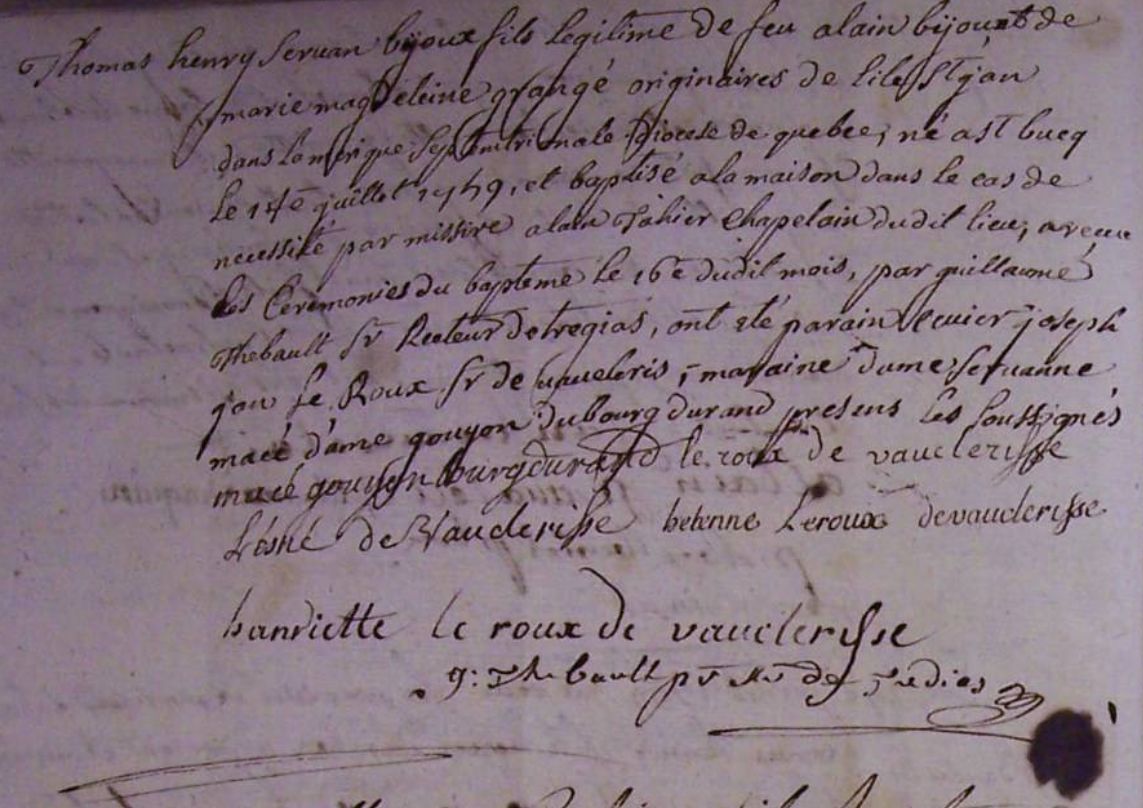
Copy of original birth record of Thomas Henry Servan Bijou in Pleurtuit, France.

Copy of original death record of T. H. S. B. from Pleurtuit, France

And just like you, she might have been holding onto hope that things would get better for her.  But not just yet.  She may have found a glimpse of joy at the birth of her son Thomas Henri Servan Bujol on July 14, 1759.  But she only had him a week.  He died on July 21, 1759.  I wonder if you could see any life in her eyes that day she buried her little newborn son?

Copy of original marriage record for the wedding of Marie Magdeleine Granger and Joseph Bourg.

I don’t know how some people find the strength to carry on from some tragedies.  But she did, thankfully, or I wouldn’t be here.  In June of 1760 she married Pierre Bourg in Pleurtuit, Ile-et-Vilaine, France.  They were 2nd cousins – their maternal grandmothers were Landry sisters.  His first wife had died on the deportation voyage to France.  I descend from the marriage of Marie Magdeleine and Pierre Bourg.  She would give birth to all of their children in France, but later they made their way to Louisiana in 1785.  She died in Louisiana.  I don’t know if there is a headstone anywhere.  There should be.  I want more people to know the name Marie Magdeleine Granger.

Grandma Belite and Family

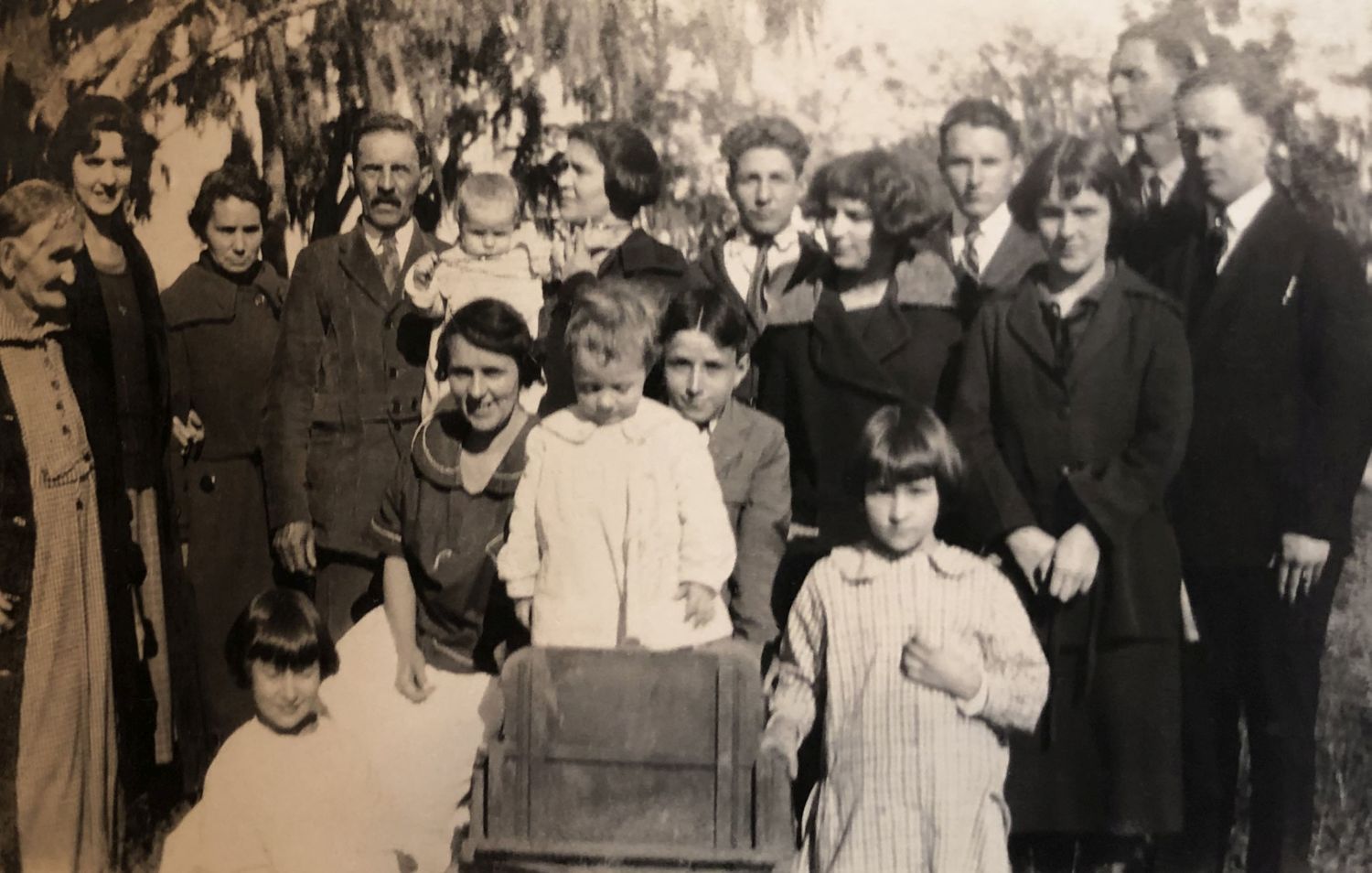
Almost two years ago I wrote the post “Christmas 1923 With Grandma Amelie” and it included a photo from Grandma Belite’s last Christmas with some of the women in her family.  It was the first photo from that family gathering in Lafayette, Louisiana, that I had seen.  I assumed that it must have been a gathering of women, since that’s the only people in the photo.  But then I found more photos from the same event and they showed that it was a much larger gathering than I initially thought.  I’m posting two more photos from that long ago Christmas day.  They were shared with me by the Tin Can Collection keeper, my cousin Tricia.  I also got versions from my dad’s first cousin Sis and she had some of them labeled.  She has everyone in the photo labeled, which is really nice.  It looks like the photos have the same people in it.  We’ll discover that as we go along.  Right now, I don’t know.  But I should know by the time I finish this post.

Grandma Belite (on far left) with her family at Christmas in 1923. This was taken in Lafayette, Louisiana, at the home of Louis and Clemence Babin Landry on South College Road.

When I got this photo from Sis, she had all the names of the people in the photo on the back of it.  So let me tell you who everyone is and say a little bit about them.

First off we have Grandma Belite (Grandma Babin to some family members) on the left side.  She was my great great grandmother.  My dad was Bob Landry.  His mother was Erie Patureau Landry (my Mee Maw).  Erie was the daughter of Marie Therese Landry Patureau, who was the daughter of Belite.  She was born Marie Amelie Bujol in 1843 in Brusly, Louisiana, during the time of slavery.

She was known as one of the beautiful daughters of the Veuve Bujol during Civil War times.  But that was long ago even when this photo was taken and Belite was an elderly woman of 80 years old.  I wish I had a photo of her when she was a young woman.  I may have to try out some of those age-regression photo apps to see what comes out.  But unless a photo of young Belite shows up, we’ll never know just how beautiful she might have been.  This was her last Christmas.  She passed away just over a month later.

Next to Grandma Belite in the front is her granddaughter Hazel Landry.  She was the 7-year-old daughter of Belite’s daughter Clemence Babin Landry.  She was the youngest of six children.  When she grew up, she changed her name to Roberta.  That’s because she became a nun and took on the saint’s name of Robert.  So she was known as Sister Roberta.  I think I went to her Golden Jubilee or something like that many years ago.  She died in 1988.

The next two people in the photo are Emma Patureau Mouton and her daughter Therese Wynhoven.  We knew them as Aunt Emma and Tez.  Emma was my Mee Maw’s sister.  They lived in Duson, Louisiana, where Emma was the organist at the Catholic Church for many years.  She also wrote poetry.  Tez was my dad’s first cousin.  If we got confused as children and called her “Aunt Tez,” he was quick to correct us.  And I don’t think it was just for the sake of genealogical correctness.  She was a link that brought many family members together.  As the saying goes, “Misery loves company.”  And a visit from Tez could sometimes bring misery.  Though she’s been gone almost twenty years, the stories of her visits are legendary.

The last two people in the front are two of Hazel’s older siblings.  The boy next to Tez is Henry Louis Landry.  I saw his grave a few months ago when I visited Belite’s grave in Lafayette.  Just recently I had a DNA match show up on Ancestry who is a great granddaughter of Henry.  I sent her a note to let her know about photos like this that I have of her family.  Maybe she’ll be interested.  Next to Henry is his sister Wana Clemence Landry.  She never got married.  She used to have family gatherings at her home.  She is buried along with her parents and grandparents in Lafayette.

On the back row we begin with Belite’s granddaughter Marie Therese Patureau.  She was another of my Mee Maw’s sisters.  She was known as Aunt Bee, like the character on The Andy Griffith Show.  She was a young woman in this photo and almost ten years later she would marry Clarence Schafer.  She was the mother of Sis and Syl.  For the sake of clarity for this picture, I’ll call her Patureau Sis.  She is the one who provided the names for all these people.

Next to Bee is Belite’s daughter Clemence.  She was the mother of Henry, Hazel, and Wana C.  She was the half-sister of my great grandmother Marie Therese Landry Patureau.  Her father was Magloire Babin, the second husband of Belite.  She had an older full sister named Amelie who died as a child.  She also had a younger sister named Albine who died in 1903 at the age of 18.  So Clemence was the only one of Belite and Magloire’s daughters to have children of her own.  And since Clemence (Aunt Clem) married Pee Paw’s brother Louis Joseph Peter Landry (Uncle Louie), they are double kin to us.  This photo was taken at their home in Lafayette on South College Road.

After Clemence comes three family members in my line of the family.  Vincent Maximilian Patureau was married to Belite’s daughter Marie Therese, who I have identified as my great grandmother.  So he was my great grandfather, but I always refer to him as Grampa Max.  He is standing next to his daughter Lydwin Patureau who is holding his granddaughter Mona Mel Mouton.  Lydwin or Aunt Win also never married and did not have any offspring.  She is holding her sister Emma’s youngest daughter (at the time) Mona Mel who was born earlier that year.  Mona Mel did get married, but she did not have any children of her own.

The next group are the three older children of Clemence and Louis.  Ethelbert was the third child and he went by Bert.  I don’t know much about him.  Call it the middle child syndrome.  Next to Bert is Naomi Landry and for the sake of this post I’ll call her the Landry Sis.  So my dad had two first cousins that were called Sis and both of them were interested in family history and have been helpful to me.  My dad made a video where he talked with Landry Sis about all of the cousins and their families.  She also identified some family photos.  Patureau Sis is much younger and is still around to help out with family history information and photos. 

Back to the photo.  After Landry Sis is Thornwell Fay Landry.  He was the oldest child of the family of six children.  I just realized that they had three boys and three girls, just like the family I grew up in.  They had about the same spacing in ages that we had, too.  I wonder if they enjoyed it as much as I did?  After Thornwell is Mee Maw’s younger sister Sylvia.  A few years later she would marry Son Marionneaux.  Like Mee Maw she would have a large family of four sons and four daughters.

The tall man in the back on the right in this photo is Anthony Joseph Mouton.  He was married to Mee Maw’s sister Emma and was known as Uncle Toby.  He lived in Duson, Louisiana, and died in 1969.  I don’t have any memories of him, but my brother Rob and my older cousins do.  He must have been a pleasant fellow, because everyone seems to speak of him fondly.  The last person on the right in this photo is Mee Maw’s brother Vincent.  He lived in Baton Rouge like I do.  One of my favorite family heirlooms is a banjo that belonged to him.

Landry family in 1923 at Christmas

Now to look at this other photo from the same day.  I decided to post it with the other one because I actually prefer it to the other one.  But the other one had the names provided, so I went with that one first.  It wasn’t until I got to Uncle Toby in my descriptions that I realized that the tall guy in the back right of this photo isn’t Uncle Toby.  He’s in the same location in the photo and he’s even posing the same way, but Uncle Toby is in the front holding Tez in this one.

The new person in this photo to the far right is Louis Joseph Peter Landry.  He was an older brother of my Pee Paw and he’s the father of six of Belite’s grandchildren in the photos.  He was the son-in-law of Belite.  But beside that, Louis’s mother Marie Celeste Leveque was Belite’s first cousin.  That puts a whole new spin on the relationships I talked about in these photos.

But all you really need to know is that they were family getting together to make sure that their cherished Grandma Babin (or Grandma Belite) had a wonderful final Christmas.

From Acadian to Cajun: Part 11 – The Ones That Didn’t Make it

It’s time to finish up my Acadian to Cajun series that I wrote throughout the year 2020.  I’ve covered all of the lines of my family that came to Louisiana from Acadie.  I’ve learned a lot while writing this series.  Before I started doing the research, I only knew that my family lines had been deported to Maryland and France.  I discovered that other family lines were deported to Connecticut, Pennsylvania, Virginia, and Massachusetts.  Some other family members had made their way to Ile St. Jean which was under French rule until 1758.  From those places, they made their way to England, France, and St. Domingue (Haiti) before arriving in Louisiana –  if they survived long enough. 

It’s time to talk about the ones that didn’t make it.  Obviously the ones that I descend from that didn’t make it were adults who had children already.  I didn’t talk about all of the family members who were affected by the Grand Derangement in the original installments.  Either I didn’t know about them or I didn’t want to overly complicate the stories at the time.  But they deserve a mention.

Installment 1 was about the extended families of Augustin Landry and Marie Madeleine Babin.

From Installment 1 of my Acadian to Cajun series, I’ve already talked about Pierre Landry.  He was the father of Augustin Landry who brought his family to Louisiana by way of Upper Marlboro, Maryland.  I talked about him in my post about Landry Grandfathers.  Augustin’s wife was Marie Magdelena Babin and her mother was Marguerite Bourg.  I talked about Marguerite in Installment 10.  But I didn’t talk about  Marguerite’s father Alexandre Bourg who was still alive at the time of the Grand Derangement. 

Can you imagine your whole life turning upside down  at the age of 84?  That’s what happened to Alexandre.  He moved to Ile St. Jean sometime in the early 1750s.  He was living with his daughter Anne and her husband Joseph LeBlanc in 1752 in Port Toulouse.  He somehow escaped being Exiled after the fall of Louisbourg in 1758.  He had been a royal notary for many years, so he may have still had some political connections on both the French and English sides of the conflict.  He was 87 years old at the time.  He was 89 years old when he died in 1760 in Richiboucton, New Brunswick, Canada.

Installment 2 covered the family of Antoine Breau and Marguerite Landry. Antoine’s mother Claire Trahan is listed below him. I could find no information about the ancestors of Marguerite Landry.

In Installment 2, I talked about the Charles Breaux family who was Exiled to Port Tobacco, Maryland, in 1755.  Charles died in Port Tobacco sometime around between 1763 and 1765.  His wife Claire Trahan made it to Louisiana where she lived a short while.  Claire’s mother was Marie Helene Pellerin and she was alive in 1755, but she was living in Ile St. Jean which was still under French rule.  She died August 27, 1756, at the age of 87.  She was my 7x great grandmother.

In Installment 3, I talked about the Pierre Breaux family.  Pierre was the brother of Charles Breaux.  Some of his family were also Exiled to Port Tobacco and Pierre died before 1763.  In the meantime his son Honore had been deported to Virginia and was sent on to England and France.  He eventually married Elizabeth LeBlanc.  She was the daughter of Victor LeBlanc and Marie Aucoin.  I talked about the tragic deaths of Marie, her parents, and two of her young children by her second husband Gregoire Maillet.

Installment 3 was about Honore Braud, Elisabeth Le Blanc, and their extended families

But I didn’t tell you anything about Victor LeBlanc’s family.  I doubt that anybody noticed because I was talking about so many people.  The other reason I didn’t write about it was that I wasn’t sure about his family.  When I looked around for information about him, I found different parents than what I had .  My dad had obtained that information from Acadian researcher Bona Arnsenault.  But recently more information was discovered that showed he was from a different family.  I needed time to “Let go of” his previous parents and make the changes. 

His parents were Pierre ‘dit Pinou’ LeBlanc (1685-1769) and Francoise Landry (1693-1767).  I descend from siblings of both of them, so there were no new lines to add to the tree.  Francoise was the sister of Pierre Landry who I mentioned earlier.  Pierre LeBlanc and Francoise Landry were Exiled to Shrewsbury, Massachusetts. They both showed up on a 1757 Census of Acadian Exiles, as well as another one conducted in 1763.  After the Seven Year War was over, many of the Acadian Exiles in Massachusetts decided to return to Canada.   Around May 17, 1767, Pierre and Francoise, along with the family of their daughter Angelique (married to Germaine Dupuis, the first cousin of my ancestor Joseph Dupuis from Installment 9), boarded the schooner Abigail bound for Quebec.  They arrived in Quebec on June 18.  Sadly, Francoise died a few months later on October 3, 1767, in Lavaltrie, Quebec, at the age of 74.  Pierre died on October 22, 1769, in Montreal at the age of 84.

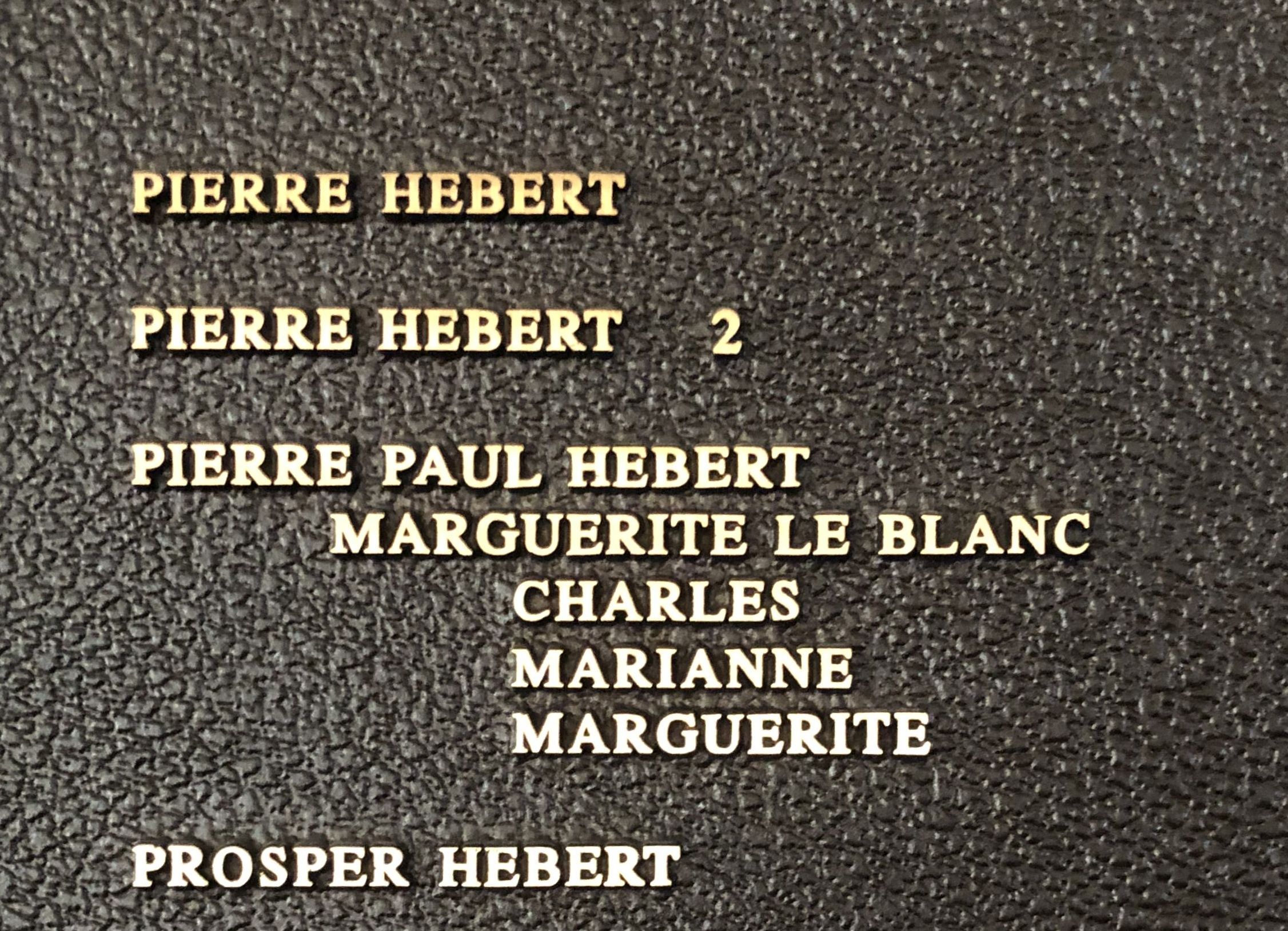
Pierre Paul Hebert’s and Marguerite LeBlanc’s families were discussed in Installment 4.

In Installment 4, we talked about the Hebert family.  They were Exiled to Georgetown, Maryland.  If you’re keeping track, my ancestors were deported to four locations in Maryland:  Upper Marlboro, Port Tobacco, Oxford, and Georgetown.  They seemed comparatively the safest places to be Exiled.  I could be biased since my ancestors survived being deported there.  We descend from survivors of catastrophes through the ages.  Just because a person is a Holocaust survivor doesn’t mean that they had an easy time of it.  And it’s not like they had a choice.

I mentioned in that installment that Marguerite LeBlanc (the wife of Pierre Paul Hebert) was the daughter of Antoine LeBlanc and Marie Babin.  I am a bit more sure of her parentage than back then and have found out more information about them.  To make things perfectly clear, I found out that Antoine LeBlanc and Victor LeBlanc were double first cousins.  That means that his father Antoine was the brother of Pierre ‘dit Pinou’ LeBlanc and his mother Anne Landry was the sister of Francoise Landry.  Antoine LeBlanc (the grandfather of Marguerite) died before the Grand Derangement in 1739 in Grand Pre, Acadie.  His wife Anne Landry (my ancestor) was Exiled to Massachusetts like her sister.  She also died in Quebec in 1767 like her sister.  Anne was 79 years old when she died.  The younger Antoine LeBlanc (father of Marguerite) died in 1744 at less than 40 years of age.  It is believed that his wife Marie Babin (my ancestor) was deported to Virginia, which is very unfortunate.  They were sent on to England where they were treated poorly.  Many of them suffered from smallpox and died.  It looks like Marie was one of those that died in 1756 in that group.

Installment 5 discussed the families of Joseph Bourg and Marie Magdelene Granger.

In Installment 5, I told you about the very tragic story of Magdelene Granger, my 6x great grandmother.  Her first marriage was to Alain Bujol.  They had two children together in Ile St. Jean, but were later deported in 1758 at the fall of Louisbourg.  She was the only survivor of her little family due to the circumstances of being Exiled.  I found out that her father Joseph Granger was alive at the time of the initial deportations in 1755.  I descend from his first wife Anne Richard who died in 1751.  Joseph remarried shortly after that (he was 54 years old) to a Marguerite Gautrot.  They had two sons before the deportations began.  Joseph’s family was deported  to Virginia. (cue the somber music) They were on a ship that arrived in England in June of 1756.  There was no sweet reunion for Joseph and Magdelene.  When she was married in 1760, Joseph is listed as deceased.  She is my inspiration for perseverance! 

Installments 6 and 7 were about the families of the brothers Etienne and Joseph Bugeaud. I descend from both of them.

In Installment 6, Joseph Bujol and Anne LeBlanc were sent into Exile with their family to Oxford, Maryland.  I bet you were relieved to hear that they weren’t sent to Virginia!  This history is so full of tragedies.  Thankfully this little family fared well during their time in Exile.  The family stayed intact and actually grew during their time in Maryland.  This wasn’t true for their extended families.  Anne’s mother Jeanne Bourgeois was Exiled to Cambridge, Massachusetts.  She arrived in December 1755 and it was the last that was heard of her.  Three of her children died in Liverpool, England, in 1756 and another one died in France in 1759.  Jeanne was probably not aware of their deaths since those events happened across the ocean.  We know that she had died before the 1763 Census at the age of about 70.

The story in Installment 7 was about Joseph Bujol’s brother Etienne and his wife Anne Forest.  Anne was another of those with a tragic story.  She lost her first husband during the Exile.  What I didn’t mention in that installment was the fate of her parents Pierre Forest and Madelaine Babin.  They were alive when the Grand Derangement began and they were deported to Weymouth, Massachusetts.  He died within the first year of Exile at the age of 62.  Madelaine shows up on the November 10, 1756, Census in Weymouth as a widow.  There are no records of her after that time.  So she probably died shortly after that before the age of 60.

Joseph and Etienne’s extended family was not Exiled during the initial deportations of 1756.  They had several younger brothers and sisters who moved to Ile St. Jean with their parents Joseph Bujol and Josette Landry.  They were there by the time of the Census of 1752.  So while Joseph the younger and Etienne were Exiled with their families in 1755, other family members were able to stay at Ile St. Jean until 1758.  It was at this point that Joseph the elder died.  Either he died prior to the deportation or as a result of it.  He was 59 years old.  Josette and some of her children fled north with the help of a son-in-law who was part of the Acadian militia.  They surrendered to the British and were held in Nova Scotia until the end of the Seven Year War.  They made their way to Quebec and settled there.  Josette eventually died on June 8, 1778, in Bonaventure, Quebec, at the age of 77.  She did not see her sons Joseph and Etienne during the last 22 years of her life.

So that’s it.  I previously covered the extended families of the ancestors I discussed in Installments 8, 9, and 10.  I don’t think I’ll ever think of the Grand Derangement or even Acadie in the same way ever again.  Hopefully I’ll always be aware of the difficulties my ancestors had to endure in order for me to be able to call myself a Cajun.  Even though those I mentioned in this post didn’t survive the Exile to make it to Louisiana, I will still consider them honorary Cajuns!  I think of it as a title of respect and they definitely deserve it.


For other installments of the “From Acadian to Cajun” series, click on the following links:

From Acadian to Cajun: Part 1 – Landry/Babin

From Acadian to Cajun: Part 2 – Breau/Trahan

From Acadian to Cajun: Part 3 – Braud/LeBlanc/Gauterot/Aucoin

From Acadian to Cajun: Part 4 – Hebert/Melanson

From Acadian to Cajun: Part 5 – Bourg/Granger

From Acadian to Cajun: Part 6 – Bujol/LeBlanc

From Acadian to Cajun: Part 7 – Foret/Bujol

From Acadian to Cajun: Part 8 – Hernandez/Babin

From Acadian to Cajun: Part 9 – Dupuis/Dugas

From Acadian to Cajun: Part 10 – Bourg/Babin/Landry

Who Is Mrs. P. M. Babin?

Van Landry, a great great grandson of Mrs. P. M. Babin, taking a selfie at the St. John Cemetery in Lafayette, Louisiana, on October 24, 2020.

As you can tell from the photo, it must be a family member.  Otherwise I wouldn’t be taking a photo of myself with her grave.  Right?  I don’t take a selfie with just any old grave!

Maybe you can be like Sis and ask, “Who is Grandma Babin?”  That is a question that she asked my dad many years ago.  Daddy laughed and eventually explained it to her.  I have made references to that question a few times in these blog posts.  I really shouldn’t make fun of Sis, she’s been so good about sharing photos and information with me.  In fact, I’m sharing one of the photos in this post.

St. John Cemetery in Lafayette, Louisiana.

Here are some clues.  This is a photo of the area showing other related graves.  In the foreground is the grave of Wana C. Landry.  Some of you may be familiar with her.  This is not my Aunt Wana.  Everyone knows that she was Wana Lidwin.  Wana C. was a granddaughter of Mrs. P. M. Babin.  She was never married.

Next to Mrs. P. M. Babin is P. M. Babin.  This is her husband.  If you don’t know who Mrs. P. M. Babin, this other grave doesn’t give you any more information.  The next two graves are for for Louis  J. Landry and Mrs. L. J. Landry.  Directly above them in this photo is a whitish grave with a black top.  That grave is for Henry Louis Landry.  He is the brother of Wana C. and they are the children of Mr. and Mrs. Louis J. Landry.

What’s that you say?  Yes, you are right!   Mrs. P. M. Babin is Grandma Belite.  You are so very clever.  For those of you still not sure, Grandma Belite’s full name is Marie Amelie “Belite” Bujol Landry Babin.  Her name is so long because I include the nickname she went by, the last name of her first husband Trasimond Landry, and the last name of her second husband Pierre Magloire Babin.  Mrs. P. M. Babin is such a lacking name for her headstone.  No given name, no nickname, and no maiden name is given.

I didn’t know where her grave was for a while, but then I asked a third cousin Chip.  He was able to provide a photo for me and told me where it was.  So I decided to go find it the other day when we were in Lafayette.  I realized the graveyard was between a friend’s house and the I-10.  I wandered around the cemetery looking for it and eventually found the group of graves.  Grandma Belite’s daughter Clemence is the one named Mrs. Louis J. Landry.  She was my Mee Maw’s (Germaine Erie Patureau) half aunt.  Clemence’s husband Louis was the brother of my Pee Paw (Robert J. Landry Sr.).

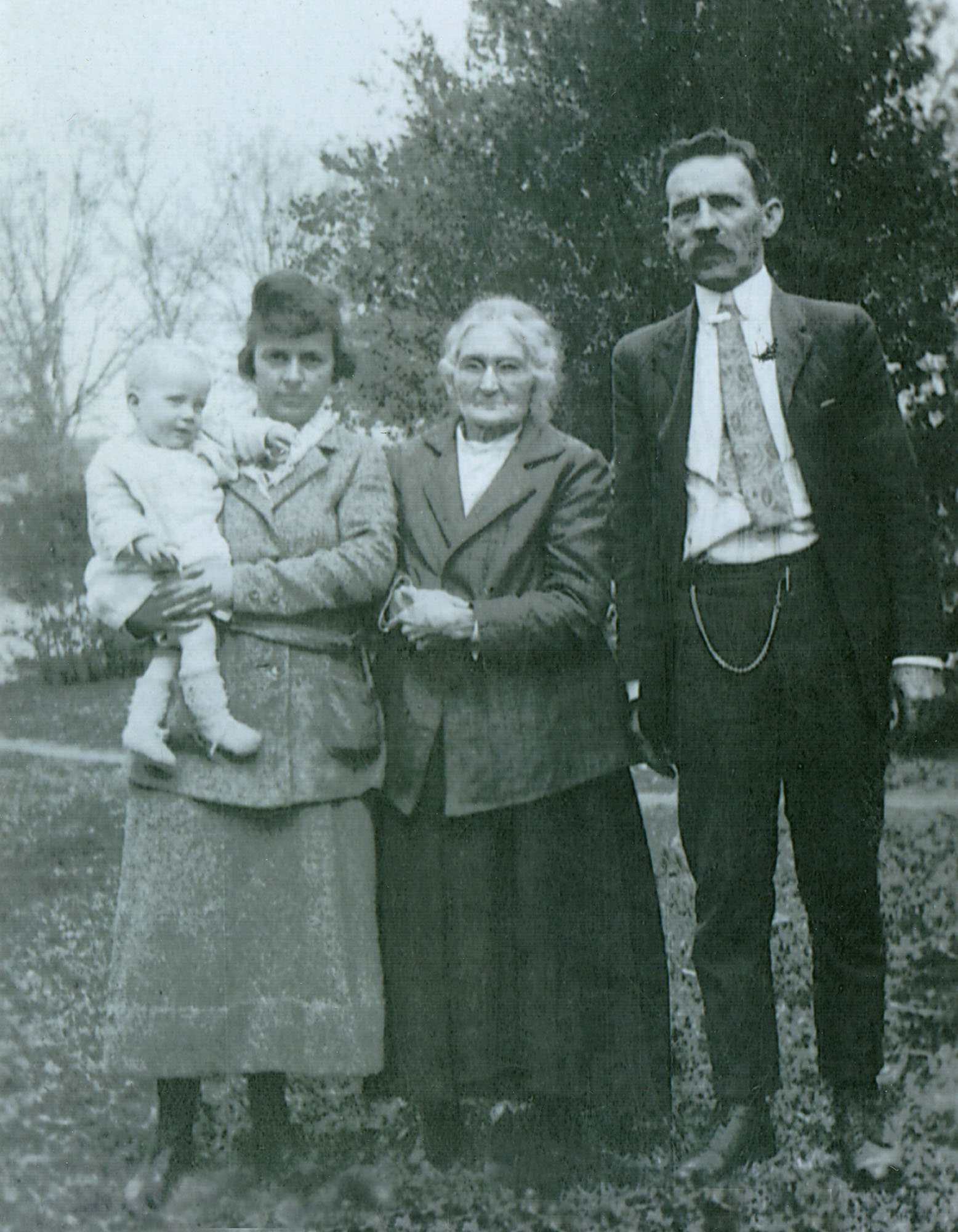
Therese Wynhoven Mouton, Emma Patureau Mouton, Grandma Belite, and Grampa Max in 1921.  This was probably taken in Duson, Louisiana.  (Thanks to Sis for providing the photo.)

Here is a photo of Grandma Belite in 1921.  She is in the middle of the photo and her son-in-law Max Patureau is on the right.  He was married to Belite and Trasimond’s daughter Marie Therese Landry.  She died in 1909.  She and Max Patureau are buried in the Patureau tomb in Plaquemine.  But Max isn’t just Belite’s son-in-law, he’s her half second cousin by their Landry mothers.  Also in the photo are Max’s daughter Emma Patureau Mouton and her firstborn daughter Therese Wynhoven Mouton.  We knew her as Tez.

So there you have it.  Mrs. P. M. Babin with her family, where even her in-laws are related to her.  She was known by those buried by her as Grandma Babin.  But to those who descend from her Landry children, she was known as Grandma Belite.

1 2