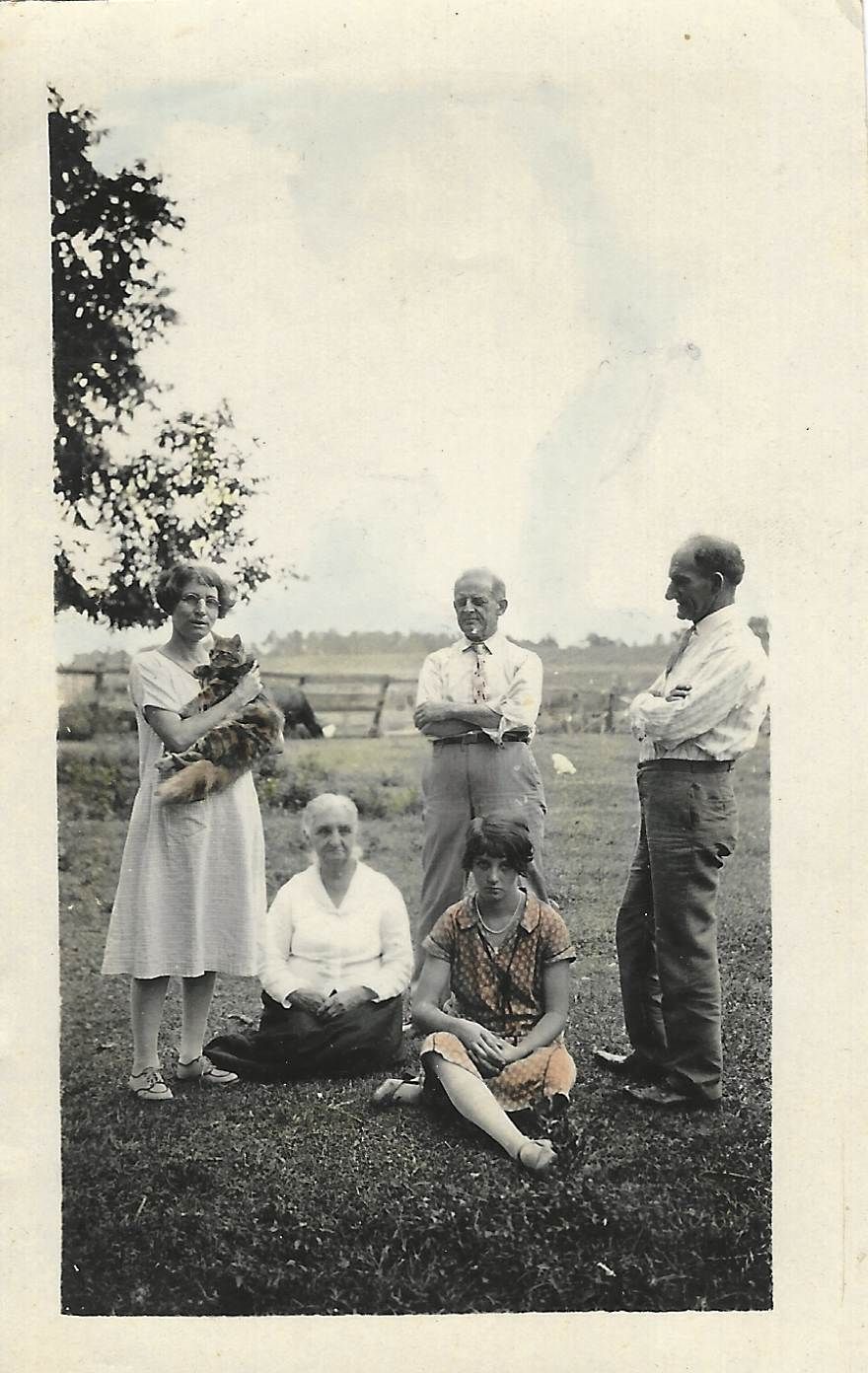
Marie Celeste Circa 1926

Marie Celeste Leveque (on the right) with her niece Amanda Leveque circa 1926

I figure it’s time to write about my Landry paternal line of the family.  I can’t go back as many generations with this line because the generations are spread out further than my other family lines.  In all of the other lines I have photos of my great great grandparents.  But in this line, I don’t have photos of Narcisse Landry and Marie Carmelite Hebert Landry.  Carmelite died in 1856 at the age of 54, and Narcisse died in 1876 at the age of 80.  I haven’t given up hope that there is a photo of Narcisse, but I haven’t been able to locate one.  Photos were being taken by 1876.

Narcisse and Carmelite were married in St. Gabriel in 1819, but soon after moved to Brusly to live.  I descend from two of their sons.  They had eight children in total.  Let me go ahead and name them for you.  Their oldest child was Marie Irma Landry who was born in 1821.  She married Francois Joseph Bujol in 1845.  His mother was Marie Francoise Leveque. The second child of Narcisse and Carmelite was Pierre Belisaire Landry, born in 1824.  In 1851 he married Marie Marguerite “Lise” Leveque, daughter of Joseph August Leveque.  Joseph August and Marie Francoise were Leveque siblings.

The third child of Narcisse and Carmelite was born in 1826 and her name was Victorine.  She married Jacques Molaison in 1843.  He had mostly French ancestry with some Acadian ancestry as well. Joseph Amedee Landry was the fourth child of Narcisse and Carmelite.  He was born in 1828, and in 1850 he married Desire Landry.  I’m not sure if her maiden name was Landry or not.  After Amedee came Elizabeth Adele Landry born in 1831.  She married Sylvanie Bourg in 1851.  Their descendants show up as strong DNA matches to me.  Following Elizabeth Adele is Marguerite Josephine who was born in 1834.  She married Simon Octave Rivet in 1860.  For some reason, I have no DNA matches from their descendants.

The last two children of Narcisse and Carmelite are the ones that I descend from.  Jean Trasimond Landry was born in 1839, and he married Marie Amelie “Belite” Bujol in 1867.  She was the niece of Francois Joseph Bujol, the husband of Trasimond’s sister.  But more importantly, she was the daughter of Anna Adele Landry, who was a half first cousin of Trasimond.  Adele and Trasimond had a common grandfather – Joseph Ignace Landry.  And lastly, Simon Joseph Alcide Landry was born in 1845.  Carmelite was twice as old as she was when she had her first child.  She became a grandmother that same year when daughter Victorine gave birth that December.  Alcide married Marie Celeste Leveque in 1868.  Marie Celeste was the half-sister of Lise Leveque through their father.  Their mothers – Clarissa and Marguerite Basilite Landry were sisters of Anna Adele Landry.

I wasn’t planning on writing all of this information when I picked out this photo of Marie Celeste tonight.  I ended up talking about Alcide’s family.  Like I said, I don’t have photos of his parents.  On top of that, I only have two photos of Alcide.  He must have avoided the camera.  But Celeste was not as put off by it.  I’m glad of that.  I have many photos of her.  As a matter of fact, I have three photos of her with the other person in this photo.  Her name was Amanda Leveque, and she was the daughter of Celeste’s sister Evaline. 

Evaline was married to Jean Baptiste Andre Leveque.  According to notes given by Mee Maw (Germaine Erie Patureau Landry), Evaline and J.B.A Leveque were cousins.  My ancestors may have married their cousins, but at least they never married one with the same last name.  The relationship I have for Evaline and J.B.A Leveque is questionable.  If they were first cousins, their fathers would be brothers that were born the same year.  That seems unlikely.  Plus I haven’t found official records proving the relationship.  But that’s okay.  We’re just looking at Celeste with one of her favorite nieces.  Why else would she have three photos showing them together?   I’m calling it.  This is Celeste Leveque Landry with her favorite niece Amanda Leveque.  And I’m sure that Celeste was Amanda’s favorite aunt.  What’s not to love about Grandma Celeste?

Emmanuel & Celeste Landry

Emmanuel and Celeste Landry’s tombs are in the St. John the Baptist Catholic Cemetery in Brusly, Louisiana.

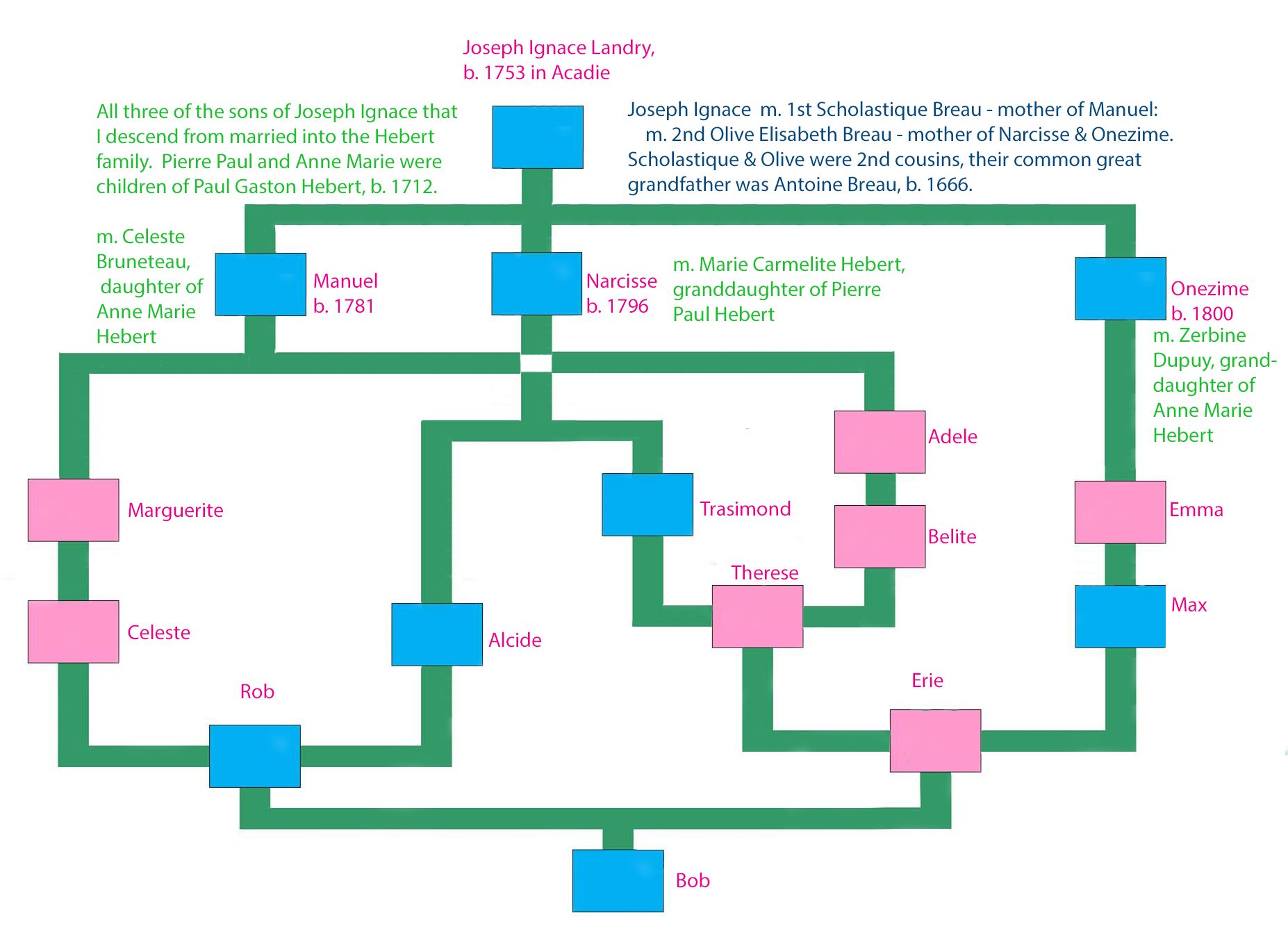
Sometimes I tend to overlook some ancestors who I don’t have photos of.  That’s not good.  Everybody deserves a mention.  When I do mention Emmanuel Landry, many times it is only in reference to his father Joseph Ignatius Landry.  I descend from Joseph Ignatius (or as the French would have said the name – Ignace.  And this family was definitely French.) five different ways.  And two of those ways are through Emmanuel Landry and Clarice Celeste Bruneteau Landry.

Both Emmanuel and Celeste were born in St. Gabriel, Louisiana.  Emmanuel was born in 1781 and he was in the first generation of Landrys in my line born in the United States.  All of his ancestors were Acadians.  And though he married someone with a French name – not Acadian, he was related to her.  That’s because Celeste’s mother was Anne Marie Hebert.  Anne Marie was born in Acadie and as a girl, she and her family and fellow Acadians were Exiled from their homeland.  The Hebert family spent their time of Exile in Georgetown, Maryland, while the Landry family spent their time in Upper Marlboro, Maryland.

But Celeste’s father was not an Acadian.  His name was Pierre Bruneteau and he was born in Ardennes, France.  He was the second husband of Anne Marie Hebert.  Her first husband was fellow Acadian Joseph Dupuis.  Anne Marie and Joseph had six children together.  I descend from their fourth child – Magloire Dupuy.  Anne Marie and Pierre married after the death of Joseph.  They only had two children together.  Celeste was born in 1790, and she was the baby of the whole bunch.

And like I said earlier, she would grow up and marry her cousin Emmanuel Landry.  I really shouldn’t call them cousins.  They were only 4th cousins.  Their common great great great grandparents were Rene Landry and Marie Bernard, some of the founders of Acadie.  Celeste and Emmanuel were probably not even aware of their common ancestors.  They probably just considered themselves husband and wife.  They were married February 5, 1808, in St. Gabriel, Louisiana.  The only surviving parent of the two was Anne Marie Hebert.  Yet two of their grandparents were still alive.  Anne Marie’s 89-year-old mother Marguerite Melanson was alive, as was Joseph Ignace’s 82-year-old mother Marie Magdeleine Babin.  They both lived in St. Gabriel at the time, so they likely were at the celebration.  Laissez les bons temps rouler.

1844 map of Brusly, Louisiana, along the Mississippi River.

Celeste and Emmanuel continued to live in St. Gabriel as their family grew.  Their first child was Manuel Dorville Landry in 1809.  Next came Rosalia and Jean Baptiste in 1811.  Then Clarissa Doralise was born in 1812, Anna Adele in 1817, and Marguerite Basalite in 1821.  I descend from Anna Adele (and her husband Amedee Bujol) and Marguerite Basalite (and her husband Joseph Auguste Leveque). (See family tree below.) Jean Baptiste died in 1823 at the age of 11.  A few years later the family relocated to Brusly in West Baton Rouge Parish, as did other Landry family members.

By 1844 Emmanuel and his brothers Elie and Narcisse had plantations along the Mississippi River.  You can see their names on this map of the river and some of the landowners of the area.  If you look at the names, you’ll see a lot of Acadian names that are familiar – Hebert, Babin, Dupuis, Daigre, and Forest.  They were all first-generation Acadians born in the US, after their parents had everything taken away from them when they were Exiled from Acadie.  From that perspective, they were making progress in their new home.


Here is my dad’s tree showing the connections to Emmanuel and Celeste. Along his maternal line, you can see Anna Adele. His paternal grandmother was Marie Celeste Leveque, who was the daughter of Marguerite Basalite.


My Favorite Finds From 2025

I thought I’d write a post about the favorite things I came across in my family history ramblings last year.  I found two really good stories about my ancestors doing commendable things.  And the other thing was an old record that was found from hundreds of years ago.  I’m always on the lookout for things like that and like to share what I find with everyone.  That way family members can see some information about their ancestors, and I’ll have a way of recording it so I don’t forget about it!  The downside is that I don’t give resources for the things I find.  I figure if people what to verify it is true or not, they can do an online search and find it, too.  At least they know what to search for.

“French Peasant” by Kevin Leveque circa May 19, 2020 (the day he posted it online).

The first image I’m using in this post is of a painting by a cousin.  The painting is called “French Peasant” and it was painted around 2020 by Kevin Leveque, a third cousin from my Landry great grandmother.  He posted a photo of the painting on Facebook, and I commented on how much I liked it.  It always makes me think of my French and Acadian ancestresses who lived and worked on farms through the years.  Kevin and I have many common ancestors, including two of the maternal ones I’m talking about here.

The first discovery I’m talking about is the discovery of Michelle Aucoin’s birth record.  She was born in LaRochelle, France, on January 29, 1620.  Her parents were Martin Aucoin and Barbe Minguette.  The family made the crossing to the New World in 1642 and were some of the founders of Acadie.  Many of those early founders’ birth records are a mystery.  There have been people looking for them for years with no luck.  So when one is discovered, it’s kind of a big thing.  At least for those of us who are looking.

Daddy had her in his tree with the correct birthplace and a close estimated birth year.  He also had the father’s name correct.  He didn’t have the correct mother and hadn’t made all of the connections to her, but I’m always amazed at all of the information he discovered.  He put in most of the branches on the tree, while I’m just fine tuning and pruning a bit.  My work is based on the groundwork provided by him and Mee Maw.  I know they would be excited with the new information being discovered.

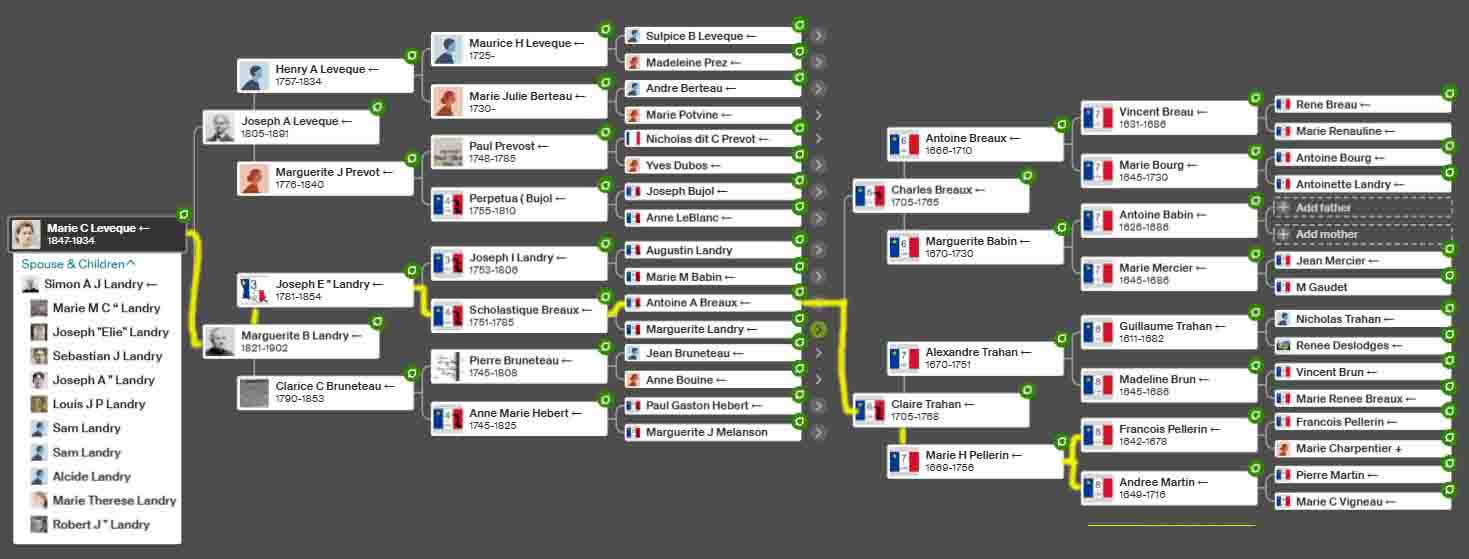
The second discovery had something to do with a witchcraft trial in Quebec in 1684.  Though the trial was in Quebec, the events that were being questioned occurred in Acadie and involved our ancestors Francois Pellerin and Andree Martin.  The witchcraft part of the story was intriguing, but my favorite part was about the actions of my great, great, great, great, great, great, great, great grandmother Andree Martin.  That’s right, she was my 8X great grandmother.  It was a long time ago.  By the way, Michelle Aucoin was also my 8X great grandmother. 

Anyway, Andree was visiting her sister one year.  As they were walking along, they witnessed a man harassing a young girl.  Instead of ignoring the situation, she asked the man to stop, then made him stop.  I love that she did the right thing.  It was not the last of their unpleasant interactions, though.  That may have led to her accusing him of using witchcraft to kill her husband.  She might have believed it, but she may have said what she needed to so the man would be stopped.  It worked.

The last of my favorite discoveries has to do with the Hine line in my mom’s tree.  This event occurred over a hundred years later than the first two stories, and it has to do with my 4X great grandfather John Hein.  He was born in 1747 in Dillenberg, Germany, to Johannes Jacob Hein and Ann Schober.  He immigrated with his father and stepmother in October 1753 to Broad Bay, Maine.  They later moved to Wachovia, North Carolina, which is where our ancestor John performed his heroic act.  He and two friends were attempting to cross a flooded creek to respond to some request for help.  All they had was a shabby canoe, and they decided to make the attempt anyway.  The canoe sank and Brother Hein was the only one that knew how to swim.  Despite the strong currents, our John was able to save his two friends.  Commendable indeed!

So now we’re on to another year.  I’m hoping for new discoveries, new photos…new everything.  We’re living in the future.  Happy New Year to everyone.

Our Legendary Acadian Ancestor

This is not a photo of my Acadian ancestress. But it is a painting by a cousin who also descends from the subject of this post. The painting is called “French Peasant” and it is by my third cousin Kevin Leveque. It makes me think of my French and Acadian ancestresses who worked on the land with their families.

Francois Pellerin lived from 1636 to 1678.  Never heard of him?  I was only slightly familiar with his name in my tree until a few months ago.  I read a few stories about him that caught my attention.  It wasn’t anything that he had done, but something that was done to him.  Interesting stories sometimes pass down through a few generations and most of the time they die out.  Fortunately for us, there are still some legal records from over 350 years ago.  And they tell an interesting story about our Francois.

Francois was born around 1636 and married Andree Martin in 1665 in Port Royal, Acadie.  They were some of the early French inhabitants of that area.  In fact, Andree’s older brother Matthieu was reported to be the first child born of French heritage in Acadie.   In the 1671 Census, they were still living in Port Royal, and they had three young daughters – Huguette, Marie, and newborn Anne.  I descend from their second daughter Marie.

Shortly after this, Jacques Bourgeois – another of my ancestors – decided to create a new settlement in Acadie.  It wasn’t too far from Port Royal, but with the primitive mode of travel back then, it took more than a week to make a one-way journey.  It was called Beaubassin, and at first it was started with Jacques and several sons and sons-in-law.  Not much later on, they were joined by others, including our little Pellerin family.

A couple of years later, the family traveled back to Port Royal for a visit.  One of the people they visited was Andree’s younger sister Marie Martin Morin.  It was in one of the years that both of the sisters rested between having 25 children between them.  During this visit, the two sisters decided to go have a walk into town.  While there, they witnessed a disturbing sight.  A man was molesting a young girl on the street.  Andree was appalled and took it upon herself to do something about it. 

She demanded that the man stop.  While attempting to make him stop, the man lunged at her.  She must have been prepared for this possibility, because she was able to grab a large piece of wood and hit him over the head with it!  She hit him pretty hard, because it stopped him from attacking the girl or herself.  I love reading an account of one of my ancestors doing the right thing.  I think she felt she had done the right thing, too.  But she also worried a bit.  The man – his name was Jean Campagna – told Andree that she would live to regret the actions she had taken.  A not so veiled threat.

You can imagine the retelling of this story when they got home to their families or with their friends.  Marie might have said something like, “You should have seen when Andree smacked him on the head!  He didn’t know what hit him.  Le tonnerre ecrase!”  Though it would have all been in French.  I wonder if the threat was repeated in the retelling.  It had such an ominous tone.  And you know it has to have some importance since it was recounted at some point.  Otherwise we wouldn’t know about it.

The Pellerin family returned to Beaubassin without further incident.  Their life continued there with the arrival of three more daughters.  Francois may have been a little disheartened by this.  Homesteading in a new area was hard backbreaking work.  Some big strong sons were always helpful in those conditions.  They needed to dyke the land to get it into condition for growing crops.  That took time and with a growing family to feed, Francois felt pressure to do something about it.  He went out to find someone who could help him out with all of the hard work.  The important thing was to find someone strong and hard-working.  In a weird twist to this story, the man who fit that bill for him was none other than Jean Campagna.

You can imagine Andree’s outrage when she saw Francois bring that big brutish man into their home.  A home that included six young girls under the age of thirteen.  She must have thought he was mad.  Didn’t he remember that Campagna had threatened her?  Francois stood his ground and insisted that it was necessary for survival. That included having the man live in their home!  That’s what happened, but you can be sure that Andree watched him like a hawk and always knew where the closest big stick was!

Then Campagna had the audacity to tell Francois that he wanted to marry their 12-year-old daughter Huguette.  There was no way Andree was going to allow that to happen.  As Campagna went around claiming he was going to marry soon, Andree went about finding another alternative.  It didn’t take her long to make an arrangement with a man named Pierre Mercier.  Even though she made this announcement, Campagna told everyone in town that Huguette was promised to him.  Campagna had a bad reputation in the town, so I’m sure everyone believed Andree over him.  He was bad news all around.

Most of the settlers weren’t fond of his drinking and gambling behaviors.  Yet he had money to lend them – at outrageous interest rates.  He also acted like he knew all the best ways of farming and working on drainage issues in the marshy land they lived on.  He wasn’t the only threat to the area’s tranquility.  There was a running history of the English attacking the French in Acadie.  Sure, they were willing to trade for things that they needed from time to time, but some of them were just as willing to attack them and burn their homes when something went wrong.  And there was always one disease or another.

Around the late 1670s, there was an outbreak of something that claimed several lives.  It was probably smallpox.  That’s what was reported in Port Royal.  Somehow it made its way to Beaubassin.  It was a quick-acting disease.  A person could be working in the field at the beginning of the week and be dead by the weekend.  It sounds quite painful.  That’s what happened to Francois Pellerin.  He was working in the marsh with Jean Campagna.  They may have gotten into some type of disagreement where Campagna “breathed into Francois’ eye.”  Not long after that, Francois fell ill.

I’m sure Andree was worried about her husband and also didn’t want her children to fall ill as well.  Maybe she kept some distance between them and her husband.  This gave Campagna a way to get in and see Francois.  He took out a mysterious box and placed it at the feet of Francois.  When Francois saw it, he asked Campagna to remove it.  In response, Campagna said, “It’s good for grinding barley.”  Nobody knew what that meant.  Francois died later that day.

Andree was sure that witchcraft was involved.  She felt that the visit to Francois on that last day was to finish him off with a spell.  Andree’s sister Marie also claimed that Campagna had tried to kill a man in Port Royal.  There was also a suspicious death of a woman who had just received a gift of butter from Campagna.  Maybe he poisoned her?  Maybe he somehow passed on a deadly disease?  When Andree’s daughter Huguette died a short time later, she thought Campagna had something to do with that as well.  In another odd twist in the story, Andree commiserated with Pierre Mercier (Huguette’s fiancé) about these deaths. They became close and ended up getting married.

They continued to talk about the evil plotting of Campagna.  With these allegations, Campagna was imprisoned before being brought to trial in Quebec.  Pierre Mercier questioned him about his promise that Mercier would never marry Huguette.  Was that a threat?  He asked him about the phrase he said to Pellerin, “It’s good for grinding barley.”  Campagna’s reply was that it was a joke.  What kind of joke is that on someone’s sickbed?  Campagna denied any wrongdoing.

A lot of these accusations were made at the urging of Le Neuf, a French seigneur who was in charge of this area of Acadie.  He had a grudge against Campagna.  Campagna had given his wife that odd gift of butter while he was away.  He thought Campagna had tried to win her affections. Le Neuf also collected testimonies of several villagers about the actions of Campagna. It was enough to get Campagna sent to Quebec where he was imprisoned for curses and spells.

In 1685 there was a trial, but it didn’t last long.  French law required that there be concrete proof when making claims against someone.  There was evidence that people didn’t like him and some of them owed him money that they didn’t want to pay back.  There was no proof of witchcraft.  The results didn’t really matter.  If he had been found guilty, he would have been banished from Acadie.  He was essentially found innocent, yet he had the same punishment. 

Campagna was not allowed to return to Acadie.  At least Andree wouldn’t have to see his disgusting face ever again.  That must have been some comfort.  I hope so.

Marie Celeste Leveque’s tree with yellow trail back to Francois Pellerin and Andree Martin. Grandma Celeste was my grandfather Rob Landry’s mother.

The Boudreaux Matriarch Was Michelle Aucoin

The topic of my post tonight was decided early this morning when I looked at my Facebook feed.  You probably aren’t surprised that I am a member of many genealogy groups on FB.  It’s what I do.  There are old photo groups, DNA groups, blogging groups, and different heritage groups.  Being a Landry, I am a member of a few Acadian groups.  They’re my people!  So I was really excited to see that the birth certificate of one of the founders of Acadie has been discovered.

Everybody knows that the Acadians originated in France.  But there haven’t been that many original documents found for those original immigrants who came to the New World about four hundred years ago.  They were some of the earliest Europeans that chose to uproot their lives and start anew in the Americas.  Many researchers through the years have been looking to find documents that can give us more information about these people.

I know my dad spent more than forty years researching our family.  He knew who Michelle Aucoin was.  She showed up in his family tree twice.  In his information, he had her parents listed as Martin Aucoin and Marie Salle.  Marie Salle was married to Martin Aucoin, but she was his second wife.  He had Michelle’s birth listed as 1618 probably in France.  But he had a few people listed as having an estimated birth year of 1618.  Both Rene l’Aine Landry and his sister Antoinette Landry were shown in his records with that year.  I remember asking him if they were twins.  He kind of chuckled and said that the dates were just estimates.  They didn’t know who was older, but they were close to the same age.  Or maybe they were twins.  It wasn’t known.

1620 baptism record of Michelle Aucoin in LaRochelle, France

So it’s exciting when one of those old documents is discovered.  I would have been super excited if I had been the one to find that old baptismal record.  Though if I had run across it, I would have had difficulty telling what it was.  It was in cursive French, and it was written over 400 years ago!  

I don’t know what the first two lines say.  I don’t think it shows the date as most baptismal records do.  (8/2/2025 – Yes! It does!  It says the twenty-ninth day of the month of January!)  The third line starts with the word for baptism or baptize.  The third line has the good stuff.  It says, “Michelle fille de (daughter of) Martin Aucoin/et du (and of) Barbe Minguet…”  It goes on to list the parrain and marraine (godparents).

So Barbe Minguet was definitely the mother of Michelle.  Not Marie Salle or an earlier wife of Martin Aucoin.  Michelle’s younger sister Jeanne’s baptismal record had been found previously, and she has the same parents.  She was ten years younger, so there had been speculation that Michelle might have been the product of an earlier marriage.  The date for Michelle’s baptism was January 29, 1620, and it took place near LaRochelle, France.  It was found by fellow Acadian and researcher Jim Cyr.

Michelle Aucoin was married to Michel Boudrot (1601-1690).  His exact birth date is not known, but he was a bit older than Michelle.  They had ten children together and all of the Acadian and Cajun Boudreaux families descend from these children.  One of them was a daughter named Marguerite (1648-1718) who married Francois Bourg (1644-1684), a son of Antoinette Landry and Antoine Bourg.  Marguerite and Francois had a son named Alexandre Bourg (1671-1760).  I’m sure when little Alexandre was a child, Michelle would remind him that she was the younger grandmother.  She might have said something like, “Your other grandmother was born in 1618.  I wasn’t born until two years later!”  It’s funny how two years can seem like a lot at certain ages in your life.

1695 signature of Alexandre Bourg

Alexandre probably wasn’t too concerned with the ages of his grandmothers.  He grew up and married Marguerite Melanson (1676-1744).  They had fifteen children together.  He was a judge and a notary, so he was educated.  Just being able to write his name was enough to put him a step ahead of many of his fellow citizens of Acadie.  He was well-respected and worked with both the English and the French during the turmoils that occurred between the countries during his life.  That didn’t protect him during the Grand Derangement when he had to flee his home when he was in his eighties.

I descend from Alexandre and Marguerite’s daughter Marie Marguerite Bourg (1701-1767) and her husband Jean Babin (1689-1755 or so).  They were the parents of Marie Magdelena Babin (1725-1814).   These two generations were also greatly affected by the Grand Derangement.  Marguerite and Jean were sent out in Exile somewhere.  Jean died at some point, but Marguerite ended up eventually in Louisiana.  She was reunited with daughter Magdelena Babin and her family, which included her husband Augustin Landry (1719-1781) and son Joseph Ignatius Landry (1753-1806).  They were the ones that brought our Landry line to Louisiana in 1767.

Joseph Ignatius Landry married Scholastique Breaux (1751-1785) in 1776.  Joseph and Scholastique had one daughter and four sons.  I descend from their son Joseph Emmanuel Landry (1781-1854).   His daughters are ancestors of my Leveque and Bujol cousins.  After Scholastique died in 1785, Joseph Ignatius remarried to Olive Elizabeth Braud (1769-1819).  They had six sons together.  I also descend from two of these – Narcisse (1796-1876) and Elie Onezime (1800-1837).  Elie Onezime’s daughter Marie Emma brought about all of the Patureau cousins I have out there.

I descend from Narcisse the most directly through his youngest son Simon Alcide Joseph Landry (1845-1917).  Alcide was the father of Robert Joseph Landry, Sr.  He was married to Germaine Erie Patureau and they were the parents of my dad Bob Landry.  So there you have it.  The connection to me all the way down from Michelle Aucoin born around January 29, 1620 in LaRochelle, France.  My what a long 405-year journey that was!


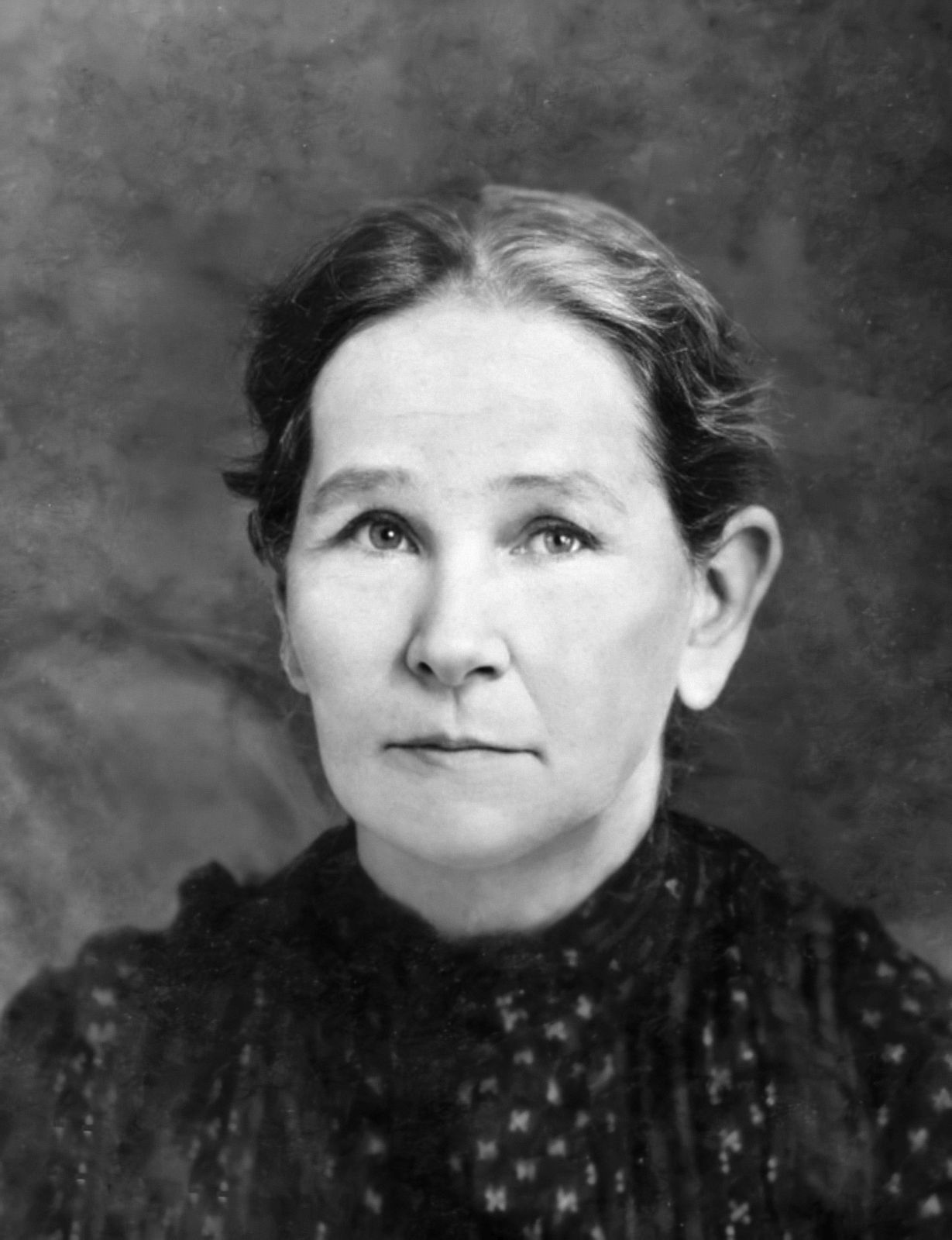
Marie Celeste Circa 1880

Marie Celeste Leveque Landry circa 1880 in Brusly, Louisiana.

This is a photo of my great grandmother Marie Celeste Leveque Landry.  Her husband was Simon Alcide Landry.  She was the mother of my paternal grandfather Robert Joseph Landry, Sr.  She was the grandmother of my dad Bob Landry, and she was called Grandma Celeste by him and his siblings.  Even though she lived to be 86 years old, she died when my dad was only five years old.  That’s because Daddy was the fifth child and Pee Paw was 36 when he was born.  Pee Paw was Grandma Celeste’s last child, and she had him at the age of 45.  

Yet even though she died when my dad and his siblings were quite young, they always talked fondly of her.  Their Bouquet cousins talk fondly of her, too.  They descend from Pee Paw’s older brother Sebastien.  He was married to his first cousin Marie Manette Landry (daughter of Trasimond Landry – brother of Alcide).  They had a daughter named Marie Manette Landry.  The older Marie Manette died shortly after the younger was born, and Sebastien went to live with his parents.  So Marie Celeste was like a mother to granddaughter Marie Manette.  Manette grew up and married Bibb Bouquet and they had a large family that was very close to my dad’s family.

This photo came from cousin Jeanne Landry, who descended from another of Pee Paw’s older brothers – Louis.  That was the Landry family that lived in Lafayette.  The photo was identified as Marie Celeste, but it didn’t have a date.  I originally estimated a date of 1905, but last week when I thought of posting this photo, I realized that it was not quite right.  That dress looked older to me.  How much older, I didn’t know.

But a friend was coming over to visit on Friday and he is more knowledgeable about the fashion trends from that time period.  So I put off posting this photo until after I talked to him.  I also thought that the dress looked rather fancy to me.  I was told that the dress was definitely earlier than the 1905 date.  It is more likely from around 1880.  In addition, the dress is not as valuable as I thought.  That would make sense, because she was a young mother with six young children to care for.  In the 1880 Census the family was living in Brusly, Louisiana.  Celeste is identified as a 33-year-old wife and Alcide was a 35-year-old store clerk.

It was soon after this that the family would move west to Westlake, Louisiana.  I think the motivation was work availability with the railroads in that area.  I guess it would be more lucrative than working in someone else’s store.  But I suppose they made enough to have a photo portrait made of Celeste.  I wonder why they didn’t do a family portrait. Whatever the reason, it is a nice photo of her.  I like having this image of Grandma Celeste.  It’s a keeper.


The Leveque Family in WBR

Marie Celeste Leveque Landry in 1905, probably in Lake Charles, Louisiana

You might read the title of this post and ask, “What Leveque family in West Baton Rouge Parish?  There aren’t any Leveque families in WBR!”  And you might be right.  I don’t know of any, and all of the Leveque family that I’m familiar with are not there.  The last Leveque post that I wrote (over a year ago!) talked about the family being in Lake Charles, Louisiana.

The Leveque name is from my dad’s side of the family.  And it comes from both sides of his family.  My dad was Bob Landry, the famous band director of Jennings, Louisiana.  He was born Robert Joseph Landry, Jr. in Lake Charles, Louisiana.  His father, of course, was Robert Joseph Landry, Sr.  My grandfather is known as Pee Paw by us grandkids.  He was born in Westlake, Louisiana, and he died many years ago.  He was the son of Simon Alcide Landry and Marie Celeste Leveque.  Alcide and Celeste were born in West Baton Rouge Parish.  They were the ones that brought our family to southwestern Louisiana.  But they weren’t the only ones that left WBR for Calcasieu Parish.

Joseph Auguste Leveque’s grave marker at the Old Catholic Cemetery in Lake Charles, Louisiana.

To get a better picture of what was going on, we have to go back another generation.  Celeste was the daughter of Joseph Auguste Leveque and Marguerite “Basilite” Landry Leveque.  Joseph Auguste was born in Donaldsonville, but the Leveque family was also connected to New Orleans.  It seems like they spent time in both places.  His first wife was Basalite’s older sister Clarissa Doralise Landry.  The Landry family had been in West Baton Rouge Parish since at least 1820.  After Joseph Auguste Leveque married Clarissa Doralise Landry at St. Joseph’s Catholic Church in 1831, they made their home in Brusly (in WBR).  They had at least six children together before Clarissa died in 1840.  

Mrs. J. A. Leveque’s grave marker at the Old Catholic Cemetery in Lake Charles, Louisiana. This Mrs. J. A. Leveque was the second one – Marguerite Basalite Landry Leveque. She was born in 1821 and died in 1902.

Joseph Auguste Leveque then married Marguerite Basalite in 1843.  They had eight children together, which included Marie Celeste who was born in 1847.  Joseph Auguste and Basalite continued to live in WBR with their family until at least 1880.  But not all of the Leveque family stayed in WBR until that date.  Two of J. A.’s sons – Louis and Justinian – made it to Lake Charles by 1867.  A decade later more siblings followed suit.  Lise and Samuel were in Lake Charles by 1880, followed by Aloysia shortly after.  Celeste and Alcide also moved west at that time, but a little further to Westlake.  

Marie Francoise Leveque’s headstone in St. John the Baptist Cemetery in Brusly, Louisiana.

J. A.’s other children who lived to adulthood also left West Baton Rouge.  J. A., Jr. was a doctor in north Louisiana.  The other four – Evalina, Louise, Benjamin, and Mai – moved to New Orleans.  With these four being in New Orleans, and Joseph Auguste being originally associated with that city, I thought we’d be related to all of the Leveques in New Orleans.  But I had a coworker who was a Leveque from New Orleans and I could find no connection to her Leveque line.

Augustin Leveque’s headstone in St. John the Baptist Cemetery in Brusly.

But there are still some Leveque connections to Brusly and West Baton Rouge Parish.  Joseph Auguste wasn’t the only Leveque to move there.  He had an older sister named Marie Francoise Leveque.  I descend from her through my paternal grandmother Germaine Erie Patureau Landry.  Francoise was married to Amedee Bujol and they had eleven children, the first ten being girls.  Some of these families stayed in WBR, but they don’t have the Leveque last name. 

In addition to these two Leveque siblings, they had a first cousin who ended up in Brusly as well.  Her name was Marie Augustin Leveque and she was married to Edmond White.  She was the daughter of our Joseph Auguste Leveque’s twin brother Jean Baptiste Leveque.  I don’t know if they were identical twins or not.   It’s a good thing these headstones have better information than Basalite’s has.  Hers just says “Mrs. J. A. Leveque.”  It has nothing about her name or maiden name.  If these other two women’s headstones were done in the same way, they would say “Mrs. Sylvestre Bujol” and “Mrs. Edmond White.”  I like seeing the Leveque name in stone commemorating their presence in WBR.

Ok, that’s my story for the day.  If you come across the Leveque name anywhere, let me know.  I’ll look into it and see if there’s a connection.  There are connections everywhere.

Who Is Maria Francisca Ovispo?

Joseph Auguste Leveque circa 1885, probably in Lake Charles, Louisiana. (This is a photo edited by Van Landry.)

I can’t believe I haven’t posted this photo more than once.  This is a photo of my great great grandfather Joseph Auguste Leveque.  I shared this photo on Christmas Eve in 2015.  That was when I was first started sharing photos and I only wrote a short little caption with the photos.  Through the years, the number of words per post has increased significantly.  That’s a good thing, right?  I also have access to tools to enhance old photos and I’ve never shared this edited photo before.

J. A. Leveque was the father of Marie Celeste Leveque.  I shared a new photo of her last week.  It was a photo of her with two sets of twins who were her great grandchildren.  Even though I am her great grandchild, too, I was born 30 years later than they were.  When I write a post about a family line, I usually move on to another line the next week.  But earlier this week I saw something about the Leveque line that really intrigued me.

That’s why I had to write about Maria Francisca Ovispo.  You may ask, “What does this Ovispo chick have to do with the Leveque family?”  That’s what I was wondering when I saw the name associated with the profile of a Leveque ancestor.  If you were a linguist, you may not have wondered, particularly if you specialize in Romantic languages.

I saw the name on WikiTree.  It is a website that is striving to connect everyone with one single tree.  You don’t have your own family tree; you enter your parents and previous generations until you find ancestors who are already on the tree.  So everyone adds what they know to anybody in the tree.  It has its benefits and drawbacks.  This week I definitely benefited from it.  Someone entered the baptism/birth record for Maria Francisca Ovispo onto the profile for Joseph Auguste Leveque’s older sister Marie Francoise Leveque.  In the biography, the person said that the baptism entry from the Diocese of Baton Rouge (DOBR) church records for Marie Francoise Leveque used her family name Ovispo.

“Ovispo?” I thought.  “That’s not right!  Her maiden name was Leveque.”  Then it donged on me that it might be a translation.  From dealing with French records, I’ve seen the word leveque in many church records.  Not because there were a lot of Leveque family in France.  I’m sure there were some, but it is usually in reference to a church official.  LeVeque means ‘the bishop’ in French.  So I did a search for the word ovispo (or obispo), and sure enough it is the Spanish word for bishop.  Louisiana was under Spanish rule in the late 1700s and many of the records show names using Spanish versions.  

I’ve never thought to look for records of the Leveque family by anything but Leveque and Levesque.  I’ve seen the name spelled both ways and I’m pretty sure it’s pronounced the same way.  Our family usually spells it without the ‘s’ in the middle of it.  I usually see that with families in Canada.  

Headstone for Marie Francoise Leveque is located in the St. Joseph Cemetery in Brusly, Louisiana.

So Marie Francoise Leveque was Maria Francisca Ovispo.  She wasn’t just my great grandmother’s aunt; she was also my 4x great grandmother and she was married to Joseph Sylvestre Bujol.  The great thing about the DOBR baptism record is that it lists both or her parents and all of her grandparents.  It lists her father as Agustin Ovispo.  That would be our Henry Augustin Leveque.  His parents are listed as Mauricio Ovispo and Julia Verto.  That would be our Maurice Henry Leveque and Marie Julie Berteau.  Marie Francoise’s mother is listed as Margarita Prevo.  I think of her as Marguerite Justine Prevot.  Her parents are listed as Pablo Prevo and Felisa Viso.  I show them as Paul Prevost and Felicite Perpetua Bujol.  

Even though the names are a bit different, it still refers to the same people.  It’s nice to see a record that confirms all of those names.  I won’t get into the different birth dates that we have for her.  The baptism record states that she was born November 15, 1796.  The headstone shows it as November 17, 1797.

Marie Francoise died in 1875.  I’ve never seen a photo of her, even though she lived well into the age of photography.  If anybody knows of one, please let me know.  Who knows? One could be out there.  My godmother has her wedding band.  I’m sure that if she had a photo of her, she would have shared it with me.  She’s generous like that.  She’ll probably share a photo of the ring if we ask sweetly.

Grandma Celeste and the Kids

Grandma Celeste and the kids circa 1930, likely in Lafayette, Louisiana.

Here is a photo I discovered recently.  I’ve had the photo for a few years now.  I got several photos from some of my Cazes cousins when I went to visit them in Brusly in 2017.  Now I don’t have any Cazes ancestors, but some of the Cazes family lines share a lot of common ancestors.  That’s why I’m never surprised to see a Cazes individual show up as a DNA match to me at any of the testing sites.  Some of my cousins may be familiar with this connection that comes through my great great grandfather Trasimond Landry.  He is one of my ancestors who fought for the Confederacy during the Civil War.  There are a few books about him written by his descendants.

In the genealogy book written by Trasimond’s grandson Tommy Landry, he mentions that Llewellyn Cazes (another grandson of Trasimond) had one of the biggest collections of information about Trasimond.  The Cazes line descends from Trasimond and his first wife Marie Amelie “Belite” Bujol through their son Moses Joseph “Uncle Mose” Landry.  Tommy descends from their son Thomas Belisaire or Tommy Landry, and I descend from their oldest child Marie Therese.  We’ll talk about another line of their offspring later.  

Claire Landry, Rosey Hebert Landry, Henry, Myrtle (daughter of Mose & Claire), and Mose Landry circa 1930s in Brusly, Louisiana

Uncle Mose brings in a little bit of confusion, because he married another Landry.  It wasn’t a close Landry cousin like some of the other family members connected with, but it was still a Landry marrying a Landry.  He married Claire Landry from Brusly.  She was the daughter of Justin Landry and Rosey Hebert Landry.  They are somewhat distant Landry cousins, but some of their daughters married into closer Landry lines.  The Cazes family had stories about Rosey, but they weren’t too pleasant.  It was said that she wasn’t a particularly nice person.

I know that isn’t true for all of the members of this family line, because my dear friend and coworker Marisa descends from Rosey through her daughter Justine.  Justine married John Peter Landry.  Both of John Peter’s parents were Landrys as well.  I like to tease Marisa about that.  I always say that even though my ancestors married their cousins, at least they didn’t have the same last name!  Like that makes any difference at all!  Rosey doesn’t look all that mean in the photo that she’s in.  My great grandmother Addie has some sour looks in her photos, but she was a sweet lady.  Never judge a book by its cover!  Or by their ancestors!  We’ll talk about another one of Rosey’s daughters later.

We have to talk about another Landry family because I still haven’t gotten to the main topic.  The other important Landry family is the family of Trasimond’s brother Alcide.  Of course I think it’s important since I descend from him as well.  Alcide was married to Marie Celeste Leveque, who we all know as Grandma Celeste.  I descend from them through their youngest child Robert Joseph “Rob” Landry.  Rob married Erie Patureau, the daughter of Trasimond and Belite’s daughter Marie Therese.  Rob may have married his first cousin’s daughter, but their last names were different.  One of his older brothers – Joseph Alcide or “Uncle Joe” – married a Landry.  Her name was Azema and she was a daughter of Rosey.  She was known as Aunt Zim.

So I got the photo of Grandma Celeste and the kids from descendants of Uncle Mose.  But that wasn’t how the photo was labeled.  It was labeled as “Louis, Roberta, and Unknowns.”  I don’t know for sure who Louis and Roberta are, but when I saw the photo the other day, I knew it was Grandma Celeste right away.  It looks just like her.  When I got the photo all those years ago from the Cazes family, I got a huge number of photos.  I thought I had skimmed through all of the folders on my computer.  Either I didn’t look through them all, or I didn’t recognize her the first time I saw it.

And who are Louis and Roberta?  Uncle Mose and his first wife had a son named Louis in 1904.  He later had a wife name Roberta, but I doubt that they knew each other as children.  I don’t think they’re related.  Imagine that!  I also think the photo was taken around 1930.  For some reason the photo puts me in mind of another Landry-Landry connection.  Trasimond and Belite’s youngest child Marie Manette married Alcide and Celeste’s son Sebastien.  Marie Manette and Uncle Seb had one child together, and Marie Manette died shortly after that.  Their daughter – also name Manette- was raised by Uncle Seb and Grandma Celeste.  Grandma Celeste was like her mother.  When Manette grew up and had children of her own, Grandma Celeste was very close to them.  

Manette and Bibb Bouquet had a set of twins in 1926 named Roberta and Robert.  When I showed it to some Bouquet cousins on Facebook, one of them verified that it was Roberta and Robert on the right in this photo.  She suggested checking into Uncle Louis.  Louis was another brother of Rob, Joe, and Sebastian.  He was married to Clemence Babin, a daughter of Belite by her second marriage after Trasimond died.  They had a son named Thornwell, who later had a set of twins of his own in 1928.  The twin sons were named Thornwell, Jr. and Louis.  That would fit perfectly with the ages of the two children to the left of Grandma Celeste in the first photo.  So I think this is a photo of my great grandmother Celeste Leveque Landry with two sets of twin great grandchildren.  Interestingly, her father had a twin brother.

I’m glad the Cazes family kept this old photo of an unknown woman with some kids.  Come to find out, it was their Aunt Celeste.  Or maybe it was their cousin Celeste?  Or cousin-in-law?  With these three Landry families connecting in so many ways, it’s difficult to determine all of the relationships between any two people.  It doesn’t really matter; I’ve got another photo of my great grandmother thanks to some generous cousins who were willing to share.  With the help of other cousins, I was able to figure out all of the identities of the children in the photo.  I like that.

Pee Paw’s 130th Birthday

Robert Joseph Landry, Sr. circa 1893 in Westlake, Louisiana.

130 years ago in Westlake, Louisiana, my great grandmother Marie Celeste Leveque Landry was getting ready to give birth to her last child.  It was about time for her to stop – she had recently turned 45.  There were a few eventful things that happened during her pregnancy.  The father and stepmother of Lizzie Borden were found murdered in their Massachusetts home. Thomas Edison received a patent for the two-way telegraph. The Pledge of Allegiance was first recited in the United States, and the next day the fifth moon of Jupiter was discovered. And The Adventures of Sherlock Holmes was published in London on the Halloween of 1892.

I don’t know if she noted these events that happened during those nine months, but they are all things that most of us are familiar with.  But she was familiar with what to expect during pregnancy.  She had already given birth to nine children – seven boys and two girls.  Celeste and Alcide’s first child had been born 22 years earlier in Brusly, Louisiana.  That’s where most of their children were born. At some point in the 1880s, the family moved west across the state and settled in Westlake.

I believe they moved there for the railroad industry in the area.  There were a few family groups that moved from West Baton Rouge Parish to Calcasieu Parish.  Some of them – like Landry and Leveque – are who I descend from.  Others – like Myhand, Bird, and Thompson – are families who married some of my ancestors’ cousins. The closest family group to Marie Celeste and her husband Alcide Landry included two of their siblings.  Alcide was the youngest in his family, and he had an older brother named Pierre Belisaire.  Pierre Belisaire was married to Celeste’s older half-sister Lise Leveque.  They also ended up in Westlake.  So even though they moved across the state, there were still family members around.

So there were a few people waiting to see what Celeste would give birth to.  Would it be a girl?  A boy? They would just have to wait and see.  But not all of the children of Celeste and Alcide were still alive.  Their oldest, Lily, had died at the age of 19 in 1889.  Celeste had given birth to twins in 1879 and one of them did not make it.  Yet there were still seven siblings waiting to see the newest addition to the family.

Once 1893 arrived, they didn’t have to wait long.  Little Robert Joseph was born on the second Monday of the year.  And it just happens to be the same date – January 9 – as the second Monday of this year.  This coming Monday will be the 130th birthday of my paternal grandfather.  Happy birthday, Pee Paw!


1 2 3