8 Years, 4 Months, & 16 Days From Home

Two weeks ago, I wrote a recap of the 10 years since I had discovered my Mooney Irish connection.  Then with St. Patrick’s Day happening five days later, I was thinking about my other Irish connections.  It was the McCullough family history that I was thinking of.  I found out about that family connection two years ago.  I even posted a short blurb that mentions an event that happened many years ago that is very interesting and tragic.
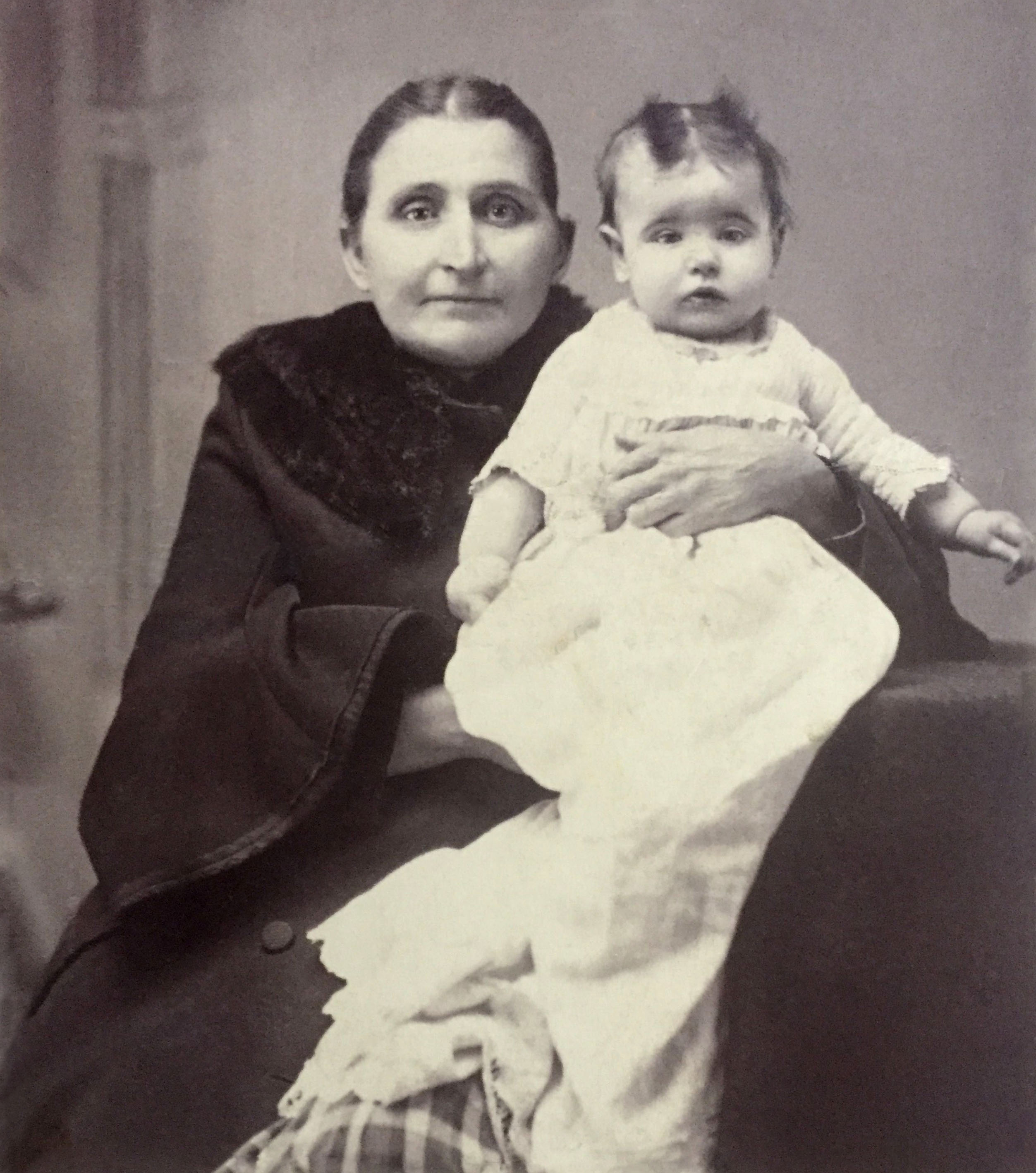
Photo of Cathrine Jane Foster Phenice and her daughter Emma Phenice in 1890 in Nebraska. Her ancestors are the subject of this story.

The connection comes through my mom’s maternal grandfather.  My mom was Betty Lou Bucklin Landry, her mother was Myrtle Phenice Bucklin, and Myrtle’s father was Harry Clifton Phenice.  HC’s mom was Cathrine Jane Foster Phenice.  Her ancestry was undiscovered for many years.  I made that exciting breakthrough in 2019, and I keep finding more interesting information about her family lines.  The story I’m talking about today comes through her father Morris Foster’s line.  His parents were Hugh Foster and Mary Elizabeth McCullough.  Mary Elizabeth’s parents were James McCullough and Martha Hance. 

James was born in 1720 in Belfast, Ireland, according to the writings in his journal.  Yes, he wrote in a journal, and the information has been saved through the years.  I have not seen it yet, but I would really like to one day.  Martha was born around the same time and probably in the same area.  How else would they end up married and immigrating to the North American colonies together in 1745?  They were ready to start an exciting new life in the New World.  They ended up settling in New Castle, which was in the colony of Delaware.

They had their first child, a daughter named Jean, about a year or so after arriving.  Their next child was John, who was born on May 27, 1748.  We know his exact date because it was written in his father’s journal.  It would have been nice if he had written all of his children’s names.  I guess I’ll just have to settle for what I get.  The family relocated at some point after John’s birth.  They moved 162 miles west into the interior of the Pennsylvania in what is now known as Franklin.  At that point in time, the further west you went, the wilder the territory.

In 1750 their third child was born.  That would be my ancestor, Mary Elizabeth.  She was followed the next year by a son that was called James.  He was born on June 11, 1751.  I will now refer to the older James as James I.  The last of the children was a son named Hance who was born around 1755.  Maybe James I wrote the birth dates of John and James because they were the central figures in the story that is infamous in the McCullough family.

It all started on July 26, 1756.  The McCullough family woke up and did the things they normally did every morning.  They probably got dressed, ate some breakfast, and talked about what they would do that day.  Nothing forewarned them of anything untoward coming their way.  They were growing flax and it was time to start preparing for harvest.  It was a family event, and they all went into the fields to start their work.  At some point 8-year-old John and 5-year-old James wandered off.  Martha might have seen them heading off and thought nothing of it.  Boys will be boys.  But not this time.

John and James walked down the road from their house like they had probably done hundreds of times.  They weren’t concerned with how far they walked, as long as they were back for their next meal.  One of them would not taste a home-cooked meal from his mother ever again.  As they were walking, their neighbor Mr. Allen – John Allen- stopped them to warn them of danger.  A White man in the community had been killed by an Indian of the Delaware tribe.  He told them to hurry home and let the rest of the family know of the danger.

John Allen must have hightailed it back the other way to warn other neighbors of the shocking news.  The two boys were alone again, and they ran toward their house to warn everyone else.  They didn’t make.  Just 50 yards from the house, they were accosted by five members of the Delaware tribe and a Frenchman.  The boys fought and screamed to try to get away, but to no avail.  Their family didn’t hear them and were unaware of what was happening.  The boys were tied up.  As John was forced to walk west for the remainder of the day, James was carried by the French and Indian captors.

This all occurred during the time of the French and Indian War.  At least that’s what it was known by the British colonies.  In French territories, like Acadie, it was known as the Seven Year War.  It was a huge war between the two superpowers – France and England.  I’ve discussed it before because that’s when England Exiled the Acadian people from their homes.  But it led to other hostilities as well – killings, scalpings, and abductions.  When I wrote those other posts, the French were the good guys.  This time, the Frenchman is one of the bad guys.  It’s all a matter of perspective.

Back to the kidnapping.  I’m sure later that day Martha and James I must have heard about the killing of the White man in the community.  Had they already started to worry about John and James?  If not, they would have started in earnest when they heard the news.  Were their babies dead?  Or would they ever see them again?  It’s hard to imagine what they went through.  Perhaps Martha decided the best way to deal with it was to take one day at a time.  “Day one,” she whispered to herself with a shaking breath.

John and James continued west with their abductors the next day.  John thought that he was going to be killed at different points, like when they threw him in cold water.  But they didn’t.  They plucked the boys’ hair and painted their skin red.  They reached Fort Duquesne, which was a French fort.  At this time, the boys were separated.  John continued further west with the Delaware, and he never knew what became of his brother.  Meanwhile, back at home, Martha was unaware of what was happening with her boys.  She continued her counting, “Day two.”

John was taken to northwestern Pennsylvania and left with a Delaware Indian family and given the name Istenggowehhing.  They would treat him as part of the family, and he would call them aunt and uncle. He learned their ways and their language, and learned to like their way of life.  It is thought that he was taken as a replacement for a son that they had lost.  Meanwhile, back at the McCullough household, Martha kept up her counting:  One week… one month …six months.

“One year,” she whispered in wonder.  “How did I survive this worrying year?”  Yet, the years moved on.  “Two years.”  “Three years.”  “Four years.”  Then at five long years, some promising news was heard.  Somehow someone that knew John had seen him with his Indian family and recognized him.  They told James I and Martha where he was.  It was a pretty long journey, but I’m sure his parents didn’t think twice about making the trip.  At least they’d have their John back!  James I decided to make the trip to Northern Pennsylvania, while Martha stayed home with the children.  The excitement was palpable!

James made his way north and finally reached the home of the Delaware people that had his son.  But by that time John no longer was familiar with the English language and had grown accustomed to his new home.  Imagine his father’s shock and surprise when John refused to go with him!  James I insisted and began the journey back to their home with his son.  He even tied John’s legs at the bottom of a horse to prevent him from running away.  It was of no use.  John escaped and went into the woods to hide until his father gave up and returned home.  Then John went back to his Indian family that he was familiar with.

Martha didn’t know when James I would return with their son, but she was waiting happily.  As she went to bed she whispered “5 years, 2 months, 18 days” with more excitement than dread.  Soon her counting for John would be over!  The next day James I came home – alone.  They just stared at each other for a long time as tears slowly ran down their faces.  As they embraced, he explained, “He didn’t want to come back.  I tried…I tried so hard.  He didn’t want to come.  He ran off.”  That was a difficult day.  That night when Martha whispered, “5 years, 2 months, 19 days,” it felt as raw as Day One.

Time passed.  “5 years, 6 months.”  “6 years.”  “7 years.” “8 years.”  Things were changing.  The French and Indian War was over.  The animosity between the two sides had settle down a bit.  Cooperation between groups was starting to happen.  One of those things was working with getting abducted children back to their original families.  There was a Colonel Bouquet who worked on that issue and was able to obtain the release of several individuals, including John McCullough.  Finally, John was reunited with his overjoyed parents.  When someone commented on how difficult it was to wait 8 years without knowing when it would end, Martha corrected them by saying, “8 years, 4 months, and 16 days.”  She said it again as she turned to her son and welcomed him into her arms.

John may not have appreciated this woman talking English (with an Irish accent) and wrapping him in her arms at first.  Or maybe he remembered his mom.  He was now 16 years old and almost an adult.  He adjusted to being back among his family and relearned the English language.  After a while he knew what his mom meant when she would say, “8 years, 4 months, and 16 days.”  It was a reminder of the time that was stolen from her.  John would grow up and marry, yet he stayed on family land.

Though I wonder if Martha’s counting continued.  Her son James was never heard from again.  There was “9 years.”  Then “10 years” and “20 years.”  At 23 years, 4 months, and 6 days, her daughter Mary Elizabeth gave birth to her first child and named him James.  Martha was pleased to know that she wasn’t the only one that thought of The Stolen One.   If the counting continued for her boy James, Martha’s last thought could have been, “30 years, 1 month, and 19 days.”

More Irish in the Foster Line

Cathrine Jane “Kate” Foster Phenice was from Mercer, Pennsylvania – or was she?

I wonder if my great great grandmother Kate Foster was ever aware of her Irish ancestry.  She was born Cathrine Jane Foster on September 16, 1848, in Cherrytree, Pennsylvania.  Her parents were Morris Foster and Anne Magdaleen Milliron.  Her father Morris died in 1852 at the age of 35.  I’m sure it was a tough time for the family.  Anne Magdaleen was left with four children under the age of 8 years old.  She took herself and her children back to Mercer, Pennsylvania, which is where she was born and where most of her family lived.  

Anne married George Richael in 1853 and quickly started increasing the size of the family.  With all of these younger siblings about, it’s very likely that Kate never heard much about her father’s family.  In fact, it was always reported that she was born in Mercer, Pennsylvania, but that isn’t true.  The family lived in Cherrytree when she was born.  The confusion around that was probably one of the reasons her descendants had difficulty tracking her ancestry.

But Morris Foster did in fact have Irish ancestry.  I’m not sure of his mother’s ancestry.  Her name was Catherine Moore and I don’t have much information on her.  His father’s name was James Foster and there are more details about his ancestry.  Last year I wrote a post about his father Hugh Foster who was born in Derry, which is in Northern Ireland.  I don’t know when he immigrated to the United States, but he ended up in Liberty, Pennsylvania.  Liberty and Mercer are both in Mercer County.

1778 will of James McCullough

Hugh Foster wasn’t the only one with Irish heritage.  He was married to Mary Elizabeth McCullough.  Like I said last year, that sounds like an Irish name for sure!  I said that I would look into her history, but I didn’t actually do that until this evening when I was looking for something to write about.  I read last year’s post and realized I had been remiss.  Lax, lax, lax!  So I started looking into her family, and it didn’t take long to find some interesting things.  I like it when that happens.

Mary Elizabeth McCullough was the daughter of James McCullough & Martha Hance.  One of the first things I found was James’ will, which was written in 1778.  He lived from 1720 to 1781.  He wills to his beloved wife Martha her bed and bed furniture, her choice of bay mares and her saddle, and her choice of two cows and six sheep.  She also has the use of the back bedroom of their house during her natural life.  She is also allowed to use the pasture to keep the animals that he left her.  The “plantation” was left to his sons John and Hance. 

From book about several counties in Pennsylvania that was compile in 1846

He instructs his sons to pay his two daughters – Jean McClellan and Mary Foster (my ancestor) – the sums of eighty pounds each.  It’s interesting to see the things that are listed in an ancestor’s will.  He mentions a wagon, a windmill, and a Bible.  He mentions other books, which shows that he was literate.  I’m not sure if the will is written in his own hand or not.  The spelling of the last name varies in the document.  They may have been ancestors of my grandmother Myrtle Phenice Bucklin, but they didn’t have the spelling superpower that she passed down to me.  He also leaves some items to other people.  I’m not sure if they are family or not.  I’ll have to explore his extended family.  Maybe I’ll do that next year!

I already know a little bit about his extended family from this blurb in an old book about Pennsylvania.  It reports that James came from Ireland with his two brothers and an unmarried sister (Anna).  It says that he is the founder of the American McCulloughs.  But more importantly, it tells us when he came to America!  Finally, I know the date of immigration for one of my Irish lines.  James first settled in Delaware in 1743.  A decade later he moved the family to Franklin County, Pennsylvania.  At that time the family consisted of himself, his wife Martha, and their son John.  If you read the clip, you can see that it was a difficult time in American history.

So this year I’ll be thinking of James McCullough for St. Patrick’s Day.  He and Martha and their daughter Mary.  Erin go bragh!


Another (Possible) Irish Connection

Mary Ann McGrath Bucklin was born in Ireland and immigrated to Palmer, Massachusetts, around1850 with her family.

I know, I know.  It doesn’t sound like I am sure of this new connection, but tomorrow is St. Patrick’s Day and I don’t want to neglect my Irish lines.  Growing up, I never really felt a connection to any Irish ancestry.  I didn’t really hear anything about it.  I knew that my great great grandmother was Mary Ann McGrath and that always sounded like an Irish name.  But for some reason, some Census records show that she was born in England.  So I thought that maybe it was a very distant Irish connection.  It happens.  Families moved about from England, Ireland, and Scotland quite regularly historically. 

So when I heard about the Great Irish Potato Famine, which occurred from 1845-1852, I didn’t associate it with any of my family.  I felt a lot of sympathy for the people who went through the events and the situations of The Great Hunger, but I didn’t feel a personal connection.

But then in 2015 or so, a DNA match helped me to figure out my family’s direct connection to that tragic event.  He had a great grandparent who had written down some family history information about our McGrath family line.  In that information, it talked about a Mary Ann McGrath who married a Bucklin man and moved to southern Louisiana.  Those were my great great grandparents Mary Ann McGrath and James Bucklin!

Mary Ann’s youngest sibling was born in Ireland in 1838, and Mary Ann married James in Springfield, Massachusetts, in 1854.  So sometimes between those dates, the whole McGrath family group moved to Palmer, Massachusetts.  That means that my family was directly involved with the Great Irish Potato Famine.  I wish I knew some of the particulars of what they went through during that historic time.  I’m sure it had a great impact on all of their lives.  Mary Ann and James and their children moved down to Louisiana in 1884.  There are still family members in that area today.  Even though I grew up in Jennings, Louisiana, which is where Mary Ann died, I didn’t realize all of those connections.  She did die 60 years before I was born, so that’s understandable.

I just recently discovered an even older connection to Ireland in my family.  Again, it is through my mom’s side of the family.  I’m a Landry, and my dad’s side of the family is almost exclusively French.  Most of his ancestry is from the Acadian connection.  Those were mainly French peoples who settled in the 1600s in the area where Nova Scotia is in Canada.  There are a few other lines who came directly from France and intermarried with the Acadian people who were Exiled from Acadie and eventually made their way to Louisiana.

Cathrine Jane Foster Phenice circa 1890 in Nebraska.

But the other Irish connection is through my great great grandmother Cathrine Foster.  She was married to Samuel Phenice, the Civil War veteran and witness to the Lincoln Assassination.  A few years ago, I discovered that her father’s name was Morris or Moore Foster.  He died when Cathrine was young, so it was difficult to find information about him for a while.

The family was from Mercer County in Pennsylvania.  Any time I have a DNA match that has ancestors from Mercer County, I can be pretty sure that the connection is from Cathrine or Samuel.  Cathrine’s mother was Anne Magdaleen Milliron.  She was from German roots, and I’ve seen plenty of DNA connections to that family line.  They had lots of big families.

But I have started to get DNA matches to Cathrine’s father’s family line as well.  The father of Morris Foster was James Foster.  His whole life was lived in Pennsylvania.  James was actually the oldest child in his family.  He was the son of Hugh Foster and Mary Elizabeth McCullough.  I’m pretty sure Mary Elizabeth lived all of her life in Pennsylvania, but her name sounds very Irish.  I’ll have to look into that name a bit more.

Hugh Foster, on the other hand, is said to have been born in Derry, Ireland.  So there it is, another Irish connection.  When I add people to my tree, I like to have good information about the connection to their children.  You’ve got to prove one generation to the next.  But I always like to see DNA pointing to the same connection as well.  It makes it seem more real to me.  Earlier this week I had a DNA connection that showed the common ancestors to be Hugh Foster and Mary Elizabeth McCullough.  A few other matches had hinted at that connection as well.

When I was deciding on what I’d write this week, I looked a bit at that Hugh Foster connection.  I saw the name of another descendant of him.  That person showed that they had taken a DNA test.  So I decided that her test would be the deciding factor on what I wrote tonight.  If she was a DNA match to my mom, I would write about our connection to Hugh Foster.  If she didn’t match, you wouldn’t have heard about him.  I suppose you know what the outcome was.

Erin go bragh.

My family tree showing Irish lines in green for both of my maternal grandparents.


Grandma Kate’s Milliron-Cribbs Family

It has been a bit over three years since I was able to finally break through the brick wall of Cathrine Jane Foster Phenice’s ancestry.  I descend from her on my mom’s side of the family.  My mom’s name was Betty Lou Bucklin and she was the daughter of Myrtle Sylvia Phenice.  Grandma was the daughter of Harry Clifton Phenice, and H. C. was the son of Cathrine or “Kate.”  For some reason the clues for her parentage did not make itself known very easily.  The only way I was able to do it was with the help of DNA matching.  It definitely pointed me in the right direction.

Cathrine Jane Foster Phenice circa 1910 in Nebraska.

One of the main things that made it difficult was that her father Moore (or Morris) Foster died in 1852 when Kate was only 4 years old.  They were living in Cherrytree, Pennsylvania, at the time.  After Moore’s death, Kate’s mother Anne Magdaleen Milliron Foster moved the family back to her childhood hometown of Springfield, Pennsylvania, in Mercer County.  It wasn’t long before Anne had remarried to a man named George Richael.  Since Anne took on the name of Richael, it wasn’t straightforward to find the connection from Foster to Milliron.  As you’ll see, we weren’t the only ones who didn’t make the connection between Cathrine Foster and the Milliron family.

I wrote a post about Cathrine’s family that included many Richael half-siblings.  It is interesting that there was never any reference to these siblings in newspaper articles about Kate.  At least I haven’t seen any.  I also wrote a post about Anne’s family when I discovered an old letter that talked about a Milliron family reunion at her brother Alexander’s home in Kansas in 1885.  That probably could have been called a Millison family reunion, because some of the siblings went by the last name Millison and others went by Milliron.  It seems strange that the two names could be from the same family until you hear the reason.  The original name was the German name Muhleisen.  The name means ‘miller of iron.’  Some family members went with an English spelling of the meaning of the name – Milliron- while others went with an English spelling of the sound of the name – Millison.

But the reunion should have included another name – Cribbs.  While Anne and Alexander’s father’s name was Milliron, their mother’s name was Cribbs.  I really should say that their parents were Daniel C. Milliron (1803-1878) and Catherine Cribbs (1805-1872).  Both of them were born in Westmoreland County in Pennsylvania, where they met and were married on February 5, 1824, in Hempfield Township.  They were not the only Cribbs-Milliron connection made that year.  Toward the end of the year Daniel’s sister Catherine Milliron married Catherine’s brother Peter Cribbs.  Ok, it’s already confusing enough that a brother and a sister marry another brother and a sister, but to have a Catherine Cribbs Milliron and a Catherine Milliron Cribbs really tops it off.

Intro to Milliron-Cribbs family history book by Christina Hettenbaugh Noring in 1964.

The two couples started their families at pretty much the same rate.  Just look at their second children.  Anne Milliron had a double first cousin Mary Anne Cribbs who was born just a few weeks before her.  There were eight Cribbs children and nine Milliron children all born within a fifteen year period.  Besides these double first cousins, there were lots of cousins on both sides of the family.  One of the things that this seems to lead to is the likelihood that someone in the family is interested in family history.  And when there is someone who starts looking into family history with a lot of people involved, they try to find a way of keeping the names all straight.  So they write it all down and sometimes it ends up being put together in a book.

And that’s what I found last night!  Peter and Catherine had a great granddaughter by the name of Christina Hettenbaugh Noring.  She was interested in the ancestry of Peter and Catherine.  This is great for me and my Phenice cousins because that means she was interested in both the Milliron and Cribbs family lines.  So there is some interesting information about how the two families came together in Westmoreland County and then made their way to Mercer County in 1825. 

Page in Noring book that shows my great great great grandmother Anna Magdaleen Millison Foster. Her daughter Cathrine is missing.

It gives a few generations of the family, including the children of Alexander and Anne Milliron and their siblings.  But there is someone missing!  They say that Anne first married Moore Foster and they had children named James, Hannah, Emery, and an unnamed infant.  According to the 1850 Census in Cherrytree, the Foster family consisted of Moore Foster, his wife Ann Magdelene, and his children James – 6, Emory – 4, and Catharine – 2.  In the 1860 Census Ann is listed as the wife of George Rihel.  Included in the household are 13-year-old Emily Foster (probably Emory Foster), Catherine Foster, and Hannah Foster, as well as the children of George and Ann.

So for some reason Cathrine was left out of the book, as well as all of her descendants.  So our family didn’t know about the Milliron-Cribbs family connection through Cathrine, and the Milliron-Cribbs cousins didn’t know about Cathrine’s connection to their group.  Was it due to Cathrine being older and leaving home when she was old enough to marry?  She and Charles ended up moving out to Nebraska, which was pretty isolated from the rest of the family.  She did have contact with her uncle Alexander and maintained a relationship.  That’s how I first noticed a possible connection to the Millison name.  It was reported in a blurb in a Kansas newspaper. 

The book I found also includes the letter I shared about the Milliron Reunion of 1885, so there were still some connections with Anne’s family.  If they had known about her daughter Cathrine, my name would have ended up in the book.   Some of the descendants listed were born in the 1970s.  I find it interesting that I’ve found my name in several family books about ancestry.  I’m listed in books about the family lines of Landry, Patureau, Keys, and Bucklin (online only). 

Even though I was left out of the book, I’m still looking forward to reading through it closely to see what family stories I can find.  If I find anything really interesting, you know I’ll share it.  Try to be patient.

Cathrine’s tree showing location of Cribbs, Milliron, and Foster lines.


Grandma Kate Opens Up

I’m so excited about this post!  You know how it is sometimes with older relatives – you want to know their story and they’re just not willing to talk about things.  I must have caught Grandma Kate on a good day.  Finally, after all these years!  I knew she would be hesitant to talk about some things.  The end of her life was difficult.  It’s pretty drastic when you get caught by fire.  She does touch on that, but mostly she talks about her family history.  How convenient for me, since that is what I am most interested in.  It is a family history blog after all.

Her voice doesn’t sound like what I expected.  It may have changed through the years.  Or maybe I was errant in my expectations.  Either way, I enjoyed hearing her story.  I hope you do, too.

Milliron Reunion in 1885

Daniel C. Milliron and Catherine Cribbs were my 4x great grandparents.  They were married on Feb. 5, 1824, in Hemphill Township, Westmoreland County in Pennsylvania.  They were both born in Westmoreland County, yet after they were  married they settled in Mercer County which is 100 miles away.

They had nine children together.  In 1825 they had Alexander, in 1826 they had Anne Magdaleen (my 3x great grandmother), in 1829 they had John, in 1831 they had Elias, in 1834 they had Cyrus (died as infant), in 1836 they had David, in 1838 they had Luis (died as infant), in 1840 they had Catherine (died as infant), and in 1842 they had Susannah (died at age 9).  As you can see, only 4 sons and 1 daughter grew to adulthood.

Once they grew up and got married, they and their children started spreading across the country.  Those were the times they were living in.  When Anne Magdaleen married Morris Foster on August 30, 1843, the US consisted of only 26 states.  By the time of her death in 1873, 11 more were added.  The Milliron families were setting up homes in some of these new states.

Transcription of May 21, 1885, letter from Milliron brothers to their brother John. The letter was found in an old family Bible.

This led to lots of distance between those siblings.  I discovered this when I found a transcription of a letter from May 21, 1885.  Three of the brothers were having a reunion at the home of the oldest brother Alexander in Wabaunsee County, Kansas.  When they were growing up, he was called Sander.  As he got older, he was known as Mac.  After a few days together at the reunion, they adjusted to calling him his new name.

From what I can tell, Sander (or Mac as we now call him) had last seen Eli in 1857.  Can you imagine not seeing your sibling for 28 years?  The last time Eli had seen Dave was in 1865.   Their time apart was only 20 years.  Sander had last seen Dave in 1870.  They don’t mention how long it had been since the brothers had seen John.  The letter was written to him and it sounds like he may have stayed in Pennsylvania.

One of the things not mentioned was the death of Anne Magdaleen in 1873.  They do talk about being the only four left of their immediate family.  So it’s evident that they did not go to Anne’s funeral.  She lived in Pennsylvania, so the only one that would have possibly made it would have been John.  We don’t hear from him, though.  They do express sorrow that he is not with them and invite him to visit each of them.  I wonder if Cathrine Foster Phenice (daughter of Anne Magdeleen) was invited to this reunion.  She only lived a day or so away, yet she and husband Samuel had six young children to care for.

The three brothers spent a few days reminiscing about old times.  They mention some of their adventures as young men and say that they have tempered themselves as older men.  It’s a little bittersweet.  They mention reading over all the old letters they could find.  Boy, I wish I had some of those!  At least I have this one.  It gives me a bit of a glimpse into the lives of my great great great grandmother’s family.


Harry C. Phenice is my maternal grandmother’s father.


A Clearer View of Kate

My inspiration for the post this week came from a website that I use for exploring DNA matches.  The name of the website is MyHeritage.com and it came out with something new recently.  This new thing has nothing to do with DNA.  It really doesn’t even have anything to do with genealogy.  They came out with a photo editing feature.

And you can call me amazed!!!  I don’t normally use three exclamation points at a time, but this time it was appropriate.  I saw a little ad for the feature.  It showed a before and after for an old photo.  I didn’t believe it.  I was like, “There is no way possible for that to be true.  They took a clear photo and blurred it to make it a ‘before’ photo.  Then they used the original photo for the ‘after’ photo.”  I was not believing it.

But I thought I’d try it.  Why not?  I had tried their colorizing feature on some photos, but I didn’t really like the results.  But it was a free trial offer.  So I went on their website and tried it on a few photos.  It’s like magic!!  Even after seeing the results, I find it hard to believe.  It puts back details like strands of hair, eyelashes, and lip texture that look authentic.

Photo that was edited using MyHeritage.com’s Photo Enhancer to clear up the image of my great great grandmother Kate Phenice and her daughter Emma from 1890.

My favorite one is this old photo of my maternal grandmother’s paternal grandmother. (I am the son of Betty Lou Bucklin Landry, who was the daughter of Myrtle Sylvia Phenice Bucklin, who was the daughter of Harry Clifton Phenice, who was the son of Cathrine Jane Foster Phenice.)  So Cathrine or Kate was my great great grandmother.  The photo was taken in 1890 in Hitchcock County, Nebraska.  I estimated this date because her 8th and youngest child Emma Orra is in the photo with her, and she was born June 20, 1889.

Look how much better their faces look!  It really brings the photos to life.  I’ve already spent way too long looking at this photo.  I just can’t get over the details that were recovered.  I thought I’d do the same with the information about Kate’s life.  The details of her life were a mystery for a long time, but last year I figured out who her parents were.  I’ve discovered a few more details in the meantime.

Cathrine Jane Foster was born in Mercer County, Pennsylvania, on Sept. 16, 1848.  We have had that information for quite a while.  Some of it was on her headstone and other parts were in a newspaper article about her death.  There were lots of other details, as well, but nothing was said about parents or siblings.

I now know that she was the daughter of Morris or Moore Foster and Anne Magdaleen Milliron.  When she was born, Morris and Anne had been married for 5 years.  They were married on Aug. 30, 1843.  It was most likely in Mercer County, because that’s where they both were born.  I don’t know much more about Morris’s family, but I do know that the Milliron family had been in Pennsylvania for about 100 years.

Morris and Anne had their first son in 1845 and his name was James.  Their second son was born in 1846 and they called him Emory.  Cathrine was their first daughter and the next to be born.  I’m not sure when she started going by the name Kate, but that seems to be what she was known by most of her life. 

The next source of information for Kate’s life was the 1850 Census.  There are six people living in the household in Cherrytree, Venango, Pennsylvania.  There are 29-year-old Moore Foster, 24-year-old Ann Magdelene Foster, 19-year-old Thomas Foster, 6-year-old James, 4-year-old Emory, and 2-year-old Catharine.  This is a Census, so the names are spelled according to the Census taker.  I’m not sure who Thomas is, but it is likely a family member, such as a brother or nephew of Moore.

The main thing that is different is where they are living.  I have Cherrytree as the birth place for James and Emory.  I’m thinking that Kate must have been born in Cherrytree as well, because in 1852 her younger sister Hannah is born in Cherrytree.  I doubt that the family was moving back and forth from Mercer.  They are about 110 miles apart.  So at some point Moore and Anne moved to Cherrytree and started having children.

Tragedy struck a few months after the birth of Hannah in 1852.  Moore Foster died at the age of 35.  I don’t know how he died, but I’m sure it was a traumatic event in the life of little 4-year-old Kate.  Anne moved her family back to Mercer County.  I suppose she did this to be closer to her Milliron family members.

About a year later Anne Magdaleen Milliron Foster married George Richael.  Over the next five years, Anne and George had three sons.  Their third son Elias was born in 1858 and he only lived for two days.  This was likely another point of sadness in 9-year-old Kate’s life.  Anne and George had two daughters following this.  Then in 1864 they had a son that they named George, Jr.  Sadly, George, Jr. died a couple of days after his first birthday.

So in 1865 the family consisted of her mother Anne and step-father George, as well as her brothers James and Emory and sister Hannah.  There were also two step-brothers and two step-sisters.  It’s hard to know if that was a happy situation or not.  There was no mention of other family members in the article about her death, and some of those step siblings were still alive.  I’m thinking it wasn’t the best situation, since it doesn’t seem like it was talked about.  Otherwise her family wouldn’t have been such a mystery.  Or maybe it was just the forgetfulness of family through the years.

Either way, 17-year-old Kate was not sticking around!  She must have met Samuel Phenice around this time.  He was 21 at this time and had fantastic tales to tell about his soldiering time in the Civil War and his eyewitness testimony for the Lincoln Assassination.  They were married Sept. 27, 1866, in Hendersonville, Pennsylvania.

And the rest, they say, is another post.

Edited version with just Kate in the photo.

Finding Cathrine Foster’s Family

Cathrine Foster Phenice circa 1910

Have I done it?!  I think I have.  The pieces all seem to add up.  I am very excited about it, since members of the family have been trying to find evidence of Cathrine Foster Phenice’s family for at least the last 50 years.  DNA was helpful in this case, but so was time spent looking.  Let me see if I can explain it for those who are interested.

My mother’s name was Betty Lou Bucklin Landry.  Her mother was Myrtle Phenice Bucklin.  Grandma’s father was Harry Clifton Phenice.  His parents were Samuel Charles Phenice (witness to the Lincoln Assassination) and Cathrine Jane Foster (died as a result of terrible burns).  We knew some of the ancestry of Samuel, but not of Kate.  The one thing we knew for certain was that she was born in 1848 in Mercer County, Pennsylvania. 

I wanted to find out more, so I decided to use my newest tool for researching.  I did a search on newspapers.com for Phenice and Kansas.  I had already done a search for Phenice and Nebraska.  I found some interesting items, but nothing led me in the direction of Kate’s Foster family.  I had to be open to the chance that her last name was not originally Foster.  It’s possible she could have been married before or possibly adopted.  There was rumor that the Foster name came about because she had grown up in a foster family.  If that had been the case, the title of this post would be “Finding Cathrine’s Foster Family” and it isn’t.  But I’m getting ahead of myself.

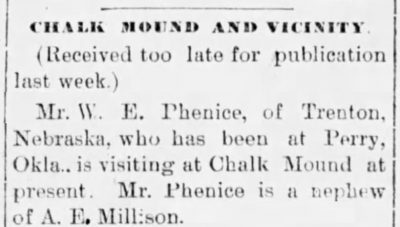
My search for Phenice and Kansas came up with one particularly juicy morsel.  It reads, “Mr. W. E. Phenice, of Trenton, Nebraska, who has been at Perry, Okla., is visiting at Chalk Mound at present.  Mr. Phenice is a nephew of A. E. Millison.”  (The Eskridge Tribune Star and Eskridge Independent, August 30, 1894)
I know who W. E. Phenice is.  Samuel and Kate had an older son named William Emory (b. 1871) and they homesteaded in Trenton, Nebraska, from 1886 to 1889.  So that part fits just right.  But neither Samuel nor Kate had a sibling by the name of A. E. Millison, because that’s the only way he could be a nephew. 

I didn’t really think about it much and then went to look at one of the sites that I have my DNA matches.  And can you guess what I found?  I found a DNA match with the last name Millison.  It really stood out since I had just seen this newspaper article with the same surname identified as a relative.  So I had to check it out a little.  I looked to see who else in the family was a DNA match to this Millison person.  My mom and both of her siblings matched him at the same point on Chromosome 9.  None of their first cousins were a match, but one of their second cousins were.  And…drumroll, please…it was our cousin Mona Q. who also descends from Samuel and Kate Phenice.  And it wasn’t just any other random DNA matching segment, it was the same exact spot on Chromosome 9. 

So I sent off a note to that DNA match to ask what he knows about the Millison name.  I was also wondering how he might be connected to this A. E. Millison.  And if he did know who he was, was either he or his wife from somewhere around Mercer County, Pennsylvania.

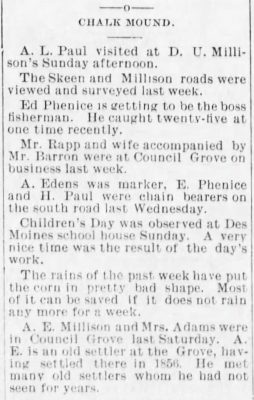
After I sent the note, I looked him up on 23andMe, which is where he tested.  On his profile he showed that his great grandparents lived in Council Grove, Kansas, which is the same area as Chalk Mound.  So he looked like he was from the same family.  Then I found an obituary for a Uba Millison at newspapers.com.  There was no information in that article, but the name is so unusual that I figured I could search for it on Find A Grave.  It worked!  I found Alexander E. Millison who died in Wabaunsee, Kansas, which is where William Emery Phenice lived in 1895.  But more importantly, I found out that A. E. Millison was born in Mercer County, Pennsylvania, the same place that Cathrine Foster was born.

Of course A. E. Millison was married to someone and she could have been born in Mercer County, too.  Kate and Samuel were both born there.  Amazingly enough, I heard back right away from my Millison DNA match.  That’s practically unheard of.  He was able to provide a few quick links for some family information.  I was able to determine that A. E. Millison was married to Phoebe Cummings who had been born  in Quebec.  So the common DNA came through A. E. Millison.  The name is also spelled Milliron and Milleson.  The family originated in Germany.

I did some research on the family and wasn’t able to find a connection to Kate right away.  A. E. did have a daughter named Orra, which is the middle name of Kate’s daughter Emma (Mona’s grandmother).  He also had sisters by the name of Catherine and Susannah, both of which are family names in the Phenice line.  But the Catherine that was his sister had a well-documented family that did not match our Cathrine.  Where was the connection?

1850 Census record from Venango, Pennsylvania. The first complete household shows Moore, Ann Magdelene, James, Emory, Catharine, and Thos Foster.

I found another tree that had the Millison family documented on it.  I thought I would try a different approach.  I searched for the last name Foster to see if that was in the tree.  Sure enough it was.  And there it was – a Catherine Foster born in 1848.  I went to check out her page and saw that her mother was listed as Anne Magdeleen Milliron, born in Mercer County, Pennsylvania.  She was the sister to A. E. Millison.  There was a brother of Cathrine with the name of Emery, another name to tie it all together.

When I saw that her father’s name was listed as Morris Foster, I thought it looked familiar.  In the beginning of 2018 I had come across a Census record from Venango, Pennsylvania, in 1850.   There was a two-year-old daughter in the household named Catharine.  She had a brother named Emory, a mom named Ann Magdelene, and a father named Moore Foster.  I had saved this but was never able to find any other information on this household.

Maybe if I had been searching for Morris Foster I would have had better luck.   The other problem is that Morris Foster died in 1852.  Ann Magdelene soon married George Rihel and the first of their nine children together was born in 1854.  So little Kate Foster grew up in a household of Rihels after that point.  She was a Foster child, but in name only. 

Catherine Foster in the Rihel household in 1860

So the relationship to A. E. Millison stated in the article was slightly inaccurate.  Kate was his niece (not his sister) and William Emory Phenice was his grand nephew.  They must have had a close family connection for them to visit like they did.   Yet that article was instrumental in making a great connection.  I am going to have to pay close attention to those old newspaper blurbs about family visiting family because you never know what little morsel of information can lead to a great discovery.

And a great discovery it is.  For Kate’s father’s side, I only have his name so far.  But for Anne Magdeleen, she is the first of four generations found.  The family was in Pennsylvania for a long time.  Most of them were from Germany, and one of our ancestors was born on the voyage to the US.  Another was a Revolutionary War soldier who died in the Battle of the Wabash at the age of 36.

Now that I’ve updated my family tree with these new names, I’ve been able to identify many DNA matches who also have these names.  I had suspected that they were connections through Cathrine Foster and now I have enough information to make the connection. 

Now that I have walked my way through all of this information, I’m starting to believe it a bit more. 

Cathrine Jane Foster Phenice family tree

It Could Have Been Gomorrah

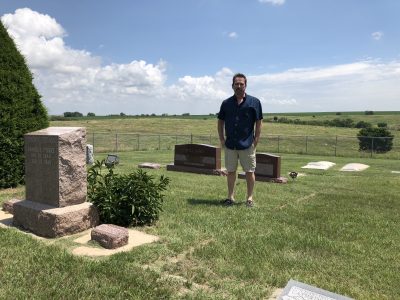
Reenacting a photo of my great great grandfather at Maple Creek Cemetery in Precept, Nebraska, in June 2018. See how windy it was.

I wasn’t sure I was going to do a post today, but I found a Wi-Fi spot to do a little work. I decided to post about my recent adventure since that’s the only photos that I have access to right now.

I mentioned the trip to Nebraska to visit the graves of my great great grandparents a few weeks ago, and decided to reenact one of the photos that I posted. That’s the photo of me standing next to the headstone in the cemetery.

Before we went to the cemetery, we stopped in the small town of Beaver City, Nebraska. At the library I found some information about my great great grandparents Samuel Charles Phenice and Cathrine Jane Foster. On two of their children’s marriage certificates, I saw that they went by the names Charles and Kate.

Charles and Kate lived in the small community called Precept, Nebraska. The early settlers picked the name by choosing a phrase from the Bible at random. It’s a good thing they didn’t pick Gomorrah! I also found a photo in a newspaper clipping that showed the church of Precept. It’s the church that Charles and Kate must’ve gone to. Their daughter was married there and Kate’s funeral was held there.

I’m glad I found that photo because it helped me to identify the church when I saw it on the way to Maple Creek (pronounced ‘Crick’ by the locals) Cemetery. The church was moved in 1927 from the cemetery area to the ‘town’ of Precept.

The church in Precept in 2018.

It seemed odd to me that they would make the effort to move the church less than 2 miles away to another secluded area. I suppose there must’ve been more people living in that vicinity. Nothing but fields and clouds for miles around. And an old abandoned church.

Which made the cemetery that much more surprising. It was immaculate! I’m glad to know that their graves are well taken care of. Maybe some of you want to check it out someday.

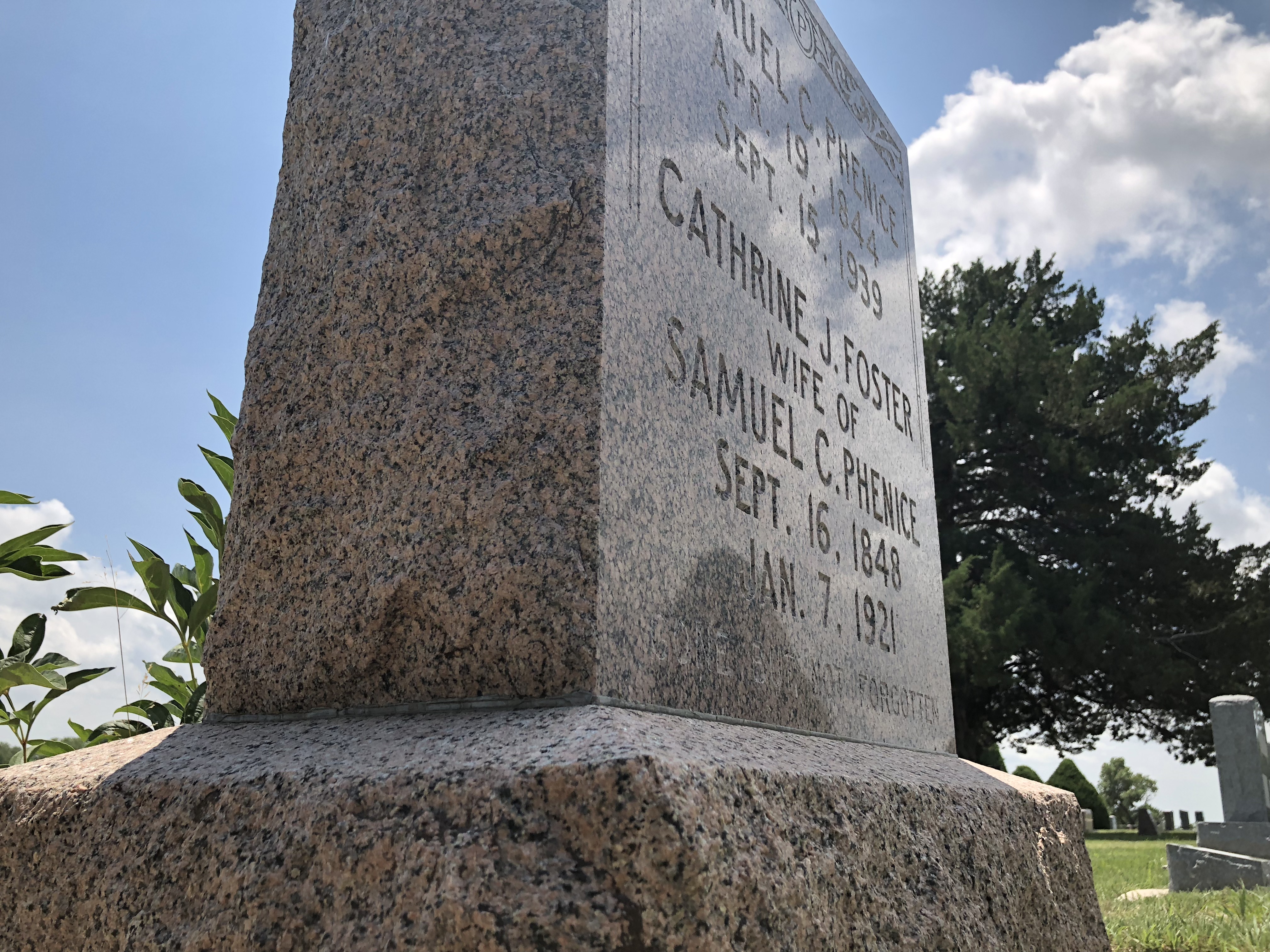
I had to get creative with this one. Her name is very hard to read when you look at it straight on. Now I know how she spells her name!

The Phenice plot. Kate was buried here in 1921 and Charles was buried in 1939.

Maple Creek Cemetery in Precept, Nebraska, is such a well-groomed cemetery. Very impressive.

Digging Up Bones

S. C. Phenice visiting his wife’s grave circa 1930.

I saw this photo for the first time just over a year ago.  I got it from my second cousin once removed (my mom’s second cousin) Mona Quillen.  It’s kind of a sad photo.

It’s a photo of my great great grandfather Samuel Charles Phenice at Maple Creek Cemetery in Precept (Furnas County), Nebraska.  He is holding a grandchild or great grandchild as he visits his wife Catherine Jane Foster Phenice’s grave.

We all know the tragedy of Catherine’s death.  Her clothes caught fire in her home just before Christmas in 1920.  She was burned terribly and died as a result of her wounds on Jan. 7, 1921, at the age of 72.  She and Samuel had gotten married Sept. 27, 1866, in Hendersonville, Pennsylvania.  (They were both born in Mercer County in Pennsylvania.)  So at the time of her death, they had been married for 54 years.  Samuel went on to survive Catherine for another 19 years.

So I’m pretty sure this was just one of many of the visits that Samuel made to this graveyard.  That means this photo was taken sometime between 1921 and 1939.  In 1930 he was living with his youngest daughter Emma Quillen (Mona’s grandmother) and her family. (According to 1930 Census.)  Since he was living with that family and the photo came from that family, I’m thinking that the photo was taken around 1930 or so.  So it’s possible that the youngster in the photo was Emma’s youngest son Harry Lincoln Quillen, who was born in 1927.  Samuel died in 1939 and was buried with his beloved wife.

The reason I’m posting this photo is that I’m planning on visiting their grave site at the end of June.  “Digging up bones” is what my mom called these types of visits.  Mona and Michelle Quillen (my 3rd cousin through Samuel & Catherine) suggested the visit to the graveyard last year and I’ve decided to do it.  I’m not sure if they are going to make it or not.  I’m hoping my brother Rob (& his wife Robyn) will make it, too.

So anyone else who might want to meet us there, we’ll be at Catherine and Samuel’s grave shortly after lunch on Saturday, June 30, 2018.  We will not actually be digging, so no shovels are needed.


1 2