The Irish Washerwoman by HC in ’43

I told everyone that I was going to share something special from my mom’s side of the family this week, and I definitely think that this fits the bill.  It is a recording of my great grandfather Harry Clifton Phenice playing the song “The Irish Washerwoman” on his fiddle on June 12, 1943, in Hathaway, Louisiana.  At least that’s what the woman in the recording says at the beginning of the group of songs that are on the disk I have.  It probably is on that date, but it could have been from another recording session around the same time.

Harry Clifton Phenice circa 1949. I wasn’t planning on posting a photo, but I thought I’d go ahead and post this rough one. I have another one of him from the same day where he is smiling.

Harry, or H. C. as he was mostly known, was my maternal grandmother Myrtle Phenice Bucklin’s father.  He was born in Pennsylvania, grew up in Kansas and Nebraska, and ended up in Louisiana as an adult.  He was married to the most recent immigrant of my ancestors – Daisy Henrietta Keys Phenice from London, England.  She came with her mother, brothers, and sisters to the United States in 1887 at 11 years of age.  Her father Henry Keys had played the violin or fiddle and I think that her mother had played the piano.  The only portrait of Martha Ann Cook Keys shows her with her hand touching a piano.  Henry died before the family moved to America, but his violin came with them.  The violin is still owned by a family member to this day.

So Daisy was around music most of her life.  That continued when she married H. C., who was a fiddler like her father.  I wonder if they played any of the same songs.  “The Irish Washerwoman” is known as an Irish song (hence the name!), but some people claim there are English origins to the song.  The song has been around since 1785, so her father could have known it. 

She was fond of her husband’s fiddling, at least according to family lore.  Once he went to play in a local music contest and she asked him what he would play.  He told her that he hadn’t decided yet.  He would make up his mind once he got there.  Well, come to find out, he played a slower song and lost the competition to Daisy’s brother Leonard.  Daisy said that he would have won the competition – over her brother playing with their father’s violin – if he had played something more lively like “The Irish Washerwoman.”  That’s the story told by my grandmother’s younger sister Marguerite in some of her writing.  I’m sure Marguerite nor Daisy were biased in any way when judging musical talent!

I love that we have recordings of my great grandfather playing his fiddle.  It’s only because of his son Sylvan’s interest in radio and sound systems.  He cut those old records back in the 40s and they’ve been preserved in one form or another since then.  I know for sure they’ve been on reel-to-reel tape, cassette tapes, computer disk, and now on iPhone recordings.  That’s probably why they are a little rough around the edges.  But you can still hear the lively tune and you may even be tempted to dance a little jig!  Accompanying H. C. on the fiddle is his wife Daisy on the piano.  The way she plays reminds me of the way my mom played when our family sang at Shakey’s and other get togethers. 

The recording starts out a little slow, but then H. C. starts playing.  The fiddle playing is really interesting.  He seems to play around with the rhythms of the song.  I can’t really explain it well, you’ll just have to listen.  I wish I had a photo of him playing the fiddle.  That would be nice.  I wonder what ever happened to that fiddle of his?  That would be nice to find out.

But for now, enjoy the sounds from the past.


A Letter From Home in 1952

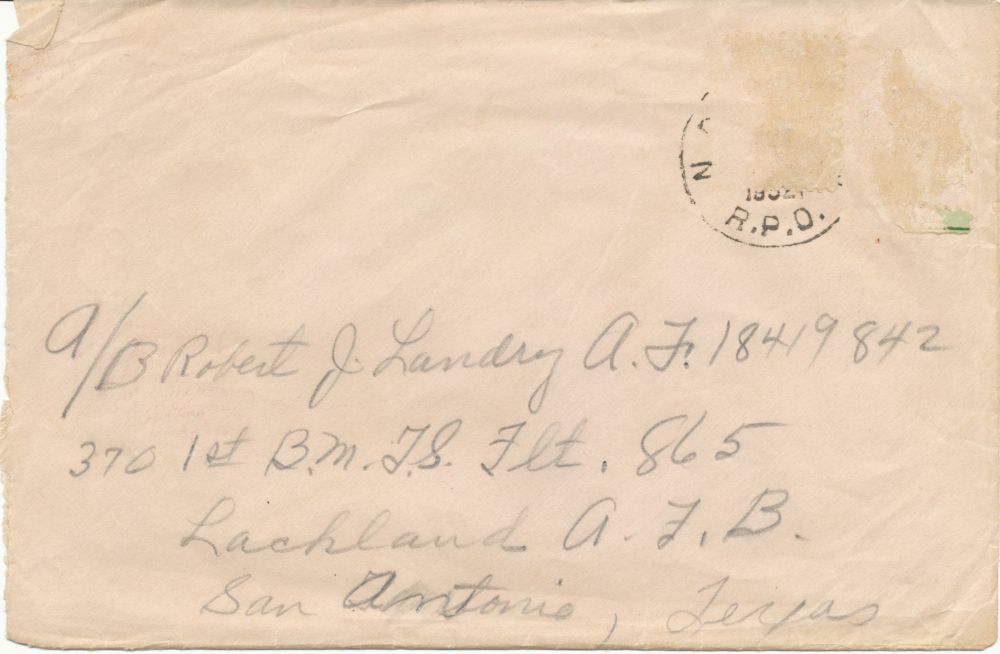
Letter from home was received on Aug. 19, 1952.

When you read this post, you’ll see that it is another one about my dad’s side of the family.  This is the third one in a row, in fact.  I usually try to switch back and forth every week.  But last week I just had to post that photo of the Patureau family heirloom.  That was the bed that was brought from France in 1840 and is now in my home.  I finally got it fixed up and ready for viewing and couldn’t wait another week.  In addition to that, I knew that this week I was going to post this letter from August of 1952.  It was written exactly 70 years ago this week.  I’ll just have to believe my maternal relatives will be okay with that.  Besides, I’ve got a really good one planned for next week about my maternal grandmother’s family member.  Just you wait and see!

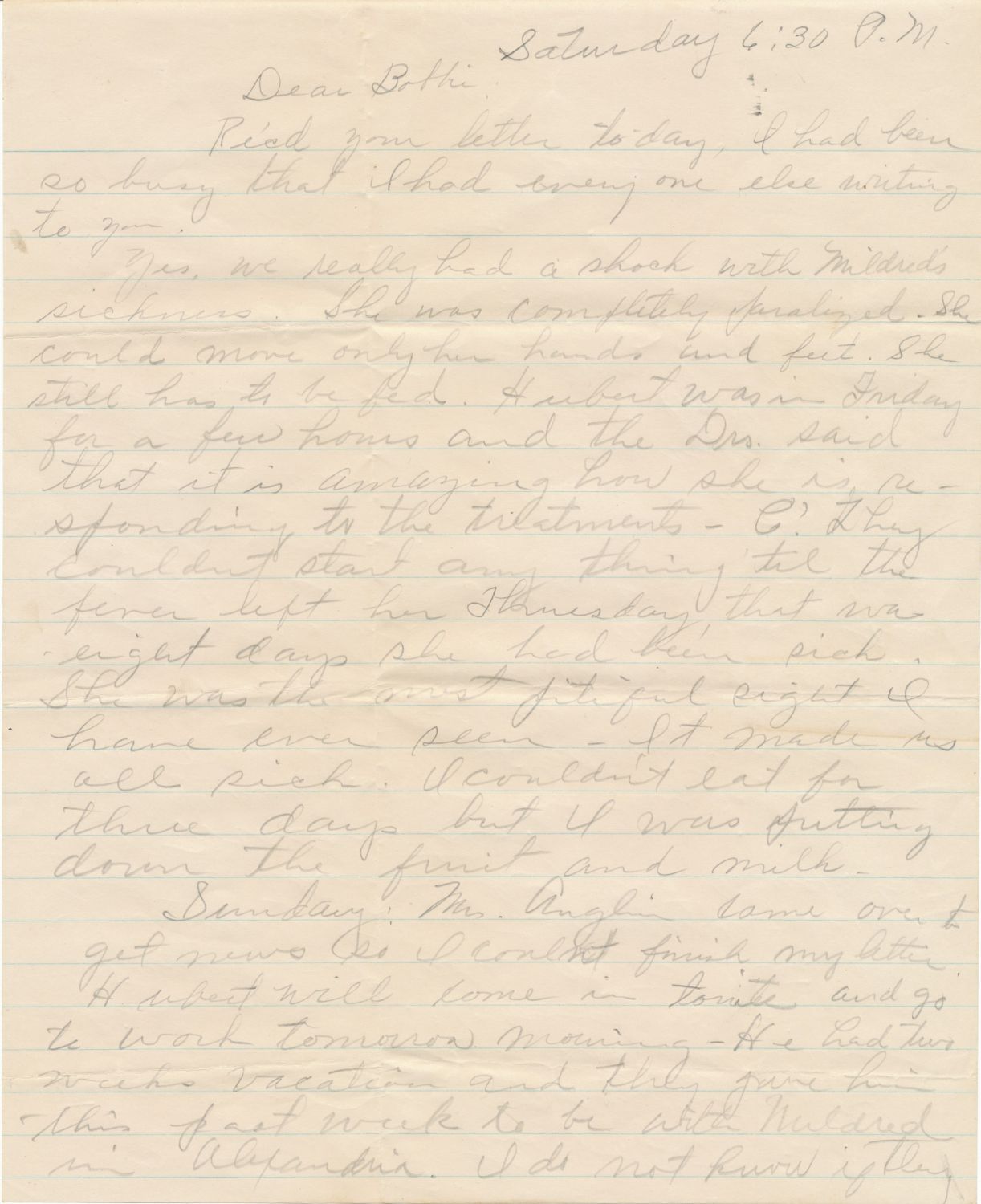
Page 1 begins on Aug. 16, 1952, and continues on the next day.

So this post is about another event that happened during the year of my parents’ wedding.  I’m pretty sure they got engaged around the beginning of 1952.  Sometime around that they met each other’s parents.  I wrote a post about that a month ago.  Then my dad went off to boot camp for the Air Force in June or July.  I posted a letter that his sister Frances and his mom Erie wrote to him in June of that year.  I never wrote anything about it.  In that letter they talk about Aunt Zim being ill.  I had to look it up to see if she had died that year.  She hadn’t, but her husband Uncle Joe died in June 1952.  That was Pee Paw’s brother.   I don’t know if my dad was able to go to that funeral or not.  I remember him speaking fondly about Uncle Joe and Aunt Zim.

While he was at training at Lackland Air Force Base in San Antonio, he got this letter from his mom.  Her name was Germaine Erie Patureau Landry.  Her friends knew her as Erie.  Her children knew her as Mama.  She was Mee Maw to me and my cousins.  She signs this letter as Mother.  I was looking through my family history stuff the other day and ran across this letter.  On the back of the envelope, it says that it was received August 19, 1952.  Mee Maw says in the letter that she started the letter on a Saturday and finished it on a Sunday.  I looked up an August 1952 calendar online and saw that the corresponding dates were August 16 and 17.  So I decided that I would write the post on the anniversary of the writing of the letter.  So that’s what I’m doing.

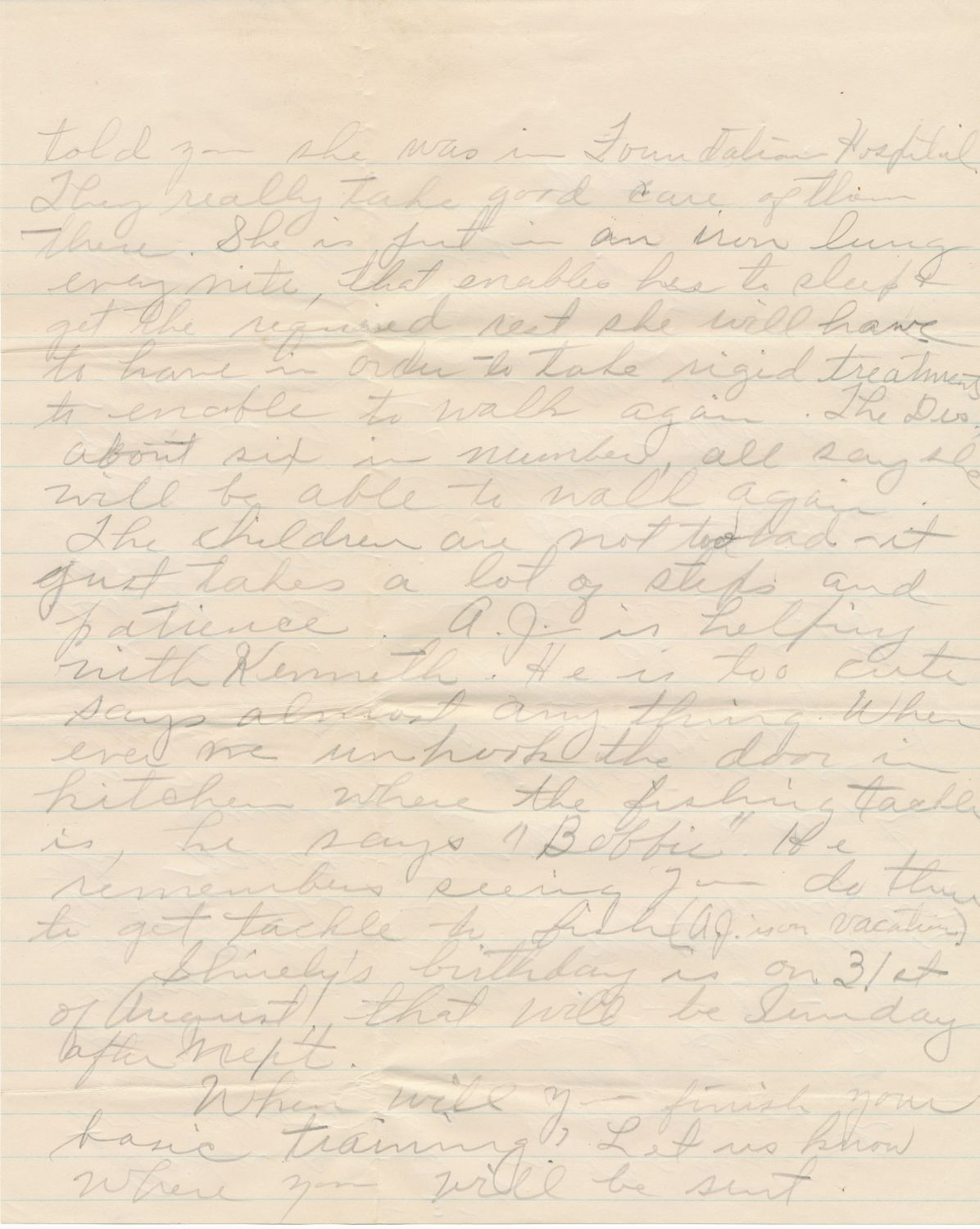
Page 2 of letter

In the meantime, last Sunday I heard something on TV that is related to what the letter is about.  The report was about a case of polio in New York.  I’m sure that if any of my cousins read or saw the news about this polio case, they thought about or mentioned our Aunt Mildred.  She contracted polio in the first week of August 1952, she had fever for eight days, and she was completely paralyzed.  According to Mee Maw, “she was the most pitiful sight I have ever seen.  It made us all sick.  I couldn’t eat for three days…”  She was very concerned about her sweet daughter-in-law.

Mildred was married to my dad’s older brother Hubert.  They had an older brother named A. J. and he is mentioned in the letter.  A. J. was married to Margie.  Daddy also had an older sister named Marie.  She is not mentioned in this letter, but she is mentioned in the June letter.  They had recently moved back to Lake Charles, which is where the family lived.  Hubert and Mildred were the first ones to give Mee Maw and Pee Paw grandchildren – and my godmother Shirley never lets any of us forget it.  She is The First after all.   But Mildred needed specialized care, so she was sent to Foundation Hospital in Alexandria.  At night time she was put in an iron lung to help her with breathing so she could gain back some of her strength.  Hubert went up there to be with her.

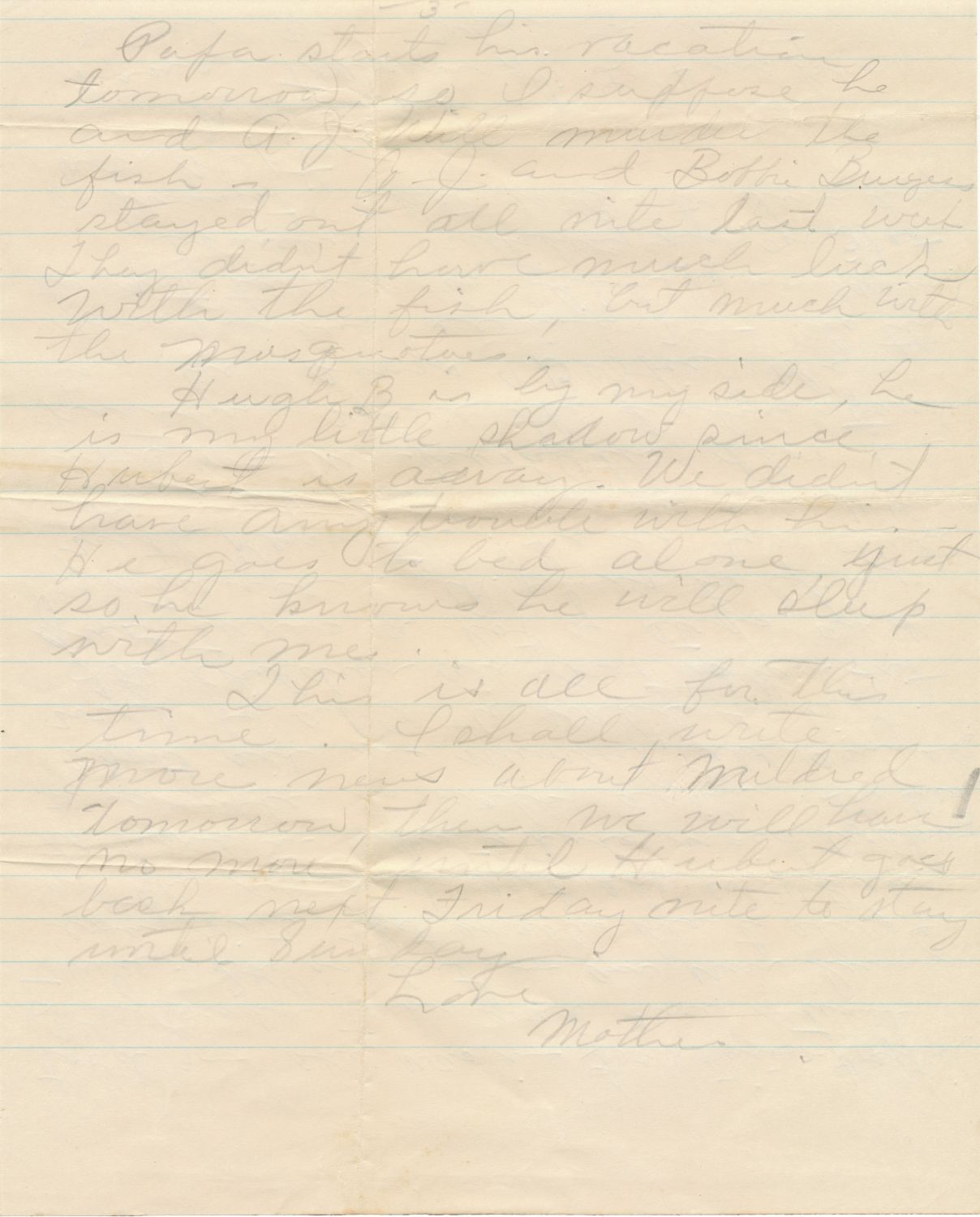
Page 3 of letter

So Mee Maw and other family members were helping out with their children.  After The First, Hubert and Mildred also had three sons by 1952.  She mentions Kenneth first, saying he is “too cute and says almost anything.”  But more importantly to my dad, little Kenneth would say “Bobbie” when he saw the fishing tackle.  My dad and grandfather liked to fish a lot back then.  Pee Paw was going to have vacation soon and he was going to spend time with A. J. “murdering” the fish.  She mentions that Shirley’s birthday is at the end of the month and we shouldn’t forget it.  Thanks for the reminder, Mee Maw!  She also talks about how Hugh B. is her “little shadow.”  I don’t think she was taking care of Dennis.  He was a newborn at the time.

That August was an eventful time in the life of the family.  Mildred would recover, but her legs would remain weakened by the polio.  She would either walk with assistance from Hubert or use a walker.  My mom was always impressed with the devotion that Hubert had for Mildred.  He would work tirelessly to help her exercise and keep her legs stretched so that she would have the most mobility possible.

My dad would continue with his training, though I’m sure at times he wished he could be with his family.  We know that he was looking forward to getting married later in the year.  He and my mom wrote sweet letters to each other during that time.  It’s nice to have these old letters to give a glimpse into what was going on all those years ago.  I’m glad they saved a few of them.

A Patureau Keepsake: The Bed From France

The Patureau family bed has a new home.

I decided to include this post in my Keepsake series, but it is really much, much more than that.  It is the amazing Patureau heirloom that I have hinted at in a few of my previous posts.  It has a long and much-traveled history in my family.  Not that I was aware of any of that history until rather recently.  And I never would have dreamed that I would come to be in possession of such an heirloom. 

There is so much to say about the whole experience of finding out about the bed, being offered the bed, and getting the bed in working order.  And it was definitely not an altogether pleasant experience.  It’s a good thing it has such a powerful story behind it, because I wouldn’t want to go through everything I went through for just any old bed.

And old it is.  This is the bed that Pierre Patureau and Rose Machet brought with them from Riberac, France, when they moved their family to Louisiana in September of 1840.  How is that for pedigree?  It is a bed that my great great great grandparents brought to the United States when they immigrated.  It must have been a treasured item for them to haul this with them across the Atlantic Ocean. 

So when Pierre died on April 21, 1860, at around 1 o’clock a.m., it is likely that he was lying in this bed when he died.  We don’t know that for sure.  I haven’t found any story about that.  But there is some lore that has followed the bed through the years.  It is said that his son Ferdinand died in the bed in 1877 after he had been injured in an accident in his sawmill.  Ferdinand’s widow Emma Landry Patureau died in 1892 in Plaquemine and it is possible that she died in the bed as well.  I’m thinking that at that point the bed was passed down to Ferdinand and Emma’s youngest daughter Victorine Patureau Cropper.  As I have shared with you recently, she had collected a large amount of Patureau photos and other memorabilia.  She and her husband Willie Cropper moved to the Beaumont, Texas, area around 1903 and the bed must have gone there along with them.  It stayed with that family line for the next 100 years or so.

Victorine had an older brother named Max.  He had married Marie Therese Landry in 1888 and by 1903 they had a somewhat large family.  I don’t know if their daughter Erie Patureau knew about that family bed all those years ago when it left her hometown and made its way to Texas.  She grew up and married a Landry of her own – Robert Joseph Landry.  Their third son was known as Bob Landry.  He grew up and did not marry a Landry or a Patureau – he married outside the family!  Their third son was born in 1960.  That would be me, and I was not aware of that bed for most of my life.

But then I heard a hint of it at some time before 2018.  I’m not sure what I heard or who I heard it from, but I was intrigued to see if I could find out more.  In April of 2018 I had a new DNA match at Ancestry.  Her name was Jo Ann and she had a Cropper from Beaumont in her family tree.  I knew immediately that it was a Patureau connection.  I sent her a note saying that I knew who she was and I hoped we could share family information.  The only photo I had (and still have) of Victorine Patureau is an old Xerox copy of a photo.  I was hoping to possibly get a better copy of that photo.  I told her I was willing to share any information or copies of any photo that I have.  I always ask this because you never know who has what out there.  I assumed that I would have more family information and/or memorabilia than she had.  In most cases I would be right.  In this case I was thoroughly and completely wrong.  Wrong, wrong, wrong. 

She wrote back quickly and one of the first things she mentioned was that she had the old Patureau family bed that came from France and Ferdinand had died in.  I was excited to hear about that and wrote to her, “Sometimes my blog post is about keepsakes in the different family lines.  That one would be really amazing.”  So I asked her for a photo of the bed.  That’s all I asked for.  I wanted to write this story about an old Patureau family bed that was still in the family.  She has shared a lot of great old family photos with me since then.  I have shared some of those on different blogs and still have a few more photos to share.  Some of my best photos have come from her.  But she did not send me a photo of the bed … until later.

Fast forward to October 28, 2021.  That week I had been caught in the middle of a discussion between Patureau family members about the Patureau tomb in Plaquemine.  It was getting worked on and some people were not happy with the progress or the steps that were being taken.  From what I saw, they were all coming from a place of concern for the final resting place of their Patureau kin.  So I wrote a post that night called “Passionate for Patureau” and talked about the many people through the years who had an interest in Patureau family history.

The very next day Jo Ann wrote to me and offered the bed to me.  She said that she didn’t have room for it and no one in her family wanted it.  She wanted to keep it in the family and could tell that I was interested in family history.  She told me that the bed posts were 8 feet tall each.  She didn’t have a mattress, but the bed was not quite full size.  We live in an old house with tall ceilings, so we thought it would work.  We agreed to take the bed sight unseen.   I asked her again about the photo of the bed, and this time she was able to find it and send it to me.  I thought it was very impressive looking.  Come to find out, the bed was in storage in Hammond, which is not that far away.

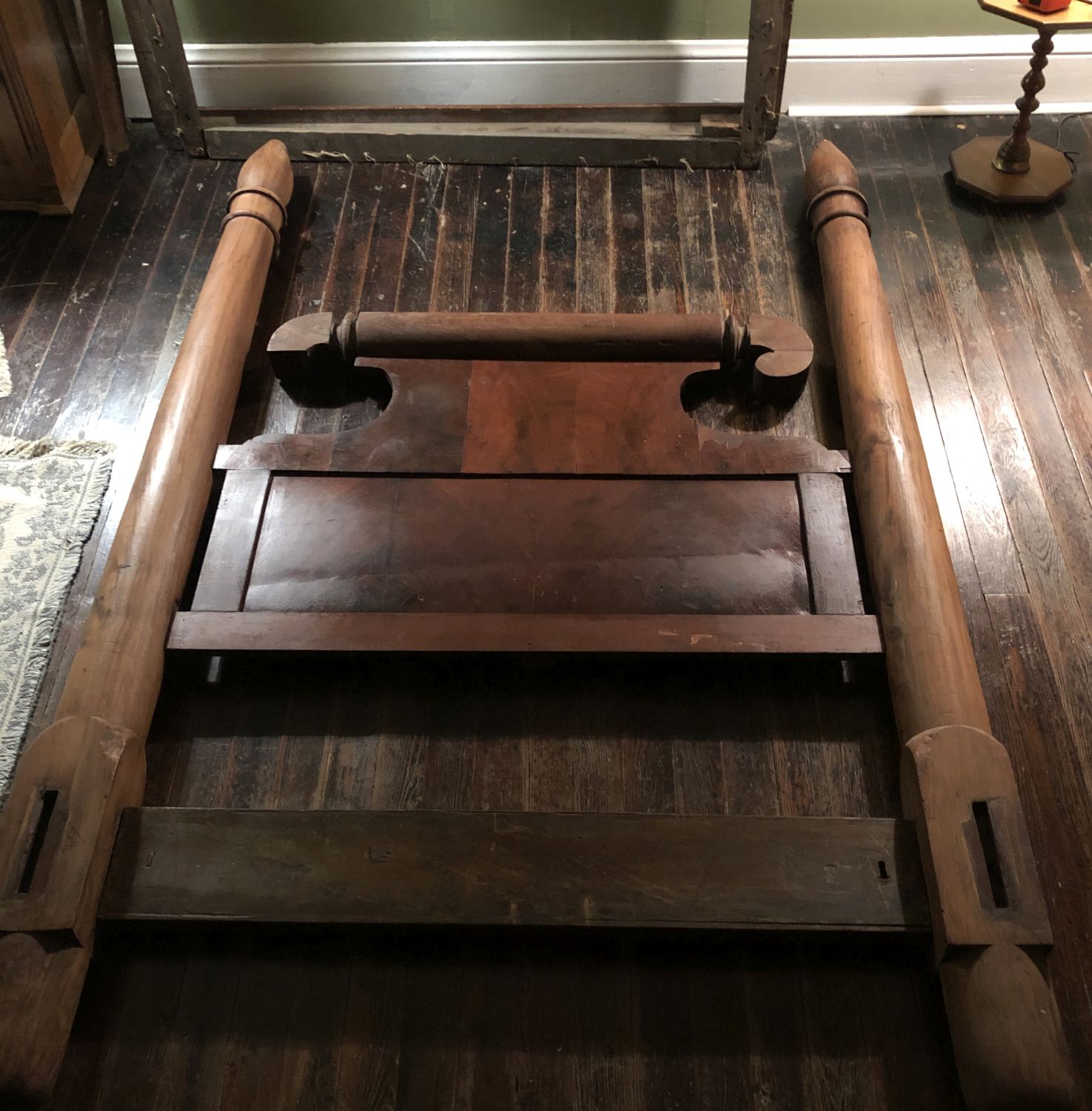
The bed when we first got it to the house. It was missing the pieces to hold it together. It needed some TLC.

So we decided to go get the bed.  We found out that the family members who had the bed were not feeling well so they could possibly have Covid.  That wasn’t going to stop us.  We went to get the bed the day after Christmas.  We also got Covid.  At first I thought it was slowing me down from putting the bed together, but it was a minor delay in what turned into a drawn out effort.

The bed is held together with threaded rods that pass through the bed posts and into the rails that have a connector set into the wood.  The threaded bolts did not come with the bed parts.  Also the top part of the headboard is a separate piece that is called a mattress roller.  It is the rounded piece sitting atop the flat veneered part.  You can see in this photo that part of the scroll is missing on the left side of the mattress roller.  Jo Ann found that piece and sent it to me.  I glued it back together.

I also went to a specialty hardware store and had some bolts cut to size for joining the bed together.  When I tested the different sized bolts to see what size fits, I shouldn’t have been surprised that the size that fit was a metric size M10.  It’s a European sizing system.  That agreed with the story of it coming from France.

After working on getting some of the bed pieced together, we had a Patureau cousin come over to try to get it all put together finally.  Thanks, Byron!  That was toward the end of February.  After scratching a few walls, breaking the fireplace mantel in the room, and almost getting crushed by the massive bedposts, we got the bed put together.  But it was not stable whatsoever.  One of the main problems was that the side rails were warped, so the posts did not stand up straight.  I had noticed that when I had the posts laying on the ground.  Plus some of the connectors would not take the threaded rods and hold together firmly.  It was an accident waiting to happen.  We didn’t want to stand near it, much less try to put a mattress on it. 

So we got professional help.  Mr. L. came and got the bed and brought it to his shop.  All I wanted done was to get the bed stabilized and ready to put a mattress on it.  He pointed out how the side rails were warped and the connectors were stripped.  He said that he’d have to replace them.  He would use new wood on the side rails, but cap it with the old wood that was there previously.  I agreed, because I wanted the bed to be sturdy.  He had asked if I wanted to repair the dings and rough spots on the bed and I said, “No.  I want it to look the same.  It’s an old bed.” 

After a while we got some progress pictures and I was not too happy to see a photo with posts that were sanded and later stained.  Not too happy at all.  But it was already done and the bed was still the bed that my family had brought from France all of those years ago.  Mr. L. said that the bed had probably been a rope bed, which was before box springs came into use.  He estimated the bed to be from around 1800.  So it probably has been in the Patureau family for almost 222 years.  He did a great job of stabilizing the bed and it looks really good.  It is not the way I had wanted it to look, but I can’t always get things my way.  Other people have said it looks so much better.  It is a beautiful bed.

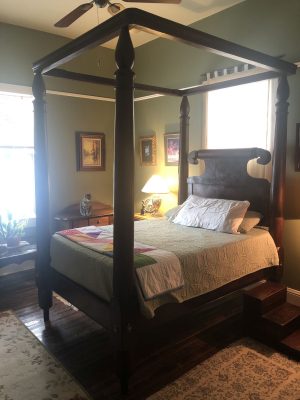
We finally got it back to our house on July 20.  I’m still amazed by the bed.  We measured the bed and had a custom mattress made.  So much for it being a free bed!  While waiting for the mattress, we put a mattress topper on the bed.  I fell asleep on it for a short nap that day.  Last weekend the mattress came in and we were finally able to get the bed made up and ready for guests.  What a piece of history.

And to think:  all I really wanted was to have a photo of the thing!

Another view of the bed.

Pee Paw Was in World War I

Robert Joseph “Rob” Landry, Sr. at Camp Humphreys in Virginia in 1918.

I’ve shared several photos of my paternal grandfather before.  I haven’t shared this one before and that kind of surprises me.  When I think of old photos of my grandfather during World War I, this is the first photo I think of.  Not because it is the best photo of him from that time period, but because it was the one that I was most familiar with when I was a kid.

My dad had this in his collection of old photos.  So when I put together a family photo album when I was in junior high school, this photo was one of the first ones to go into it.  My dad’s father was named Robert Joseph Landry when he was born on January 9, 1893.  His parents were Alcide Landry and Marie Celeste Leveque. 

We’ve looked at the Landry household during the 1900 Census.  That year, Rob was the youngest member of the household at 7 years old.  It also included his parents and his five older siblings – Elie, Seb, Joe, Louie, and Marie Therese.  There was an older sister named Lily that was born in 1870, but she had died in 1889.  That was before Rob was born, so he didn’t know her.  In a sad twist of fate, his sister Marie Therese also died at about the same age in 1909.  She was closest to Pee Paw in age, so he would have been close to her.  He later named his first daughter after her.  Actually, Mee Maw’s mother was Pee Paw’s first cousin and her name was also Marie Therese Landry.  She also died in 1909, so Aunt Marie was probably named for both of them.

But before all of that came to pass, Rob Landry grew up in the Landry household with four older brothers.  I don’t know if any of his brothers were in the military, but his father Alcide had been in the Civil War along with his brother Trasimond.  And even though Rob was interested in baseball and was pretty involved in the sport, he registered for the military on June 5, 1917.  He was stationed at Camp Lee in Virginia according to some of the photos I’ve seen.  I know that he ended up having some hearing loss because of the training with munitions.  I also know that he was at Camp Humphreys in August of 1918.  The war ended not long after that, but I don’t know if Pee Paw was let go because of the loss of hearing or if it was because of the war being over.

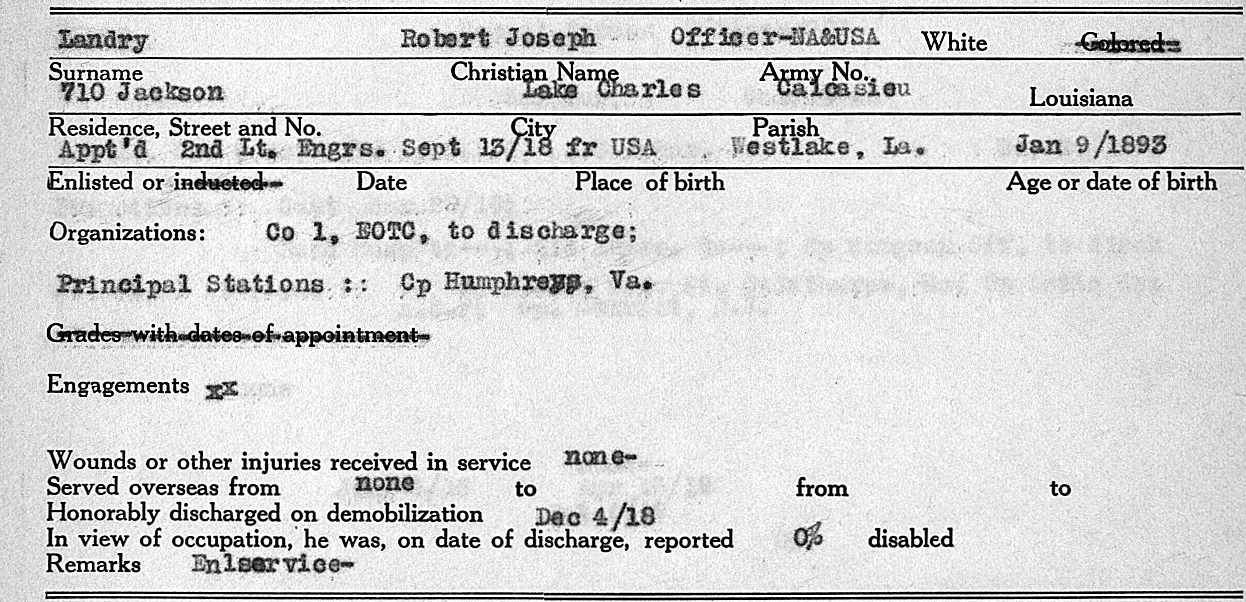
Discharge information from 1918.

Oh, look, I found the discharge papers.  There is no mention of any disability, though I know I’ve heard that he had hearing loss as a result of military training.  It also says that he was at Camp Humphreys  in Virginia.  Camp Lee was another camp in Virginia during the Great War, and he may have been at both of them.  I’ve also seen a date of 1919 on some of the photos, but from this document that seems unlikely.  It says that he was discharged in December of 1918.

There’s one more thing.  Have you been able to figure out which one of the soldiers was my Pee Paw?  I probably should have told you from the beginning.  He is the soldier standing on the front row on the far right.  If you don’t know your left from your right, he’s the guy in the front with a smile on his face.