Erie Get Your Gun

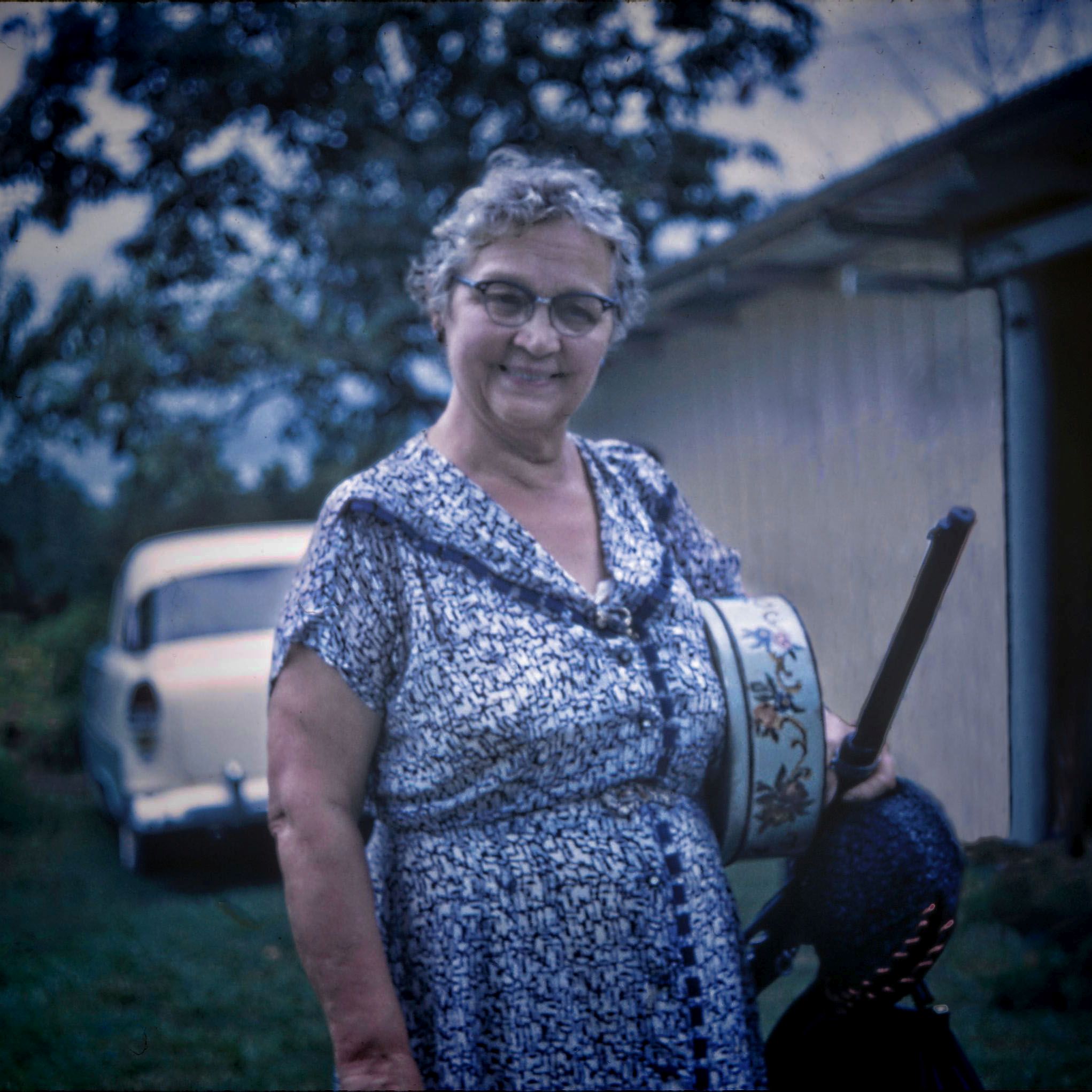
Erie’s got her gun and is ready to take on the world. This was taken around 1963 in Lafayette, Louisiana, at a picnic hosted by her cousin Wana C. Landry’s home.

I don’t know why these last few Landry/Patureau posts are featuring guns.  I have two posts named Grandfathers With Guns, so I thought I would try to give a more balanced view.  Besides, I had this great photo of Mee Maw that I’ve been wanting to post for a while.  So my desire to present a more balanced view finally motivated me enough to edit this photo in the way I wanted to.

Because you know Mee Maw, she didn’t go anywhere without her fruitcake tin and gun!  Well maybe you don’t know Mee Maw.  She was born Germaine Erie Patureau on August 6, 1895, in Crescent, Louisiana.  You could actually say that the family lived in Plaquemine.  They lived right on the corner of the Bayou Road and Patureau Lane.  That’s right!  They lived on the road that they named for themselves.

She was a child at the turn of the century (not the Millennial century, the one before that!) and it was a very rural area.  They usually had to entertain themselves with reading books, eating food, playing cards, or playing music.  (I will be posting some musical stories soon.)  But sometimes, if they were lucky, the showboat would stop in their area and put on a show for them.  There was an area not far from their home that would be used as a stage for the actors who traveled on the boat.  This sounds very charming, even though it reminds me of the musical “Show Boat.”

I have to admit that I am not particularly fond of most musicals.  Even though my family was very musical and sometimes we would break into song during a conversation, I always hated to see that in a movie.  And when I think about “Show Boat” I cringe.  But I try to look past that when I think of Mee Maw and her family enjoying the performances of the people from the showboat.  (Let’s just hope they weren’t musicals!)

So why is it that I referenced another musical (“Annie Get Your Gun”) when I named this post?  Yet something else to get past.  I guess for the same reason I named two posts “Grandpa’s Got a Gun,” I think that it has a ring to it.  So let’s get back to Erie and her love for guns.

Sorry, I don’t know if Mee Maw had a love for guns or not.  It’s not something I can ever remember talking to her about.  I’m surprised that I have a picture of her holding a gun. (She was really holding a gun in the photo.  I only edited it to make her more noticeable and to make the background less noticeable.)  We always talk about Mee Maw being so sweet, so I thought I would post this picture showing her tougher side.

Oh well, even when she’s holding a gun she looks sweet.  That’s Mee Maw.

Great Grandpa Lou

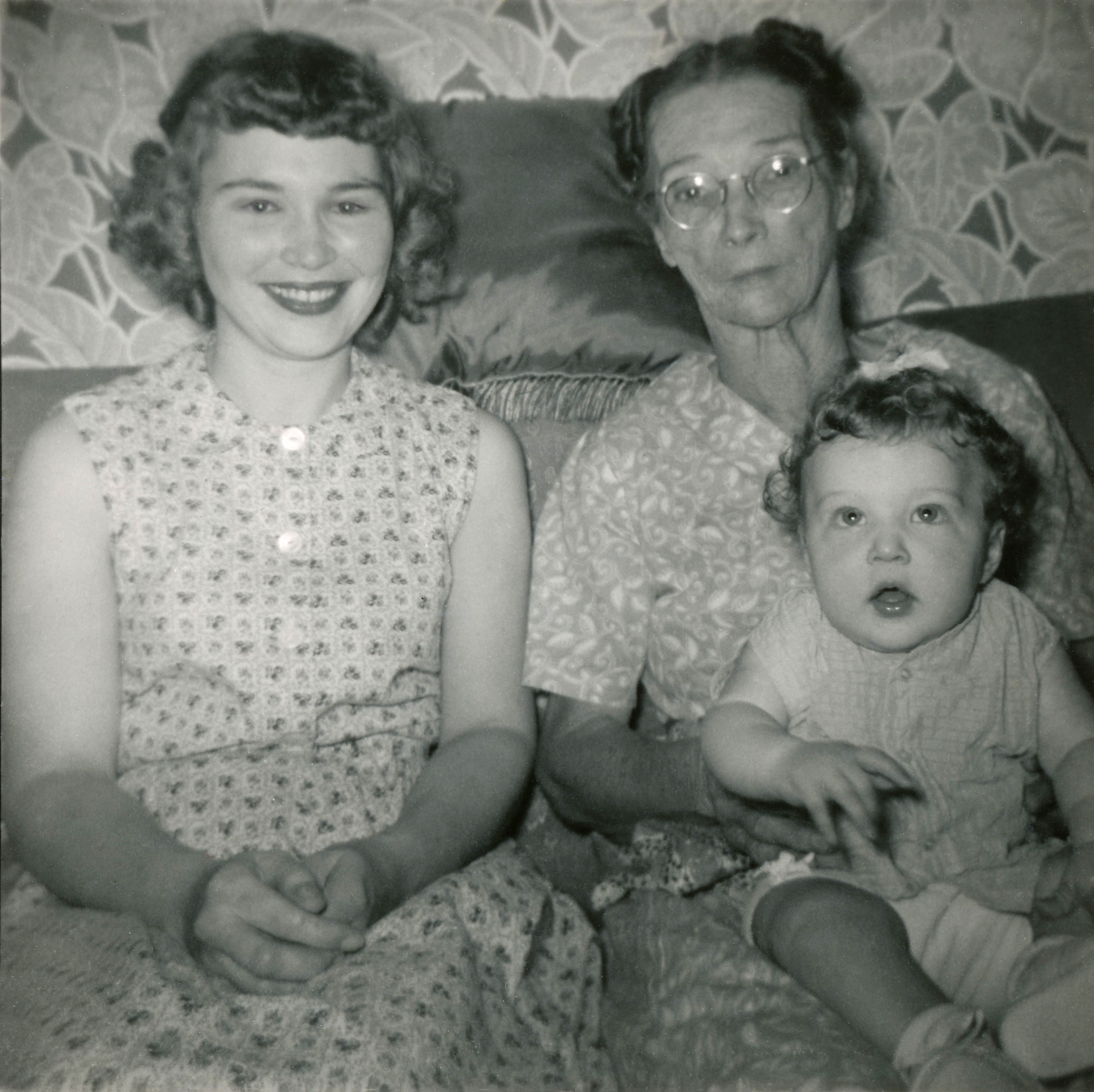
Great grandmother and great granddaughter.

Addie Hine Bucklin with great grandchild number five Jodie Lou Landry in 1954.

This photo makes me smile.  It almost makes me laugh out loud.  The photo causes me to smirk with a soft chuckle.  It’s cute.  It’s sweet.  But it’s a little blurry.  I cleaned it up a bit, but I can’t make it clear.  There’s only so much you can do in photo editing.

I still like it quite a bit.  That’s kind of obvious since I’m using it for this week’s post.  The little girl in the photo is my oldest sister Jodie.  She was born on October 14, 1953, at Edwards Air Force Base in California.  She died on November 5, 1989 in Franklin, Texas.  Way too young.

Our mom was Betty Lou Bucklin Landry, who was the daughter of Fred Bucklin.  Fred’s mother was Addie Hine Bucklin, the other subject in this photo.  So she was the great grandmother of little Jodie in this photo.  And yet there is another person in the photo.

The other person in the photo is shown in a photo on the wall above the other two.  It’s a photo from 1905 of Addie when she was young married woman and her husband Louis Charles Bucklin, sometimes known as Lou.  In recent letters I’ve seen he was called that in 1893 by his peers.  And even though he died in 1927, he was still influencing my family much later on.

One of those influences was in 1933 when my mom was born.  There was talk of naming her Addie Lou in honor of both of Fred’s parents.  Addie was adamantly against that.  She did not want that cute little granddaughter of hers saddled with such an old fashioned name as Addie.  So mom was named Betty Lou and I have to say that the name really suited her.

Then when Jodie was born in 1953, her middle name was Lou as well.  So shortly after this photo was taken, Jodie would have started to talk a bit.  I’m not sure of the time frame.  But when she was learning what to call herself and her parents, she got a bit mixed up.  But in a good way.  She knew that she was Jodie Lou.  She knew that mom was Betty Lou.  I suppose that sometimes she was Mama Lou, because when she learned to call daddy “Pappy” she naturally ended up calling him Pappy Lou.

I’ve heard the Pappy Lou story all of my life, and I always thought it was a sweet story.  So when I found this negative and scanned it earlier this week, it reminded me of that story so much.  I don’t remember ever seeing the photo before.  And like I said at first, it’s cute.  It’s sweet.  And it’s appropriate that great grandpa Lou shows up in the photo.


Here is another photo from the same visit.

Three generations

Betty Lou Bucklin Landry, Addie Hine Bucklin, and Jodie Lou Landry in 1954.

Grampa’s Got a Gun – Pee Paw and the Big One

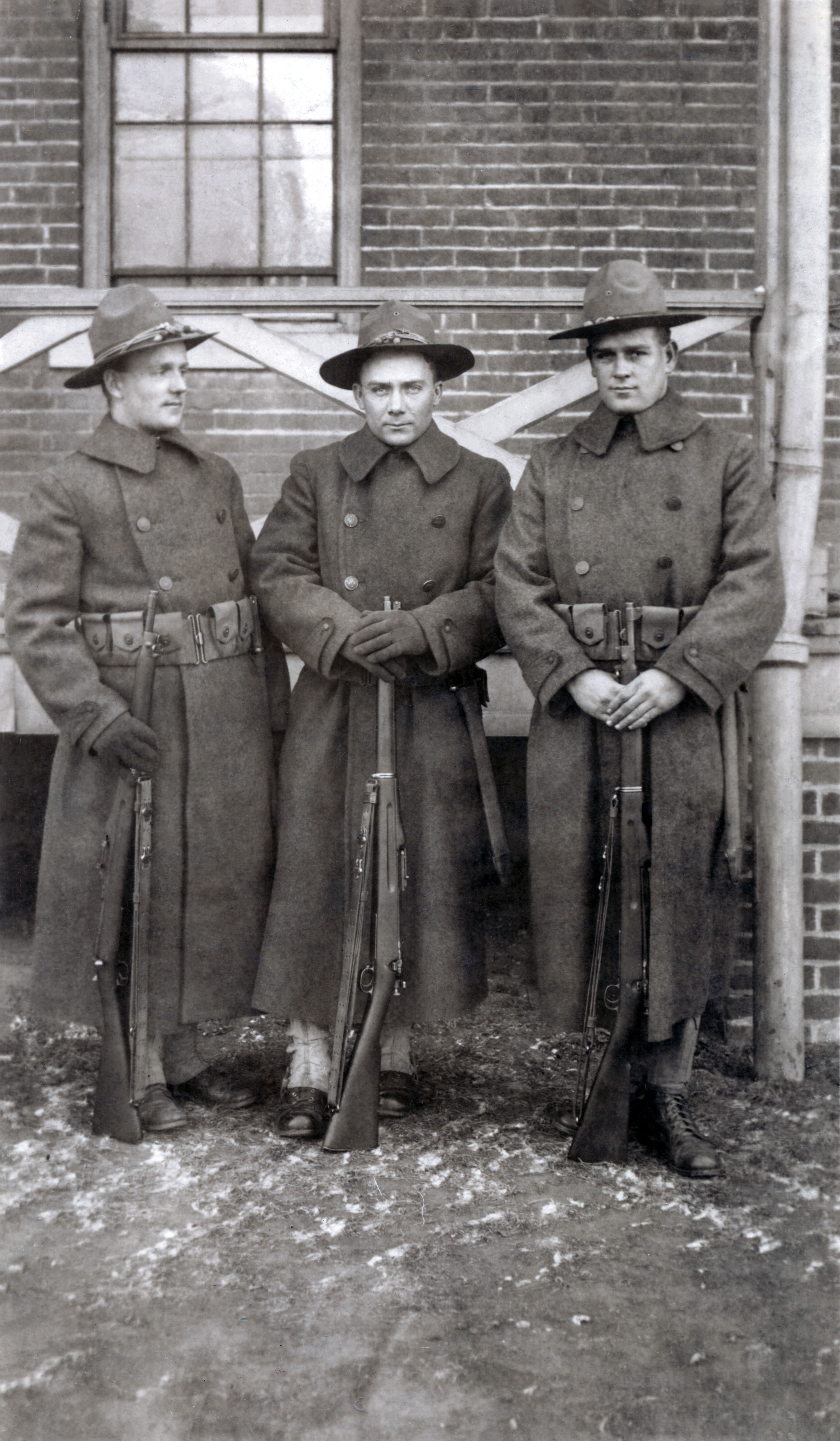
There is something about that title “Grampa’s Got a Gun” that has a ring to it.  I’m not sure what it is.  Maybe it’s just the alliteration.  I like the photo as well.  I’ve posted other photos of my paternal grandfather Robert Joseph Landry, Sr. in World War I – aka Pee Paw in the Big One – and this is the first one that shows him with a gun.  It is from the A. J. Collection, which means that I got it from my uncle AJ earlier this year.

Pee Paw in World War I

My grandfather Robert Joseph Landry, Sr. is the tall one on the right in the photo. It was taken at Camp Lee in Virginia.

It’s such a good photo, too.  So clear and in focus that you can see that Pee Paw is the only one that is not wearing gloves.  Did the southern boy not know how to dress for cold weather or did he just not like wearing gloves?

It was taken at Camp Lee in Virginia which is near Petersburg, Virginia.  This was a training site for soldiers during World War I.  I’m saying that it was at Camp Lee because that is what was written on the photo.  The photo also had a date of 1919 on it.  This does not match with the 1917 date I had on other photos of Pee Paw at this camp.  One of these days I will get incontrovertible proof of when he was stationed at Camp Lee.  In the meantime let’s just say it was sometime around 1918.

And everybody knows what happened in 1918, right?  There was a worldwide influenza epidemic.  In looking for information for this post, I saw that during that epidemic 10,000 soldiers were stricken by the flu, and 700 of those died as a result.  So some of these men went to train to fight in a huge international conflict but ended up dying before they completed training because they caught a flu virus.  Known as “The Spanish Flu” and “La Grippe” this version of the flu killed more soldiers than were killed through warfare.

So Pee Paw made it through the Great War.  He did not see action, but he was faced with the greatest killer at that time.  He survived that microscopic enemy, and that gun didn’t help him a single bit.

I still like the title, though.

Dressmaking with Paints and Pixels

My great great grandmother Martha Ann Cook was a dressmaker who studied her art in Paris, France.  She had completed a two year apprenticeship presumably in Walthamstow, England, prior to going to Paris in 1860 to study.  Her sister Henrietta was three years younger than Martha and was not put to a business because she was thought “too delicate.” Being delicate was never a term I’ve heard describing my great great grandmother.

After completing her studies in Paris, she opened up her own dressmaking business in England.  She designed and made clothes for small children and sold ribbons and dress accessories.  Her business was successful and she was able to hire other women to work in her shop, which continued even after she was married and having children.  She would also travel to Paris every year to see the latest styles. It appears that she put a lot of thought and effort into her whole business endeavor.

Which would make me think that she would have been concerned with the look of her own dresses and wardrobe choices.  And this would be particularly true when she decided to sit for a portrait.  The portrait that I’m talking about is today’s photo.  When I first saw it, I thought it might be a photo.  It was a Xerox copy of a photo that was in the book “Cook-Keys Family: Two Centuries in England and America” by Edith Keys Segraves.  I’ve posted that old version before, but I just recently obtained a much better version.

Martha Ann Cook Keys

Portrait of Martha Ann Cook Keys in England circa 1865

Edith Segraves’ daughter Carolyn let me scan the best version of the photo.  I could tell from this version that it was actually a photo of an old painting.  I decided to clean it up to get it looking as best I could.  Nothing but the best for old Martha!  One of the first things I noticed was that painting hands was not the artist’s strong point.  The fact that the painting showed two hands is telling.  The old phrase “cost you an arm and a leg” was in reference to having your portrait painted (or so I’ve heard).  Supposedly the extra limbs were quite pricey.  So to have both hands in the portrait was a sign of prosperity.

It could also be Martha’s desire to show off her dress properly.  How can you show the true design of a dress without arms and hands showing?  Whatever the case, those pricey hands didn’t quite look right.  So I changed them!  That’s right.  She’s got brand new hands after well over one hundred years.  So the pixilized hands are not authentic, but I’m sure they look closer to the real thing than what was there previously.

I also cleaned up her face a little.  There were scratches across them that had to be removed.  I was careful to make sure I didn’t change the way she looked.  Then I came to her dress.  Some of it had been damaged and it wasn’t complete because it had been a circular painting.  I cloned parts of the painting with paint parts and pixels.  It ended up looking like a dress-shaped blob on the drawing.  I knew that Martha would not approve of that.  She was all about dresses!

So I did a search online for French dresses from the 1860s and came across something that might help the photo out.  It was a black mourning dress that somewhat matched what Martha was wearing.  I used that image to give the dress a bit of shading and texture.  With some helpful input from Carolyn, I think I came up with something that Martha would approve.  French fashion with paints and pixels.