I wasn’t sure what I was going to write about today, but then I saw a photo of my cousin Julie Phenice Campbell at Ford’s Theatre in Washington, DC. I made a few comments and then realized that I hadn’t gone into the details of my great great grandfather’s Civil War experience. So I’ve decided that the time is now. Plus I have a really cool photo of him that I obtained this year.

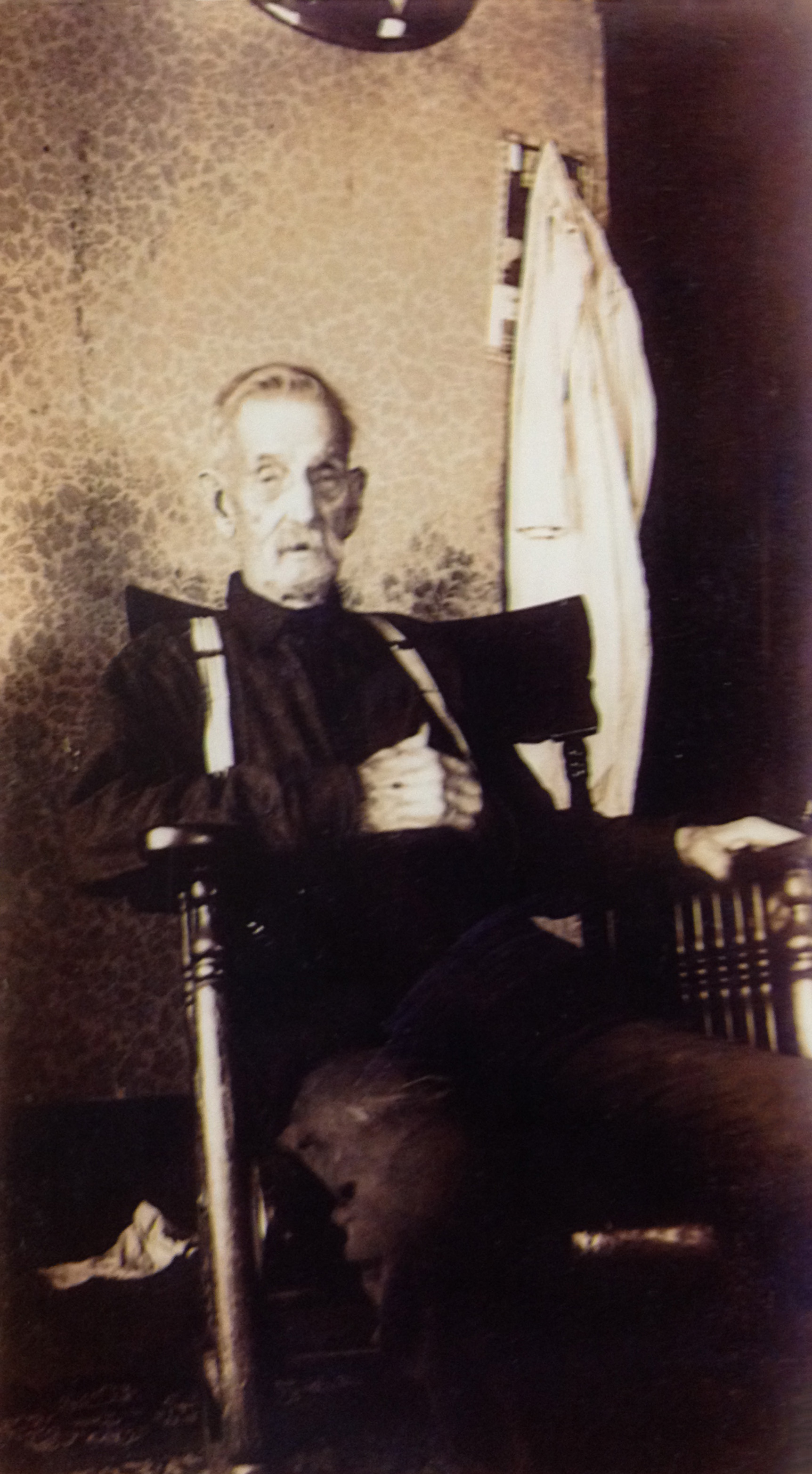
Samuel Charles Phenice in his elder years.
Isn’t this a cool photo of an old grizzled man? This is Samuel Charles Phenice later in his life. (He was the father of Harry Clifton Phenice, who was the father of Myrtle Phenice Bucklin, who was the mother of Betty Lou Bucklin Landry, who was my mother.) He lived to the ripe old age of 95. Any time I hear the question, “If you could visit one of your ancestors to have a conversation with them, who would it be?” I always think of the man in this photo. So many questions that I would like to have answers to. So much wishful thinking. Let me tell you what I do know.
Samuel Charles Phenice was born in Mercer County, Pennsylvania, on April 19, 1844. He was the fourth of seven children to Daniel Phenice and Susan Jackson Phenice. The family must have stayed in that area during his childhood, because when he enrolled to fight in the Civil War, he would become part of the 57th regiment of the Pennsylvania Infantry out of Mercer County. He was a private in Company F.
According to a document I found, the 57th regiment went on furlough on Jan. 8, 1864, for a period of 49 days. When the soldiers returned to camp, there were a large number of new recruits. Among those recruits was Samuel Charles Phenice, who had enlisted on Feb. 12, 1864. During March they became part of the 2nd Brigade, which was composed of units from Pennsylvania, New York, and Maine. In April Samuel celebrated his 20th birthday, though he was quoted as saying that he suffered “many hardships, hunger and thirst.” Maybe a not-so-happy birthday.
On May the 3rd of that year, Samuel and his fellow soldiers marched to Chancellorsville, Virginia. This is close to Spotsylvania and there were many skirmishes going on in the area. The 57th, along with other Union troops, advanced along country roads and woods. In one particularly wooded area on the morning of May 5th, Confederate forces were encountered and frenzied fighting took place. The fighting was at short range (when you could see your enemies behind the trees) and was vicious, yet brief. There were twenty-two killed, one hundred twenty-eight injured, and three missing.
Among those injured at the “Battle of the Wilderness” was 20-year-old Samuel Phenice. He was shot in the left thigh – more specifically the “inner aspect of the thigh and about the middle of the thigh.” Part of the information about the wound was gotten from a medical report from 1915 that reports that complications of varicosity of his leg was a direct result from the wounds received during the War.

Civil War hospital in the Spotsylvania, Virginia, area after the Battle of the Wilderness in 1864. (I found this photo online.)
After he was wounded, Samuel spent a while recuperating. He went to a place that was probably very similar to what you see in this photo. It is a photo of a makeshift infirmary in the Spotsylvania area after the Battle of the Wilderness. I don’t recognize Samuel in the photo, but there is no way to make out some of these people. On May 24, 1864, he was a patient at Carver General Hospital in Washington, DC. A week later he was transferred to Haddington in West Philadelphia.
Once he recovered well enough, he became part of the “Invalid Corps” (9th Regiment of the Veterans Reserve Corps) on October 8, 1864. The only posting that I know of was the one on April 14, 1865, at Ford’s Theatre in Washington, DC. And everybody recognizes that place and date. Samuel was stationed at the front of the theater checking passes of military personnel. According to one account Samuel was an eyewitness to John Wilkes Booth’s entering the presidential box and shooting President Abraham Lincoln. He also was a witness to the flight of the assassin. So my great great grandfather was present at one of the defining moments in American history.
Samuel was honorably discharged from the military on July 5, 1865. Though he would get married and raise a family, he would never forget those vivid events that he experienced as a 20-year-old young man. He obviously liked to recall the events, because there are several articles about him speaking about it. One says “Phenice often recalled the wild scenes in the theater after the shooting.”
Oh, to be able to hear those stories in his voice. Like I said at the start of this story, I would love to be able to pull up to Great Great Grandpa Samuel’s rocking chair and say, “Grandpa, tell me ’bout the good ol’ days.” My excitement would build as he’d rock back with a grin on his face and say, “Well, now, young man, that may take me a while…”
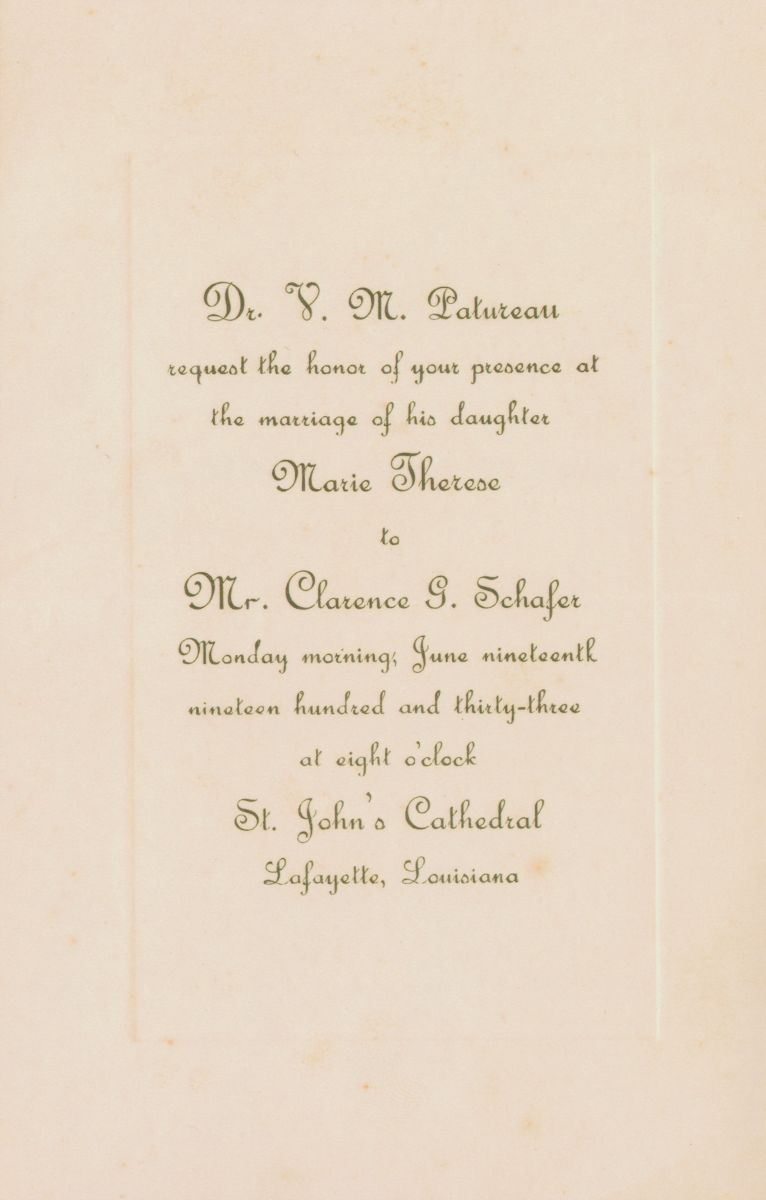
 This photo is from the wedding of Marie Therese “Bee” Patureau and Clarence Schafer on June 19, 1933. It looks like a very nice affair. The wedding took place at St. John’s Cathedral in Lafayette, Louisiana. Bee was the younger sister to my Mee Maw (Germaine Erie Patureau was the mother of Bob Landry, my father), who I can’t find in this photo. I know that she was there, because there is another photo of the event that supposedly shows her. (It doesn’t look like her to me.) Erie and Bee’s father was Grampa Max (Vincent Maximilian Patureau) who is standing proudly in the middle of his large family.