From Acadian to Cajun: Part 9 – Dupuis/Dugas

The Wall of Names of Acadian Exiles in Louisiana in St. Martinville. Joseph Dupuis (2) is my 5X great grandfather. Listed under him are four of his nieces and nephews.

These installments can be pretty tricky to write.  I want to be as accurate as possible, but that is really difficult to do when there is conflicting information out there.  Human memory is very much influenced by belief and the passage of time.  The Grand Derangement happened 265 years ago in another country where a different language was spoken.  A lot of turmoil was going on when it happened.  When the people eventually settled in a place to call home, they just wanted to get their lives together.

What has survived are a few old church documents and some Censuses before and during the Exile.  One of the treasured items from back then are the Declarations of  the Acadians at Belle-Ile-en-Mer in France.  The Acadian Exiles in this area were interviewed and asked to tell about their family histories.  Many of the people were able to give information about their families back to the time of the founders of Acadie in the 1600s.  Of course most of this was based on human memory, so some errors were present in their statements

The Declaration that I was most interested in was that of Marie Josephe Dupuis on February 27, 1767, at the Village of Parlavant.  I don’t descend from her, but I do descend from her younger brother Joseph Dupuis.  He is the main person I’m writing about in this installment.  Marie Josephe was the oldest of eleven children of Antoine Dupuis and Marie Josephe Dugas.  Antoine and Marie Josephe were married around 1719 in Riviere au Canards, Acadie.  Their first child (Marie Josephe) was born in 1721.

Like I said, she was the oldest of eleven children.  They were born over a period of 20-25 years.  That included two sets of twins.  Joseph and his twin brother were one of those sets.  According to their older sister, they were born in 1745.  Their parents Antoine and Marie Josephe died around 1747.  It looks like some of the older children were caring for the younger ones after that time.  Some of them were adults with children of their own.  So when the Grand Derangement happened in 1755, the family was split up even more.

So when Marie Josephe Dupuis (Theriot) made her declaration in 1767, she hadn’t seen some of her siblings for almost twelve years.  Sadly, some of them had passed away.  From what I can tell, six of her siblings had died since their Exile from Acadie, yet she was only aware of one of those deaths.  Marie Josephe and a younger sister named Ozite (and their husbands and children) were originally Exiled to Virginia in 1755.  Like other Exiles sent to Virginia, they were deported the following year to Falmouth, England, where they were treated with neglect.  Many Acadian Exiles died in 1756 from the smallpox, including sister Ozite, Marie’s husband Pierre Theriot, and several other Theriot family members. 

Evidently all that Marie Josephe knew about her other siblings is that they had been “transported to New York.”  There was another sibling (Anne Marie – the twin of Ozite) that “passed with their family to the Mississippi” and was never heard from again.  According to other sources, she died before 1767.  So that would mean that eight siblings were “transported to New York.”  Yet all other sources say that Joseph’s twin brother Jean Baptiste was Exiled with Marie Josephe and Ozite and he ended up in France as well.  Yet Marie Josephe clearly states that Joseph and Jean Baptiste were “transported single” to New York.  If he was with her in France, she would surely know about it.  She may have overlooked Jean Baptiste when talking about the twins.

So that leaves seven siblings that were transported to New York:  Joseph, Magdeliene, Antoine, Simon Pierre, Marguerite, Euphrosine, and Charles.  But they didn’t actually go to New York.  They went to Connecticut.  See how difficult it is to figure out what happened back then?  Even the ones that were living back then didn’t know what was happening.  Of course if those in charge didn’t care if the Acadians lived or died, they certainly weren’t concerned if they knew what was going on with their families.  You can only tell the truth if you know the truth.  So we can forgive Marie Josephe for any errors in her Declaration.  She went through a very traumatic time and she meant well.

So let’s see what happened to Joseph and his siblings (and their families) that were sent to Connecticut.  It looks like at least seven ships left the shore of Acadie with over 1000 individuals who were forcibly removed from their homeland.  They left sometime in late 1755 and arrived during the month of January 1756.  I haven’t seen information about where they stayed or even if they were all in the same place.  What I have found is that his sister Magdeliene died in Connecticut in 1762.  There is no more information on his other older sister Marguerite, so I’m thinking she probably died between 1756 and 1762.  His younger brother Charles survived and somehow he and some of their sisters’ children made it back up north and settled in Quebec.  So that left Joseph with Antoine, Simon Pierre, and Euphrosine.

Toward the end of the Seven Year War (in 1763) French officials were encouraging Exiles to relocate from English colonies to French-owned Sainte Dominque (now Haiti).  There they would be used as laborers on a naval base on the island with the incentive that the Exiles would be given land grants.  Joseph and his other three siblings joined a group of 180 Acadians from New England ports who headed to St. Domingue in August 1764.  It was not the best situation.  The officials sent them to Mirebalais (near Port au Prince) and did not give them the land that was promised.  The Acadians did not fare well and many of them died from malnutrition and tropical diseases.

Joseph had not married yet, nor did he have any children, so we know he survived.  How else would he become my ancestor?  But his siblings were not as fortunate.  Simon Pierre and his two older sons Francois and Firmes died within a month or two of arriving in their tropical environs. (His wife had died in 1760 in Connecticut.)  On January 4, 1765, his younger sister Euphrosine passed away at Mirebalais.  She had become a new, young mother the previous year, but her son had died a month before she did.  Then in August his oldest brother Antoine died as well.  Antoine’s wife and three of his seven children had died in September and October of 1764 in Mirebalais as well.

And then there was Joseph.  When I saw his name on the Wall in St. Martinville where the list of Acadian Exiles in Louisiana is shown, I noticed a few names under his.  I didn’t know who the other people were, but later found out that they were his niece and nephews.  “Hmm,” I thought, “That’s interesting.”  But now that I’ve found out the details of his life in Exile, I have to say that it is more than “interesting.”  It’s very touching.

Joseph was an orphan when the Grand Derangement began, but fortunately he had several older siblings who were willing to help him through those terrible times.  As they went from Acadie, to Connecticut, and then on to Sante Dominge, their numbers were decreasing.  Yet if it weren’t for them, he may not have survived.  So when he found out about a chance for a better life in Louisiana, Joseph Dupuis took action.

There was a ship of Acadian refugees that docked at Cap Francais for over two weeks.  The ship was The Virgin.  It came from  Maryland and it included my Landry ancestors who had spent their exile there.  Joseph made his way across the island to meet up with the ship.  He took along the surviving four children of his brother Antoine.  It’s what family does.
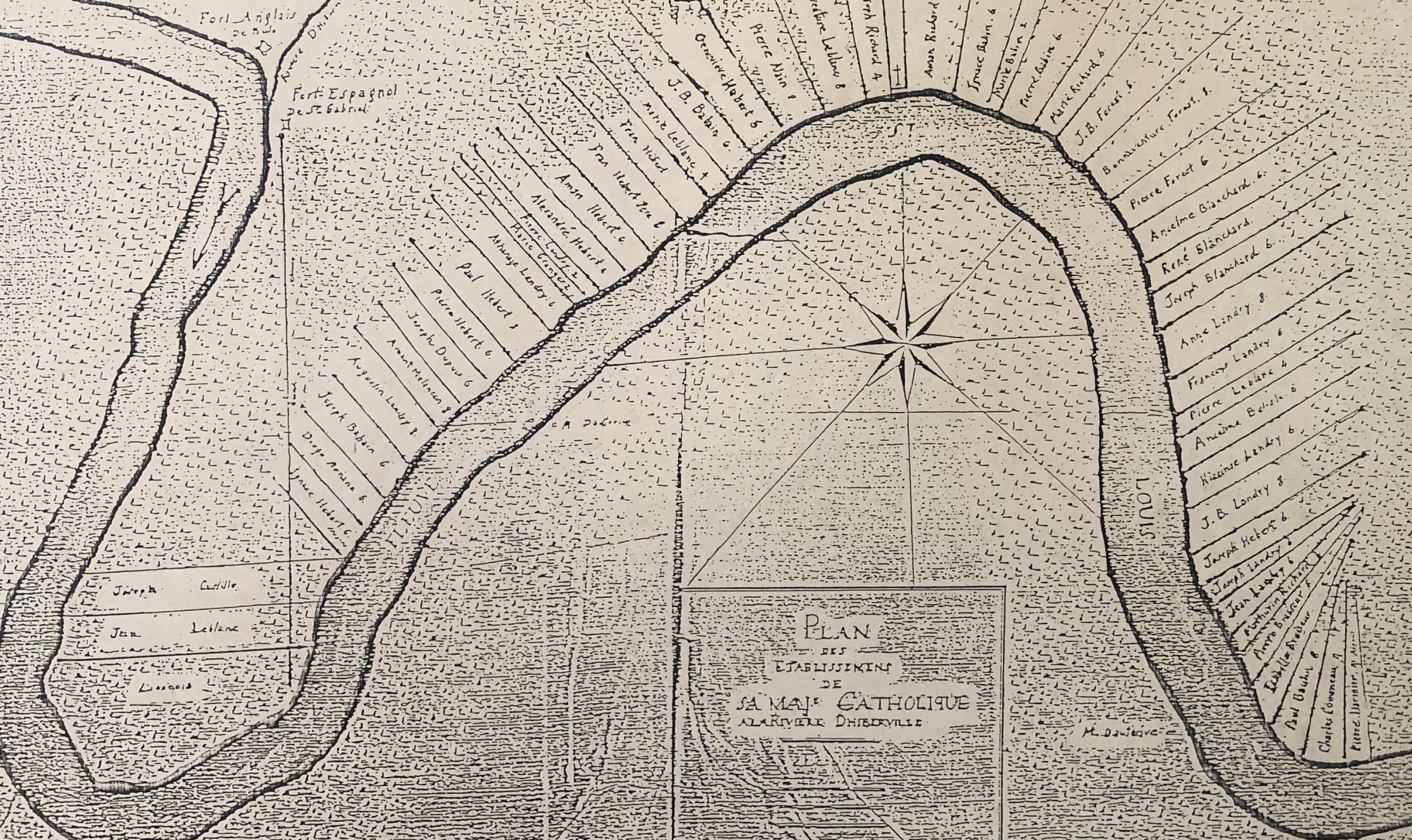
Map of St. Gabriel showing the location of the Acadians who settled there in 1767.

The Virgin arrived in New Orleans on July 23, 1767.  Joseph settled with the other Acadians in St. Gabriel.  At the end of Installment No. 4, I talked about Anne Marie Hebert being at the right age for marrying in 1769.  Her family had settled in St. Gabriel in July 1767 as well.  Her father and her brother owned property next to each other.  And the property next to her brother’s was owned by none other than our Joseph Dupuis.  She evidently came to the conclusion that he was good marriage material, because they were married on March 27, 1769.

In the 1777 St. Gabriel Census, it shows Joseph and his wife Anne Marie with their two young sons.  His nephews Jean Baptiste and Simon lived nearby.


My family tree with path to Joseph Dupuis highlighted.


For other installments of the “From Acadian to Cajun” series, click on the following links:

From Acadian to Cajun: Part 1 – Landry/Babin

From Acadian to Cajun: Part 2 – Breau/Trahan

From Acadian to Cajun: Part 3 – Braud/LeBlanc/Gauterot/Aucoin

From Acadian to Cajun: Part 4 – Hebert/Melanson

From Acadian to Cajun: Part 5 – Bourg/Granger

From Acadian to Cajun: Part 6 – Bujol/LeBlanc

From Acadian to Cajun: Part 7 – Foret/Bujol

From Acadian to Cajun: Part 8 – Hernandez/Babin

From Acadian to Cajun: Part 10 – Bourg/Babin/Landry in a short story called “Finding Home”

From Acadian to Cajun: Part 11 – The Ones That Didn’t Make It

The Swimming Pool Part 2

My maternal grandparents Fred Bucklin and Myrtle Phenice out on the beach with family in southern Louisiana circa 1929.

I’m excited about this photo.  It’s not an enhanced photo and it’s not a photo that I’ve shared before.  I’ve shared another photo from the same day before.  That was the original The Swimming Pool post from over four years ago.

I got this photo from my cousin Carla last year.  I’ve shared a few others that she shared with me and there are more to come in the future.  I was excited to get this one and a few others that were taken on the same day as the original photo I posted.  I wasn’t expecting that.  But it wasn’t until today when I was looking for something to post, that I realized that my grandmother (Myrtle Phenice Bucklin, mother of my mom Betty Lou Bucklin Landry) is in the photo. 

In the other photo it looked like the Bucklin brothers were fighting over a girl.  The girl was in the middle of that photo and she is in the middle of this one also.  She’s facing the camera.  I think she could be Grandma Myrtle’s older sister Grace.  Myrtle was in that original photo too, but she was off to the side looking a bit dejected.  But not in this one.

You can see her in front to the left.  She is facing away from the camera.  I recognized her because of her feminine shoulders and the straps of her swimsuit.  Even from this side view, you can recognize her strong high cheekbones.  Her hair matches the other photo as well.  Maybe she had it pinned up.  And even though you can’t see her face, it seems to me that she is having a better time. 

Did I hear someone say, “Hogwash!”  Well I’ll explain why I say that.  She is reclining on the beach between the cute Bucklin twins (Fred Bucklin was my grandfather and Clarence was the father of cousin Carla).  It looks like she may be sharing a secret behind a large hat with one of them, while the other one is behind her and reaching for her playfully.  I still can’t tell them apart in photos.  That happens when the photo is almost 100 years old and the two that I’m talking about were identical twins.

I’m still not exactly sure what is going on in this photo.  But now that I realize that my grandmother Myrtle is in it, I’m liking it much more.  It looks like they’re having a relaxing and fun time on the beach.

Crop of photo

Do NOT Try This at Home!

Enhanced photo of Alcide Landry circa 1890.

I had decided that I was not going to post this photo this week.  It’s one of the only things I was sure of as far as my blog goes.  I try to plan things out a little, but I’m usually not sure what I’ll exactly say from week to week.  I have been looking for something about my great grandfather Simon Alcide Landry to write about.  He was the husband of Marie Celeste from two weeks ago, but I really didn’t say much about him.  I have lots of photos of Marie Celeste through her years, but only one of Alcide.  I thought I would save this enhanced photo of him for later.  It’s the only photo I have of him.

So that was it.  I was not going to post this photo of him this week.  What I was doing this week was re-reading the book “Tirailleurs” by my 3rd cousin Thomas H. Richey.  It had been a while since I had read it and I thought I might find something regarding family history in it.  It’s mainly about Alcide’s older brother Trasimond’s experiences in the Civil War. 

But sometimes it mentions baby brother Alcide.  I was reading along, minding my own business, when I got to page 123.  It recounted a story about Alcide that I didn’t remember.  I read the book before, but I must have just overlooked it somehow.  I didn’t this time.  I decided then and there that I was going to write my blog this week about the story that was told.  It’s time for something a bit lighthearted.

It was the summer of 1863 in Brusly Landing in southern Louisiana.  On the plantation of Narcisse Landry, his son Alcide Landry was aching to join in on the fighting in the War.  But he wasn’t old enough yet.  He wouldn’t be turning 18 until August 16.  In June they were growing their corn crop, but didn’t dare to harvest it yet because the Yankees would just confiscate it.  There were some skirmishes going on at Port Hudson, so there were many Union soldiers about.

Port Hudson fell to the Union, so things settled down a bit.  Older brother Belisaire decided it was safe to harvest the corn.  Part of that work fell to young Alcide, who was not the least bit thrilled.  His 18th birthday couldn’t come soon enough and it was still a month away.  So he set to work picking up the corn as he rode in his corn wagon.

Don’t ask me what a corn wagon was, because all I can say is that it was probably a wagon for gathering corn!  And all I know about this one is that it had a bench in the front of it, just behind the horse that was pulling it.  Nothing automated in those days!  On this particular corn wagon on July 29, 1863, young 17-year 11-month 13-day-old Alcide Landry was sitting on the bench behind an old mare horse.  It had been a long, hot southern Louisiana day and Alcide was making his way back to the barn.

As they were riding along, Alcide was preoccupied with thoughts of the army.  He would grab an ear of corn, shuck it, and throw the grains of corn on the mare’s back and watch them fall.  Then he’d grab another ear.  As he was going through his repetitive process, he was pulled out of his reverie by a pungent explosion.  That old mare had lifted her tail and let out a stream of obnoxious fumes practically right in his face!  I’m surprised it didn’t knock him off of his bench.  I’m sure he had a few choice words for his horsey friend!

They continued on their way, and as they were approaching the barn, Alcide picked up another ear of corn to shuck.  At this moment, the mare lifted up her tail for another surprise.  Before he realized what he was doing, Alcide has used the ear of corn in his hand to stop up the source of the foul gift.  And before the mare realized what she was doing, she was bucking up her back legs and kicking at the source of whatever it was that was hindering her gassy relief.  “Tonnerre m’ecrase!”

All Alcide could see was the belly of the mare as her back legs rose up and kicked the corn wagon and his ribs.  Fortunately for Alcide it was an old mare after a long day’s work.  Unfortunately for Alcide she was still a pretty powerful animal.  So now, not only did he have to wait until he turned 18, he also had to wait for his ribs to heal.  I’m sure during his time of waiting he must have shaken his head a few times wondering how he could have done such a thing.

What a story!  I wonder if that was a story passed down to some of his children or grandchildren?  I’d never heard it that I recall.  And the French phrase in there means something like, “Thunder crushes me!”  It sounds like an explosive situation all the way around. 

I’m glad I know this story.  I hope you enjoyed it.


Keys Sisters Revisited

Crops taken from the enhanced copy of an old 1894 photo of Ruth, Daisy, and Mabel Keys

My first Keys Sisters post was in December of 2015.  That was a photo of the sisters Daisy, Ruth, and Mabel Keys in around 1894 when they were but young girls.  This was only seven years after the family had immigrated from England.  The Keys Sisters- Part 2 was posted a year and a half later.  That photo was taken around 1951 when the sisters were much more mature.  Fifty-seven years can do that to a person!

Enhanced photo from 1951 of the Keys sisters. From left to right are Ruth Keys Bryan, Daisy Keys Phenice, and Mabel Keys Miller

The connection to me is that Daisy is my great grandmother – my mother’s mother’s mother.  She is the source of my mitochondrial DNA.  Most of my maternal cousins have the same mtDNA since my mom has more sisters than brothers.  Actually it was only one brother, so his children have their mother’s mitochondrial DNA.  She’s from England, so we all have mtDNA straight from across the pond.

Three years have now passed since Part 2, so it’s time for another look at the sisters.  I hope they realize how fortunate they were to have each other for so long.  After recently losing the second of my three sisters, it makes me a little jealous of what they had.  But I won’t dwell on that, I’ll continue to celebrate with them for what they had.  Too bad I don’t have a new photo to share with you.  Like I said in the title, I’m just revisiting.

Enhanced photo from 1894 with Ruth, Daisy, and Mabel Keys

“Here he goes with those enhanced photos again,” you may be saying with frustration.  I agree.  I like to see new photos.  I haven’t found any new photos of the sisters together, but I have improved the ones I have.

The 1894 photo was a really good photo, considering it was just a photo of the original photo sent to me from Aunt Loris.  All three of the faces have enough details that the enhanced photo looks like the person it’s supposed to.  It helps that none of them are smiling with their teeth showing.  The enhancer always seems to give everyone perfect teeth! 

The 1951 photo was very blurry, so I wasn’t sure that it would work well for that photo.  It worked much better than I thought it would, even though there are some blurry parts near the edges of the photo.  It also doesn’t seem to figure out that if one side of a person’s face looks like they’re wearing glasses, the other side should have glasses, too.  Daisy’s teeth were a little too perfect at first.  So I looked at several photos of her and edited the photo to make it look more realistic.  I think it is a good improvement over the original.

Maybe we’ll have another part to this Keys Sisters series.  If so, it will have to be a different photo of the sisters that I don’t know about yet.  Wouldn’t that be grand!