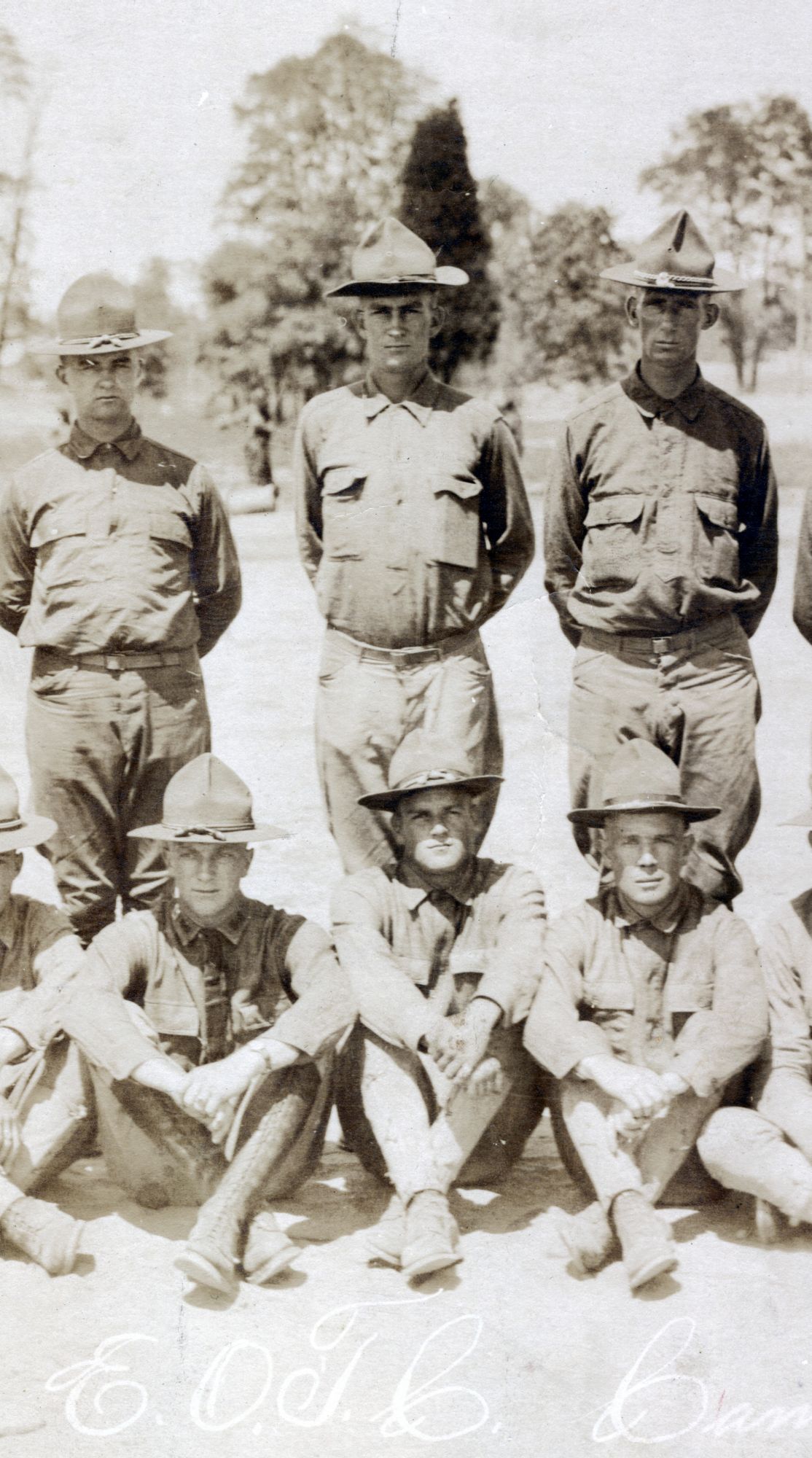
Pee Paw at Camp Humphreys in August 1918

I have posted a few photos of my paternal grandfather in World War I.  Some of those photos are ones I have seen as far back as I can remember.  My dad had several photos of him and his cohorts from back in the day.  The photos weren’t labeled, so I never knew exactly when they were taken.  I figured they were from some time around 1917 or 1918.

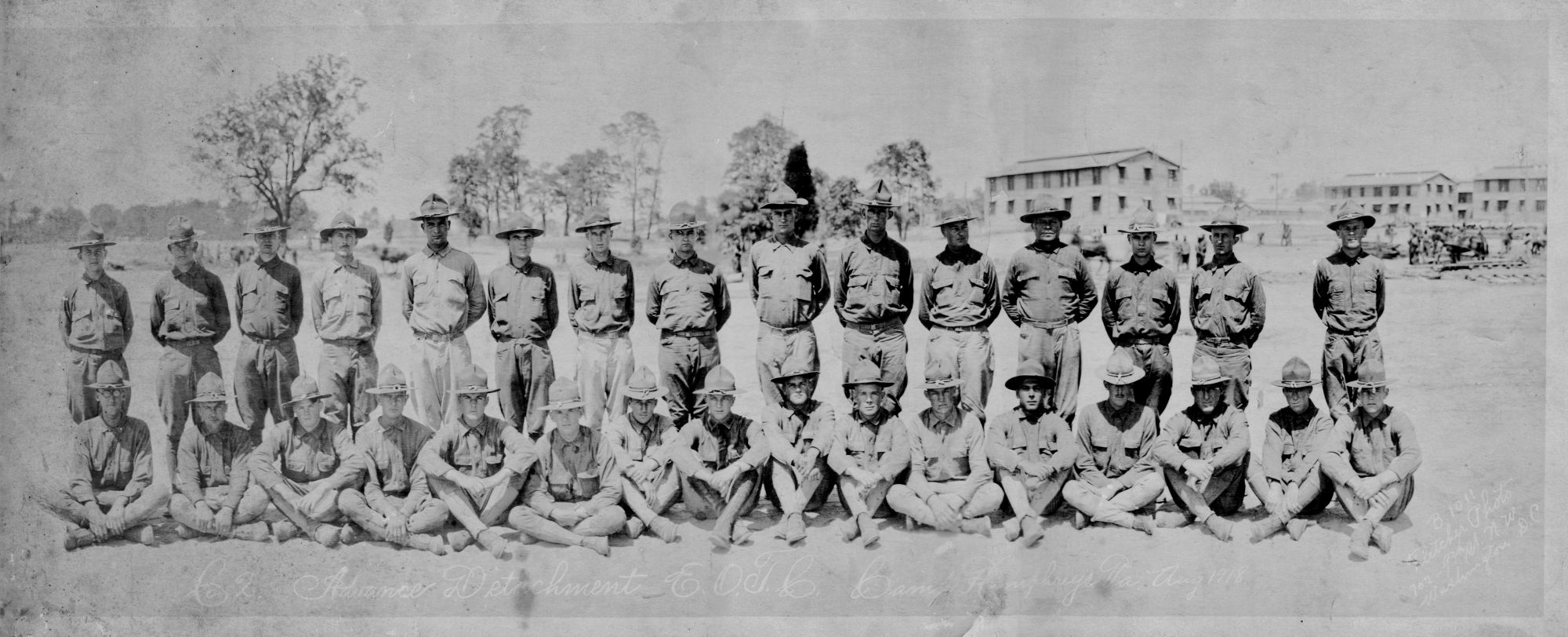
2nd Company Advance Detachment E. O. T. C., Camp Humphreys, Virginia, August 1918. My grandfather Robert Joseph Landry, Sr. is the one directly above the C. in E.O.T.C. He was 25 years old at the time.

This photo is different in many ways – it’s new to me, it’s a large panorama, it’s a large group of service members, and it has identification.  The first time I saw it was last year when I got together with a few cousins to share photos.  It is part of the Duffy Family Tin Can Collection.  My Aunt Wana was married to a Duffy and she somehow came into possession of many old photos.  She had many of them in a tin can in her attic, hence the name Tin Can Collection.  I don’t think this one was in a tin can though.  It is a large panoramic photo that has been rolled up for a long time.

The Keeper of the Collection is my cousin Tricia.  She guards it enthusiastically.  I wasn’t able to take a photo of the panoramic photo roll when we got together since it was so large.  But thankfully, Tricia let her guard down for a moment and allowed me to take it with me so I could scan it.  So we can thank Tricia (and anyone else named Duffy) for this wonderful photo.

The scan was a little tricky since the photo is so large.  I had to scan it in three sections and merge them together.  I notice a bit of ghosting, but it came out pretty good.  There are actually two images on the roll.  This one is a photo of the Company with their hats on.  The other one (which I’m saving for a later date) is one with their hats removed.  The great thing about these photos is the information written (or etched) on them.

The writing identifies the men as the  Company 2 Advance Detachment at Camp Humphreys in Virginia.  And to top it all off, it gives a date of August 1918.  On the right side at the bottom, it looks like some information about the photo for military archives.  I may have to share it on a military website I’ve seen.  Maybe someone else can find a family member from this group. 

I know I was excited to see a photo of my grandfather from a hundred years ago.   I hope you enjoy it, too.

Front and center is my grandfather Robert Joseph Landry, Sr. of Lake Charles, Louisiana

Myrtle Giving Haircut

Myrtle Phenice Bucklin giving haircut to sister-in-law Irma Hetzel Phenice circa 1939

I’ve always liked this photo.  Mainly because it is a photo that includes my Grandma Bucklin in it.  The photo source was not a very high quality.  I think it was a scan of a Xerox of a photo.  There were lots of stripes and graininess in the photo, so I doctored it the best I could.  I like the way it looks, though I wonder what a scan of a good photo would look like.  Maybe one will come my way now that I’m putting this one out there.

Myrtle Sylvia Phenice was born Dec. 19, 1906, somewhere around Hathaway, Louisiana.  She was married to Fred Bucklin on March 12, 1930, at the Raymond Methodist Church in Raymond, Louisiana.  They had five children together, including my mom Betty Lou who was born in 1933.  You can tell from the title that my grandmother is the one giving the haircut.  But you don’t know whose hair she is cutting.  That would be Irma Hetzel Phenice.

At least I think she was a Phenice at the time.  I estimated that date on the photo.  Irma married Myrtle’s younger brother Henry in 1934.  Yes, I think the date is close enough to be sure that Irma is her sister-in-law at the time of the photo.  It seems like homemade haircuts are very common with my family.  I have photos of my other grandmother cutting a grandchild’s hair.  I also have a photo of my dad cutting his brother’s hair.  When we were young, my mom cut our hair most of the time.  I cut my own hair.  It’s a family thing.

But I think it might be a bit more popular now that the coronavirus is keeping people in their houses, and salons & barbershops aren’t open.  I’m here to tell you that you will survive a homemade cutting.  But I’m not trying to “educate” you or convince you to participate.  I just wanted to share an old photo that I like.

I hope you enjoyed it. (If you can see it through that mop of overgrown hair that you have by now!)


July 6, 2020 – Here is the photo enhanced.


Sept. 20, 2020 Addendum – Van Giving Haircut

I finally participated in the Caronavirus Pandemic Home Haircutting Extravaganza!  Cousin Mary came over with her mom Maggie and her children Aiden and Violet.  If you had seen Aiden’s hair, you would think I was talking about him when I wrote the last line of the blog post.  With a lot of coaxing from Mary, he finally decided  to trust me and my scissors.  Like I said before, I’m sure he will survive the homemade haircut!

From Acadian to Cajun: Part 6 – Bujol/LeBlanc

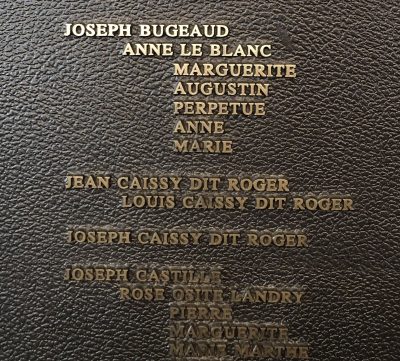
My ancestors Joseph Bujol (Bugeaud) and Anne LeBlanc were among the Acadian Exiles who made their way to Louisiana. These names are on a Memorial Wall in St. Martinville, Louisiana.

Here we are again, looking at another installment of the stories of my Acadian ancestors who were sent into Exile and eventually ended up in Louisiana.  This time we will be looking at the experience of Joseph Bujol and his wife Anne LeBlanc.  We haven’t looked at any of my ancestors with the last name of Bujol yet.  Last time we did look at a Bujol who was married to one of my ancestors, but sadly he died during the turmoil of the Exile. 

We have also looked at an ancestor with the LeBlanc last name previously.  Elizabeth LeBlanc was married to Honore Breaux, and her father Victor was Anne’s second cousin through the Acadian founder Daniel LeBlanc.  There are seven paths from Daniel down to me.  I won’t go over all of that, but I will say that I descend from Daniel’s children Rene, Andre, and Anthony.

But let’s get back to our main subjects.  Joseph Bujol was born in Pisiquit, Acadie, in 1723.  His father was also named Joseph and his mother was Josette Landry.  They lived in a place called  the Village de Abraham Landry.  Abraham Landry was the father of Josette and the grandfather of Joseph the younger.  We have definitely talked about the Landry name in previous posts.
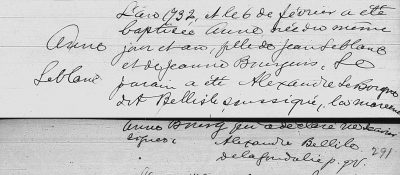
Anne Leblanc’s baptism record

Anne LeBlanc was born February 6, 1732, in Grand Pre, Acadie.  She was the youngest of the nine recorded children of Jean LeBlanc and Jeanne Bourgeois.  They lived in St. Charles aux Mines, Acadie.  Like many young women who are married, she was married in her hometown to a somewhat older husband Joseph Bujol in 1750.  Her father had died in 1747, so she was not given away by her father as many brides are. 

Within a year of their marriage, they had their first child – a daughter that they named Marguerite.  In 1753 they had son by the name of Augustin.  Then in 1755 they had their most important child – a daughter that they named Perpetua (or Perpetue).  I think she’s special because she is my 4X great grandmother.  She was also the last of my ancestors to be born in Acadie.  It was that same year that the Grand Derangement began.

This was the time that the English forced the residents of Acadie from their homes and Exiled them to various places.  Most of their homes and churches were burned, along with many records within them.  They were sent off with not much more than the clothes on their backs.  Many of them died in the process due to shipwrecks, diseases, and malnourishment.

On October 27, 1755, Joseph and Anne, with their three children, were loaded onto the ship “The Ranger” and torn from their homeland.  On November 29th they reached the shores of Annapolis, Maryland.  They did not disembark at that point, because they ended up continuing on to Oxford, Maryland.  This is where they would spend their next 12 years of Exile.

I can’t imagine going through this Great Upheaval like they did with an infant daughter and two other young children.  The danger and uncertainty of it all must have been terrifying.  Their outcome was better than others I have written about.  Other ancestors who had recently been married and with young children didn’t fare so well.  Some of them lost their first spouse and others lost children.  (Another sober nod goes to Magdelene from my last installment.)

They weren’t spared all grief, though.  Anne LeBlanc lost four siblings in the first few years of the Exile.  After recently enduring the death of a second sister, I can’t imagine losing four in such a short time.   I don’t see that Joseph lost any siblings at this point, but his father did die in 1758.  I know many of his siblings ended up in Quebec, so he likely never saw them again. 
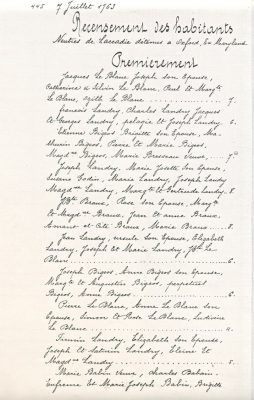
The 1763 Census for Oxford, Maryland, of the Acadians in Exile.

Their life continued in Oxford.  If you look at the July 1763 Census from Oxford, Maryland, the sixth household listed begins with Joseph Bigeos.  That’s our Joseph Bujol.   Anne is listed after him, as are their children Marguerite, Augustine, and Perpetue.  And there’s one more.  They had a little girl that they named Anne in 1757 while in Oxford.

That little girl Anne Bujol would later marry a little boy that is listed on this same page.  The third household listed starts with his parents Joseph and Marie Josette (Bourg) Landry and continues on to the son named Joseph.  He would be known as Joseph “dit bel Homme” Landry and he would marry Anne Bujol in Donaldsonville, Louisiana.  They would have over a dozen children and eventually die in Donaldsonville.  There is a huge monument/tomb in the Catholic Cemetery there.  Everyone always asks me if I descend from that well-known Landry.  I say, “No, but we are related.”  When I try to explain how I’m related, their eyes glaze over.  Except for the ones that really do descend from him.  I know some of them.

Joseph Bujol and Anne LeBlanc would have one more child while in Oxford.  Marie Madeline was supposedly born in 1762, yet she didn’t show up in the 1763 Census.  Perhaps the Census was negligent.  It’s been known to happen.  She was not their last child, but their stay in Oxford was coming to an end.  Like the other Acadians I have talked about, they heard about opportunities in Louisiana and decided to take their chances.  In late June of 1766, they joined over 200 other Acadian Exiles and boarded an English chartered ship that departed from Baltimore.

The ship did not head directly to Louisiana.  It reached Belize in September 1766 after making a stop in Cap Francais.  They then continued on to New Orleans.  These new arrivals had not been given permission to emigrate to the now Spanish-owned territory, yet the Spanish authorities were expecting more immigrants.  Because the Exiles “…had arrived in misery and were in great need, they were helped immediately…”  This group was sent to the Acadian Coast and given small lots of land.

In 1769 they were living in the Pointe Coupee area with their family.  The listing is as follows:   #74 Joseph BUJEUX, 46; Anne LEBLANC, wife, 36; Augustin, son, 16; Joseph, son, 3 months;  Margueritte, daughter, 18;  Perpetue, daughter, 14;  Anne, daughter, 12;  Marie, daughter, 8;  Joseph LANDRY, uncle, 65. 

I’ll leave it like that; with the family making a new home in Louisiana and welcoming a new baby boy.  You might as well go ahead and call them Cajuns.
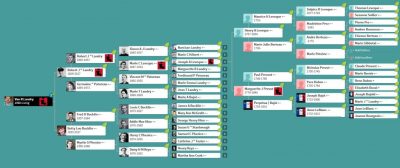

family tree showing the path to ancestors discussed in this blog post

Follow the red Louisiana icons to find Joseph Bujol & Anne LeBlanc


For other installments of this series of blog posts, click on the following links:

From Acadian to Cajun: Part 1 – Landry/Babin

From Acadian to Cajun: Part 2 – Breau/Trahan

From Acadian to Cajun: Part 3 – Braud/LeBlanc/Gauterot/Aucoin

From Acadian to Cajun: Part 4 – Hebert/Melanson

From Acadian to Cajun: Part 5 – Bourg/Granger

From Acadian to Cajun: Part 7 – Foret/Bujol

From Acadian to Cajun: Part 8 – Hernandez/Babin

From Acadian to Cajun: Part 9 – Dupuis/Dugas

From Acadian to Cajun: Part 10 – Bourg/Babin/Landry

From Acadian to Cajun: Part 11 – The Ones That Didn’t Make It
Unbearable Marital Infelicity

I found an article about one of my ancestors about three years ago and was very intrigued by it.  I knew I would write a story about it at some point, I just had to find the right time.  But it seems that there never is a right time when writing about an ancestor’s suicide.

So even though it doesn’t feel like the right time, it does feel like the time to write it.  At least that’s what I’m doing.  The ancestor I’m talking about is John Stanbrough, my great great great grandfather.  Obviously I didn’t know him, but I do think about him from time to time.  There is no photo of him that I know of, even though he did live into the time of photography.  At the time of his birth in 1820, photography was not around.  But during his 57 years of living, it had developed quite a bit.

Let me tell you about my connection to him.  I am the son of Betty Lou Bucklin Landry.  Her father was Fred Bucklin, who was the son of Addie May Hine Bucklin.  Addie was the daughter of Susan Stanbrough Hine.  Sue was the third daughter and sixth child of John Stanbrough & Lydia Mills Stanbrough.   There was an older half brother by her father’s first wife.  She also had six younger siblings.

John Stanbrough was born November 18, 1820, in Clinton County, Ohio.   He was a Quaker.  For a genealogist, that is a good thing because it means that there are lots of records for that person and their ancestors.  The Stanbrough or Stanborough family had been in the US for many generations.  They started out in New York and moved on to Tennessee.  Our line went on to Ohio and then to Indiana around 1830.  Grandma Sue brought our line down to Louisiana in 1894.

John married Lydia Hunt in 1838.  They had one son together in 1839 and then Lydia died in 1842.  Not long after that, John met another Lydia.  This one had the last name of Mills.   They were married on Sept. 20, 1843.  If you added up the children I mentioned earlier, you’d know that they had a dozen children together over about a 20 year period.

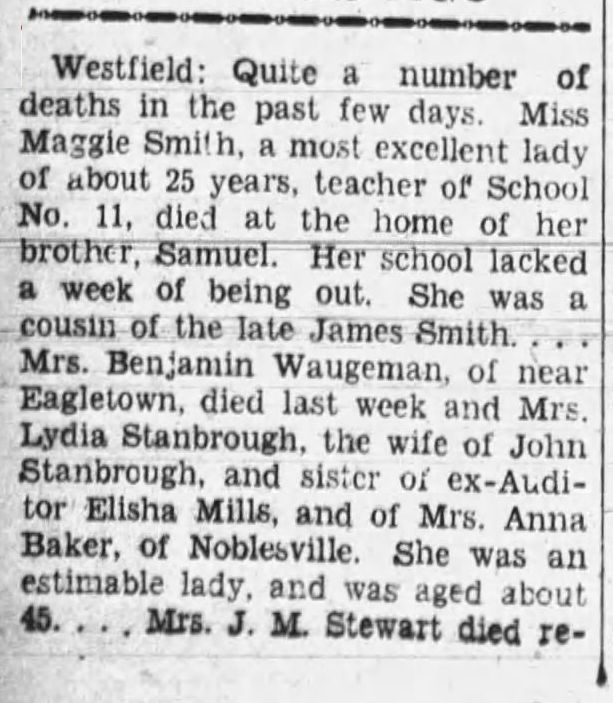
The Noblesville Ledger from March 24, 1873, in Indiana.

Then in 1873, just 10 years after the birth of their last child, Lydia died at the age of 50.  The Noblesville, Indiana, newspaper article incorrectly gives her age at death as 45.  This was the second Lydia that he had lost.   And she was an “estimable lady.”

Later that year, Sue Stanbrough married George Hine and they started a family.  Addie May was born on Sept. 23, 1876, in Noblesville, so there were some happy things going on for John at the time.  He must have gotten lonely again (even with several children in his house), because he decided to get married again in 1877.  He married the widow Margaret Hollis Embree on June 3.  She was 16 years younger and she had six children of her own. 

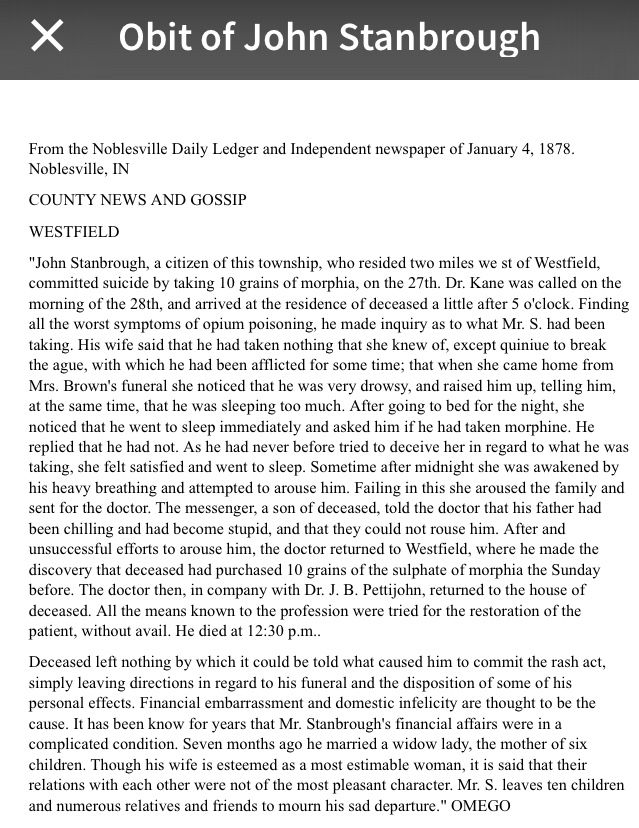
Obituary of John Stanbrough

I had seen a lot of this information before three years ago when I first saw the transcription of the newspaper article about John Stanbrough’s death.  I wonder if his friends and neighbors were surprised like I was to see this information about a suicide?  What would make a recently married man feel that this was the choice he should make?

The article gives a few clues.  John took an overdose of morphine.  He was able to get grains of morphia without any question from a doctor.  He was taking quinine because he suffered from ague.  This condition of recurring severe chills and fever and him taking quinine point to malaria, which is usually accompanied by pain in the bones and joints.  Chronic pain is not an easy thing to deal with.  Yet this was not cited as a possible cause for his “rash act.”

The article does talk about John leaving a message as to how to dispose of his personal effects.  They suspected that his reasons for the action were marital “infelicity” and financial problems.  They point out that he only married his wife seven months ago, that she had six children, and that they didn’t get along particularly well.  Yet she, also, was an “estimable” woman. 

I’m sure this hit Grandma Sue quite hard.  She was living in the same town at the time and her younger siblings were in the house when all of the commotion was going on.  It was a traumatic time for the Stanbrough household of 1877 Noblesville.  I’m sure it was not John’s intention to traumatize his family.  All he could probably see was the pain and problems that he was experiencing.  He likely thought that they’d be better off without him.

A thought that nobody else likely agreed with.