A Cherished Photo of Pee Paw
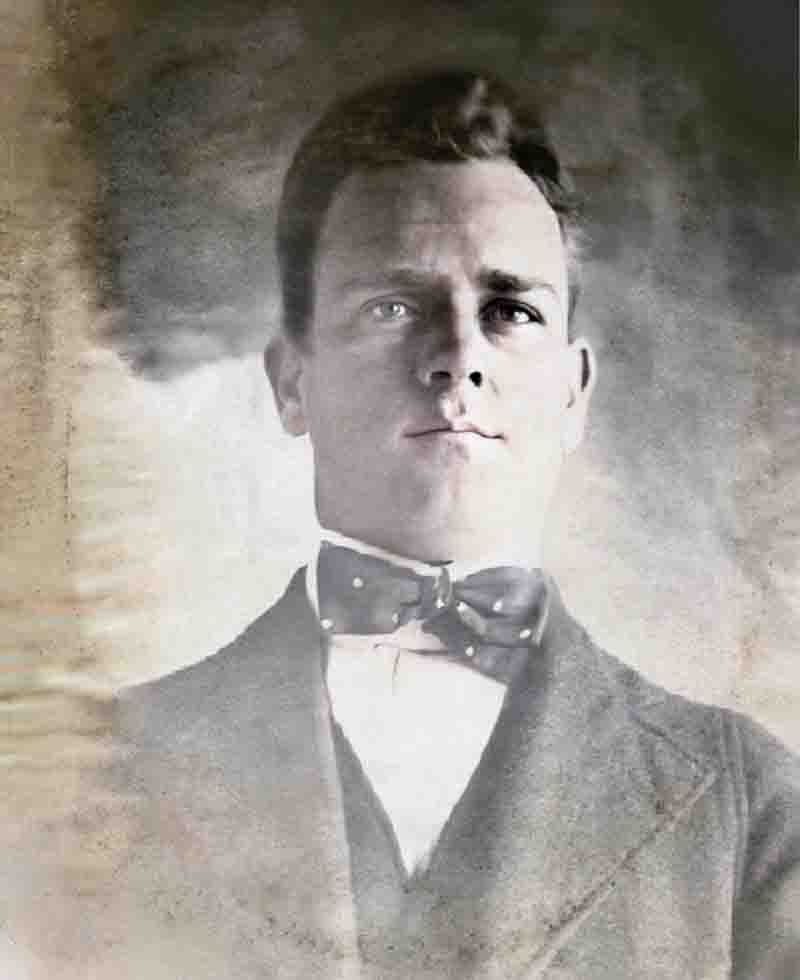
Robert Joseph “Rob” Landry, Sr. circa 1922 in Lake Charles, Louisiana.

Here is a photo that I found last week.  I’ve had it in my digital files for quite a while, but I don’t remember seeing it before last weekend.  How is that for a cherished photo?  The date on the file was 1999.  Daddy must have scanned it or somehow had a digital file made of this old photo of his own dad.  I could tell that the original photo must have been really good, but all I had to start with was a small washed-out image.  I knew as soon as I saw it that I had to share it, but it had some work to be done on it.

So that’s what I did.  And yes, this is the improved version of the photo after healing, cloning, shading, leveling, and fading one version over another for about an hour.  I left some of the staining along the left side of the photo because I wanted to keep some of that old time charm.  Actually, I wanted you to be able to see that there is an oval shape around the face of my grandfather.

I’m pretty sure the oval is a result of the original enlarged photograph having been in a frame for a long time.  I’m sure that my Mee Maw – Germaine Erie Patureau Landry – must have been the one that framed this cherished image of her dear husband.  (My spellcheck is telling me to change that spelling to “dead” husband!  That was not what I wanted to convey!  I’m pretty sure she cherished him when he was alive!)  He does look quite dashing in the photo.  I’m hoping that someone else in the family might have an original of this photo.  It would be nice to get a better copy of this photo.

Robert Joseph “Rob” Landry was born in Westlake, Louisiana, on January 9, 1893.   He was the youngest of the ten children of Simon Alcide Landry and Marie Celeste Leveque Landry.  The family had moved west from West Baton Rouge Parish a few years earlier to find work in the railroad industry of Calcasieu Parish.  He grew up in Westlake, where he developed his interests in fishing and baseball.  As a young man he was a semi-professional baseball player in Louisiana and Texas.  In 1917 he joined the military during the Great War (WWI).  He went through training, but the war ended before he was ever deployed abroad.  

In 1921 he married Germaine Erie Patureau from Plaquemine, Louisiana.  I’m thinking the photo was taken around that period of time or shortly after.  He still looks like a young man, but he’s starting to show some features of his older years.  It didn’t take too long for his hair to start thinning, so I don’t think he was much older than 29 or 30.  It’s a good photo.  I’ll definitely keep it.  I’ll probably even cherish it.  I hope you do, too.

Louis Bucklin With Two Eyes

This title is making me laugh.  It probably shouldn’t.  I sometimes laugh inappropriately at things.  But I can’t help it, I find so many things funny.  And it’s not funny that later in life, my great grandfather Louis Bucklin lost one of his eyes.  I’m pretty sure it was a result of a farming accident.  He was a farmer after all.  He was also a writer.  He kept journals for many years.  I have not read them all.  I don’t think that I’ve seen them all.  I’ve only seen a photo of a grouping of old journals that he wrote, and it looked like there were a lot of them.

Drawing of Louis Bucklin from circa 1900. I enhanced the photo.

He wasn’t too revealing about his personal life in those journals.  He didn’t write about the young girl he was interested in who was living in Leeds, Iowa, in 1893.  I only know about that because he must have saved the letter that she wrote to him to break up with him.  That letter didn’t stay in the Bucklin family, but it somehow was kept in the Keys family.  Fortunately, his son married into the Keys family and the letter survived until it came back to me.  It led to all kinds of discoveries about Louis and his brother Joe.  I’ve written all about that previously.

Louis also didn’t write about his interest in Addie May Hine, who later became his wife.  All he really said in his journals was that Addie had come to the house to help his mother Mary Ann McGrath Bucklin do some household chores.  I guess that’s something.  She did merit a mention.

The journal also comes in handy when people ask questions about some of the history of the Hathaway, Louisiana, area.  He mentions a few people and some events that happened.  He was in a play in Jennings, Louisiana, on May 20, 1894.  I don’t know the name of the play, but he felt it would have gone better if they had been more organized and better practiced.  He pointed out blunders by a Hoag and a Macmartin.  A few weeks later he talked about an impromptu Fourth of July celebration in China, Louisiana.  China is another small community north of Jennings.  He was particularly impressed with the speeches of Mr. Powell and Mr. Eaton.

I don’t know when Louis lost his eye.  I don’t know if that information is in one of his journals or not.  I’m also not sure when this image of him was done.  I’m thinking that it is a drawing that was made when he was in his twenties or thirties.  Unfortunately for us, there aren’t many photos of him to compare it to.  He was very good at avoiding the camera.  I’ve never been that fond of this picture, but since there are so few of him, I’m using it.  Some of his features in this image remind me of my grandfather, which points to me that it might be pretty accurate.  

I do know that his eyes were blue, because that was the color of the glass eye that was made for him to replace the eye he had lost.  Somehow one of his grandchildren came across that eye in Addie’s bedroom years after Louis died.  I’m hoping that she was snooping a bit.  It would be a bit strange if it was out on display or set up as if it were looking at her.  There I go laughing again.  Because as strange as the idea of having it on display sounds to me, I would really like to see that eye.  I’d even be tempted to post a photo of it for everyone to see!

And to go a step further, I’d like to have that eye in my collection of family heirlooms.  I have a display case for all of my rocks and minerals.  There are already a few glass pieces in it.  I think that eye might look good on display.  Maybe.  Maybe not.  If this ever were to happen, I do know that the reaction I would get from people would make me laugh.   No maybe about that.

Louis Bucklin’s journals from 1915-1920.

Patureau Brothers: When They Were Doctors

Last year, my favorite acquired photo was an old tintype of these Patureau siblings.  That old photo was taken in 1881 and it’s the earliest photo of my great grandfather Vincent Maximilian Patureau that I know of.  It was from the Box 301 Collection that was discovered in my Aunt Wana’s attic.  She is my dad’s sister, and they both were grandchildren of Grampa Max through their mother Germaine Erie Patureau Landry.  That old 1881 photo of Max and his brother (Pierre) Oscar wasn’t the only photo of them in that collection.  There was this other one from about forty years later.

Max and Oscar Patureau circa 1920 in Lafayette, Louisiana

So I’m estimating that this photo was taken around 1920.  I came up with that date because of another photo that was taken on the same day.  That photo includes one of Max’s sons, and I used his apparent age to estimate the date.  But looking at these two old geezers makes me question that.  They look to be in their sixties, but that wouldn’t be correct for 1920.  Max was only 55 in 1920, while Oscar was only 54.  I think people looked older sooner than we do now.  Or maybe I’m just kidding myself.  

I still think the date is pretty accurate.  The latest the photo could be is 1926.  That was the year that Oscar died.  He never did make it to the age of 60, so there never was a photo of those Patureau brothers in their sixties.  The earliest photo I have of them was when they were teenagers.  I had trouble identifying Grampa Max at first because it was from before he grew out his ever-present mustache.   Late last year I posted that photo in a post titled Patureau Brothers: Before They Were Doctors.

It was always my intention to use this later photo for a follow-up to that post.  The two Doctors Patureau look like they were well-dressed and respectable.  I think Grampa Max started his veterinary business in Plaquemine, Louisiana, sometime after 1900.  Before then, he made barrels, provided a service for delivering groceries, and ran a grocery store.  In 1889 there was an ad for installing lightning rods, and the provider of these services was V. M. Patureau and Bro.  I’m thinking Max was probably working with Oscar, because his other two younger brothers – Alcide and Omer – were working as barbers.

The first piece of information about Max’s veterinary practice was in the form of newspaper recommendations in the 1908 Plaquemine newspaper.  He may have asked people to write to the paper to help him get his business started.  People had good things to say about his skills and kindly manner.  Max’s wife – Marie Therese Landry Patureau – died in 1909, and then a few years later he moved his family and his practice to Lafayette, Louisiana.

Oscar Patureau went to dental school in Nashville, Tennessee, in 1895.  I don’t know how he managed that, because he had married in 1888, and by 1895 they had three young children.  He must have been determined to accomplish that and worked hard.  By the time of the 1900 Census, the family was living in New Orleans and he was working as a dentist.  In 1920 he was still working in the medical field.  I assume he continued working until his death in 1926.  Grampa Max continued to work as a veterinarian until 1933, when he retired due to declining health.

So there you have it – Doctor Patureau and his brother Doctor Patureau.  Otherwise known as Max and Oscar.  Taking some time out of their busy schedules 100 years ago to visit their brother and probably sharing a funny story or two.  Grampa Max strikes me as someone who would have had some interesting stories to tell.


Betty Lou Started McNeese in 1951

Several times in these posts I’ve talked about my mom meeting my dad when she went off to college.  They were both in the band and they both played baritone.  They would have met then, if not for the fact that they had run into each other in 1950 the year before, when she was still in high school.  She remembered him because he helped her find her way when she was lost.  He remembered her because she was a sweet girl who was interested in music.

Betty Lou Bucklin from Hathaway, Louisiana, in the fall of 1951 at McNeese State College in Lake Charles.

But how could he forget her?  Look how cute she was!  I don’t remember this photo when I was growing up, but I know that it was taken in the fall of 1951.  I know that because it is from an old McNeese State College yearbook for the year of 1952.  The photo identifies Betty Lou Bucklin from Hathaway, Louisiana.  That’s my mom!

The photo is shown in the section for the freshman class, but that’s not where this one is from.  It’s from the Wesley Foundation group that she must have been a part of.  I don’t know why I specify, because they’re the same photo in both locations.  The Wesley Foundation is a church group for Methodist students.  She would not have met my dad in that group.

My dad was Robert Joseph Landry, Jr. from Lake Charles, Louisiana.  He was four years older than Betty Lou.  People knew him as either Bob or Pluto.  He had French and Acadian ancestry, and he was Catholic.  That didn’t stop young Bob from asking her on a date the very first day that they showed up for band practice a few days before classes even started.

As I recall, their first date was a double date with Daddy’s friend Harvey Prejean and his date who would later be his wife.  Another memorable thing about that date was that it was the first time either my mom or my dad had pizza.  I don’t think anybody nowadays can reach college age without ever trying pizza.  It would be unAmerican!

I don’t know if my dad found out that she was Methodist on their first date or shortly after.  When he first found out, he stopped seeing her.  You have to understand my dad’s family.  There was a long history in their family of staying within their community to marry.  They were French and mostly Cajun, and they spoke mainly French.  That separated them from other Americans.  My dad’s ancestors stayed within their group when it came time to marry and start a family.  In fact, all of his grandparents were related to each other.  It was a more common practice in previous centuries.  My dad was the first generation in his family that only spoke English.  Still, he didn’t know what to think when he found himself attracted to someone not from the same background, much less the same religion.

When my mom used to tell this story, it didn’t seem like she was too upset about the fact that he quit seeing her.  She seemed to be quite nonchalant about it.  Maybe she knew it wasn’t anything personal about herself and she had the confidence to deal with it.  Or maybe it confused her and she was angry with him for dumping her.  She never said anything about her trying to get him back or flirting with him.  Of course, she knew the happy ending to the story when she was telling it.

It didn’t take long for him to realize that he wanted to spend the rest of his life with this different girl from Hathaway, as long as she agreed to become Catholic.  That wasn’t a problem for my mom.  Sure, she made lighthearted fun of Catholics when she was a younger girl, but she outgrew that foolishness.  Mostly.  Besides, he was a good guy who seemed pretty trustworthy.  They decided within that first year that they would get married.

My mom only went to college for one year.  Then on November 1, 1952, she became Mrs. Robert Joseph Landry, Jr.  But she would always be just Betty Lou from Hathaway!