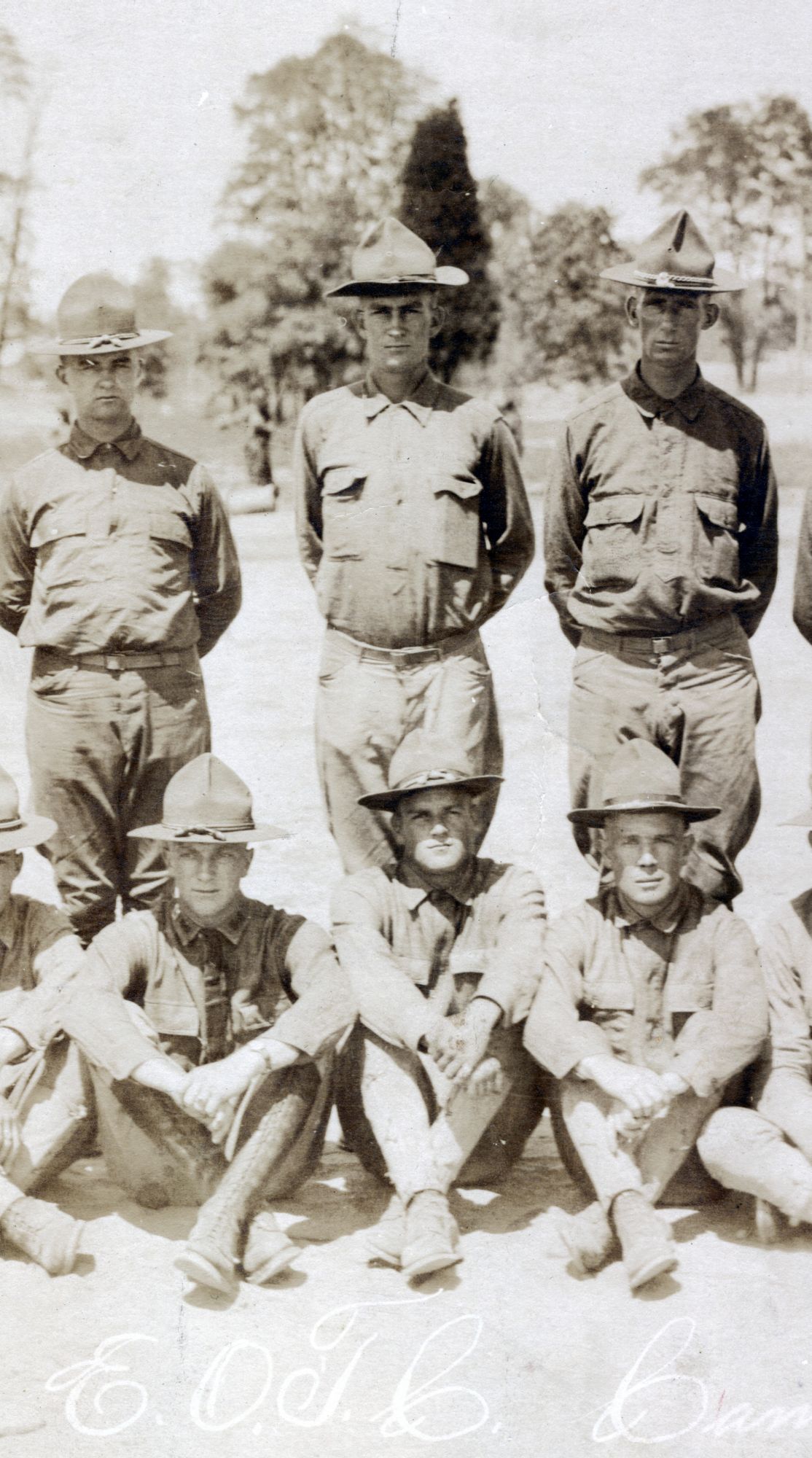
Pee Paw at Camp Humphreys in August 1918

I have posted a few photos of my paternal grandfather in World War I.  Some of those photos are ones I have seen as far back as I can remember.  My dad had several photos of him and his cohorts from back in the day.  The photos weren’t labeled, so I never knew exactly when they were taken.  I figured they were from some time around 1917 or 1918.

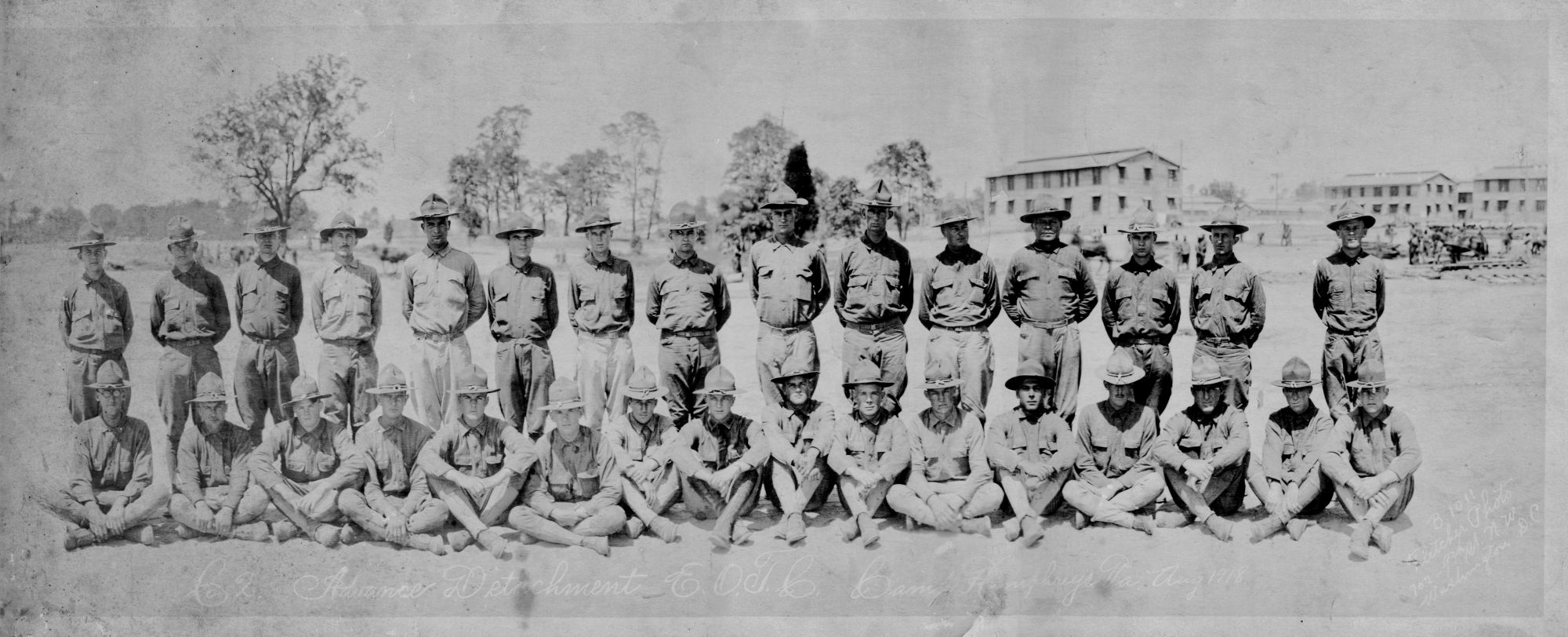
2nd Company Advance Detachment E. O. T. C., Camp Humphreys, Virginia, August 1918. My grandfather Robert Joseph Landry, Sr. is the one directly above the C. in E.O.T.C. He was 25 years old at the time.

This photo is different in many ways – it’s new to me, it’s a large panorama, it’s a large group of service members, and it has identification.  The first time I saw it was last year when I got together with a few cousins to share photos.  It is part of the Duffy Family Tin Can Collection.  My Aunt Wana was married to a Duffy and she somehow came into possession of many old photos.  She had many of them in a tin can in her attic, hence the name Tin Can Collection.  I don’t think this one was in a tin can though.  It is a large panoramic photo that has been rolled up for a long time.

The Keeper of the Collection is my cousin Tricia.  She guards it enthusiastically.  I wasn’t able to take a photo of the panoramic photo roll when we got together since it was so large.  But thankfully, Tricia let her guard down for a moment and allowed me to take it with me so I could scan it.  So we can thank Tricia (and anyone else named Duffy) for this wonderful photo.

The scan was a little tricky since the photo is so large.  I had to scan it in three sections and merge them together.  I notice a bit of ghosting, but it came out pretty good.  There are actually two images on the roll.  This one is a photo of the Company with their hats on.  The other one (which I’m saving for a later date) is one with their hats removed.  The great thing about these photos is the information written (or etched) on them.

The writing identifies the men as the  Company 2 Advance Detachment at Camp Humphreys in Virginia.  And to top it all off, it gives a date of August 1918.  On the right side at the bottom, it looks like some information about the photo for military archives.  I may have to share it on a military website I’ve seen.  Maybe someone else can find a family member from this group. 

I know I was excited to see a photo of my grandfather from a hundred years ago.   I hope you enjoy it, too.

Front and center is my grandfather Robert Joseph Landry, Sr. of Lake Charles, Louisiana

From Acadian to Cajun: Part 6 – Bujol/LeBlanc

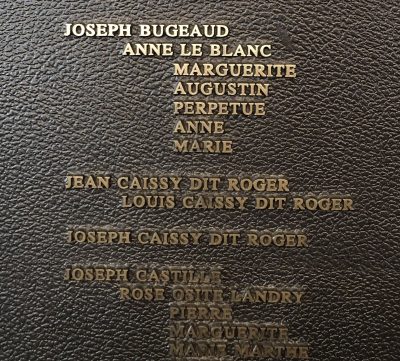
My ancestors Joseph Bujol (Bugeaud) and Anne LeBlanc were among the Acadian Exiles who made their way to Louisiana. These names are on a Memorial Wall in St. Martinville, Louisiana.

Here we are again, looking at another installment of the stories of my Acadian ancestors who were sent into Exile and eventually ended up in Louisiana.  This time we will be looking at the experience of Joseph Bujol and his wife Anne LeBlanc.  We haven’t looked at any of my ancestors with the last name of Bujol yet.  Last time we did look at a Bujol who was married to one of my ancestors, but sadly he died during the turmoil of the Exile. 

We have also looked at an ancestor with the LeBlanc last name previously.  Elizabeth LeBlanc was married to Honore Breaux, and her father Victor was Anne’s second cousin through the Acadian founder Daniel LeBlanc.  There are seven paths from Daniel down to me.  I won’t go over all of that, but I will say that I descend from Daniel’s children Rene, Andre, and Anthony.

But let’s get back to our main subjects.  Joseph Bujol was born in Pisiquit, Acadie, in 1723.  His father was also named Joseph and his mother was Josette Landry.  They lived in a place called  the Village de Abraham Landry.  Abraham Landry was the father of Josette and the grandfather of Joseph the younger.  We have definitely talked about the Landry name in previous posts.
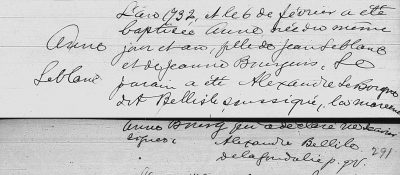
Anne Leblanc’s baptism record

Anne LeBlanc was born February 6, 1732, in Grand Pre, Acadie.  She was the youngest of the nine recorded children of Jean LeBlanc and Jeanne Bourgeois.  They lived in St. Charles aux Mines, Acadie.  Like many young women who are married, she was married in her hometown to a somewhat older husband Joseph Bujol in 1750.  Her father had died in 1747, so she was not given away by her father as many brides are. 

Within a year of their marriage, they had their first child – a daughter that they named Marguerite.  In 1753 they had son by the name of Augustin.  Then in 1755 they had their most important child – a daughter that they named Perpetua (or Perpetue).  I think she’s special because she is my 4X great grandmother.  She was also the last of my ancestors to be born in Acadie.  It was that same year that the Grand Derangement began.

This was the time that the English forced the residents of Acadie from their homes and Exiled them to various places.  Most of their homes and churches were burned, along with many records within them.  They were sent off with not much more than the clothes on their backs.  Many of them died in the process due to shipwrecks, diseases, and malnourishment.

On October 27, 1755, Joseph and Anne, with their three children, were loaded onto the ship “The Ranger” and torn from their homeland.  On November 29th they reached the shores of Annapolis, Maryland.  They did not disembark at that point, because they ended up continuing on to Oxford, Maryland.  This is where they would spend their next 12 years of Exile.

I can’t imagine going through this Great Upheaval like they did with an infant daughter and two other young children.  The danger and uncertainty of it all must have been terrifying.  Their outcome was better than others I have written about.  Other ancestors who had recently been married and with young children didn’t fare so well.  Some of them lost their first spouse and others lost children.  (Another sober nod goes to Magdelene from my last installment.)

They weren’t spared all grief, though.  Anne LeBlanc lost four siblings in the first few years of the Exile.  After recently enduring the death of a second sister, I can’t imagine losing four in such a short time.   I don’t see that Joseph lost any siblings at this point, but his father did die in 1758.  I know many of his siblings ended up in Quebec, so he likely never saw them again. 
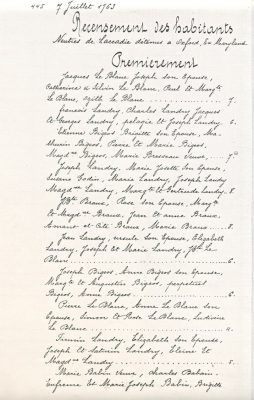
The 1763 Census for Oxford, Maryland, of the Acadians in Exile.

Their life continued in Oxford.  If you look at the July 1763 Census from Oxford, Maryland, the sixth household listed begins with Joseph Bigeos.  That’s our Joseph Bujol.   Anne is listed after him, as are their children Marguerite, Augustine, and Perpetue.  And there’s one more.  They had a little girl that they named Anne in 1757 while in Oxford.

That little girl Anne Bujol would later marry a little boy that is listed on this same page.  The third household listed starts with his parents Joseph and Marie Josette (Bourg) Landry and continues on to the son named Joseph.  He would be known as Joseph “dit bel Homme” Landry and he would marry Anne Bujol in Donaldsonville, Louisiana.  They would have over a dozen children and eventually die in Donaldsonville.  There is a huge monument/tomb in the Catholic Cemetery there.  Everyone always asks me if I descend from that well-known Landry.  I say, “No, but we are related.”  When I try to explain how I’m related, their eyes glaze over.  Except for the ones that really do descend from him.  I know some of them.

Joseph Bujol and Anne LeBlanc would have one more child while in Oxford.  Marie Madeline was supposedly born in 1762, yet she didn’t show up in the 1763 Census.  Perhaps the Census was negligent.  It’s been known to happen.  She was not their last child, but their stay in Oxford was coming to an end.  Like the other Acadians I have talked about, they heard about opportunities in Louisiana and decided to take their chances.  In late June of 1766, they joined over 200 other Acadian Exiles and boarded an English chartered ship that departed from Baltimore.

The ship did not head directly to Louisiana.  It reached Belize in September 1766 after making a stop in Cap Francais.  They then continued on to New Orleans.  These new arrivals had not been given permission to emigrate to the now Spanish-owned territory, yet the Spanish authorities were expecting more immigrants.  Because the Exiles “…had arrived in misery and were in great need, they were helped immediately…”  This group was sent to the Acadian Coast and given small lots of land.

In 1769 they were living in the Pointe Coupee area with their family.  The listing is as follows:   #74 Joseph BUJEUX, 46; Anne LEBLANC, wife, 36; Augustin, son, 16; Joseph, son, 3 months;  Margueritte, daughter, 18;  Perpetue, daughter, 14;  Anne, daughter, 12;  Marie, daughter, 8;  Joseph LANDRY, uncle, 65. 

I’ll leave it like that; with the family making a new home in Louisiana and welcoming a new baby boy.  You might as well go ahead and call them Cajuns.
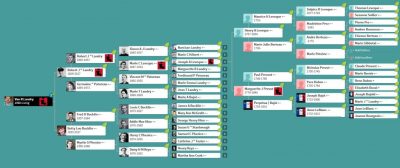

family tree showing the path to ancestors discussed in this blog post

Follow the red Louisiana icons to find Joseph Bujol & Anne LeBlanc


For other installments of this series of blog posts, click on the following links:

From Acadian to Cajun: Part 1 – Landry/Babin

From Acadian to Cajun: Part 2 – Breau/Trahan

From Acadian to Cajun: Part 3 – Braud/LeBlanc/Gauterot/Aucoin

From Acadian to Cajun: Part 4 – Hebert/Melanson

From Acadian to Cajun: Part 5 – Bourg/Granger

From Acadian to Cajun: Part 7 – Foret/Bujol

From Acadian to Cajun: Part 8 – Hernandez/Babin

From Acadian to Cajun: Part 9 – Dupuis/Dugas

From Acadian to Cajun: Part 10 – Bourg/Babin/Landry

From Acadian to Cajun: Part 11 – The Ones That Didn’t Make It

Bobby Landry at Landry Memorial in 1943

Robert Joseph Landry, Jr. was the young 8th grade student in the middle of the photo (the taller one). He was known as Bobby back then. This was at Landry Memorial High School in Lake Charles, Louisiana.

One of my Leveque cousins made a Facebook post yesterday about Landry Memorial High School in Lake Charles.  It inspired me to write my blog about Landry Memorial today, because that’s where my dad and his brothers went to school back in the day.  I remember looking through my dad’s old report cards when I was a kid and wondered about the Landry name associated with the school.  I never really bothered to ask about it back then.  My main concern were the bad grades that my dad made.  He explained them to me by saying that he only studied for enough to pass the class.  That really didn’t help explain it to me.

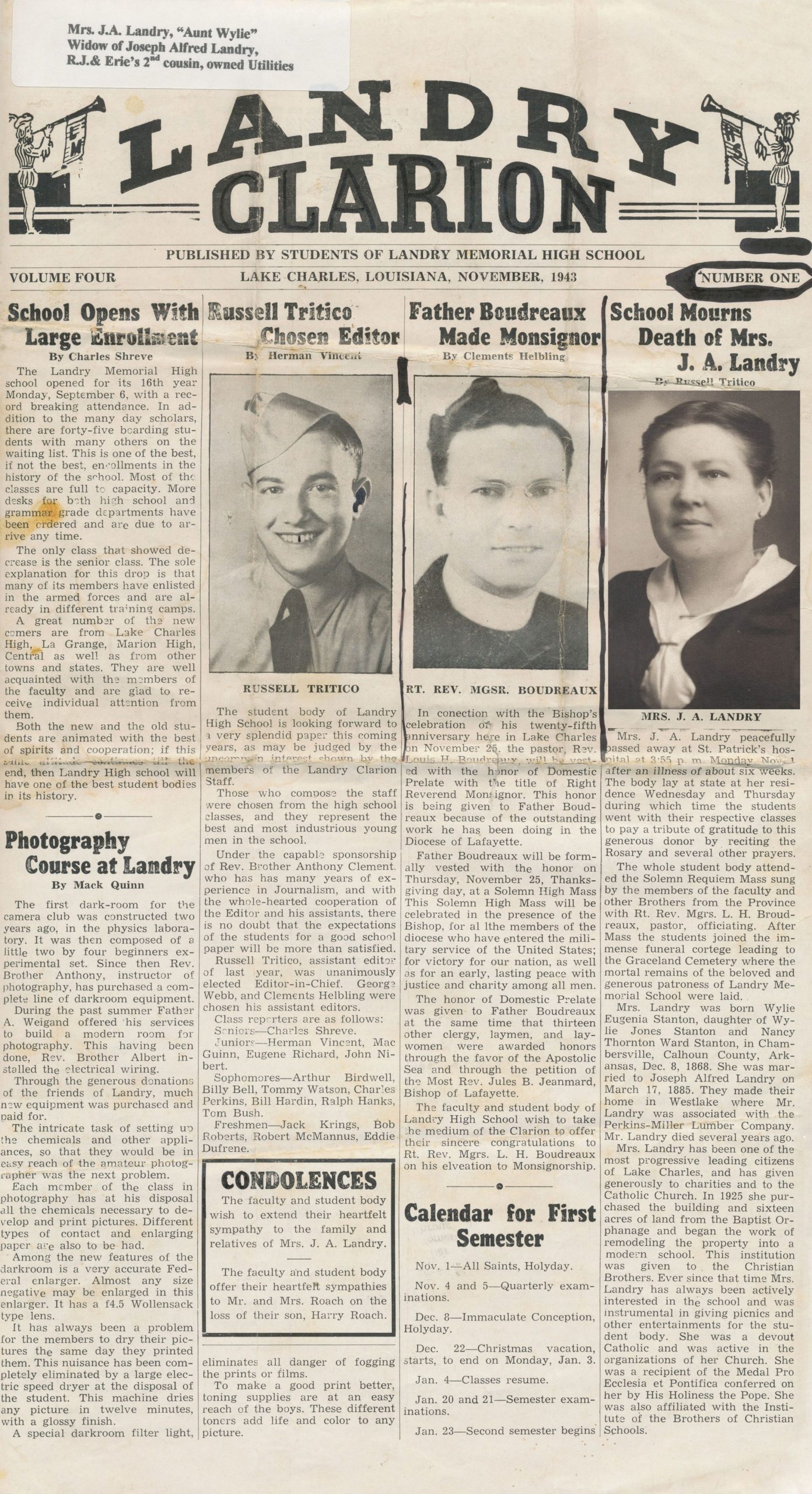
Nov. 1943, p. 3

But later I found out the history of the school and the connection to the family.  When I was in high school, our family sang at Shakey’s Pizza Parlor in Lake Charles.  On Friday nights I remember there being many students from St. Louis High School that would come to listen to us sing and play for them.  Or maybe they just came for the pizza.  In college I went to St. Louis to participate in various meetings and retreats.

During that time I didn’t realize that St. Louis High had once been Landry Memorial.  I probably wasn’t paying attention when my dad likely told us that he went to school there.  To me, St. Louis was just another high school in Lake Charles.  But I found out differently later on.

My dad was an 8th grade student at Landry Memorial in 1943.  In the first photo, he is the center student in the middle row.  If you read the information in the second photo (Nov. 1943, p. 3) at the bottom of the first column, they describe my dad.  “Bobby is small but is full of fight.  I am sure that he will turn out to be as good as his brother was, who played center for the Tigers in 1941.”  The brother they were talking about was my Uncle Hubert, who was a few years older than my dad.  I don’t know if their prediction turned out accurately.  All I ever heard about were his musical undertakings.

Nov. 1943, p. 1

But the first page of that old 1943 paper is interesting as well.  It talks about the death of Mrs. J. A. Landry.  She was born Wylie Eugenia Stanton in 1868.  My dad and his siblings called her “Aunt Wylie.”  She used to send her limousine to pick up my dad’s family on Sundays to bring them to church.  It left an impression.  She died on Nov. 1, 1943.

The school talked about her death because she had been instrumental in developing it.  In 1925 she purchased the old Baptist Orphanage on Seventh Street and had it remodeled to operate as a Catholic school for boys.  The school was dedicated as Landry Memorial High School on December 15, 1927, in memory of her late husband who had died in 1923.

In the school newspaper it mentions that J. A. Landry was associated with the Perkins-Miller Lumber Company.  That is true, but he did much more than that.  He was one of the main driving forces in getting modern utilities developed in Lake Charles.  He ran an ice company called J. A. Landry & Co.  Later he had the Lake Charles Ice, Light, and Water Works Company and Lake Charles Railway, Light and Waterworks Co.  He was a forward thinking entrepreneur.  I suppose that’s why his wife dedicated the school in his name.

He was born Joseph Alfred Landry, Jr. to Joseph Alfred Landry and Marie Aloysia Leveque.  He and my grandparents (Pee Paw and Mee Maw) almost have identical family trees.  There seemed to be quite a few Landry and Leveque connections back then.  They were all related to one another in various ways.  The closest connection was that Pee Paw was J. A. Landry’s half first cousin through their Leveque mothers.  

My great grandmother Celeste Leveque Landry was a half-sister to Aloysia Leveque Landry (their mothers were Landry sisters) and Aloysia’s full brother Justinian.  Justinian was the great grandfather of that Leveque cousin I mentioned at the beginning.

Like I said, he was talking about Landry Memorial High School, too.  It’s a family thing.

From Acadian to Cajun: Part 5 – Bourg/Granger

On the Wall of Names in St. Martinville, Louisiana. Included in the Acadian Exiles of Louisiana are Joseph Bourg with his wife Marie Magdelene Granger and family. Their daughter Marie Josephe Bourg was my 5X great grandmother.

So far I have talked about several families that came to Louisiana after being Exiled from Acadie in the 1750s.  I’ve mentioned the surnames Landry, Babin, Breaux, Trahan, LeBlanc, Gautreaux, Aucoin, Hebert, and Melanson.  I’m surprised at how many names there are, and there are more to go.  I’m learning a lot from doing this series.

One of the things I’m learning is all of the roundabout ways that the Acadians made it to Louisiana.  You’d think that they didn’t want to become Cajuns!  But that was not what was on their minds.  The most important thing was survival, and after that was finding family.  The family we are focusing on this time are the Bourg and Granger families.

Joseph Bourg was born in 1733 in St. Peter & St. Paul, Cobequit, Acadie.  He was the youngest child born to 55-year-old Abraham Bourg and his second wife 37-year-old Marie Theriot.  Joseph had an older sister who was 22 years older than he was.  The information about their parents is scarce.  Their deaths are given as “after 1733,” which means that the last record of their life was the birth of their son Joseph.  Joseph was one of those in the last generation of people who lived their childhood in Acadie.  He was a young adult when the Grand Derangement began in late 1755.

He was not among the first groups of Acadians deported from Acadie.  He was either living in or had escaped to Ile St. Jean, which is now known as Prince Edward Island.  Ile St. Jean was still under French rule, so it was a sanctuary for some of the Acadian people.  It was still a time of uncertainty because they knew they could be Exiled at any time.  Yet Joseph did not put his life on hold.  In 1757 he married Marguerite Josephe Dugas.  They only had a short time together in Acadie.

After the fall of Louisbourg in July 1758 to the English, it was decided that the inhabitants of Ile St. Jean were to be Exiled to France along with other Acadians.  Several transport ships were assembled in November, when the Acadians were deported from the only homeland they knew.  They traveled on one of the “Cinq Paquebots Anglais” (“Five English Ships”).  The voyage was met with terrible disasters.  A storm delayed the ships from their intended departure date.  When they finally set out to France, they were met with another storm.  It is believed that some 1300 Acadians were lost at sea during that winter voyage to France.

Joseph was not spared from the suffering.  His wife Marguerite died on the trip, as well as his sister Elizabeth, his brother Jean Pierre, and his sister Madeleine, along with her three youngest children.  A very sad trip indeed.  Yet he did survive, as did his brother Alexandre.  They arrived in St. Malo, France on January 23, 1759.

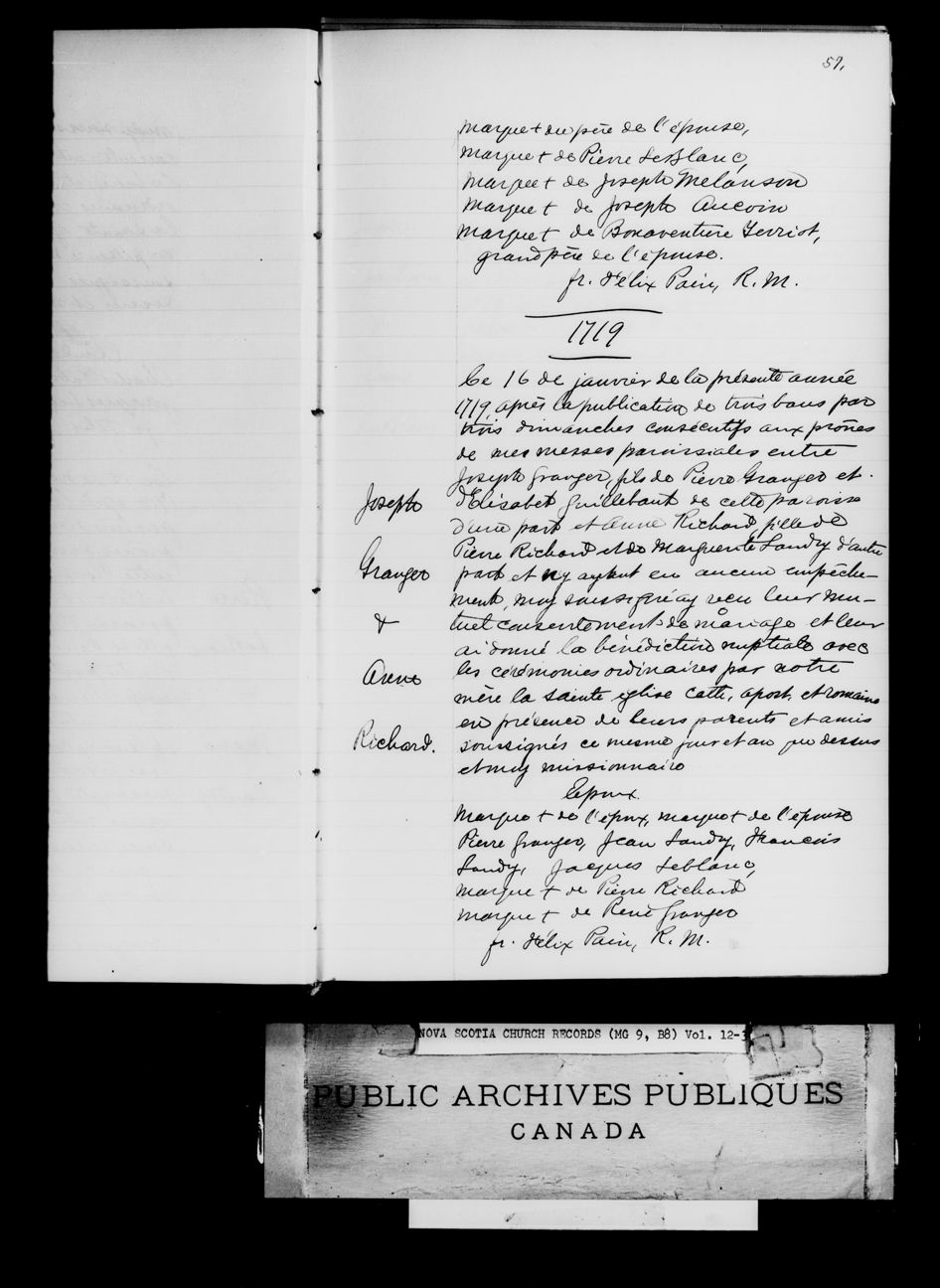
Marriage document from Jan. 16, 1719.

Meanwhile, back in Acadie on January 16, 1719,  Joseph Granger married Ann Richard.  What’s interesting about this marriage is that there are some documents that survived from that time.  Most of the records were destroyed by the British during the Grand Derangement.  But some of them were hidden away and brought into Exile in Maryland.  When those Acadians made their way to Louisiana 12 years later, the documents made it there as well.  Pretty amazing.

Birth record for Marie Magdeleine Granger and her twin sister Anne.

The other interesting thing about this couple is that they had a daughter named Marie Magdelene who I descend from.  She was born in 1731 in Grand Pre, Acadie.  She, too, grew up in Acadie.  In 1750 she was married to a man named Alain Bujold.  In 1752 Magdelene and Alain were living in Ile St. Jean with their 9-month-old son Simon.  They had a daughter in 1756 that they named Marie Louise.  Like others living in that area, they were not deported until the fall of Louisbourg in 1758.

Magdelene was not spared from suffering during the voyage of the “Cinq Paquebots Anglais.”  Little Louise Marie died during the crossing of the ocean.  Her husband Alain’s parents (Oliver Alain Bujold and Madeleine Boudrot) also died on the voyage.  Alain would die within the first month after their arrival in St. Malo in January of 1759.  Less than a month later her boy Simon would die as well.  She must have been surely and thoroughly heartbroken with all of that loss.  She was all alone in a foreign land. 

Do me a favor and read that last paragraph again. (Or read a more detailed account here.) I think Magdelene deserves it.  She was forced from her home and lost everything that was most dear to her.  It must have been devastating.  How could she find the hope and strength to carry on?  I don’t know how she did it, but I know she did.  Otherwise I wouldn’t be here.  So let’s see what she did next.

At some time during 1759 or 1760 Magdelene met (or met again) fellow Acadian Exile Joseph Bourg.  They probably knew each other because they were second cousins from their Landry grandparents.  That did not deter them from getting married on June 30, 1760, in Pleurtuit, Ile-et-Vilaine, France.

In 1761 Magdelene and Joseph had twin sons who they named Joseph and Pierre.  A year later little Marie Joseph came along.  She is my 5X great grandmother.  In 1765 they had another son and they named him Sebastian.  The family was in St. Servan for a while, then moved on to St. Coulomb.  They were following the same path as other Exiles who were trying to form a community in France.  They had two more children, Jean Baptiste in 1768 and Elizabeth Blanche in 1770.  In 1774 Joseph’s brother Alexandre died.

Like many Acadians in France during the Exile, they found themselves in Nantes in  1776.  One of their twin sons Joseph died, and Pierre was married to fellow Acadian Marguerite Dugas.  In 1785 Joseph, Magdelene, and their four youngest children boarded the ship La Bergere headed for Louisiana.  Pierre was on the same ship with his wife.  They arrived in New Orleans on August 15, 1785.  They eventually made their home along Bayou LaFourche.

The last bit of information that I have about Joseph and Magdelene comes from the 1788 census of the LaFourche District.  It shows that Joseph was  the 56-year-old head of a household that included his 54-year old wife Marie (Magdelene) Granger, his 19-year old son Jean Baptiste, and his 18-year-old daughter Elisabeth. He and his family lived on a piece of land with six arpents frontage. They also had a cow, two horses, and four hogs.

Missing in that household was 27-year-old Marie Josephe.  Once again, what happened to her is a story for another time.

Unlike other ancestors in my tree, there is only one path to Joseph Bourg and his wife Marie Magdelene Granger.  It goes through my paternal grandmother Germaine Erie Patureau, or Mee Maw as we call her.


For other installments of this series of blog posts, click on the following links:

From Acadian to Cajun: Part 1 – Landry/Babin

From Acadian to Cajun: Part 2 – Breau/Trahan

From Acadian to Cajun: Part 3 – Braud/LeBlanc/Gauterot/Aucoin

From Acadian to Cajun: Part 4 – Hebert/Melanson

From Acadian to Cajun: Part 6 – Bujol/LeBlanc

From Acadian to Cajun: Part 7 – Foret/Bujol

From Acadian to Cajun: Part 8 – Hernandez/Babin

From Acadian to Cajun: Part 9 – Dupuis/Dugas

From Acadian to Cajun: Part 10 – Bourg/Babin/Landry

From Acadian to Cajun: Part 11 – The Ones That Didn’t Make It
Good-bye, Karen

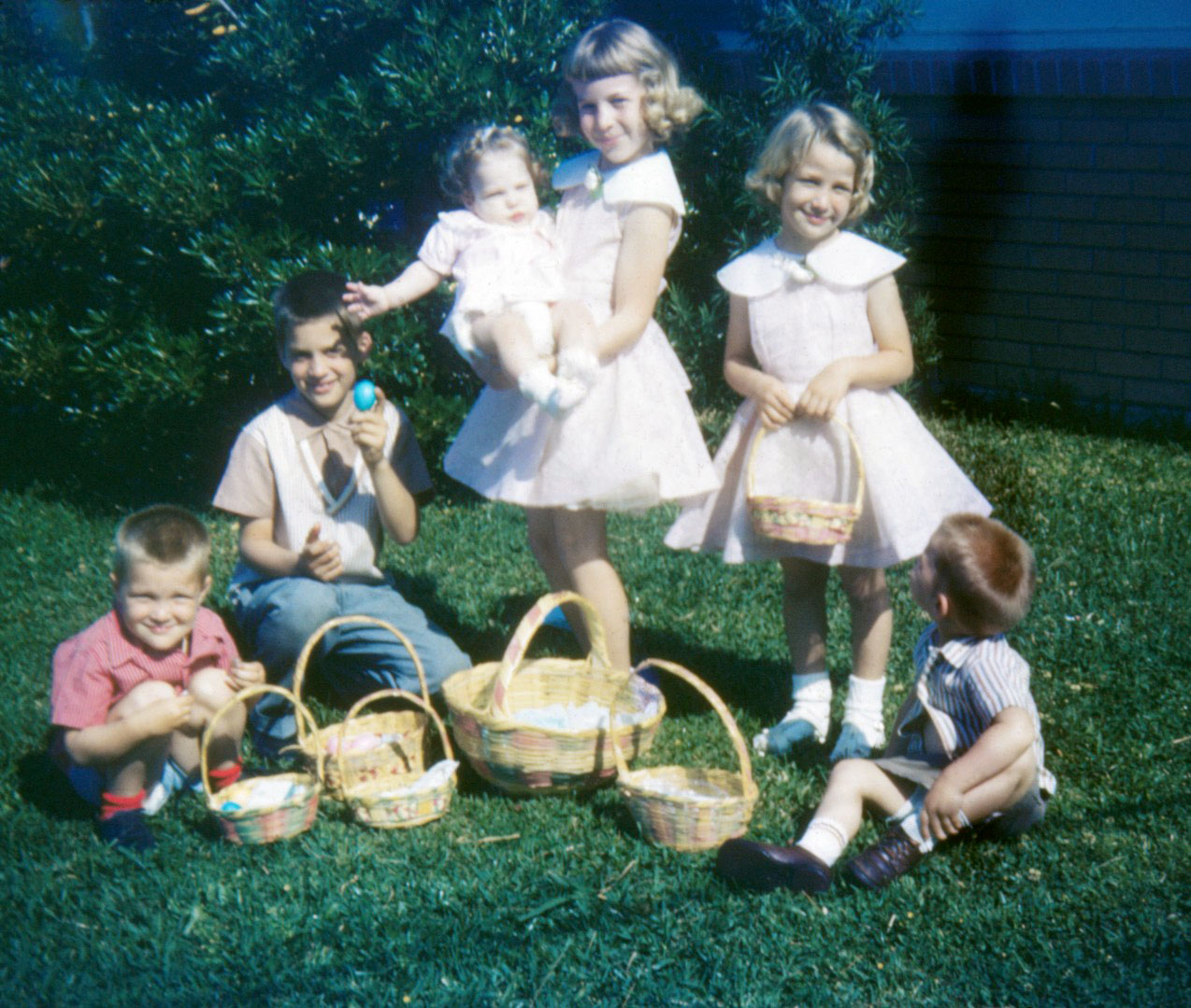
Easter 1963 – The Landry family siblings in happier times. From left to right is Al, Rob, Jamie, Jodie, Karen, and Van.

I was planning on writing a post in my “From Acadian to Cajun” series that I’ve been doing this year.  But then something happened that is so much more important – last night my older sister Karen passed away.

What can you say about a sibling who has passed away?  Nothing seems to be enough.  There is such a long history together.  She was already part of the family when I came around.  It seems like she should still be here, but that’s not the way life goes sometimes.  

She was diagnosed with Multiple Systems Atrophy about three years ago after several things started going wrong.  As the name implies, various systems in a person’s body begin to atrophy.  A person slowly loses functioning in the body over time.  Time that I thought we would have more of.

What I can say about her is that she dealt with her condition admirably.  She always seemed to me to be upbeat and positive.  She was a sweet and loving person.  Saying that sounds trite, but it is true.  She was a peaceful soul.  She will be missed.

Good-bye, Karen.


My Dad’s Maternal Line

I try to switch back and forth between my father’s side of the family to my mom’s side of the family.  It’s only right that I give them equal time.  Plus I have stories to tell about both sides of the family.  Then I try to cover each of my grandparents’ lines about once a month.  But then a great story will come along and throw everything off, because I just have to share it with everyone.

So according to my figuring, it is time to write a Patureau post.   I looked through my info and decided on a story of my dad’s maternal line.  The only problem with that is that when you follow the maternal line, the surname changes every generation.  But my dad’s line is unusual.  He was a Bob Landry and his mother was Germaine “Erie” Patureau.  His grandmother was Marie Therese Landry.  His great grandmother was Marie Amelie “Belite” Bujol.  Belite was the daughter of Anna Adele Landry.

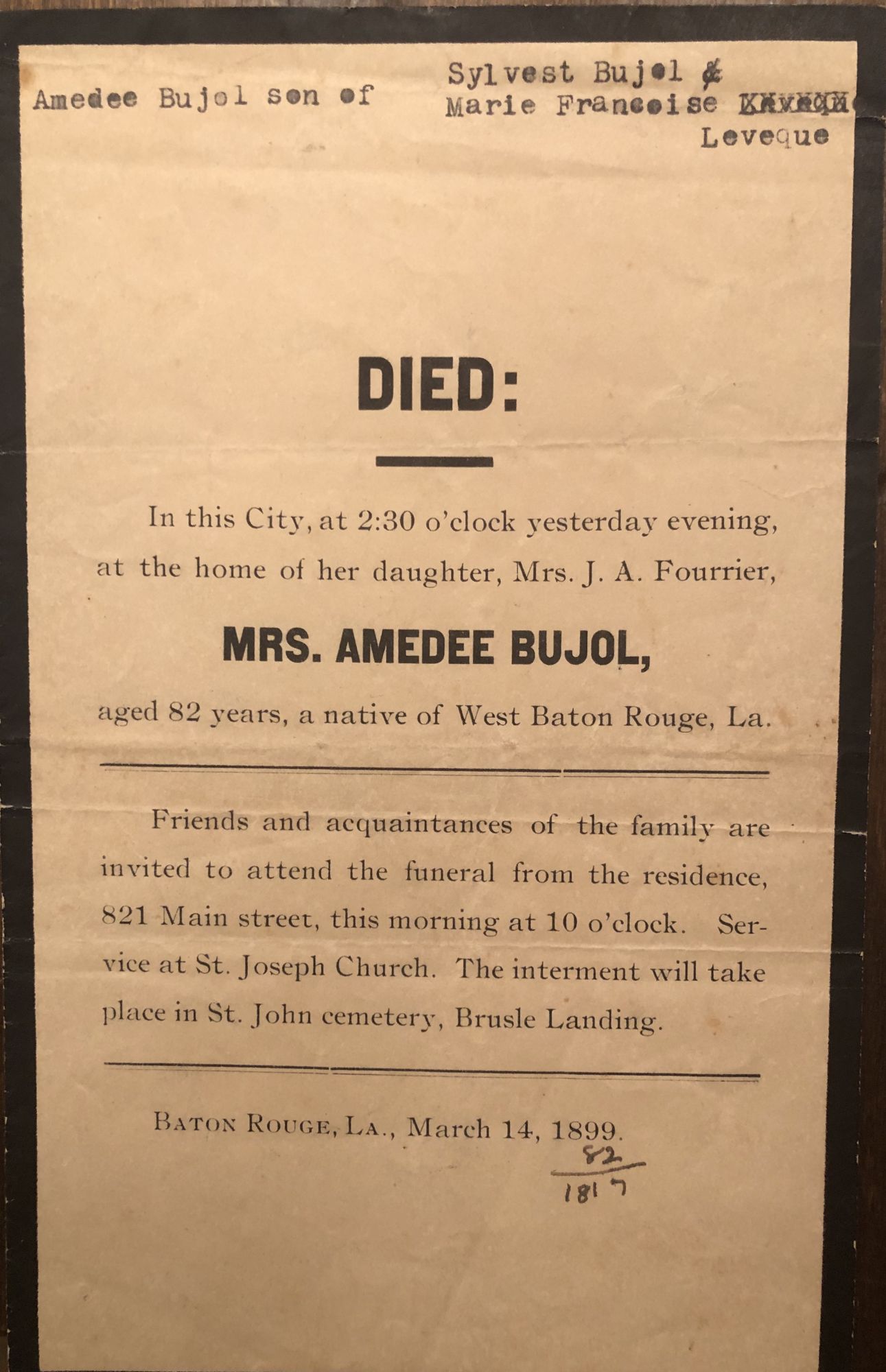
Death notice for Mrs. Amedee Bujol on March 14, 1899

So how is that for a Patureau story?  It’s full of the Landry name!  I shouldn’t be surprised, because everywhere you look in his tree you’ll find a Landry.  But then again, almost all of the Patureau families in southern Louisiana, Texas, and beyond descend from a Landry.  The Patureau immigrant Ferdinand Patureau was married to Marie Emma Landry, the half first cousin to Anna  Adele Landry.  So we’re all one big happy family anyway.

The impetus for this post is this death notice that I “found” last year.  Actually it was shared with me and other cousins by our cousin Daphne – she of the “Secret Collection.”  The death notice only identifies the deceased as “Mrs. Amedee Bujol,” with no indication of her first name or maiden name.  Then at some later date someone (my grandma Erie -better known as Mee Maw – or my dad) typed in more information.  But that information is only more facts about Amedee Bujol and not about Mrs. Amedee Bujol.

Well let me tell you who Mrs. Amedee Bujol was.  She was Anna Adele Landry.  She was born on June 21, 1817, in St. Gabriel, Louisiana.  Her parents were Manuel Landry and Celeste Bruneteau.  When she was 22 years old, she married the infamous Amedee Bujol (full name Joseph Hubert Amedee Bujol) and took his name.  Over the next thirteen years they became the parents of ten daughters in a row!  Finally in 1856, they gave birth to a son.  Amedee died the next year from exhaustion!  Not really.  He did die, but I don’t know what the cause was.  He was buried in Brusly, leaving Adele a widow with nine small children.  (Twin daughters had died in infancy in 1851.)

In the 1860 Census she was listed as “Widow A. Bujol” in the household of “Leveque & Bujol” in Iberville Parish.  It identifies Leveque & Bujol as planters, but there was a Louis Leveque in the household and he was a lawyer.  He was a first cousin of Amedee Bujol (his mother was a Leveque) and it looks like he may have been in business with Adele.  So they had a plantation or worked with a plantation in pre-Civil War times.  But the war was not too far off.

On April 26, 1861, Brusly had a big celebration with their citizens to cheer on those young men who were going off to fight for Southern Freedom.  There were bands playing and crowds cheering as the military men showed up with their new uniforms and armament.  Adele Landry Bujol (known as the Widow or Veuve Bujol) played a part in that celebration.  She and some of her “beautiful” daughters sewed a new company flag for the Acadian men of the Tirailleurs.  Her daughter Amelie “Belite” would later marry one of the war heroes from the Tirailleurs – Trasimond Landry.

My dad’s family tree showing maternal line to Anna Adele Landry Bujol

In the 1870 Census, Adele is listed as “Amedee Bujol,” a 52 year old female with three daughters, one son-in-law, and a domestic servant.  I can see being called the Widow Bujol, but it seems strange that she would be known by her husband’s name years after he died.  Finally in 1880, she is listed as Adele Bujol when she was living with her daughter Belite and Belite’s second husband Magloire Babin.  Belite did not stay a widow for very long like her mother had.  In fact, Trasimond died in Feb. 1879 of yellow fever and Belite gave birth to a child by Magloire Babin on May 31, 1880.  So she was married at least within seven months of Trasimond’s death.  Not that there’s anything wrong with that.  It’s just such a difference from her mother being a widow for 43 years and her grandmother (Marie Francoise Leveque Bujol) being a widow for 51 years.

Before I found that death notice for Adele last year, the 1880 Census was the last record I could find for her.  So for her death, all I could know for sure was that it was “after 1880.”  So I was excited to finally find the exact date of her death.  It looks like she died on March 13, 1899, at the house of her daughter Mrs. J. A. Fourrier (nee Anaise Amenide Bujol) at 821 Main Street in Baton Rouge, Louisiana.  That’s not far from where I live.  She was buried across the river at the Catholic Cemetery in Brusly.  I would think she would be buried near Amedee.  I found his grave at the Brusly cemetery, but didn’t see hers. 

So ends my story of Mrs. J. H. A. Bujol.


March 27, 2020 – I went by the address where great great great Grandma Adele took her last breath.  This is not the house that was there in 1899, but it is the same location.

From Acadian to Cajun: Part 4 – Hebert/Melanson

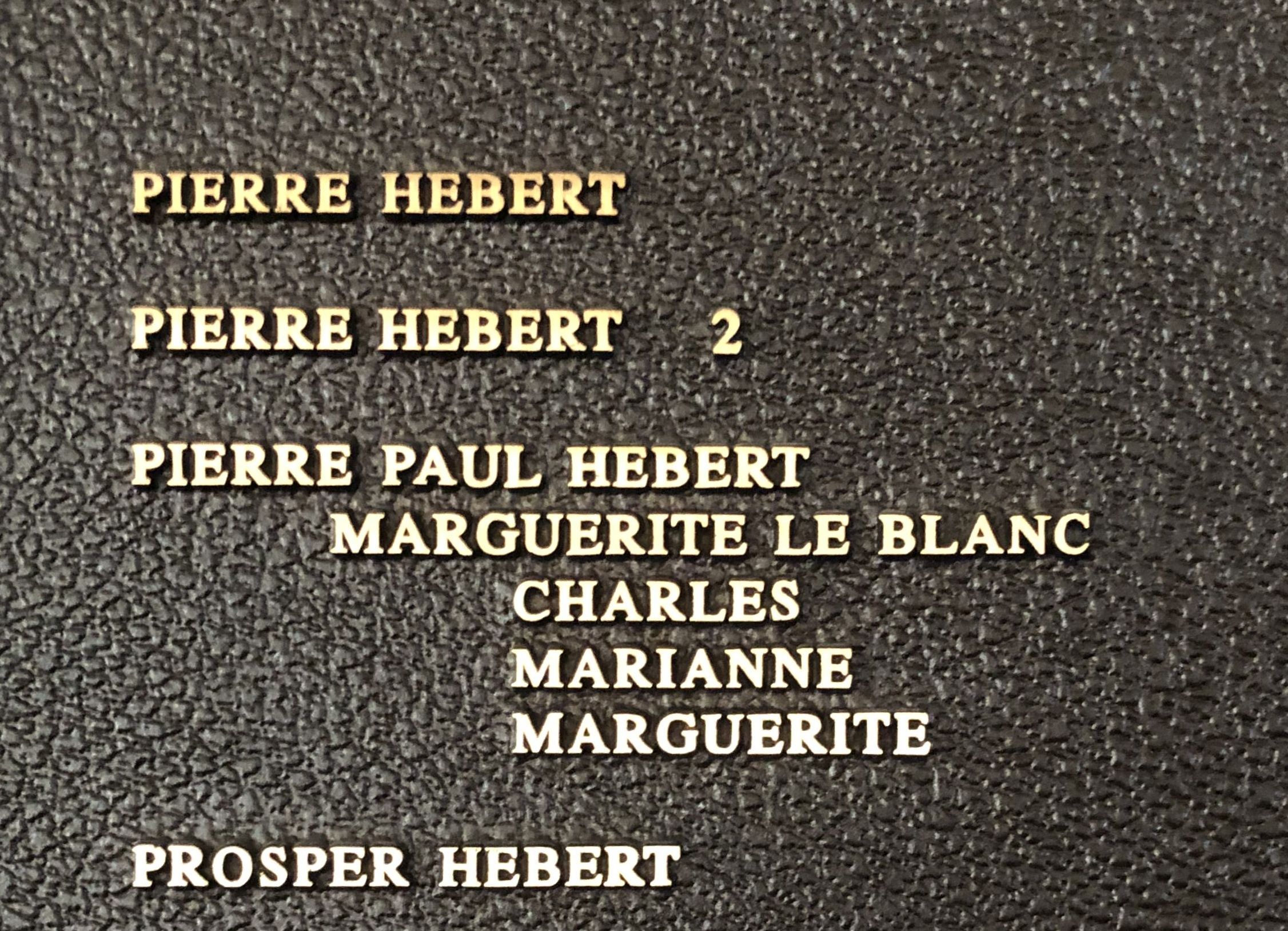
Paul Hebert and Marguerite Melanson were my 5X great grandparents who came to Louisiana from Acadie via Maryland.

It’s time for another installment of the series about my ancestors who went through the Grand Derangement.  This was when the French-speaking inhabitants of Acadie were Exiled from their homeland by  the British.  The year was 1755 and there was a war going on between England and France.  So this made the English leery of those people who spoke funny and followed the Roman pope.  They were just altogether different and not to be tolerated.  So off they were sent with minimum belongings and maximum uncertainties.

Pierre Paul was the son of Paul Gaston Hebert & Marguerite Josephe Melanson.

The family line I’ll talk about this time is the most common Acadian/Cajun surname in Louisiana – or so I’ve been told.  I’ve always thought that the Landry name was the ‘Smith’ of southern Louisiana.  But I’ve been corrected by some of my Hebert kin.  It seems that the Hebert name is the most common.  But that’s okay with me.  I once said that I am a Patureau.  Well, now I am saying, “I am an Hebert.”  Let’s look at that connection.

Record of the 1736 marriage of Paul Hebert & Marguerite Josephe Melanson. The title of the entry shows Marie Josephe Melanson, but the body of the entry shows the correct name of Marguerite Josephe Melanson

 On April 13, 1712, my 5X great grandfather Paul Gaston Hebert was born in St. Charles Aux Mines, Acadie.  His parents were Guillaume Hebert and Marie Josephe Dupuis.  On November 6, 1718, my 5X great grandmother Marguerite Josephe Melanson was born in Grand Pre, Acadie.  Her parents were Phillip Melanson & Marie Catherine Dugas. 

Paul and Marguerite  grew up in their parents’ households in Acadie before the Great Upheaval, as did several generations of their family before them.  Their great great grandparents had founded Acadie a hundred years previously.  Many generations had been born there and died there. Marguerite lost her mother in 1733, and she would be the last of this line to be buried there.  This also meant that her mother was not present when Marguerite married Paul on May 14, 1736, in Grand Pre.

In 1737 Marguerite and Paul had their first child, a son named Pierre Paul.  He was my 4XG grandfather.  Another son Joseph was born in 1739 and I don’t descend from him.  In 1745 they had a daughter named Anne Marie.  I descend from her.  Twice.  Oh, no.  That’s not right.  I descend from her three times through her two husbands.  But now I’m getting ahead of myself.

Marguerite and Paul had a total of nine children before the Grand Derangement in 1755.  The names were Pierre Paul, Joseph, Charles, Marie, Anne Marie, Ignace, Madeleine, Jean Baptiste, and Armand.  Considering some of my ancestors that were deported to Virginia and consequently to England where there was lots of disease and disasters, the Hebert family was fortunate to be sent to Georgetown, Maryland, for their period of Exile.  It was still no picnic in the park and I wouldn’t wish their treatment on anyone that I know.  They were expelled from their homes and shipped to an unwelcoming foreign place.

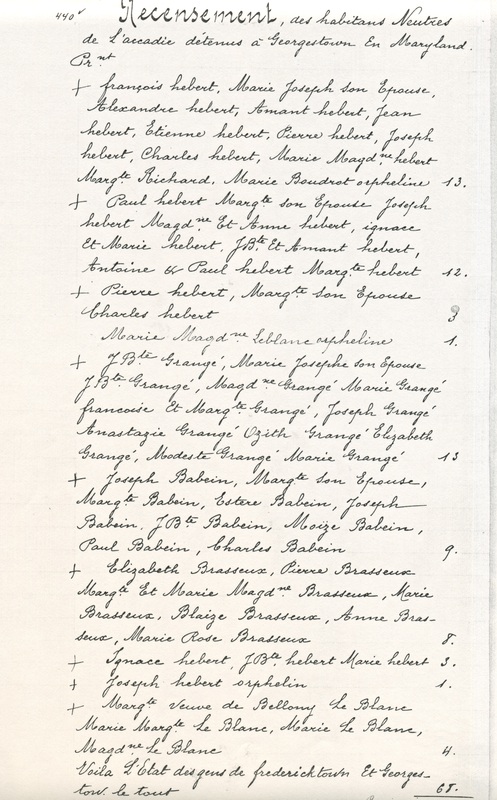
1763 Georgetown, Maryland, Census

And yet the family continued to grow.  During their first five years of Exile in Maryland, Marguerite and Paul had three more children:  Antoine, Paul, and Marguerite.   They had their youngest child in 1760, which was the same year that their oldest Pierre Paul got married.  He married a fellow Acadian Exile by the name of Marguerite LeBlanc.  I’m not certain of her parents, but I think their names were Antoine LeBlanc and Marie Babin.  I do know that Pierre Paul and Marguerite had a son named Charles in 1762.

So when the 1763 Census in Georgetown was taken of the French Neutrals, there were lots of Heberts to be found.  That is easy to see from the list of names.  The first group of names starts with Francois Hebert.  He was a first cousin to Paul Hebert.  Francois’s wife Marie Joseph Melancon was first cousin to Paul’s wife  Marguerite Joseph Melancon.  The next group listed is Paul and Marguerite.  Then there is Pierre Paul, Marguerite, and their new little son Charles.  The next three families listed are a Granger, a Babin, and a Brasseux.  The next one listed is Ignace Hebert, who is a brother of Paul.  The last family group on this page starts with the name Marguerite veuve Bellony LeBlanc.  That means that Marguerite was the widow of Bellony.   She was the sister of Paul Hebert, which shows that there were many family members present with them in Georgetown.

There is not much more information about their term of Exile in Maryland.  There is a marriage registered by Rev. Joseph Mosley in his journal.  It reads “26 Dec. 1765 (Thu) married Joseph Hebert and Anne Mary Landry; witnesses John Blake, Mrs. Witherstrand, and many French; second and third degree dispensations.”  That would be Paul Hebert & Marguerite Melanson’s son Joseph.  I think the dispensation was due to fact that the two lovebirds were cousins through the Melanson family name.  I’m sure that did not deter the “many French” from passing a good time!

When we next hear of this family group, they are among the Acadian Exiles who settled in St. Gabriel, Louisiana, on July 27, 1767.  According to the records, they owned one axe and two trunks.  Really?  Couldn’t they fit that axe in one of those trunks?  That just tells me that they weren’t very good packers!  Or maybe there was some significance to the axe that I’m not aware of.

In 1769 Anne Marie Hebert was 24 years old and at a good age for marrying.  So when she met another Acadian Exile who had settled in Louisiana, that’s just what she did.

But that story is for another time.

_____

Here is my family tree showing the shortest link to my Hebert ancestors.


For other installments of the “From Acadian to Cajun” series, just click on the following links:

From Acadian to Cajun: Part 1 – Landry/Babin

From Acadian to Cajun: Part 2 – Breau/Trahan

From Acadian to Cajun: Part 3 – Braud/LeBlanc/Gauterot/Aucoin

From Acadian to Cajun: Part 5 – Bourg/Granger

From Acadian to Cajun: Part 6 – Bujol/LeBlanc

From Acadian to Cajun: Part 7 – Foret/Bujol

From Acadian to Cajun: Part 8 – Hernandez/Babin

From Acadian to Cajun: Part 9 – Dupuis/Dugas

From Acadian to Cajun: Part 10 – Bourg/Babin/Landry in a short story called “Finding Home”

From Acadian to Cajun: Part 11 – The Ones That Didn’t Make It

Aunt Framay Has Passed Away

The Landry family had sad news this week.  My dad’s youngest sister Frances Mae Landry Raley died on February 26, 2020.  She was born May 6, 1934, to Robert Joseph “Rob” or “Pappy” Landry, Sr. and Germaine Erie (our beloved Mee Maw) Patureau Landry.  She was the seventh of eight children.  She was the youngest of four girls.  And she was a real sweetheart.

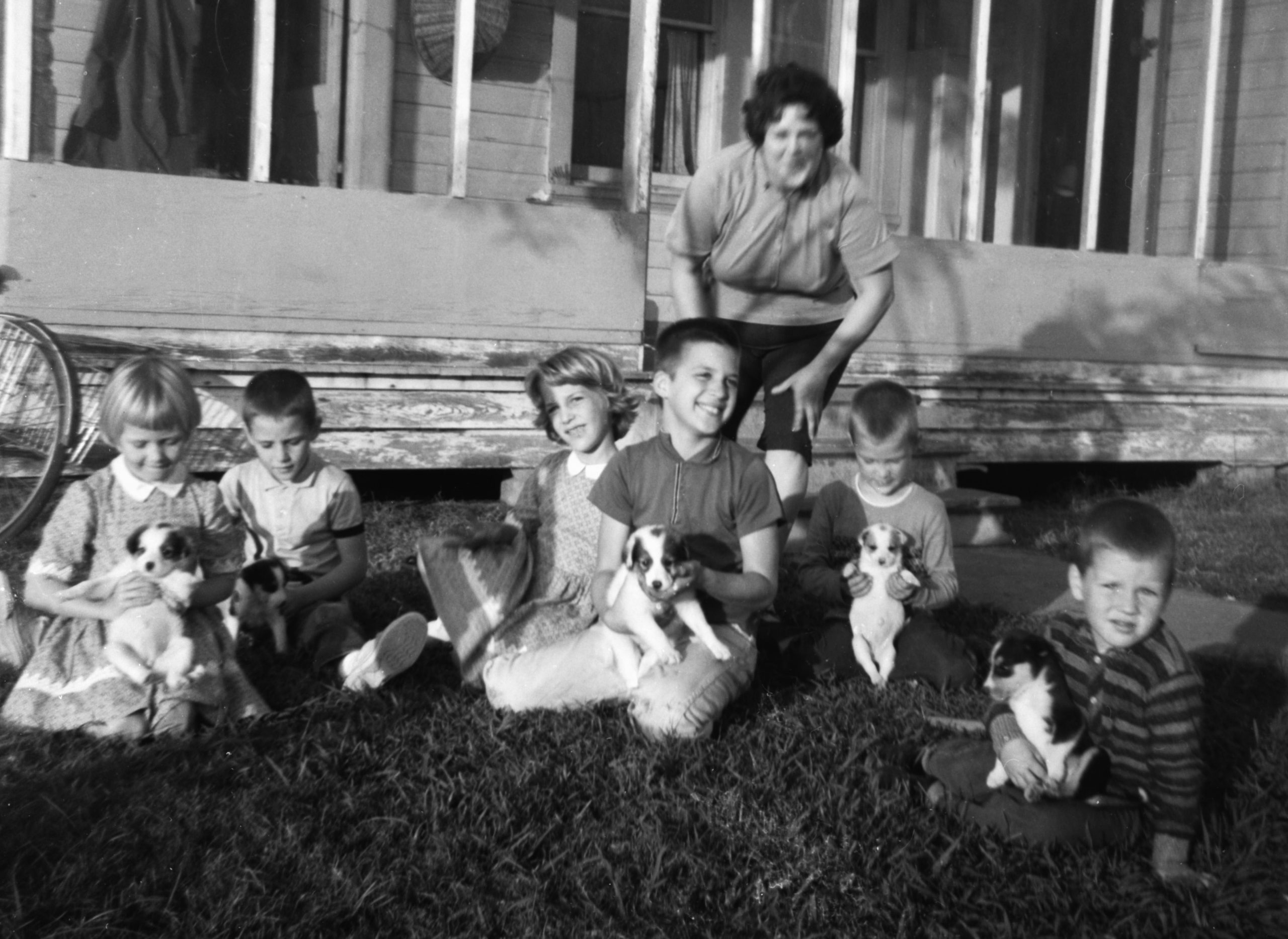
The Landry and Raley cousins visiting in June 1964 in Jennings, Louisiana.

My earliest memories of her were when I was just a kid.  Aunt Frances would not be considered a dainty woman at this point.  So when she came toward this little 3-year-old boy with her loving heart and big kisses, I was a little bit intimidated!  Like in this picture from June of 1964, she is bending down to greet me with a kiss and I am nowhere to be seen! 

My dad’s Landry family tradition of kissing one another in greeting was off-putting to my mom’s sensibilities and I probably took after her when I was a kid.  But don’t get me wrong.  I always liked my Aunt Framay, but I did avoid those kisses from time to time.  It wasn’t like with Cousin Tez.  We avoided her like the coronavirus.  We didn’t want to catch those bumps.  There is a huge difference.  If you don’t see it, then I didn’t explain it well.

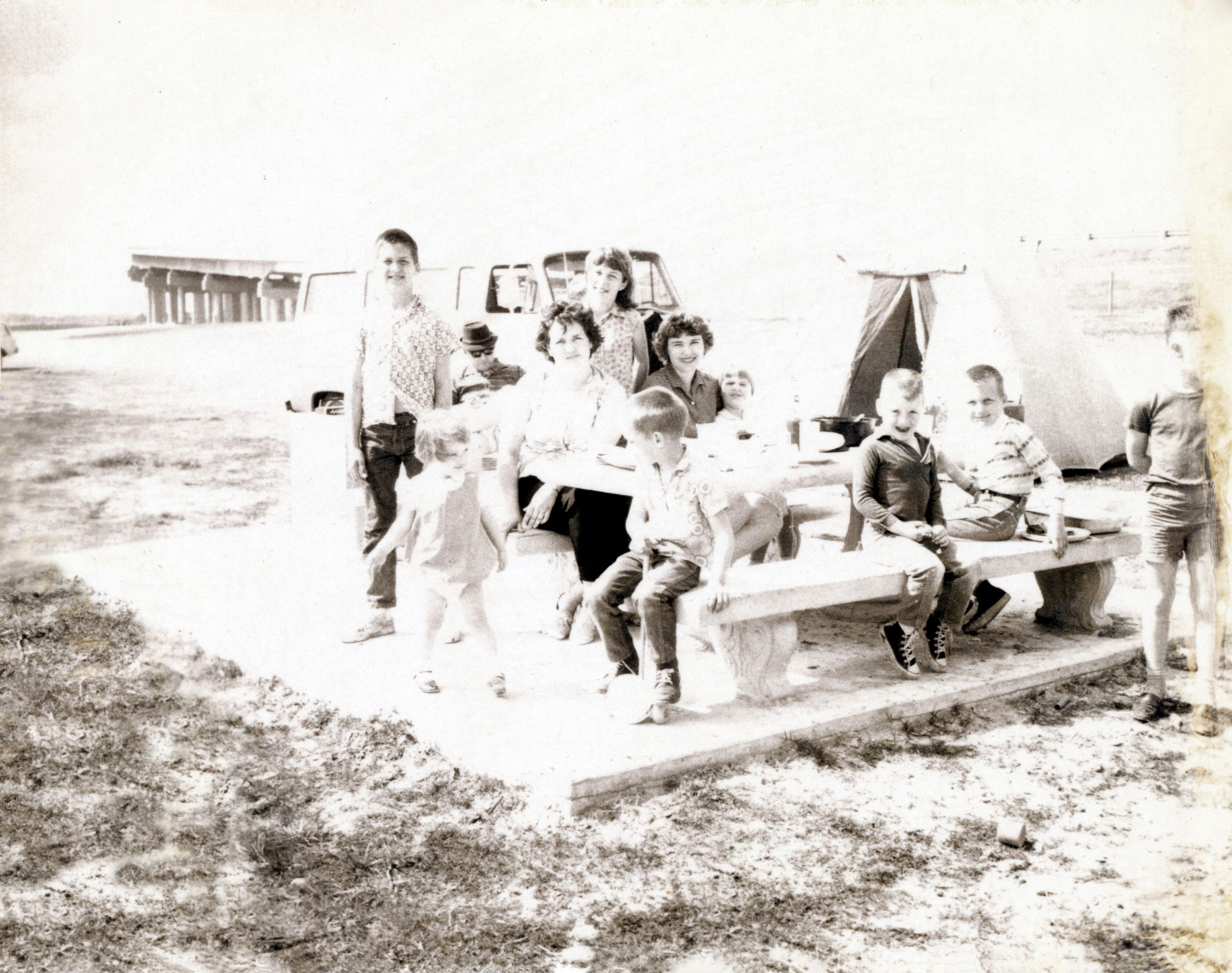
July 4th picnic in Lake Charles circa 1965. Rob Landry, Colleen Raley, Joe & Frances R., Jodie, Van, Betty, and Jamie L., Greg R., Al L., and Scott (I think) R.

This photo is from a year later when the family got together in Lake Charles.  I’m sure it was a July 4th get together for the whole Landry family.  But this picture again shows mainly the Bob Landry family and the Frances Landry Raley family.  I’ve always liked this photo even though it is overexposed. 

Mama is smiling nicely in the photo and Aunt Frances is acting all nonchalant like she’s not thinking about sneaking a kiss from me.  But as you can see, I’m not buying it for an instant!  I’ve got my head turned slightly, just in case she tried a sneak attack.  That woman was light on her feet!

I’m sorry.  I shouldn’t talk like that, especially since she is recently deceased.  But she had a great sense of humor, so I’m sure she’d approve.  The only thing I’ve thought about this photo before tonight was that I wished I had been looking at the camera.  There were no worries about a sneak attack that I can recall.

Me with Aunt Frances at my parents’ 50th wedding anniversary in 2002 sharing a laugh.

What I do remember about Aunt Frances was that not only was she very loving, there was a strength about her.  Very specifically at two tragic events.  The first one was at Mee Maw’s funeral in 1973.  It was the first time I remember witnessing my dad crying.   I also remember him being comforted by his sisters, particularly by Aunt Frances.  She was an emotional rock for the family.   The other event was the funeral of my sister Jodie in 1989.  My parents were really torn up at the loss of their firstborn child.  Aunt Frances’s hugs and kisses were exceptionally comforting on that day.  She had a big heart.

I remember her being a comfort to me at my parents’ deaths in 2017, but at that point her superpowers were starting to wane.  Not that she was any less loving, that power continued until the end of her life.  But her body was giving out slowly as it does with age.  There was no more sneaking around with her powerful hugs and kisses.  That was a definite shame.

There is a line from one of my favorite movies that goes something like, “I can’t continue being stingy with my loving.  Before this I would measure it out and only return what I was given.  Now I see that one must get on with one’s loving.  Giving love is what matters.”  That is the way I saw my Aunt Frances.  Always ready to love.

Even silly little boys who didn’t know what love was when it smacked them in the face! 

From Acadian to Cajun: Part 3 – Braud/LeBlanc/Gauterot/Aucoin

The second installment of this series was about Antoine Breaux and his close family.  He was the son of Charles Breaux.  This week we are looking at the family of Antoine’s first cousin Honore Breaux – my 4X great grandfather.  His father Pierre was the brother of Charles and his mother was Marguerite Gautrot (More commonly seen in southern Louisiana as Gautreaux).

Honore was born in the small Village of Breau in Pisiquit, Acadie, in 1735.  This is where he spent his childhood.  He was the second of seven children with a good mix of four boys and three girls.  Though there was a war going on between France and England during some of his childhood, it was mostly occurring in the Old World.  There were some consequences to Acadie, but his home life was probably undisturbed by it.  He was one of the last of the Acadians to have an undisturbed childhood in Acadie.

Honore was 20 years old when the time of the Exile began in the middle of 1755.  He was likely living on his own, because he was not rounded up with his immediate family.  He was deported to Virginia, while his parents were sent to Maryland with the large group of the Breaux family we talked about last time.  That didn’t seem too far from Virginia, right?  Maybe he would someday see his parents and siblings again.

Honore’s future wife (and my 4X great grandmother) took a different route to their eventual meeting.  Elisabeth LeBlanc was born in 1743 in Beaubassin, Acadie, to Victor LeBlanc and Marie Aucoin.  She had an older sister named Marie Marguerite and younger brothers named Pierre, Armand, and Olivier.  Before I tell you about their odyssey, let me go back a little further with their family to show just how much an impact the Grand Derangement had on this family.

Victor LeBlanc died before the Exile (in 1750), but his wife Marie Aucoin was alive at the time.  Her parents (Elisabeth’s maternal grandparents) were Rene Aucoin & Madeleine Bourg.  At the time of the Exile, Rene and Madeleine were deported to Virginia, which was where their granddaughter’s future husband also was sent. 

Virginia was not a very welcoming place for the Acadians.  By the spring of 1756, Governor Dinwiddie was ready to rid himself of these “internal enemies.”  So by May 10th over 1000 Acadians were thrown out of Virginia and sent to England aboard ships Fanny Bovey, Virginia Packet, Bobby Goodridge, and Industry.  Rene Aucoin & Madeleine Bourg and Honore Breau were aboard Virginia Packet.

The ships of exiled Acadians began arriving in English ports starting on June 18th.  Virginia Packet was in Bristol, England, the following day.  The town was unprepared for them because they weren’t told about the departures from North America.  For three days they were left at the wharves.  They were then housed in old, ruined buildings.  Many of the young, old, or weak died of smallpox and exhaustion.  Rene (66) and Madeleine (62) were dead before September of that year.  Rene’s (Aucoin) family was really hit hard.  Within that same year, his sister Agnes and six of her children died from smallpox and neglect.  Honore must have been a sturdy 21-year-old, because he made it through this place of disease and death.  He and the other surviving Acadians were then moved to Falmouth in October, 1756.  He was continually getting further away from his parents, so his chances of reuniting with them were decreasing as time went by.

Meanwhile his future wife Elisabeth LeBlanc avoided that initial round of deportations.  Her mother Marie Aucoin had remarried to a man named Gregoire Maillet around 1751 and they relocated to Ile St. Jean.  They had a daughter named Marguerite in 1752 and a son named Felix in 1754.  Since Ile St. Jean was still under French Rule, they were not Exiled in 1755.  It was still an unstable situation with conflicts going on between England and France.  In the midst of all of this, Marie and Gregoire welcomed little Madeleine to their family in 1756. 

Ile St. Jean did not remain under French control very long.  The French stronghold at Fort Louisbourg fell to the English in July of 1758.  It was decided that the French inhabitants of Ile St. Jean would be deported to France. Elisabeth and her family were treated as prisoners for a few months. She was able to stay together with her family, except for her older sister Marie Marguerite who had got married earlier that year.  Her fate was now connected to her husband.  The household of Gregoire Maillet and Marie Aucoin were loaded onto the Tamerlan in late 1758 with a destination of France.

The ship arrived in St. Malo, France, on January 16, 1759.  There were many tragedies that occurred on these ships deporting the Acadians to France during a time when winter storms can cause troubles.  Though our family were not aboard one of the ships that sank, they still encountered tragedy.  During the transport, young Felix and Madeleine died and were buried in the Atlantic Ocean.  Poor Marie.  I don’t know if she was aware of the deaths of her parents in England, but she was with her two babies when they died on their forced journey.  She was keenly aware of those deaths.

As far as the bigger picture was concerned, this was the time of the Seven Year War.  I’m sure that’s not what it was called when it began in 1755.  The deportation of the Acadians from their homeland continued throughout this time of war.  The Treaty of Paris brought the war to an end in February of 1763.  During the war Exiles in England and in other places were considered prisoners of war.  They were not free to go wherever they chose, nor could they obtain employment.  They were to be provided government funds to meet basic needs, but the funds were not provided in a timely manner.

So at the time of the Treaty of Paris, we find Honore still in England.  We don’t know if he had heard the news of his father Pierre Breaux’s death that occurred sometime before 1763 in Port Tobacco.  Honore was considered a prisoner of war, but now the war was over.  He and several other Acadians were put on board the royal frigate La Dorothée and sent to France.  They arrived on May 23 in St. Malo.  Honore was identified as a 28-year-old single man who was plowman, laborer, and carpenter. 

I’m sure you can all guess what happened next.  When we last saw Elisabeth LeBlanc, she had reached St. Malo with her mother Marie.  Her mother died three months after their arrival in France.  Elisabeth was the oldest of the five remaining siblings, so I’m sure she grew up quickly and helped to care for her younger siblings.  By the end of the war, she was 23 years old.  She met Honore sometime after that, and they were married on Feb. 10, 1766.  They lived in St. Servan, France, at this time.  Nine months after their marriage their first child Jean Charles was born.

My connection to Olive Elisabeth Breaux and her father Honore is through my paternal line.

The most important event happened in 1769.  Olive Elisabeth was born.  She is my great great great grandmother.  She would later marry Joseph Ignatius Landry, who you heard about in the first two installments of this series.  Their third son’s name was Narcisse.  His fourth (and youngest) son was Simon Alcide.  Simon Alcide’s seventh (and youngest) son was Robert Joseph “Rob” Sr., who was my grandfather.  My father was Robert Joseph Jr. or Bob.  He was the third of four sons.  My name is Van and I’m the third of three sons.  There are two other paths from Olive Elisabeth to myself.  I’ll post a chart for those two paths at the end of this story.

In 1771 Honore and Elisabeth had a daughter named Marie Madeleine.  A year later they had a son named Pierre Paul who died 11 months later.   It seemed like they were trying to make a home there.  Honore and his family joined other Acadians in an attempt to develop a community on the island of Bouin in Poitou, France, in 1773.  They had another son Elie in 1774.  The Poitou venture was unsuccessful, so they moved on to Nantes in 1775.  Their last four children were born there:  Jeanne in 1776, Pierre Paul in 1779, and twins Rose Marie and Charles in 1781.  All of their children were born in France.

1763 Census of French Neutrals in Port Tobacco, Maryland, includes Marguerite Breaux veuve (widow of Pierre Breaux)

I had mentioned the possibility of Honore reuniting with his parents after being torn from them during the Great Upheaval.  That was not to happen.  As I mentioned earlier, his father died before 1763.  His mother Marguerite Gautrot Breaux had been with the Breaux group that arrived in New Orleans on Feb. 4, 1768 aboard the Ginea.  They were sent to Natchez in 1768.  She relocated to Ascension Parish in Louisiana and died there in 1773 at the age of 67.  So her name made it to the Wall in St. Martinville, as did her son’s, but they were not reunited in Louisiana.

Marguerite Gauterot arrived in New Orleans in 1768. Her husband Pierre Breau died in Exile in Maryland.


Then in 1783 a Frenchman from Poitou developed a project to relocate the Acadians to Louisiana.  Even though there wasn’t much work to be found in France and the assistance they were provided was sporadic, the Acadians didn’t know if they should trust this proposal.  Other attempts at starting communities had failed and the participants had returned to France.  Once the kings of France and Spain had been sold on the idea, the Acadians soon decided to go along with the idea.

On May 12, 1785, the family of Honore and Elisabeth boarded the LaBergere along with their fellow Acadians bound for Louisiana.  They arrived in New Orleans on August 15 and settled in St. Gabriel near other Breaux family members who had arrived previously.  I don’t know if Honore reunited with any of his siblings or not.  It’s possible that two of his younger sisters made it to Louisiana, so it could have happened.  It’s hard to imagine living in an unsettled situation for thirty years.  That’s a whole generation.  Honore started the Exile as a young man, and when the family found their new home, his oldest son was just about the same age.  At least he made it.  Not all of them did.

In 1787 Olive Elisabeth Breaux married Joseph Ignatius Landry in St. Gabriel.  Honore and Elisabeth were there to see their daughter married.  They survived long enough to see all of the children of Olive Elisabeth and Joseph Ignatius.  In fact, they outlived Joseph Ignatius who died in 1806.  At the time of Joseph Ignatius’s death, court documents of August 4, 1806, show that the guardianship of his minor children was proposed to go to their grandfather Honore Breaux. 

He accepted that responsibility on the same day.

The second path from Olive Elisabeth to myself goes through my Patureau line. All of the Patureau families originating in Louisiana descend from Honore Breaux.

The third path between Honore and me goes through the Civil War hero from the South – Trasimond Landry.


For other installments of the “From Acadian to Cajun” series, click on the following links:

From Acadian to Cajun: Part 1 – Landry/Babin

From Acadian to Cajun: Part 2 – Breau/Trahan

From Acadian to Cajun: Part 4 – Hebert/Melanson

From Acadian to Cajun: Part 5 – Bourg/Granger

From Acadian to Cajun: Part 6 – Bujol/LeBlanc

From Acadian to Cajun: Part 7 – Foret/Bujol

From Acadian to Cajun: Part 8 – Hernandez/Babin

From Acadian to Cajun: Part 9 – Dupuis/Dugas

From Acadian to Cajun: Part 10 – Bourg/Babin/Landry

From Acadian to Cajun: Part 11 – The Ones That Didn’t Make It

1 14 15 16 17 18 27