From Acadian to Cajun: Part 10 – Bourg/Babin/Landry

Finding Home

Magdelena Babin was in charge.  She didn’t necessarily want to be in charge, but she was.  So many others had died.  She had been through it so many times before, even been on the receiving end of it four times.  That’s not nearly as many times as other women in her family.  Back in Acadie it was considered a true blessing to have twelve children.  So she had lots of experience.

But she had a wonderful teacher.  The best.  People from all over Pisiquit would send for her mother any time there was a question or problem related to childbirth.  Marguerite Bourg could tell the sex of the child just by looking at a pregnant woman.  And she always knew the right thing to say to the expectant mom to soothe her worries.  She had a lifetime of experiences.  She was at the birth of at least ten of her younger siblings starting at the age of 7. 

Of course her mom’s Grandmere Bourg had been the midwife then, and little Marguerite became more helpful with each birth.  By the time she was 17 and Grandmere died, she had learned a lot of those skills.  She had a knack for it and loved those little babies.  With her mom’s last two children, there was no need for anyone else but Marguerite.  Little Jean died after just a few months, but it wasn’t due to anything she had done.  Marguerite always said that God must have needed him more than they did.  A few years later Marguerite got married and started having children of her own. Giving birth herself had given her a different view of the whole thing.  It helped her to be more compassionate than she was previously.  It was a calling that she followed happily.  Marguerite always knew what to do in any situation.  If only she was here now.

But she wasn’t.  Magdelena hadn’t seen her since that horrible day that the ships left Home almost twelve years ago.  They hadn’t believed that it would actually happen until that day.  Even with all of the threats they had heard, they didn’t believe it.  “How could they send us away from our homes?” Magdelena asked for the thousandth time, “We didn’t want to leave our homes, so they burned them down!  They slaughtered our livestock and poultry.  We started believing then.  But it wasn’t real until they boarded us on those stinking ships and we left our beautiful harbor.  It’s the last time I ever saw anything beautiful.”

Maryland had been a place of death and despair.  Though she had heard whisperings of worse situations for others from Acadie.  She still had her husband Augustin Landry and their children, so she gave God thanks every day.  But two of his sisters died during that time.  People didn’t die in their thirties and forties back in Acadie.  It was a hard life in Maryland and it changed a person. “None of the Old Ones are around anymore,” Magdelena mused, “Tante Dorothee had been with us in Maryland, but she died in those first years.  She was only 50, but would have been 60 now.  That’s barely old, but she knew some of what Mama knew.  Mama would be 66 now if she was alive.  Oh  my Jesus, let her be alive.  Blessed Virgin, protect her.”  She always thought that the intercessions of the Blessed Virgin were particularly powerful since they were traveling on a ship that bore her name – Virgin.

Yes, they were finally getting away from Maryland and they had hopes for something better in this place they were going called Louisiana.  “Yes, a glimmer of hope if God so wills it.”  Being aboard a ship added further to her predicament.  “Nobody wants to give birth on a ship, yet Teetsy was due any day now.”  Teetsy was the nickname that she and her mother had for Magdelena’s first cousin Theotiste Babin.  Theotiste and her husband Dique were expecting their first child.  They had been trying for a few years and now the time was approaching.  A first child after that situation can be tricky, but on a boat?  Not the best time to be in charge of being the midwife.  Teetsy’s mom Annemarie couldn’t do it.  She was one of Augustin’s sisters that had died in Maryland.  So Teetsy requested Magdelena, and Magdelena accepted.

“Any day now,” Magdelena told Theotiste, “Things are moving along nicely.”  She tried to be as encouraging as she could.  New mothers seemed to worry more than most.  The baby’s head wasn’t quite in the right position.  She had tried to make an adjustment, but the baby did not want to cooperate.  She wasn’t worried.  Not too much, anyway.  She decided to go up top for a breath of fresh air.  It was a bit stuffy down below.  Not like it was on the Dolphin when they came out of Acadie.  “That was the worst,” she thought as she shuddered.  “It wasn’t the temperature like it is on this ship.  It was being crammed into the hold and treated like cargo.  Best not to think of those times.”  She started praying the rosary to take her mind off of those sorrowful times.  “Best to think on God’s Glory.”

On deck things were happening all around.  They had been at shore at St. Domingue now for over a week.  She was hoping that it would be a short stop so Teetsy could have the baby once they arrived in Louisiana.  It didn’t look like that would happen unless they left immediately.  That was something that she was not in charge of.  As she finished the rosary, she continued to worry about delivering that baby aboard ship.  She was the one in charge and the baby wasn’t cooperating. “If only Mama was here.  Dear God, let your will be done.”  As she said that, she noticed a young woman running on the dock.  Something about  her looked familiar.  She ran up to a group of people, including an older woman.  They then disappeared behind a building on the dock. 

Her breath caught.  “Could it really be?” she wondered.  The young woman reminded her of her younger sister Marie.  Marie had been 12 years old the last time she had seen her.  She would be twice that old now – a young woman like the one she saw running.  And she ran to an older woman that reminded her of her mother.  She knew that some of these people on the docks were other people who had been from Acadie.  She never knew where her mother and sister were for all those years.  How could they have made it down to here?  Her father Jean Babin had died before the Terrible Times.  At least he was spared that.  “God forgive me,” she prayed quickly, “I don’t mean to be ungrateful!”

She decided to make her way to where the new passengers were coming onto the ship.  She just had to see one way or another.  She prepared herself for disappointment.  She had become really good at that.  Her legs were shaky as she got closer.  She even saw someone else being greeted by a long lost loved one.  She was happy for them.  “Miracles do happen!” she thought as she let out a long steady breath. 

And then she saw her mother’s face for the first time in twelve long years.  She watched her walking for a while.  Her gait was a little unsteady and she had a slight stoop.  The years had been hard on her.  When their eyes met, tears fell quickly from her eyes.  “Glory to the most loving God,” she heard herself saying, “Thank you, Dearest Virgin, for prayers always answered.”  Her mother had stopped in her tracks when she saw Magdelena.  Marie stopped, saw that her mother was looking at something, and looked to see what it was.  As she saw Magdelena she gave a big toothy grin and shouted, “Hey, Magdelena!”  Magdelena was surprised that she could hear her from that far away with the din of all the people with their arms waving.

“My baby girl,” Marguerite whispered as she greeted Magdelena with a hug and kisses to both cheeks, “Let me look at you.”  They stood and looked at each other a minute.  “Praise God from whom all blessings flow.  I prayed for this day so many times.”

“Me, too,” replied Magdelena, “With hope against hope.  We lost Tante Dorothee in Maryland.  There were so many deaths”

“Yes,” she said as she acknowledged the death of her sister with a sign of the Cross, “So many deaths.  Tante Marie died here in St. Domingue a few years back.”  Marie was her older sister.  They began sharing their stories of their sufferings over the past twelve years.  Magdelena was surprised that her mother had endured so much.  Maryland seemed a bit tame compared to the situation at le Mirebalais in St. Domingue.

Magdelena realized that her mind had been completely taken away from the matters at hand.  “Wait,” she said suddenly, “We’ve got to go check on Teetsy!”

“Teetsy’s here?” asked Marguerite,  “Is she okay?”

“Yes, she’s been with us all along.  The whole family was in Maryland with us.  Tante Annemarie and cousin Dorothee passed away a few years ago.  Teetsy and her husband Dique are expecting their first child any day now.  Everything will be fine now that you’re here.”

“I’ll do what I can do,” Marguerite said, “but God’s will be done.  Is it a boy or a girl?”  When Magdelena indicated that she couldn’t tell, Marguerite gave her a studied look for a while.  “It’s a girl.  As soon as I get that head into position, everything will work out fine.  She’s still got a few days to go.”

Magdelena was stunned, “How could you know that?”

“I feel it in my waters,” was all she replied.

And so it came to pass.  That baby girl was pleased to move her head wherever Marguerite directed it.  The ship pulled out of port and headed to Louisiana.  As the ship made its way into the Mississippi River, the baby girl made its way into the outside world.  She was named Marguerite in honor of her aunt.  As Magdelena held little Marguerite in her arms for the first time, all she could say was, “What a beautiful thing the Lord has made.”


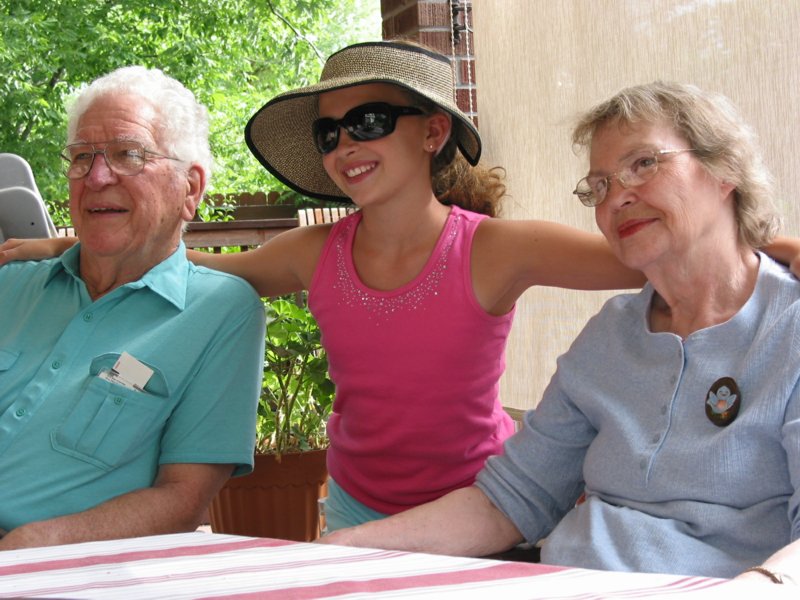
My grandmother Germaine Erie Patureau Landry (my Mee Maw) with her youngest daughter. They descend from the women in this story.

I decided to write this story after I saw how the lives of several of my ancestors came together on the Virgin as it made its way to Louisiana.  But the main impetus was that I found out that the mother of Magdelena Babin Landry had also made it to Louisiana.  And that’s what this series is all about.  I’m trying to put as much information together that I can find from those days of Exile.

In Installment 1 I talked about Augustin Landry and his wife Magdelena Babin.  I didn’t talk about her parents because her father Jean Babin had died in 1751, which is before the Grand Derangement.  He was “spared the Terrible Times” as Magdelena says in the story.  I didn’t really know what happened to Marguerite at that point, so I left her out of the installment.  I didn’t think she had made it to Louisiana.  I didn’t see her name on the Wall in St. Martinville, so I figure she died sometime around 1755.

In Installment 8 I talked about Diego or Dique Hernandez and his wife Theotiste Babin.  She and Magdelena were first cousins, though Magdelena was about 18 years older than her cousin.  I descend from both of them.  Theotiste’s father Joseph Babin made it through the years in Exile and to Louisiana, but his wife Anne Marie Landry died in 1763.  Theotiste and Dique were expecting their first child when they boarded the Virgin in Maryland and had their daughter shortly before arriving in Louisiana.  They named her Marguerite.

Marie Marguerite Bourg Babin is listed as Marie Veuve Babin on the Wall in St. Martinville, Louisiana

When I discovered that Marguerite Bourg Babin had survived the years of Exile and showed up in New Orleans at the same date (July 23, 1767) as her daughter Magdelena, I figured out what had happened.  There was a hint of St. Domingue in one of the sources I found about her.  That tied in with what I had written in Installment 9 about Joseph Dupuis.  He had been in Connecticut and found his way to le Mirebalais, St. Domingue in 1764.  Several of his family members died at that point.  One of Marguerite Bourg’s sisters died at le Mirebalais in 1764 as well. 

I also knew that Joseph Dupuis had joined the Acadians on the Virgin in 1767 and he arrived in New Orleans on the same date as Marguerite Bourg, Magdelena Babin and Augustin Landry & fly., and Theotiste & Diego & little Marguerite who was only a few days old at the time.  So Marguerite Bourg was reunited with her daughter Magdelena either at the port of St. Domingue or in New Orleans.  For the sake of the story, I put it at the port of St. Domingue.  On the August 1767 Census, Magdelena and her family were living next to Marguerite and Marie in St. Gabriel. It appears that Marguerite lived out the rest of her life in St. Gabriel near her family.

I don’t know if Marguerite was a midwife or not.  There is no record of that.  And Marie may not have had a toothy smile!  But with Theotiste giving birth during the voyage, I thought it would be likely that she would turn to an older female family member to be of assistance.  So I wrapped all of these facts up into a story with lots of fictionalizing to season it.

I do know that they were very Catholic, so I added that into their characters.  While a lot of what happened wasn’t real, my main focus was on the fact that a mother and daughter reunited after 12 years of Terrible Times.  So when the two women’s eyes meet, it was my eyes that were shedding tears.  Reuniting with your mother would be like Finding Home.

For other installments of the “From Acadian to Cajun” series, click on the following links:


From Acadian to Cajun: Part 1 – Landry/Babin

From Acadian to Cajun: Part 2 – Breau/Trahan

From Acadian to Cajun: Part 3 – Braud/LeBlanc/Gauterot/Aucoin

From Acadian to Cajun: Part 4 – Hebert/Melanson

From Acadian to Cajun: Part 5 – Bourg/Granger

From Acadian to Cajun: Part 6 – Bujol/LeBlanc

From Acadian to Cajun: Part 7 – Foret/Bujol

From Acadian to Cajun: Part 8 – Hernandez/Babin

From Acadian to Cajun: Part 9 – Dupuis/Dugas

From Acadian to Cajun: Part 11 – The Ones That Didn’t Make It

Who Is Mrs. P. M. Babin?

Van Landry, a great great grandson of Mrs. P. M. Babin, taking a selfie at the St. John Cemetery in Lafayette, Louisiana, on October 24, 2020.

As you can tell from the photo, it must be a family member.  Otherwise I wouldn’t be taking a photo of myself with her grave.  Right?  I don’t take a selfie with just any old grave!

Maybe you can be like Sis and ask, “Who is Grandma Babin?”  That is a question that she asked my dad many years ago.  Daddy laughed and eventually explained it to her.  I have made references to that question a few times in these blog posts.  I really shouldn’t make fun of Sis, she’s been so good about sharing photos and information with me.  In fact, I’m sharing one of the photos in this post.

St. John Cemetery in Lafayette, Louisiana.

Here are some clues.  This is a photo of the area showing other related graves.  In the foreground is the grave of Wana C. Landry.  Some of you may be familiar with her.  This is not my Aunt Wana.  Everyone knows that she was Wana Lidwin.  Wana C. was a granddaughter of Mrs. P. M. Babin.  She was never married.

Next to Mrs. P. M. Babin is P. M. Babin.  This is her husband.  If you don’t know who Mrs. P. M. Babin, this other grave doesn’t give you any more information.  The next two graves are for for Louis  J. Landry and Mrs. L. J. Landry.  Directly above them in this photo is a whitish grave with a black top.  That grave is for Henry Louis Landry.  He is the brother of Wana C. and they are the children of Mr. and Mrs. Louis J. Landry.

What’s that you say?  Yes, you are right!   Mrs. P. M. Babin is Grandma Belite.  You are so very clever.  For those of you still not sure, Grandma Belite’s full name is Marie Amelie “Belite” Bujol Landry Babin.  Her name is so long because I include the nickname she went by, the last name of her first husband Trasimond Landry, and the last name of her second husband Pierre Magloire Babin.  Mrs. P. M. Babin is such a lacking name for her headstone.  No given name, no nickname, and no maiden name is given.

I didn’t know where her grave was for a while, but then I asked a third cousin Chip.  He was able to provide a photo for me and told me where it was.  So I decided to go find it the other day when we were in Lafayette.  I realized the graveyard was between a friend’s house and the I-10.  I wandered around the cemetery looking for it and eventually found the group of graves.  Grandma Belite’s daughter Clemence is the one named Mrs. Louis J. Landry.  She was my Mee Maw’s (Germaine Erie Patureau) half aunt.  Clemence’s husband Louis was the brother of my Pee Paw (Robert J. Landry Sr.).

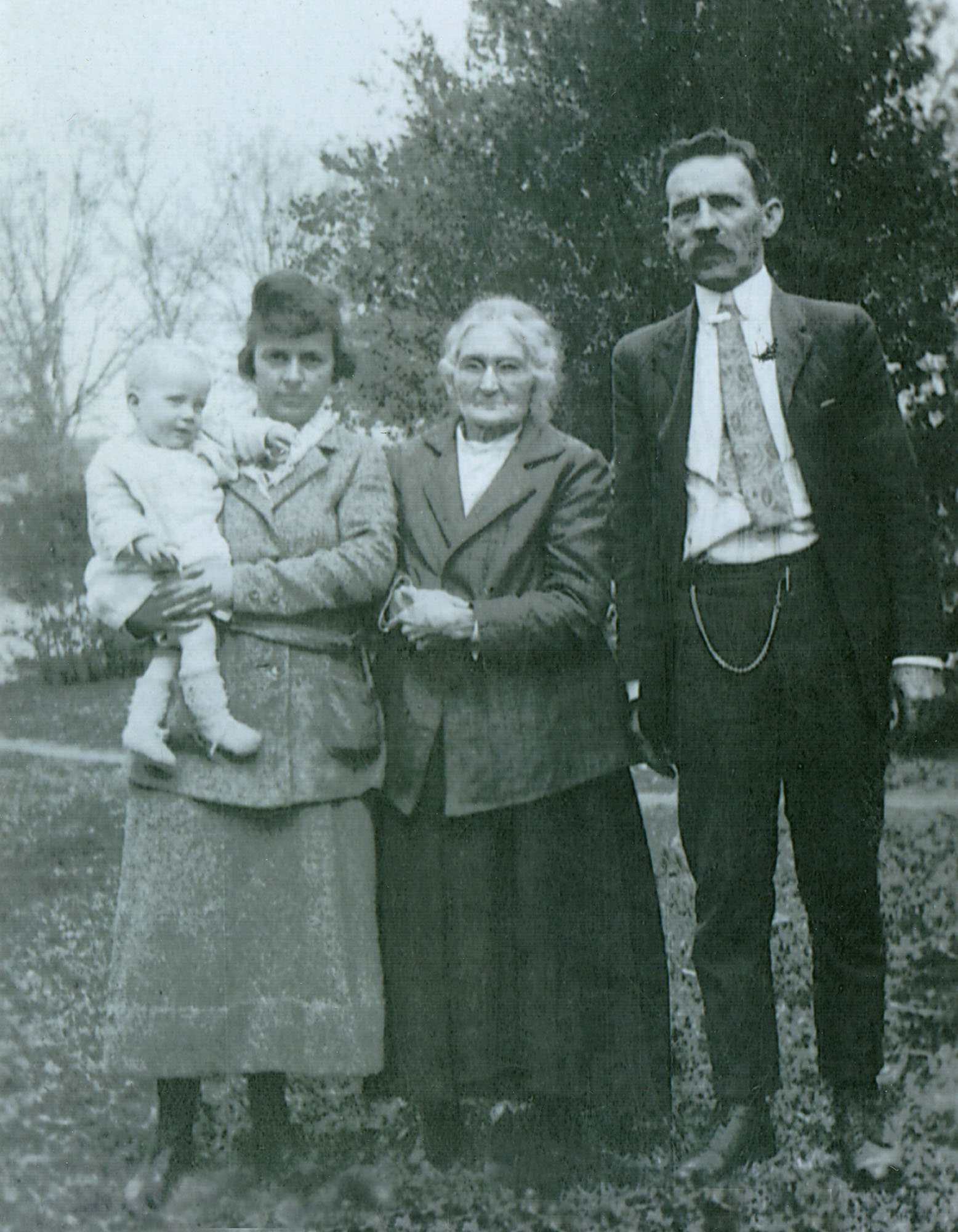
Therese Wynhoven Mouton, Emma Patureau Mouton, Grandma Belite, and Grampa Max in 1921.  This was probably taken in Duson, Louisiana.  (Thanks to Sis for providing the photo.)

Here is a photo of Grandma Belite in 1921.  She is in the middle of the photo and her son-in-law Max Patureau is on the right.  He was married to Belite and Trasimond’s daughter Marie Therese Landry.  She died in 1909.  She and Max Patureau are buried in the Patureau tomb in Plaquemine.  But Max isn’t just Belite’s son-in-law, he’s her half second cousin by their Landry mothers.  Also in the photo are Max’s daughter Emma Patureau Mouton and her firstborn daughter Therese Wynhoven Mouton.  We knew her as Tez.

So there you have it.  Mrs. P. M. Babin with her family, where even her in-laws are related to her.  She was known by those buried by her as Grandma Babin.  But to those who descend from her Landry children, she was known as Grandma Belite.

Bobbie and the Horsey

Bobbie Landry circa 1930.

Now here is an old photo.  I guess it’s not extremely old.  It’s only from 90 years ago.  It’s funny what you consider old when you get to certain ages.  When I saw these photos when I was a kid, they seemed so very ancient.  They were less than 40 years old back then.

This is a photo of my dad Robert Joseph Landry, Jr. when he was about 2 years old.  He was born at the end of January in 1929 and I’m thinking this photo was taken late in 1930.  I know for sure that it was taken in Lake Charles, Louisiana, at the home that he grew up in on Nichols Street.  I’ve seen that house in lots of other photos and it always seems to have a ladder leaning up against it.  What’s up with that?

And then there’s that horsey he’s riding.  Or is it a trike?  It looks like a cross between a rocking horse and a tricycle.  I looked it up online and found several images of this type of contraption.  Most of them are even older than this version.  They were a thing in the mid to late 1800s and some had steel wheels.  Maybe Mee Maw had one (or wished she had one) when she was a child and got one for her kids.

I looked further and thought that I found a name for them – velocipede.  I thought it was an interesting name, because it wasn’t a velociraptor.  It’s a horsey!  But then I saw that the definition of a velocipede is a human-powered land vehicle with one or more wheels.  Come to find out, I had a velocipede when I was a kid.

But it wasn’t a horsey velocipede!  My only consolation is that when I was riding a tricycle, we actually had horses to ride, too.  Yes, I had a pony!

Landry Grandfathers

The research that I’ve been doing for the “From Acadian to Cajun” blog series has taught me a lot.  I’m working on a follow-up to the posts I’ve written about my Acadian ancestors who came to Louisiana.  That post will be about The Ones That Didn’t Make It.  Some of our ancestors died during the Exile, while others ended up settling somewhere else.  For these ancestors, it was their children that made it to Louisiana.

One example of that is in my Landry line.  The person in question is my 5x great grandfather Pierre Landry.   I’ve talked about him once before in regards to him living long enough to get to know his grandchildren in my line.  That post was four years ago in a post about my great grandfather Alcide.

What I mentioned was that in my line, I descend from the later children in the family.  This leads to grandchildren being born after the passing of their Landry grandfather.  I was born in 1960, which is three years after my Pee Paw (Robert Joseph Landry, Sr.) died.  My dad was born in 1929, which was ten years after Alcide the Great died.  Pee Paw was born in 1893 and his grandfather Narcisse had died in 1876.  Alcide was born in 1845 and his grandfather Joseph Ignatius had died in 1806.  Narcisse was born in 1796 (first generation born in Louisiana) and his grandfather Augustin had died in 1781.

Now here is where there is a difference.  Joseph Ignatius was born around 1753 (the last generation in my Landry line to be born in Acadie) and his grandfather Pierre didn’t die until 1786 at the age of 94 years old.  So he and his grandson Joseph Ignatius were alive at the same time for 33 years.  Going back further, Augustin was born in 1719 and his grandfather Antoine had died in 1710.  Pierre was born in 1690 and his grandfather Rene died two years later.  Most people don’t have memories from before they were two years old.  And they didn’t have photos to show that help to build memories.  Antoine did not know his grandfather, because his father Rene had immigrated to Acadie before Antoine was born.  Nobody knows who the father of Rene was.

So it looks like the only one that would have memories of his Landry grandfather probably didn’t have any.  That’s right.  In the one instance where the grandfather lived long enough, the family was ripped apart by the Grand Derangement in 1755.  So Joseph Ignatius was only two years old when his part of the family was Exiled to Maryland.

I’m not really sure what happened to grandfather Pierre in 1755.  Some Acadians had made their way to Ile St. Jean after the English came back into possession of Acadie.  They didn’t trust the English with their insistence on signing an unconditional oath, so they went to a place still controlled by the French.  Pierre eventually made his way to Maskinonge, Quebec, which is where he died in 1786.  At least two of his sisters had made it to Quebec as well, though they both died about 20 years before he did.  Five of Pierre’s children died before he did as well, though we don’t know if he was aware of that fact.

As we saw in the information about the Dupuis line of the family, people did not get much information about their family members in other countries.  Marie Josephe Dupuis made her declaration at Belle-Ile-en-Mer, France, and she wasn’t aware of the deaths of several of her siblings from a few years previous.  So it’s doubtful that there was much exchange of information between Pierre and Joseph Ignatius over the years that they were both alive.  Probably not even a stinking Christmas Card!

1996

Landry Family in 1996

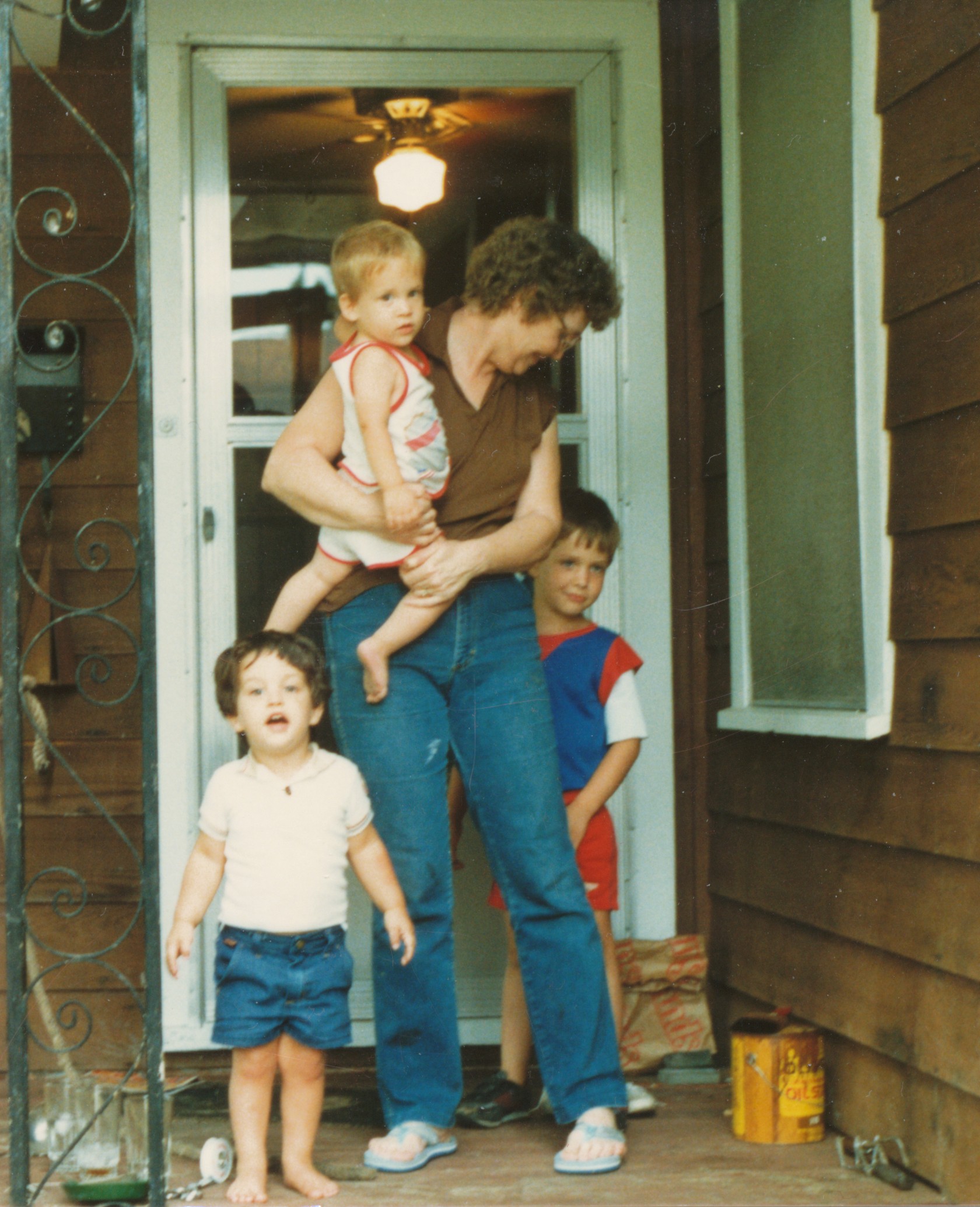
Grandkids with Grammie in 1986.

So it wasn’t until my niblings’ generation that they were able to get to know their Landry grandfather in any significant way.  My dad’s first grandchild was born in 1981 and my dad passed away in 2017.  My dad had 35 years to enjoy being a grandfather.  And he got to enjoy them with a dozen grandkids when all was said and done.

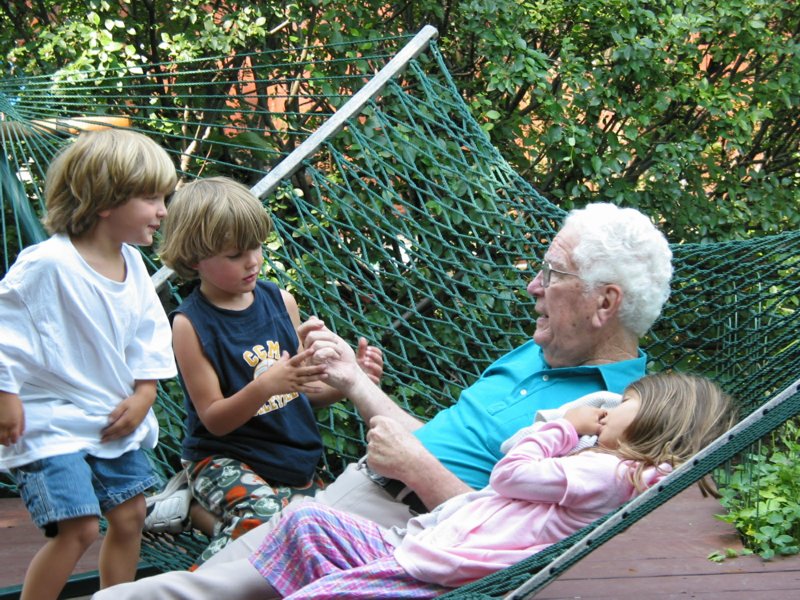
Pappy (Robert Joseph Landry, Jr. or Bob) with his Landry grandchildren in 2007.

But more importantly, my nieces and nephews have lots of great memories of their Landry grandfather.  The same can not be said of any other known generation in my Landry line.  Oh, and by the way, we are definitely of the Landry line.  I had our YDNA tested and it matches other Landry testers.

Alex Landry with Pappy (Robert Joseph Landry, Jr.) and Grammie (Betty Lou Bucklin Landry)

And that Landry name is continuing.  Not with me.  I don’t have any children.  My older brother Al has children.  Al was born after Pee Paw died, so he didn’t know our Landry grandfather either.  But his children did know their Pappy Landry, as can be seen in these photos.

Bitsy: 50 Years Gone

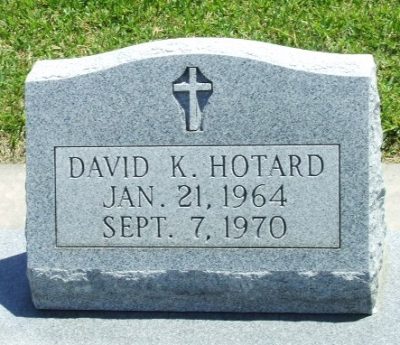
This is a post that I’ve been thinking about writing for a while.  It’s about one of my earliest memories concerning death.   Only recently have I discovered that the subject of this post – David Hotard – was a distant cousin.

I was born in Lake Charles, Louisiana, on the Halloween of 1960.  I was the 5th of 6 children of Bob and Betty Landry.  It was not long after my younger sister was born in 1962 that we moved to Jennings, Louisiana.  The first two years in Jennings we were renting a two story house north of the interstate.  Then we moved into town to the yellow house on Lucy Street.  It was there that we met the Hotards.

Looking at those dates now, I realize that David must have been an infant when we moved next door to them.  He was one of four sons of Mr. and Mrs. Hotard.  My older brother and I were a little older than they were and we played together a lot.  You know, playing games and riding bikes – the things that kids did growing up in the South in the 60s. 

It was a small town, so we always thought it was pretty safe.  And as I remember, David was the nicest of the brothers.  He never hit me over the head with a hammer and didn’t cut my finger with a shovel!  He also had a nickname.  We called him Bitsy.  I’m thinking that Mr. Hotard must have given him that nickname.  He did that with everyone.  I was either “Van the Bomb” or “Ban the Bomb.”  Karen was “The Lucy Street Crier.”

Things changed in September 1970.  It was the year that David started first grade.  As I remember it, he only attended three days of classes.  David decided he wanted to go bike riding.  He came by our house to see if anyone wanted to go with him.  No takers.  He found another neighbor to go with him.  They did not get far.  He was practically in front of his house when a car hit his bike and knocked Bitsy to the street.  He had a severe head injury and as a result he died shortly afterwards.  He died on September 7, 1970.

That day was very memorable, but even more so was the funeral.  It was a few days later.  I know it was a school day, because we missed half a day of school that year.  It was such a sad day.  I remember going to the graveyard and seeing Mrs. Hotard sobbing.  I remember crying along with her and it still chokes me up to think about it.  It must have been at this point that my mom talked about how parents should never have to endure the death of one of their children.  Such a terrible loss.

Earlier this year I wrote a post about my Acadian ancestors and their experiences during the Grand Derangement.  In this particular post I mentioned my Bourg ancestors.  One of the Hotard brothers sent me a note saying that they also descended from the Acadian Bourgs!  Come to find out, little Bitsy had been my 7th cousin twice removed.  His grandmother Hazel Bourg had been my 7th cousin.  She died in 1967, but I don’t recall that happening.  All my life I thought Mrs. Hotard was only Italian.  She was my 7th cousin once removed Sandy Passantino through the Cajun side of her family.  Imagine that!

I recently reread the book about my ancestor Trasimond Landry.  There is a mention of Trasimond going to a funeral of a friend when he was young.  He grew up with Arthur and his twin brother Anatole.  Arthur’s funeral was the first funeral he had attended where he cried.  When Trasimond’s mother Marie Carmelite died a few years later, Anatole was there to share the grief.

When I read that, it made me think about my experience at Bitsy’s funeral all those years ago.  And like Trasimond who had his friend at his mother’s funeral at a later time, my cousin Sandy was at my parents’ wake.  She actually led the rosary that night.  But we didn’t know we were related back then.  We were just sharing grief again over the loss of people we both cared about.

From Acadian to Cajun: Part 9 – Dupuis/Dugas

The Wall of Names of Acadian Exiles in Louisiana in St. Martinville. Joseph Dupuis (2) is my 5X great grandfather. Listed under him are four of his nieces and nephews.

These installments can be pretty tricky to write.  I want to be as accurate as possible, but that is really difficult to do when there is conflicting information out there.  Human memory is very much influenced by belief and the passage of time.  The Grand Derangement happened 265 years ago in another country where a different language was spoken.  A lot of turmoil was going on when it happened.  When the people eventually settled in a place to call home, they just wanted to get their lives together.

What has survived are a few old church documents and some Censuses before and during the Exile.  One of the treasured items from back then are the Declarations of  the Acadians at Belle-Ile-en-Mer in France.  The Acadian Exiles in this area were interviewed and asked to tell about their family histories.  Many of the people were able to give information about their families back to the time of the founders of Acadie in the 1600s.  Of course most of this was based on human memory, so some errors were present in their statements

The Declaration that I was most interested in was that of Marie Josephe Dupuis on February 27, 1767, at the Village of Parlavant.  I don’t descend from her, but I do descend from her younger brother Joseph Dupuis.  He is the main person I’m writing about in this installment.  Marie Josephe was the oldest of eleven children of Antoine Dupuis and Marie Josephe Dugas.  Antoine and Marie Josephe were married around 1719 in Riviere au Canards, Acadie.  Their first child (Marie Josephe) was born in 1721.

Like I said, she was the oldest of eleven children.  They were born over a period of 20-25 years.  That included two sets of twins.  Joseph and his twin brother were one of those sets.  According to their older sister, they were born in 1745.  Their parents Antoine and Marie Josephe died around 1747.  It looks like some of the older children were caring for the younger ones after that time.  Some of them were adults with children of their own.  So when the Grand Derangement happened in 1755, the family was split up even more.

So when Marie Josephe Dupuis (Theriot) made her declaration in 1767, she hadn’t seen some of her siblings for almost twelve years.  Sadly, some of them had passed away.  From what I can tell, six of her siblings had died since their Exile from Acadie, yet she was only aware of one of those deaths.  Marie Josephe and a younger sister named Ozite (and their husbands and children) were originally Exiled to Virginia in 1755.  Like other Exiles sent to Virginia, they were deported the following year to Falmouth, England, where they were treated with neglect.  Many Acadian Exiles died in 1756 from the smallpox, including sister Ozite, Marie’s husband Pierre Theriot, and several other Theriot family members. 

Evidently all that Marie Josephe knew about her other siblings is that they had been “transported to New York.”  There was another sibling (Anne Marie – the twin of Ozite) that “passed with their family to the Mississippi” and was never heard from again.  According to other sources, she died before 1767.  So that would mean that eight siblings were “transported to New York.”  Yet all other sources say that Joseph’s twin brother Jean Baptiste was Exiled with Marie Josephe and Ozite and he ended up in France as well.  Yet Marie Josephe clearly states that Joseph and Jean Baptiste were “transported single” to New York.  If he was with her in France, she would surely know about it.  She may have overlooked Jean Baptiste when talking about the twins.

So that leaves seven siblings that were transported to New York:  Joseph, Magdeliene, Antoine, Simon Pierre, Marguerite, Euphrosine, and Charles.  But they didn’t actually go to New York.  They went to Connecticut.  See how difficult it is to figure out what happened back then?  Even the ones that were living back then didn’t know what was happening.  Of course if those in charge didn’t care if the Acadians lived or died, they certainly weren’t concerned if they knew what was going on with their families.  You can only tell the truth if you know the truth.  So we can forgive Marie Josephe for any errors in her Declaration.  She went through a very traumatic time and she meant well.

So let’s see what happened to Joseph and his siblings (and their families) that were sent to Connecticut.  It looks like at least seven ships left the shore of Acadie with over 1000 individuals who were forcibly removed from their homeland.  They left sometime in late 1755 and arrived during the month of January 1756.  I haven’t seen information about where they stayed or even if they were all in the same place.  What I have found is that his sister Magdeliene died in Connecticut in 1762.  There is no more information on his other older sister Marguerite, so I’m thinking she probably died between 1756 and 1762.  His younger brother Charles survived and somehow he and some of their sisters’ children made it back up north and settled in Quebec.  So that left Joseph with Antoine, Simon Pierre, and Euphrosine.

Toward the end of the Seven Year War (in 1763) French officials were encouraging Exiles to relocate from English colonies to French-owned Sainte Dominque (now Haiti).  There they would be used as laborers on a naval base on the island with the incentive that the Exiles would be given land grants.  Joseph and his other three siblings joined a group of 180 Acadians from New England ports who headed to St. Domingue in August 1764.  It was not the best situation.  The officials sent them to Mirebalais (near Port au Prince) and did not give them the land that was promised.  The Acadians did not fare well and many of them died from malnutrition and tropical diseases.

Joseph had not married yet, nor did he have any children, so we know he survived.  How else would he become my ancestor?  But his siblings were not as fortunate.  Simon Pierre and his two older sons Francois and Firmes died within a month or two of arriving in their tropical environs. (His wife had died in 1760 in Connecticut.)  On January 4, 1765, his younger sister Euphrosine passed away at Mirebalais.  She had become a new, young mother the previous year, but her son had died a month before she did.  Then in August his oldest brother Antoine died as well.  Antoine’s wife and three of his seven children had died in September and October of 1764 in Mirebalais as well.

And then there was Joseph.  When I saw his name on the Wall in St. Martinville where the list of Acadian Exiles in Louisiana is shown, I noticed a few names under his.  I didn’t know who the other people were, but later found out that they were his niece and nephews.  “Hmm,” I thought, “That’s interesting.”  But now that I’ve found out the details of his life in Exile, I have to say that it is more than “interesting.”  It’s very touching.

Joseph was an orphan when the Grand Derangement began, but fortunately he had several older siblings who were willing to help him through those terrible times.  As they went from Acadie, to Connecticut, and then on to Sante Dominge, their numbers were decreasing.  Yet if it weren’t for them, he may not have survived.  So when he found out about a chance for a better life in Louisiana, Joseph Dupuis took action.

There was a ship of Acadian refugees that docked at Cap Francais for over two weeks.  The ship was The Virgin.  It came from  Maryland and it included my Landry ancestors who had spent their exile there.  Joseph made his way across the island to meet up with the ship.  He took along the surviving four children of his brother Antoine.  It’s what family does.

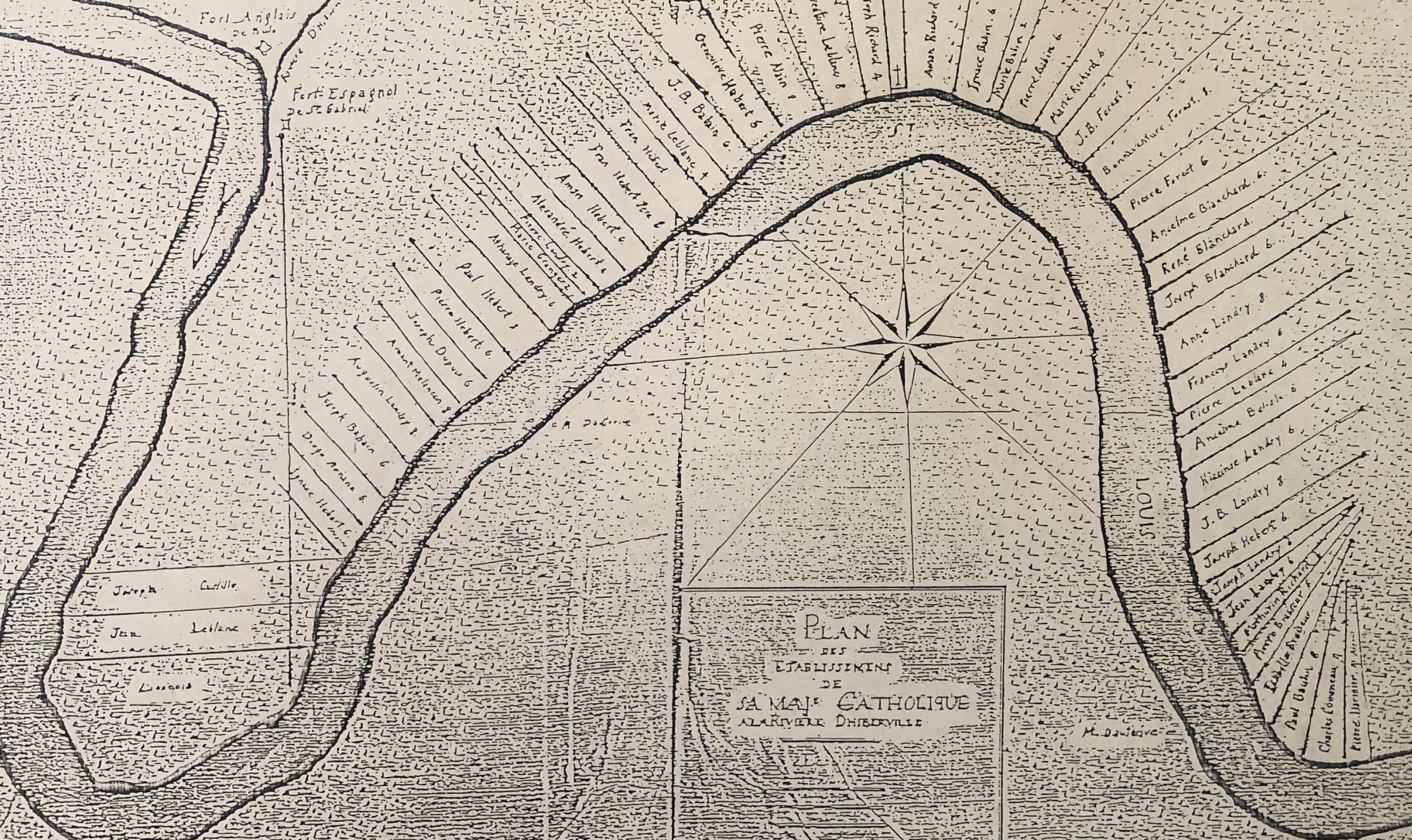
Map of St. Gabriel showing the location of the Acadians who settled there in 1767.

The Virgin arrived in New Orleans on July 23, 1767.  Joseph settled with the other Acadians in St. Gabriel.  At the end of Installment No. 4, I talked about Anne Marie Hebert being at the right age for marrying in 1769.  Her family had settled in St. Gabriel in July 1767 as well.  Her father and her brother owned property next to each other.  And the property next to her brother’s was owned by none other than our Joseph Dupuis.  She evidently came to the conclusion that he was good marriage material, because they were married on March 27, 1769.

In the 1777 St. Gabriel Census, it shows Joseph and his wife Anne Marie with their two young sons.  His nephews Jean Baptiste and Simon lived nearby.


My family tree with path to Joseph Dupuis highlighted.


For other installments of the “From Acadian to Cajun” series, click on the following links:

From Acadian to Cajun: Part 1 – Landry/Babin

From Acadian to Cajun: Part 2 – Breau/Trahan

From Acadian to Cajun: Part 3 – Braud/LeBlanc/Gauterot/Aucoin

From Acadian to Cajun: Part 4 – Hebert/Melanson

From Acadian to Cajun: Part 5 – Bourg/Granger

From Acadian to Cajun: Part 6 – Bujol/LeBlanc

From Acadian to Cajun: Part 7 – Foret/Bujol

From Acadian to Cajun: Part 8 – Hernandez/Babin

From Acadian to Cajun: Part 10 – Bourg/Babin/Landry in a short story called “Finding Home”

From Acadian to Cajun: Part 11 – The Ones That Didn’t Make It

Do NOT Try This at Home!

Enhanced photo of Alcide Landry circa 1890.

I had decided that I was not going to post this photo this week.  It’s one of the only things I was sure of as far as my blog goes.  I try to plan things out a little, but I’m usually not sure what I’ll exactly say from week to week.  I have been looking for something about my great grandfather Simon Alcide Landry to write about.  He was the husband of Marie Celeste from two weeks ago, but I really didn’t say much about him.  I have lots of photos of Marie Celeste through her years, but only one of Alcide.  I thought I would save this enhanced photo of him for later.  It’s the only photo I have of him.

So that was it.  I was not going to post this photo of him this week.  What I was doing this week was re-reading the book “Tirailleurs” by my 3rd cousin Thomas H. Richey.  It had been a while since I had read it and I thought I might find something regarding family history in it.  It’s mainly about Alcide’s older brother Trasimond’s experiences in the Civil War. 

But sometimes it mentions baby brother Alcide.  I was reading along, minding my own business, when I got to page 123.  It recounted a story about Alcide that I didn’t remember.  I read the book before, but I must have just overlooked it somehow.  I didn’t this time.  I decided then and there that I was going to write my blog this week about the story that was told.  It’s time for something a bit lighthearted.

It was the summer of 1863 in Brusly Landing in southern Louisiana.  On the plantation of Narcisse Landry, his son Alcide Landry was aching to join in on the fighting in the War.  But he wasn’t old enough yet.  He wouldn’t be turning 18 until August 16.  In June they were growing their corn crop, but didn’t dare to harvest it yet because the Yankees would just confiscate it.  There were some skirmishes going on at Port Hudson, so there were many Union soldiers about.

Port Hudson fell to the Union, so things settled down a bit.  Older brother Belisaire decided it was safe to harvest the corn.  Part of that work fell to young Alcide, who was not the least bit thrilled.  His 18th birthday couldn’t come soon enough and it was still a month away.  So he set to work picking up the corn as he rode in his corn wagon.

Don’t ask me what a corn wagon was, because all I can say is that it was probably a wagon for gathering corn!  And all I know about this one is that it had a bench in the front of it, just behind the horse that was pulling it.  Nothing automated in those days!  On this particular corn wagon on July 29, 1863, young 17-year 11-month 13-day-old Alcide Landry was sitting on the bench behind an old mare horse.  It had been a long, hot southern Louisiana day and Alcide was making his way back to the barn.

As they were riding along, Alcide was preoccupied with thoughts of the army.  He would grab an ear of corn, shuck it, and throw the grains of corn on the mare’s back and watch them fall.  Then he’d grab another ear.  As he was going through his repetitive process, he was pulled out of his reverie by a pungent explosion.  That old mare had lifted her tail and let out a stream of obnoxious fumes practically right in his face!  I’m surprised it didn’t knock him off of his bench.  I’m sure he had a few choice words for his horsey friend!

They continued on their way, and as they were approaching the barn, Alcide picked up another ear of corn to shuck.  At this moment, the mare lifted up her tail for another surprise.  Before he realized what he was doing, Alcide has used the ear of corn in his hand to stop up the source of the foul gift.  And before the mare realized what she was doing, she was bucking up her back legs and kicking at the source of whatever it was that was hindering her gassy relief.  “Tonnerre m’ecrase!”

All Alcide could see was the belly of the mare as her back legs rose up and kicked the corn wagon and his ribs.  Fortunately for Alcide it was an old mare after a long day’s work.  Unfortunately for Alcide she was still a pretty powerful animal.  So now, not only did he have to wait until he turned 18, he also had to wait for his ribs to heal.  I’m sure during his time of waiting he must have shaken his head a few times wondering how he could have done such a thing.

What a story!  I wonder if that was a story passed down to some of his children or grandchildren?  I’d never heard it that I recall.  And the French phrase in there means something like, “Thunder crushes me!”  It sounds like an explosive situation all the way around. 

I’m glad I know this story.  I hope you enjoyed it.


Marie Celeste in Color

I posted a story a while back about a family photo of my mom’s family.  It was a black and white photo that my mom had hand tinted.  I talked about a group on Facebook that provides coloring services for free for black and white photos.  Some of them are really good, but I’m not really much a fan of it.

Then there’s the MyHeritage.com site that I’ve been using a lot to enhance photos.  I’ve shared some of them already.  They also have a coloring feature for the photos, but I don’t usually like the results from that either.  It never really looks realistic or flattering.  I’ve been enhancing a lot of my old photos lately, and occasionally I’ll try the coloring feature just to see what it might look like.

Marie Celeste Leveque circa 1868 (colorized)

When I tried it on this photo on my dad’s maternal grandmother Marie Celeste Leveque Landry, I was pretty excited.  I really liked the colors that it provided.  The shading was a little too severe, but I knew I could fix that.  So that’s what I did.  I think it really brings the photo to life.  What do you think?

I posted the black and white version of the photo of Grandma Celeste almost five years ago.  It is the photo that is on her headstone at her grave in Lake Charles, Louisiana.  But this photo was taken long before then.  It was taken some time around 1868.

I figure it was probably taken around then based on her age in the photo and the fact that she married Simon Alcide Joseph Landry on November 24, 1868, at the age of 21.  The photo looks like an engagement or wedding photo, but I’m not sure if that was done back then.  It’s a nice photo that shows what she looked like as a young adult.  I thought I would give some other details about her life at the time as well.

The best thing to show some detail about her life is the 1870 Census of West Baton Rouge, Louisiana.  This is the first Census after the Civil War and things were decidedly different for Celeste and her family.  The families in the South were having to figure out a new way of doing things.  They were no longer able to use enslaved individuals to do their hard work for their benefit.  And rightfully so!

1870 Census showing Celeste and Alcide’s household in West Baton Rouge, Louisiana

So in 1870 Alcide is shown as a farmer on his piece of land valued at $1000 and Celeste is ‘Keeping house.’  They are also the new parents of 5-month-old Carmelite.  That would be Marie Marguerite Carmelite Landry, who would later be called Lily.

Directly below their household is listed the household of Celeste’s first cousin Marie Amelie “Belite” Bujol Landry.  She was married to Alcide’s brother Trasimond.  Trasimond and Belite were married on November 30, 1867, and they had two children in 1870.  Their oldest daughter Therese was my great grandmother, but she was only two years old at this time.  They also have a 6-month-old daughter named Catherine.  She would be known as Kate.  Also in the household is 75-year-old Narcisse Landry, the father of Trasimond and Alcide.

Like I said, Celeste and Belite were first cousins.  Actually their mothers were sisters with the Landry maiden name.  Their grandfather was Joseph Emanuel Landry, the half-brother of Narcisse.  This means that Celeste and Belite’s children were 1st cousins through their fathers, 2nd cousins through their mothers, and half second cousins since their parents were related.

Yet the two families did not always remain neighbors.  Celeste and Alcide would move to the western part of the state, where their youngest child Rob was born in 1893 in Westlake.  Two-year-old Therese would grow up and marry Max Patureau from Plaquemine.  His mother was Emma Landry, first cousin to Trasimond and Alcide and the Landry sisters who gave birth to Celeste (by Basalite) and Belite (by Adele).  Therese and Max’s daughter Erie was born in Plaquemine in 1895.  Nevertheless, that didn’t stop Erie and Rob from getting together and eventually becoming my grandmother and grandfather.  Even though they were also our first cousin three times removed and second cousin once removed, we just called them Mee Maw and Pee Paw.

From Acadian to Cajun: Part 8 – Hernandez/Babin

Diego Hernandez and Theotiste Babin are listed under Pierre Paul Hebert and Marguerite LeBlanc. Their children born in Louisiana (Marie Marthe Hernandez and Simon Hebert) would later be married to each other.

This new installment introduces a new surname to the series while it repeats a few others.  The new surname is Hernandez.  While the name looks and sounds Hispanic, I’m pretty sure that it’s not.  Daddy always had him listed in his book as Jacques Diego Hernandez.  I’ve seen him listed with the first name of Denis or Dique and the last name of Arnandez or Arnaudese.  Since he settled in Louisiana while it was under Spanish rule, his name was more consistently written as Hernandez.

The  surname that I’ve written about previously belongs to Diego’s wife Judith Theotiste Babin.  Theotiste was actually a first cousin of Anne Forest from the previous installment.  Theotiste’s father Joseph Babin was the brother of Anne’s mother Madeleine Babin.  Theotiste was also connected to the Landry family from the first installment.  Her mother was Anne Marie Landry, who was the sister of Augustin Landry.  In addition, Augustin’s wife Magdelena Babin was the niece of Joseph Babin.

There are other connections to families that I discussed previously in this series, but I won’t get into all of that.  It is way too confusing.  Acadie was an isolated area for quite a while with a large population growth, so they inevitably had many cousins marrying cousins.  It has happened in many places all over the world.  Speaking of Acadie, let’s go back there to the time before the Grand Derangement and introduce you to the Babin and Landry families.

In 1687 Vincent Joseph Babin married Anne Theriot in Pisiquit, Acadie.  Their first child in 1689 was a boy they named Jean.  Jean would later have a daughter named Magdelena who would marry Augustin Landry.  Vincent and Ann would then have six daughters.  One of them was Madeleine, who would later be the mother of Anne Forest. In 1713 Joseph Babin was born to Vincent and Anne.

While Joseph Babin was one of the younger children of his parents, Anne Marie was one of the older children of hers.  Her parents were Pierre Landry and Marguerite Forest and they were married in 1712.  They lived in Pisiquit, in the parish of La Sainte Famille.   Their first child was a daughter named Marie who was born in 1714.  In 1715 Anne Marie was born.  Augustin was next in line and he was born in 1719.  Pierre and Marguerite also had two more boys and two more girls.

So Joseph Babin and Anne Marie Landry grew up, met, and were married around 1736.  Their first child Dorothee was born around 1737 or 1738.  She was born before the first son Joseph born in 1739.  They then had a daughter named Elizabeth in 1743.  Their next daughter was either Anne or Judith Theotiste who was born in 1744.  The couple would then have two more sons named Etienne and Cyprien.  The last child was born in 1751, just a few years before the Great Upheaval.

On August 10, 1755, the English began rounding up the Acadians so they could be deported from their homeland.  It was the beginning of a great tragedy for many of the Acadian people.  The biggest positive about it is that Joseph and Anne Marie’s family were placed on board the Dolphin along with other family members of the extended Landry and Babin families.  They were Exiled from the land of their birth on October 27 and they reached Upper Marlboro, Mayland, in early December of that year.  This is where they were to spend the next twelve years of their life.  If they survived.

Page 2 of the list of French Neutrals living in Upper Marlboro, Maryland, in July of 1763.

According to the Belle Ile en Mer declaration of Anne Marie’s nephew by her older sister Marie, Anne Marie went into exile with her family.  But she did not live much longer.  She had passed away by the time of the Census of French Neutrals in Upper Marlboro, Maryland, in July of 1763.  Joseph is listed and identified by the French word veuf – which means widower.  Dorothee, Pierre, and Joseph are not listed because they were adults at this point.  The others listed in the household with Joseph are Elizabeth, Etienne, and Cyprien.

Theotiste is not in the household, but she is listed just below them with her husband Diego Hernandez.  His name is specified as Dique Landre in this document.  “Scholars” think that Dique Landre is none other than our Diego Hernandez.  It seems to fit with all the other documents that I’ve seen, such as Baton Rouge Diocese records, St. Gabriel land holdings, and Iberville Parish court archives.  They must have married while in Exile in Maryland.  Yet I don’t know where Diego comes from.  He’s listed in this Census along with Exiled Acadians.  I just realized that both the given names I have for him – Diego and Jacques – are versions of the name James.  So I could be looking for a James or Jacques with the last name of Hernandez, Arnaudese, or Landre/Landry.  I guess I’ll just be on the lookout for a Jacko Landry!

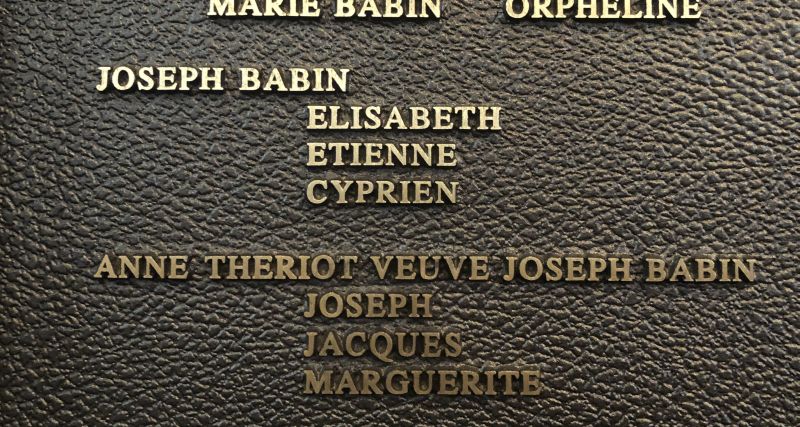
Joseph Babin is listed with his children Elizabeth, Etienne, and Cyprien on the Wall of Acadian Exiles in Louisiana. The Wall is in St. Martinville, Louisiana.

Not much is known about their time in Maryland, as far as personal details about their lives.  We just know that they weren’t really wanted there and were never really part of the community.  Though a few of them did decide to stay in Maryland and they were able to become a part of the society.  None of my ancestors did that.  Joseph, Elizabeth, Etienne, Cyprien, Theotiste, and Diego were part of the Acadians who settled in St. Gabriel, Louisiana.  They arrived in New Orleans on the ship The Virgin on July 12, 1767, and made their way to Fort St. Gabriel.  There was an additional member of the family when they arrived.  Theotiste gave birth to a daughter that they named Marguerite during the voyage.

Map of St. Gabriel showing the location of the Acadians who settled there in 1767.

When they arrived in Louisiana, they were given land grants by the Spanish Crown.  As you can see in the photo, Theotiste and Diego were on a plot next to her father Joseph (listed as Diego Arnanz).  On the other side of Joseph is his brother-in-law Augustin Landry.  Two plots down from him is Joseph Dupuis.  I’ll be talking about him in my next installment.  Past him are Pierre Paul Hebert and Paul Gaston Hebert.  We talked about them in the 4th installment. 

This is an early map of St. Gabriel, so it doesn’t show all of the families that I descend from who settled there.  The Antoine Breau family were Exiled in Port Tobacco, Maryland, and they had a two year diversion to Fort Natchez before they made it to St. Gabriel in 1769 or so.  The Honore Braud family spent a much longer time in Exile in France, but they eventually made it to St. Gabriel in 1785.  They were just in time for their eligible daughter Olive Elizabeth to get together with recently widowed Joseph Ignatius Landry, son of Augustin. 

Joseph Ignatius and Olive had a son named Narcisse.  Narcisse would get married to Marie Carmelite Hebert, the daughter of Marie Marthe Hernandez and Simon Hebert.  They would have a son named Trasimond who would marry Belite Bujol.  Belite would bring in the Bujol and Bourg lines that were discussed in previous installments.  Trasimond and Belite had a daughter named Marie Therese who would marry Max Patureau.  Max would bring the Dupuis line into the mix.  He was a descendant of the Joseph Dupuy who was one of those early Acadians who settled in St. Gabriel next to our other ancestors.

Max and Therese had a daughter named Erie.  She would marry Rob Landry.  Rob Landry would not bring any other lines to the mix.  Everyone that was related to Rob was related to Erie.  But these two would bring about someone very special.  That would be their daughter Germaine Erie Landry.  She was a very sweet person and she was my aunt.  She was born on April 6, 1927, and she died yesterday (July 15, 2020) at 6:40 pm.  She was a good older sister to my father.  She was the loving wife of Ross Winn.  She was the caring mother to her three children.  She was a devoted Catholic all her life.  She was a dedicated nurse for many years.

She was such a good person.  She will be missed.

Landry Reunion on June 11, 2016. Here I am with my aunts Frances Landry Raley and Germaine Landry Winn. Frances died in February 2020 and now Germaine has died.


For other installments of the “From Acadian to Cajun” series, click on the following links:

From Acadian to Cajun: Part 1 – Landry/Babin

From Acadian to Cajun: Part 2 – Breau/Trahan

From Acadian to Cajun: Part 3 – Braud/LeBlanc/Gauterot/Aucoin

From Acadian to Cajun: Part 4 – Hebert/Melanson

From Acadian to Cajun: Part 5 – Bourg/Granger

From Acadian to Cajun: Part 6 – Bujol/LeBlanc

From Acadian to Cajun: Part 7 – Foret/Bujol

From Acadian to Cajun: Part 9 – Dupuis/Dugas

From Acadian to Cajun: Part 10 – Bourg/Babin/Landry in a short story called “Finding Home”

From Acadian to Cajun: Part 11 – The Ones That Didn’t Make It

Summertime Fun 1963

I thought it was time for something more recent.  And when I say recent, that is a relative term.  After writing about events 100 and 200 years ago about ancestors of mine, I thought I’d share a photo that included me and my siblings. 

So I went looking for a photo.  I was hoping I could find something in color, so I first looked in my folder of photos from the 1970s.  I was also looking at some of the enhanced photos I did, but none of them struck me.  I liked some of them, but mostly they are from Christmases past.  I can’t post a photo of Christmas when it’s 100 degrees outside.  That’s just wrong.

Summertime fun with the Landry family in 1963.

I thought I’d try to find something a little earlier.  When I saw this photo, I knew it was the one.  It’s got all of my siblings in it, plus the addition of my dad.  It’s in color.  Imagine that!  I think it is from an old slide that was taken in August of 1963.  I edited it a bit to clean it up.  But mainly I chose it because it screams, “Summertime!”

When I think of family summer vacations, I always think of Six Flags and Astroworld.  Those were our usual go-to places every summer.  But this photo is from before that era.  We were living in a two story house on LA-26 just north of the I-10 in Jennings.  The house was directly south of a canal that runs through that area.  At night, we could see the spotlight from the Jennings airport from our bedroom on the second floor.

I don’t remember going anywhere else for vacations during this time.  Of course I was a bit young in the photo.  My older brothers might remember more.  Because of this photo, I do know that we went for a swim back then in our trusty plastic pool!  Doesn’t it look delightful?  We all look like we were having fun!  That’s what matters.

Let me identify everyone in the photo.  On the far left is my brother Al.  My dad (Robert Joseph “Bob” or “Pluto” Landry, Jr.) is next and he is holding me.  Then there are Karen, Rob, Jamie, and Jodie.  Mama (Betty Lou Bucklin Landry) must have taken the photo.  It certainly is a blast from the past.

1 13 14 15 16 17 27