From Acadian to Cajun: Part 2 – Breau/Trahan

I decided to go ahead and write another post for this series.  Even though it was only last week that I wrote the other one, it was still last year.  I’ve also spent a lot of time looking at this part of my family history all week long.  And talk about sad!  This is a really depressing period in the life of Acadians/Cajuns.  I don’t know why I didn’t think it would be so bad, since I have looked at it before and read books about it.

But when I start to look and see what exactly was happening to my ancestors and their families at that time, it’s a bit more personal.  And there are some really tragic events that occurred.  It sounds kind of morbid, but I am intrigued by sad events that I discover.  Mainly because I can write about them and memorialize them in some way.  That way we can get to know them a bit and make a bit of a connection.  But most of those other events that I discover are tragedies that are a result of illness, sickness, or accidents.

This time it is different.  This was intentionally done to my family.  Sure, the Acadians were ornery and refused to give an unconditional oath to the king of England.  But they were his (somewhat) loyal subjects, being that they were born in an English-ruled area.  Like I said last week, they were the third generation born in Acadie.  But they were treated like foreign invaders and prisoners of war.  It was a travesty!

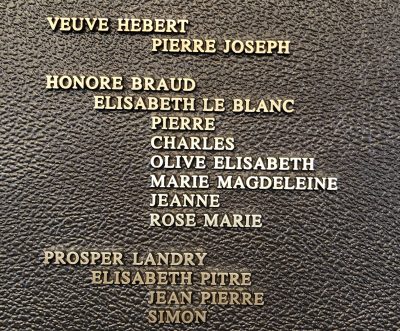
The Wall of Acadian Exiles in Louisiana in St. Martinville, Louisiana, includes the Breau families.

One of those families that was treated this way was the Breau family of Pisiquit, Acadie.  My main focus when I was looking for information on this family was my 5Xgreat grandfather Anthony Breaux.  He is also called Antoine in various records and on the Wall in St. Martinville, but I use the name Antoine to designate his grandfather.  The last name is also variously spelled Breau, Braud, Brot, and Bro.

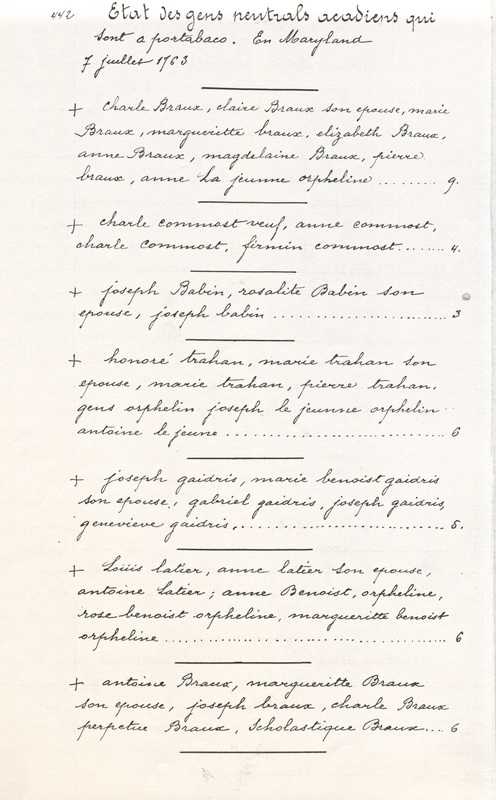
So Anthony is on the Wall as Antoine Breau, but then I realized that his parents are listed below him.  The listing is for “Claire Trahan veuve Charles Breau,” which designates Claire as the widow of Charles when she came to Louisiana.

But at the time of the Grand Derangement, he was very much alive.  He and his wife Claire were 50 years old.  They had been married for 26 years, and their family with nine children lived in Pisiquit.  I saw in one document that they lived in the Village of Breau.  There must have been a lot of Breau families that lived there!

One of those families was the family of their oldest child Anthony and his wife Marguerite.  Anthony was 25 years old and Marguerite, who was born a Landry, was 18.  They had two young children.  The oldest was 3 or 4 year old Scholastique, who was later to be my 4Xgreat grandmother.  She had a young brother Joseph just a year old.  They were just getting started with their little family in the quiet little hamlet of the Village of Breau.

Then things took a turn.  The Great Upheaval happened and things were never the same for these families.  These three generations of the Breaux family along with many other families were forcibly removed from their homes.  Many homes were burned, as well as churches and church documents.  This large Breaux group were made to board the ship The Dolphin on October 27, 1755, and they never saw the land of their birth again.

If you read my post last week, you may remember that this is the same ship that contained my Landry family that was Exiled at the same time.  The ship reached Boston on November 5th and Annapolis on the 30th.  While the Landry family went to Upper Marlboro, the Breaux group went to Port Tobacco.

There are a few documents of the time that was spent in Maryland.  Claire, the grandmother of my Scholastique, was a seamstress and she was able to make some money from time to time for the officials in the area.  She also must have had a green thumb, because at one point she helped Mr. Mundell with his crop.  She also grew rye.  She and Charles had at least three new grandchildren who were born in Port Tobacco.  Anthony and Marguerite had a son named for Charles in 1758, a daughter named Perpetue in 1761, and another daughter named Marie Rose in 1764. 

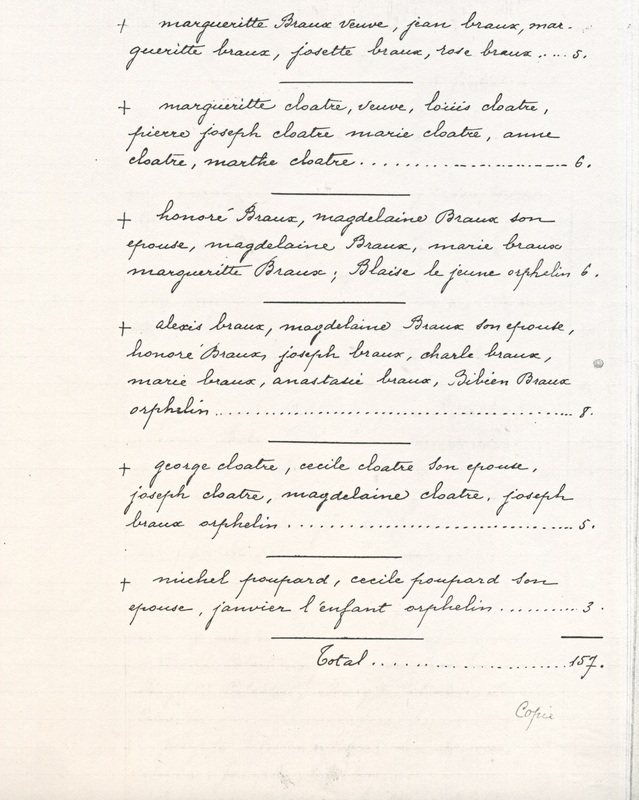
List of the French Neutrals in Port Tobacco, Maryland, in 1763, includes the household of Antoine Breaux. The family is listed at the bottom of the page.  His parents are in the first household listed. This is the last record of Charles Breaux being alive.

Those were the highlights of their stay in Maryland.  You already know the down side, because Claire was a widow when she made it to Louisiana.  I said that from the beginning.  Charles died sometime around 1764 or 1765.  I hope he made it to at least the birth of little Marie Rose.  That would be nice.  But we don’t really know. The main clue is a journal entry of a local priest on August 12, 1765, that says, “…my order to Clare Braux Widow for 3 bushels of Rye…”  So Charles was probably my age right now when he died (59 years old). 

The Breaux family group only stayed in Maryland a few more years.  On December 17, 1767, they boarded the ship The Jane bound for Louisiana.  They were hoping to join those other Acadians like the Landry family that went to St. Gabriel.  But when they reached New Orleans in Feb. 1768, they were brought to Fort St. Luis de Natchez in Mississippi aboard The Guinea.  It was here that after a few months Claire Trahan Breaux died.  She spent 50 years in her homeland, before spending a dozen long, hard years in Exile in Maryland.  She lived less than a year in the South.  She was buried on June 7, 1768.

On September 9, 1769, Anthony made his mark on a document giving his unconditional oath of allegiance to Spain.  A month later he made a request to abandon the land that was given to him in Natchez in exchange for land nearer to the other Acadians who settled between Baton Rouge and New Orleans.  He was granted permission and the family then settled in St. Gabriel, Louisiana.

The 1771 Census shows the family living in St. Gabriel with 3 heads of cattle, 7 hogs, and 3 chickens on a piece of land along the Mississippi with 8 arpents frontage.  Just over a year later, another census shows them with seven head of cattle, thirty-seven hogs, and thirteen chickens.  They were moving on up!

On February 12, 1776, Scholastique married Joseph Ignatius Landry in St. Gabriel.  I mentioned him in the post last week.  He spent a dozen years of Exile in Maryland also, but in Marlboro.  In 1779, Scholastique’s younger sister Perpetue married Joseph Ignatius’s younger brother Mathurin.  That means all of my wonderful cousins descended from Mathurin are actually my double cousins thru this line! 

In 1781 Joseph Ignatius & Scholastique’s third child was born.  His name was Joseph Emanuel Landry and he is my 3X great grandfather.  The path to me goes like this:  Emanuel Landry had a daughter named Marguerite or Basilite Landry, Basilite had a daughter named Marie Celeste Leveque, “Granma Celeste” had a son named Rob or “Pappy” Landry, Pappy had a son named Bob, and Bob was my father.  But Emanuel was also my 4Xgreat grandfather.  That path goes like this:  Emanuel had a daughter named Anna Adele Landry, Adele had a daughter named Marie Amelie “Belite” Bujol, Belite had a daughter named Marie Therese Landry, Marie Therese had a daughter named Germaine Erie Patureau, Erie had a son named Bob, and  Bob, as you know, was my father.

In 1782 Anthony Breaux died in St. Gabriel at the age of  52.  Joseph Ignatius and Scholastique had their fourth and final child in 1783.  Scholastique then died in 1785 at the age of 34.  After making it through a decidedly turbulent childhood in Exile and reaching the land of milk and honey and meeting the man of her dreams, she died after only eight years of being married.  This must have been a tragedy for the whole Breaux and Landry family.

But as you know, people recover and move on.  Joseph Ignatius did.  I have a total of five paths of lineage from him to me.  You will hear about the other three in the next installment.  That story entails a longer, more distant, and more tragic period of Exile. 

You’ve been warned…

Here is the first path to Scholastique Breaux that I talked about in this post.


This is the second path.


For other installments of the “From Acadian to Cajun” series, click on the following links:

From Acadian to Cajun: Part 1 – Landry/Babin

From Acadian to Cajun: Part 3 – Braud/LeBlanc/Gauterot/Aucoin

From Acadian to Cajun: Part 4 – Hebert/Melanson

From Acadian to Cajun: Part 5 – Bourg/Granger

From Acadian to Cajun: Part 6 – Bujol/LeBlanc

From Acadian to Cajun: Part 7 – Foret/Bujol

From Acadian to Cajun: Part 8 – Hernandez/Babin

From Acadian to Cajun: Part 9 – Dupuis/Dugas

From Acadian to Cajun: Part 10 – Bourg/Babin/Landry

From Acadian to Cajun: Part 11 – The Ones That Didn’t Make It

From Acadian to Cajun: Part 1 – Landry/Babin

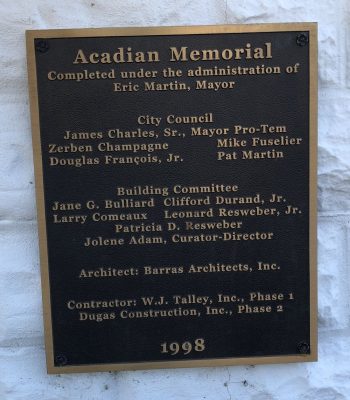
The Acadian Memorial Wall in St. Martinville was completed in 1998.

Earlier this year I went to the Acadian Memorial in St. Martinville, Louisiana.  It was on the same day that I met up with some cousins to exchange old family photos.  I have shared a few photos that I obtained on that day and still have some more in the queue.  But I haven’t shared any photos that I took at the Memorial.

I’ve decided to share those in installments, with each installment to cover a family name or family group.  Before I went to the Memorial, I looked through my family tree to figure out which of those family names to look for on the Memorial Wall.  There are at least seven or eight groups that were represented.  There would have been more if they hadn’t married their cousins through the years.  But as the sign says, they were Exiles in Louisiana and they were different.

One of those differences was pointed out to me when I visited the museum.  When I was telling one of the Memorial staff members about the names I was searching for, they corrected my pronunciation.  I’ve lived almost all of my life in southern Louisiana and I have more Cajun heritage than anything else, but I don’t really have a Cajun accent.  The area around Jennings where I grew up had a lot of immigrants from the northern states and western Europe, as can be evidenced by my mom’s family tree.  I also never learned to speak French, which would have been helpful at the Memorial because there were some visitors from France on the day that I was there.

Thankfully, the workers there spoke English and were willing to help.  If you ever go there, it helps to know that the first several columns are roughly in alphabetical order according to family group.  These include those Exiles who came to Louisiana from areas of North America.  Those fill up more than half of the columns of the Wall.  After that, it lists the seven ships that came from France in 1785 with those Acadians that had been Exiled there.  I descend from people from both groups.

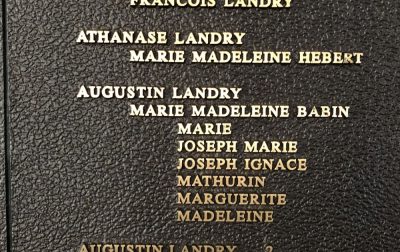
The Landry group that I connect with includes Augustin Landry, Marie Madeleine Babin, and their son Joseph Ignace.

I thought I would start with the most obvious group for me – Landry.  I feel more connected to that name since it is my last name and I have several lines that are Landry.  It identifies me as Cajun and I identify with that.  I have learned more about the history of the Cajuns, who started out as French settlers in Acadie.  They were immigrants from France who made a new home in North America, some of the earliest to do so. 

They had their own identities, too.  They didn’t think of themselves as French Americans or some such term; they were Acadians.  In much the same way, I don’t identify with the term Acadian Exile in Louisiana.  Mainly because it sounds like you are still displaced.  The Acadian Exiles who came to Louisiana made it their home and eventually they became known as Cajuns – hence the title “From Acadian to Cajun.”  These are my ancestors who started out in Acadie, were exiled from their homeland in 1755, and made it to Louisiana some years later.

That first Landry group from my family consisted of Augustin Landry, his wife Marie Madeleine Babin, and their family.  They were all born in an area of Acadie known as Pisiquit.  Augustin was born in 1719 and he was the third generation of Landry in my line to be born in Acadie.  He married his first wife Ann Rivet and they had two children together.  Their daughter Marie was born around 1747, and son Joseph Marie was born around 1749.  Then Ann died around 1750. 

Augustin married Marie Madeleine Babin in 1752 and they had Joseph Ignace in 1753.  I descend from Joseph Ignace, though I usually refer to him as Joseph Ignatius.  It is spelled a variety of ways in the records.  I probably pronounce it incorrectly, too!  After Joseph Ignatius, Augustin and Marie Madeleine had at least three more children – Mathurin, Marguerite, and Madeleine.  But the last of the children were not born in Acadie, they were possibly born in Exile. 

The birth records for these children were lost in the confusion of the next few years, if there ever were any records for them.  The Exile of the Acadian people began August 10, 1755.  People were pulled from their homes,  gathered into public spaces, then shipped off from their homeland.  There were a number of people who died in the process.  It was an ugly time for the Acadian people.  The Landry family that we’re looking at were put on board a ship called the Dolphin that departed Pisiquit on October 27, 1755.

This was not like going on a cruise.  No luxuries with options to choose from.  They also didn’t have many belongings with them.  It was all left behind.  The ship reached Boston on November 5th.  Most of the passengers stayed on board as leaders of the towns tried to figure out what to do with these now-destitute people.  A furious gale hit Boston at this time and 47 Acadians were removed.  Our Landrys continued on with the Dolphin down to Annapolis, Maryland, on November 30th.  From there, they continued on to Upper Marlboro.  They arrived in early December and this is where the Landry family spent 12 years in Exile.  Of the 230 Acadians that started off in Acadie on the Dolphin, 180 arrived on the shores of New England.

I don’t know if the Landry family had casualties during this time or not.  I have the names of two other children for Augustin and Marie Magdeleine with births before 1755.  They do not show up on the Memorial Wall for the family that made it to Louisiana.  Looking at the history of the Landry families before and after that point, it is likely that there were a few children born during that time period.  We don’t know all of the details, but we know that it was a very traumatic time for the Landry family.

Augustin and Marie Landry and family are listed as Neutral Acadiens in the 1763 Census at Upper Marlboro, Maryland.

Their time in Maryland was better, but it was still not home.  The Catholics in Maryland at the time were restricted.  They  could not own land, vote, or hold office.  If they did find work, they were double taxed.  They could not practice their religion.  It was worse for the Acadian Exiles because they started out with nothing and they did not speak the local English language.

I won’t go into all of the politics that were going on between England, France, and Spain during this time.  I don’t know it all and there are too many players to discuss.  It was a fight for land and people and power.  At some point Spain gained control of land in the area that is now Southern Louisiana.  They needed people to populate the area and they were willing to relocate people.  Not only that, they were providing land grants to these people.  Somehow Augustin and Marie Madeleine found out about this and decided to move their family to a place that sounded more promising.

So they packed up all of their belongings and took off on a new adventure.  In April of 1767 the Landry family and their two trunks boarded the ship called The Virgin that was chartered by the Spanish government and headed to New Orleans.  They reached the Mississippi River on July 12, 1767, and continued on to Fort St. Gabriel.  Augustin was given a land grant encompassing 8 arpents frontage along the Mississippi River at St. Gabriel.  Two years later he gave his mark (he could not read or write) showing his unconditional oath of allegiance to Spain.  He must have done this to avoid another period of Exile.

And, as anyone who has ever spent any time here would know, there have been Landry families living in Southern Louisiana ever since.

My family tree with continuation showing Landry line to Augustin Landry.


For other installments of this series of blog posts, click on the following links:

From Acadian to Cajun: Part 2 – Breau/Trahan

From Acadian to Cajun: Part 3 – Braud/LeBlanc/Gauterot/Aucoin

From Acadian to Cajun: Part 4 – Hebert/Melanson

From Acadian to Cajun: Part 5 – Bourg/Granger

From Acadian to Cajun: Part 6 – Bujol/LeBlanc

From Acadian to Cajun: Part 7 – Foret/Bujol

From Acadian to Cajun: Part 8 – Hernandez/Babin

From Acadian to Cajun: Part 9 – Dupuis/Dugas

From Acadian to Cajun: Part 10 – Bourg/Babin/Landry in a short story called “Finding Home”

From Acadian to Cajun: Part 11 – The Ones That Didn’t Make It
A Phenice Keepsake: Painting by Grandma

I know, I know.  You all must be asking, “Another Phenice post?  When are you going to talk about my group?”  And you’re right!  I wrote about my grandmother three weeks ago and then last week I wrote about her father.  “What’s up with that?”  you must be asking yourself.

What’s up with that is that today is my Grandma Bucklin’s birthday!  Myrtle Sylvia Phenice was born on December 19, 1906, in Hathaway, Louisiana.  She was the third of seven children born to Harry Clifton Phenice and Daisy Keys Phenice.  And reportedly, she was a very pretty little baby.  I may have told you that before, but it bears repeating.  When my mom was a little girl, she won a contest for Gerber’s Cutest Baby.  (Or so I’ve been told.)  My grandmother probably bragged about that for a while.  Yes, my grandmother was known for bragging on occasion.  There are worse things a person can do.

But then my grandmother quit bragging about it when young Betty Lou (my mom) started to brag about it herself.  At some point Grandma must have started to answer with a comeback akin to, “I was known to be pretty baby, too, if I may say so myself!”  I never personally witnessed this exchange between my mother and grandmother, but Mama told me that it was a thing. 

I’m sure they were both very cute babies, but that’s not what I wanted to talk about today.  Otherwise I would be posting photos of them as babies and learn how to set up a poll on Facebook or something.  I wanted to share a keepsake that I have from Grandma.  I have a few keepsakes from her – a key, a puzzle, a carving – but those aren’t very impressive or personal.

Oil painting by Myrtle Sylvia Phenice Bucklin, date unknown

This is much more personal and I rather like it.  My mom gave it to me some time around 2014.   My mom wrote a little blurb on the back of it.  It says, “Mama painted this for Uncle Roy and Aunt Effie.  It was given to me after they died.”  Uncle Roy Bucklin died in 1999.  His wife Effie Hetzel Bucklin died in July of 2001, so she got it some time after that.

So I have no idea when it was painted or how long it was hanging in the home of Uncle Roy and Aunt Effie.  I’m also not familiar with any other paintings by my grandmother.  So if anyone else has any original artwork by her, I would love to see it.  Just a quick little digital photo would be sufficient.

Now I’m really curious to see if anyone is going to share something with us.  This is so much better than a vote for the cutest baby.  But for what it’s worth, I always thought I was a cute baby.

If I may say so myself!

Grandpa Phenice on the Porch

H. C. Phenice circa 1949

This is a photo of my great grandfather Harry Clifton Phenice.  It was taken some time around 1949 in Hathaway, Louisiana.  It doesn’t look like the house that my mom lived in when she was growing up, so I guess it was her Phenice grandparents’ home nearby.

Figuring out where they lived at the time can be tricky.  It seems that they moved often.  In the family history book by Edith Keys Segraves, my Grandma Myrtle wrote about H. C. and Daisy’s (her parents) life.  She listed eleven different places they lived.  Mostly they were in Jefferson Davis Parish in southern Louisiana.  

Before they were married, H. C. and Daisy started out far apart.  He was born in Pennsylvania, where his parents and  grandparents were born and lived.  His family moved to Tennessee at one point, but ended up homesteading in Nebraska for most of H. C.’s growing up years.  Daisy Keys, on the other hand, was born in England and lived there until she moved with her mom and her siblings to Southern Louisiana in 1887 at the age of 11.

H. C. did not make it to Louisiana until 1898.  It must not have taken long for them to meet and become enamored with each other.  They were married Dec. 27, 1900, in Lake Charles.  Their first home together was half a mile west of the J. Anderson place.  This is where Sylvan and Grace were born.  I have no idea where the J. Anderson place is.  That was another piece of information that Grandma wrote about.  She left out the next place they lived – Colorado.  I have photographic evidence that H. C. was in a gold mine in Cripple Creek.  And there is a story about the local women being a little too loose for the likes of the young couple trying to rear their children in an upright manner.  So they moved back to Louisiana in time for Grandma to be born at the McGuire place.  I have no clue where that is either!  I do know that it was in 1906. 

Another tidbit of information from Grandma includes the fact that the family bought their first car in 1920.  I suppose they took a train for their cross country moves, but for local travel they used a horse and wagon.  When the family lived close enough to a church, the children were encouraged to go.   They would either walk, ride a horse, or take the buggy.  I wonder if the whole family fit in that first car they got.  At that time all seven of their children we born and they were from 2 to 18 years old.  I don’t think they had station wagons like we had when I was a kid!  It didn’t have a radio, either.  They got their first radio in 1924 and it wasn’t in their car.

Let’s get back to the time of the featured photo.  After moving around for several years, H. C. and Daisy’s son Orville built a small house on his place for them in 1940.  “When they became ill” the house was moved to the property of my grandparents Fred and Myrtle Bucklin.  That was in 1950.  So the picture was probably taken on the porch of that small house before it was moved to my grandparents’ property.

But all of that information isn’t necessary to enjoy the photo.  It’s a charming photo on its own.  It pictures my mom’s grandfather in the way that she knew him.  He liked to walk around his yard barefoot and in his overalls (the only clothes that his wife didn’t make for him).  And sometimes he took time to pose for a photo for his teen-aged granddaughter Betty Lou.  She would then post it on her blog to share with the cousins.

Oh, wait!  No, that’s me that does that.  Enjoy.


A Portrait of Pee Paw

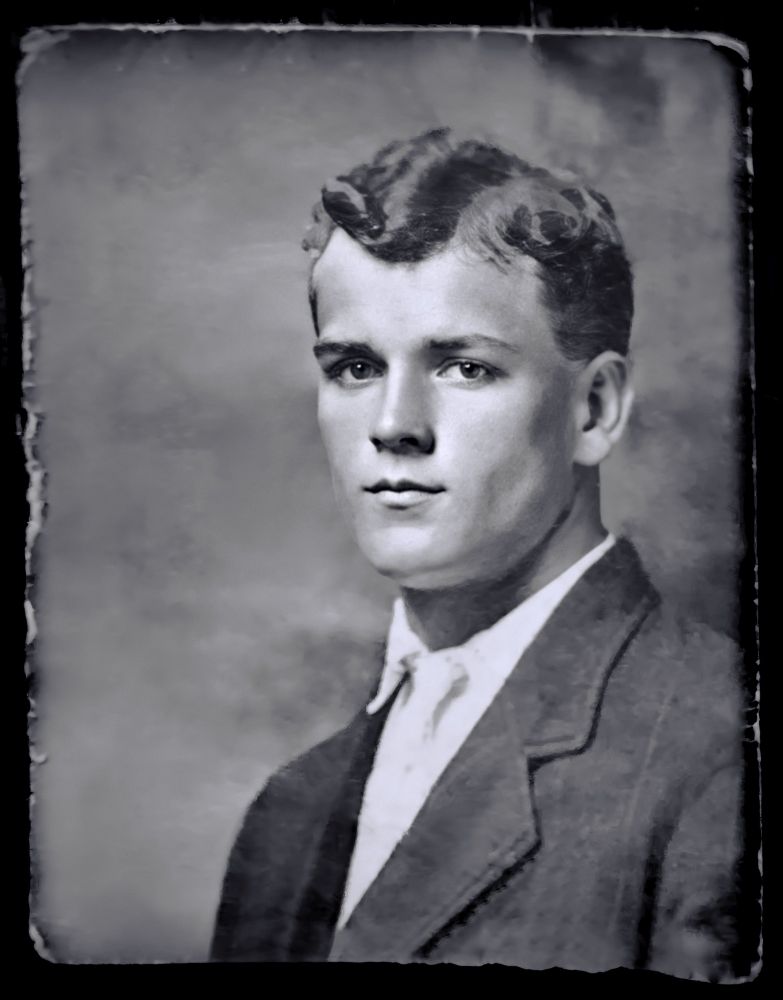
Robert Joseph Landry, circa 1914. Photo edit by Van Landry

I thought I would continue my grandparent theme again this week.  Two weeks ago I had my paternal grandmother featured.  Last week I had a photo of both of my maternal grandparents.  So that just leaves my paternal grandfather.

But not only that, I had photos that showed them in really good light.  In Mee Maw’s case, I meant that literally.  The lighting of the photo was really special.  Last week with Grandpa and Grandma, the photo was really good of both of them and the twinkle in Grandma’s eyes was noticeable.  So I had to do something special for Pee Paw as well.

Fortunately for all of us, I obtained a really good photo of him earlier this year when a few of us Landry cousins got together to share our photographic treasures.  This photo is from the Secret Collection.  It is a very small photo.  It might have actually been in a locket that my grandmother had.  I could be mistaken.  But trust me, it was small and it had several creases in it.  I cleaned it up tonight so I could share it with everyone.

As I said, this was my paternal grandfather.  His name was Robert Joseph Landry, Sr., though he went by Rob and Bob when he was this age.  He was born Jan. 9, 1893, in Westlake, Louisiana, to Simon Alcide Joseph Landry and Marie Celeste Leveque Landry.  Alcide had fought in the Civil War out of Brusly, Louisiana, and later married his half first cousin Marguerite Baselite Landry Leveque’s daughter Celeste.  The family moved to southwestern Louisiana shortly before Rob was born.  He grew up in Westlake and I know they were still there in 1912.  I have a photo of him in 1912 and another one of him from 1915, and this one looks like it was taken between those times.

It’s such a great photo of him.  It looks like a studio portrait.  Very professional.  I wonder what the occasion was?  He was mainly involved with baseball during this time.  I’m sure it was taken before he joined the military in 1917.  All this speculating makes me realize how little I know about the details of his life.  When we cousins got together to share photos, I discovered that his hearing loss was a result of a training accident during his time in the military.  That’s what led to his discharge and why he wore a hearing aid the rest of his life.

So I am discovering more as I keep exploring all of my relatives.  I’m also getting these great photos.   And I share it all with my adoring fans.  Can you believe it?  I’ve posted at least one post a week – every week – for the past four years. That’s a lot of posts!   l intend to keep writing them. 

Why stop now?  I’m on a roll!

Grandma’s Bright Eyes

I thought I would post something related to Thanksgiving this week.  My childhood memories for Thanksgiving are focused on my mom’s side of the family.  I don’t think we ever celebrated Thanksgiving with the Landry side of my family.  If we did, I’ll need a reminder.  Photos would be helpful.  Since my memories of Thanksgiving were associated with the Bucklin side of the family, I went in search of associated photos.

Fred Bucklin, Jodie Lou Landry, and Myrtle Phenice Bucklin in May of 1954. I think this was at my  great grandmother Addie Bucklin’s house in Hathaway, Louisiana.

This is what I found.  It doesn’t have anything to do with Thanksgiving, but it does have my Bucklin grandparents in it with my oldest sister Jodie.  How could I not choose this photo?  Actually, it chose me.  My grandmother’s eyes literally reached out and grabbed me. 

I spent some time last night cleaning up this scan so I could share it everyone.  Not only is it a great photo of my grandmother, but it is really good of Grandpa and Jodie.  For those of you who may not know, my mom was Betty Lou Bucklin Landry, and she was the daughter of this couple.  Fred D. Bucklin was born Oct. 2, 1907, in Roanoke, Louisiana, and Myrtle Sylvia Bucklin was born Dec. 19, 1906, in Hathaway.

The photo was taken May of 1954, which is seven months after Jodie was born.  Since Jodie was born when my dad was stationed in California with the Air Force, this is likely the first time Grandma and Grandpa got to see little Jodie Lou.  She wasn’t their first grandchild.  Mom’s older sister Sylvia already had two sons.  But Jodie was their first granddaughter.  She was their only granddaughter for less than a year.  Little Toni was already on her way – she’d be born that August.

A few years later our numbers would grow to twenty.  The Thanksgiving get-togethers out at Grandma and Grampa’s in Hathaway were great.  The food was always so good and plentiful – turkey with gravy, dressing, ham, potatoes, and other savory dishes.  But then there was dessert – pecan pie, brownies, toffee bars, and cakes.  The all time best, though, was Grandma’s divinity.   With all of that food, you’d think we’d be too full to move.  But we were kids, and that didn’t stop us.  We ran.  We played tag.  We had satsuma-eating contests.  We played chicken freeze tag.  I wish I could say ‘we’ played with fire out by the old bamboo stand, but somehow I always missed out on that activity.  I may have been too busy playing with the sock monkey.  I guess I can’t really complain.

So ‘Happy Thanksgiving’ to all of my Bucklin cousins!  I still think of you all fondly.  Happy Thanksgiving to everyone else, as well.  May it be safe and joyful.

Mee Maw in the Golden Light

When I was thinking about what I was going to write this week, I definitely knew that it had to be something less dark and gloomy.  The last few weeks my posts have been about death and hardship.  And last week’s topic was about multiple deaths and it was exceedingly long.  (As has been pointed out to me!)  So this week I decided to do something short and sweet and light.  With that prerequisite and the fact that it was time to do a Patureau topic, I decided on this photo that I acquired earlier this year.

Mee Maw with a few of her grandchildren in 1959.

This is a photo of my paternal grandmother Germaine Erie Patureau Landry.  She was known as Erie from the early part of her life.  Later she became Mama, and I knew her as Mee Maw.  When I saw this photo, I knew immediately that I would be sharing it on my blog.  It was taken in Lake Charles, Louisiana, in August of 1959.  There was a date printed on the border of the photo, and the ages of my first cousins looks about right for that date. 

The blond boy with the striped shirt is Mark Reeves, the son of Marie Landry Reeves and Malloy Reeves.  The other three children are the offspring of Germaine Landry Winn and Ross Winn.  The boy in the white shirt is Doug, the little girl with the blond curly hair is Phyllis, and the dark haired girl with the smile is Daphne.  We can thank Daphne for sharing this photo with me.  Thanks Daphne!

This photo was taken before I was born, but I sure wish there was a photo of me with Mee Maw that has this same glorious look.  The lighting is just perfect.  I’m sure it is light coming from the western setting sun.  It’s so dreamy looking.  Maybe it’s just me, but I also think it portrays my grandmother in the way that all of us grandchildren feel about her.  She looks so happy to be with her grandchildren, because they were each special to her.  Why else would we all continue to claim to be her favorite?

And you know what?  I was her favorite.  I know she thought I was special!

The Sad History Surrounding Joe Bucklin

Joseph C. Bucklin, circa 1909. I remember when I first saw his photo, I thought he looked handsome and prosperous and that this might have led to him having things go his way rather regularly. I learned otherwise.

I’ve already written A Sad Story about Joe Bucklin.  He was my great uncle.  Or was he my great great uncle?  Whichever he was, he was my great grandfather Louis Charles Bucklin’s older brother.  And boy did he have a sad story to tell.  I wrote the first story about it three years ago, then followed up on it a year later with a Surplus Sunday about the Bucklins, the Ausmans, the MacVeys.  The second story talked about Joe Bucklin’s history, but then veered off into some other family history.

This time I want to keep the focus on Joe.  He does seem to be the center of a large number of tragic events in both the Bucklin and Ausman families.  Joe was married to two of the Ausman sisters.  Both of the sisters died, as did young daughters by each of them.  Since I wrote those other two stories, I have collected more and more information about the Bucklin and Ausman families.  I have no relation to the Ausman family, but I was intrigued with all of the misfortune that befell them and our poor Joe.  Recently I’ve gotten some answers to things that I had been wondering about, so now is the time for the story I’ve been planning.

Joe Bucklin was born in Massachusetts in 1861 to James Bucklin and his second wife Mary Ann McGrath Bucklin.  He had an older half-brother and half-sister by his father and his father’s first wife.  He also had an older sister Jennie by James and Mary Ann.  The family moved to Iowa around 1863 and a year later James and Mary Ann had another son named Edd.  In 1866, the family moved to Delaware County in Iowa.  My great grandfather Lou was born there in 1873.  The 1880 Census shows the family still living in Delaware County.

The Ausman family was from Canada.  By 1873 Samuel and his wife Jane had eight children: Phillip, John, Jennie, Evaline, Lambert, Minnie, Aggie, and Ida.  At that point they decided to move to the United States, and they too picked Delaware County in Iowa as their new home.  They had their sixth daughter, little May Ausman, in Iowa.  I’m assuming that the Ausmans and the Bucklins must have met each other at this point. 

If they did meet each other and become friends, that didn’t keep the Ausmans from moving to Nebraska in the late 1870s.  Once they were there, they had their fourth son.  His name was Willie and he was the last of a total of ten children.  Sadly, there was only a two year period when all ten of the siblings were alive at the same time.  In April of 1881 the first of several deaths occurred when 18-year-old Evaline died.  The only connection to Joe Bucklin was that the families probably knew each other at this point.  Joe was almost two years older than her, so they were peers.  The next few deaths become much more personal to Joe.

About five years after the Ausmans move from Delaware County, the Bucklins moved to Jefferson Davis Parish in southern Louisiana.  James, Joe, and Jennie were able to obtain homesteads in 1884.  Lou was still too young, though he and his future wife would be the ones who would care for the farm for many years to come.  Those first few years were a lot of hard work involved with clearing the land and building roads and bridges.  I’m not sure of James’ participation in all of that.  He was likely involved, though for only a few years.  He died in 1890 at the age of 69.  Joe was 29 at the time and I’m sure it hit him hard.

I’m not sure how, where, or when the Ausmans and Bucklins came back together again, but there are clues.  In Samuel Ausman’s obituary it said that he had spent some time farming in Louisiana.  His daughter Jennie got married to Charles Henry McKague in Nebraska in 1882, but by 1892 they were living in southern Louisiana.  The families must have lived close by, because in 1893 Lou Bucklin mentions the McKague name in his journal.  In the letter that May wrote to Lou in 1893, she talks about the cold weather in Iowa and how it is a different cold than in the south.  They had just recently moved to Iowa again, so it could be that they had just moved from the south.  So if Samuel did farm in Louisiana, it had to have been in the early 1890s.

That would explain why the McKagues moved there.  It would also explain how Joe and Aggie got together.  Joe and Aggie were married in December of 1892.  This was just a few months before another tragedy befell the Bucklin family.  Joe’s older sister Jennie died in June of 1893 at the age of 36.  That is such a young age to die, yet his wife and four of her sisters never reached that age.  Evaline had died in 1881 at the age of 18, and the next one to die in the Ausman family was Jennie.

Jane Ausman (in the middle) with daughters Minnie, May, Ida, and Aggie. This was taken around 1897. Two of Jane’s daughters had died previously, and three more would die in the next six years. Such tragedy for the Ausman family. They were left with only one daughter: Minnie. Seeing three of her sisters die in southern Louisiana made her steer clear of the place. She ended up living in Clear Lake, Washington, about the farthest place in the continental United States from Jefferson Davis Parish, Louisiana. She lived into her sixties.

Jennie was 34 years old when she died around 1896.  She was the mother of six children 13 years old and younger.  When I was finding out more about the Ausman family, I had wondered if there were descendants alive today.  With so many tragedies back then, I didn’t know.  So I did a little exploring with the family and found some descendants.  The most surprising thing I found was for the descendants of Jennie.  I actually graduated from high school with one of her descendants!  You just never know.

Around this same time Joe and Aggie moved from Lake Charles, Louisiana, to Jennings.  They also had their second daughter named Gladys.  (Though Gladys may be the daughter of Ida Ausman MacVey and an unknown father.)  Joe and Aggie’s first daughter Leola was born in 1893.  They had a son named Harold on July 15, 1899, during the few years of calm they had.  But that calm came to an end not long after he was born.

On August 8, 1899, Agnes “Aggie” Ausman Bucklin died at the age of 28.  This third Ausman sister death was definitely the most difficult one by far for our Joe.  It was his wife of only a short seven years!  Yet to make matters worse, their 6-year-old daughter Leola died on December 28, 1899.  The next few months must have been difficult for Joe.  It was so difficult that his mother Mary Ann went to stay with him to help out.  In another tragic twist, his mother ended up getting sick with the flu and she died April 10, 1900.  Poor, poor, Joe.

Willie Ausman, with Ida, May, and Jane Ausman. Circa 1897. This was taken during a short interval between the death of Janet “Jennie” Ausman McKague in late 1895 or early 1896 and the death of Ella “May” Ausman on Sept. 8, 1900. During that time, all three of these Ausman children got married. Willie Ausman got married to Edna O’Neal on October 16, 1899. They were witness at his sister May’s wedding the following day. Edna signed her name as “Mrs. Willie Ausman.” May and Bert did not live to see their first anniversary. Willie and Edna were married for over 45 years. Ida married Joe Bucklin on November 15, 1900.

Meanwhile, May Ausman had gotten married to Bert Lukenbill  on October 17, 1899.  When I tell you that, you may think that I’m leading this story to something more positive and upbeat.  But I’m not.  This is one of the most recent facts that I have discovered.  I knew that May had died before 1910;  I reported that previously.  But I didn’t know the particulars of where, when, and how.  Now I do.

When the Lukenbills got married in late 1899, they decided to move south for health reasons for Bert.  They ruled out southern Louisiana, maybe because two of May’s sisters had already died there.  So they decided to try somewhere new.  As Ausman luck would have it, they decided on Galveston, Texas.  Does anyone know what happened in Galveston in 1900?  I’ll tell you.  There was a huge hurricane that hit the city on September 8.  The city was hit hard and thousands of people died.  The newspapers reported that “everything between M and P streets had been wiped away by the tidal wave…”  Bert and May lived on O street and they were never seen alive again.  May was 25 years old at the time.

Oh, the choices we make!  If May had decided to move to Jennings, Louisiana, where her brother-in-law Joe lived, she may have lived a long time.  Or if she had decided to marry Lou Bucklin instead of dropping him like a hot potato in 1893, she also might have lived a long time.  But if that had happened, I wouldn’t be here writing this terrible tale.  So here I am writing about her untimely death.

Newspaper article from Sept. 18, 1900, about deaths in Galveston, Texas.

When Bert and May’s parents heard about the destruction and didn’t hear from their children, they decided that they needed someone to go into the devastation and seek out any information.  So who did they contact?  Why Joe Bucklin of course.  What’s a little more death and tragedy to deal with for him?  He’s used to it.  So he headed to ground zero shortly after disaster struck.  He was unable to find any trace of them.   A month later the Lukenbills received a telegram saying that Bert’s body had been found and buried. 

What a year for Joe.  During that yearlong period his wife died, his daughter died, his mother died, his sister-in-law and brother-in-law died and he was sent to search for any sign of them.  But do you know what else was going on during this period?  He must have been seeing Ida Ausman, because he got married to her on Nov. 15, 1900.  Did they fall in love while grieving over the deaths of family members?  Stranger things have happened.

So Joe and Ida settled in Jennings.  Joe and his brother Edd had a business called “Bucklin Bros.” in downtown Jennings that seemed to be very successful.  Things calmed down…for a short time.  You know where this is leading.  You might be thinking, “If he’s still writing, more tragedy is coming.”  And you’d be correct.

And by telling you that Joe and Ida welcomed a bouncing baby girl in July of 1903, that shouldn’t convince you to let your guard down.  They named their little girl Ida May after her mother and her most recently deceased aunt.  Two months later, on September 5, 1903, Ida Ausman Bucklin died at the age of 30.  Joe must have had the worst case of deja vu ever.  Four years after his first wife died, his second wife (and sister to his first) died.  And like that terrible year in 1899, a few months later it was followed with the death of a daughter.  Little Ida May Bucklin died on December 16, 1903, at just five months old.

Dec. 17, 1903, issue of the Jennings Daily Times Record.

What a painful story to write!  Can you see why I became so intrigued with the Ausman family that intertwines with my Bucklin family?  Every bit of information I would find would bring a new glimpse of some painful event in their lives.  My great grandfather witnessed all of these event and it must have been difficult for him to see his brother going through all of that. 

Joe would go on to get married again two years later.  He did not father any more children.  His brother Edd died in 1911, and after that the Bucklin Bros store eventually closed.  Joe and his wife moved out of state and he died of the flu in 1918 at the age of 57.  His son Harold moved to North Carolina where he died in 1926 at the age of 27.  He was the last in the line of Joseph C. Bucklin.


Hey, look!  A Happy Story About Joe Bucklin!

Jodie – 30 Years gone

It’s difficult to believe that thirty years have passed since the death of my oldest sister Jodie.  She was only 36 years old when she died and all five of us siblings have long passed that age.  One of the things she said to me when she was dying is, “I want you to remember me young and cute.”  That was an easy thing to do.  And it gets easier every passing year. 

Oct. 14, 1957 – Jodie on her 4th birthday. This was taken when we lived in Lake Charles, Louisiana.

I decided to use this week’s post to show a few photos of her during each decade of her life.  I also thought I’d share some of the writing from my journal for the year of her death.   So that is what will follow this paragraph.

Jodie died at 12:15 in Mamma’s arms on November 6, 1989.  I write this with tears in my eyes two weeks later.  I love her and will miss being able to talk to her and be with her.  She has always been there since I was born.  The first child and I was the fifth.  My earliest memory is from when we lived in Lake Charles and I was less than two years old.  I remember sitting near the end of the driveway at 1317 Clover Drive with her.  She was playing jacks and I was watching her.  All of my memories of her seem to be sunny now.  I like that.

In February Jodie called to let me know that she would be having surgery on Tuesday February 21 in the morning.  She called each of us siblings because she wanted the news to be heard from her.  The surgery was for what they thought was a hernia in her stomach.  When they did a CAT scan of her abdomen, they discovered a tumor at the bottom of her rib cage on the right side.  The surgery became exploratory and they later did tests on the tumor.  Sometimes later she let us know that it was lymphoma, a type of cancer that is easily cured (IF caught early enough).  The doctors felt positive in being able to get rid of it.

Rob, Al, Jodie, Karen, Jamie, and Van Landry in November of 1965 at 758 Lucy Street in Jennings, Louisiana. That’s our dog Princess in the photo with all of her puppies.

She began chemotherapy some time in March.  I called and talked to her on March 19, 1989, and told her about getting to meet Amy Grant two days earlier.  Jamie was there visiting and she told me that she was pregnant for the third time.

Sat. April 8, 1989 – Rene & Michael’s wedding day.  The wedding was nice.  Had good visit with college friends at reception.

May 7, 1989 – Crawfish boil with The Phone volunteers.  Yum!

May 12, 1989 – 10 yr reunion from high school.  It was fun to see everyone.

May 20, 1989 – Bought car stereo so trip to Jodie’s next week wouldn’t seem so long.  Called Mama for her birthday.

I went to visit Jodie and Randy and Chris and Kyle on Friday, May 26, 1989.  I got there around 7:30.  We had a good visit.  Jodie was in about her eleventh week of chemotherapy.  It was really toxic to the body.  She had lost weight and her hair.  She tired easily and needed lots of rest. 

May 27, 1989 – Went to the Rhodes’ camp after going to see Chris play T-ball…

Jamie, Jodie, and Karen in Jennings on December 24, 1978.

May 28, 1989 – Went to eat at Dairy Queen.  Then we came back and watched “Robin Hood” and “American Tail.”  I talked with Jodie and Chris.  Jodie says he’s been a big help for her.  Getting things for her and taking care of himself more.  She says she’s trying to prepare them to do things for themselves…

During this time I decided to talk to her about the possibility of dying.  It is what we were all afraid of.  Why deny it and avoid it?  It is the thing that scared us the most.  I kept thinking it wasn’t as bad as other cases and that it shouldn’t be happening at all – not to our family.  But it was.

June 22, 1989 – Jodie called about doing a bone marrow donation… There was a possibility of doing a high powered chemotherapy that would destroy her bone marrow to get rid of any traces of cancer once the rest was in remission.

June 30, 1989 – Flew to Denver to visit Rob and Robyn.  Went hiking in the mountains and had lots of talks.

July 8, 1989 – Went to Winter Park for a music festival with Rob and Robyn.

July 15, 1989 – Went canoeing with young adult group with cousins Kim and Wade.

July 16, 1989 – Began getting depressed about Jodie.  Things just didn’t seem to be going good.  The chemotherapy didn’t do the trick… Things weren’t going as smoothly as they were supposed to be according to what the doctors first said.  The possibility of Jodie dying began to be real and that was depressing.

July 22, 1989 – Went with Kim to Evangeline Downs with a bunch of her (our) family. 

July 23, 1989 – I began to worry that Jodie was going to die quickly.  Like she was going to go to the hospital for chemotherapy and die.  I was planning a vacation and worried that she would die while I was gone and I wouldn’t hear about it.

July 28, 1989 – With help from Kim, Rex, Lisa, and Mary, moved some of my stuff to my new apartment.  Apt. 107 at Concord Estates.  Diane let me borrow her truck.

August 12, 1989 – Went to Mom and Dad’s in Jennings.  We went to the Hine family reunion.   There were pretty many people there.  Played horseshoes.  Back to Baton Rouge for going away party for Megan and Ruben.

Aug. 18, 1989 – Started vacation.

Aug. 21, 1989 – museums in Washington, DC

Aug. 25, 1989 – Went to the Statue of Liberty…

Aug. 28, 1989 – Went on the “Freedom Trail” in Boston

Aug. 30, 1989 – Back home

Sept. 1, 1989 – Chris’s 8th birthday.  Called and talked to Jodie and Chris.  Told her about my vacation, especially about the bear.  We had a good talk.

Sept. 3, 1989 – Went to Houma for Sarah’s 5th birthday.  Went to Sarah’s birthday party at bowling alley.  It was fun.  Later on everyone was sick and throwing up.

Sept. 18, 1989 – 2 years at BBECI.  Talked to Bob.  I got an eleven % raise because of re-evaluation.  I’m now making almost $30, 000 a year.  Good enough to keep me…  I’d like more, but don’t want to make any more major changes in my life:  just moved, relationship change, and situation with Jodie…

Sept. 21, 1989 –  Called Jodie…  she said the tumor in her abdomen was growing even with the chemotherapy.  She couldn’t undergo another treatment because of her low blood count.  Things were not looking up at the moment…

Sept. 24, 1989 – Went to visit the Moving Wall and went to the library.  Al called to see if I wanted to go skiing in January…

Oct. 1, 1989 – Mamma called to let me know what the doctors said to Jodie:  There is no more chemotherapy to try.  All of it has been tried and none of it worked.  It just hurt her and the cancer stayed.  There was nothing hopeful that they could do.  It was a very disturbing phone call.  I just want to yell for it all to stop.  Sobbed a bit.

Randy, Jodie, Kyle and Chris Rhodes in 1988. Such a cute little family.

Called Jodie.  She sounded positive about the possibility of radiation treatment.  She wanted to try anything to make it.  Especially for Chris and Kyle.

Friday, October 6, 1989 – Last visit with Jodie.  Al and Rob and their wives were also there.  Jodie’s abdomen had swollen noticeably in the last few weeks.  It was a scary thing to see.  She was slow in her movements and tired easily.  She was in good spirits.  We all played Pictionary.  It was fun.

Oct. 7, 1989 – Got up and visited… She talked about the tumor growing so rapidly in the last weeks and was really frightened because there wasn’t much room for it to grow anymore.  Mamma was there and I remember her telling me years before that she did not want to experience the death of any of her children.  I started to remind her of  that, but I couldn’t.  All I could say was, “I remember you telling me…” and I couldn’t go any further.  After I tried a second time, she got up and left.  She must have figured that if I couldn’t say it, she didn’t want to hear it…  Jodie was giving us some old photos of hers.  She was pretty sure she was dying and want to give us a few things.  She worried about how everyone was handling it and wanted to help us deal with it.

We were watching Chris and Kyle play.  Jodie said she knew they would probably play like that after she died.  Soon after she died.  She understood that it didn’t mean they didn’t care.  Kids play.  She said she could imagine Randy getting remarried and they would be a family.   I asked her if that is what she wanted.  She said, “Yes, I want them to be happy.  I want them to have a mother to love them.  I know that no one will love them as much as I do.”  Rob and Robyn left during the day.  It was difficult watching them say their goodbyes.

Oct. 8, 1989 – Visited for a while with Jodie and the family.  Then it was time for me to leave.  Jodie and I walked outside.  The boys were riding bikes and just playing around.  I was standing at the driver’s door of my car and she was on the other side of the car.  It was sunny and she was trying to block the sun from her eyes.  We were talking about a lot of different things.  She told me that Dennis had called her and talked to her.  She said she was polite to him.  He was a big part of her life at one point.  She talked about her family now.  She thought that her little family was so good the way it was.  She really regretted not being able to see Chris and Kyle grow up.  She also realized that they would be OK without her.  She had come to accept things really well.  She still had hopes for their family of four to continue a while longer.

She said that she was hoping for the best and preparing for the worst.  She said that we are never guaranteed another day.  I could die in a car wreck on my way back to Baton Rouge.  At least she had had time to prepare herself and those she knows as best she can.  I decided it was time to leave.  We both thought it would be the last time we’d see each other.  We hugged each other and started crying.  We talked a little more and then hugged goodbye again.  It was difficult leaving.  One of the hardest things in my life.  I told the boys goodbye and pulled out of the driveway.  Jodie had Chris and Kyle in the front yard on the bench and they waved to me.  It was sunny and nice weather.  I think I will always remember this day.  It was the last time I saw her alive.

I didn’t really journal much after this.  Jodie got progressively worse during the month.  We spoke a few times, but she was very weak.  As I said earlier, she died on November 6.  Actually, according to my mom, she died shortly before midnight on the 5th.  The coroner was called and came over after midnight.  Her death was officially listed as the 6th.  The family all got together in Franklin, Texas, for the wake and funeral.  I remember how comforting it was to have extended family there.  The most comforting ones were my parents’ siblings.  My younger sister Jamie and her family wasn’t there because Jamie was giving birth to her youngest daughter Beth.  We heard about it between the viewing and the funeral itself.  Such a bittersweet day.

I still miss you, Jodie.

Eating Tacks in the Civil War

Two years ago I wrote about my great great grandfather Samuel Charles Phenice’s Civil War experiences.  He was on my mom’s side of the family, and all of her ancestors were from the Northern USA, England, or Ireland.  The Phenice line was in Pennsylvania for a few generations and that is where Samuel joined the military in February 1864.  He fought and was injured in the Battle of the Wilderness a few months later.  He then was in the “Invalid Corps,” where he was stationed at Ford’s Theatre on the historic night of the Lincoln assassination.

Parts of pages 318 and 319 from the book “History of Mercer County.”

Since I wrote that post, I found out a few more details that I thought I’d add to his story.  One of the things I thought about his previous experiences was that he was a new recruit when he went into battle and was injured.  That could mean that he didn’t really know his fellow soldiers very well and might have felt very alone.  This first document I found eased a bit of that concern.  (Not that it would make any difference at this point anyway!)  I saw this document a few times before I noticed the important part.  While the names are in alphabetic order for the most part, it’s not strictly in order. 

The thing that I noticed was that Samuel’s brother William Henry Phenice was in the same Company F as he was.  As you see in the document, they spelled the name differently – Phenicy.  Samuel himself spelled his last name as Phenicie on some documents.  Our line of the family now consistently spell it as Phenice.  The descendants of William Henry spell it the same way.  There are a few of them who have taken DNA tests and they are strong matches to us.  I like this other connection that we have that our ancestor brothers fought together in the Civil War out of Mercer, Pennsylvania.

The other new information comes from an article I found in Nebraska last year when I visited Samuel and Cathrine Phenice’s graves.  I had already seen at least four articles that talked a little bit about Samuel’s Civil War and Lincoln Assassination experiences, so I wasn’t expecting to see more.  But I was wrong.   In Beaver City’s little library there was a binder with Phenice information in it.  A lot of the information was about the Civil War group called the Grand Army of the Republic or G.A.R.  It was for veterans of the Union army.  There was even a small square in the middle of town that had a monument for this group.  I can kick myself now for not walking across the street to see it.  It’s likely to have his name engraved on it, but I don’t know that for sure.  Maybe another cousin will visit one day and give a report.

1937 Newspaper article from Precept, Nebraska

But I did find this article.  What struck me most were the details about his time after getting injured in battle.  Soon after sustaining the injury, he was taken to a field hospital.  Unfortunately for young Samuel, the hospital was taken over by Confederate forces.  It did not stay in Confederate hands for long, but it was a difficult time nonetheless.  There was no fresh food supply for the patients, so they resorted to the emergency rations called hardtack.  They would heat it up a little to soften it, but it still was barely palatable.

But even worse was the medical situation.  The injury that he had sustained was not too severe when he first received it.  But due to lack of care and supplies, he suffered from gangrene.  They were finally able to make a compound to clean out the damaged tissue and he was able to heal more quickly.  The field hospital went back to Union hands and he was then transferred to the West Philadelphia Hospital.  I had seen records of his stay in Philadelphia as well as a stay in Pittsburg.

He reports that he was able to make a visit home between that time and the time he was assigned to Ford’s Theatre.  He talks about having worked at the Theatre for some time before the Assassination.  I had wondered about that.  All I knew before was that he was there that one night.  I didn’t know if it was a one time assignment or something else.  Obviously it was the something else.  He states that he was familiar with the layout of the stage and such. 

Previously I had been skeptical about all of the details that he seemed to remember from that night.  But if he was in familiar surroundings, it would have been easier to remember all of the things that went on at that historical event.  Yet, he says that several people died at the Theatre that night.  I’ve never seen that report anywhere else, so I doubt that it happened.   So I’ll leave it up to you to decide what parts of the article are true or not. 

I’ll clarify one item.  They didn’t really eat tacks.  Hardtack is a type of hard biscuit.

1 33 34 35 36 37 64