From Acadian to Cajun: Part 3 – Braud/LeBlanc/Gauterot/Aucoin

The second installment of this series was about Antoine Breaux and his close family.  He was the son of Charles Breaux.  This week we are looking at the family of Antoine’s first cousin Honore Breaux – my 4X great grandfather.  His father Pierre was the brother of Charles and his mother was Marguerite Gautrot (More commonly seen in southern Louisiana as Gautreaux).
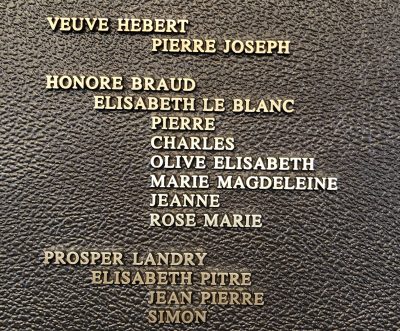
Honore was born in the small Village of Breau in Pisiquit, Acadie, in 1735.  This is where he spent his childhood.  He was the second of seven children with a good mix of four boys and three girls.  Though there was a war going on between France and England during some of his childhood, it was mostly occurring in the Old World.  There were some consequences to Acadie, but his home life was probably undisturbed by it.  He was one of the last of the Acadians to have an undisturbed childhood in Acadie.

Honore was 20 years old when the time of the Exile began in the middle of 1755.  He was likely living on his own, because he was not rounded up with his immediate family.  He was deported to Virginia, while his parents were sent to Maryland with the large group of the Breaux family we talked about last time.  That didn’t seem too far from Virginia, right?  Maybe he would someday see his parents and siblings again.

Honore’s future wife (and my 4X great grandmother) took a different route to their eventual meeting.  Elisabeth LeBlanc was born in 1743 in Beaubassin, Acadie, to Victor LeBlanc and Marie Aucoin.  She had an older sister named Marie Marguerite and younger brothers named Pierre, Armand, and Olivier.  Before I tell you about their odyssey, let me go back a little further with their family to show just how much an impact the Grand Derangement had on this family.

Victor LeBlanc died before the Exile (in 1750), but his wife Marie Aucoin was alive at the time.  Her parents (Elisabeth’s maternal grandparents) were Rene Aucoin & Madeleine Bourg.  At the time of the Exile, Rene and Madeleine were deported to Virginia, which was where their granddaughter’s future husband also was sent. 

Virginia was not a very welcoming place for the Acadians.  By the spring of 1756, Governor Dinwiddie was ready to rid himself of these “internal enemies.”  So by May 10th over 1000 Acadians were thrown out of Virginia and sent to England aboard ships Fanny Bovey, Virginia Packet, Bobby Goodridge, and Industry.  Rene Aucoin & Madeleine Bourg and Honore Breau were aboard Virginia Packet.

The ships of exiled Acadians began arriving in English ports starting on June 18th.  Virginia Packet was in Bristol, England, the following day.  The town was unprepared for them because they weren’t told about the departures from North America.  For three days they were left at the wharves.  They were then housed in old, ruined buildings.  Many of the young, old, or weak died of smallpox and exhaustion.  Rene (66) and Madeleine (62) were dead before September of that year.  Rene’s (Aucoin) family was really hit hard.  Within that same year, his sister Agnes and six of her children died from smallpox and neglect.  Honore must have been a sturdy 21-year-old, because he made it through this place of disease and death.  He and the other surviving Acadians were then moved to Falmouth in October, 1756.  He was continually getting further away from his parents, so his chances of reuniting with them were decreasing as time went by.

Meanwhile his future wife Elisabeth LeBlanc avoided that initial round of deportations.  Her mother Marie Aucoin had remarried to a man named Gregoire Maillet around 1751 and they relocated to Ile St. Jean.  They had a daughter named Marguerite in 1752 and a son named Felix in 1754.  Since Ile St. Jean was still under French Rule, they were not Exiled in 1755.  It was still an unstable situation with conflicts going on between England and France.  In the midst of all of this, Marie and Gregoire welcomed little Madeleine to their family in 1756. 

Ile St. Jean did not remain under French control very long.  The French stronghold at Fort Louisbourg fell to the English in July of 1758.  It was decided that the French inhabitants of Ile St. Jean would be deported to France. Elisabeth and her family were treated as prisoners for a few months. She was able to stay together with her family, except for her older sister Marie Marguerite who had got married earlier that year.  Her fate was now connected to her husband.  The household of Gregoire Maillet and Marie Aucoin were loaded onto the Tamerlan in late 1758 with a destination of France.

The ship arrived in St. Malo, France, on January 16, 1759.  There were many tragedies that occurred on these ships deporting the Acadians to France during a time when winter storms can cause troubles.  Though our family were not aboard one of the ships that sank, they still encountered tragedy.  During the transport, young Felix and Madeleine died and were buried in the Atlantic Ocean.  Poor Marie.  I don’t know if she was aware of the deaths of her parents in England, but she was with her two babies when they died on their forced journey.  She was keenly aware of those deaths.

As far as the bigger picture was concerned, this was the time of the Seven Year War.  I’m sure that’s not what it was called when it began in 1755.  The deportation of the Acadians from their homeland continued throughout this time of war.  The Treaty of Paris brought the war to an end in February of 1763.  During the war Exiles in England and in other places were considered prisoners of war.  They were not free to go wherever they chose, nor could they obtain employment.  They were to be provided government funds to meet basic needs, but the funds were not provided in a timely manner.

So at the time of the Treaty of Paris, we find Honore still in England.  We don’t know if he had heard the news of his father Pierre Breaux’s death that occurred sometime before 1763 in Port Tobacco.  Honore was considered a prisoner of war, but now the war was over.  He and several other Acadians were put on board the royal frigate La Dorothée and sent to France.  They arrived on May 23 in St. Malo.  Honore was identified as a 28-year-old single man who was plowman, laborer, and carpenter. 

I’m sure you can all guess what happened next.  When we last saw Elisabeth LeBlanc, she had reached St. Malo with her mother Marie.  Her mother died three months after their arrival in France.  Elisabeth was the oldest of the five remaining siblings, so I’m sure she grew up quickly and helped to care for her younger siblings.  By the end of the war, she was 23 years old.  She met Honore sometime after that, and they were married on Feb. 10, 1766.  They lived in St. Servan, France, at this time.  Nine months after their marriage their first child Jean Charles was born.

My connection to Olive Elisabeth Breaux and her father Honore is through my paternal line.

The most important event happened in 1769.  Olive Elisabeth was born.  She is my great great great grandmother.  She would later marry Joseph Ignatius Landry, who you heard about in the first two installments of this series.  Their third son’s name was Narcisse.  His fourth (and youngest) son was Simon Alcide.  Simon Alcide’s seventh (and youngest) son was Robert Joseph “Rob” Sr., who was my grandfather.  My father was Robert Joseph Jr. or Bob.  He was the third of four sons.  My name is Van and I’m the third of three sons.  There are two other paths from Olive Elisabeth to myself.  I’ll post a chart for those two paths at the end of this story.

In 1771 Honore and Elisabeth had a daughter named Marie Madeleine.  A year later they had a son named Pierre Paul who died 11 months later.   It seemed like they were trying to make a home there.  Honore and his family joined other Acadians in an attempt to develop a community on the island of Bouin in Poitou, France, in 1773.  They had another son Elie in 1774.  The Poitou venture was unsuccessful, so they moved on to Nantes in 1775.  Their last four children were born there:  Jeanne in 1776, Pierre Paul in 1779, and twins Rose Marie and Charles in 1781.  All of their children were born in France.

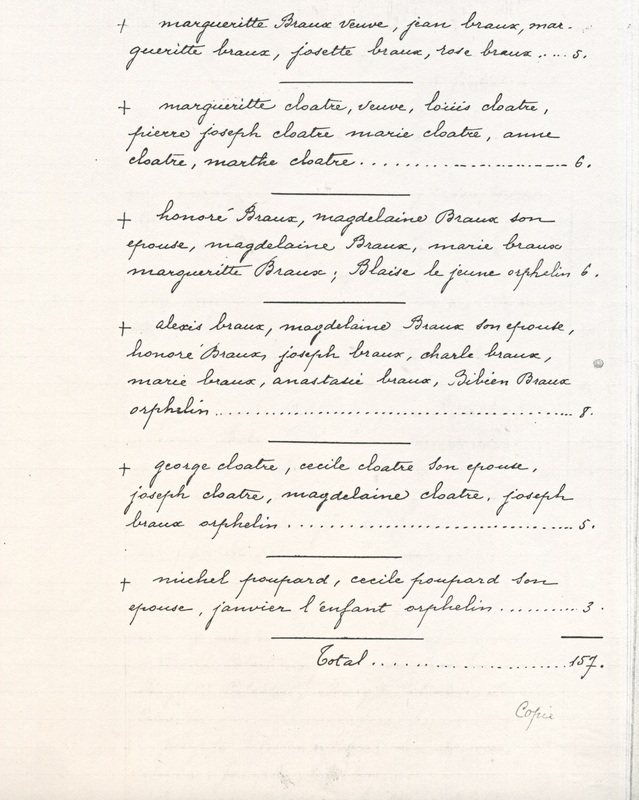
1763 Census of French Neutrals in Port Tobacco, Maryland, includes Marguerite Breaux veuve (widow of Pierre Breaux)

I had mentioned the possibility of Honore reuniting with his parents after being torn from them during the Great Upheaval.  That was not to happen.  As I mentioned earlier, his father died before 1763.  His mother Marguerite Gautrot Breaux had been with the Breaux group that arrived in New Orleans on Feb. 4, 1768 aboard the Ginea.  They were sent to Natchez in 1768.  She relocated to Ascension Parish in Louisiana and died there in 1773 at the age of 67.  So her name made it to the Wall in St. Martinville, as did her son’s, but they were not reunited in Louisiana.

Marguerite Gauterot arrived in New Orleans in 1768. Her husband Pierre Breau died in Exile in Maryland.


Then in 1783 a Frenchman from Poitou developed a project to relocate the Acadians to Louisiana.  Even though there wasn’t much work to be found in France and the assistance they were provided was sporadic, the Acadians didn’t know if they should trust this proposal.  Other attempts at starting communities had failed and the participants had returned to France.  Once the kings of France and Spain had been sold on the idea, the Acadians soon decided to go along with the idea.

On May 12, 1785, the family of Honore and Elisabeth boarded the LaBergere along with their fellow Acadians bound for Louisiana.  They arrived in New Orleans on August 15 and settled in St. Gabriel near other Breaux family members who had arrived previously.  I don’t know if Honore reunited with any of his siblings or not.  It’s possible that two of his younger sisters made it to Louisiana, so it could have happened.  It’s hard to imagine living in an unsettled situation for thirty years.  That’s a whole generation.  Honore started the Exile as a young man, and when the family found their new home, his oldest son was just about the same age.  At least he made it.  Not all of them did.

In 1787 Olive Elisabeth Breaux married Joseph Ignatius Landry in St. Gabriel.  Honore and Elisabeth were there to see their daughter married.  They survived long enough to see all of the children of Olive Elisabeth and Joseph Ignatius.  In fact, they outlived Joseph Ignatius who died in 1806.  At the time of Joseph Ignatius’s death, court documents of August 4, 1806, show that the guardianship of his minor children was proposed to go to their grandfather Honore Breaux. 

He accepted that responsibility on the same day.

The second path from Olive Elisabeth to myself goes through my Patureau line. All of the Patureau families originating in Louisiana descend from Honore Breaux.

The third path between Honore and me goes through the Civil War hero from the South – Trasimond Landry.


For other installments of the “From Acadian to Cajun” series, click on the following links:

From Acadian to Cajun: Part 1 – Landry/Babin

From Acadian to Cajun: Part 2 – Breau/Trahan

From Acadian to Cajun: Part 4 – Hebert/Melanson

From Acadian to Cajun: Part 5 – Bourg/Granger

From Acadian to Cajun: Part 6 – Bujol/LeBlanc

From Acadian to Cajun: Part 7 – Foret/Bujol

From Acadian to Cajun: Part 8 – Hernandez/Babin

From Acadian to Cajun: Part 9 – Dupuis/Dugas

From Acadian to Cajun: Part 10 – Bourg/Babin/Landry

From Acadian to Cajun: Part 11 – The Ones That Didn’t Make It
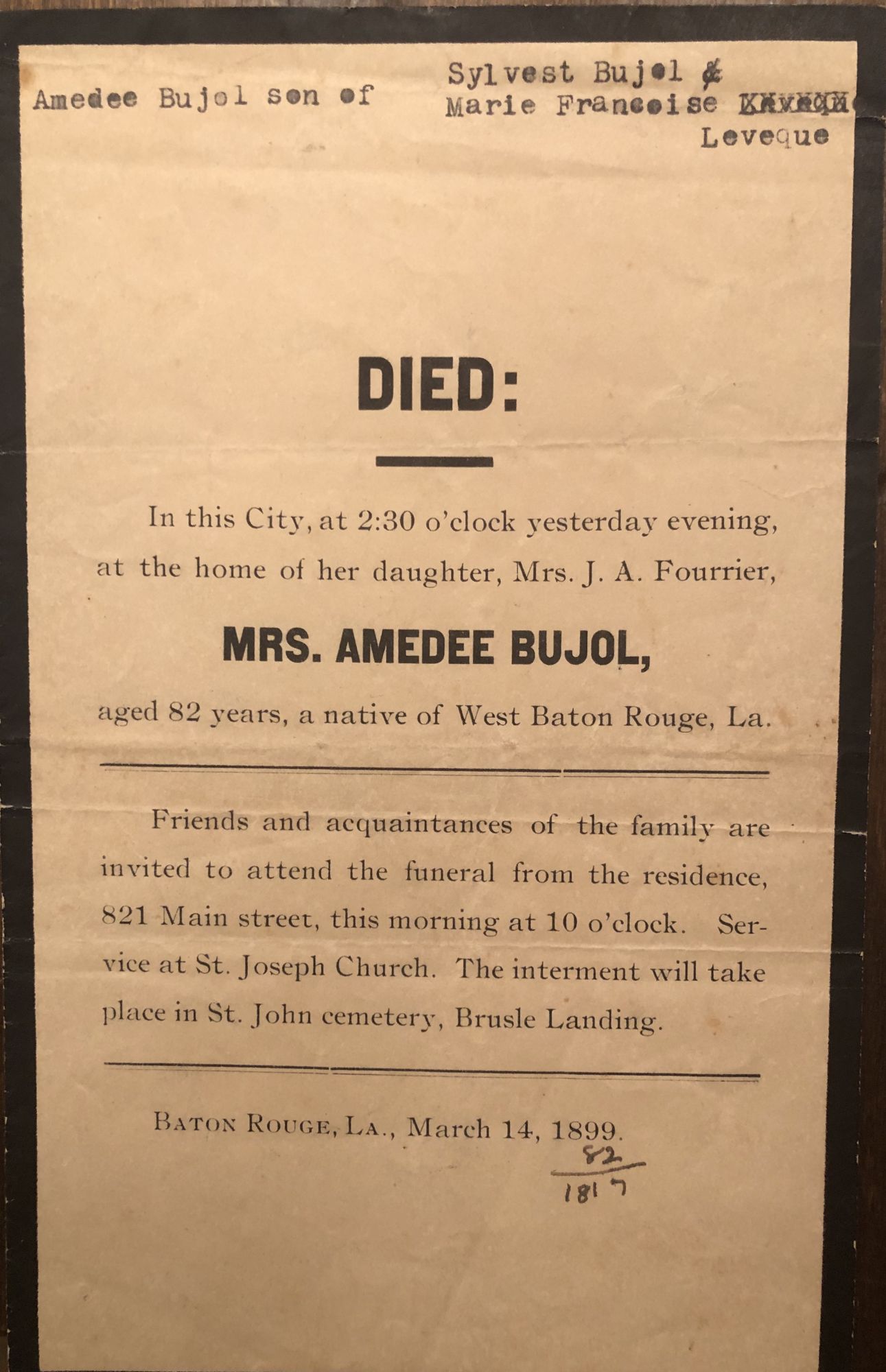
Names on a Grave – Patureau

I’m doing something I’ve never done before on a blog post.  I wouldn’t normally do this, but it is a good cause.  At least I think so.  I guess I should just come right out with it…  I’m asking for money.  Not for myself, but for a family history cause.   It’s all about the Patureau Tomb in Plaquemine.  If you’re not familiar with it, it is the old Catholic Cemetery in Plaquemine, Louisiana. 

I went and visited that tomb a few months ago.  Sad to say, I had to ask for directions.  I thought I knew where it was, but I was wrong.  When we finally got there, I went to see about something on that family tomb.  Don’t tell anyone, but I may have broken something off accidentally.  I was nervous that someone might have seen me and tried to hide the evidence!  I laugh about it now, but it was in a bit of a state of disrepair.  That’s where the request for money comes from.  But before I get into those details, I want to tell a story about one of the names on the grave.

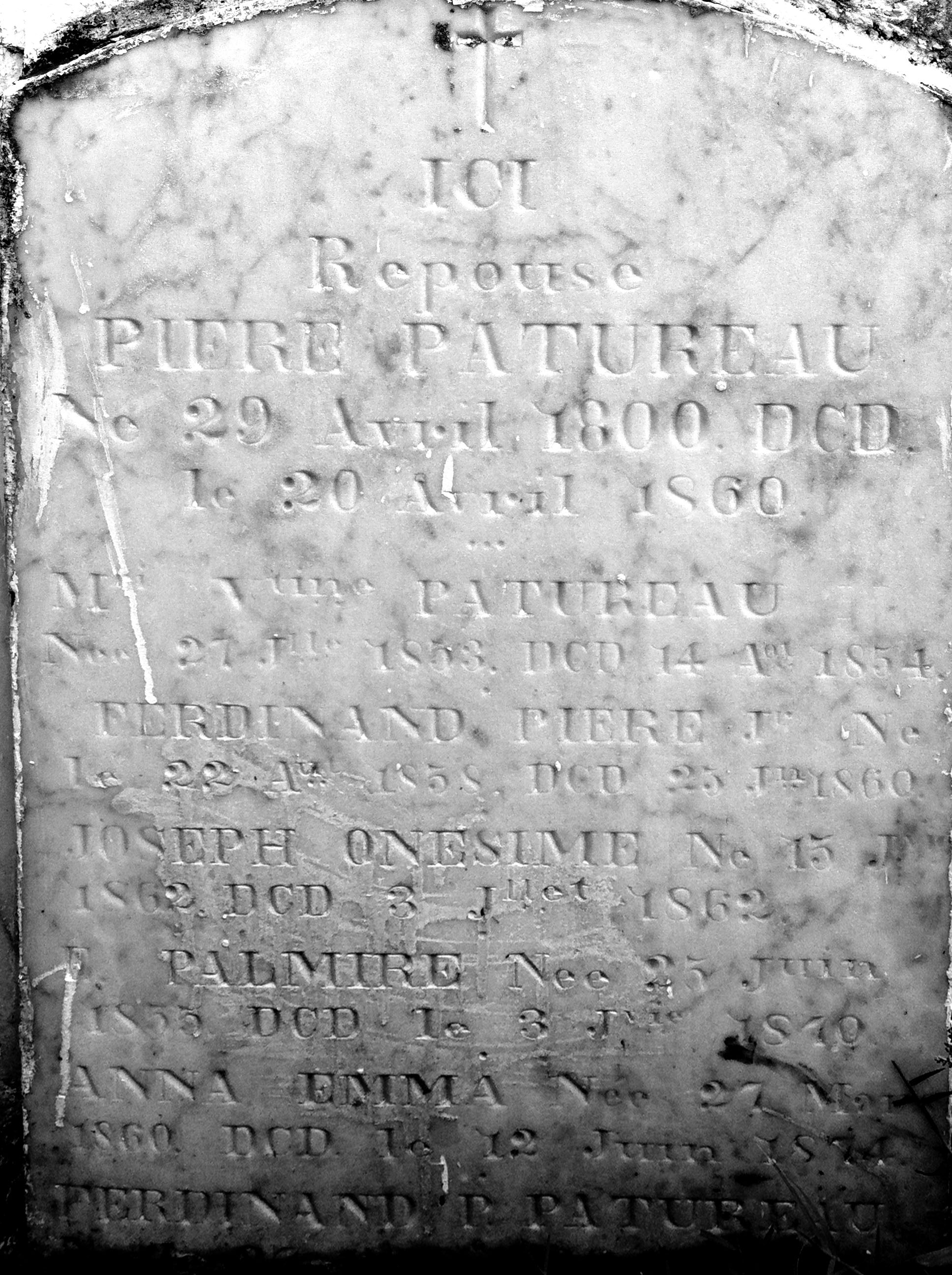
Plaque of names on the Patureau family tomb

On the Patureau tomb there is a large plaque with several names on it.  At the top is the name of Piere Patureau who was born in 1800 in France.  He was the patriarch of the family that immigrated to Plaquemine, Louisiana in 1840.  At the bottom of the plaque is his son Ferdinand Pierre Patureau who is the son that carried on the Patureau name in southern Louisiana and places further afield.

The person that I want to tell the story about is just above Ferdinand.  Her name was Anna Emma Patureau and she was the ninth child of Ferdinand and his wife Marie Emma Landry.  I had noticed her name a few years ago because she was born in 1860 and she died in 1874.  I wondered what had caused her death at such a young age.  Grampa Max was only five years younger than her, so her death would have greatly affected him.  But he wasn’t around to ask about it and nobody else seemed to have any information about Anna Emma.

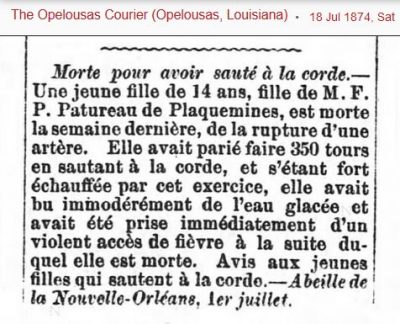
Then one day my search on a newspaper website brought something to my attention.  It was an old newspaper article written in French in an Opelousas publication in 1874.  I don’t know French, but I have been working a bit with French documents enough to recognize some words.  I could make out that a daughter of F. P. Patureau in Plaquemine had died at the age of 14.  I had found her!

So I used my trusty French translation app on that googly search engine and found out what the article was talking about.  Apparently Anna Emma had decided that she wanted to set a world record or something on June the 12th, a day of the year when the average temperature is 90 degrees.  The sport she chose was jumping rope.  So she started jumping.  She made it to 50. Then she made it to 100.  Then 200.  I wonder if she started feeling bad by the time she reached 300?  Because something went terribly wrong when she reached 350.  She must have overheated, because she stopped and drank some cold water.  It doesn’t say that she stopped to drink the cold water.  That was something I surmised.
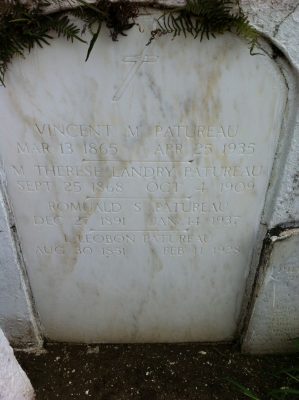
The article says that drinking the cold water caused her to have a furious fever which led to her death.  But it also says that she died from a ruptured artery.  Since I am not fluent with French, I may be missing some other meanings to phrases they use in the article.  But it sounds like she either died from something like an aneurysm or from heat stroke.  Either way, it was a sad day at the Patureau household in Plaquemine, Louisiana.  Thanks to Abeille (Bee) in New Orleans for providing that story to the Opelousas Courier.

So you see?  Those aren’t just names on a slab of stone.  They represent people like Anna Emma who had dreams of something more that being a “Notice for girls who jump rope” as the article states at the conclusion.  She died with a dream of accomplishing something.  So we want those names to last a while.  This takes us back to the reason for the money.  Like I said, the family tomb was in disrepair, even though some family members were paying for upkeep.  The years take their toll.

Another plaque on the Patureau tomb show Vincent (Grampa Max) and Leobon, patriarchs of large family groups in southern Louisiana.

For the past several years some of my dad’s first cousins have been paying to provide that service.  They are granddaughters of Grampa Max.  Sis and Syl are the daughters of Marie Therese Patureau Schafer (and nieces/step daughters of Zita Patureau Schaefer).  Maxine and Winona are the daughters of Sylvia Patureau Marionneaux . When they noticed that the whole structure needed to be reconstructed, they researched what was required and found a reputable person to do the work.

The total cost of the work is $5000.  Those four women have generously paid $1000 each for this work.  I am going to go ahead and pledge $100 to take part in the restoration.  I know that a few of my first cousins have done the same.  I am hoping that there are enough of you out there that are willing to help so we can reimburse our generous cousins so they don’t have such a large burden to bear.  Wouldn’t that be nice?

For many of us, the tomb is a resting place for three generations of our family.  This is true for me, since Grampa Max is buried there.  It is also true for all of you that descend from Louis Leobon Patureau.  You know who you are!  Maybe you don’t, but I’m not going to name names.  So don’t worry, Byron.

So if you are feeling the desire to help out with this familial endeavor, just send me a note and we can figure out the best way to keep our family history crypt going. 

Go, go, Patureau!

Mee Maw in the Golden Light

When I was thinking about what I was going to write this week, I definitely knew that it had to be something less dark and gloomy.  The last few weeks my posts have been about death and hardship.  And last week’s topic was about multiple deaths and it was exceedingly long.  (As has been pointed out to me!)  So this week I decided to do something short and sweet and light.  With that prerequisite and the fact that it was time to do a Patureau topic, I decided on this photo that I acquired earlier this year.

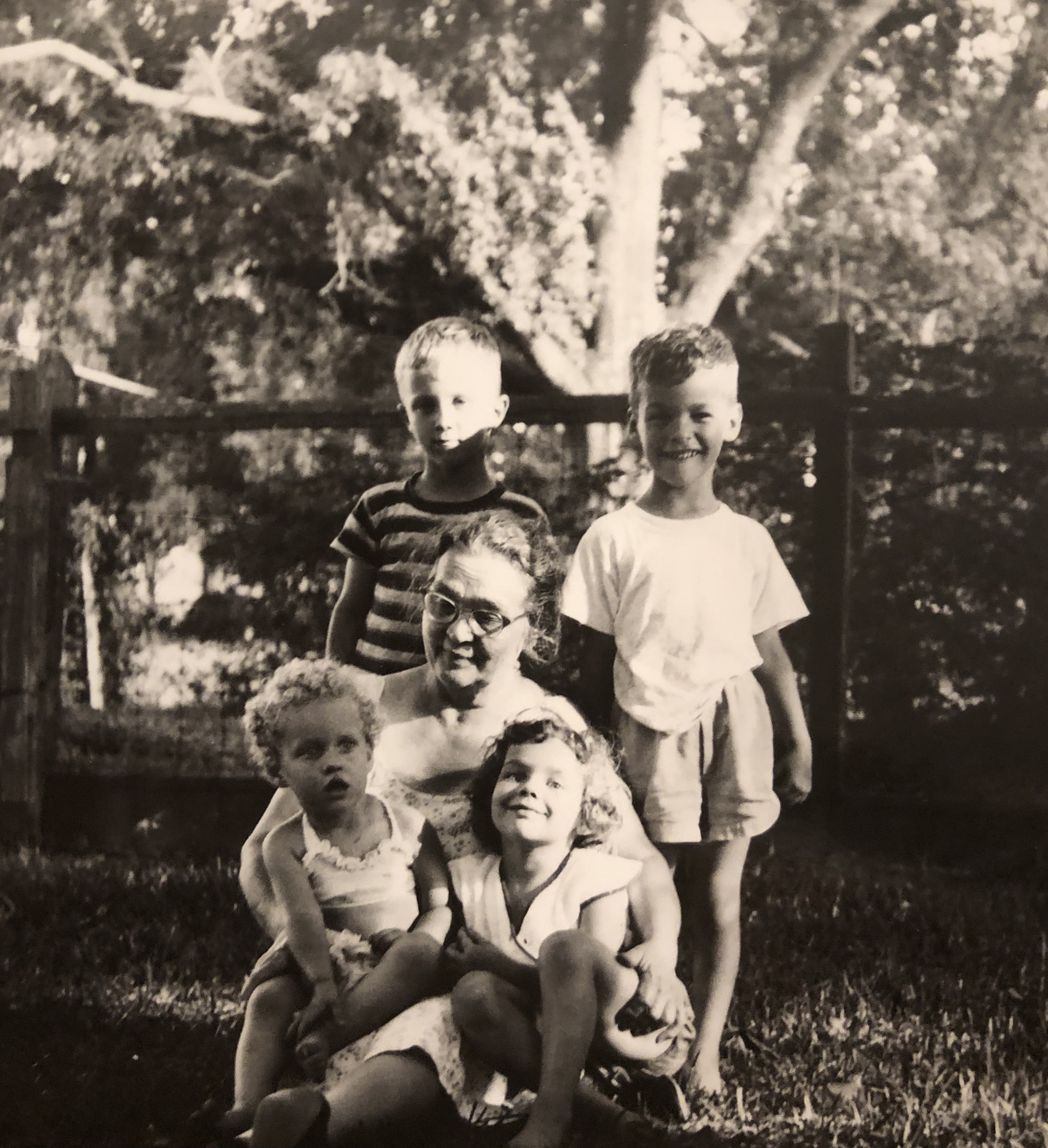
Mee Maw with a few of her grandchildren in 1959.

This is a photo of my paternal grandmother Germaine Erie Patureau Landry.  She was known as Erie from the early part of her life.  Later she became Mama, and I knew her as Mee Maw.  When I saw this photo, I knew immediately that I would be sharing it on my blog.  It was taken in Lake Charles, Louisiana, in August of 1959.  There was a date printed on the border of the photo, and the ages of my first cousins looks about right for that date. 

The blond boy with the striped shirt is Mark Reeves, the son of Marie Landry Reeves and Malloy Reeves.  The other three children are the offspring of Germaine Landry Winn and Ross Winn.  The boy in the white shirt is Doug, the little girl with the blond curly hair is Phyllis, and the dark haired girl with the smile is Daphne.  We can thank Daphne for sharing this photo with me.  Thanks Daphne!

This photo was taken before I was born, but I sure wish there was a photo of me with Mee Maw that has this same glorious look.  The lighting is just perfect.  I’m sure it is light coming from the western setting sun.  It’s so dreamy looking.  Maybe it’s just me, but I also think it portrays my grandmother in the way that all of us grandchildren feel about her.  She looks so happy to be with her grandchildren, because they were each special to her.  Why else would we all continue to claim to be her favorite?

And you know what?  I was her favorite.  I know she thought I was special!

Go Go Patureau – to Texas and Mexico

This is my second Go Go Patureau installment.  I don’t know if you remember, but almost a year ago I posted the first one.  It was called “Go Go Patureau – To Mexico!” and it was about my grandmother (Mee Maw or Germaine Erie Patureau Landry) and her sisters traveling to Mexico.  I wasn’t planning on a second part to that story, but I found some more information since that last article.  I also got an improved version of a photo that I posted a few months ago.  And since it could be seen as a travel photo, I thought I’d combine the two pieces of information for this post.

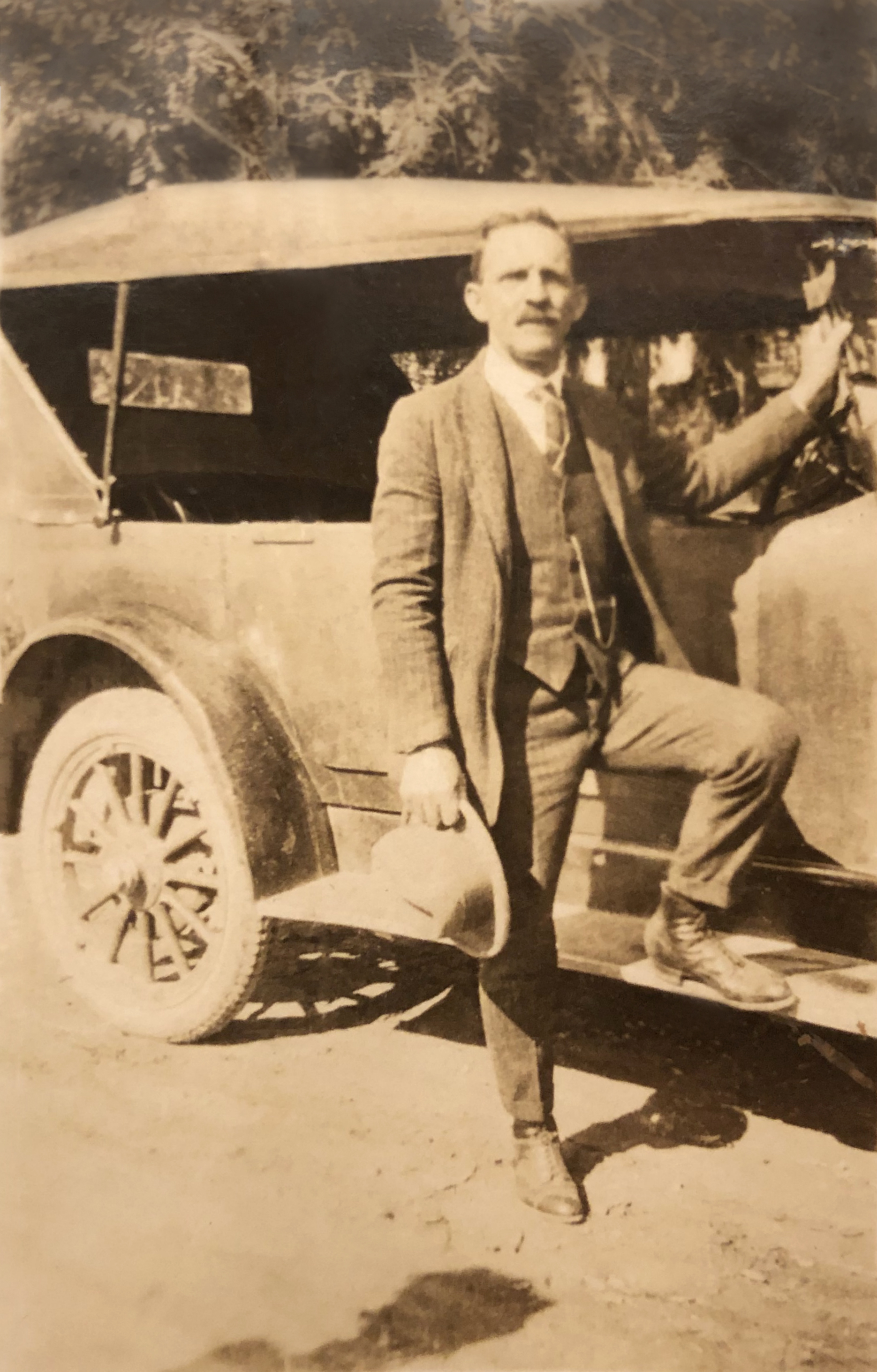
Vincent Maximilian Patureau was known as Grampa Max to his family. Here he can be seen circa 1914 with an old timey automobile. Ready to travel.

I always like to start out with an interesting photo from the past.  Some people aren’t inclined to read all the words that I write down, so I’ll give them a morsel to catch their attention.  Isn’t this a great one?  This is my dad’s maternal grandfather Max Patureau looking dapper with his old jalopy.  Of course, at the time it was a newfangled jalopy. 

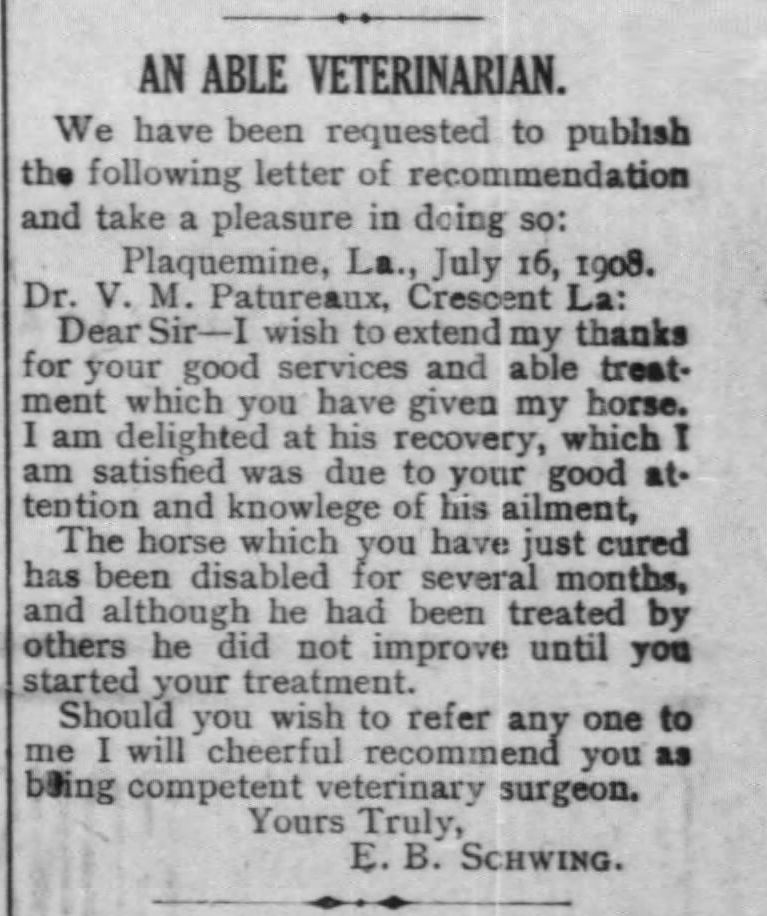
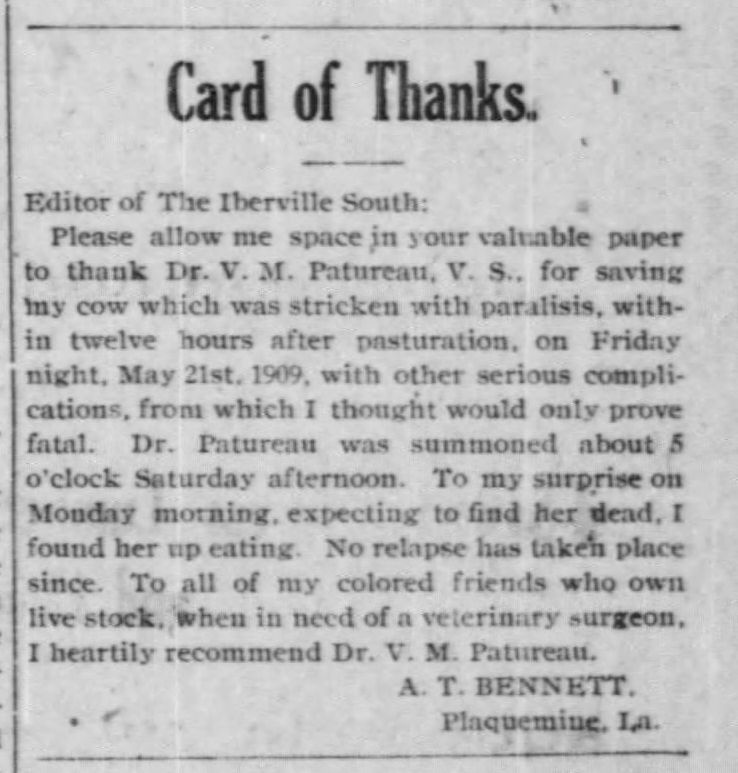
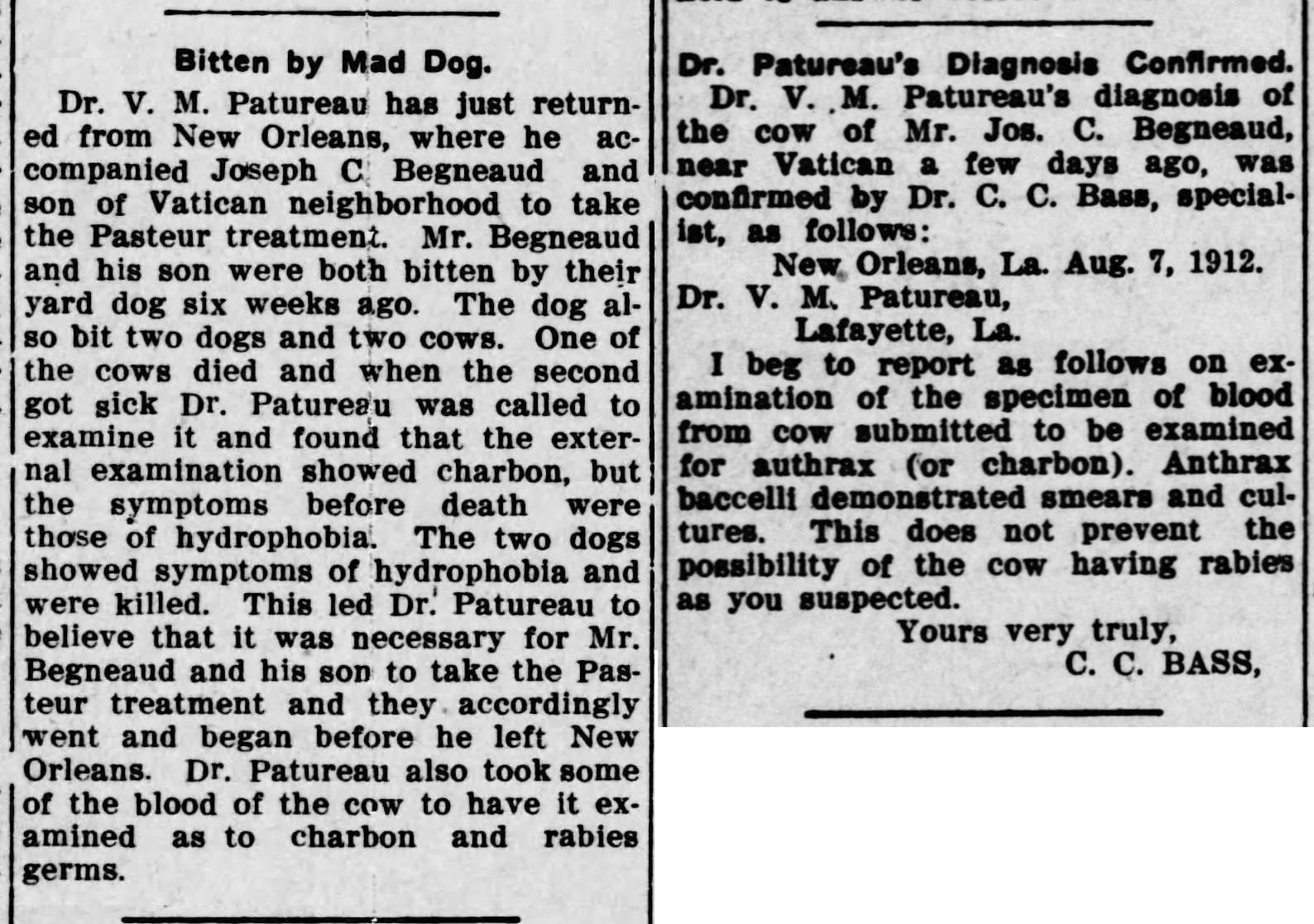
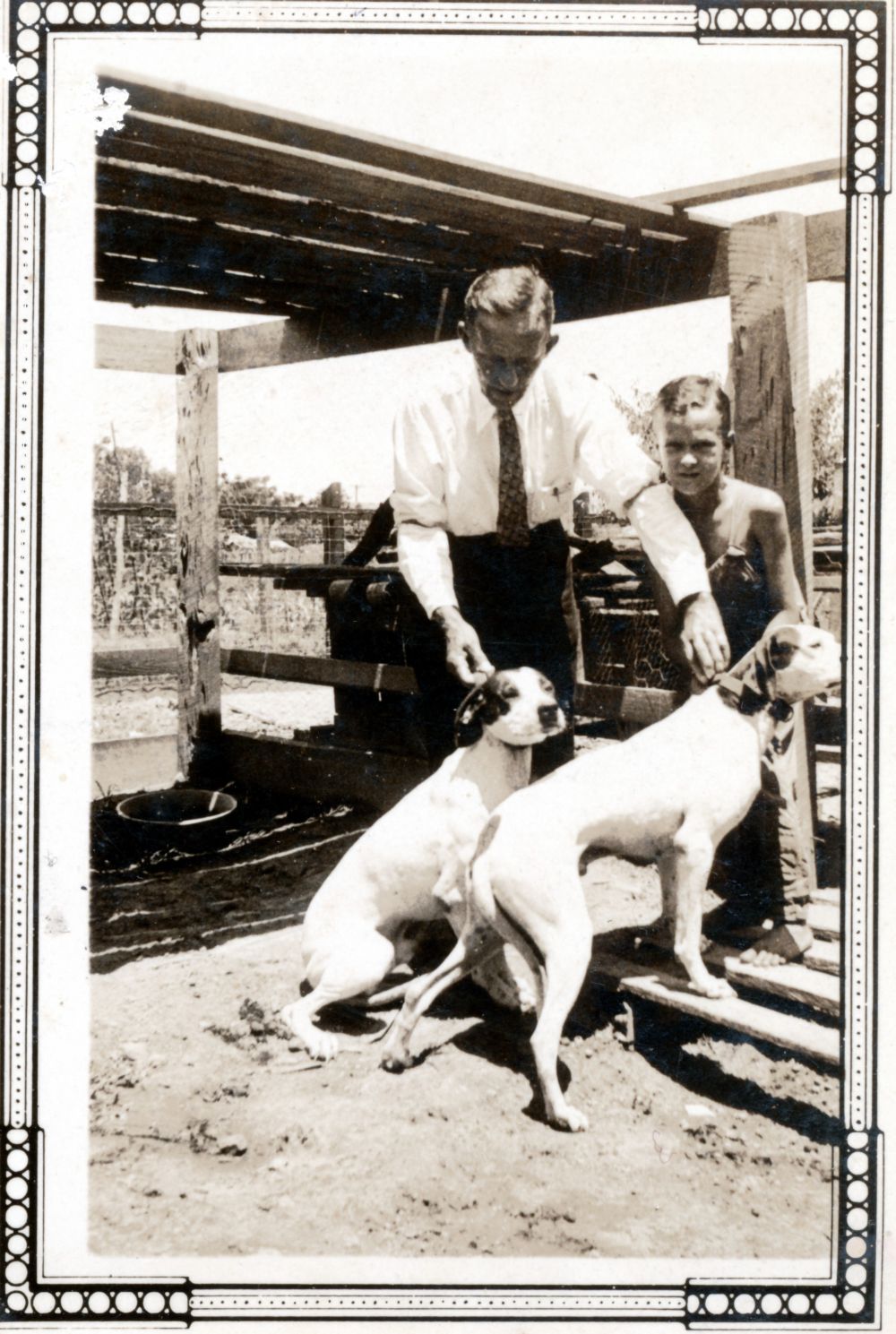
That side of my family was known for enjoying traveling.  Mee Maw liked to travel when she was older.  Tez made her way across southern Louisiana visiting family along the way, whether they wanted her there or not!  And even though Mee Maw and Pee Paw never owned a car, her father Max did.  Part of that was that he had a veterinary business in Lafayette and he visited homes and farms to care for larger animals.  But you already know this, because I’ve posted photos of him with a cow and with a horse.

You may be wondering like I did whether he did much more traveling.  I am not wondering any more, because I actually found an article that talks about him traveling to visit family.  And since you read the title of this post, you know that he went to Texas and Mexico.

Jan. 7, 1905  Newspaper article

So here is the article that I found.  It’s a treasure!  Do small towns still write articles like this anymore?  It talks about Mr. and Mrs. Max Patureau attending Mrs. Patureau’s sister’s funeral in Lake Charles on Dec. 21, 1904.  Her sister is referred to as Mrs. Sebastian Landry.  Mrs. Patureau was Marie Therese Landry Patureau and her sister was Marie Manette Landry Landry. They were two of the daughters of Civil War hero Trasimond Landry.  Sebastian was the son of Trasimond’s brother Alcide.  Marie Therese’s daughter Erie would later marry Sebastian’s brother Rob. 

I’m sorry.  Don’t try to figure out that last paragraph.  Just know that Max and Therese went to the funeral of Therese’s younger sister Marie Manette who died as a result of childbirth of her first child at the age of 28.  The child was a little girl they also named Marie Manette.  She would grow up and marry Bibb Bouquet and have nine children.  I went to Bibb and Manette’s 50th wedding anniversary.

Since they traveled to the western part of the state, I guess Grampa Max decided to take the opportunity to visit more family even further west.  So he sent his wife and small child back home in the care of her mother.  She is called Mrs. Magloire Babin in this article, but we know her as Grandma Belite.  She was Marie Amelie “Belite” Bujol Landry Babin.  She was first married to Trasimond Landry, who was the father of three of her daughters – Therese, Manette, and Kate, who was also known as Mrs. Thos. Blanchard.

Max’s first stop in Texas was at his sister Victorine’s home in Beaumont.  She was married to William Albert “Willie” Cropper and at that point in time, they had six children.  Max and Therese had nine at the time, so I think that was incentive for Victorine to have even more children.  It must have been a competition between Max, Victorine, and their brothers Louis Leobon and Abel.  It’s the reason I have so many third cousins out there!

Max went on to visit his cousin in Corpus Christi.  She is named “Mr. Cruis Cutires” in the article.  I mean really!  They don’t even give the women’s first names in this article.  At least they could get the “Mrs.” part right!  Max’s cousin Rosa Crixell married a man named Cruz Gutierrez.  They only had five children at the time.  Obviously they were not part of the competition, though they would end up with nine children.

Cousin Eliza

Next, “he was taken to Brownsville” to meet other cousins for the first time.  This means that he was not driving himself at the time, so I’m not sure how he was getting about.  The cousins he met were “Mrs. De’Falcon and  her children, the Cruxielle boys.”  I’ve shared a photo of “Mrs. De’Falcon” before, but I called her Eliza.  Her name given to her at birth was Eliza Patureau Laulom and she was the first cousin of Grampa Max.  She was also the mother of Rosa Crixell AKA “Mr. Cruis Cutires” or Mrs. Cruz Gutierrez.  They were probably named after Rose and Eliza Patureau.

“The Cruxielle boys” were the sons of Eliza Patureau Laulom and Vicente Crixell, Sr..  The sons’ names were Teofilo, Vicente Jr., Joseph, and Luis.  They had some notoriety in southeastern Texas.  Joseph or Jose was a saloon owner and city marshall who was later assassinated in 1912 by a former Texas Ranger.  But when Max visited, they were alive and well and they showed him a good time.  Vicente Sr had died in 1880 and Eliza was then married to Albino Falcon.  (Hence the “Mrs. De’Falcon.”)  It sounds like the Crixell boys brought him over to Mexico to visit more family and friends.  There was (and still are) extended Patureau family members who lived in Brownsville and Guadalajara, Mexico.  Having been born in the Matamoros area of Mexico himself, Max was probably treated as a prodigal son.

It was a trip of a lifetime for Grampa Max.  Lucky for us, we have the newspaper article to recount his delightful adventure.  And now, with my help, you know who they were talking about in that article.  It always helps to know the connections.

Our Erie the Student Revisited

I posted a few photos five months ago pertaining to my paternal grandmother’s school days.  The photos were somewhat grainy because they had been taken from school programs or newspapers and they were over 100 years old.  I’m revisiting that topic because I got an improved photo this past weekend.  My cousins and I actually got together and looked through some old photos and memorabilia!  We had been talking about it for a while and it came together at the last minute.

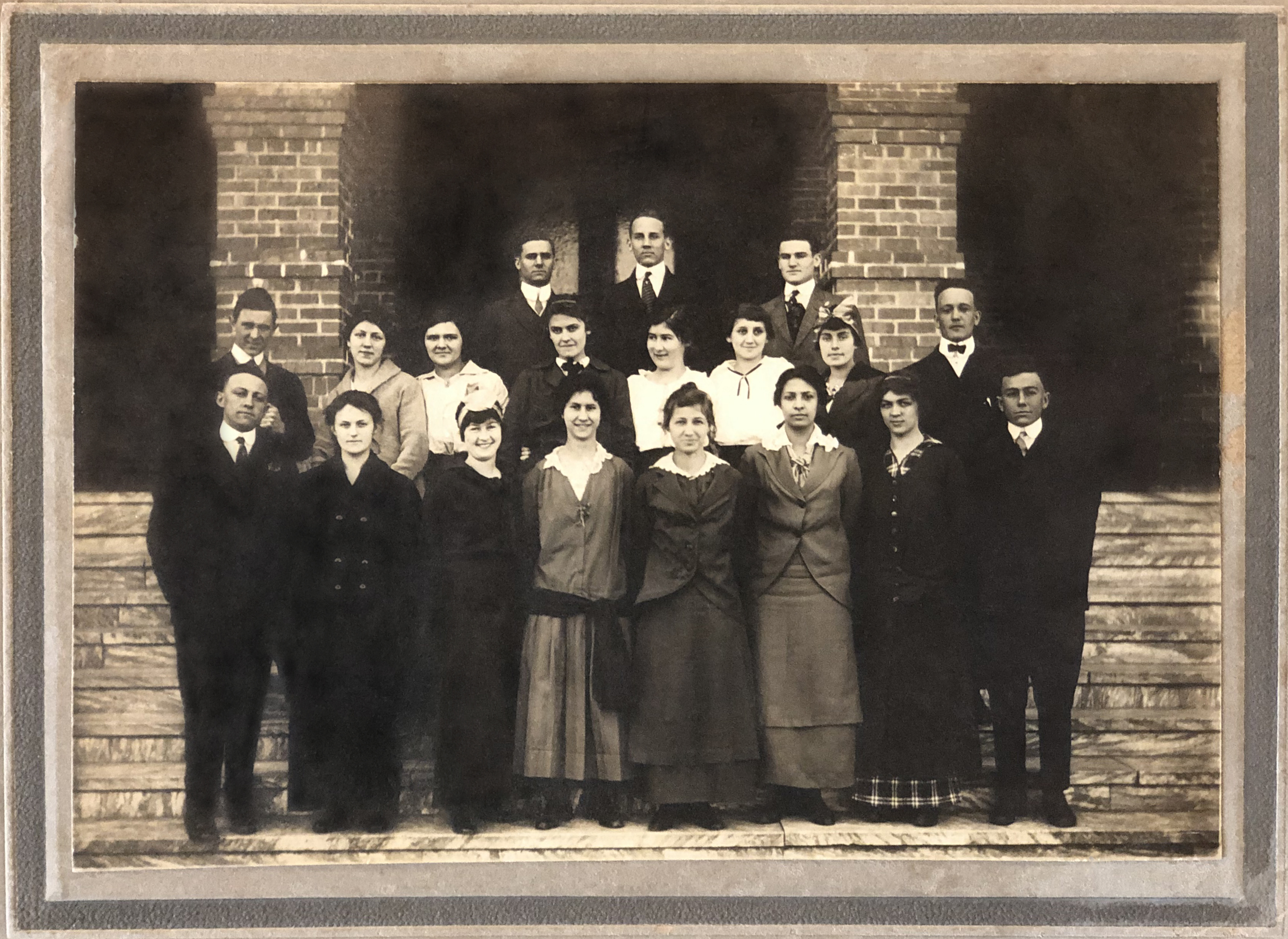
The SLI Class of 1915 included my grandmother Erie Patureau Landry.

This is one of the photos that I had seen a previous version of before.    The difference between my first version and this one is vast.  A wrinkled up school program just isn’t quite as good as an original 5 x 7 photo.  You can actually make out people’s faces and facial expressions.  It’s a really nice photo, which is why I wanted to share it with everyone.

That and the fact that my grandmother is in it.  Since you already read the title, you know that it is about my grandmother Erie.  Her given name was Germaine Erie Patureau.  She was born in Crescent, Louisiana, (near Plaquemine) in 1895.

This photo was taken shortly before March 29, 1915, in Lafayette, Louisiana.  That date is the issue date for the Vermilion, which was the school newspaper for SLI.  It was a special issue for the Class of 1915.  Erie can be seen in the first row, second from the right.  Once she graduated from SLI, she taught in Lafayette for a number of years before she got married in 1921 to my grandfather Robert Joseph Landry, Jr.  They had eight children who grew up and had children of their own.

All through that time, she held on to this old photo.  When meeting with my cousins, I realized she held on to many more photos as well.  Plus there were newspaper clippings and death notices.  They were all relating to ancestors, children, grandchildren, and relatives.  That didn’t include all the things that I had gotten from my dad.  He also had her “Patureau Family Papers,” which was the genealogical information that she collected through the years.  You could tell that all the things she collected had been divided among her children .  Of course this must have been when she died in 1973.  A few of those things got back together this past weekend.

You could also tell that she had an appreciation for her family.  I think she passed that down as well.

Aint Zita’s 1939 Visit

I know this photo has been posted before on Facebook.  I had a version of the photo from my dad, but it was not a good quality, even with a good scan.  I fixed it up as good as I could and shared it, too.  But it was not a blog post.  I got a better quality photo from cousin Sis a while back, with intentions to get it looking better to share.

And here it is!  Ain’t it grand?  I really like this old photo from around 1939.  I think it was taken in Lake Charles at my grandparents’ home when my grandmother’s sister Zita came for a visit.  Hence the title.  Or course, the title doesn’t actually say “Aunt Zita.”  I spelled the title the way I’ve heard the name ever since I can remember.  And for some reason I hear the other ones’ names pronounced like “ant,” but for Zita I always hear the “Aint.”  Say it!  It’s got a nice ring to it. 

The grandmother I’m talking about is my  paternal grandmother Germaine Erie Patureau Landry.  My generation always called her “Mee Maw.”  She was a sweetie.  She was married to Robert Joseph Landry, Sr., who we called Pee Paw.  At least all of the cousins who were born before he died called him that. 

Now that I’ve introduced those three from the older generation of Patureau kin in this photo, I’ll point out which ones they are.  Zita Patureau Schafer is the woman standing on the far left.  Next to her is Pee Paw, with Mee Maw looking over his shoulder.  All of the others in the photo are from the next generation in the Patureau line.  Nobody from that generation of our Patureau line had Patureau for a last name.  Maybe someone from our Patureau line should marry a cousin with the Patureau last name?  Just a thought!

Seven of the eight children of Mee Maw and Pee Paw are in the photo.  Their oldest son A. J. is not in it.  Next to Mee Maw we have Marie, Hubert, Germaine, and Bobbie – my dad.  The front row has my dad’s younger siblings along with Aunt Zita’s daughters.  They are actually the daughters of Erie and Zita’s sister Marie Therese “Bee”, who died shortly after the birth of her younger daughter.  Zita married Bee’s widower Clarence Shafer and raised the daughters Sis and Syl as her own.

Sitting in the front is my dad’s brother Johnny, cousin Sis, cousin Syl, sister Frances, and sister Wana.  They all look so sweet and cute.  Hey!  Didn’t I say that about last week’s photo?  Oh, well.  It’s true again this week.  But last week I was working with a photo of my great aunts and uncles, and this week was with my aunts and uncles.  One generation makes a big difference in commonalities in facial features.  While I did see some common features in my own grandmother last week, I didn’t notice as much with my grandfather’s siblings. 

This week I saw many more common features that brought to mind many of my cousins.  So I spent a little time with my sisters Karen and Jamie, my godmother Shirley and her daughter Chelleen, my cousins Colleen, Paula, Jeanne, and Tricia as I worked on the photo.  I had an enjoyable time.  I hope you do, too.


The Patureau Bakery

Have you ever heard of the Patureau Bakery?  I hadn’t heard anything about it before I found a reference to it this week.  Granted, it was a long time ago that we’re talking about, but with all the research that my dad and grandmother did, it seems like it would have come up.  Maybe they knew about it and I wasn’t listening.  There are lots of things that I wish I could ask them.  Now I have to rely on old newspapers and other documents in one place or another.

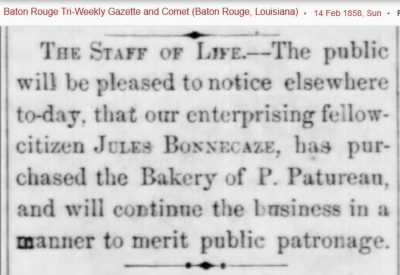
So this is what I found.  It’s a newspaper article from the Baton Rouge Tri-Weekly Gazette and Comet on Feb. 14, 1858.  The title of the article is “The Staff of Life” and I’m not sure what that means.  It talks about a man named Jules Bonnecaze that purchased the Bakery of P. Patureau.
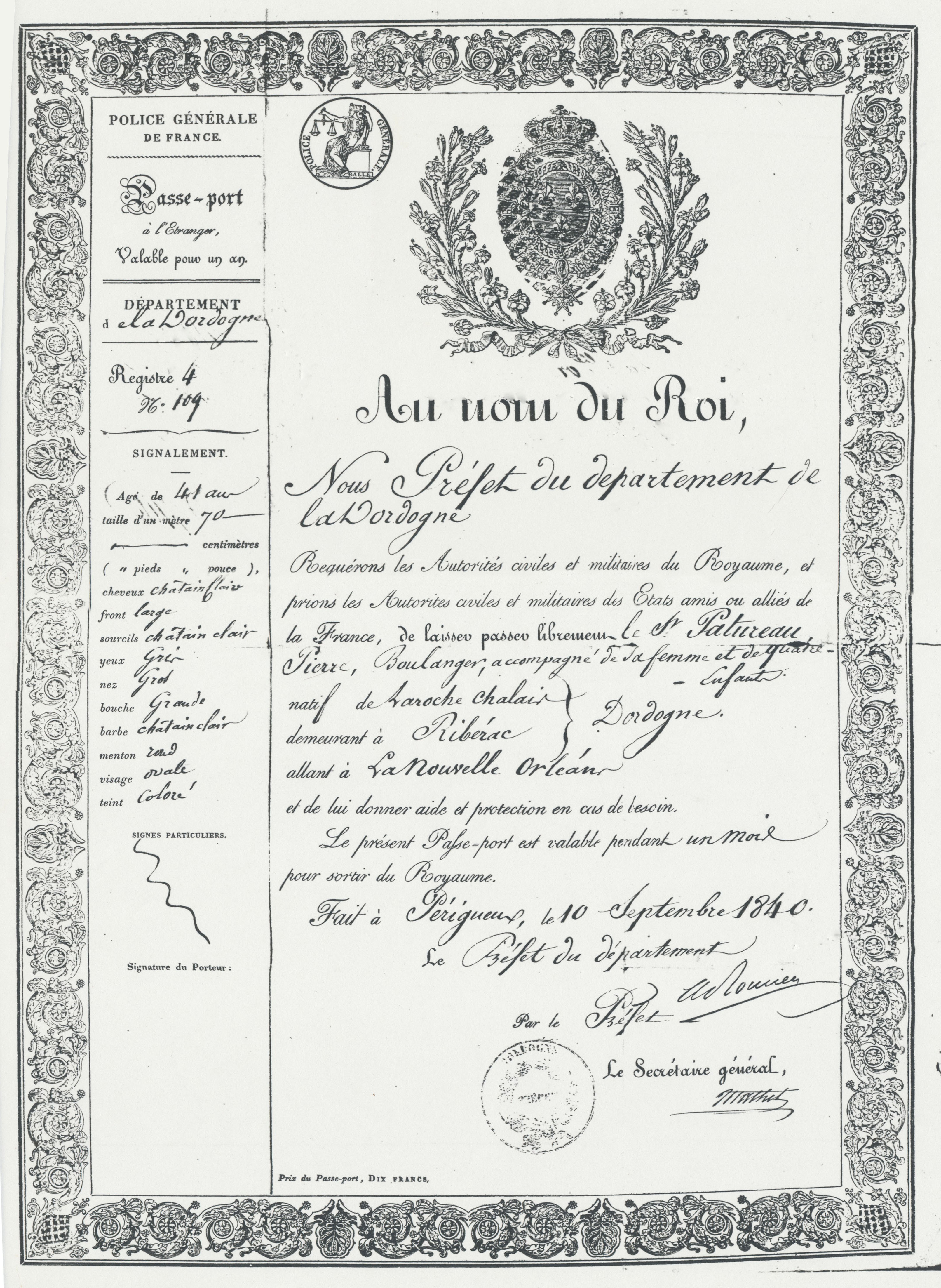
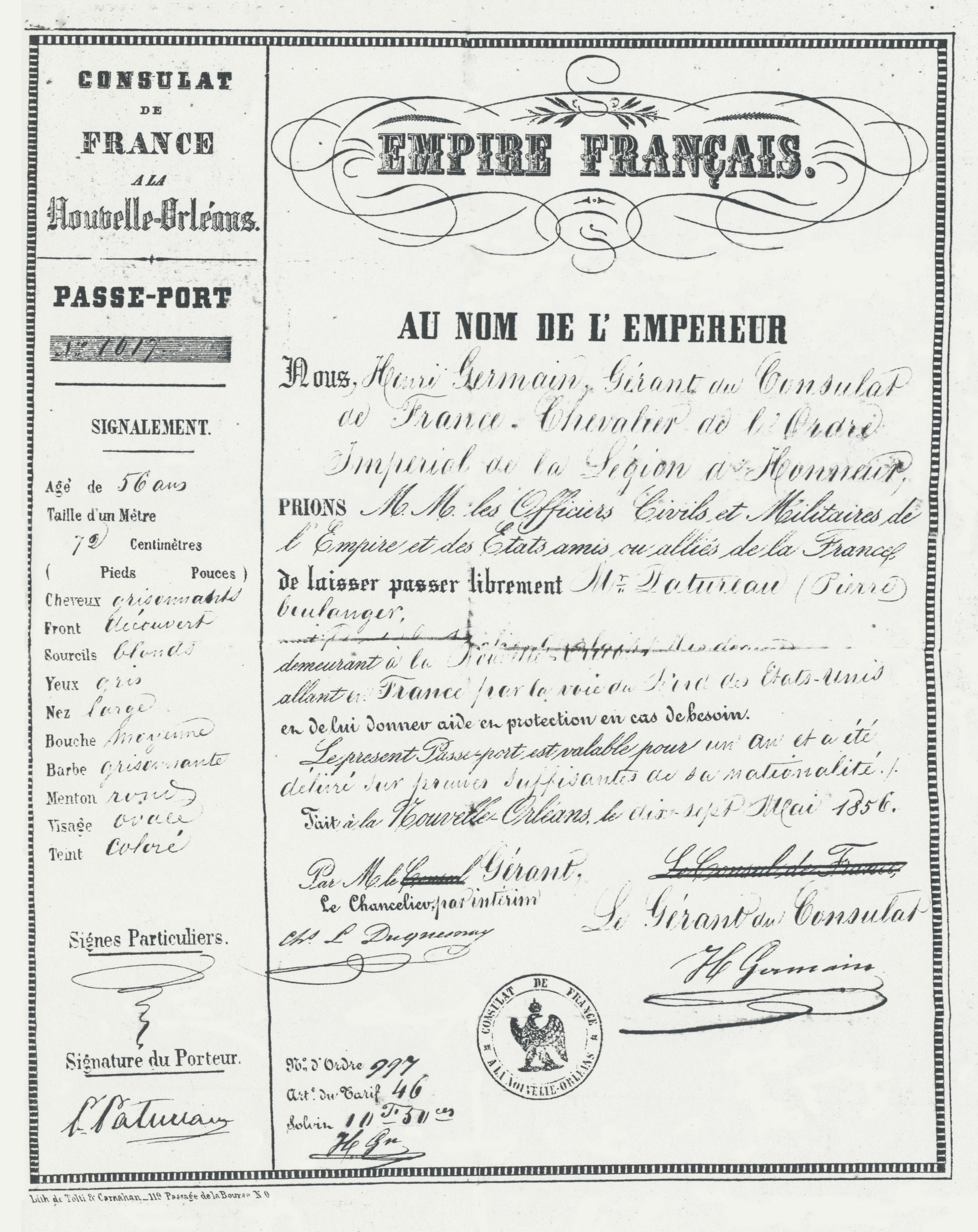
Now it doesn’t say that the baker was Pierre Patureau or that the bakery was in Plaquemine, but I’m pretty sure that’s who they were talking about.  Even though I hadn’t heard about a bakery owned by the Patureau family in Plaquemine, I had wondered  if there had been one.

Pierre Patureau was born August 29, 1800, in LaRoche-Chalais, Dordogne, France.  He was married to Anne Rose Machet on July 24, 1820, at the same place.  Rose was born Aug. 19, 1801, in Mareuil, Charante, Poitou-Charantes, France.   They had five children (including my great great grandfather Ferdinand Pierre Patureau) and then in 1840 they immigrated to the United States.  The passport names Pierre Patureau and lists his wife and four children.  (There was an older daughter named Jeanne who either died or stayed behind in France.) 

On the 1840 passport, as well as the 1856 passport, Pierre is identified as a boulanger.  Boulanger is the French word for baker.  So I knew he was a baker in 1840 when he came to the United States and sixteen years later another passport says the same thing.  He was also listed as a passenger on a ship leaving France in 1857 with the destination of New Orleans.  On that passenger list he was also identified as a baker (boulanger). 

Those documents made me wonder if he continued his culinary skills when he reached his new country.  So when I saw the newspaper article this week, I just knew that the P. Patureau with a Bakery was our very own Pierre Patureau, boulanger.

The other thing I found interesting about the passport is that they give a description of my great great great grandfather Pierre.  Since there are no photos of him, it is the best way to get an idea of what he looked like.   His hair, facial hair, and eyebrows were light brown in 1840, but by 1856 they were graying.  He had a large, somewhat open forehead over light grey eyes.  He had a rather large nose, an average to large mouth, and a round chin with an oval face with a dark complexion. 

I don’t know what to make of the height that they give for him.  One of them says 70 cm and the other says 72.   That can’t be correct!  That would be only 28 inches.  If we had an ancestor that was only two and a half feet tall we would have heard about that.  I think something is missing in the translation.  Yet the nose must have been large.  On one document it was described as ‘wide’ and the other one said ‘big.’  Official documents don’t lie.

“Grandpa, what a big nose you have!”

“Oui, oui.  The better to tell when the bread is just perfect.”


July 29, 2023 Update

Voila!  I have been studying French for the past 105 days (started on April 16) and I thought I’d look over some of my French documents.  I was looking at numbers and it reminded me of this post about the height of my ancestor Pierre Patureau.  In this post I said that the documents report him being 70 or 72 centimeters.  I knew that had to be wrong, because that would have been only 28 inches tall and we would have heard about that.  But it was because I read the passports incorrectly.  For the category of his height (taille) it reads “d’un Meter ______ Centimeter.”  I thought it meant height in meters and that they said he was 70 (or 72) Centimeters.  But what it says is “one meter ____ centimeter.”  So it is actually saying that he was 1.70 or 1.72 meters!  That comes out to be about 5′-8″ in American measuring terms.  Now that sounds more like it.  Much more likely than 2′-4″ for a grown man, even if he was French.

Oh, yeah, I also have determined that an old family photo is of Pierre Patureau.  You can see what he looks like in the post “I Say This is Pierre Patureau.” 

Landry Family at the Park

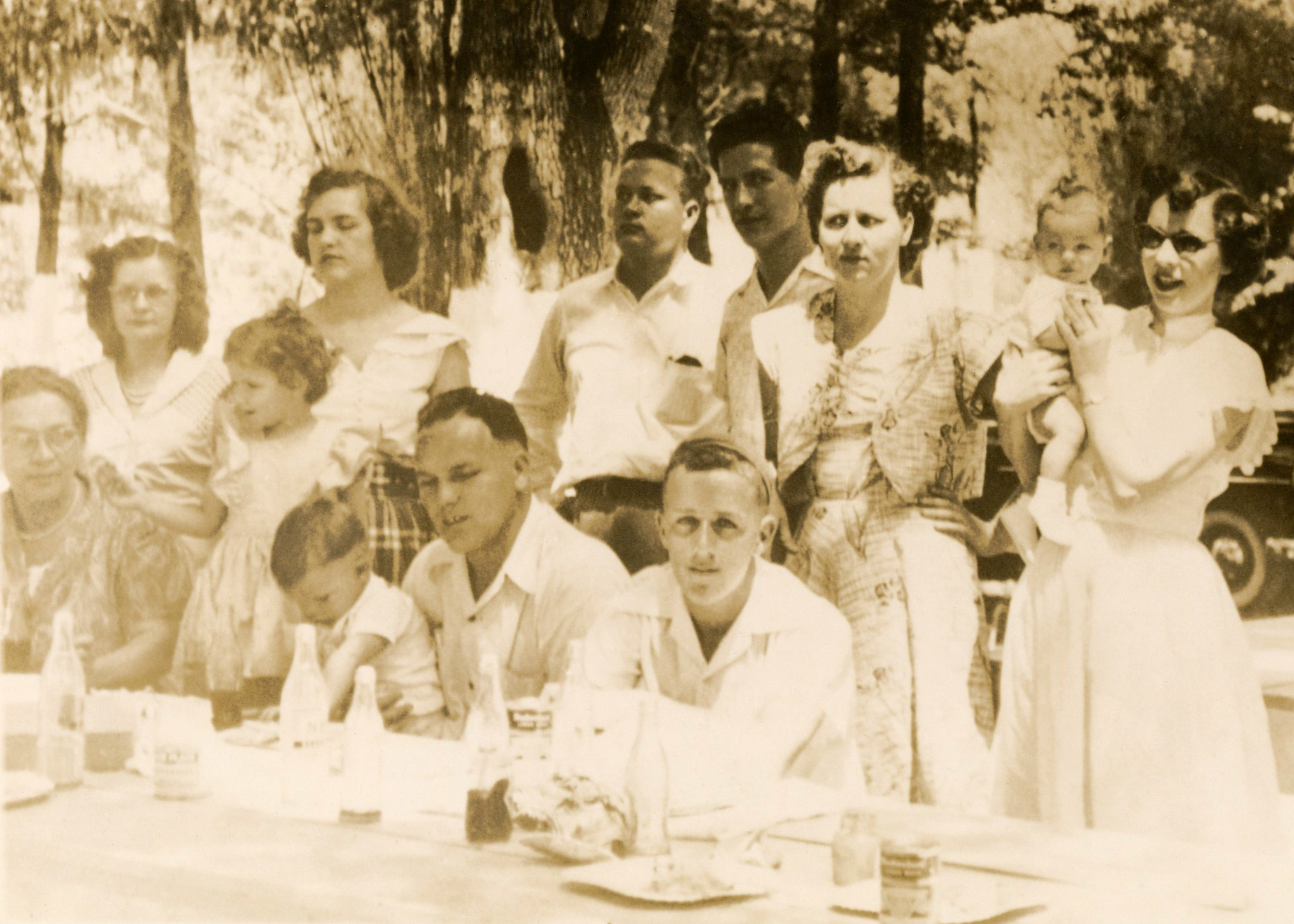
Landry family circa 1952

Here is a nice photo of my dad’s family from around 1952.  This is when the family was growing at a rapid pace.  He and his brothers and sisters were getting married and starting to have children.  As you can see, a few of them have already made their appearance.

My dad was Robert Joseph Landry, Jr.  Most people called him Bob or Pluto, though the family called him Bobbie.  Not me, of course, I called him Daddy.  But I don’t think he was a father at this point.  I’m not even sure if he was married then, either.

Of course I know that my parents were married on November 1, 1952, in Lake Charles, Louisiana.  I’m thinking that this photo was taken either at the I-10 Park in Lake Charles or at Sam Houston Park  north of Lake Charles.  I’m judging the year based on who is in the photo.  Of course my godmother Shirley is there.  She is “The First” after all.  The first three were born in  the late 1940s, and that included her younger brother Hubey and cousin Mark. 

Let me identify the people in the photo before I mention any more people.   Starting on the left, you’ll find our dear sweet grandmother.  That’s my dad’s mom.  We called her Mee Maw.  (or Memaw as some like to say)  Her name was Germaine Erie Patureau Landry.  She was “Mrs. Robert Joseph Landry, Sr.”  She was very traditional, what can I say?   Standing next to her is my aunt Mildred Sutherlin Landry.  She was the mother of Shirley Landry Shaw, who is standing next to her.  Shirley is standing in front of our aunt Frances Landry (later Raley).  Frances looks like she might be thinking something negative about something she is looking at.  But that couldn’t be possible, because she never had any negative thoughts!  She’s likely just blinking while the camera shutter snaps.

In front of Shirley and Frances is a young boy.  He’s most likely Hubey, because he’s sitting in his father Hubert Landry’s lap.  Behind him are standing the oldest brother A. J. Landry and my dad.  Sitting at the table is my godfather Johnny Landry.  Now the next person definitely looks like she is not happy.  That’s my aunt Marie Landry Reeves.  She was the mother of my cousin Mark.  Maybe she’s upset that she doesn’t have her son in the photo?  Nor her husband.  Or maybe that’s Mark in the photo and Aunt Germaine is holding him.  If that were the case, then shouldn’t that glare be turned toward Germaine.  I suppose I’m reading it all wrong.  I’m sure Aunt Marie was very happy that day.  Anyone can see that!  Right?

So what’s throwing me off about the date of this photo is that when I first saw it, I thought the child on the right was Germaine’s daughter Daphne.  She wasn’t born in the 40s, so it would push the year back a little.  If it is her, there should be more grandchildren in the photo.  Also missing from the photo is Pee Paw, Aunt Wana and Uncle Duffy, Uncle Ross, and Uncle Malloy.  One of them was probably taking the photo.  I’m sure my older cousins will help me out with these uncertainties.

Either way, it is a dreamy picture of some of the Landry family in the early 50s.

Christmas 1923 With Grandma Amelie

The first time I remember seeing this photo was shortly after clearing out my parents’ house in January 2016.  I was the one that took all of the old photos and genealogy information for both of my parents.  I was thinking that I was familiar with all of the old photos that they had, but I was wrong.  There were several photos that I had seen online from other relatives that I had hoped to get copies of, and I discovered that I now had those photos.

But there were several others like this one that I didn’t recall seeing anywhere else.  I found this image on a slide that was in a box of many more.  On the border of the slide, it reads “Grandma Amelie + women who spent last Christmas with her 1923.”  (As you can see in the photo I posted.)

I knew who Amelie was.  She is my great great grandmother.  My dad was Bob Landry and his mother was Erie Patureau Landry.  Her mother was Marie Therese Landry Patureau, who was the oldest daughter of Marie Amelie “Belite” Bujol Landry Babin.  Boy, that is a mouth-full!  But she was known by simpler names, such as Belite, Amelie, Grandma Amelie, or Grandma Babin. 

But who were all of these women spending Grandma Belite’s last Christmas with her?  My first thought was that it was some kind of women’s retreat that she had gone to.  But really, what 80-year-old woman goes on a retreat a month before she dies?  Not that she knew she was going to die just over a month later (Jan. 28, 1924), but you can see that she seems a bit frail in this photo.  I then considered that some of the women were family members.  I didn’t really give it much more thought, because I didn’t really recognize anyone in the photo.

Van Landry with dad's first cousin Sis Vicknair.

Van Landry with dad’s first cousin Sis Vicknair.

A little over a year later in July 2017, I went to a Landry family reunion in Lake Charles.  Of course there were lots of cousins there.  One of those cousins was my dad’s first cousin Sis, who has been collecting Patureau family information for a while.  When she was sharing her book, I saw this photo again!  And she had the names of everyone in the photo!  After seeing some more of her photos and some of the ones I had, we realized we need to meet up and share.

Amazingly, we actually followed through with that!  Me and my own first cousins haven’t done the same thing, yet.  We’ve been talking about it for a few years.  Someday soon, I say, very soon.

Grandma Amelie + women Christmas 1923

Grandma Amelie + women Christmas 1923

So this is the photo that Sis shared with me.  I’ve edited it to clean it up a bit and now I can tell you who all of those women are.  I should have suspected that they were her grandchildren.  She was referred to as “Grandma Amelie” on the notation after all!   They all descended from her.

On the front row is Emma Patureau Mouton, Hazel Landry, and Wana C. Landry.  The back row is Sylvie Patureau, Naomi “Sis” Landry, Therese Wynhoven “Tez” Mouton (held by Sis), Grandma Belite, Clemence Babin Landry, Lydwin Patureau, Mona Mel Mouton (held by MTP), Marie Therese “Bee” Patureau, and Zita Patureau.

The main thing I don’t like about this photo is that my Mee Maw isn’t in it!  Neither is her sister Lorena.  Their mother Marie Therese Landry Patureau wasn’t in it because she died in 1909, but their sisters Emma, Sylvie, Lydwin, Bee, and Zita were there.  It also includes Emma’s daughters Tez and Mona Mel.  Mee Maw was expecting her first child in a few months, so maybe that’s why she didn’t attend the gathering.  Besides grandchildren and great grandchildren, one of her daughters is in the mix.  Clemence was her daughter by Belite’s marriage to Magloire Babin.  Clemence was married to Louis Joseph Peter Landry, and their daughters were Sis, Hazel, and Wana C.

I was considering explaining all of the other ways that everyone was related to one another, but it got really confusing quickly.  Best just to say that Belite looks like she had a lovely gathering for her final Christmas with her family.


Dec. 17, 2021 – Update

I’ve been looking over some videos that my dad made and noticed some bits of information about this photo.  This photo was taken at Uncle Louie and Aunt Clem’s home on South College Road in Lafayette, Louisiana.  The copy of the photo I had from Daddy was a slide photo.  I think he got that from his first cousin Naomi “Sis” Landry Vincent, the daughter of Louie and Clem.  She put together a slide show of all of her old photos and got together with Daddy to explain who everyone was in those photos.  An extremely helpful slideshow that fills in a lot of gaps that I had.  Thanks again, Daddy and Sis, as well as cousin Tez who shared some of her photos as well.


Our Erie the Student

Long before my dear sweet Mee Maw (Germaine Erie Patureau Landry) taught me and my siblings how to play Solitaire – even before she taught her own children how to play Canasta and Pinochle, she was just little ol’ Erie, student at SLI. According to this old school newspaper, she started school there in 1912 after graduating high school from Crescent, Louisiana.

Class photo from around 1914 at SLI in Lafayette, Louisiana

I think this picture titled “Fourth Year Class” was taken in 1914 at the beginning of her senior year at SLI. The accompanying school newspaper cover shows the graduating class of 1915 with Erie on the front row. Neither one of the photos is very clear. They are school newspaper photos after all and I think it’s amazing that they have survived in any form all of these years later. I like this photo because she looks so stylish with her black skirt and lace-up boots. (In the front on the right.)

I remember that when I was younger, I thought my Mee Maw was from Lafayette. Now I think of her a being from Plaquemine. Most of her childhood was spent in Crescent, which is a suburb of Plaquemine. Her mother died in 1909 when Erie was just 14 years old. Her mother’s mother Belite (Marie Amelie Bujol Landry Babin, known as Grandma Babin to some) moved to Lafayette by 1910. Her father Max (Vincent Maximilian Patureau) stayed in Crescent until 1912, which was around the time Erie finished high school. He set up practice in Lafayette in October of 1911 and brought the children over in April of 1912.

So once she finished high school, her home was Lafayette for about ten years. Even after she got married in 1921 and moved to Lake Charles to live, her father lived in Lafayette for several more years. When I was a kid I didn’t consider all of these details. I wish I had asked a bit more back then, but we were too busy playing games and singing songs. So it’s a good thing these articles were saved that have a few photos and some reminiscences of young Erie.

The Vermilion, Class 1915, page 1.

The front page photo has Erie second from the right on the front row. (See here for a better version of the photo.) It looks like the photo must have been taken in the cooler time because of the heavier clothes. This photo has more people in it than the previous one, so that is a little confusing for me. Usually classes get smaller as time goes on with people dropping out or moving away.

This front pages starts introducing members of the class and telling what each individual accomplished during the years. Mee Maw is not mentioned there.

The Vermilion, Class 1915, page 2.

The second pages gives a description of the paper and its staff. It also has a dedication. Someone must have asked the class what they wanted to will to the younger class mates. It’s called “LAST WILL AND TESTAMENT OF THE SENIOR CLASS.” Very dramatic. Check out number 19: I, Erie Patureau, do will and bequeath my good times to Pierre Hernandez.

My favorite part of the pages is the article on the right side called “HISTORY OF THE CLASS OF ’15.” (That’s 1915 in case you were unsure.) It mentions many of the class members, but what they write about Mee Maw is sweet – “The following January after all dangers of finals was over Erie showed up. Modest and retiring, she was hard to make friends with, but we were determined and now she’s ours.” I like that.

The Vermilion, Class 1915, page 3

Page 3 continues with introductions to the class. There at the bottom of the first column is our Germaine Erie Patureau. That’s where I learned that she entered S. L. I. I. from Crescent Graded School in 1912. It doesn’t list any accomplishments at all. Not one. I wonder why that is? What it does have is a quote in Latin: “Dulce est recipere in loco.” According to Google translate, that means “Sweet is back in place.” That makes no sense.

I tried to reword it, but nothing really made sense. Put sweet back in its place? Give sweetness back in place? Dude? Sweet! (What does mine say?) So I searched again and found a famous Latin quote – “Dulce est desipere in loco.” That means, “It is sweet on occasion to play the fool” or “It is pleasant to be frivolous at the appropriate time.” I wonder if that is a quote that she liked, or was it said to her?

The Vermilion, Class 1915, page 4.

Page 4 has a letter that is a study in alternative reality. Someone wrote a letter as though it were years later and talks about the old classmates he runs into on his travels. There is a mention of our Erie in it. In that alternate reality, she went to Europe as a Red Cross nurse helping in a hospital.

While that would have been a grand and noble thing to do, I do prefer the reality of her staying here in the States and becoming my grandmother. Of course, I am biased.

1 6 7 8 9 10 14