George and Susan’s Eighteen in ’19

George and Susan with their 18 in ’19. A nice old family photo from almost a hundred years ago.

George Henry Hine and his wife Susan G. Stanbrough Hine had eighteen living grandchildren in 1919. Their daughter Addie’s fifth child did not make it past infancy or there would be one more in this photo.  There are actually more people in the photo.  It includes their six children and a few unidentified people who are most likely family.

Before I get too far, let me remind you who George and Susan are to me.  I am Van Landry and my mother was Betty Lou Bucklin Landry.  Her father was Fred Bucklin who is one of the twin boys standing directly behind George (the seated man).  The twins’ mother Addie Hine Bucklin (my great grandmother) is standing directly behind them.  Addie’s parents are George and Susan, who are my great great grandparents.  I’ve actually posted two other photos previously that were taken at the same occasion, though they were of smaller groups than this.

What’s that you ask?  ‘Who are all of those people?’ Well I already told you who the important ones are, so I suppose you want me to name everyone.  So that is what I will attempt to do.  I think we’ve settled it now that George and Susan are the older couple sitting in the front of all of their progeny.  They were from Indiana and while there, they had their six children.  They then moved to Louisiana in 1894 where the children grew up and started families of their own.

Hine family group in 1919 with name designations.

Addie was the first one born and she was the first one to provide them with a grandchild.  She is the one with the big A on her head in the second photo.  She was married to Louis Charles Bucklin, but he rarely showed up in photos.  Their first child was Leo (A1) who was born in 1898.  According to a letter written by Susan in 1916, Leo had an accident with a saw blade that left him “a cripple.”  Leo did walk with a limp for the rest of his life.  Next was Mary (A2) who was born in 1900.  Ralph (A3) was born in 1902 and he later had a daughter named Helen.  In 1903 Addie and Lou had a son named Paul, but he was the one that did not live past infancy, so he is not in the photo.

In 1904 a son named Carl (A5) was born.  The photos from this date are the only ones of him that I know of.  When he was very young, he lost his hearing and never learned to speak.  I don’t know if there were any other learning deficiencies or just that there was no Anne Sullivan out in the country in 1919, but I don’t think he had an education.  When my mom was a kid, she was kind of scared of him.  He stayed up in his room a lot, but sometimes he came down to sit on “his nail keg in the kitchen.”

On to number A6.  That would be Herbert born in 1906, who was the grandfather of Joseph.  Too bad Herbert is mostly hidden behind an unidentified boy in the photo.  Clarence (A7) and Fred (A8) came along in 1907.  Clarence is the father of Carla, and Fred is the grandfather of me and all my maternal cousins.  In 1909 Edna (A9) was born.  One of her sons was Mel Keys (my mom’s first cousin through the Bucklins and 2nd cousin through the Keys) who helped to build the working model of the Starship Enterprise for the original Star Trek series.  And he is the father of Steven and Teresa.

The tenth child of Addie and Louis was Robert (A0) who was born in 1911.  He’s sitting in the front looking a little sad.  We have seen that same look time and again from his mother.  I’ve given her a hard time about it on these blog posts, but look at her mother Susan.  She has a big frown on her face as well.  I guess Addie came by that scowl honestly.  Yet there is a photo of Susan with a smile on it from this same day.  I’ll save that for a special occasion!

Back to the list of people – particularly the children of Addie.  We’ve already named ten!  But there are two more to go.  In 1915 she had another set of twins.  Not identical ones this time.  A girl by the name of Ruth (AA) was born with a boy named Roy (AB).  Ruth is the matriarch of the Bruchhaus branch of our family and Roy was the father of Jeannette and Doris.

On now to the second child of George and Susan.  Take heart, some of them did not have any children at all.  After Addie was born in 1876, along came Bert in 1878.  He was married to Anna Jones (BW) and they had three children.  Leta (B1) was born in 1912, Wanda (B2) was born in 1917, and Harold was born in 1921.  Being that the photo was taken in 1919, Harold can not be seen in the photo.

Harrison Rowe is the next child of George and Susan.  Rowe was born in 1880 and he was married to a woman named Electra (or May).  She may be the dark haired woman standing in front of Rowe, but I don’t have any identified photos of her.  They did not have any children that I know of.

Lonnie was born in 1882 and he was married to Millie (LW).  They had two children and they both show up in this photo.  Arthur Henry (L1) was born in 1905 and Alta Zay (L2) was born in 1912.  Jim was born in 1884 and he was married to Dorinda Thomas (JW) who had been a teacher at Nubbin Ridge in the Hathaway area.  They had four children together.  Aulden (J1) was born in 1908.  He graduated from Jennings High School in 1926 (the year after my grandmother Myrtle Phenice Bucklin) and lived the rest of his life in Jennings, Louisiana.  Audrey (J2) was born in 1910.  The baby at the time was Kenneth (J3) who is in his daddy’s arms.  Later on another daughter was born. Her name was Darlene and she was born in 1923.  She was married to Dalton Landry in Jennings.  I remember being confused about this when I was a kid.  They were Landrys but they were related to us from Mama’s side of the family?  What?  It doesn’t seem confusing at all now.

The last child of George and Susan was Ollie who was born in 1886.  He was a mama’s boy.  When he was younger he dated a girl, but he was too connected to his mom to allow the relationship to become more serious.  I’m not sure if he lived with both parents at this time, but after his father died later this year, the 1920 census shows him living with his mom and her 70 year old brother James Stanbrough.  Ollie lived with his mother until she died in 1933 and only married after that time.  He was a mama’s boy.

But Susan must have been a loving person.  She seemed fond of her children and grandchildren.  She also had her brother living with her family for many years.  He came down from Indiana with her family and he never married as well.  I don’t know his story.  He may be one of the identified men in this photo – possibly the bearded man in the back left.  There is also another adult man, an adult women, and some children who are unaccounted for.  I wish I knew who they were.

Well, that’s it. Thanks for traveling back to 1919 with me.  I hope you enjoyed it.  But most of all I wish you a Happy Thanksgiving.

A Home for the Keys

I’ve spoken a few times about my Keys family when they first moved to the United States from England in the spring of 1887.  The main thing that people in the family talk about is how the family of Thomas Lord MacVey let the family stay in their chicken house because the Keys didn’t have a home when they first moved to southern Louisiana.

The original Keys house that was built in 1887. Mabel Keys is on a horse in front of the house.

And since the Keys arrived in the spring, it was a good time for building a house.  The matron of the family – Martha Ann Cook Keys – decided to stay in the China, Louisiana, area, so she purchased forty two acres of land.  Soon after that there was a building bee by the local townsfolk to build the family a house.  And this photo shows that house.

The lumber was hauled to the site by oxen and wagon.  The house had wooden floors with a kitchen, bedroom and living room with bookshelves downstairs.  The half story upstairs was one big room.  The house was heated with a fireplace.  A chimney can be seen on the right side of the house in the photo.

I’m sure they were grateful to have their own home to live in, especially since it had all the conveniences of a modern home.  A man named Monroe brought mail from Jennings to Art Anderson’s store where Martha would go to pick it up.  She would go to Welsh or Jennings by horse or wagon for the few needs required by the family.  Eventually there was a nice trail beaten down by the horse’s hooves.  The prairie grass was as tall as or taller than the wagon.  The different houses in the area had driveways in a sense – they each had their own beaten down path to the main trail that led to Jennings or Elton.  That main trail was on the high ground, of course.

And while we are getting closer to cars that drive themselves, our ancestors had something similar.  Since taking a trip to Jennings or Welsh could take all day, sometimes they would fall asleep on their way home.  It was no problem, though, because the horses knew the way home.  What more could you ask for?

There was one problem they had to look out for while living out on the primitive prairie during the fall, and that was grass fires.  My mom used to talk about this from time to time.  I think she was proud of her great grandmother’s resourcefulness.  Martha learned how to “back fire” a prairie fire.  This is done by starting a controlled burn of the grass near your house in the direction of the wind.  That way the grass will slowly burn toward the prairie fire and there is no fuel for the fire around your house.

When I look at this photo, I imagine that Martha is standing in the doorway looking out at her youngest daughter Mabel sitting on their horse.  It has only been a couple of years since the move, but she is satisfied with the changes that she has made for her family.  They have a home in a quiet, safe place with horses, cows, pigs and chickens aplenty.  She admires the trees that she’s planted, knowing that they will grow and produce food for her family.  She and her children are adjusting well to this new, strange land.  Yet it is already feeling like home.

Pappy Landry on the Streetcar

This is a photo of my paternal grandfather Robert Joseph Landry, Sr.  He was known by friends and family as Rob or Uncle Rob.  His children called him Papa or Pappy.  But us grandchildren all knew him as Pee Paw.  (Though some of us spell it wrong – PePaw or some such thing.)  It was taken around 1924 in Lake Charles, Louisiana.

Rob was born on Jan. 9, 1893, in Westlake, Louisiana, to Civil War veteran Simon Alcide Joseph Landry and Marie Celeste Leveque.  Alcide and Celeste were half 1st cousins once removed with a common ancestor of Joseph Ignatius Landry.  Both were born on plantations in slave-era southern Louisiana just before the Civil War.  They were married in 1868 in West Baton Rouge Parish, which is where they had grown up.  Their first child Marie Marguerite Carmelite (named after both grandmothers) Landry arrived in 1870.  They then had seven sons in a row.  The next daughter arrived around 1889, probably just before the family moved to the Westlake area.

I’m not really sure why the family moved to that area.  Probably for employment opportunities.  They weren’t the only ones in the family that moved there.  A few other families from the extended Landry, Leveque, and Bird families moved there.  I’m sure they moved there hoping for the best of everything, but sadly that was not to be.  Their oldest daughter Marguerite Carmelite died shortly after moving there.  She is buried in the Old Catholic Cemetery in Lake Charles.

It wasn’t long before our very own little Rob showed up and hopefully brought some joy to their lives.  He was the last child to be born to the couple.  His father Alcide was 47 at the time of his birth.  He was the baby of the family and the one closest in age to him was the only surviving sister Marie Therese (there’s that name again!) who was four years older than him.  When he was six years old, she died as well.  So after that he grew up as the youngest son of six or seven boys.  (I am not entirely sure of the number of sons in the family or if any died early.)

As you know from previous posts, he was fond of baseball and fishing and he was in World War I.  He also worked for Gulf States Utilities and one of the positions he held was that of streetcar conductor.  And that is who you see in this photo.  Rob as a young man starting out with a company that he would stay with for several years.  He had married his sweetheart Erie Patureau and they were starting a family of their own in Lake Charles.  He looks like a friendly and happy fellow.  I like that.

A Keepsake Letter – A Message From Susan

When you first read this title, you may have thought that I was referring to my great great grandmother Susan Stanbrough Hine on my mother’s father’s side of the family.  Although I do in fact have a letter (two letters now) from her that I intend to share later on, I am writing about a different ancestor named Susan.  This one is Susan Jackson Phenice, my great great great grandmother on my mother’s mother’s side of the family.  Her son was Samuel Phenice who fought in the Civil War.  Her grandson was H. C. Phenice, who was the Phenice that brought the Phenice name to Louisiana.

And H. C didn’t just have one grandmother with the name of Susan – both of his grandmothers were named Susan.  I’m pretty sure his other grandmother’s name was Susan Penrod Foster.  ( Correction – now I am absolutely sure that his other grandmother was not another Susan.  Her name was Anne Magdaleen Milliron Foster.)  I’m not certain about that other Susan, so in the meantime we will look at Susan Jackson Phenice and the letter that she wrote to us.

Well, it wasn’t actually written to us, but we can take some of her sentiments to heart.  It was written on April 16, 1877, to her daughter-in-law Ida Fitzgerald Phenice, who was married to son Abraham Phenice.  They had a small daughter named Emma Maud (maud in the letter) who was about three years old at the time.  Susan talks about some of her children, though she doesn’t mention Samuel by name.

Let’s take a look at that letter now.  I have spent some time cleaning up the scan of the letter so it would be more legible.  But I will go ahead and transcribe it for you.

First page –

April the 16, 1877

Well Dear Ida I suppose you think/ by this I dont intend to write to/ [indecipherable words] I should/ and would have writen before but/ when I heard from when ever you/ wrote to Abram (her son Abraham) in particular after/ I was informed of your condition/ I sympathize with you very much/ for I have experienced such times/ but be of good cheer and in good heart/ keep up your courage and dont/ dispare for he that puts on the/ burden – can take it of again all/ that we must do is to look to Jesus/ and he will help in times of need/ how soon do you expect to be/ back to work  you could be here/ before that time  we would all/  (continued on page 2)

Page 2 –

feel better satisfied to be/ together there  none of us can count/ on many years at the longest/ and why not be with each/ other while we are here  it is the Joy of my heart when the children / comes home  you wanted to know/ if Abe was as good a son as he was a husband/ he is  I am/ very proud of him and/ all the rest but better boys than/him and harper is cant be/ found every day.  I expect we will/ move to petrolia this week or the/ first of next  if you come out here you/ will be handy the catholic church/ Just quit(e) a short distance from where/ our house is and the methodist/ church is handy too  I think Willams (another son)/ family will be here soon.  Just as/ soon as we leave the house Daughter/ Kate will be quite handy and [blob]  (continued on page 3)

Page 3 –

That Dear little boy of/ yours (Abe) went to petrolia (in Butler County, Pennsylvania) to work/ this morning as lively as a cricket/  he is in good heart   work is/ plenty  they can get all they do/ can do  all they have to do is to work/ and they will money no doubt/

well Ida I have nothing of/ importance to write to you/ as Abe writes so often he tells you/ all the news  the family is/ all well  I dont feel very rugged to day  my head aches/ considerable but it will soon/ be better  I am going to make/ myself some coffee and that/ will straiten me out   I suppose/ I trouble myself to much about/ moving  the boys scolds me/ for it  that Abe and Harper they think I have no need to worrie  (continued on page 4)

Page 4 –

Ida Dear remember me in/ your prayers that I may obtain/ a home in heaven  Oh that/ we all will meet at the right of god/ and walk hand in hand in/ the new Jerusalem where there/ is no sickness nor sorrow  all is/ peace and happiness  let us try to/ meet the Dear ones gone before us/

I will stop by bidding/ you good by for a while/ kiss maud for me  this is her/

from your mother

Susan Phenice

the family all sends their love/ to you and maud

(end of letter)

Isn’t that a sweet keepsake to have?  I remember Mama having a copy of it in her collection of family information.  I don’t know how she got it.  Maybe her cousins provided her with the copy.  I’m grateful to whoever did.

My favorite part of the letter is from page 2 when she says “it is the Joy of my heart when the children comes home.”  I’ve even used it as cousin bait.  That is a term I’ve read in genealogy circles (trust me, they’re out there) that doesn’t sound very sweet.  It just means a little enticing tidbit that you share with a cousin to tempt them into responding to you.  I did that with cousin Mona and it worked!  I edited it to fit my message by altering her quote to “It is the Joy of my heart when the children come together.”  I think it has the same meaning and I’m sure Grandma Susan would approve of my intent.

And if I was actually having a conversation with ol’ Susan, I’d also like to ask her about “the Dear ones gone before us.”  Because I don’t know the names of her parents or grandparents.  I do know that she was born in Somerset County, Pennsylvania, in 1806, and then she died in Petrolia two years after she wrote this letter.  And it’s obvious from her writing that she has strong beliefs and that she really cherished her family.  Good things to know.

My mom’s family tree. Her mom was the Phenice, so you can follow her line (the yellow trail) up to Susan Jackson (Phenice).

A Patureau Wedding From 1933

As you can tell by now, I really like old photos.  Especially those of my own family.  I also like photos with large groups of people in them.  Wedding photos are nice, too.  So this old photo is particularly nice because it has all of those elements in it.  Of course, it’s really not that old.  It’s only from eighty-four years ago.  It was taken a month after my mom was born.  But it’s from my dad’s side of the family.

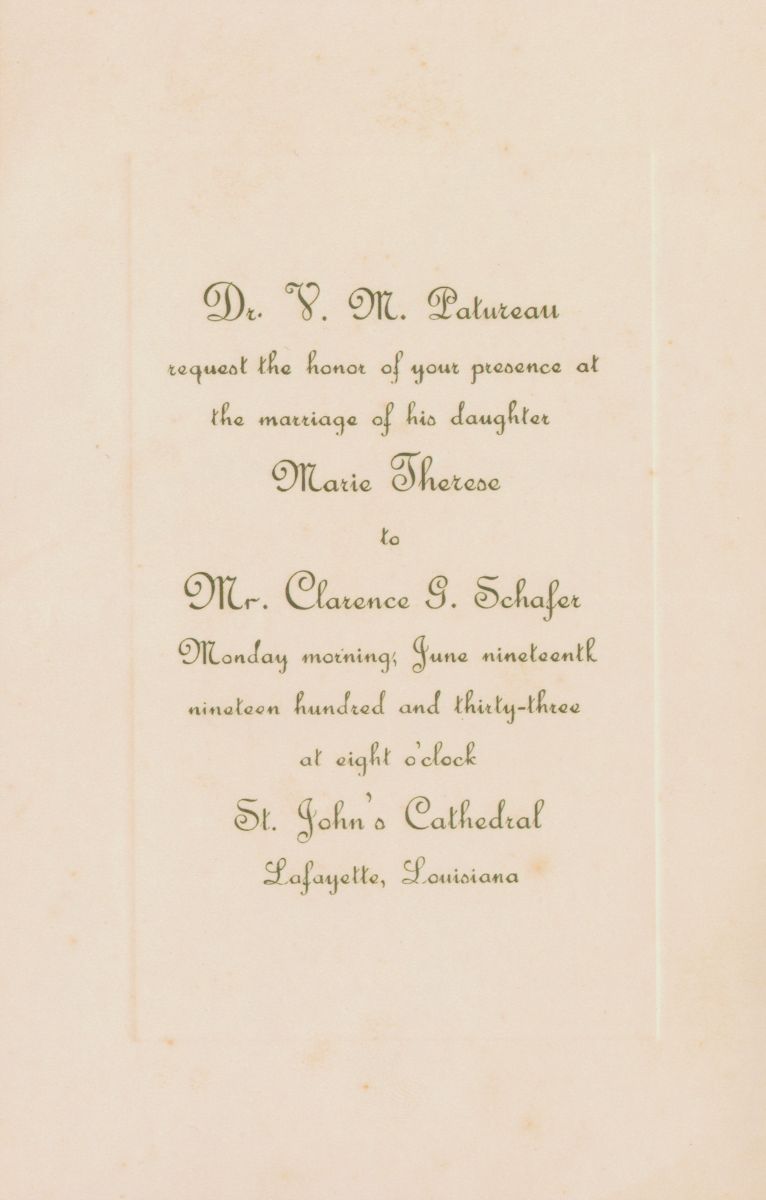
This photo is from the wedding of Marie Therese “Bee” Patureau and Clarence Schafer on June 19, 1933.  It looks like a very nice affair.  The wedding took place at St. John’s Cathedral in Lafayette, Louisiana.  Bee was the younger sister to my Mee Maw (Germaine Erie Patureau was the mother of Bob Landry, my father), who I can’t find in this photo.  I know that she was there, because there is another photo of the event that supposedly shows her. (It doesn’t look like her to me.)  Erie and Bee’s father was Grampa Max (Vincent Maximilian Patureau) who is standing proudly in the middle of his large family.

The wedding couple are seated in chairs with the bride surrounded by many bouquets of flowers.  Sylvia (another Patureau sister) and her husband Son Marionneaux are directly behind the bride.  On each side of Sylvia are two more Patureau sisters.  (Neither of which is wearing a hat.)  On the left is Lidwyn and on the right is Emma.  Emma is the mother of Tez.  Tez was just a 12-year-old girl at the time with no signs of bumps to be seen.  She can be seen sitting on the ground directly in front of her mother.  Her father is the tall man in the back at the center of the photo.  His name was Toby Mouton.  The other Patureau sibling in the photo is Mee Maw’s brother Rome (rhymes with homey) on the far right.

Sadly, the marriage was not very long lasting.  The shortness of duration was not due to a lack of affection nor infidelity nor infelicity.  The end of the marriage was due to the death of Bee only a short four years later.  But not before the births of her two daughters Syl in 1934 and Sis in 1937.

We can thank Sis for sharing this photo with us.  It really is a beautiful photo.  Full of familiar and familial faces at a happy moment in their lives.

Invitation to the festive occasion.


July 5, 2019 – I found this newspaper article about the wedding.  It ran in Lafayette’s “The Daily Advertiser” on the day of the wedding.

Depression Era Bucklin Babies

Here is a photo of my mom’s family toward the end of the Depression.  The Depression officially started on October 27, 1929, and lasted for about a decade.  My grandparents Fred Bucklin and Myrtle Phenice must have been dating when it started, because they were married a few months later on Mar. 12, 1930.

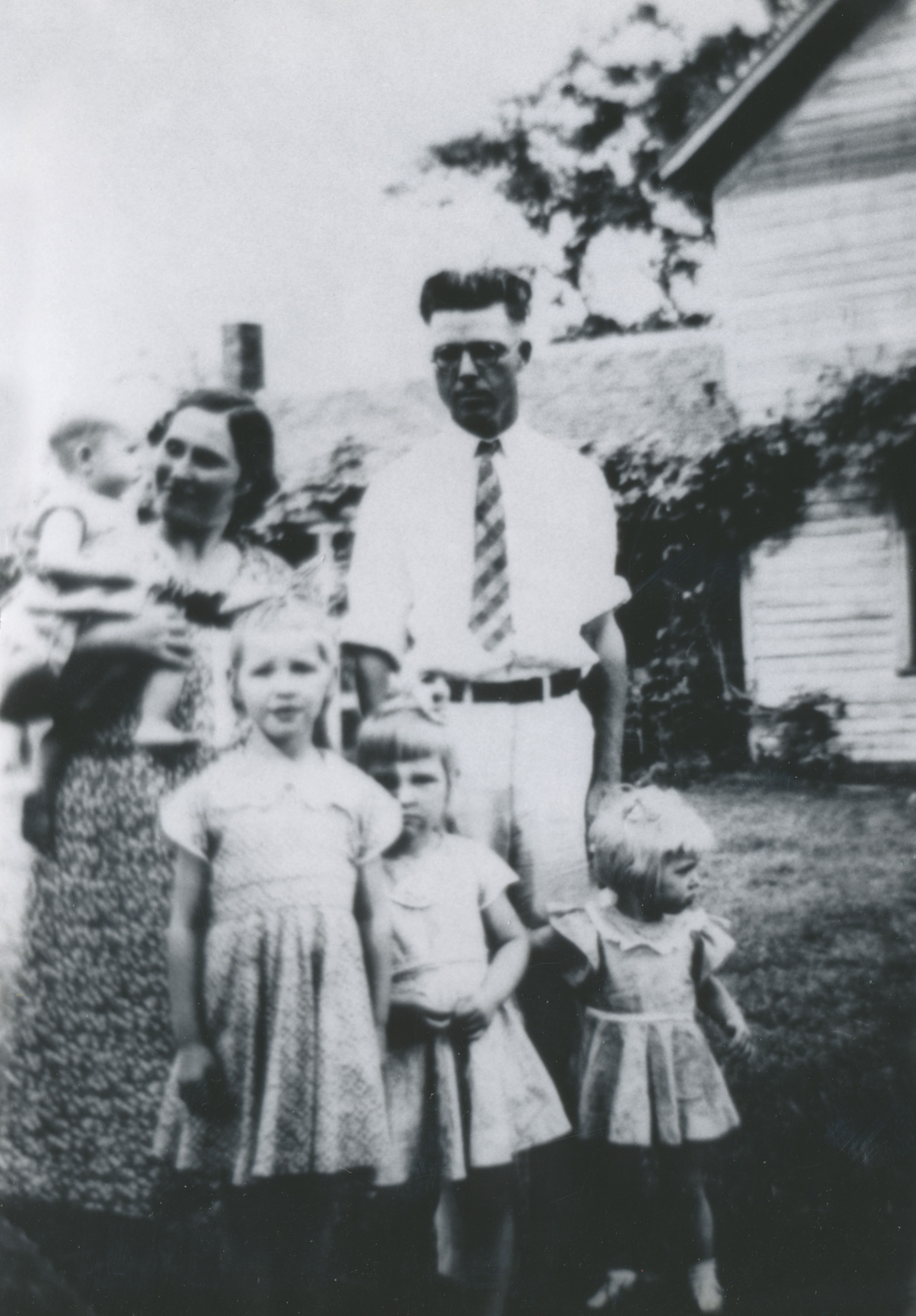
Bucklin family of Hathaway circa 1938

This photo was taken around 1938.  I base this on the fact that the youngest one in the photo is aunt Loris who was born at the end of August in 1937.  She looks to me to be a few months old.  Grandma and Grandpa would have been in their early thirties at this point.  The girls in the front (starting with the oldest on the left) are Sylvia at age 7, Betty Lou at age 5, and little Alma at age 2.

It looks like Betty Lou is a bit shy and is hiding behind her big sister.  It reminds me of a photo of our family when we were young and Jamie is doing the same thing next to me.  I wonder what Alma was distracted by.

It’s not a professional photo, but like I said at the beginning, it was during hard times.  Grandpa was a nurseryman during this time and grandma helped him out with that.  I know they didn’t have a lot of money at the time because my mom talked about how special it was that her cousin had a ‘real’ doll to play with.  Obviously this means that my mom and her sisters did not have store-bought dolls to play with during this time.

But things were different back then.  People were not used to the prosperity that seems so prevalent now.  The family seemed to deal with it all pretty well.  My mom was quite frugal all her life.  It really wasn’t necessary for her to tape up ziploc bags to store things in her purse!  But she couldn’t be persuaded.  She should be named the patron saint of recycling!

A Bazaar Picnic

I’m not really sure about the circumstances of this picnic.  But for some reason the photos and the writing on the back of them has captured my attention.  At least for now!  As much as I like old photos of my ancestors, the addition of seeing their handwriting in letters or on photos is a nice bonus.


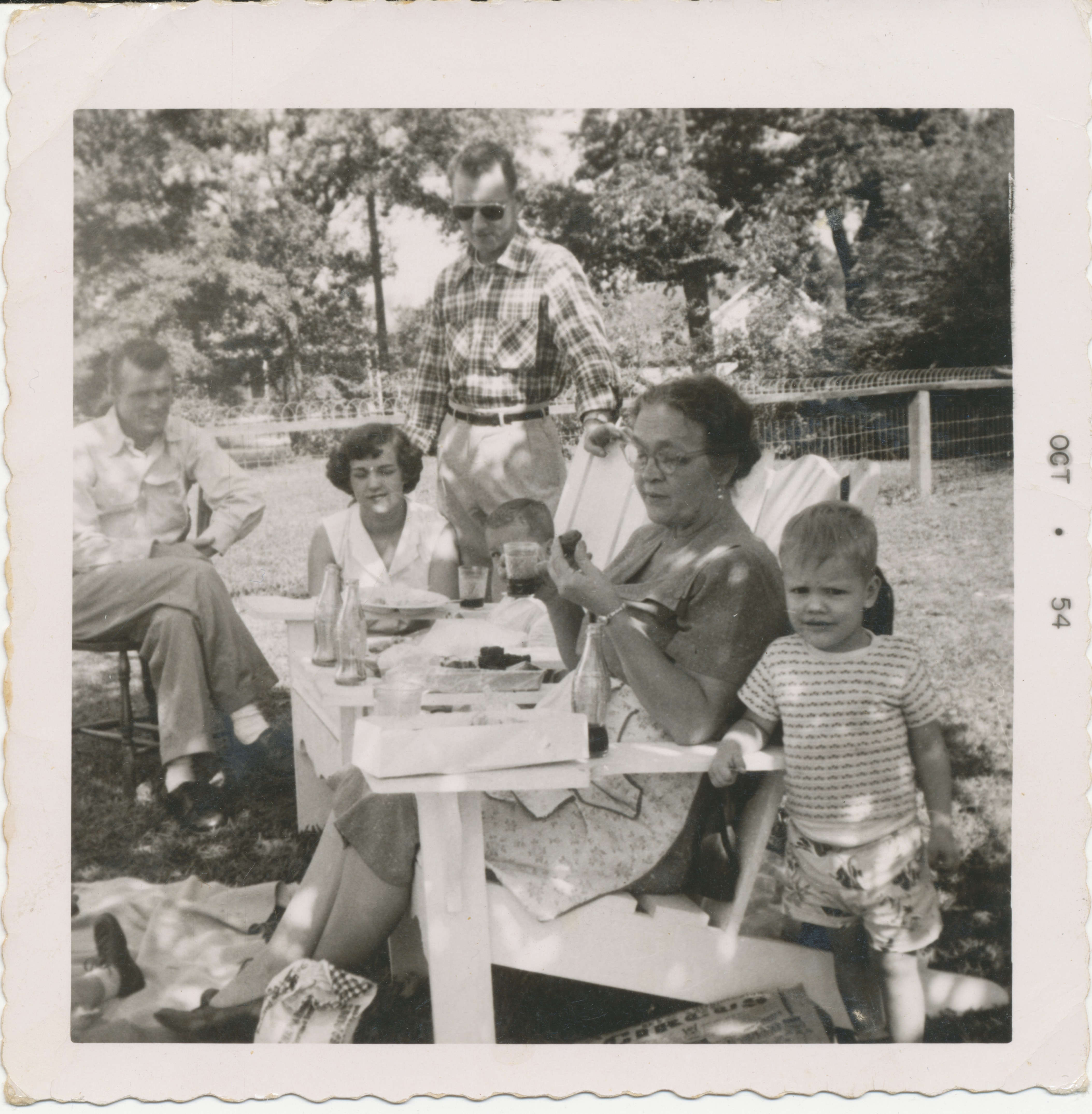
These photos were taken around this time of year, but they were from 63 years ago.  The exact date was October 17, 1954.  This first photo shows uncle Duffy, my cousin Douglas Winn, my Mee Maw (paternal grandmother Germaine Erie Patureau Landry), another cousin Dennis Landry, uncle Joe Raley, and aunt Frances Raley.  The little girl sitting on the blanket in the front is not identified.  I’m thinking it is another cousin Daphne Winn, because she looks to be too young to be The First (Shirley Landry) who would have been seven at the time.  It’s Mee Maw’s writing on the back, because as you can see, she labels herself as ‘me.’

The grand occasion for this picnic was named on the photo.  It reads, “The St. Huberts (sp) Bazaar was held in Prejean’s pasture, so we went to Wana’s and I had a picnic in her back yard with children.  But we never could get them all together.”  I’m not sure if the Bazaar was canceled or it was just close to Wana’s house, but Mee Maw must have decided it was the perfect day for a picnic at her daughter’s house.  And those disagreeable children would not behave and get together for a group photo.  But we have the photos nonetheless to memorialize that outstanding picnic from years gone by.

This other photo is obviously from the same day.  But it was written by one of Mee Maw’s children.  (Hence the naming of Mee Maw as ‘Mama’ on the back of the photo.)  In this photo you see Duffy, Frances, Joe, Douglas, Mee Maw, and Dennis.  Even though the photo doesn’t mention it, you can also see the legs of the little girl on the blanket that I call Daphne.  (I’m sure Daphne has this photo with all the names on it too, but hers probably has her name written on it!  Unless of course, it is not Daphne.)

I like other details of the photo as well.  You can see the bottles of Coca-Cola on the blanket.  No canned sodas back then!  No red Solo cup either.  And Mee Maw was prepared, too.  She had a box of Cut Rite wax paper in her lap in case there were leftovers to save for later.

Oh, well, that’s it.  Just a short little picnic in Wana’s back yard.  Nothing fancy.  Nothing really important.  Not much to write about when you think about it.  But sometimes it’s those simple things that can be cherished the most.  What any one of her grandkids wouldn’t give to be able to have a nice little October picnic in their back yard with their beloved Mee Maw.

A Witness at Ford’s Theatre

I wasn’t sure what I was going to write about today, but then I saw a photo of my cousin Julie Phenice Campbell at Ford’s Theatre in Washington, DC.  I made a few comments and then realized that I hadn’t gone into the details of my great great grandfather’s Civil War experience.  So I’ve decided that the time is now.  Plus I have a really cool photo of him that I obtained this year.

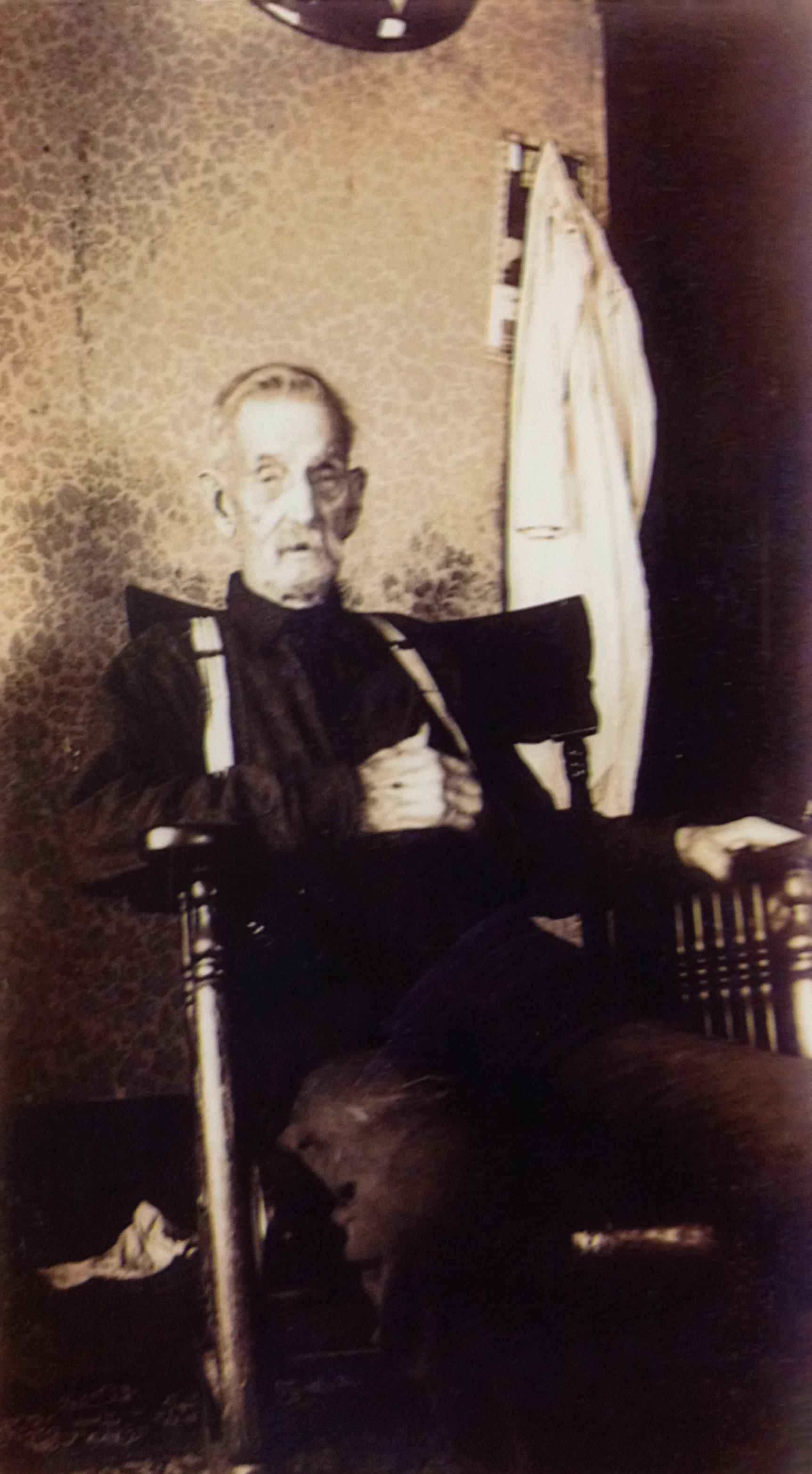
Samuel Charles Phenice in his elder years.

Isn’t this a cool photo of an old grizzled man?  This is Samuel Charles Phenice later in his life. (He was the father of Harry Clifton Phenice, who was the father of Myrtle Phenice Bucklin, who was the mother of Betty Lou Bucklin Landry, who was my mother.)  He lived to the ripe old age of 95.  Any time I hear the question, “If you could visit one of your ancestors to have a conversation with them, who would it be?” I always think of the man in this photo.  So many questions that I would like to have answers to.  So much wishful thinking.  Let me tell you what I do know.

Samuel Charles Phenice was born in Mercer County, Pennsylvania, on April 19, 1844.  He was the fourth of seven children to Daniel Phenice and Susan Jackson Phenice.  The family must have stayed in that area during his childhood, because when he enrolled to fight in the Civil War, he would become part of the 57th regiment of the Pennsylvania Infantry out of Mercer County.  He was a private in Company F.

According to a document I found, the 57th regiment went on furlough on Jan. 8, 1864, for a period of 49 days.  When the soldiers returned to camp, there were a large number of new recruits.  Among those recruits was Samuel Charles Phenice, who had enlisted on Feb. 12, 1864.  During March they became part of the 2nd Brigade, which was composed of units from Pennsylvania, New York, and Maine.  In April Samuel celebrated his 20th birthday, though he was quoted as saying that he suffered “many hardships, hunger and thirst.”  Maybe a not-so-happy birthday.

On May the 3rd of that year, Samuel and his fellow soldiers marched to Chancellorsville, Virginia.  This is close to Spotsylvania and there were many skirmishes going on in the area.  The 57th, along with other Union troops, advanced along country roads and woods.  In one particularly wooded area on the morning of May 5th, Confederate forces were encountered and frenzied fighting took place.  The fighting was at short range (when you could see your enemies behind the trees) and was vicious, yet brief.  There were twenty-two killed, one hundred twenty-eight injured, and three missing.

Among those injured at the “Battle of the Wilderness” was 20-year-old Samuel Phenice.  He was shot in the left thigh – more specifically the “inner aspect of the thigh and about the middle of the thigh.”  Part of the information about the wound was gotten from a medical report from 1915 that reports that complications of varicosity of his leg was a direct result from the wounds received during the War.

Civil War hospital in the Spotsylvania, Virginia, area after the Battle of the Wilderness in 1864. (I found this photo online.)

After he was wounded, Samuel spent a while recuperating.  He went to a place that was probably very similar to what you see in this photo.  It is a photo of a makeshift infirmary in the Spotsylvania area after the Battle of the Wilderness.  I don’t recognize Samuel in the photo, but there is no way to make out some of these people.  On May 24, 1864, he was a patient at Carver General Hospital in Washington, DC.  A week later he was transferred to Haddington in West Philadelphia.

Once he recovered well enough, he became part of the “Invalid Corps” (9th Regiment of the Veterans Reserve Corps) on October 8, 1864.  The only posting that I know of was the one on April 14, 1865, at Ford’s Theatre in Washington, DC.  And everybody recognizes that place and date.  Samuel was stationed at the front of the theater checking passes of military personnel.  According to one account Samuel was an eyewitness to John Wilkes Booth’s entering the presidential box and shooting President Abraham Lincoln.  He also was a witness to the flight of the assassin.  So my great great grandfather was present at one of the defining moments in American history.

Samuel was honorably discharged from the military on July 5, 1865.  Though he would get married and raise a family, he would never forget those vivid events that he experienced as a 20-year-old young man.  He obviously liked to recall the events, because there are several articles about him speaking about it.  One says “Phenice often recalled the wild scenes in the theater after the shooting.”

Oh, to be able to hear those stories in his voice.  Like I said at the start of this story, I would love to be able to pull up to Great Great Grandpa Samuel’s rocking chair and say, “Grandpa, tell me ’bout the good ol’ days.”  My excitement would build as he’d rock back with a grin on his face and say, “Well, now, young man, that may take me a while…”

Marie Therese Landry Patureau

You have to be careful when you talk about my father’s maternal grandmother.  Not that she’ll get mad at you or anything, it’s just that the name Marie Therese is very popular in our family.  Not only did my great grandmother have the name, but so did my dad’s sister (Aunt Marie), one of his first cousins (Sis – thanks again for providing this new and improved photo of your namesake!), and one of my second cousins (Therese).  And there are a few other more distant cousins with the same name too.

Marie Therese Landry circa 1888.  She was the mother of my Mee Maw.

This Marie Therese was born in 1868 to Trasimond Landry and his wife Marie Amelie “Belite” Bujol Landry in Brusly, Louisiana.  She was the first child born to that union.  According to the book “The Tirailleurs”, Trasimond and Belite began courting during the Civil War.  I guess you can call it courting even though he was fighting in a war.  They saw each other on an occasional leave and then corresponded by letters.  Belite was one of four beautiful daughters of widow Bujol, and Trasimond was particularly partial to her tender charms.

Trasimond and Belite were married after the war on Nov. 30, 1867.  Ten months later came along our little Marie Therese.  Over the next eight years two sisters and two brothers joined her.  They lived on a farm at first, but then Trasimond gave up farming and became a teacher and took on some minor roles in politics.  He died when Marie Therese was only eleven years old, so I’m sure she helped her mother out with the younger children.  Belite married Magloire Babin in 1880, which led to two younger half-sisters for Marie Therese.  I don’t have much more information about the next few years.

I do know that Marie Therese married Vincent Maximilian Patureau on Oct. 10, 1888, in Brusly, but afterwards they were living in Plaquemine on Patureau Lane.  I don’t know how they met, but it was probably through the family.  They were cousins after all!  Hey, if her parents did it, why not her?  It was the custom back then.  Ten months after they were married, Marie Therese and Max welcomed their first child into the world.  They went on to have many more children – and lose a few – until our Marie Therese died on October 4, 1909, at the young age of 41.  The anniversary is just a few days off.  So think about her on her anniversary, whether your name is Marie Therese or not!

Hein/Hine – My German Roots

When I was growing up I always thought my mom’s side of the the family was German and English.  For some reason I always assumed that the German came from the Bucklin line of the family.  When I was in high school, I took on the task of reading (and recording on cassette tape) my great grandfather Louis Charles Bucklin’s journal from 1893.  This was for the benefit of my grandfather Fred Bucklin because he had vision problems.  (Note from Sept. 21, 2019: For the first time I’m thinking this might have also been a way my grandfather tried to get me interested in his own family history.  The journal was his father’s and it had been around all of his life.)

I remember coming across an entry where he talks about a man from Ohio (with two of the “finest daughters“) who asks him if he was German.  Lou tells him “No, I am an Irishman.”  When I read that, I thought that he was lying to the man from Ohio to put him off because he was not interested.  I just knew that he was German and not Irish.  But I was wrong.  His mother was a full blooded Irish woman with the last name of McGrath and the Bucklins are of English descent.

But Lou’s wife Addie Hine’s family line (my Grandpa Fred’s mother Addie Hine), on the other hand, is German.  I’ve come across some information recently that makes me much more certain of the line that goes back to Germany.  Since I don’t have a photo of the Hein family that immigrated from Germany to the US (it was in 1753 after all), I am posting a photo of the Hine family just before they immigrated to Louisiana in 1894.

Hine family in 1892 in Boone County, Indiana. From left to right is Rowe, Jim, George, Ollie, Addie, Susan, Bert, and Lonnie. (Could the dog be Sammy?)

This is the George Henry Hine family in Boone County, Indiana, in 1892.  As you can see, it is a very rustic existence with a log cabin.  All of the family was born in Indiana.  But they were born in Noblesville, Indiana, which is in the neighboring county of Hamilton.  I know that George’s wife Susan Stanbrough Hine’s family was from the Noblesville area.  But I just recently found that George had some family members living in Boone County.

In a previous post I talked about how I discovered that George’s mom Malina’s maiden name was Cox.  Now I’ve discovered that Malina’s father’s name was Benjamin Cox.  I found a will for him that is from Boone County at his death in 1877.  It lists a daughter by the name of Maline Cox Hines.  Don’t be concerned with the spelling, like I said before, they did not have the Myrtle Phenice spelling gene!  His history shows him as being from North Carolina, which is where Malina was born.  It all fits together nicely.  It also might explain why the family moved from Hamilton County to Boone County.

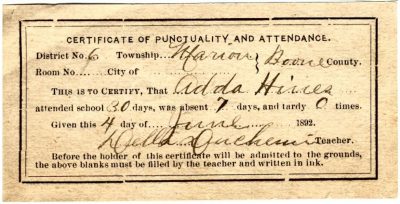
George was born in Hamilton county in 1846 (and died in 1919) and showed up with the family there through the 1870 census.  Then the family shows up in Boone County in the 1880 census.  They stayed there until they moved to Louisiana in 1894.  In the meantime the kids were going to school, as can be evidenced by this certificate that Addie received for attendance that was dated June 4, 1892.

So let me take you back to Germany along the Hine line.  George’s father was John Peter Hine (1819-1900).  He was the first in this line to use the more English spelling of Hine rather than the German spelling of Hein.  It looks like the extended family did likewise.  Some of the later generations also changed the spelling to Hines, but our family line stuck with Hine.  John Peter was born in Bethabara, North Carolina, and moved to Indiana in 1841.

John Peter’s father was Peter Hein.  He was born in 1794 in Bethabara, North Carolina, and lived his whole life in Forsyth County, North Carolina.  He died a few months after the birth of John Peter.  (Actually he died before the birth of John Peter.  I should pay a little closer attention to the dates! For more information, read Becoming a Father Posthumously) This explains why John Peter was his only child.  All of the other generations had at least five children.

Peter’s father was Johannes or John Hein (1749-1806). He immigrated with his father Johann Jacob Hein (1713-1795) in October of 1753 from Germany.  They were both born in Dillenburg, Germany, and when they immigrated, they originally settled in Broad Bay, Maine.  Then in 1770 they moved with a group of 300 people to a Moravian settlement in what is now Forsyth County, North Carolina.

John Hein was the son of Jacob’s first wife who died in Germany.  Jacob remarried in 1752 and immigrated with his new wife and his children in 1753.  They were part of the Moravian church.  The church had many missions and settlements in the New World.  One of those settlements was Bethabara, which is where the Hein family settled in 1770.  Johann Jacob Hein died in 1795 and is buried in the Friedland Moravian God’s Acre.  His legacy carries on.

1 … 45 46 47 48 49 … 65