Keys Reunion 2017 Recap

Last weekend we had our Keys Family Reunion and it was a great success.  Success?  Is that the right word?  I suppose it is.  There were over a hundred people in attendance (101 to be exact – that’s over a hundred!) and everyone seemed to get along splendidly.  The rainy weather did not seem to put a damper on anyone’s spirits.

Daisy's grandkids in 2017

Grandchildren of Daisy Keys at the 2017 Reunion: Front Row – Linda Phenice Rogers, Marilyn Phenice Strickland, Loris Bucklin Woolley, Kathleen Phenice Montgomery; Back Row – Carol Phenice Bourque, Lisa Phenice, Darla Hill Wilson, Shelly Hill Russell, Julie Phenice Campbell, Paul Phenice, and Diane Phenice Prejean

It had been around twelve years since the last reunion, at least I think that’s what I heard from those in the know.  Since that time, there were a few deaths in the family.  In addition to my own parents’ recent deaths, there were the deaths of my mom’s aunt Marguerite, aunt Wilma, aunt Elta, and aunt Edna.  Now, aunt Edna was my mom’s aunt because she was my grandfather’s sister, but she was married to my grandmother’s cousin who was a Keys, so she was always at the previous reunions.  These were the last of my mom’s aunts and uncles.  This led my aunt Loris to proclaim that now she and her cousins were the “old aunts and uncles.”  I am from the Daisy Keys line and there were eleven of her grandchildren who were in attendance.


2017 Keys Reunion

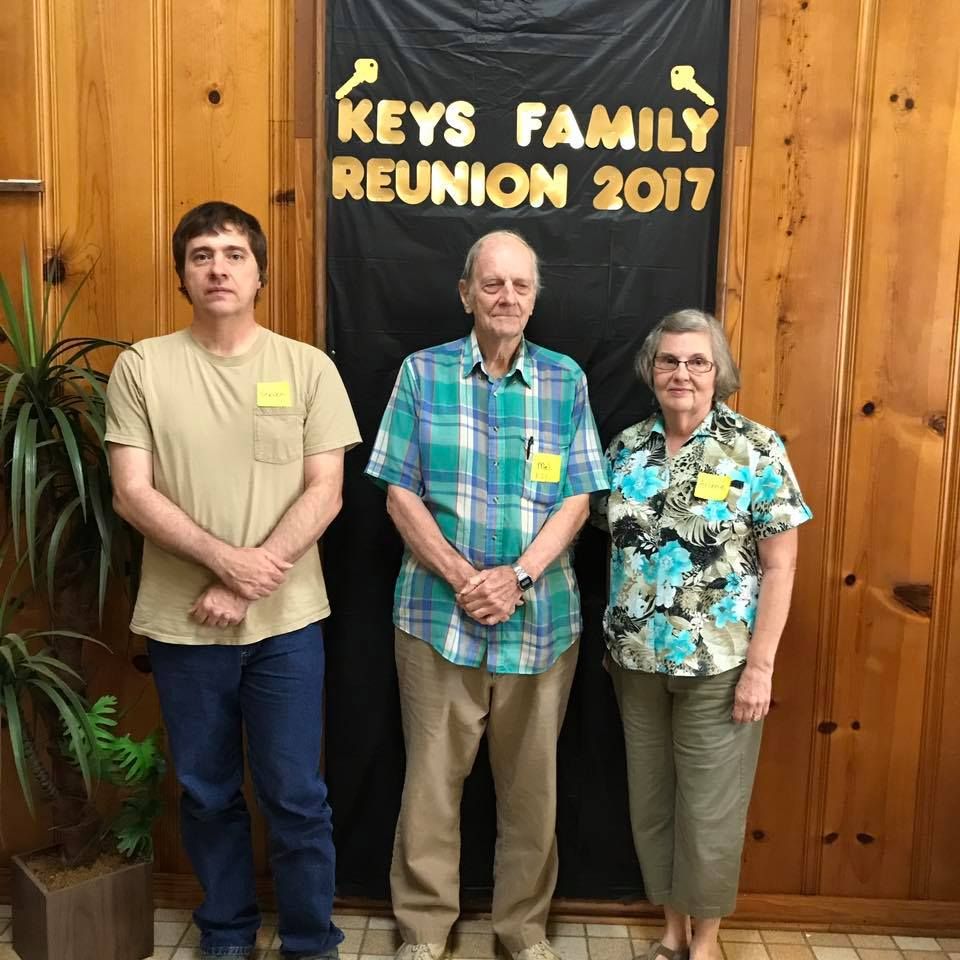
Steven, Mel, and Arlene

As everybody knows, Daisy was the third child of Henry Keys and Martha Cook Keys.  The first child born to that union was Henry Alfred “The Judge” Keys.  He was represented at the Reunion by his grandchildren Melvin Keys and Arlene Keys Ware, as well as Mel’s son Steven.  This was a treat for me, Karen, Charla, and Mary because we are Star Trek fans and Mel helped to build the original model for the star ship Enterprise that was used in the filming of the original series back in the 1960s.  Live long and prosper.


2017 Keys Family Reunion

Sue Hebert

The second child born to the honored couple was Leonard James Keys.  None of his descendants were in attendance.  We’ve already accounted for child number three.  And then there was Ruth.  The fourth child of Henry and Martha was named Rosetta Ruth Keys.  We had one brave soul who descends from Ruth in attendance.  This is Sue Carol Bryan Hebert.  She’s been verified, too.  She’s taken a DNA test and she matches aunt Loris, cousin Charla, and other Keys relatives.  Not that there ever was a question pertaining to the relation, mind you.  I just wanted to mention the DNA verification.  Another interesting thing about the Ruth Keys lines is that there is still a surviving daughter. (She has since passed away. Martha Bryan Boose was born in 1920.  She was not able to attend.

Neither did any of the many descendants of the youngest child Mabel Keys Miller.  Where were they?  That family settled in Kinder.  Surely some of them were close enough to attend!?  Sorry, I’m getting crazy here.  I know it was the Daisy Keys family that orchestrated the event, but they were invited.  Maybe we’ll see a few at the next get together.  Actually I hadn’t expected as much of a turnout as there was, so I should be happy.

Yes, I am happy…

The Lincoln Collection

Last week my post was about my mom’s side of the family, so my plan was to make this week’s theme about my dad’s side of the family. But then something happened. A second cousin once removed happened. And she happened to be on my mom’s side of the family. She took a DNA test at Ancestry last year and I have communicated with her a little bit from time to time. But both of us were dealing with issues with aging and failing parents.

Our lives have changed a bit because me and my siblings buried my parents at the end of January and her father died two weeks later. We had talked about old photos and such, but that was put on the back burner at the time. Now there is time and that cousin got back in touch with me.

You see, her father had been the last remaining first cousin of my grandmother Myrtle Phenice Bucklin on the Phenice side of her family. His name was Harry Lincoln Quillen and he was the son of Emma Phenice Quillen. Emma’s brother Harry Clifton Phenice was my grandmother’s father. If you’ve followed me thus far, you will have figured out that the cousin I’m talking about is my second cousin once removed Mona Quillen.

Well, you may not have figured out her name, but you might have figured out our relationship. Anyway, she had started to clean out her father’s home and came across several old photos. Since she remembered that I was interested in that, she got in touch with me.  And boy am I glad she did! The photos that I have seen are mind blowing! Sorry, I shouldn’t build it up too much. I would hate for you to be disappointed when you see some of the pieces in the Lincoln Collection. That’s what I’m calling it. They belonged to Harry Lincoln Quillen and our common ancestor was a witness to the Lincoln assassination, so that’s the name I’ll use – the Lincoln Collection. I actually gave a preview of it by posting a new cover photo on Facebook. I had a photo that was taken on the same day, but the quality of this new photo is much better. Probably because mine had been a photo of grandma’s old photo that has since disappeared, and the Lincoln Collection photo was an original.

The Phenice family in 1937

The Samuel Charles Phenice family in Beaver Creek, Nebraska, circa 1937.

But the photo that I’m posting today is a new one to me.  It relates to the photo that I posted last week.  Last week’s photo was of Daisy Keys Phenice and some of her siblings, and this week’s photo is of her husband Harry Clifton Phenice and some of his siblings.  Daisy was prominently displayed last week, but this week H C is hiding his face.  I mentioned that Daisy and her siblings lived within 20 miles of each other.  The same can not be said for H C.  He was born in Pennsylvania and by the time he was six years old, the family was living in  Nebraska.

In 1898 at the age of 24, he left home and went to seek fame and fortune.  So of course he came to southern Louisiana.  It was here that he met his young sweetheart with a British accent and they were married in 1900.  But being 1000 miles from his family is quite a bit different than it is today.  The country did not have an interstate system at that time and jumping on a plane wasn’t available either.  It wasn’t until 1920 that H C and his family bought their first car.  I don’t know how often he visited his parents and other family members, but he must have from time to time.  There are photos to prove it like this one.

From left to right you see H C’s brother Edd, father Samuel, niece Leora, H C, and sisters Myrtle (mother of Leora), Emma, and May.  I like the way he is hugging on his niece and sister.  He must have been glad to see them on one of his infrequent visits.  I also like the fact that someone took a photo of the get together.  And that Emma Phenice Quillen saved that photo and wrote everybody’s names on it.  And that her son Harry Lincoln held on to it all of his life.

But most importantly I am glad that his daughter Mona was also interested in preserving those old photos and was willing to share them with me.  And she likes that they are being shared with the family.  This is not the best photo that I got.  I have to save some for later, of course.  But remember when I told you the story about my great great grandmother who died as a result of catching fire?  I said that I wanted to tell the story of her life and I mused about finding a good photo of her to go along with the story.  Well I am happy to say that I have found the perfect photo for that story!

Ok, I think I have said enough in this introduction to the Lincoln Collection.  I hope I have left you wanting for more.  I want more!  It sounds like she has just touched the surface of the treasure trove of photos that she has.  And what I’ve got so far are just snapshots of the original photos.  More images made at better resolutions with a scanner are foreseen in the future.  Must…be…patient…

A Voice From the Past – Sammy Got Run Over

I’ve got another keepsake that I want to share with all of you.  I found this last year when I was going through some of the things I collected from my parents’ home when we cleaned it out for selling.  I’m not talking about the photo that I’m posting with the keepsake.  The photo is part of a promise that I made on here a few weeks ago.  I said that the next thing I’d post for Addie would be a photo of her smiling.

Addie Hine Bucklin

Addie Mae Hine Bucklin circa 1937

For those of you who don’t know who Addie is, she is my maternal grandfather’s mother Addie Mae Hine Bucklin.  (mother of Fred Bucklin, grandmother of Betty Lou Bucklin, and great grandmother of Van Landry)  In most of the photos I have of her, she has a rather severe look on her face.  I thought it was time to share a photo of her smiling since the story in the post is a happy one.  Yes, Sammy did get hit by a car, but he recovered quite well as you’ll hear Addie explain to you.  That’s right, you’ll be hearing the story of Sammy the dog in Addie’s own voice from around 1944.

Addie’s oldest daughter Mary was married to Sylvan Phenice.  He was a sound engineer and one of the things he was able to do was make recordings with a turntable using a cutting needle.  And I thought it was tough when I was a youngster recording conversations secretly using a reel to reel tape recorder!  Somehow he was able to record a conversation with Addie going into detail about her dog falling in the wheel track.  (It must have been a dirt road with deep ruts from the wheels of the cars and trucks.)

Sylvan’s wife Mary can also be heard in the conversation.  I wouldn’t want to get that one too excited.  Her voice would be piercing!  The other people in the recording are Roy Bucklin and his wife Effie.  So find a quiet spot, click on the link to the site that has the recording, close your eyes, and let yourself be transported back to 1944 in rural southern Louisiana.

Sammy Got Run Over – as told by Addie Mae Hine Bucklin.

I thought I’d go ahead and put the transcript of the recording on here in case there was anything you weren’t able to make out.  I am very thankful to aunt Loris who is the one that was able to recognize the voices in the recording.  Mom had it labeled, but I didn’t know which voice belonged to which person.  Thus begins the transcript:


Roy Day Bucklin:  Effie’s a gardener.

Addie Mae Hine Bucklin:  That was the morn… that was the morning that uh Sammy got out in the road and got run over.

Effie Hetzel Bucklin: (at the same time) Yeah, I’ve been trying but I’m afraid that uh it’s not going to amount…

Roy: Did Mr. Compton die?

Mary Bucklin Phenice:  Who’s Sammy?

Addie:  Our little dog.

Mary:  Your little dog?

Addie:  He followed me to mailbox and just as I got out there, there’s a, a pickup went by and he run out to bark and he got too close and it run over him.  And uh, I don’t know if it knew it hit him or not;  it didn’t stop, it just went on and there Sammy was layin’ right in the wheel-track, you know, just all drawed up.  And he commenced makin’ the funniest noise.  Now I was afraid to go and pick him up.  And uh, I stood there and looked around and I thought I heard Roy out in the shop and I said, uh.  Went and called him and I said, “Come here!” and he come, looked at him, and he said, “Oh, I’m afraid he’s done for.”  And we just stood there and watched him.  We’d speak to him and he wouldn’t let on like he heard us.

After a while, why I guess he was kinda commencin’ to get over it, and he’d raise up and look, you know, but he, you could tell that he didn’t know what he was lookin’ at.  So I looked down the road and I saw a car comin’ and I said, “Well, Roy, let’s get him outta the road.  There comes a car.”  So he picked him up and really just puttin’ him out of the track.  Well he just took him on in to the yard.  He laid there.  We’d talk to him.  Still he didn’t know what we’s sayin’.  I guess we musta stayed there fifteen minutes just lookin’ at him, you know.  And we couldn’t see any place was hurt, only just the blood dropped out of one eye – just two or three drops.  Then uh..(cough)…so like, like uh, when we got ready to go to the house, like we said, “Come on, Sammy!  Let’s go!” and he got up and followed us to the house!

Mary:  He’s alright?!

Addie:  And he laid around all day that day, though, Roy was workin’ out with the cattle and he didn’t pay any mind.  He just laid around.  After that, well he seemed to be alright.

Mary:  Shocked him, I guess.

Addie:  Broke… broke the collar off of his neck.  He had… he had a leather collar on.

Roy (interrupting): Must, he, must, car musta hit him on the neck.  That collar was layin’ where the car had hit him.

Mary:  It shocked him.

Addie: It’s a shock, I guess. Long, oh for several days he, he wouldn’t bark at cars.  He’s got over it now. He runs out.  This next time he’d catch it harder and it’d be the last of him.

Christmas Eve Eve 1920

It was getting cold that late December day.  The following day would be the coldest day of the month and would get down to -17 degrees.  That would be a really cold Christmas Eve.  So as they gathered around their trash burner/wood stove, thoughts of the upcoming first Christmas of the 1920s may have been crossing their minds.  Cathrine would be thinking about the many meals that this stove would be used to prepare.  There were many grandchildren who would hopefully enjoy the feast she intended to prepare.

Samuel Charles Phenice with wife Catherine circa 1920 Nebraska

Samuel Charles Phenice with his wife Cathrine Jane Foster Phenice and their two great grandsons Floyd and Elmer Racine (sons of Marie Taylor Racine, grandsons of Anna May Phenice Taylor – listed in Cathrine’s obituary). This was probably in Nebraska circa 1920.

Samuel as well was probably thinking of that feast to come.  Of course, he didn’t have to worry about that overmuch because it was probably his devoted wife of 54 years who would be doing that cooking.  He may have been recounting to his friend Louis the exciting times he had in years past, such as that long ago day at Ford’s Theatre in Washington, DC.  Whatever they were thinking, those thoughts were soon swept from their minds because of what happened next.

Cathrine probably opened the stove to put more wood on the fire as she had done thousands of times during her 72 years on earth.  No big deal, just a part of her ordinary life in her 1920s home in Precept, Nebraska.  But this was no ordinary day.  Either she stood too close to the fire or for some reason there was a particularly strong draft, but something definitely went wrong for her.  Before she knew it, her dress was on fire and evidently it was burning quickly.  When she realized the severity of the situation, she screamed and began to run in a panic.

I’m sure this was a horrific sight for her husband to behold.  Anybody knows how painful it can be to witness a loved one suffer.  So to see his beloved wife being consumed by fire must have been heart-wrenching.  “Who’s going to cook my Christmas feast now?” he wondered in alarm.  I’m sorry.  I was doing so well telling this serious and terrible story without breaking the tension, but then my evil humor took over.  I’m sure that thought was nowhere near his mind.  He sprang into action no matter the consequence to himself.

He got to his wife, caught her, and tried everything he could to extinguish the flames.  In the process he burned his hands terribly.  His friend Louis Adler witnessed what was happening, filled up a container with water, and did what he could to help put out the fire.  The fire had reached her hair, because he poured water over her head to stop the flames.  The fire was put out, but not before burning poor Cathrine so badly that her life ended as a result of it.

She did not die immediately.  It was said that she suffered miserably.  It must have been a very somber Christmas that year for the Phenice family.  Their beloved matriarch suffered with blood poison as a result of the burning.  It sounded like she had severe burns over a large portion of her body.  She was quoted as saying shortly before she died, “I know you if I can’t see you,” which makes me wonder if she was blinded by the fire.  She ended up dying at 3:20 p.m. on January 7, 1921, at the age of 72 years, 3 months, and 22 days.  I like the way in some parts of the country, the age is given like that in obituaries or on headstones.

Even though she suffered for two weeks, the family reported that she was patient all the way.  When writing an obituary, I would think that most people try to make it reflect the person and be true to who they were.  The report of being patient was written two times in that one article.  I suppose they wanted that to be well understood.

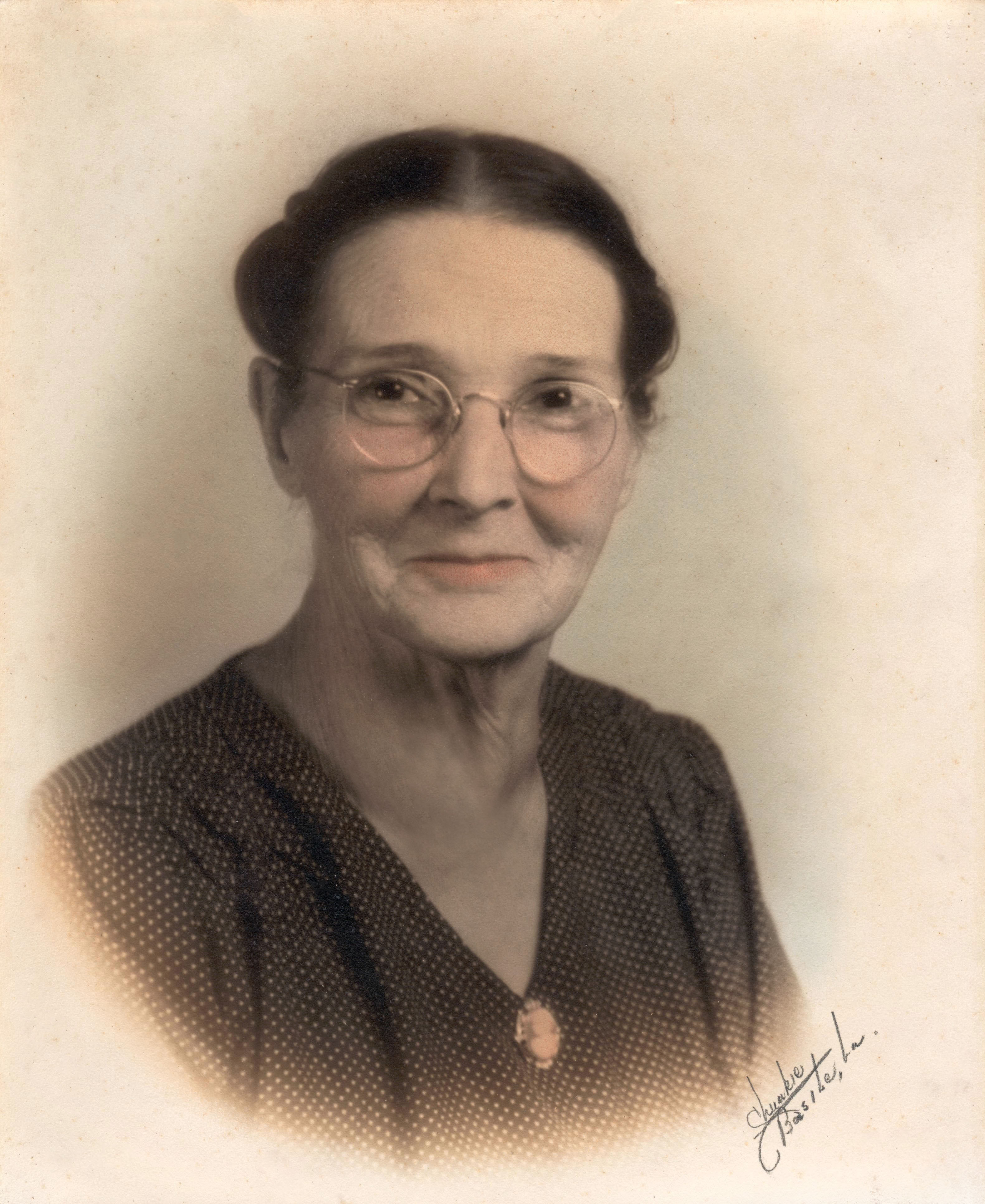
Catherine Jane Foster Phenice

Cathrine Jane Foster Phenice circa 1910.

She sounds like a good woman who relied on her faith to see her through.  Generosity to those in need was also attributed to her.  I can believe it because of what she inspired in others.  Her husband risked his own life to attend to her terrible situation.  Then her children lovingly tended to her during her last weeks of suffering before tenderly laying her to rest.


I’ve been wanting to write about Cathrine Jane Foster Phenice for a while now.  Like the first picture above, she was kind of in the shadows.  Her husband was a witness to the assassination of President Lincoln, so he tended to get most of the attention.  It is such an historic event.  But his wife deserved to be the center of attention at least once.  I was planning on writing her life story, but got carried away with the events surrounding her final days.  I will probably write another story about her at a later date.  (See the great photo I found and the post I wrote about it here.)  Maybe I’ll find another photo to post of her as well.  That first photo was another one of the photos that I had taken of my grandmother’s photos back in the 80s and forgotten about until recently.

The portrait of her had been in my mom’s possession for as long as I can remember.  I hate to make fun of her, but she always reminded me of Grandpa from the Munsters.  My mom must have thought similarly, because she wrote, “Isn’t she a cutie?” on the back of the photo.  I may also do a Munsters version of this photo at one point.  All in good fun.  (Here is the result.)

I’m also posting the obituary from their local paper.  I worked for hours cleaning it up so it could be legible.  Most of the details from my story came from that.  I also looked at historical meteorological data and did a search for (vintage) trash burner (/stove).  It answered my question as to why they would have a trash burner inside.  After all these hours spent with these photos and articles, I have grown quite fond of my great great grandmother Cathrine Jane.

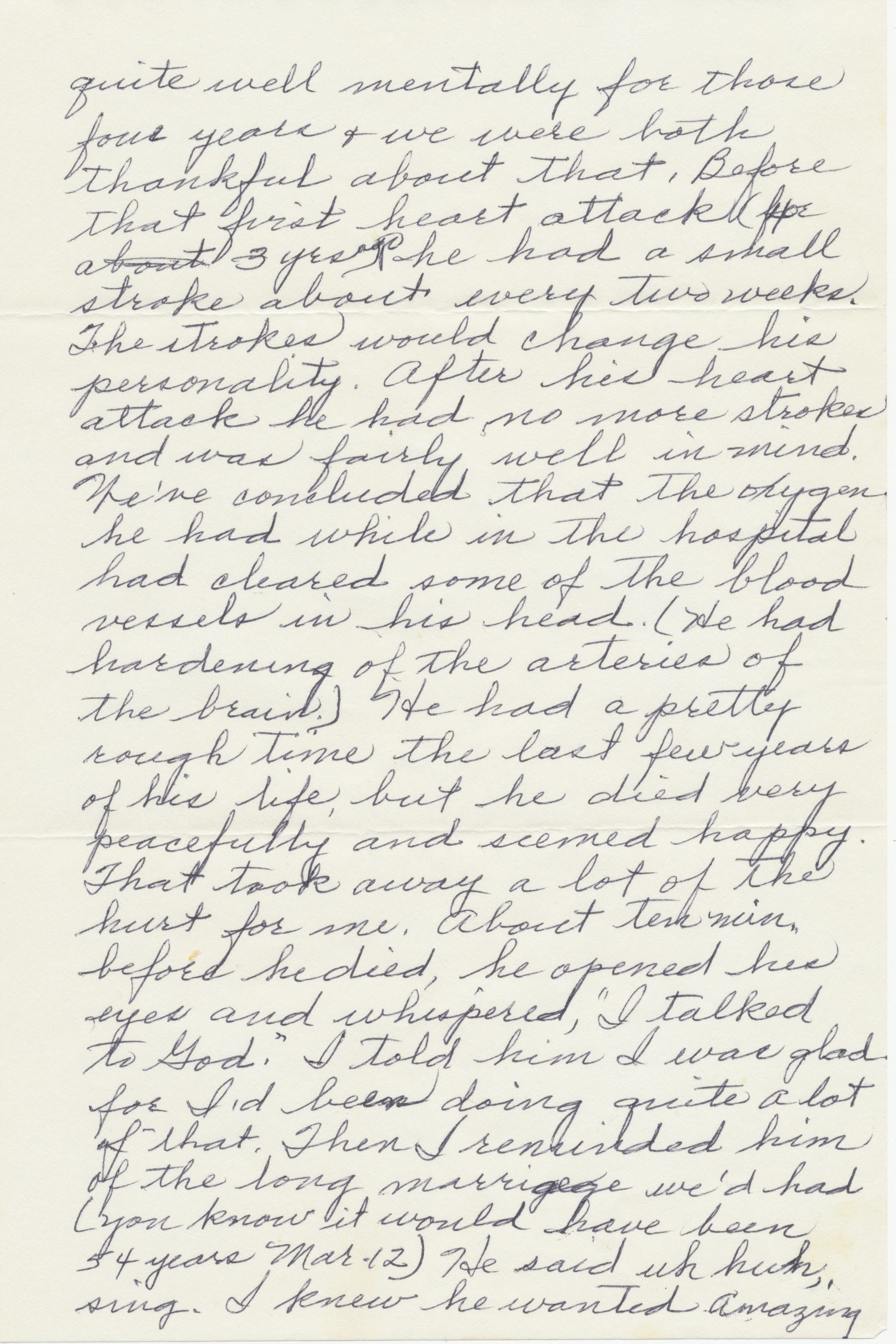
A Keepsake Letter: Much love, Myrtle

This letter has been on my mind the past few days, so I thought it would make a good post in the Keepsake series.  My cousin Mary texted me a note about the song “Amazing Grace” that was played so wonderfully at my parents’ funeral by a family friend Marcus Davis.  She also talked about how it had been Grandma and Grandpa’s favorite song.  That put me on a quest to find this letter that I had acquired a few months earlier.

It came from a stash of some of my mom’s treasured mementos.  It is a letter that my grandmother Myrtle Phenice Bucklin wrote to her childhood friend Emily Brown Stothart.  It was written a couple of months after the death of my grandfather Fred Bucklin.  They had been married for almost 54 years.  That should be enough information to set you up to read the letter I’m posting.  It mostly speaks for itself, and thankfully she had nice penmanship as well.

I think it is a wonderful letter to have.  So touching and sweet.  There is something that I want to accentuate, though.  She kind of casually makes the statement, “A person can’t help but grieve…” and continues on.  Grieving is not the same as, “I shed a few tears” or “I felt a bit sad.”  After witnessing firsthand the grief of someone losing their spouse of many decades, I’m sure it was a powerful feeling and experience for her.  And this letter was one of the ways that she dealt with some of that grief.

It is also interesting to see her talk about some childhood experiences.  I really liked how she talked about fixing their hair in the “new styles” that they had seen on their favorite blog (Oops, wrong time frame.  Must have been from magazines.)  In another letter her friend talked about riding the buggy to school and sometimes Myrtle’s brothers Henry and Orville would ride horses to accompany them.  Oh, the good old days.

A Phenice Frankenphoto

Sylvan, Myrtle, and Grace Phenice in 1907.

Sylvan, Myrtle and Grace Phenice circa 1907.

This is an unusual looking photo, isn’t it? It’s been pieced together a bit like that famous monster. That wasn’t the plan when I first decided to post this photo, but it came about from the story I wanted to tell. I also want to refer back to a couple of previous posts. I had once said that I didn’t have a photo of my grandmother when she was a youngster. I even suggested that she might have not liked the way she looked when she was younger and got rid of the photos. (I was thinking that I mentioned that in the Pool Post, but actually it came from the Graduate Post.) I also mentioned that I had discovered some old photos back in November. (That one was from a comment to the Camelot Post.)

So this is one of the photos that I discovered in a box of old negatives that I have had since the 1980s. At least the main portion of the photo is from that photo. Around 1982 Grandma (my maternal grandmother Myrtle Phenice Bucklin) asked me to take some photos of some of her old photos. So I borrowed some of her old photos and took some black and white photos of them with my old Canon SLR camera. She paid for the film, of course. I was a poor college student at the time after all. When I got the prints in, I gave her a set of prints, some of the negatives, and returned her old original photos. My set of prints and negatives went in a box. They were just old pictures. I didn’t want them in my photo albums.

Fast forward to November 2016. I went looking for some other negatives that I wanted and came across these old black and white photos that I had completely forgotten about. They made a liar out of me. I said that there were no early photos of her. And I had one all along. Fortunately the names were written on the back of the photo. The boy in the photo is Sylvan Austin Phenice who was born Nov. 23, 1901. He was the first child born to Harry Clifton Phenice and Daisy Keys Phenice. In the middle of the photo is my grandmother. She was born Myrtle Daisy Phenice on Dec. 19, 1906. The other girl in the photo is Grace Leona Phenice, who was born Dec. 14, 1903. They were all born in Louisiana. The family lived in Colorado for a short time after the birth of Grace and before the birth of Myrtle. (See Gold Mine Post)

But in finding the “lost” photo, I realized something else. I had a piece of the original photo in a group of photos that I had gotten from my mom. I didn’t know who was in the photo or what the rest of the photo was, but I knew that part of the photo was missing. The original piece that I had is what makes up the head of Sylvan in the upper left portion of the photo. So now I know that the missing part of the original photo is my grandmother as a toddler. Where, oh where, is the rest of the photo? Don’t I wish I knew! As you can see, the detail in the original is much better than the photo I took in 1982. And I thought I was being so clever!

Well, at least I found this old photo of my grandmother. And I identified part of the original photo. And remembered something else. Remember when I said that I wondered if my grandmother got rid of her old photos because she didn’t like the way she looked in them? That was so far from reality! My mom has a baby photo of herself that was from a contest she won. Something like “Gerber’s Cutest Baby” or some such thing. Well I can remember my mom saying that Grandma used to say, “Well I was a cute baby, too.” and probably showed my mom this old photo to prove it. And from what I could tell, it seemed like there was a bit of contention about who had been the cutest baby. Some people’s children!

A Keys Keepsake

I thought I’d do something a little different for the start of the year.  I’m not stopping the vintage photos with stories, but I thought I’d do something different from time to time.  I’ve been thinking of doing this for a while and now is a good time to start.  So this the the first of the Keepsake Throwback Thursdays.  The more I talk to people about family history and such, the more I find out about different treasures that have been passed down through the generations.  I am hoping to take photos of some keepsakes that other people have so they can be shared with the family.  Just like the old photos, you can share them and keep your treasure at the same time.

This week I’m going back to the 1880s in England.  It was a time before all of our modern conveniences.  It was a time before this branch of the family had left Europe.  It was a time of myths and legends, kings and castles.  Yes, you heard that right, castles.  (You also heard the myth part, too, right!?)

In 1883 my great great grandmother Martha Ann Cook Keys had a problem on her hands.  Her second son Leonard, who was 10 at the time, had come down with diphtheria.  It is a very dangerous disease and in fact a few years earlier in England, two members of the royal family had died from it.  So it was a scary situation.

She called a doctor to see to her ailing son, but the doctor just wanted to know if her husband was home.  When she inquired as to why he was asking this, the doctor said that Leonard would probably die that night.  The doctor left without offering any hope, but Martha did not give up.  She decided to take the situation into her own hands, literally.  She put a finger down Leonard’s throat to break the membrane that can form and kill a person.  It was a risk, because this could also lead to hemorrhaging.  She was fortunate that it did not and Leonard began to recover.

Cross stitch

Cross stitch by Leonard Keys from 1883 in England

His recovery took a while, so Martha sent him to stay with her Aunt Jane for a while.  She must have been a very important person because she lived in a castle.  Or so goes the family legend.  I have not been able to find any resources that proved that the family owned a castle at one time.  But I haven’t found any that proved that we didn’t either.  My mom always seemed to believe that there was a family castle, so it must be true. It was while he was recovering in the lavish luxuries (minus modern conveniences, of course) of the family castle that he did this cross-stitch sampler.

For those of you a little older than me, you may remember this item hanging in the house of Daisy Keys Phenice.  Mama said that is was hanging in her house for YEARS before it was given to her by her grandmother Daisy.  And that is why it is still in my family.  It was given to my great grandmother by her brother because he undoubtedly wanted her to have it.  For those younger than me, one day I will pass it on to someone deserving.  Or at least desiring!

From Finicy to Phenice

1935is - Three Generations of Phenice

Circa 1935 – Harry Clifton Phenice, Myrtle Phenice Cozad, Samuel Charles Phenice, Bernard Orville Phenice, May Phenice Taylor, and Emma Phenice Quillen.

This is one of the photos that I rediscovered the other day.  It shows three generations of my Phenice family in it.  I believe the young man in the middle is Orville Phenice, my grandmother’s brother.  Their father is Harry Clifton Phenice, who is shown on the left.  His father is the old man in the middle of the photo – Samuel Charles Phenice, a Civil War veteran and witness to the Lincoln assassination.   The other three women are Harry’s sisters Myrtle, May, and Emma.  The topic of this week’s post concerns the three generations prior to these three.

My grandmother and her siblings were born in southern Louisiana, but the generations before her were born in Pennsylvania. Her father H. C. moved to Louisiana in the 1898.  His father Samuel was born in Mercer County, Pennsylvania, moved around a  bit and ended up in Nebraska.  Samuel’s father Daniel was also born in Mercer County.  The father of Daniel was unknown and there have been many family members who have done research trying to find out who he was.  The further you go back, the more different the name is spelled.  Nowadays we spell the name “Phenice,” but the earliest spelling I found for the family name is “Finicy.”  Previous researchers uncovered some good information, but they were unable to identify the parentage of Daniel Phenice.  That was before DNA testing.

In 2013 I had a DNA test for myself and my parents at 23andMe.  I only found one Phenice connection on that site.  But at AncestryDNA it was a different story.  I tested my aunt Loris Woolley there last December. I started finding Phenice connections right away.  There were four 2nd cousins through the Phenice line and two 3rd cousins (to my mom’s generation).  It was helpful that they shared a good amount of common DNA with my mom, aunt Loris, uncle Austin, and their 1st cousin Julie.

In addition to all of those matches, there were several more who had ancestors with the surname “Phenicie” in their trees.  Those ancestors were all from Pennsylvania and some of them were from Mercer County.  I had seen some of the ancestors previously because they had names similar to names in our tree.  They have a Daniel Phenicie born around the same time (1808) as ours and a Samuel Phenicie who also fought in the Civil War.  I wasn’t sure how all of these other DNA matches connected, but the common DNA was pointing in the same direction.

I let the matches add up for most of 2016, but by October I had enough to inspire me to go looking for a connection.  So I made a spreadsheet of all of the names and started comparing DNA and family trees.  I looked through old research that had been done (thanks to Orville’s daughters Marilyn, Kathleen, Linda and Carol, plus some others) and found a common theme of a John Phenice born around 1765.  So I sketched out a provisional family tree.

I put John Phenicie as the father of our ancestor Daniel Phenice (b. 1809).  Since I had a few DNA matches who were descendants of Joseph Phenicie (b. 1762) and because they were born close to the same time, I put John and Joseph as brothers with an unnamed father born around 1730.  I had many more DNA matches who were descendants of Samuel Phenicie (b. 1795), so I also put him as a son of John Phenice.  Additionally, there were a few descendants of an Eliza Fennesy that were DNA matches, but the parents were unknown. From there I had to try to find some source documents to back this up.

I pored through the old census records from the late 1700s and early 1800s in areas that I knew the family had lived.  Daniel and Samuel were known to have lived in Mercer and Somerset counties in Pennsylvania, and Joseph and his descendants lived in Bedford and Franklin counties.  I had already found Daniel in the Springfield, Mercer, PA censuses of 1850 and 1860.  His name was spelled Finnesy and Finnessy in those documents.  I knew I was going to have to be flexible in the spelling of the name.  I went to the 1840 census in Springfield and looked through every page of it.  I finally came across a Daniel with the alternate spelling of “Finecy.” (Transcribed as “Ferney” by Ancestry.)  I was glad to finally find him in 1840, but was even more excited when I saw the name directly below his – John Finecy.  And he was the right age to be Daniel’s father.  Families lived close to each other more often back then, so this looked very promising.

I continued my search for these two in the Springfield of 1830.  I didn’t find Daniel or John there, but I did find Samuel.  I checked all of Mercer county for Daniel, but I couldn’t find him.  Since Daniel married Susan Jackson in Somerset County in 1831, I decided to look in Somerset County.  I didn’t find Daniel, but I did find John.  He was listed on the census as “John Finicy, Sr.” (Transcribed as “Finiag” by Ancestry.) There was a John Finicy, Jr. a few pages before, so I would think that he was another son of John Phenicie.  There were no other names close to Finecy/Phenice and the like.  I found “John Finasee” in 1820 in Somerset County and “John Finnessee” in 1810 in Allegheny County.  I think the borders were moving back then more than the people.  They weren’t changing as much as the spelling of the name, though!

In the meantime I had been corresponding with a descendant of Eliza Finnesy.  I explored her family tree, but was unable to find out how she was connected to our Phenicies.  I was directed to the 1850 census of Eliza after she had married a Wingard.  In that census, there was a woman in the household named “Margaret Finnesy” (same spelling as my Daniel – actually the same census taker).  The relationship was not identified in the census.  There was also a death certificate that showed Eliza’s maiden name as being Finnesy, so Margaret was most likely her mother.

Then I found a really good source.  It was a record of a marriage between a John Phinnecy and a Margaret Maurer on May 29, 1792.  This tied together everything that I had found and supposed up to that point. From information in the 1850 census Margaret would have been born around 1774, so that would put them at the right age to have been parents to Samuel, Daniel, and John Jr.  In addition to these children, I found some more DNA matches who had a Mary Finnessee born in 1798 in their trees.  In one of them they had the birth location as Allegheny County, which corresponded to what I had found for John Phenice in 1810.  I believe she is another child of John and Margaret.

All of this information makes me feel pretty certain that John and Margaret were indeed the parents of those individuals.  In addition to the paper sources, the DNA backs it all up.  And the members of our extended family were the only people with that last name in those counties.  I searched through those census pages till I was cross-eyed!

There is another record that I found, but I’m less sure of it.  It is for a “John Archibald Finnacy” born in 1765 in Maryland.  I don’t know why I am unsure of this as being “our” John Phenicie.  There were references in census records that showed Joseph and other family members as being born in Maryland.  The name and the date correspond as well.  There is a similar record for a Joseph Finnacy born in the same location.  The birth date is shown as 1768 which is different than all other records of Joseph Phenicie which show him as being born in 1762.  In any case, it gives the parents of these two as Stephen (b. 1730) and Ann.  That date would match my supposition and other clues.  Stephen is also a common name in both family lines.

So the data all seems to support the suppositions I made to start off.  I found the name of John Phenice’s wife – also known as my great great great great grandmother Margaret Maurer.   Since everything else lined up so well, I also added the parents of John as being Stephen Finnacy and Ann.  I’m happy with the results, though I haven’t been able to find out when the family immigrated or where they are from.  I get new matches frequently and there are also a few unconnected DNA matches who have the Finecy name in their trees.  There’s always something else to explore.


May 11, 2017 Update – I obtained a new photo from the same day as this photo was taken.  Better yet, the names of everyone was labeled on the photo!  So I edited this post with those names and here is the photo.

The Samuel Charles Phenice family in 1935.

Harry Clifton Phenice, Lola “Myrtle” Phenice Cozad, Samuel Charles Phenice, Anna “May” Phenice Taylor, and Emma Orra Phenice Quillen. A father and four of his children circa 1935.
Gunnysack Dresses

1941-Phenice Family

Front and back of photo from circa 1941. Girls in gunnysack dresses?

Ever since I was a kid I remember my mom talking about how she and her sisters would make their dresses out of old flour sacks.  I felt so sorry for her.  I thought that it must have been really uncomfortable.  And it must have been particularly depressing to go to school like that when there had to have been other kids with store-bought clothes made out of real cloth.  How could we possibly complain about anything when she suffered through such depravity?

Then one day about two or three years ago, she was talking about those dresses made out of flour sacks again.  She was saying how she liked to be the one to ride into ‘town’ and pick out the best prints for the dresses she was thinking about making.  I was like, “What are you talking about?  Flour sacks don’t have prints on them.”  She looked at me like I was crazy.

“Why are you asking about that?” she asked, “I’ve told you about that several times.”  I went on to say that I had heard her before, but I never knew burlap bags ever had any prints on them.  Maybe something like “FLOUR – 40 LBS” or some such label.  Then she knew I was crazy.  “Burlap bags?  How do you get that from flour sacks?” she asked.

I told her that that was what I’ve always pictured when she told us this story.  And it wasn’t just me.  My sisters Karen and Jamie also thought the same thing. (They may deny it now, though!)  We all got a kick out of this misunderstanding.  They both shared an article about the topic a while back on Facebook.  It explained the whole phenomenon and talked about how in the early 40s over three and a half million women and children were wearing garments made from feedsacks.

I’m thinking that the photo I’m posting today may be showing a part of that history.  It’s from the right era.  I’m not really sure, but it looks like a possibility to me.  The dresses all look somewhat simple and each one is made from comfortable looking cloth of a single type of print.  I really didn’t notice the dresses when I first decided on using this photo for my post.  When I was editing the photo, the prints of the dresses caught my attention and reminded me of the discussion with my mom.

I picked the photo out because there is that homespun charm about it.  I’m posting the photo unedited at first and including the back of it.  There’s an oil spot on the front that shows on the back also.  I’m not sure what caused that.  But on the back of the photo a child’s handwriting has labeled everyone in the photo.  Then on the top right corner in my mom’s handwriting, it reads “taken by Betty with 1st camera.”  How sweet is that.  Little Betty Lou taking a photo of her mom’s family with her first camera.  On the far left is my grandmother Myrtle AKA Grandma.

1941-Phenice family

Front: Myrtle, Marguerite, Grace, Daisy, and Harry Phenice Back:Warren, Henry, Sylvan, and Orville

I’m also posting an edited version of the photo.  That’s what I do.  Clean it up a bit.  Remove the scratches.  Remove the dust.  Remove the charm.  Wait, did I say that?  Yes, I did.  That’s why I decided to post both versions.  I think the cleaned up version looks better, but the original has more charm.  I don’t think that’s the case most of the time, but sometimes I do wonder.  Not enough to make me stop though.


1 7 8 9 10 11