Grandma Myrtle the Aviatrix

My grandmother Myrtle Sylvia Phenice Bucklin in June of 1963 in Hathaway, Louisiana.

This is Myrtle Sylvia Phenice Bucklin.  Aviatrix supreme.  Flying ace of the Phenice flock.  Not really.  I just like this whimsical looking photo of my mom’s mom.  I always thought my Grandma Bucklin had a humorous streak and this photo proves it.  Not that she didn’t have a stern streak, also.  Many of her former students have attested to that claim.  But this photo of her is a favorite of mine because of a few things.

It reminds me of the days when I was really young.  We would drive out to the country and visit my grandparents (and sometimes our cousins) in Hathaway, Louisiana.  That area is prairie land and has been since my ancestors homesteaded there in the latter part of the 19th century.  It’s very flat with not many trees around.  You could see the line of rain coming from out in the distance.  The haze of the sky in this picture reminds me of that.

Some of my earliest memories of going to their house out in the country has to do with airplanes.  My Uncle Austin has always had a fascination with airplanes.  His room had model airplanes hanging from strings.  I don’t know if he was there at the time or if he had moved away and was traveling the globe, but I definitely remember his room.  And I’m sure that’s where the plane in this photo came from.  I would assume that the goggles came from there as well.  Uncle Austin now lives in the War Vets home in Jennings and there are airplanes hanging from the ceiling of the hallway to his room.  It so reminds me of my memory of his room back then.

But the best part of this photo is the whimsical smile on Grandma’s face.  With a tilt of her head and her sassy stance, it makes for a charming photo.  I’m not really sure what she is doing with the plane.  I can just imagine her shouting “Prepare for takeoff!” followed by her hearty laugh.  She’d give that plane a good heave into the sky.  Then a prairie wind would carry it away as we’d sit by and admire it flying and looping through the air.

After a moment of being mesmerized by the spectacle, we’d ask Grandma how she did that.  But she wouldn’t be anywhere we could see.  How could that be?  We could still hear her laugh echoing through the sky!  But then we’d realize that it wasn’t an echo, it was Grandma flying around in that plane and laughing.  As she’d fly over us, she’d smile down at us and shout, “Let your imaginations soar!”  She’d disappear in the distance with her laughter drifting back down to us.

Homesteading in Southern Louisiana

I recently wrote about how my Landry family came to southern Louisiana.  That was 250 years ago and it was before the United States was formed.  My mom’s side of the family came here more recently.  Not all at the same time, but pretty close.  The main lure was the opening up of this area by railroad and an offering of land for homesteading.

I found some documents online last week that show when the homestead papers were filed for some of my ancestors.  They keep putting more and more historical information online.  Of course, I have to look in the right places to find those things that are already there.  So I was excited to find these records that I hadn’t seen before.  They pretty much support the information I had concerning when my ancestors arrived in southern Louisiana.  The first group to arrive here was the Bucklin family.

1884 register of homesteads in southern Louisiana

The names on the register start with my great, great grandfather James Bucklin.  He and two of his children – Joseph and Jennie – filed for homestead claims on April 2, 1884.  They had come from Hampden County, Massachusetts, by way of Coffins Grove, Iowa.  Even though her name is not on the register, my Irish great great grandmother Mary Ann McGrath Bucklin was involved with the whole endeavor as well.

My great grandfather Louis was only 11 years old at the time and was not able to file a claim of his own.  He did work on the claim and kept a journal for many years about the day to day farming that was done.  I remember seeing the name of Shoesmith in that journal and now I see it on this homestead register.

1887 homestead register for southern Louisiana

According to the information I found, the next to show up in the area was Martha Ann Keys.  Her claim was filed on November 11, 1887.  She was born in England and had arrived in America with her five children just four months earlier.  I know they lived in a chicken house for a while (thank you Thomas Lord MacVey!), but I’m not sure how long it was before a house was built.  A photo of the house they lived in has information on the back that says the house was built in 1888.  Another factor that comes into play was the second husband of Martha Keys.

“What’s that?” you ask, “Another husband?  Say it isn’t so!”  Yes, there was another husband that isn’t talked about much.  It was in the days before social media, after all.  She and William T. Davis were married for only a short time because she got rid of him.  It was said that she did not like the way he treated the kids.  (Maybe they had gotten in the habit of scratching the floor with their toes – you know, like chickens! – and it drove him crazy and he’d send them to the barn.)  Whatever the issue was, they didn’t stay together.

This next part doesn’t make sense to me.  In the family history book it says she lost her claim because of this marriage.  In the register you can see that the claim was “cancelled for relinquishment” on  November 13, 1889, which is just over two years after the start of the claim.  She never divorced Mr. Davis, but did not take his name.  Details have a way of being lost with the death of a few generations.  (An interesting name on this page in the register is Thomas Buller, who I think is the great grandfather of Pam Buller.)

1892 register for homestead in southern Louisiana

Our next arrival was the Hine family from Indiana.  This claim was dated February 10, 1896, though other information says they arrived in Louisiana in 1894.  The name on the register is George H. Hine, my great great grandfather.  He came was his wife Sue and their six children ranging in ages from 10 to 20.  The oldest was my great grandmother Addie.

To help out with the family or possibly to earn some money on her own, Addie would help people with chores around the house.  One of these people that she helped was Mary Ann McGrath Bucklin, whose son Lou just happened to be the right age for marrying.  (Lou’s journal entry for July 6, 1896 – I went over & got Miss Hines to help mother, she commenced work at noon.)  Addie and Lou were married in 1898.  (Notice the name in the register under George Hine.  It is Henry Kohl, an ancestor of Joseph Connors.)

H. C. Phenice signed Daisy’s autograph book on Dec. 24, 1900, which was three days before their marriage.

That leaves the Phenice side of my mom’s family.  That generation of the Phenice family did not immigrate to southern Louisiana.  They were from Pennsylvania and had homesteaded in Nebraska.  One brave son name Harry – my great grandfather – came to Louisiana seeking his fortune.  Why he came to Louisiana is a mystery.  But he arrived in 1898 at the age of 24.

He did not homestead.  At least I have never heard of him homesteading and did not find a record of it.  And according to the verse he wrote in Daisy Keys’ autograph book, he found his fortune in a little English girl.  He said she was “all to me.”  They were married in 1900 and lived in the China/Hathaway area for the rest of their lives.  Though they did spend a year in Colorado hoping to find that monetary fortune at a gold mine at Cripple Creek.

So that’s how those families came together to bring about my maternal grandparents and my mom.  They came from Massachusetts, Pennsylvania, Indiana, England, and Ireland with dreams and ready for hard work.  I, for one, am glad they did.

My mom’s family tree.

Teacher, Teacher, I Declare!

Third grade class of Mrs. Bucklin in 1945. Loris Bucklin is the girl in the middle with the bangs.

There are a lot of teachers in my family.  I just discovered one this week, but that is for another time.  Right now I want to focus once again on my maternal grandmother Myrtle Sylvia Phenice Bucklin.  It seems like most of the people knew her from her days of teaching at Hathaway School in Hathaway, Louisiana.  Either that or from her singing at church.  Or both.

I got this photo from Aunt Loris almost a year ago.  It is her third grade year of school at Hathaway when she had Grandma as her teacher.  I don’t know the names of any of the other kids in the class, but maybe some of you know them.

Teaching Certificate from 1928

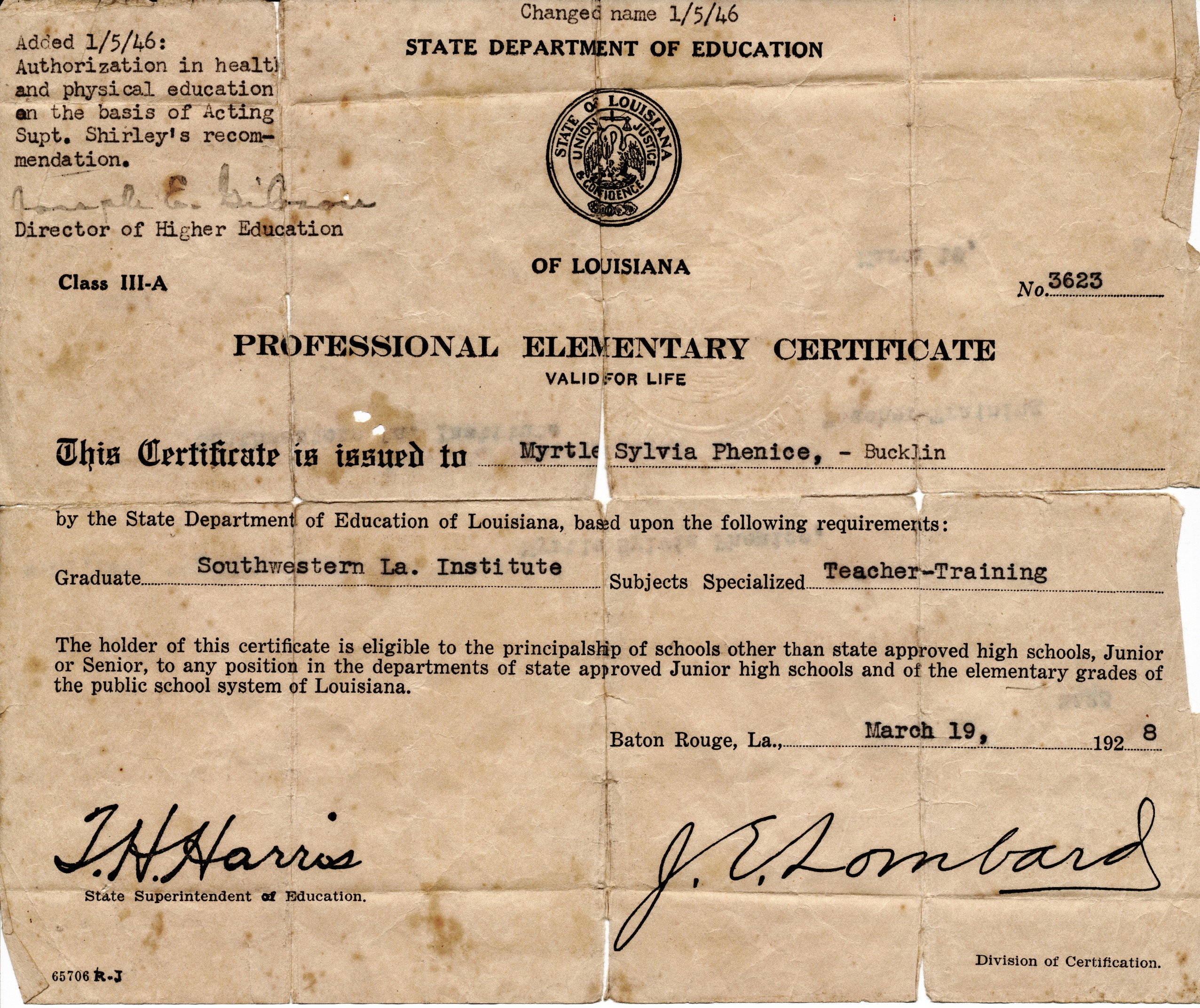
Grandma got her high school diploma in 1925, then proceeded to continue her education at Southwestern Louisiana Institute in Lafayette.  On March 19, 1928, she received her Professional Elementary Certificate from SLI that was “Valid For Life.”  She was not married at the time, so the name on the certificate was Myrtle Sylvia Phenice.  It looks like she added Bucklin later so she wouldn’t confuse her little third grade children.

She continued to further her education and received her B. A. from McNeese State College in 1957.

She then taught in Calcasieu Parish schools for two years until her marriage in 1930.  She didn’t teach during the time that she was having children and rearing them.  I’m sure she was teaching her children many wonderful things, but she wasn’t teaching in the school system.  She returned to the school system to teach at the Hathaway School in 1945.  The info from her memorial says that she returned in 1946, but it must have meant the school year ending in 1946.  You can see in the photo that it was the third grade class and the school year is 1945-1946.

She got back just in time to be aunt Loris’s teacher.  I wonder how that happened?  Did she prefer third graders?  Did Loris beg her to start teaching and be her teacher?  Why didn’t she teach older students?  Aunt Alma was in the fifth grade, mom was in the 7th, and Sylvia was probably in the 8th.  She could have taught them all if she picked a higher grade.

But third it was.  And that’s how a lot of people knew her – Mrs. Bucklin, the 3rd grade teacher at Hathaway.  She was just Grandma to me.


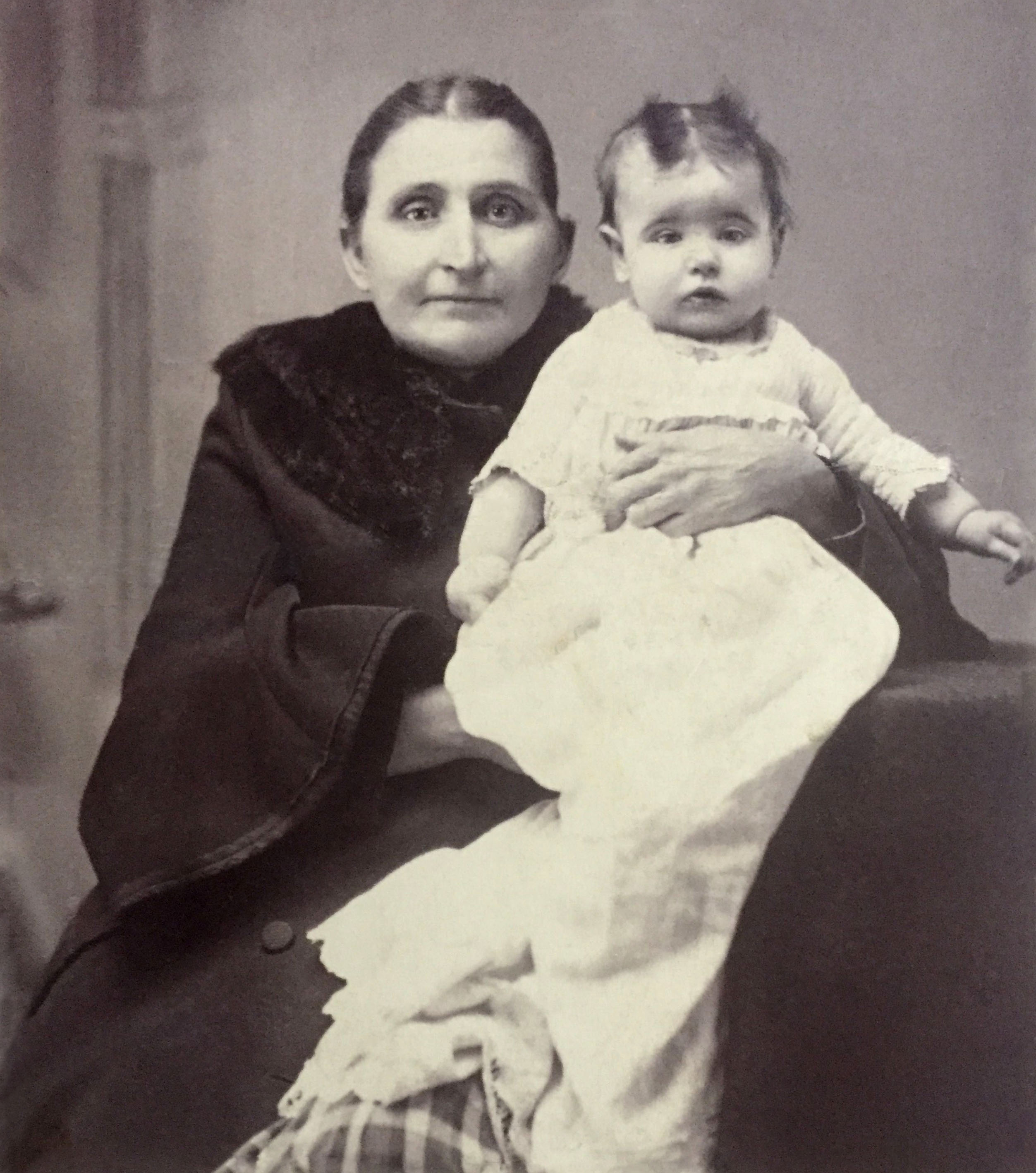
Mamma and Nook in 1890

‘Mamma + Nook’ was the inscription written on the border of this photo.  Do you recognize anyone?  Yes? No?

I was so excited when I first saw this photo.  Not only because of the cute little baby who was obviously called Nook.  (Or do I have that wrong?  The little baby could actually be ‘Mamma’ and the older one ‘Nook.’)  I was excited because I recognized my great great grandmother Cathrine Jane Foster Phenice immediately.

Even though the other photos of her that I had seen were from about 20 or 30 years later, she still had that Grandpa Munster look about her.  I shouldn’t say that.  I still feel a little guilty about turning her later years photo into a Grandpa Munster lookalike for Halloween this year. (Animating old photos has helped to change my view of her.)

Cathrine or Kate was the mother of Harry Clifton Phenice.  Harry was the father of Myrtle Sylvia Phenice Bucklin.  Myrtle was the mother of Betty Lou Bucklin Landry.  And everyone knows that Betty Lou was my dear sweet mama.  Kate was also the mother of the little girl in the photo.  Her name was Emma Orra Phenice and she was the grandmother of Mona Quillen, the person who graciously shared this photo with me.  It is part of the collection that I refer to as the Lincoln Collection.

I got this photo earlier this year and fell in love with it.  But I have to take my time in sharing the really good ones since there are a limited number of them.  Consider this a Christmas gift from me.  It’s kind of appropriate because the last time I featured Kate, there was a Christmas theme.  (She had her fire incident on Christmas Eve Eve, remember?)

1889 Homestead Testimony Page 1

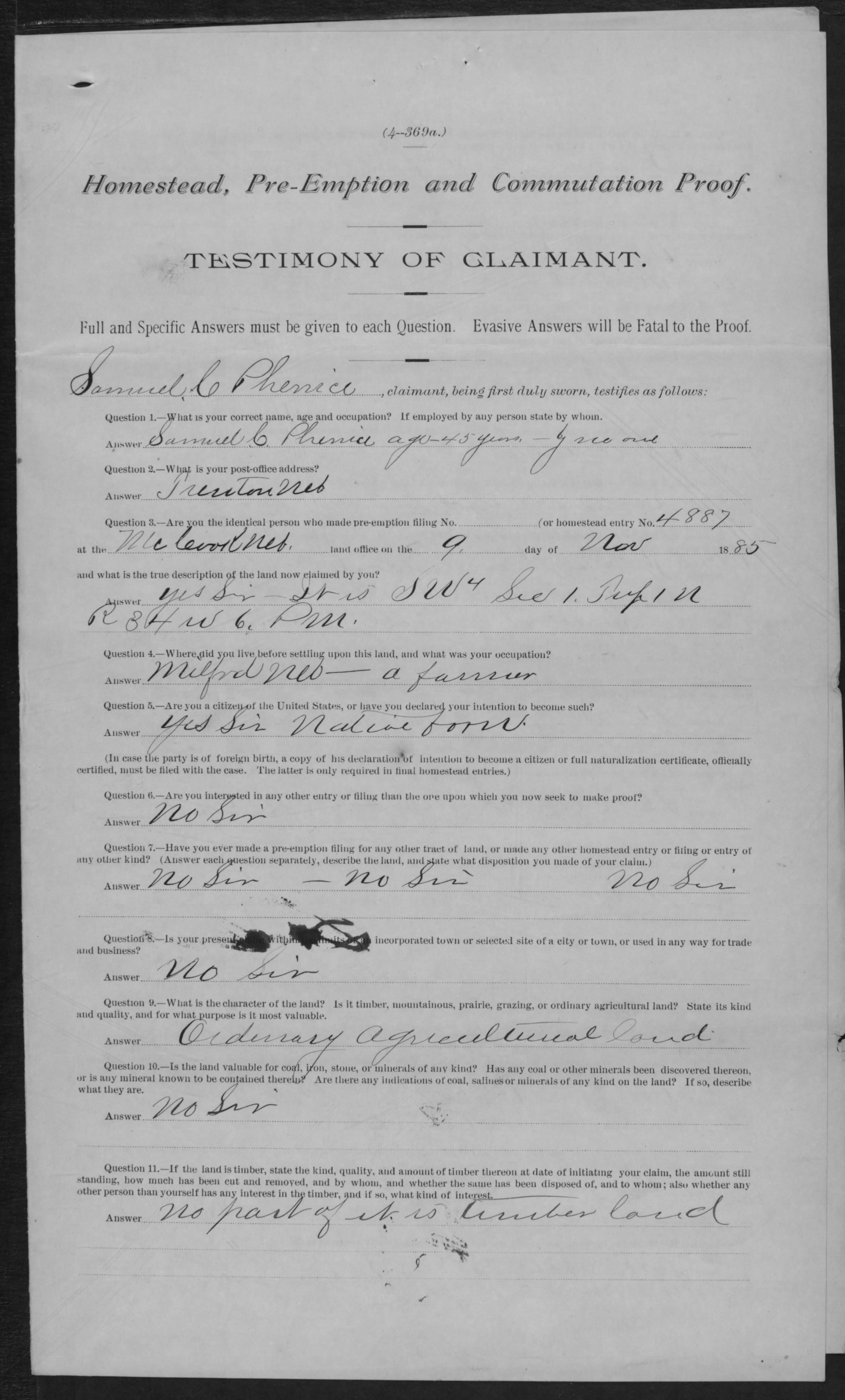
Since Emma was born in 1889, I’m dating this photo as 1890.  And I happened to run across some other information earlier this year that gives some more glimpses into what was going on with the Phenice family in 1889.  I found a document titled “Homestead, Pre-Emption and Commutation Proof.”  It was for the land homesteaded by Samuel Phenice in McCook County, Nebraska.  He had filed a homestead entry No. 4887 on Nov. 9, 1885.  He moved onto the property on April 1, 1886 and commenced to “building a house worth $12.” (see page 2 of document)

1889 Homestead Testimony Page 2

He stated that his family consists of himself, his wife, and their six children.  This was true for June 8, 1889, which is when the document was written.  Kate had given birth to seven children, but they had lost an infant daughter named Mollie in 1881. So when little Emma was born on June 20, Samuel and Kate would have seven children.  Emma was their last child.

The document states that Kate and the children moved onto the property (and into the $12 house he built) on about June 10, 1886, which was about ten weeks after he started work on the site.  According to page 3, the house was “part dug + part sod house, 22 by 24 feet with an ‘Ell’ 14 by 22 feet in size, has 4 doors and 5 windows worth $200.”

1889 Homestead Testimony Page 3

He goes on to list improvements on the land and their value.  They had a stable worth $20, a granary worth $20, a 155 ft. deep well worth $80, 65 acres of farmed land worth $130, and forest and fruit trees worth $50.  He puts a total value as $500.  He also had farm implements such as two plows, a cultivator, a mower (not a riding one, I’m sure!), a wagon, and a barrow.  All of which he had owned since before moving on to the property.

Aren’t you just loving all of these details?  I am.  It describes so much of what their life would have been like out in the prairie lands in Nebraska where his neighbor (& witness in other documents) lived 3/4 of a mile away.  The neighbor said he visited frequently.

1889 Homestead Testimony Page 4

When the neighbor visited, he probably noticed that there was a horse, five cows, a colt, three hogs, and a mess of chickens.  When he went into the house he would have seen the stove, the two tables, and the ten chairs.  He may or may not have seen the four beds and the bedding.  If he shared a meal with them he would have seen the dishes and cooking utensils.

He would definitely notice those six kids ranging from age three to twenty-one.  (Our H. C. was 15 at the time.)  It’s hard not to notice that many kids running around underfoot.  It also would have been hard not to notice that Kate was soon to be adding a seventh to the group.  Would he have commented on that?  Would that have been frowned upon?  There’s no way to know about that.  That wasn’t included in the document.

One of the other things I like about this document is that it was written by Samuel himself and signed as well.  And his answers to some of the questions are interesting as well – “No Sir” and “I think not.”  Little did they know that we would be looking back at that document and photo almost 130 years later to get a glimpse of their lives.

You may now return to the present.

A Keepsake Letter – A Message From Susan

When you first read this title, you may have thought that I was referring to my great great grandmother Susan Stanbrough Hine on my mother’s father’s side of the family.  Although I do in fact have a letter (two letters now) from her that I intend to share later on, I am writing about a different ancestor named Susan.  This one is Susan Jackson Phenice, my great great great grandmother on my mother’s mother’s side of the family.  Her son was Samuel Phenice who fought in the Civil War.  Her grandson was H. C. Phenice, who was the Phenice that brought the Phenice name to Louisiana.

And H. C didn’t just have one grandmother with the name of Susan – both of his grandmothers were named Susan.  I’m pretty sure his other grandmother’s name was Susan Penrod Foster.  ( Correction – now I am absolutely sure that his other grandmother was not another Susan.  Her name was Anne Magdaleen Milliron Foster.)  I’m not certain about that other Susan, so in the meantime we will look at Susan Jackson Phenice and the letter that she wrote to us.

Well, it wasn’t actually written to us, but we can take some of her sentiments to heart.  It was written on April 16, 1877, to her daughter-in-law Ida Fitzgerald Phenice, who was married to son Abraham Phenice.  They had a small daughter named Emma Maud (maud in the letter) who was about three years old at the time.  Susan talks about some of her children, though she doesn’t mention Samuel by name.

Let’s take a look at that letter now.  I have spent some time cleaning up the scan of the letter so it would be more legible.  But I will go ahead and transcribe it for you.

First page –

April the 16, 1877

Well Dear Ida I suppose you think/ by this I dont intend to write to/ [indecipherable words] I should/ and would have writen before but/ when I heard from when ever you/ wrote to Abram (her son Abraham) in particular after/ I was informed of your condition/ I sympathize with you very much/ for I have experienced such times/ but be of good cheer and in good heart/ keep up your courage and dont/ dispare for he that puts on the/ burden – can take it of again all/ that we must do is to look to Jesus/ and he will help in times of need/ how soon do you expect to be/ back to work  you could be here/ before that time  we would all/  (continued on page 2)

Page 2 –

feel better satisfied to be/ together there  none of us can count/ on many years at the longest/ and why not be with each/ other while we are here  it is the Joy of my heart when the children / comes home  you wanted to know/ if Abe was as good a son as he was a husband/ he is  I am/ very proud of him and/ all the rest but better boys than/him and harper is cant be/ found every day.  I expect we will/ move to petrolia this week or the/ first of next  if you come out here you/ will be handy the catholic church/ Just quit(e) a short distance from where/ our house is and the methodist/ church is handy too  I think Willams (another son)/ family will be here soon.  Just as/ soon as we leave the house Daughter/ Kate will be quite handy and [blob]  (continued on page 3)

Page 3 –

That Dear little boy of/ yours (Abe) went to petrolia (in Butler County, Pennsylvania) to work/ this morning as lively as a cricket/  he is in good heart   work is/ plenty  they can get all they do/ can do  all they have to do is to work/ and they will money no doubt/

well Ida I have nothing of/ importance to write to you/ as Abe writes so often he tells you/ all the news  the family is/ all well  I dont feel very rugged to day  my head aches/ considerable but it will soon/ be better  I am going to make/ myself some coffee and that/ will straiten me out   I suppose/ I trouble myself to much about/ moving  the boys scolds me/ for it  that Abe and Harper they think I have no need to worrie  (continued on page 4)

Page 4 –

Ida Dear remember me in/ your prayers that I may obtain/ a home in heaven  Oh that/ we all will meet at the right of god/ and walk hand in hand in/ the new Jerusalem where there/ is no sickness nor sorrow  all is/ peace and happiness  let us try to/ meet the Dear ones gone before us/

I will stop by bidding/ you good by for a while/ kiss maud for me  this is her/

from your mother

Susan Phenice

the family all sends their love/ to you and maud

(end of letter)

Isn’t that a sweet keepsake to have?  I remember Mama having a copy of it in her collection of family information.  I don’t know how she got it.  Maybe her cousins provided her with the copy.  I’m grateful to whoever did.

My favorite part of the letter is from page 2 when she says “it is the Joy of my heart when the children comes home.”  I’ve even used it as cousin bait.  That is a term I’ve read in genealogy circles (trust me, they’re out there) that doesn’t sound very sweet.  It just means a little enticing tidbit that you share with a cousin to tempt them into responding to you.  I did that with cousin Mona and it worked!  I edited it to fit my message by altering her quote to “It is the Joy of my heart when the children come together.”  I think it has the same meaning and I’m sure Grandma Susan would approve of my intent.

And if I was actually having a conversation with ol’ Susan, I’d also like to ask her about “the Dear ones gone before us.”  Because I don’t know the names of her parents or grandparents.  I do know that she was born in Somerset County, Pennsylvania, in 1806, and then she died in Petrolia two years after she wrote this letter.  And it’s obvious from her writing that she has strong beliefs and that she really cherished her family.  Good things to know.

My mom’s family tree. Her mom was the Phenice, so you can follow her line (the yellow trail) up to Susan Jackson (Phenice).

A Witness at Ford’s Theatre

I wasn’t sure what I was going to write about today, but then I saw a photo of my cousin Julie Phenice Campbell at Ford’s Theatre in Washington, DC.  I made a few comments and then realized that I hadn’t gone into the details of my great great grandfather’s Civil War experience.  So I’ve decided that the time is now.  Plus I have a really cool photo of him that I obtained this year.

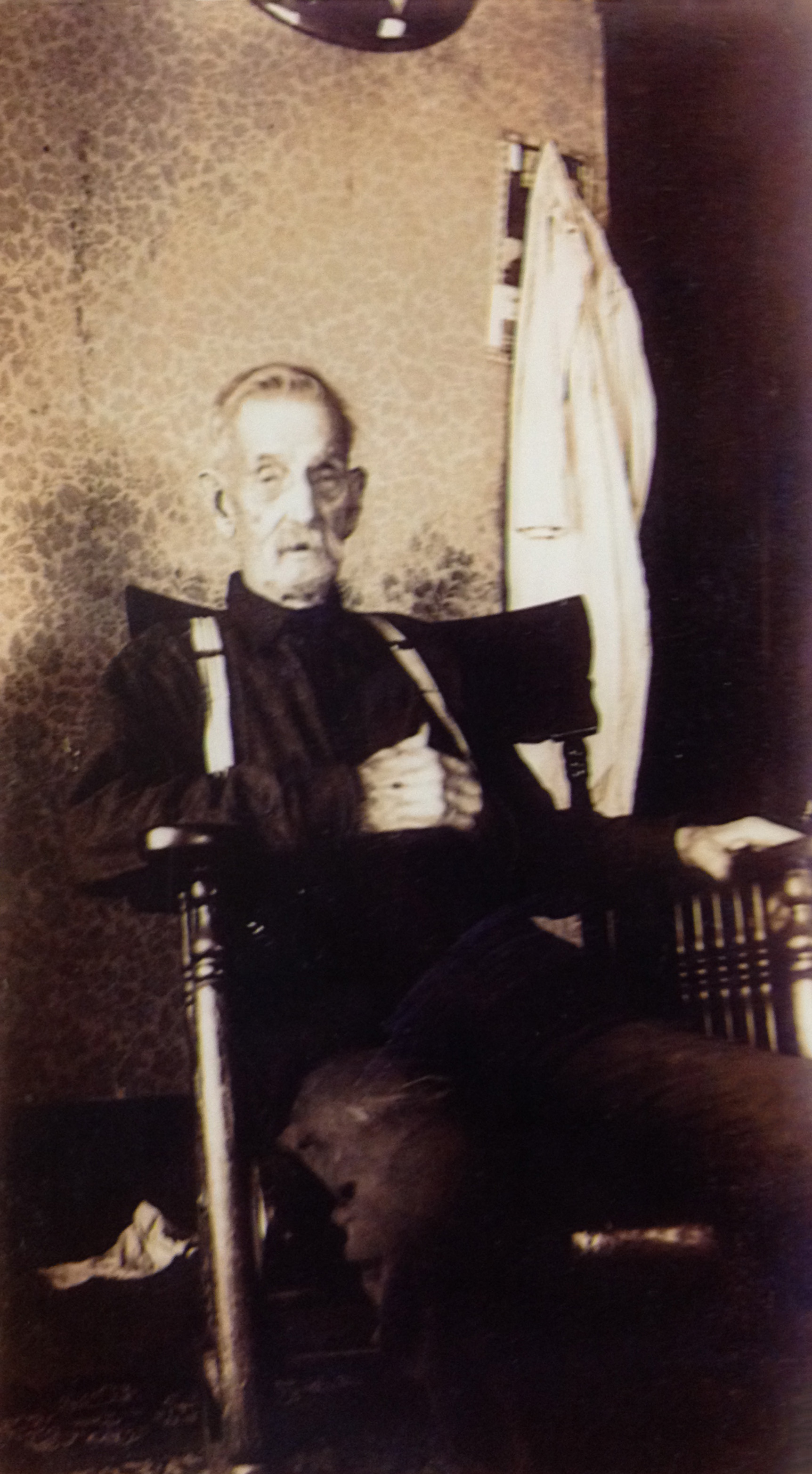
Samuel Charles Phenice in his elder years.

Isn’t this a cool photo of an old grizzled man?  This is Samuel Charles Phenice later in his life. (He was the father of Harry Clifton Phenice, who was the father of Myrtle Phenice Bucklin, who was the mother of Betty Lou Bucklin Landry, who was my mother.)  He lived to the ripe old age of 95.  Any time I hear the question, “If you could visit one of your ancestors to have a conversation with them, who would it be?” I always think of the man in this photo.  So many questions that I would like to have answers to.  So much wishful thinking.  Let me tell you what I do know.

Samuel Charles Phenice was born in Mercer County, Pennsylvania, on April 19, 1844.  He was the fourth of seven children to Daniel Phenice and Susan Jackson Phenice.  The family must have stayed in that area during his childhood, because when he enrolled to fight in the Civil War, he would become part of the 57th regiment of the Pennsylvania Infantry out of Mercer County.  He was a private in Company F.

According to a document I found, the 57th regiment went on furlough on Jan. 8, 1864, for a period of 49 days.  When the soldiers returned to camp, there were a large number of new recruits.  Among those recruits was Samuel Charles Phenice, who had enlisted on Feb. 12, 1864.  During March they became part of the 2nd Brigade, which was composed of units from Pennsylvania, New York, and Maine.  In April Samuel celebrated his 20th birthday, though he was quoted as saying that he suffered “many hardships, hunger and thirst.”  Maybe a not-so-happy birthday.

On May the 3rd of that year, Samuel and his fellow soldiers marched to Chancellorsville, Virginia.  This is close to Spotsylvania and there were many skirmishes going on in the area.  The 57th, along with other Union troops, advanced along country roads and woods.  In one particularly wooded area on the morning of May 5th, Confederate forces were encountered and frenzied fighting took place.  The fighting was at short range (when you could see your enemies behind the trees) and was vicious, yet brief.  There were twenty-two killed, one hundred twenty-eight injured, and three missing.

Among those injured at the “Battle of the Wilderness” was 20-year-old Samuel Phenice.  He was shot in the left thigh – more specifically the “inner aspect of the thigh and about the middle of the thigh.”  Part of the information about the wound was gotten from a medical report from 1915 that reports that complications of varicosity of his leg was a direct result from the wounds received during the War.

Civil War hospital in the Spotsylvania, Virginia, area after the Battle of the Wilderness in 1864. (I found this photo online.)

After he was wounded, Samuel spent a while recuperating.  He went to a place that was probably very similar to what you see in this photo.  It is a photo of a makeshift infirmary in the Spotsylvania area after the Battle of the Wilderness.  I don’t recognize Samuel in the photo, but there is no way to make out some of these people.  On May 24, 1864, he was a patient at Carver General Hospital in Washington, DC.  A week later he was transferred to Haddington in West Philadelphia.

Once he recovered well enough, he became part of the “Invalid Corps” (9th Regiment of the Veterans Reserve Corps) on October 8, 1864.  The only posting that I know of was the one on April 14, 1865, at Ford’s Theatre in Washington, DC.  And everybody recognizes that place and date.  Samuel was stationed at the front of the theater checking passes of military personnel.  According to one account Samuel was an eyewitness to John Wilkes Booth’s entering the presidential box and shooting President Abraham Lincoln.  He also was a witness to the flight of the assassin.  So my great great grandfather was present at one of the defining moments in American history.

Samuel was honorably discharged from the military on July 5, 1865.  Though he would get married and raise a family, he would never forget those vivid events that he experienced as a 20-year-old young man.  He obviously liked to recall the events, because there are several articles about him speaking about it.  One says “Phenice often recalled the wild scenes in the theater after the shooting.”

Oh, to be able to hear those stories in his voice.  Like I said at the start of this story, I would love to be able to pull up to Great Great Grandpa Samuel’s rocking chair and say, “Grandpa, tell me ’bout the good ol’ days.”  My excitement would build as he’d rock back with a grin on his face and say, “Well, now, young man, that may take me a while…”

Music in the Family Part V – Jacko and Papi

Every week that I post something about music, my sock monkeys Jacko and Papi have been begging to include them in a post.  “After all,” Papi said, “I am the one that taught you how to sing.”  I always thought it was my mom and dad.  They did do a lot of singing when I was growing up.  But I also remember spending time with Papi when I was a kid.

Here is a photo of me with Papi when I was three years old.  It sure does look like he may have been singing in my ear!  He assured me that he was singing the “Yo! Ho!” song to me.  “What?” I asked, “That song wasn’t written until our Reunions Adventure.  This picture was taken way before that.”

“I know,” Papi said, “I started the song years ago when I taught Buddiloo to sing.”  So now he’s trying to take credit for teaching my mom to sing!  I know he was around back then, but I never really know when to trust what he is saying.

“Yes,” he explained, “It was around the time I was coaching Murder to sing for those old recordings you shared with everyone a few weeks ago.  I told you that!  You never listen to me.  Some sock monkey whisperer you are!  Hmmph!”

“You weren’t even there back then,” I started, but then I realized that he had been there.  I have a picture of him with Mama back in 1938.  Jacko shared it with y’all in the Sock Monkeys in the Past post.  And the recordings of Grandma (Myrtle Phenice Bucklin, not Murder as Papi incorrectly calls her) were done around 1944 “when those German Nasties were around,” as Papi likes to put it.  I’m sure he’s going to take credit for teaching her to play the baritone now.  “No,” he said, “She learned that at school.  I just sang along with her when we called the cows.”  That’s good to know.

So today I’m going to share with you “Papi and Jacko’s Traveling Song.”  According to Papi he started it in the 1940s, then he and Jacko added some more verses in 2007, and finally Jacko and I added the last part in that same year.  I’m sure some of you will recognize the melody from “The Lonely Goatherd” song from “The Sound of Music.”  It’s a rather catchy little song.  I hope you enjoy it.

Yo! Ho! Going on Adventures –
Jacko and Papi’s Traveling Song


Long, long ago lived a monkey sock

And a little girl that everyone called Betty Lou.

She played him a song on her baritone

Til the cows all came a-runnin’ with a moo.

They went to church with her Ma and Pa

And sang and gave their Glory Be’s to You Know Who.

She took along little Cyrus sock

Cuz he promised that he wouldn’t throw his poo!

After the service he told them tales

Of many of the places that he’d traveled to.

He made sure that they knew his skills

So they wouldn’t want to put him in a zoo.

Yo, ho! Going on adventures.

Yo, ho! Always on the move.

Yo, ho! Going on adventures.

That’s what I like to do.

Much later on in a different state,

He befriended a sock monkey who was very new.

His little friend took the name Jacko

And Cyrus then became his Papiloo.


Most of the time they stayed at home

With a family of several kids who grew and grew.

They looked forward to summertime

Cuz the fam’ly always went to somewhere new.

Yo, ho! Going on adventures.

Yo, ho! Always on the move.

Yo, ho! Going on adventures.

That’s what we like to do!

All of the kids grew up and left

and the house that they had lived in was too big for two.

The ma and pa got a smaller place

And they decided just one sock would do.


Poor little Jacko was sent away

and Jacko and his Papi had a big boo hoo!

They gave him a tag with an asking price.

At least they didn’t put him in a zoo.

He sat on a shelf with some other socks

as people walked right by with not much else to do.

Kids always grabbed them and pulled their tails

and some of them were taken home in twos.


A man by the name of Van came in,

And he journeyed from the same state as Papi Lou.

With help from above Van and Jacko met

And they became a trav’ling team of two.

Yo, Ho! Going on Adventures.

Yo, Ho! Always on the move.

Yo, Ho! Going on Adventures.

That’s what we like to do!


Not long ago Papi surfed the web

and came upon a story too good to be true.

Though he was old he still liked to see

the adventures of sock monkeys on the move.


There on the screen was his friend Jacko

and he traveled with a man that Papi thought he knew.

When he heard that his name was Van,

he knew it was the son of Buddiloo!


He sent off a note to his friend Jacko

to see about returning to the place he knew.

Jacko and Van came to pick him up

and their reunion was a big todo.


They met up with friends on their way back home,

and Papi hugged and kissed the girls of Rue Cou Cou.

Though Jacko and Van begged to take him home,

Papi went to live with Betty Lou.


Yo, Ho! Going on Adventures.

Yo, Ho! Always on the move.

Yo, Ho! Going on Adventures.

That’s what we like to do!

Music in the Family Part III – Listen to Myrtle Sing

The more I look into my family history for references to music, the more I realize how much it plays a part of the family.  I had thought at first that the series would be a month long, but now I’m thinking it will probably be close to two months long.  And since last week we looked at my dad’s side of the family, this week will be looking at my mom’s side.  In particular, the focus will be on my mom’s mom Myrtle Phenice Bucklin.  My Grandma.

Myrtle Phenice Bucklin

Myrtle Phenice Bucklin circa 1949

When I was a kid I never really cared for Grandma’s singing.  She sang kinda loud with a vibrato that seemed operatic to me.  I’ve never been a fan of the opera.  Different strokes for different folks.  But music was always very important to her.  She was singing til the day she died.  I mean that literally.  When she was 79 years old she was still singing at nursing homes for the “old folks.”  On May 6, 1986, she was singing and playing the piano for her peeps when she had a stroke and fell off the piano bench.  She ended up dying the following morning at 6:01 am.

Not only was she singing at the end of her own life, she sang at the end of her husband’s life too.  (You know this already if you’ve read all of my other posts.)  She sang his favorite song to him – “Amazing Grace” – and as she wrote in a letter to her childhood friend, “I’d finished singing, he looked up at me, smiled and died.”  Music was definitely an important part of her life.  But music wasn’t just a part of the end of her life, it was part of her early life, too.

Her father was Harry Clifton Phenice and her mother was Daisy Keys Phenice.  Both of them were musical people.  HC played the fiddle and he like to play by ear.  According to writings of Grandma’s sister Marguerite, he played a “homey” style that everyone liked.  He would play at community dances along with other extended family members.  He entered a fiddle contest in Jennings once and lost because he played a slow tune.  Daisy was beside herself because he didn’t play a showstopper like his usual upbeat songs like “Turkey in the Straw” or “Irish Washerwoman.” (or even “Soldier’s Joy”)  This allowed Daisy’s brother Leonard to win the contest when clearly HC was the better fiddler. (No bias there.)

The family also would have other families come over for a ‘sing-a-long.’  Daisy would bake peanuts or popcorn, and sometimes she would go all out and make popcorn balls with caramel and nuts.  (A treat that my mom would make for us from time to time.)  HC would play the fiddle, Myrtle (Grandma) or Daisy would play the piano, her brother Henry would play the violin, and Warren and the others would all sing along.  So Grandma grew up around music and was used to playing and singing in front of people.

That is a good thing, because otherwise she wouldn’t have been a willing participant when her older brother Sylvan suggested that he would record her singing some of her favorite songs in 1944.  Sylvan was into radio and sound systems from a young age.  This led to the Bucklin family being one of the early adopters for radio in the early days.  It also led to Sylvan making recordings of his family conversations and singing.  I am particularly thankful to him for that.

When I ‘rediscovered’ these recordings last year, I wasn’t sure who it was singing on them.  I thought it sounded like Grandma, but they were in a style that I liked.  I checked with mom and she assured me that they were Grandma.  The recordings were from around 1944.  It was after that time that she started taking singing lessons and adopted the more operatic style that I heard when growing up.  She even sings the old Irish song “Mother McCree” with a brogue and rolls her Rs.  I love it. (The titles of the songs are linked to the recordings.)

The recordings are in really good shape.  I did edit them to make it easier to listen to them.  When she sang “Smiles” she went straight into “Perfect Day” and I wasn’t sure it was a new song. I separated them into two separate files. Then on “There’s an Old Spinning Wheel in the Parlor” the song was cut off before the ending.  Fortunately for us, she had perfect pitch which made the editing easy.  Otherwise the beginning of the song would be out of tune with the end.

So enjoy listening to Grandma sing these old songs from bygone days.  I always find that listening to them in my car has the best effect.  If you have a smart phone that is linked to your sound system, that is.  And do it when you’re not driving!  I’m sure that thought never crossed her mind when those songs were recorded.  Mercy me!

After Grandma and Grandpa moved to Jennings in the 1970s, Grandma sang many solos at the Trinity United Methodist Church.

Surplus Sunday: The Bucklin/Keys/Ausman/MacVey connections

Surplus Sunday?  What is that?  It’s an additional sharing of information on family history, that’s what it is!  I know I already posted two times this week, but I had so much information that came my way recently.  Fair warning – this post is extremely long and covers 125 years of history with the Keys and Bucklin families and how they were connected with two other families of no relation – the Ausmans and the MacVeys.  All because of a secret old letter that was recently uncovered.  It also connects several other previous posts that I have written.  Hopefully this will answer all of the questions that you may have had on the subject.  So first off you will need to read the letter that Louis Charles Bucklin received on that long ago day in April of 1893.  The envelope was addressed to L. C. Bucklin and the letter commenced with a quaint “Dear Friend.”  Here is the letter in its entirety:

Leeds, Iowa                    April 20th (18)93

Mr. L. C. Bucklin

Dear Friend,

Will now try to answer your welcome letter, which I received some time ago.

I hope you are not having as dissagreeable weather as we are having at present. – It snowed quite hard for over an hour yesterday forenoon, it commenced by raining in the morning, and then turned into snow in the forenoon, and then rained again in the after noon.

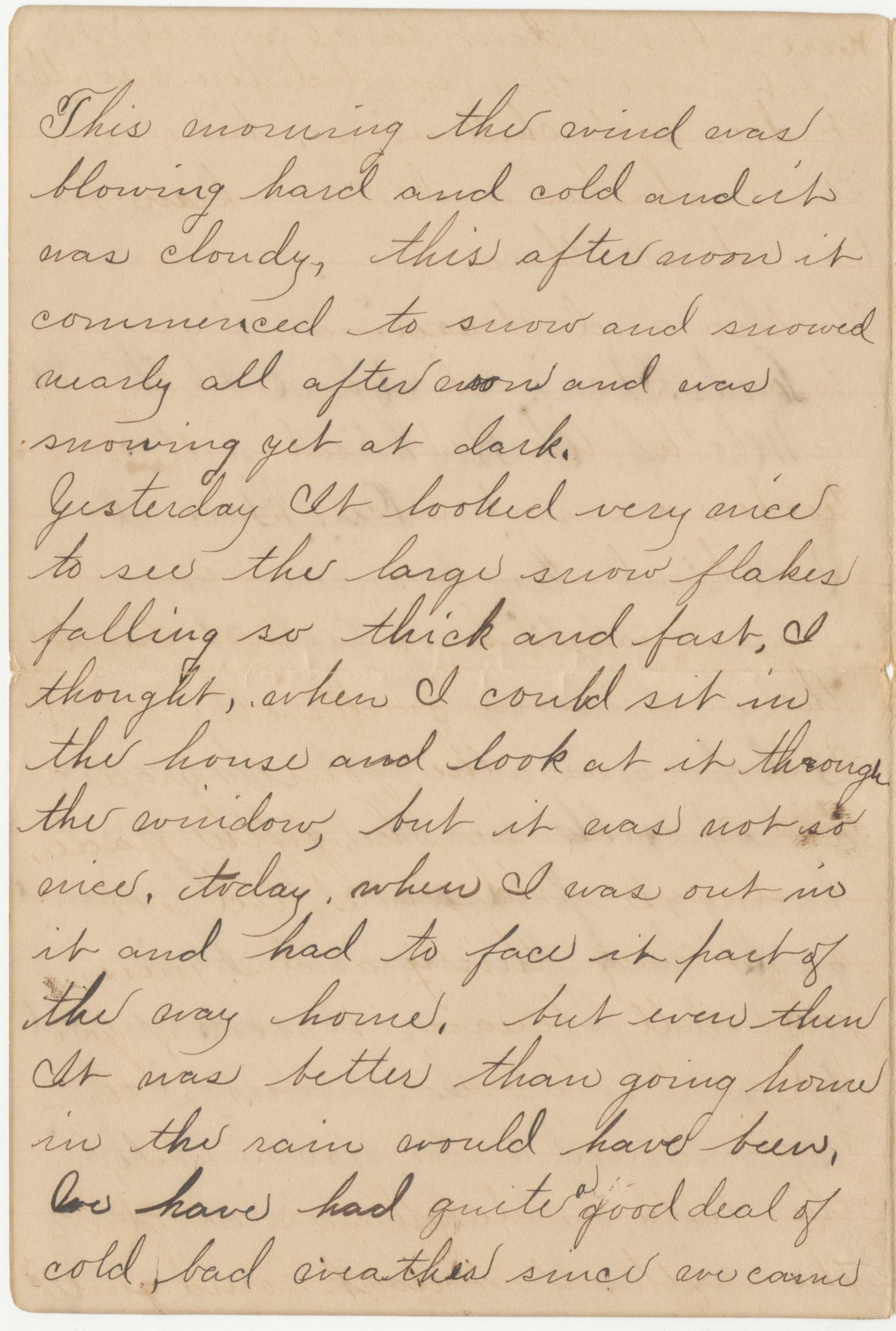
This morning the wind was blowing hard and cold and it was cloudy, this after noon it commenced to snow and snowed nearly all after noon and was snowing yet at dark.

Yesterday It looked very nice to see the large snow flakes falling so thick and fast, I thought, when I could sit in the house and look at it through the window, but it was not so nice, today, when I was out in it and had to face it part of the way home, but even then It was better than going home in the rain would have been.  We have had quite a good deal of cold, bad weather since we came

Here, but I don’t think we feel it a bit more than we did down south, it does not chill us so, but of course it is sharper and more kean hear than down there.

Willie and I commenced going to school a week ago monday.  we both like it real well, our teachers are real nice.  Mine is very kind to me. – We have a very large brick school building there are seven grades in the school.  Willie is in the fourth grade, and I am in the fifth grade.  I always told you I did not know any thing and I guess you will beleave it now if you did not before. – but I think I can learn more for a while, in the fifth grade than I could in the sixth, if it don’t sound quite so

“big.” –I have to study very hard, and quite a good deal at night, and as I am not used to it, I get very tired.  In my room we have, mental and complete Arithmetic, vocal music, spelling and reading in the after forenoon, and Geography, Language and drawing in the after noon, school is let out at a quarter to twelve and takes up again at half past one, and we have no recess.  I took my dinner today as it was so cold, and I studied all the noon hour after I ate my dinner and I have had the headache ever since. – I can keep up in all my classes execept music and Language, and they have been nearly a year at them and as I never studied eather of those before I am behind them in that.

My brother Phil lives ten or twelve miles north of here on a farm, and Sioux City is south of here.

Lambert is living in Merrill but perhaps I told you that before.  Mother is visiting at Phils, and Lamberts this week.  Pa and her went out to Phils Saturday night and Pa came home Sunday night. – It seems very lonely without mother here.

The Church and School house are quite close together, both are quite a distance, from here.  It seems so nice to go to Sunday school in a church once snow, of corse the church is not so nice as the ones you go to but it is away ahead of a “school house”.

Ida and Willie both had the fever about two weeks ago and again this week.  Willie has it this afternoon Ida had it Sunday afternoon and as Ma is away I have to help Ida all I can, and I do not have much time to write.  I had to learn a lesson tough before I commenced this so it was after nine when I commenced to write, it is ten now so I must close for tonight will finish this the first opertunity I have.                  Good night..

Sunday Afternoon

Thursday night when I commenced this letter I thought I would finish it the next night, but there was a temperance lecture in the M. E. Church Friday and

saturday nights and we all attended them so I could not finish this as I would liked to have done.

They organized a good Templers loge last night.  John, Anna, Mother, Ida, and myself joined.  We will meet next Tuesday night.  We have a prayer meeting every Wednesday night and they have a young peoples Epworth League every Sunday night before preaching, there is a small room seprate from the main part of the church that they use for that, and prayer meeting.

How I would like to go to some of those nice churches you attend they must be grand.  I am afraid I would not know how to act in so large a congragation as you told about.

there was one hundred and one (101) members in our Sunday school today.  I like living hear real well going to school, and so many other things to go to that I have not been very lonesome yet.  We are getting aquainted with quite a good many too.

Now Lou, please don’t be angry at me for not answering sooner, for I could not help it.  Mother says she don’t want me to write so often as I have been doing. – I some times, don’t know what to do, she does not know how we feel towards each other, and she is so afraid of looseing me. – She does not need to worry about that, for I consider it my duty to take care of her as long as she needs me.  she has raised a large family, and, I, am her youngest girl.

3) and I think it is my duty to stay with her now since she is not strong any more.

It will be better for you to learn to care for some one else, if you can, Lou, for I am afraid we can never be anything more than Friends.

Oh if we only knew just things would be, but perhaps it is better that we should not know, for one might feel worse than we do as it is.

Remember Lou, that you can always find a friend in Jesus he is always redy and willing to help us, in time of trouble and sorrow, if we will only ask him, for I know by experience.

We received a letter from Aggie last week telling about the awful storm they had.  How glad I am that none of them were hurt.  I am so sorry

it ruined so many of your sisters things, but that is not so bad as if some of them were hurt.  Oh how much we have to be thankful for.

You spoke of your Uncle and cousins thinking of going to La.  Perhaps they will wait till you will be home for vacation.  how nice for you, it would be if they would.

When does you have vacation and how long.

I wish I could see you marching with your uniforms and guns.  I never saw any Soldiers eather.  I will have to close now.  I hope this will find you well,

I remain your true friend

May Ausman

I first saw this letter on May 14, 2017.  It was texted to me from my mom’s first cousin Julie Phenice Campbell.  She said that she found it in a pouch from her father that contained some old letters that had been sent to her (and my mom’s) grandmother Daisy Keys in the 1880s.  In addition to those letters, there were two other letters that were sent to my mom’s grandfather Louis Charles Bucklin in 1893.  Since Julie is not related to the Bucklins, it is a mystery how those letters ended up with her father.

I was kinda glancing through this letter when I first read it because I thought it was written by an old roommate.  She starts it with “Dear Friend” after all.  I was so surprised to see the signature of this letter that I had started to realize was a “Dear John” letter.  May Ausman (who was about 17 years old when she wrote the letter) mentions some of her siblings in this letter – Phil, John, Lambert, Ida, Willie, and Aggie.  Aggie Ausman was married to Lou’s older brother Joe Bucklin.  They had gotten married in 1892 and were living in Jennings, Louisiana.  But for Louis, this letter was the beginning of a rough few months. This sad news was received in April 1893.  Next, Lou received a letter from Joe in May of 1893 that talks about their sister Jennie doing poorly.  Then Jennie ended up dying in June of that year.

He was keeping a journal at this time.  The entries started in January of 1893 when he was traveling from his home in China, Louisiana, to attend Ohio Normal University in Ada, Ohio.  The entries for 1893 stopped when his sister died in June.  When I found this letter and realized it was during the time of the journal, I checked the journal for the time he would have received this letter.  He was talking about things in early April, then the next entry was in June.  So where were the entries for May?  I looked closely and noticed that there were pages missing.  Each page had a number on it and the April entry was on page 30 and the next page in the journal was 33.

I was looking for reference to the letter in his journal to see if he had been upset by the news.  Maybe little May didn’t mean much to him, or maybe she meant a lot.  The other letter that I received from my mom’s cousin Julie was a letter to L. C. Bucklin in Mar. 1893 from his previous roommate.  It is a very short letter, but it does mention that Lou might be sending letters “out to Iowa to that May you know.”  So someone else knew that he was interested in the girl named May.  But more telling are the missing pages from his journal.  If she didn’t mean anything, he wouldn’t have said anything about it.  It looks like he must have written something about it.  Then either he didn’t want anyone ever to see what he wrote, or someone else didn’t want it to be known and the pages were made to disappear.  Is that why Addie always had a scowl on her face?  I should hope not!

The reason the letter surprised me was because of the added connection to the Ausman family.  I mentioned earlier that Louis Bucklin had it rough for a few months, but his brother Joe had it rough for a few years.  (I wrote about this in The Sad Story post on Aug. 17, 2016.) He and his wife Aggie Ausman had a daughter named Leola in 1893 and then it shows that they had another daughter named Gladys in June of 1896.  They had a son in July of 1899.  Those were all of the good things.  Then the bad things started the next month.  In August 1899 Aggie died.  I’m not sure what she died from, but it could be complications from childbirth.  Following that, Leola died in December 1899.

Since Joe was having such a hard time, his mother Mary Ann McGrath Bucklin went and stayed in Jennings to help him care for the children.  At least to care for Joe and his son Austin.  For some reason, at least according to the 1900 census, Gladys was living in Iowa with her Ausman grandparents and Aggie’s younger sister Ida, who is listed as Ida McVey.  Anyway, his mother ended up dying in April 1900.  It was a really tough year for Joe.

But by the end of the year things were changing for Joe.  He married Aggie’s younger sister Ida in November of 1900.  I guess things were good for him for a while.  He and his brother Ed ran a boot and mercantile store in Jennings and he was married with a young daughter and son in the household.  I’m assuming that Gladys was staying with him due to information you will hear later.  Joe and Ida had a daughter named Ida Bucklin sometime around July of 1903.   Then on Sept. 5, 1903 Joe’s wife Ida died.  I’m not sure of the cause of death for this sister, either.  In addition to that, further tragedy occurred in December with the death of his daughter Ida.  A very sad story indeed.

When I got the letter that was sent from May to Lou in 1893, I already knew about all of the tragedies of their sisters and nieces.  But it made me start to look at the connection between these families again.  One of the questions that stood out was the name Ida “McVey” in the 1900 census.  How did she get that last name?  I didn’t see any marriage or divorce for her.  She was living at home in 1893 when May wrote that letter and was living at home in 1900 when her name was McVey.  So I decided to look into it.

I did a search on Ida Ausman at Ancestry.com, but this time I added a husband with the name of McVey – no first name.  I just wanted to see what would show up.  And sure enough something did!  I found a family tree that listed a William Lee MacVey who had married Ida Ausman in Iowa in September of 1895.  All of that information fit with what I knew about Ida and her family.  But that’s not all of the information that it showed.  It had a divorce date from a month later and a reason for the divorce.  That’s amazing.  I hardly ever see a reason for a divorce in people’s family tree.  I was excited about that because I was really curious to know why a marriage ended in divorce in less than a month!

The information in the family tree gave the reason for divorce as, “Marriage did not last long because she was pregnant but NOT William Lee’s child.”  Oh, my goodness!  Say it isn’t so.  I was curious about how someone would know this, so I looked to see whose tree it was in relation to these people.  The person who had the tree was the granddaughter of William Lee MacVey from his second wife!  I got in touch with her (let’s call her Nancy MacVey) and Nancy said that she didn’t know about this juicy bit of history when her grandparents were alive, she only found out about it when she started researching.  She found marriage records and divorce proceedings where he told the judge, “She can go back to her mamma!”    This was very scandalous for a small Iowa community in the 1890s.

Hey wait a minute!  She was supposedly pregnant in October of 1895.  If that was the case, she would have had a child in the middle of 1896.  There is no child attributed to her at that time. But her sister Aggie who was married to Joe Bucklin is supposed to have had a daughter named Gladys in June of 1896.  Is Gladys Bucklin actually the daughter of Ida Ausman McVey?  Why else would Gladys go live with her Ausman grandparents in 1900 when her brother stayed in Louisiana with his dad and his dad’s family?  And then after the death of the two Idas, Gladys shows up again in Iowa with her Ausman grandparents in the 1910 census.

Too bad May didn’t write another letter with all of these details in it.  Maybe she intended to, but sadly she had died by 1910 herself at the age of 33.  The Ausman family lost five of their children before 1910.  According to Bucklin family history Gladys had also died at the age of 21 in 1917, yet in the 1920 census and the 1930 census, she was still living in Iowa.  Did they just write her off because she wasn’t exactly a Bucklin and tragedy seemed to follow her wherever she went?  I guess we’ll never know.  Gladys may have had a hard life.  Born out of wedlock in the 19th century (barely) and then her mother and sister dying.  Some people may have thought she were cursed or some such thing.  She may have thought the same thing.  Again, we’ll never know.

Of course, you know, just because someone in that MacVey family made a claim about Ida didn’t mean it was true.  Just how trustworthy was this MacVey family anyway?  Sure, there was family lore on the Keys side of my family about a McVey family in southern Louisiana.  The Keys family had nothing but praise for these people.  But not every MacVey family was as good as our McVey one.  Right?  So I saw that the names of William Lee’s parents were Thomas and Rebecca, and I started some more research.

The Keys family has a lot of information about the family when it immigrated in 1887 from England.  My grandmother’s first cousin did a lot of research and put together a book about the family in 1980.  I knew the McVey name was in there somewhere.  Everyone in my family knows the last name, we never bothered with the first names before.  I found a poem my mom’s aunt wrote, but all she mentions is “the McVeys.”  So I had to scour the old 1980 Keys family history book.  And guess what I found?  That’s right, I found some names.

In one part of the book, it talks about a family that helped my Keys family when they decided to stay in southern Louisiana: “The McVeys were one of the families which treated them well.  Mr. McVey had a large chicken house with wood floors and a window which they cleaned.  This was their first home though temporary.”  That’s the legend.  Our family lived in a chicken house that was provided by the McVeys!  Those Keys definitely did not suffer from a feeling of entitlement back then.  They were extremely grateful.  So much so that when they mentioned the people who were nice to them, the short list included a Frank McVey and a T. L. McVey.  Hey, could T. L. be Thomas?  I went back to the family tree, and sure enough William Lee MacVey’s father was Thomas Lord MacVey, our very own T. L. MacVey.  And William had a brother named Frank.

So the family that made the comment about Ida wasn’t just related to the legendary hero McVeys on the Keys side of my family, they were the very same family!  So I guess Ida was a tramp after all!  I looked into the MacVey family history and found out that the family of T. L. MacVey and his wife Rebecca Noble MacVey and their two sons had just started homesteading in China, Louisiana, in 1887 themselves.  So it was at least a brand new chicken house that the Keys stayed in.  That’s always good to know when looking for a chicken house to live in!

I corresponded a bit more with Nancy MacVey.  I expressed my thanks from my family to hers for the help given to us in our time of need.  I let her know that if she were ever in Baton Rouge and needed a place to stay, my house would always be open to her.  She had actually been to Louisiana a few times  in 2011 and 2012 looking for the graves of T. L. and Rebecca.  (Uh oh!)  She had found T. L. and had been unable to find Rebecca’s.  According to her information, Rebecca had been buried in a place called Fairview in 1892.  She didn’t know if that was a church name, cemetery name, or whether it was in Louisiana or Iowa.  She couldn’t find it.  I didn’t remember ever hearing the name Fairview before.

As I tried to keep track of all of these details, I thought I’d double check those missing pages from the L. C. Bucklin diary.  I have a paper copy from Louise Bucklin Connors, but she gave me a digital copy as well.  So I went to look for the digital copy and came across something else that she had sent me as well.  It was a transcription of headstones at the Raymond Methodist cemetery.  I thought I might as well check it for the grave that I just heard that Nancy was looking for.  Sure enough, it was in there.  I had been to that gravesite with Louise’s son Joseph and took photos of the Bucklins’ graves.  I remembered Joseph telling me that he had taken photos of all of the graves at that site.  So I sent him a note asking if he could find the photo of Rebecca Noble MacVey’s headstone.  He was able to find it quickly and send it to me.  I let Nancy know that I had located her great grandmother’s burial site and then created a memorial for her on Find a Grave.

As a finishing touch to this story, my cousin Mary sent me a note saying that she knew someone who was writing a history of Hathaway.  Really?  Who would write such a thing?  And even more puzzling, who would read such a thing?  Of course I would, but I’m unusual.  Not many people know about that tiny hamlet in southern Louisiana.  And even less care.  Anyway, I told her about a blog online that had some Hathaway information and she sent me a booklet that she got from Grandma Bucklin about the history of the Methodist Church in Raymond.  On the first page of this history it talks about the new church, “known as the Fairview Methodist Episcopal Church, represented by Gilbert N. Brown.”  So Nancy had asked if I knew about a Fairview church or cemetery and I said I didn’t.  But now I do.  Her great grandmother had been buried in the Fairview Methodist Cemetery, which is now known as the Raymond Methodist Cemetery.  Mystery solved.

And doesn’t that Brown name sound familiar too?  Well, maybe not to you, but to me it did.  Nancy had told me that one of the MacVeys had married a Brown.  And, in another little twist, Grandma’s best childhood friend had been a Brown as well.  I’m sure you know where this leads, so I’ll explain the details.  Thomas Lord MacVey and Rebecca Noble’s other son Frank married Gilbert Brown’s daughter Libbie.  Libbie’s brother Eugene Brown had a daughter named Emily, whose childhood friend was Myrtle Phenice.

I wonder if Grandma knew that her friend’s uncle and parents were the ones that owned the chicken coop that housed her mom’s family when they moved to the area?  Or that her friend’s uncle’s brother was the first husband of her future father-in-law’s sister-in-law?  Probably not, they were too busy fixing their hair with the latest styles or chatting as they were riding their buggy to that old Hathaway school.
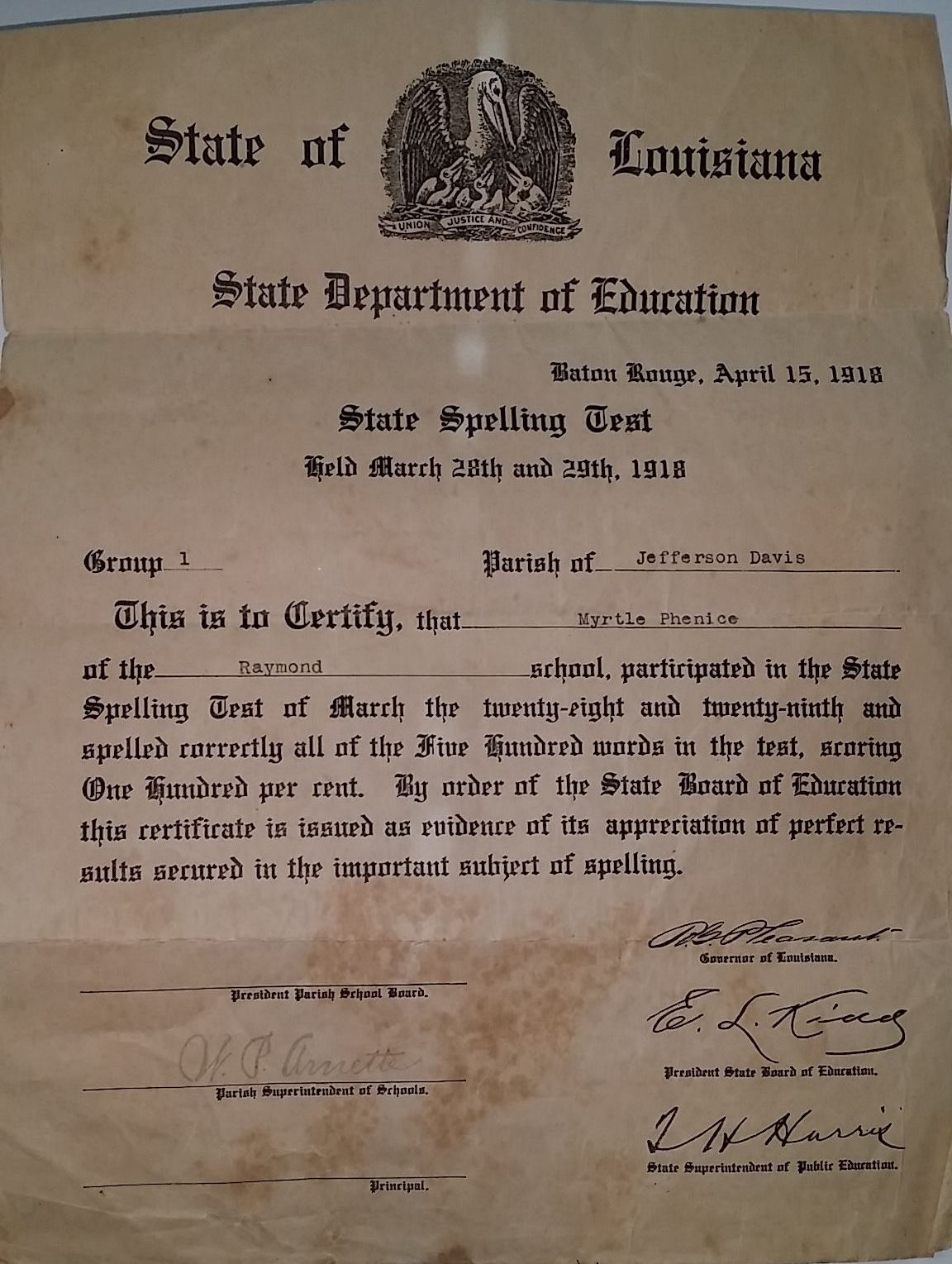
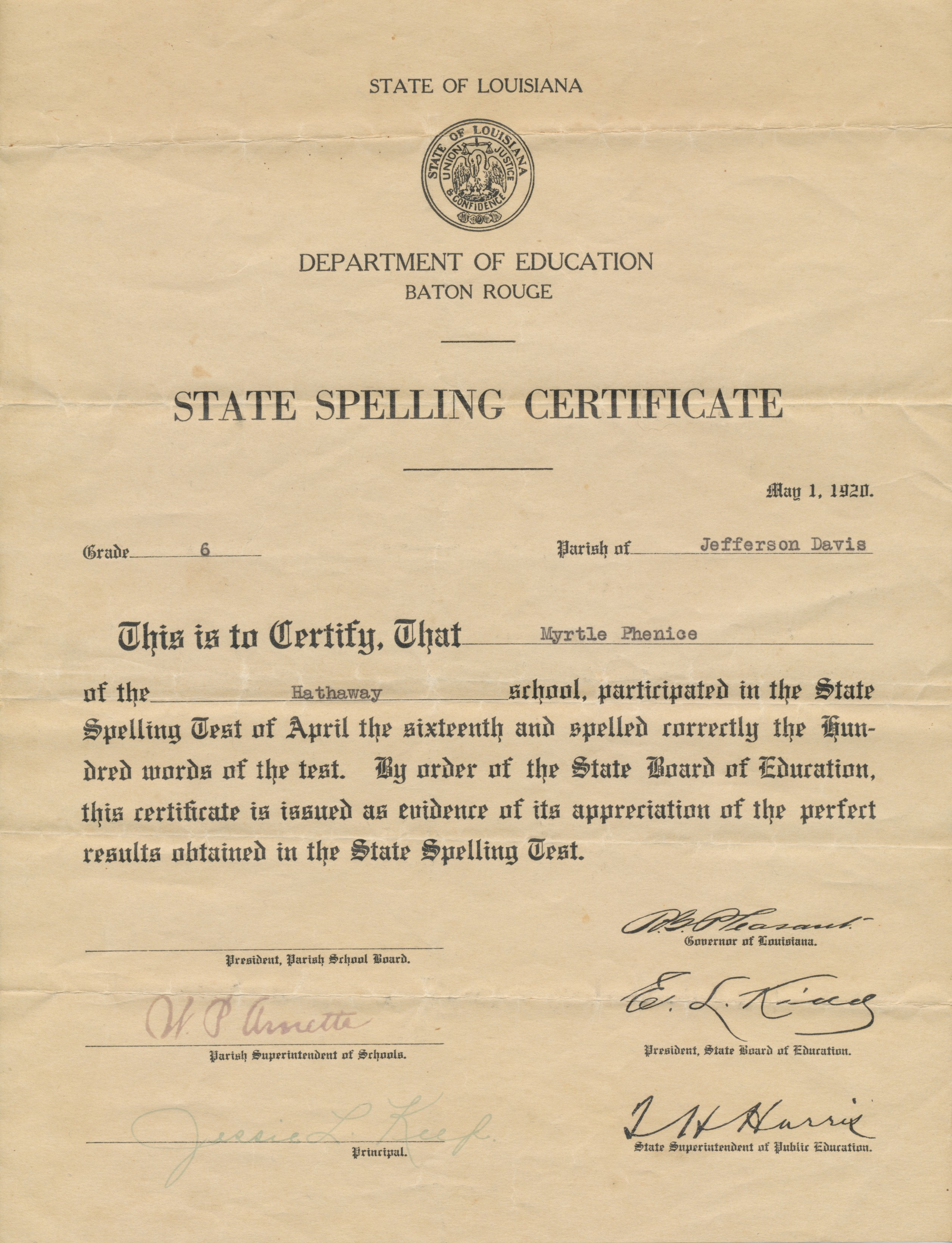
Keys Reunion Treasures

As I said in my first post today, I am happy.  I’m happy about the success of the 2017 Keys Family Reunion, but the other reason I am happy is that some of the cousins brought some old photos to share with me.  That’s what helped to get this whole event started in the first place.  I shared some old photos and a few stories with everyone, people showed some interest, the photos reminded some of us of the Keys reunions that were fun to attend in the past, and a new reunion was organized.  (Thanks to Julie Phenice Campbell and her cousin Diane Phenice Prejean.)

Family outing

H. C. and Daisy Phenice family circa 1926-1930

So I thought I’d share a couple of the photos that I acquired at the Keys Family Reunion 2017. That’s what Throwback Thursdays are about, right? Old photos. And these two photos are from around 1930. From the ages of the children I approximated the date and from the clothes they’re wearing I can tell that the two photos were taken the same day.

It looks like a casual day with the family getting ready for a picnic.  At least that’s what I always thought.  You see, I’ve had a poor version of this first photo for a while.  The old version looks like a Xerox copy of a photo.  But my cousin Shelly Russell (Marguerite’s daughter) brought the original photo to the Reunion and was willing to let me borrow it so I could get a good scan of the photo.  It is a photo of Daisy Keys Phenice with her husband Harry Clifton Phenice and their seven children.

From left to right you can see (or not see) Daisy, my grandmother Myrtle, Grace, Sylvan, Orville, Henry and Marguerite (both behind Warren’s arm), Warren, and H. C. Phenice.  There is no picnic basket and there is a dog in the photo, so I’m not sure why it always brings to mind a picnic.  It’s a really good photo of my grandmother Myrtle and her sister Grace.  They were so pretty.  Too bad Warren’s arm is covering Henry’s and Marguerite’s faces.  It makes me worry about his descendants.

Keys Family Reunion 2017

Daisy Keys Phenice with family and friend

This next photo comes to us by way of Marilyn Phenice Strickland (Orville’s daughter).  I took snapshots of some old photos that she brought to the reunion.  I like to think of this as the Post Picnic Phenice Photo.  As you can see, it was taken the same day as the first photo, but the subjects have been changed.  HC, Warren, and Henry are not present and a sister-in-law and a friend have taken their place.

From left to right are Sylvan and his wife Mary Bucklin Phenice (sister of Fred Bucklin), Daisy Keys, Myrtle, a family friend, Marguerite, Orville, and Grace.  There are several reasons that I like this photo:  1)  Mary Bucklin looks so cute in it that maybe you’ll forget her shrill voice from the Sammy the Dog recording that you heard previously.  2)  Daisy actually looks like she is smiling in the photo.  She doesn’t scowl as bad as my other great grandmother Addie, but sometimes she gives her a run for the money.  3)  It’s another photo that Myrtle and Grace look pretty in.  It must have been a good day for them.  4)  Marguerite’s face is showing, so we can better determine the date of the photo.

What these photos really made me think is that there are a lot more photos out there that I have not seen yet.  Come on people!  Scan those old photos!  If not for yourself, do it for me or posterity!  You can email them to me and I’ll share them with the rest of the family.  And that’s for all you family members out there – Landry, Patureau, Bucklin, Keys, Hine, Phenice, Leveque, Archibald – preserve those old treasures.  Someone will appreciate it someday.  Maybe.

1 6 7 8 9 10 11