Music in the Family Series Part VI – Fiddling With the Keys

As I have said previously, there have been a lot of musical members of our family/families.  My family was known as a musical family since before I was born.  If you have been reading my Music in the Family Series, you would also know that there were musical family members before my parents were born as well.  So this week I’ll take you back even further.  Further than all of my other postings in this series.  Let’s go back to the 1840s.

The musical information comes from the 1840s, but the individual I’m talking about was born in 1822.  That’s right!  Almost 200 years ago, my great great grandfather Henry Keys was born in Chipping Ongar, Essex, England, to George and Elizabeth Crouchman Keys.  The date was April 12th and he was not alone.  He had an identical twin brother named James.

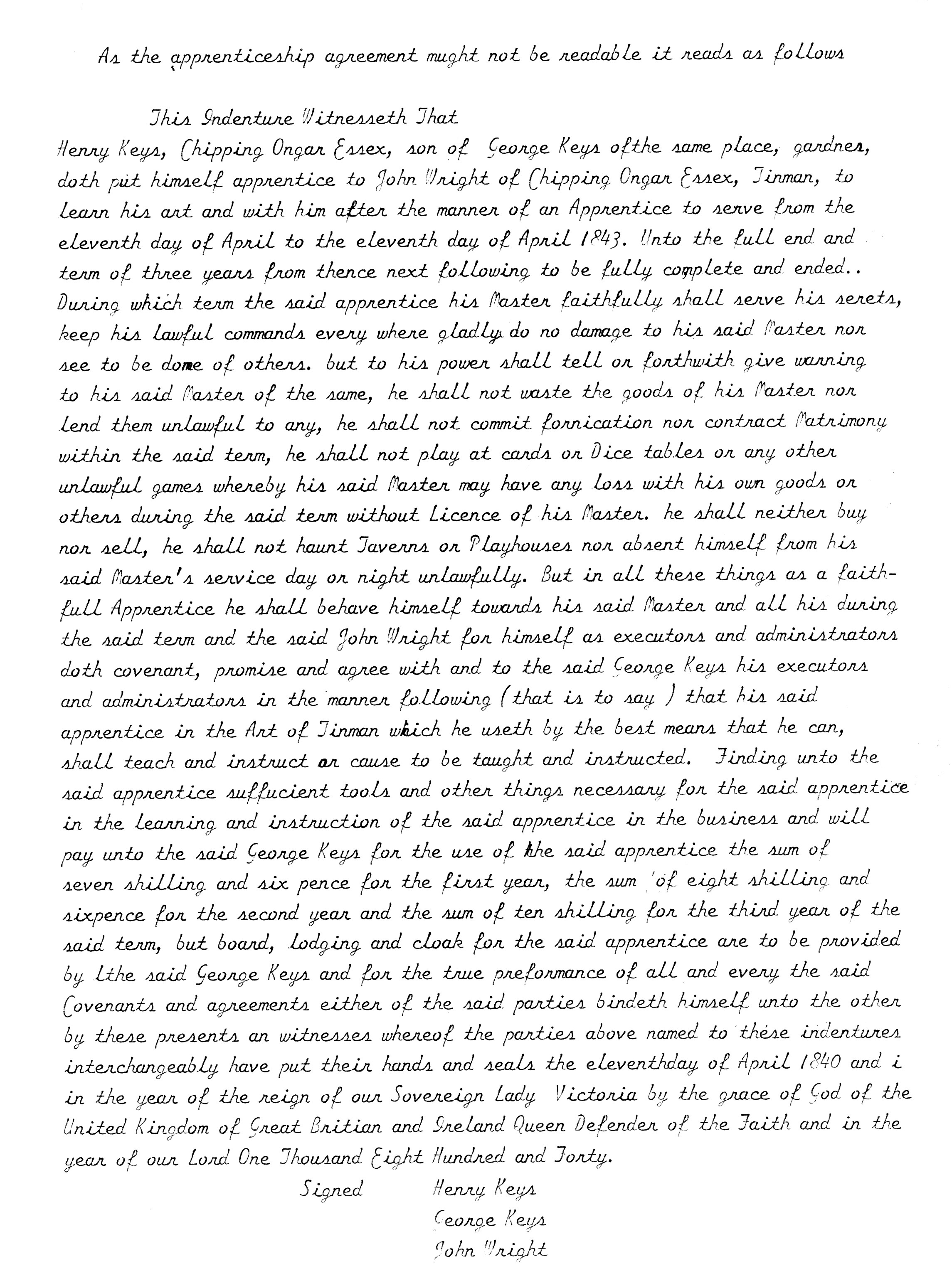
April 11, 1840 – Apprenticeship contract for Henry Keys to tinman John Wright

The day before Henry became 18 years old (in 1840) he entered into a contract of apprenticeship with a tin plate worker (aka a tinman) named John Wright.  The contract was for a period of three years and was signed by Henry Keys, George Keys, and John Wright.  (Pretty cool to see the signature of my great, great, great grandfather.)

The day before Henry became 21 years old (1843) he completed his apprenticeship and became a Tinman.  (He did not have a friend named Oz.  At least there is no record of anyone by that name giving him anything!)  But the most relevant part of the completion of his apprenticeship is that he rewarded himself for the accomplishment.  He had saved up money during these three years and the cherished reward that he bought himself was a violin.  It shows you what was important to him.

As a bachelor for twenty-six years, he worked as a tin plate worker making gas meters.  I’m sure he was also playing his violin during this time, but there really isn’t much else written about this period in his life.  It was on November 8, 1869, that he married Martha Ann Cook on her 33rd birthday.  She herself was an independent person who had a business of her own making clothes and accessories for children.  She must have been a musical person as well, because the only portrait of her shows her standing next to a piano with her hands fiddling with the keys.
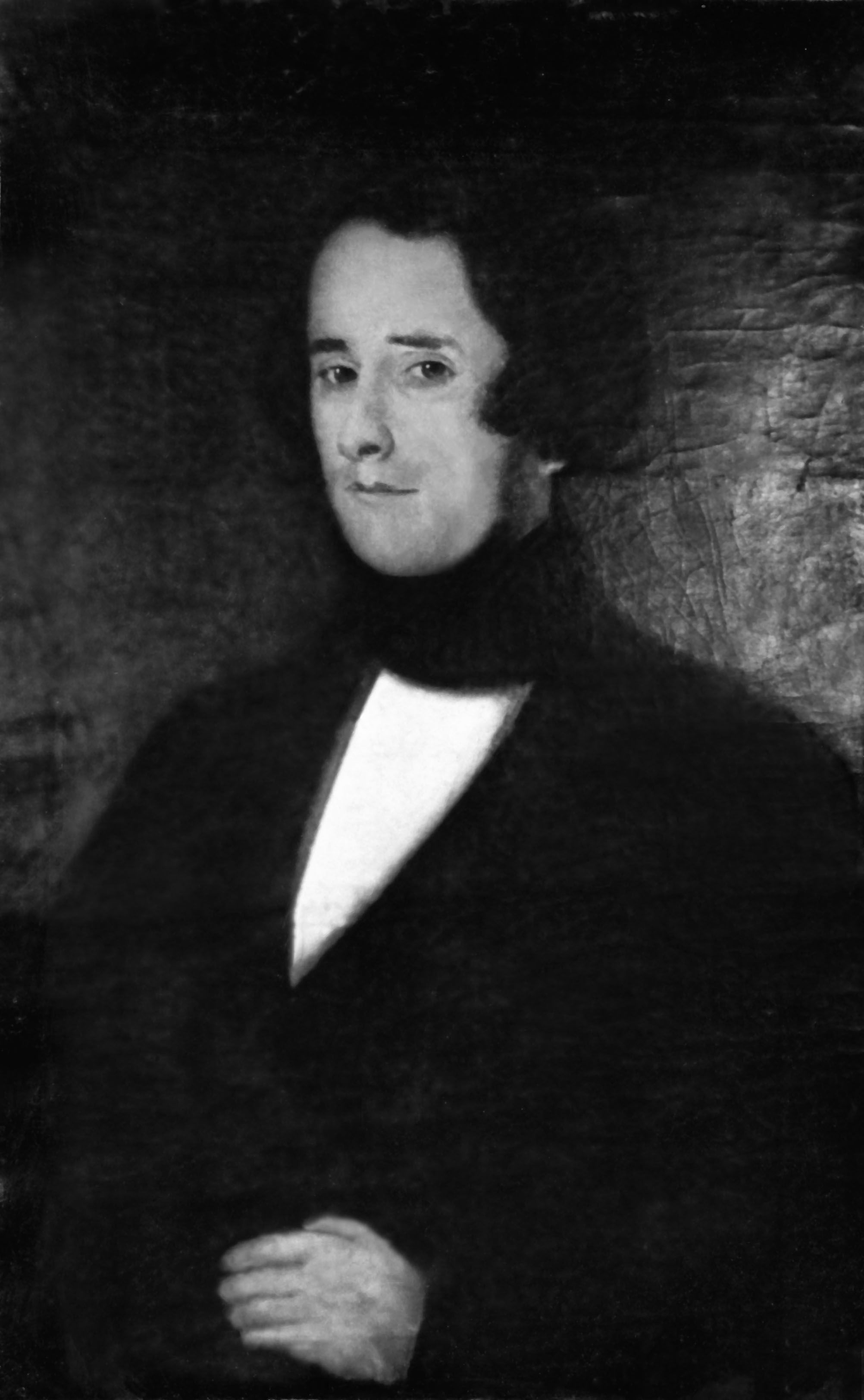
Henry Keys

I believe this is a photo of a portrait of Henry Keys. I estimated it to be from 1880, but it could be earlier.

By 1881 Henry and Martha had five children together.  Another sign that they were a musical family is the fact that the two boys Henry and Alfred sang in a boys choir in London.  On at least one occasion they sang with the choir for Queen Victoria.  Their daughter Daisy (my great grandmother) was known to play the piano, but I’m not sure when she learned.  From the portrait mentioned earlier it looks like there was a piano in the home, so she could have learned as a child in England.

Henry and Martha had family members who moved to America.  They decided that they would move the family to America also and began to save money for this new chapter in their life.  So again, this must have been something important to them.  But sadly, Henry suffered with bronchitis for four months and died at the age of 64 in 1886.  He never made it to America where his wife and children would eventually go.  But his violin did.

I’ve read accounts of the move to America and they always say “They sold everything they had.”  But they didn’t.  They held on to a few prized possessions.  One of those cherished items was the violin that Henry bought in 1843.  When they made it to Louisiana, at some point Martha gave the violin to her son Leonard with the proviso that he would learn to play it, as long as he practiced in the barn!  This makes me laugh.  It reminds me of my mom.  When I was in junior high, I learned how to play many different instruments.  My dad was the band director so I could taken them home with me.  The only thing my mom discouraged me from playing was the violin.  When a person is learning the violin, the notes can be rather screechy in a way that would give mom a headache.  I acquiesced.
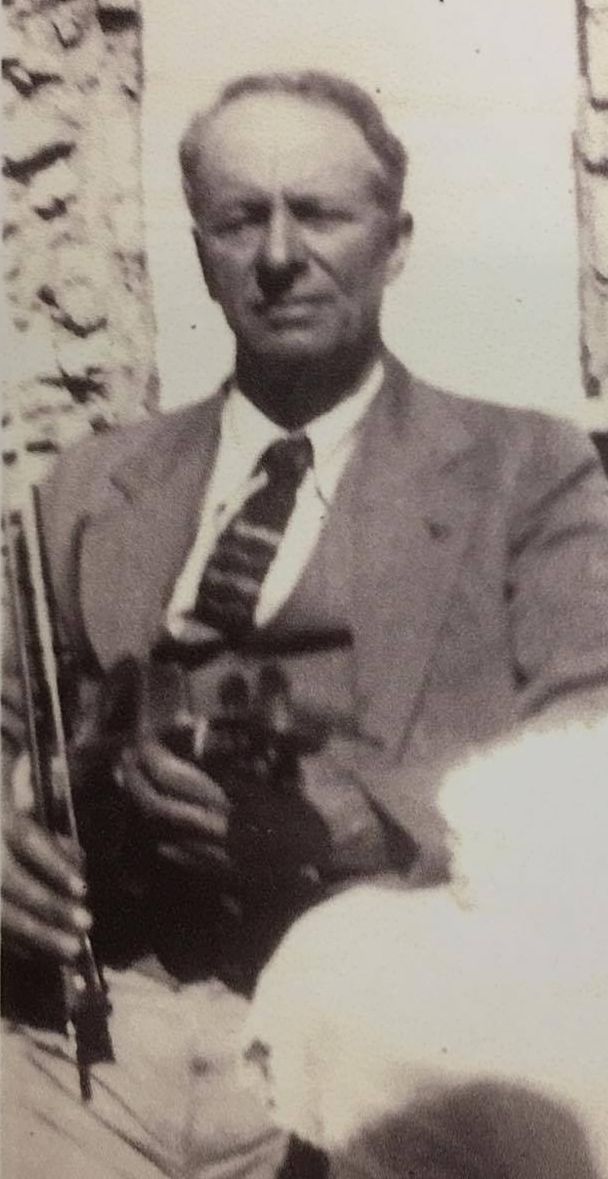
Leonard James Keys with the violin his father bought in 1843.

And learned the violin Leonard did.  But he also learned to play the trombone and flute.  His older brother Henry played the violin, clarinet, and flute.  I’ve told you that Daisy played the piano.  Her husband Harry Phenice played the violin as well.  So did the husbands of Daisy’s sisters Ruth and Mabel.

When I was researching this information, I notice there are a lot of descendants who are musicians.  It could be that every family has a musician here and there, but it does seem like quite a few in my family.  The researching also made me wonder about that old violin from 1843.  Is it still around?  Does a family member have it?  I know that musical instruments can last a long time if taken care of properly.

So I asked my cousin Carolyn (daughter of Edith who provided me with the improved version of the photo/portrait of Henry Keys) if she knew of the whereabouts of that violin.  Her grandfather was Leonard Keys, so it is likely to be with her family group somewhere if at all.  She let me know that “Yes, indeed!” that violin is still in existence.  It is in the possession of her cousin Johnny and he still enjoys playing it!  How cool is that!?  She sent me this photo of her grandfather Leonard with the cherished violin.  A family keepsake that one day I’d like to see in person and photograph.

Here is a transcription of the apprenticeship contract of 1840 that came from Edith Keys Segraves’ book.
 

Music in the Family Part V – Jacko and Papi

Every week that I post something about music, my sock monkeys Jacko and Papi have been begging to include them in a post.  “After all,” Papi said, “I am the one that taught you how to sing.”  I always thought it was my mom and dad.  They did do a lot of singing when I was growing up.  But I also remember spending time with Papi when I was a kid.

Here is a photo of me with Papi when I was three years old.  It sure does look like he may have been singing in my ear!  He assured me that he was singing the “Yo! Ho!” song to me.  “What?” I asked, “That song wasn’t written until our Reunions Adventure.  This picture was taken way before that.”

“I know,” Papi said, “I started the song years ago when I taught Buddiloo to sing.”  So now he’s trying to take credit for teaching my mom to sing!  I know he was around back then, but I never really know when to trust what he is saying.

“Yes,” he explained, “It was around the time I was coaching Murder to sing for those old recordings you shared with everyone a few weeks ago.  I told you that!  You never listen to me.  Some sock monkey whisperer you are!  Hmmph!”

“You weren’t even there back then,” I started, but then I realized that he had been there.  I have a picture of him with Mama back in 1938.  Jacko shared it with y’all in the Sock Monkeys in the Past post.  And the recordings of Grandma (Myrtle Phenice Bucklin, not Murder as Papi incorrectly calls her) were done around 1944 “when those German Nasties were around,” as Papi likes to put it.  I’m sure he’s going to take credit for teaching her to play the baritone now.  “No,” he said, “She learned that at school.  I just sang along with her when we called the cows.”  That’s good to know.

So today I’m going to share with you “Papi and Jacko’s Traveling Song.”  According to Papi he started it in the 1940s, then he and Jacko added some more verses in 2007, and finally Jacko and I added the last part in that same year.  I’m sure some of you will recognize the melody from “The Lonely Goatherd” song from “The Sound of Music.”  It’s a rather catchy little song.  I hope you enjoy it.

Yo! Ho! Going on Adventures –
Jacko and Papi’s Traveling Song


Long, long ago lived a monkey sock

And a little girl that everyone called Betty Lou.

She played him a song on her baritone

Til the cows all came a-runnin’ with a moo.

​

They went to church with her Ma and Pa

And sang and gave their Glory Be’s to You Know Who.

She took along little Cyrus sock

Cuz he promised that he wouldn’t throw his poo!

​

After the service he told them tales

Of many of the places that he’d traveled to.

He made sure that they knew his skills

So they wouldn’t want to put him in a zoo.

​

Yo, ho! Going on adventures.

Yo, ho! Always on the move.

Yo, ho! Going on adventures.

That’s what I like to do.

​

Much later on in a different state,

He befriended a sock monkey who was very new.

His little friend took the name Jacko

And Cyrus then became his Papiloo.


Most of the time they stayed at home

With a family of several kids who grew and grew.

They looked forward to summertime

Cuz the fam’ly always went to somewhere new.

​

Yo, ho! Going on adventures.

Yo, ho! Always on the move.

Yo, ho! Going on adventures.

That’s what we like to do!

​

All of the kids grew up and left

and the house that they had lived in was too big for two.

The ma and pa got a smaller place

And they decided just one sock would do.


Poor little Jacko was sent away

and Jacko and his Papi had a big boo hoo!

They gave him a tag with an asking price.

At least they didn’t put him in a zoo.

​

He sat on a shelf with some other socks

as people walked right by with not much else to do.

Kids always grabbed them and pulled their tails

and some of them were taken home in twos.


A man by the name of Van came in,

And he journeyed from the same state as Papi Lou.

With help from above Van and Jacko met

And they became a trav’ling team of two.

​

Yo, Ho! Going on Adventures.

Yo, Ho! Always on the move.

Yo, Ho! Going on Adventures.

That’s what we like to do!


Not long ago Papi surfed the web

and came upon a story too good to be true.

Though he was old he still liked to see

the adventures of sock monkeys on the move.


There on the screen was his friend Jacko

and he traveled with a man that Papi thought he knew.

When he heard that his name was Van,

he knew it was the son of Buddiloo!


He sent off a note to his friend Jacko

to see about returning to the place he knew.

Jacko and Van came to pick him up

and their reunion was a big todo.


They met up with friends on their way back home,

and Papi hugged and kissed the girls of Rue Cou Cou.

Though Jacko and Van begged to take him home,

Papi went to live with Betty Lou.

​


Yo, Ho! Going on Adventures.

Yo, Ho! Always on the move.

Yo, Ho! Going on Adventures.

That’s what we like to do!

Music in the Family Part IV – Patureau Keepsake

I thought I should have a Keepsake version of Music in the Family.  Especially since I was wanting to showcase this instrument for a while.  I tried to find photos or audio files of it in action, but no such luck.  I do have a few photos of it though.  So here you go.

1928 Vega tenor banjo

This was my dad’s banjo for many years.  He played it at Shakey’s sometimes with the family band in the 1970s, but it has a longer history than that.   Daddy left me a document about the banjo that he wrote on January 15, 2005.

Besides playing it with the family band, he also stated that he played it with some Dixieland bands in Lake Charles.  He also played it in the orchestra pit with a ‘pit band’ for Lake Charles Little Theater productions.  But he wasn’t the first owner of this Vega Four string Tenor banjo.

Vincent Maximilian Patureau, Jr. circa 1922

Daddy inherited it in 1956 when his uncle Vincent Maximilian Patureau, Jr. passed away.  Daddy was 27 years old at the time and Uncle Vincent died at the age of 54.  He was my Mee Maw’s youngest brother.  Uncle Vincent had it for many years and played it with a band in Baton Rouge.  That’s about all I know.  I’m not sure when he lived in Baton Rouge.  Probably in the 1920s and 30s when he was in his twenties and thirties.

Maybe at the age he is in this photo.  I got this photo recently from my dad’s cousin.  (Thanks again, Sis!)  He may have honed his craft for a few years, then decided to buy himself a nice Vega banjo.  That would fit with the timeline of when this banjo was produced.  According to Daddy the serial number places it as being put together in 1928.

I got the banjo in August of 2015 when we moved my mom and dad into Assisted Living in Lake Charles.  I encouraged him to keep it because there was room for it in the apartment that he had, but he wanted me to take it.  So I did.  I’ve always thought it was a beautiful instrument.  And now it’s back in Baton Rouge, where it first came into our family.

1928 Vega tenor banjo

1928 Vega tenor banjo

Music in the Family Part III – Listen to Myrtle Sing

The more I look into my family history for references to music, the more I realize how much it plays a part of the family.  I had thought at first that the series would be a month long, but now I’m thinking it will probably be close to two months long.  And since last week we looked at my dad’s side of the family, this week will be looking at my mom’s side.  In particular, the focus will be on my mom’s mom Myrtle Phenice Bucklin.  My Grandma.

Myrtle Phenice Bucklin

Myrtle Phenice Bucklin circa 1949

When I was a kid I never really cared for Grandma’s singing.  She sang kinda loud with a vibrato that seemed operatic to me.  I’ve never been a fan of the opera.  Different strokes for different folks.  But music was always very important to her.  She was singing til the day she died.  I mean that literally.  When she was 79 years old she was still singing at nursing homes for the “old folks.”  On May 6, 1986, she was singing and playing the piano for her peeps when she had a stroke and fell off the piano bench.  She ended up dying the following morning at 6:01 am.

Not only was she singing at the end of her own life, she sang at the end of her husband’s life too.  (You know this already if you’ve read all of my other posts.)  She sang his favorite song to him – “Amazing Grace” – and as she wrote in a letter to her childhood friend, “I’d finished singing, he looked up at me, smiled and died.”  Music was definitely an important part of her life.  But music wasn’t just a part of the end of her life, it was part of her early life, too.

Her father was Harry Clifton Phenice and her mother was Daisy Keys Phenice.  Both of them were musical people.  HC played the fiddle and he like to play by ear.  According to writings of Grandma’s sister Marguerite, he played a “homey” style that everyone liked.  He would play at community dances along with other extended family members.  He entered a fiddle contest in Jennings once and lost because he played a slow tune.  Daisy was beside herself because he didn’t play a showstopper like his usual upbeat songs like “Turkey in the Straw” or “Irish Washerwoman.” (or even “Soldier’s Joy”)  This allowed Daisy’s brother Leonard to win the contest when clearly HC was the better fiddler. (No bias there.)

The family also would have other families come over for a ‘sing-a-long.’  Daisy would bake peanuts or popcorn, and sometimes she would go all out and make popcorn balls with caramel and nuts.  (A treat that my mom would make for us from time to time.)  HC would play the fiddle, Myrtle (Grandma) or Daisy would play the piano, her brother Henry would play the violin, and Warren and the others would all sing along.  So Grandma grew up around music and was used to playing and singing in front of people.

That is a good thing, because otherwise she wouldn’t have been a willing participant when her older brother Sylvan suggested that he would record her singing some of her favorite songs in 1944.  Sylvan was into radio and sound systems from a young age.  This led to the Bucklin family being one of the early adopters for radio in the early days.  It also led to Sylvan making recordings of his family conversations and singing.  I am particularly thankful to him for that.

When I ‘rediscovered’ these recordings last year, I wasn’t sure who it was singing on them.  I thought it sounded like Grandma, but they were in a style that I liked.  I checked with mom and she assured me that they were Grandma.  The recordings were from around 1944.  It was after that time that she started taking singing lessons and adopted the more operatic style that I heard when growing up.  She even sings the old Irish song “Mother McCree” with a brogue and rolls her Rs.  I love it. (The titles of the songs are linked to the recordings.)

The recordings are in really good shape.  I did edit them to make it easier to listen to them.  When she sang “Smiles” she went straight into “Perfect Day” and I wasn’t sure it was a new song. I separated them into two separate files. Then on “There’s an Old Spinning Wheel in the Parlor” the song was cut off before the ending.  Fortunately for us, she had perfect pitch which made the editing easy.  Otherwise the beginning of the song would be out of tune with the end.

So enjoy listening to Grandma sing these old songs from bygone days.  I always find that listening to them in my car has the best effect.  If you have a smart phone that is linked to your sound system, that is.  And do it when you’re not driving!  I’m sure that thought never crossed her mind when those songs were recorded.  Mercy me!

After Grandma and Grandpa moved to Jennings in the 1970s, Grandma sang many solos at the Trinity United Methodist Church.

Music in the Family Part II – Patureau

When I was young I thought I knew everything.  Understood everything.  What is it about the innocence of youth that makes people think this?  Is it innocence?  Yes, I guess it is.  Maybe a little bit of ignorance thrown in with it, though.  The older I get, the more I realize that I don’t know everything.  Not even close.  When you are young, you know your immediate family and you kinda know your place in it.  When you start looking into family history, you realize that your family is much bigger and spread out.

This is particularly true for the idea of music in my family.  When my family had the Landry Family Band in the 70s and 80s, we (maybe I should say I) thought we were so innovative and different.  People would even say that it was “special” or “extraordinary.”  We weren’t famous or anything, but we did play together every week at Shakey’s Pizza Parlor in Lake Charles.  We’d also play for events or parties.  It was pretty special, but it wasn’t the first time that family members performed music together.

Kelly's String Band

Kelly’s String Band circa 1900 performed in the Plaquemine, Louisiana, area.

Just look at this photo from 1900.  The name of the band was Kelly’s String Band and there were some family members in it from my Patureau family line.  In the front with the funny looking trumpet (not a string) is my great great uncle Alcide Patureau (my father was Bob Landry, his mother was Erie Patureau, her father was Max Patureau, and Max & Alcides’s father was Ferdinand Patureau who was originally from France).  Alcide’s (& Max’s) brother Omer is the one in the middle with the banjo.  The guy on the right with the mandolin is Alcide and Omer’s (& Max’s) nephew Ferdinand Hebert (son of Aline Patureau Hebert).  The two guys standing up are Nick Manola and Wade Landry.  I don’t know of any relation to them.

So at least 70 years before our Shakey’s day, there were family members performing for other people’s entertainment.  And I’m sure there were probably more before that in the unknown history of the family.  This is the earliest photographic record of a band in my family.  I’d love to know what they sounded like and what kinds of music they played.

Plaquemine, Louisiana, in 1894 - Patureau family

Omer Patureau and Ferdinand Hebert

I have this other photo of two of these members who must have performed on their own with their dueling banjos.  This is Omer Patureau and Ferdinand Hebert in a photo dated 1894.  Both photos show that they were taken in Plaquemine.

As I’ve said before, people in the past did not have as readily available access to entertainment and information as we do now.  Maybe when people came from their homes and listened to them entertain, they heard things like people saying they were “special” or “extraordinary.”  And maybe they were.

As I get older and particularly with the passing of both of my parents, I do look back at those times playing music with my family and they are special to me.  And they will become more special as time goes by.  This I do know.


Feb. 17, 2022 – Update

I received a better version of the Kelly’s String Band photo.  I also figured out how I am related to Wade Landry.  In addition to that, I’ve learned more about his life.  So check out my new post to see it all – Patureau and Landry Musicians Circa 1900.

Music in the Family Part I

I promised last week that I would post something about music.  I shared a post on Facebook this morning.  It was a video from two years ago of our Landry Family Band reprising an old Dixieland song “Jada.”  It was me, my sisters Karen and Jamie and my mom and dad playing at Villa Maria Retirement Center in Lake Charles.  We were all in town to find an assisted living home for my parents.  I didn’t realize at the time that it would be the last “performance” I would have with them.  A bittersweet video to watch.

Most people knew us as a musical family, but there have been many musicians in the family through the years on both sides of the family.  That made it difficult for me to decide where I would start this musical series.  But then that little video popped up today as a jumping off point.  So I’ll start the series by going back some years before the video I mentioned.  Some of you may be thinking of the Shakey’s days where the Landry Family Band had their heyday, but I’ve already shared that before.

Bucklin siblings in Hathaway with musical instruments

Betty Lou on baritone, Loris on trombone, and Austin with the uke in 1950 or so.

I’m taking it a little further back than that.  Shakey’s was 40 years ago and I’m going back 26 years before that when my mom Betty Lou Bucklin was a girl in high school.  This is a photo of her with her younger sister Loris and their brother Austin.  Mama played the baritone and aunt Loris played the trombone.  I’m not sure what Austin is doing with that ukelele.  He doesn’t seem to be very pleased with it.  Maybe it was out of tune or missing a string.  Maybe he didn’t think it went along with the baritone and trombone too well.  Whatever the case may be, he doesn’t seem happy in the photo.

But I’m happy that I found this photo.  I don’t ever remember seeing it when growing up.  I found the negative last year when I was going through some stuff that mom gave me.  The photo was taken around 1950, which was around the time that Mama met Daddy.  Young Betty Lou visited LSU in Baton Rouge on April 27, 1950, to compete in the State Music Festival Clinic where she earned a Superior rating on her performance on that baritone.

My mom was never good with directions.  I don’t know how many times she got lost when trying to get somewhere.  Most of the time it was a hindrance, but in this situation it proved to be beneficial.  She was at LSU and she needed help with directions.  The person she found to help was none other than a college student by the name of Bob Landry.  The other interesting thing about that meeting is that it was five years to the day prior to the birth of their second child, my brother Rob.

It was rather appropriate that their first meeting was centered around music.  My mom liked to tell that story about their encounter.  She kept the certificate she won that day and wrote a little bit about it on the back of it in 2013: “He’s been leading me around for over 60 years.”  Together til the end.

Erie Get Your Gun

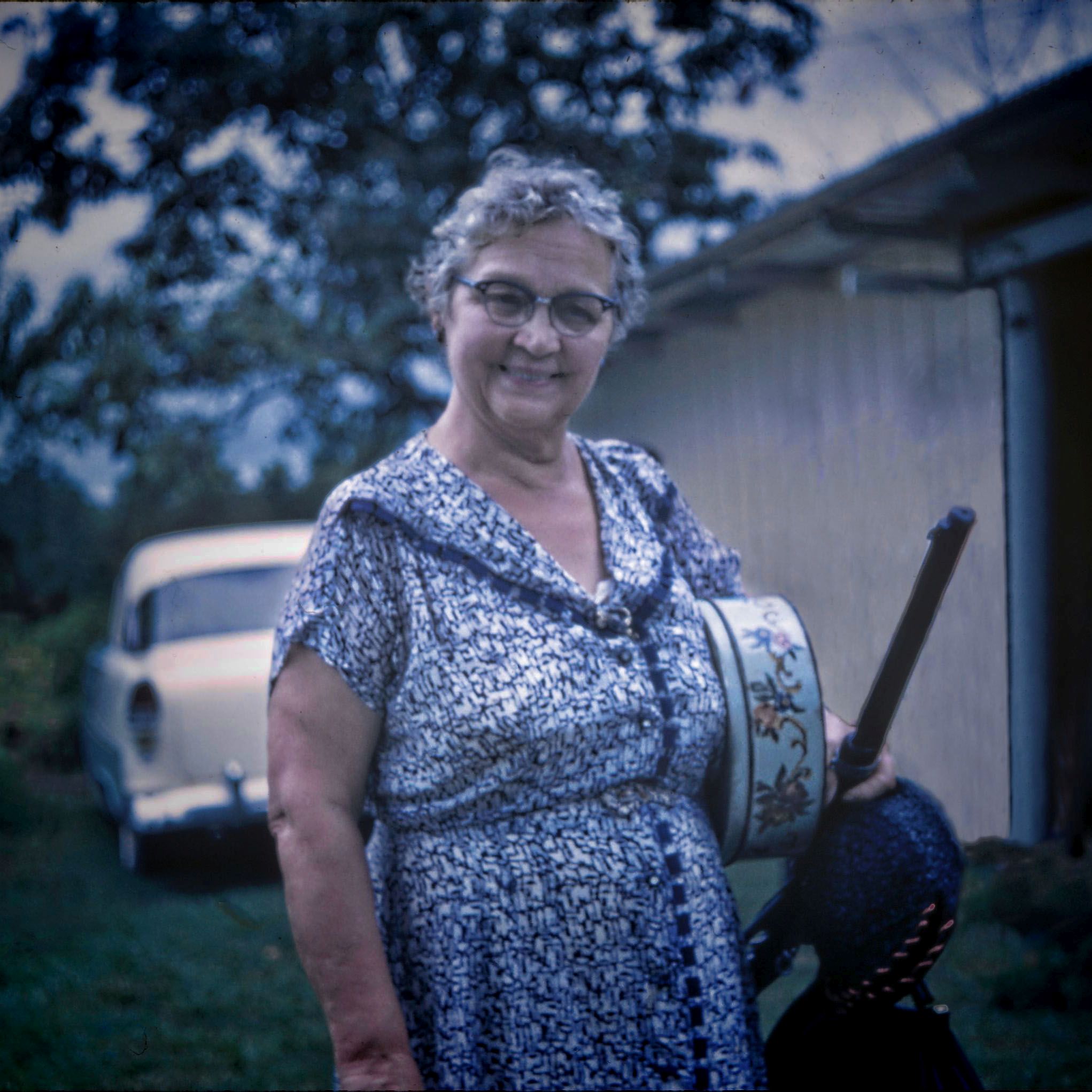
Erie’s got her gun and is ready to take on the world. This was taken around 1963 in Lafayette, Louisiana, at a picnic hosted by her cousin Wana C. Landry’s home.

I don’t know why these last few Landry/Patureau posts are featuring guns.  I have two posts named Grandfathers With Guns, so I thought I would try to give a more balanced view.  Besides, I had this great photo of Mee Maw that I’ve been wanting to post for a while.  So my desire to present a more balanced view finally motivated me enough to edit this photo in the way I wanted to.

Because you know Mee Maw, she didn’t go anywhere without her fruitcake tin and gun!  Well maybe you don’t know Mee Maw.  She was born Germaine Erie Patureau on August 6, 1895, in Crescent, Louisiana.  You could actually say that the family lived in Plaquemine.  They lived right on the corner of the Bayou Road and Patureau Lane.  That’s right!  They lived on the road that they named for themselves.

She was a child at the turn of the century (not the Millennial century, the one before that!) and it was a very rural area.  They usually had to entertain themselves with reading books, eating food, playing cards, or playing music.  (I will be posting some musical stories soon.)  But sometimes, if they were lucky, the showboat would stop in their area and put on a show for them.  There was an area not far from their home that would be used as a stage for the actors who traveled on the boat.  This sounds very charming, even though it reminds me of the musical “Show Boat.”

I have to admit that I am not particularly fond of most musicals.  Even though my family was very musical and sometimes we would break into song during a conversation, I always hated to see that in a movie.  And when I think about “Show Boat” I cringe.  But I try to look past that when I think of Mee Maw and her family enjoying the performances of the people from the showboat.  (Let’s just hope they weren’t musicals!)

So why is it that I referenced another musical (“Annie Get Your Gun”) when I named this post?  Yet something else to get past.  I guess for the same reason I named two posts “Grandpa’s Got a Gun,” I think that it has a ring to it.  So let’s get back to Erie and her love for guns.

Sorry, I don’t know if Mee Maw had a love for guns or not.  It’s not something I can ever remember talking to her about.  I’m surprised that I have a picture of her holding a gun. (She was really holding a gun in the photo.  I only edited it to make her more noticeable and to make the background less noticeable.)  We always talk about Mee Maw being so sweet, so I thought I would post this picture showing her tougher side.

Oh well, even when she’s holding a gun she looks sweet.  That’s Mee Maw.

Great Grandpa Lou

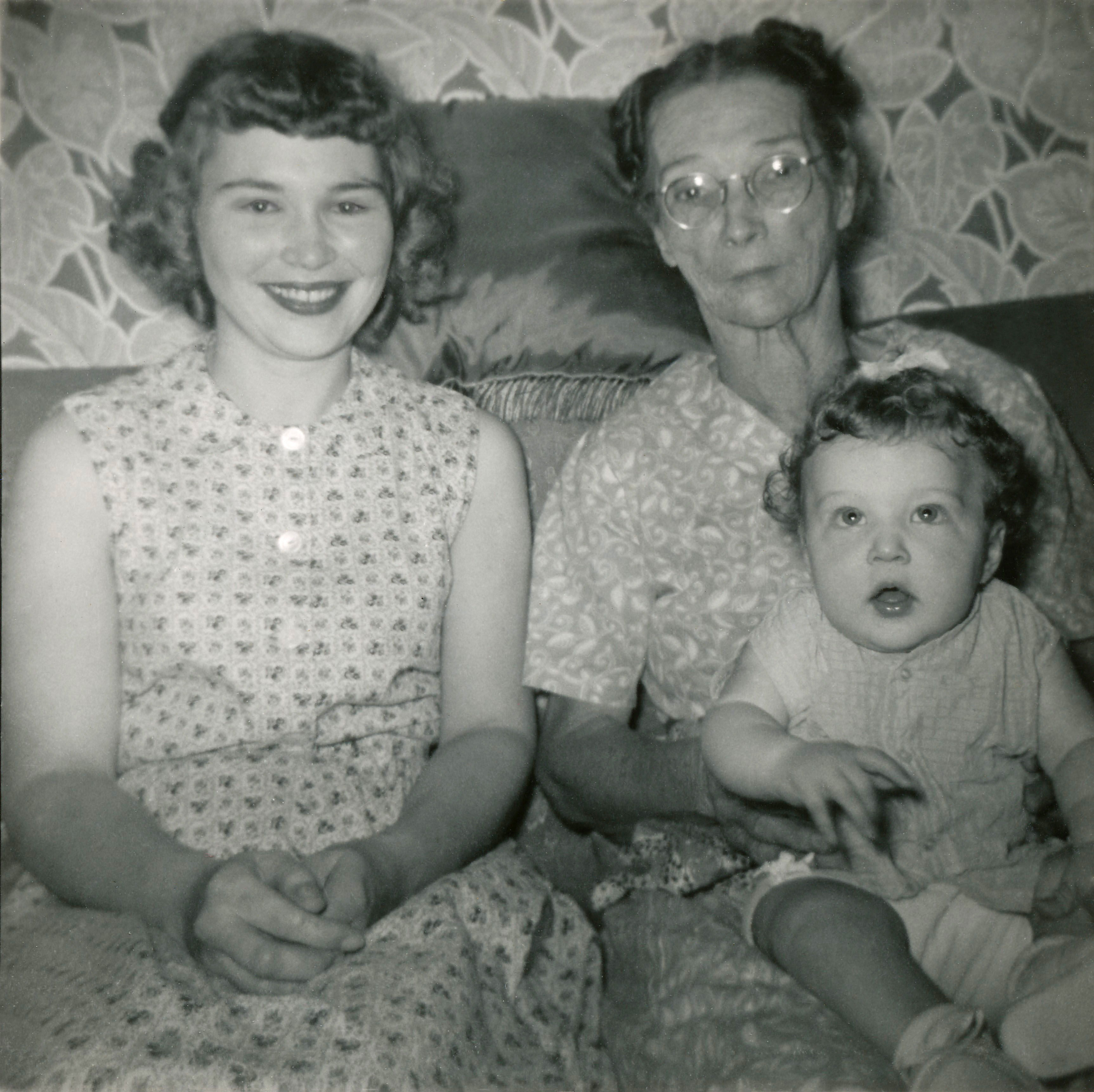
Great grandmother and great granddaughter.

Addie Hine Bucklin with great grandchild number five Jodie Lou Landry in 1954.

This photo makes me smile.  It almost makes me laugh out loud.  The photo causes me to smirk with a soft chuckle.  It’s cute.  It’s sweet.  But it’s a little blurry.  I cleaned it up a bit, but I can’t make it clear.  There’s only so much you can do in photo editing.

I still like it quite a bit.  That’s kind of obvious since I’m using it for this week’s post.  The little girl in the photo is my oldest sister Jodie.  She was born on October 14, 1953, at Edwards Air Force Base in California.  She died on November 5, 1989 in Franklin, Texas.  Way too young.

Our mom was Betty Lou Bucklin Landry, who was the daughter of Fred Bucklin.  Fred’s mother was Addie Hine Bucklin, the other subject in this photo.  So she was the great grandmother of little Jodie in this photo.  And yet there is another person in the photo.

The other person in the photo is shown in a photo on the wall above the other two.  It’s a photo from 1905 of Addie when she was young married woman and her husband Louis Charles Bucklin, sometimes known as Lou.  In recent letters I’ve seen he was called that in 1893 by his peers.  And even though he died in 1927, he was still influencing my family much later on.

One of those influences was in 1933 when my mom was born.  There was talk of naming her Addie Lou in honor of both of Fred’s parents.  Addie was adamantly against that.  She did not want that cute little granddaughter of hers saddled with such an old fashioned name as Addie.  So mom was named Betty Lou and I have to say that the name really suited her.

Then when Jodie was born in 1953, her middle name was Lou as well.  So shortly after this photo was taken, Jodie would have started to talk a bit.  I’m not sure of the time frame.  But when she was learning what to call herself and her parents, she got a bit mixed up.  But in a good way.  She knew that she was Jodie Lou.  She knew that mom was Betty Lou.  I suppose that sometimes she was Mama Lou, because when she learned to call daddy “Pappy” she naturally ended up calling him Pappy Lou.

I’ve heard the Pappy Lou story all of my life, and I always thought it was a sweet story.  So when I found this negative and scanned it earlier this week, it reminded me of that story so much.  I don’t remember ever seeing the photo before.  And like I said at first, it’s cute.  It’s sweet.  And it’s appropriate that great grandpa Lou shows up in the photo.


Here is another photo from the same visit.

Three generations

Betty Lou Bucklin Landry, Addie Hine Bucklin, and Jodie Lou Landry in 1954.

Grampa’s Got a Gun – Pee Paw and the Big One

There is something about that title “Grampa’s Got a Gun” that has a ring to it.  I’m not sure what it is.  Maybe it’s just the alliteration.  I like the photo as well.  I’ve posted other photos of my paternal grandfather Robert Joseph Landry, Sr. in World War I – aka Pee Paw in the Big One – and this is the first one that shows him with a gun.  It is from the A. J. Collection, which means that I got it from my uncle AJ earlier this year.

Pee Paw in World War I

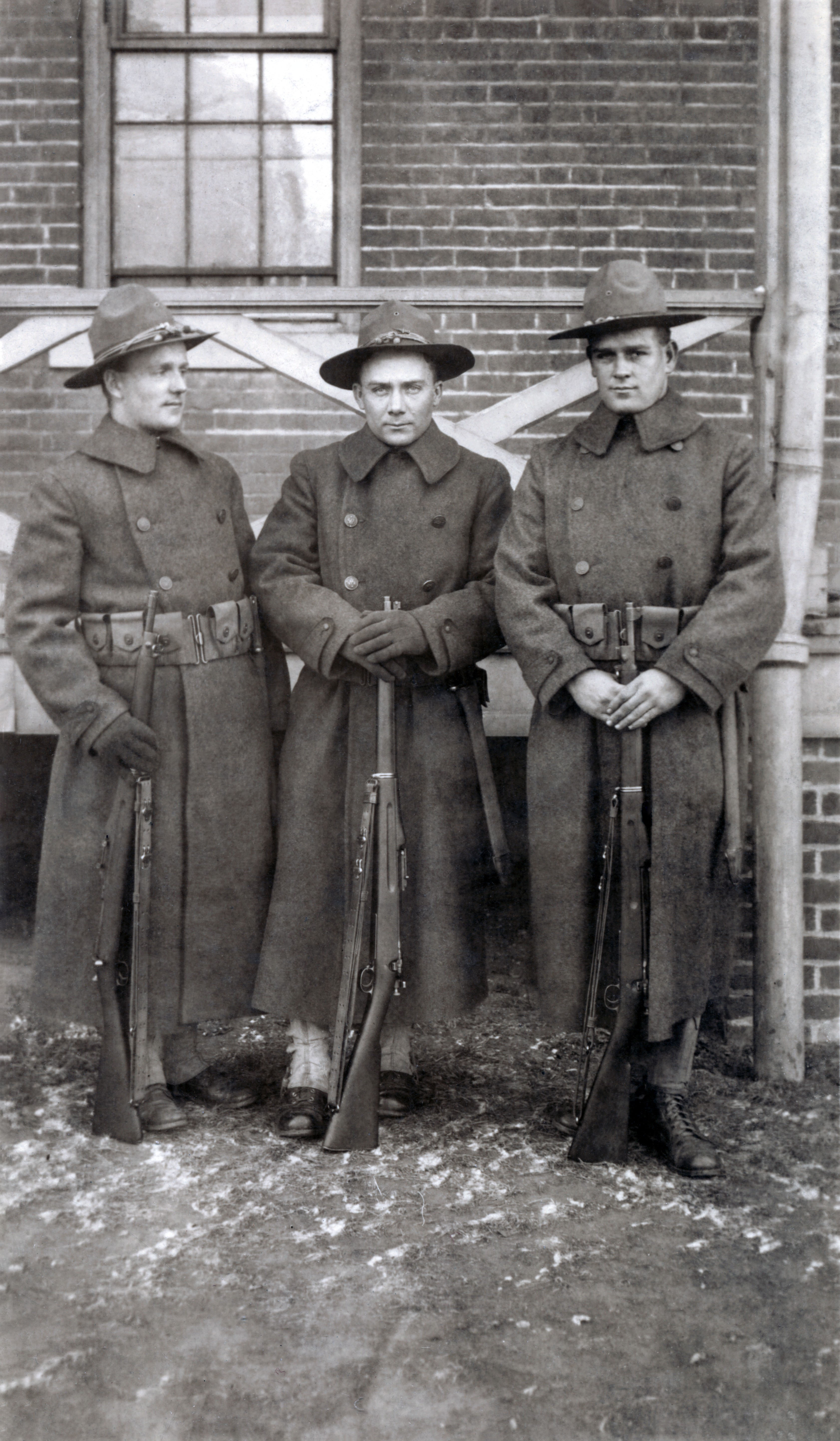
My grandfather Robert Joseph Landry, Sr. is the tall one on the right in the photo. It was taken at Camp Lee in Virginia.

It’s such a good photo, too.  So clear and in focus that you can see that Pee Paw is the only one that is not wearing gloves.  Did the southern boy not know how to dress for cold weather or did he just not like wearing gloves?

It was taken at Camp Lee in Virginia which is near Petersburg, Virginia.  This was a training site for soldiers during World War I.  I’m saying that it was at Camp Lee because that is what was written on the photo.  The photo also had a date of 1919 on it.  This does not match with the 1917 date I had on other photos of Pee Paw at this camp.  One of these days I will get incontrovertible proof of when he was stationed at Camp Lee.  In the meantime let’s just say it was sometime around 1918.

And everybody knows what happened in 1918, right?  There was a worldwide influenza epidemic.  In looking for information for this post, I saw that during that epidemic 10,000 soldiers were stricken by the flu, and 700 of those died as a result.  So some of these men went to train to fight in a huge international conflict but ended up dying before they completed training because they caught a flu virus.  Known as “The Spanish Flu” and “La Grippe” this version of the flu killed more soldiers than were killed through warfare.

So Pee Paw made it through the Great War.  He did not see action, but he was faced with the greatest killer at that time.  He survived that microscopic enemy, and that gun didn’t help him a single bit.

I still like the title, though.

Dressmaking with Paints and Pixels

My great great grandmother Martha Ann Cook was a dressmaker who studied her art in Paris, France.  She had completed a two year apprenticeship presumably in Walthamstow, England, prior to going to Paris in 1860 to study.  Her sister Henrietta was three years younger than Martha and was not put to a business because she was thought “too delicate.” Being delicate was never a term I’ve heard describing my great great grandmother.

After completing her studies in Paris, she opened up her own dressmaking business in England.  She designed and made clothes for small children and sold ribbons and dress accessories.  Her business was successful and she was able to hire other women to work in her shop, which continued even after she was married and having children.  She would also travel to Paris every year to see the latest styles. It appears that she put a lot of thought and effort into her whole business endeavor.

Which would make me think that she would have been concerned with the look of her own dresses and wardrobe choices.  And this would be particularly true when she decided to sit for a portrait.  The portrait that I’m talking about is today’s photo.  When I first saw it, I thought it might be a photo.  It was a Xerox copy of a photo that was in the book “Cook-Keys Family: Two Centuries in England and America” by Edith Keys Segraves.  I’ve posted that old version before, but I just recently obtained a much better version.

Martha Ann Cook Keys

Portrait of Martha Ann Cook Keys in England circa 1865

Edith Segraves’ daughter Carolyn let me scan the best version of the photo.  I could tell from this version that it was actually a photo of an old painting.  I decided to clean it up to get it looking as best I could.  Nothing but the best for old Martha!  One of the first things I noticed was that painting hands was not the artist’s strong point.  The fact that the painting showed two hands is telling.  The old phrase “cost you an arm and a leg” was in reference to having your portrait painted (or so I’ve heard).  Supposedly the extra limbs were quite pricey.  So to have both hands in the portrait was a sign of prosperity.

It could also be Martha’s desire to show off her dress properly.  How can you show the true design of a dress without arms and hands showing?  Whatever the case, those pricey hands didn’t quite look right.  So I changed them!  That’s right.  She’s got brand new hands after well over one hundred years.  So the pixilized hands are not authentic, but I’m sure they look closer to the real thing than what was there previously.

I also cleaned up her face a little.  There were scratches across them that had to be removed.  I was careful to make sure I didn’t change the way she looked.  Then I came to her dress.  Some of it had been damaged and it wasn’t complete because it had been a circular painting.  I cloned parts of the painting with paint parts and pixels.  It ended up looking like a dress-shaped blob on the drawing.  I knew that Martha would not approve of that.  She was all about dresses!

So I did a search online for French dresses from the 1860s and came across something that might help the photo out.  It was a black mourning dress that somewhat matched what Martha was wearing.  I used that image to give the dress a bit of shading and texture.  With some helpful input from Carolyn, I think I came up with something that Martha would approve.  French fashion with paints and pixels.

1 … 46 47 48 49 50 … 58