Jacko’s Adventures – A Decade of Fun

Jacko's Adventures:  To The Faces and Beyond

The first book in the series of Jacko’s Adventures

Can it really be 10 years ago that Van and I started our Grand Adventures?  At least that’s what he told me.  I’m not good with the numbers or keeping track of time.  I do know that it’s been several munce since we went to see those Faces up in the North.  But if Van says it’s 10 years, I’ve gotta believe him.  He keeps track of stuff like that and I don’t really care if he is right or wrong.

All I know is that we had a lot of fun!  And that’s all that matters.  The cover of my first book (Jacko’s Adventures: To The Faces and Beyond) is one of my favorite photos.  I’m sitting on a giant’s foot in Tulsa, Minnesota or somewhere.  That foot is so big that it makes me look small.  But I’m not.  I’m just the same size as when I became.  I don’t look any older now, either.  The same can not be said of Van.

2006-06-08(17)Papi&MtRushmore3The other really good thing about that trip was that we came across a photo of my Papi at Rushmount.  I had told stories about Papi to Van for a while, but until we saw that picture of him in real life, I don’t think he believed anything I said.  It’s not like I lie like he does.  Everything I say is really real.  Because of this picture, we started moving to the point of reuniting with my old Papi.  He read about us in the book about our Adventures, sent off an email to see about getting together with us, and the rest is history.

But I’m getting ahead of myself.  This post was supposed to be about our first Adventure and celebrating 10 years of fun.  So “Happy Anniversary” to us!  I’m feeling festive.  I think I’m going to go get Van to play the guitar so we can sing our fun little traveling songs.  “Yo! Ho!  Going on Adventures.  That’s what we like to do.”

“Mind if I stay for a little while?

1969 - Germaine Erie Patureau Landry going on a trip

Germaine Erie Patureau Landry was better known to us as Mee Maw. She has packed her grip and is ready to go. Circa 1969.

This is my grandmother.  She was such a sweet woman.  All of us grandkids called her Mee Maw and she fit the name perfectly.  She became a widow in 1957 at the age of 62.  She had been a teacher before she got married.  She gave that up when she got married in 1921 because at that time it wasn’t appropriate for a teacher to be married.  But she was busy anyway.  She had eight children to bear and rear!

But that’s just the prequel to this story.  This story is about her being a grandmother.  As my wonderful godmother Shirley likes to point out, she was the first grandchild born.  But she wasn’t by herself for very long.  By the time Mee Maw became a widow, she had fourteen grandchildren.  Eventually there were twenty-nine grandchildren (though one of them only lived a few short years).

Yet she made us all feel like we were her favorite.  She liked to travel whenever she could.  She was known as a go-go Patureau.  (I think Jacko would have liked her.  He likes to be on the move, too.)  Then she would come to visit her grandchildren and bring them gifts.  I still have a monkey bank that she got for me when she went to the Grand Canyon.  And as you can tell, she must have paid attention to what kind of things I like.

But we didn’t need presents.  Her being there would have been good enough.  I remember her as being soft and warm and comforting.  She did snore a bit loudly when you slept with her, but that can be forgiven.  And she lied to me!  I remember asking her something about her skin (which was a result of aging skin – something a little boy like me didn’t know better than to ask) and she made something up that I believed for the longest time!  I love that.

She was a good grandmother.  I have many fond memories of her.  I wish I had a few more.

Tony was a Skunk

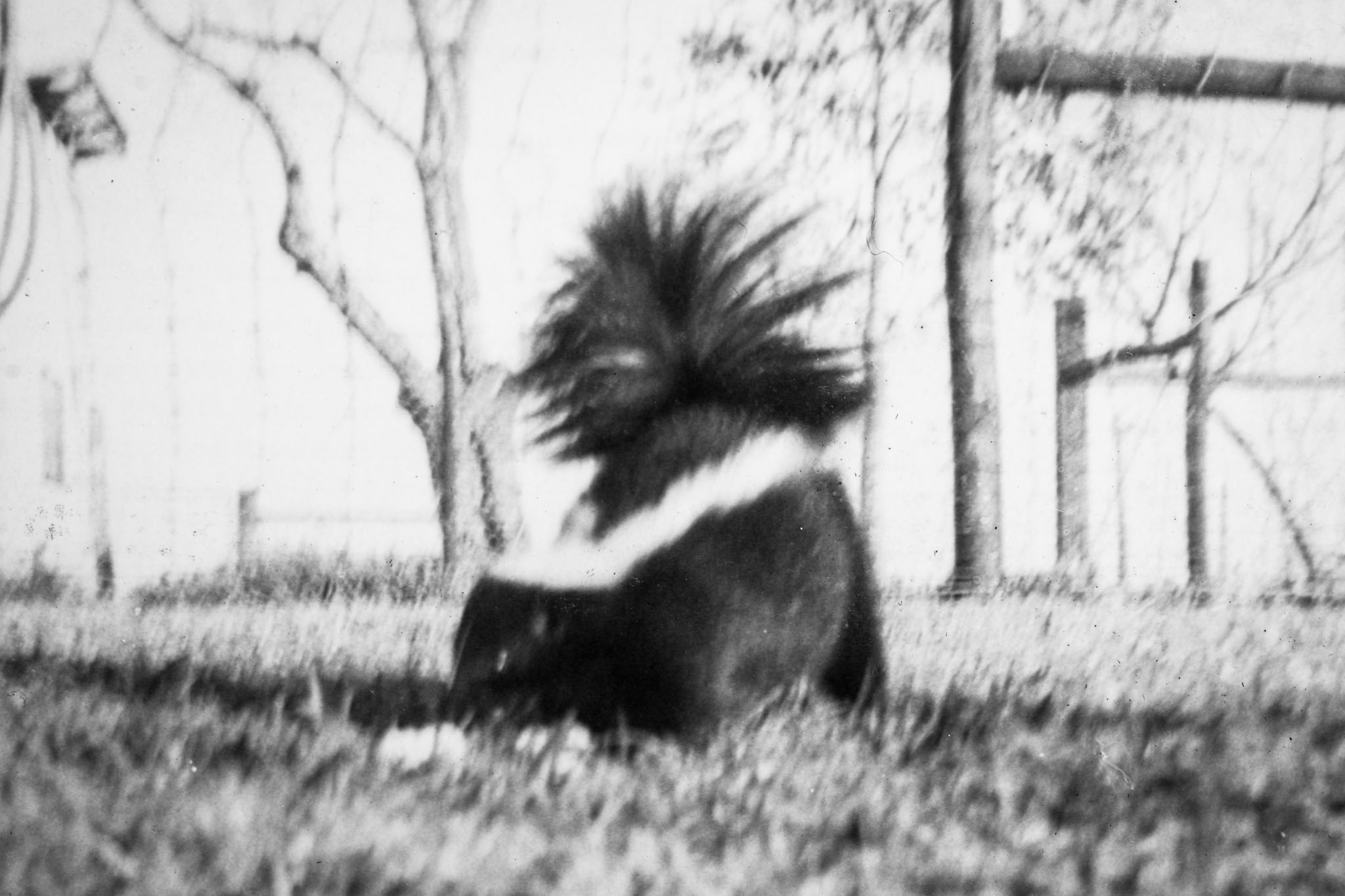
Tony the SkunkI got mom to write this week’s post.  She always says she wished she had asked questions of her parents and written things down.  I had heard the basics of this story many times.  This isn’t a very important story in our family genealogy, but it needed to be told:

Tony started out as a baby skunk. He didn’t stink as he was too young for his scent glands to function. I named him Tony because Mom gave me Tony Home Permanents to curl my straight hair. The formula that makes curls happen smells kind of bad, and it reminded me of the skunk smell.

His mom was shot when found living in Dad’s work shop. But when the babies got hungry they cried and were found – they were too cute and helpless. Dad told me he would not have shot the mother skunk if he had known her babies were under the air-compressor. Dad was worried about working in the same building with a wild skunk. He had lost his sense of smell so could not tell if he got sprayed until he got home and someone told him he stunk.

Dad gave me and two cousins each a baby skunk for pets. These little guys did not have their eyes open yet and required bottle feeding (I had a baby doll bottle I used, but as Tony got older, he chewed the rubber nipple off and we had to find a new bottle several times), until he was old enough for solid foods.

He was really excited when he got a raw egg one of Mom’s chickens laid. When he was young, the egg was too big and he would wrestle with it trying to get a tooth to break the shell. I helped him after a few minutes by making a small crack. It got easier as he grew bigger, stronger, and smarter … it was easier to break the shell, but he still worked at getting a good grip on the egg … it would never stay still! He straddled the egg and held it with front and rear legs and then tried to bite it to break the shell. When the egg broke, he would wade into the mess he had made and start licking up the egg white and yolk. He was very happy!

You knew he was upset when he started stomping his feet! Tony would raise his tail, stomp his front feet thus clicking his long (for digging up worms, etc.) paw nails on hard surfaces and then turn his rear half at us, he didn’t know his scent glands had been removed. He went through all the motions a wild skunk would do.

Tony loved to run through the yard grass and poke his nose at bugs or just sniff around. I would let him out of his cage occasionally and watch him looking around. He was always very busy in the grass and made it hard to photograph him.

Dad built a big elevated (about 3 feet above ground with a flip up lid) outdoor house for him which was at the fence next to the area the chickens were allowed to foraged free for bugs, seeds, etc., and he lived all of his adult life in it. I piled grass clippings in his sleeping area, and he would make a nice nest to curl up in. Or maybe an old bath-towel to keep him warmer. Big bowl of water in his outdoor open play area (screened sides) where he would also be fed the eggs and appropriate food for skunks (like big grasshoppers and crickets when I could find them). He basically ate what the cats ate.

I went to college at Univ. of Southwest Louisiana (now called Univ. of Louisiana, Lafayette. Mom and my brother, Ray, took over caring for Tony as I lived at a dormitory far away from home.

Tony lived a long time. Mom asked me if I wanted to let him go. He had never been a wild skunk and I wasn’t sure instinct would be enough to keep him safe. And, he didn’t have the natural weapon all skunks have (scent glands). To me he could not defend himself, and would not be able to escape larger predators. We did not let him go. Years later he died a natural death in his cage. Ray thinks he lived about 10 years. Wild animals don’t make good pets. We saved Tony’s life but he missed out on having a natural life in the wild.

John R. Koll and Ada May Whittington

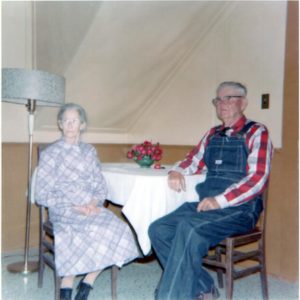
Mr. and Mrs. John KollAda May Whittington was the daughter of Thomas Whittington and Mobelia Bryant.  She was born on December 27, 1881, in Bayou Chicot, Louisiana.  She married John Rudolph Koll on April 4, 1908 when she was 26 years old.  She died on May 25, 1963, in Jennings, Louisiana, at the age of 81, shortly after their 55th wedding anniversary.

John Rudolph Koll was born on January 31, 1884, in Kiron, Iowa to Henry Frederick Koll and Anna Fredericka Wulf.  After leaving Iowa, the Koll family spent four years in Arkansas before moving to Jennings, Louisiana in 1900 when he was 16.  His father helped him and four of his brothers buy their own land.  A 1957 newspaper article says John operated a 620 acre farm, with 172 acres in rice and the rest in pasture for 250 head of cattle.  He served on the parish school board for 36 years and held the position of president.  He gave a silver dollar to every Hathaway High School graduate while he served on the school board.  He died on February 17, 1965, in Jennings, Louisiana, at the age of 81.  Both he and Ada are buried in Greenwood Cemetery in Jennings.

Mom says when he was at a grandkid’s birthday party, he would count the birthday candles in German.  He said he didn’t remember much German.  He was young when his grandparents died so I wonder if he just never had much exposure to the language.

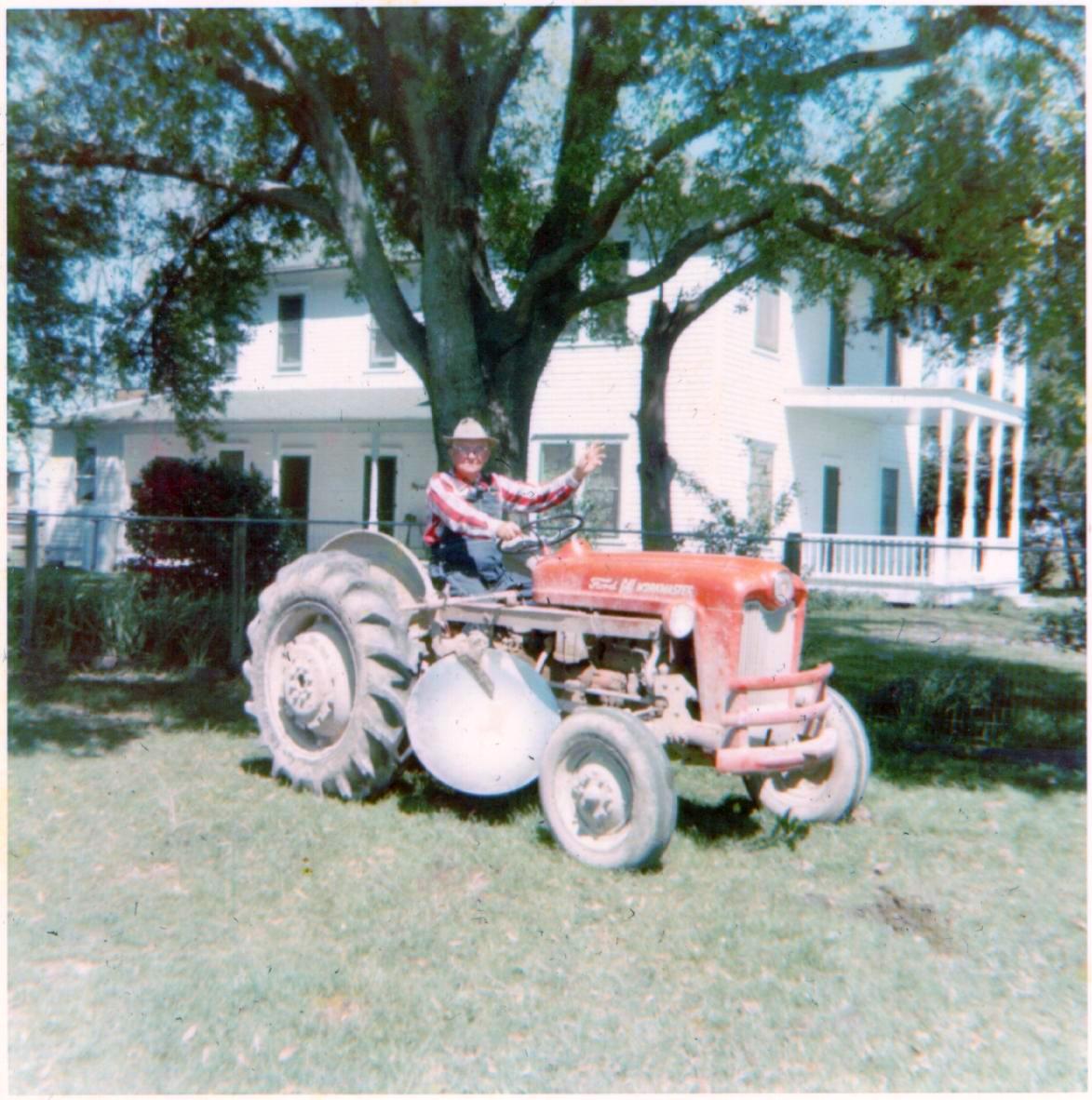
In his later years, he would drive his tractor to his nearby children’s houses when he wanted to visit.

John and Ada had four daughters:
1. Bertha Mobelia Koll, born March 19, 1909 in Elton, LA
2. Dora Anna Koll, born October 14, 1911 in Elton, LA
3. Marie Gertrude Koll, born December 11, 1912 in Elton, LA
4. Esther Maria Koll, born April 27, 1920 in Elton, LA

I didn’t do as heavy research on these Kolls because I know many of you actually knew them and can probably tell me more than I could find online or in old newspaper articles.

John R. Koll on tractor  John and Ada Koll


Newlywed’s First Kitchen

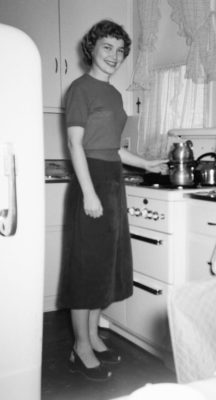
1953-03 Betty Landry LoResThinking of my mom (Betty Lou Bucklin Landry) on her 83rd birthday. Called earlier today and wished her a happy birthday. Then later I came across some old negatives and found this photo that I don’t ever remember seeing before. I think is from March of 1953, which was in her first year of marriage. She looks so happy to be in her very own kitchen.  She gave birth to her first child seven months later.

Johann and Dorathea Kohl

John and Dora Kohl Cabinet CardOur first Koll ancestors in this country, Johann, Dorathea, and two children, arrived at the port of New Orleans on June 13, 1853 on the ship Johann Schmidt after sailing for 72 days. They had uprooted and traveled South from their home in Schleswig to set sail from Hamburg, Germany in the Holstein region.

Johann Rudolf Kohl (John Rudolph Koll) was born March 3, 1817 in Schleswig-Holstein, Germany (then Denmark). He died June 24, 1887 in Preston, Jackson County, Iowa.

Dorathea (Dora) Claudine Mohr was born December 25, 1819 in Kochendorf, Schleswig-Holstein, Germany. She died on July 31, 1890 in Preston, Jackson County, Iowa and was buried August 2. Her death date is “Jun 31” on church records and her gravestone, but there aren’t 31 days in June.  Her burial date suggests July is probably correct.

They made the trip with daughters Anna age 8 (or 11) (1842-1925) and Maria (Mary) age 5 (1848-1934).  Their nine month old son, Christian, died during the voyage on May 28, 1853.

The passenger list of the ship says they intended to live in Iowa, his occupation was farmer, and they came from Sleswick (Schleswig).  John finalized the purchase of 40 acres of Iowa public land from the government in June 1854.

There were two other Kolls listed just below on the passenger list, maybe John Koll’s sister or sister-in-law: Anna Koll who was 20 and baby Dorothea who was under a year old. And there were several Mohrs including Dorathea’s mother, Frederica Juliane Thams that came with them.

The name recorded on the passenger list is Johann Koll and later as John Rudolph Koll on the land record.  His gravestone says Johann R. Koll.  Our family records say that his son Henry was the one to change the family name from Kohl to Koll as an adult.  Those records make me question that, but I have not seen his name in his own handwriting so it’s possible people just kept misspelling his name and it finally stuck in the next generation. John’s daughter Mary was still using Kohl when she got married in 1870.

In Iowa, they had three more children, Dora (1856-1941), Hans Karl (1856-1932), and Henry Fredrick (1861-1937). Dora moved to North Dakota with her husband Henry Brinkman. Anna, Mary, and Hans stayed in Iowa.  Henry Fredrick moved to Arkansas and later Jennings with his wife Anna Wulf.

The photo is a Cabinet Card style print with the mark A. Nott, Preston, Iowa. I found photographer Arthur Nott had a studio in Maquoketa, Jackson County, Iowa in the 1870s and 1880s. The features of the card also appear to be from the 1880s meaning they were probably both in their 60s when it was taken.


The variation in place names and countries when researching was confusing me so I had my brother John explain it:

To delve into their Danish (at the time) place of origin and why we and they considered it German we must run through the issues that plagued the people of the area and touched most of the Europe in the 19th Century.  Perhaps also giving some insight into possible reasons for their immigration, leaving a conflicted land with more war looming for the promise of America.

First off, their origin is currently in the German State of Schleswig-Holstein the northernmost state bordering Denmark.  The area has a long and varied history, comprising the majority of the Duchy of Holstein and the southern part of what was the Duchy of Schleswig (or Sleswick in old English translations).  Duchies are similar to Counties or Parishes within the later larger State.

But at the time of their departure, these same lands were under the sovereign rule of the Danish King.  For many centuries, the King of Denmark was both a Danish Duke of Schleswig and a Duke of Holstein within the Holy Roman Empire (the larger entity that ruled over Germany at the time).

Which brings us to the daunting Schleswig-Holstein Question which was the name given to the complex issues arising in the 19th century out of this odd regional situation.

With the abolition of the Holy Roman Empire in 1806, Denmark claimed Holstein as part of their kingdom which was unpopular among the majority German population in Holstein and southern Schleswig. In the early steps of unification, Germans felt differently and also claimed the Duchy of Holstein within their new Prussian led German Confederation.

This unpopularity led to strong unification movements and gave a pretext for Prussia to declare war on Denmark in order to seize Schleswig and Holstein, by ‘liberating’ Germans from Danish rule.  Though due to alliances, this first 1848 attempt at the liberation ended in a status quo.

Due to unrelated wars, Denmark’s backing had eroded by 1860 and the conflict culminated in Prussia and Austria invading Schleswig on February 1, 1864.  After a short campaign, Denmark capitulated whereby Prussia and Austria took over Schleswig and Holstein respectively in October 30, 1864.

The following war between Prussia and Austria in 1866 unified the two duchies now both under Prussian rule along with most of Germany.  Finally, Germany was formed as a country after defeating France in yet another war, the Franco-Prussian War, on January 18th, 1871.

The Swimming Pool

1929 - Bucklins and Phenices out for a swim cleaned

I love this old photo.  Don’t you just love those old swimsuits?  It’s another old photo that makes you sit back and wonder what is going on.  It’s definitely not one of those staid, studio portraits that you might typically find from that era.  I’d like to know more about this photo.  Mainly I want to know who everyone is.  If you can help with that, let me know.

I’ll start by writing about what I do know.  The first time I saw this photo was two days ago.  Joseph messaged it to me after he had ‘rediscovered’ it on his computer.  He and his mom have been collecting old Bucklin family photos for a while now.  Since the photo also includes some Phenice family, he agreed to let me post it with questions to pool our knowledge.  It’s a swimming pool.

I know that the girl on the far right is my grandmother Myrtle Phenice.  I was estimating that the photo was taken around 1928 or 1929, which is before her 1930 wedding to Fred Bucklin.  There seems to be three distinct groups in this photo, yet she stands alone.  Looking back at the others.  Slightly amused…or grinning to bear it.

The first group on the left are the Bystanders. Most of them are looking at the camera, wondering what to do.  “Are we taking a picture or are we goofing around?”  They seem a bit unsure.  I am more than a bit unsure.  I’m clueless.  I have no idea who any of these people are.  I’m not even sure if the person in the striped swimsuit is a boy or a girl.  Which bathroom would you direct them to?

I think of the next group as the Bucklin Brothers Brawlers.  It looks like they’re fighting over a girl.  If one of them is Fred, I can see why Myrtle is not very amused.  Fred has an identical twin, so one of them could be Clarence (b. 1907).  And Herbert has a similar look and he is close to the same age as the twins (b. 1906).  And who is the girl?

I’ll call the next group the Phenice Fraternity Frolickers.  Myrtle had four brothers:  Sylvan (b. 1901), Henry (b. 1909), Orville (b. 1911), and Warren (b. 1916).  Can you tell which one is which and which one is not present?

So many questions.  Is the Bystander boy standing by the Bucklin Brawlers a Bucklin or a Phenice?  Is Myrtle happy or sad?  Where’s Waldo?  Was Waldo a Bucklin or a Phenice?  Where was this taken?  My guess on that would be on the Ouiska Chitto.  It’s only about 10 miles from the China/Hathaway area that they all lived in and it has beaches and wooded areas like that still.

So if you have a few answers (or suggestion or questions), join in on the swimming pool.  The water’s fine.


Check out Part 2

Presidential Relation

Uncle Ray Bucklin sent me this.  Ray is the one that got us into genealogical DNA testing.  Through 23andMe, he discovered our long lost 2nd cousin Van.  He wasn’t really that lost, we just didn’t know he was into genealogy and old photos too.  We have also discovered a bunch of other distant relatives and found some valuable information to build our family tree.

We are related to Barack Obama through Sir Thomas John Whittington born 1488 in Pauntley, Solers, Gloucestershire, England.  If you trace your family back far enough there is a good chance you can find a common ancestor somewhere.

Barack Obama is descended from Thomas John Whittington’s daughter Margaret Whittington Thockmorton.  We are descended from Thomas’ son Alexander Whittington on the Koll side.  We are also descended from Thomas’ daughter Jane through the Bucklins.

Louise and Ray are Barack Obama’s 15th cousins once removed through the Bucklins.  Joseph, John and Van are his 16th cousins.

Louise and Ray are Barack Obama’s double 13th cousins three times removed through the Kolls. Joseph and John are double 14th cousins twice removed.  We are descended twice from John Whittington 1698.  The question on the Whittington stuff is listing Edward as Grief’s father.  But the numbers work out whichever Whittington was his father in that generation.

Barack Obama is 18th on the list, so if Thomas John Whittington is 14 generations back for me, Louise and I are somewhere around being 14th cousins 3 times removed and Joseph and John are around 15th cousins 2 times removed.

BUCKLINKOLLOBAMA

Great Great Grandchildren
Great Great Great Grandchildren
President Barack H. Obama, Jr 1960
Grandchildren
Great Great Grandchildren
Stanley Ann Dunham Obama 1942
Bucklin Children
Great Grandchildren
Stanley Armour Dunham 1918
Addie Hine 1876
Grandchildren
Ruth Lucille Armour Dunham 1900
Susan Stanbrough Hine 1851
Koll Children
Gabrielia Clark Armour 1876
John Stanbrough 1820
Ada May Whittington 1881
Susan Overal Clark 1849
Evan Stanbrough 1790
Thomas Whittington 1857
George Washington Overal 1820
Solomon Stanbrough 1766
Elisha Whittington 1804
Anne Browning Overall 1780
Nehemiah Stanbrough 1736
Grief Whittington 1762
Susannah Hickman Browning 1745
Josiah Stanbrough 1685
Edward Whittington 1726
James Hickman ??
John Stanbrough 1665
John Whittington 1698
Edwin Hickman 1690
Sarah James Stanbrough 1648
Smart Whittington 1676
Martha Thacker Hickman 1667
Thomas James 1627
William Whittington 1649
Eltonhead Conway Thacker 1646
John Jones 1591
William Whittington 1616
Edwin Conway 1610
Elizabeth Jones Morgan 1572
John Whittington 1578
Dorothy Ann Tracy Conway 1563
Elizabeth Bodenham Morgan 1538
Richard Whittington 1541
Ann Throckmorton Tracy 1546
Jane Whittington Bodenham 1518
Alexander Whittington 1511
Margaret Whittington Throckmorton 1518
Thomas John Whttington 1488

Hine Family Photo 1892

Hine_1892George Hine and Susan Stanbrough’s family we think around 1892 in Indiana. This photo was not labeled and was extremely faded. Van and I realized it was the Hines. The oldest is Addie, who looks like she is about 16 years old here.  That would put the youngest, George Oliver, at 6 which seems like it could fit. The family moved to the Jennings, Louisiana area in the Fall of 1894.
 
George Henry Hine 1846–1919
Susan G. Stanbrough 1851–1933
 
Addie May Hine (Bucklin) 1876–1960
Bert J. Hine 1878–1962
Harrison Rowe Hine 1880–1916
Alonzo J. Hine 1882–1967
James Aulden Hine 1884–1949
George Oliver Hine 1887–1954
Photo scanned by jciv from Jeannette Bucklin Jackson’s collection.

Veterinarian at your Service

Vincent Maximilian Patureau

Vincent Maximilian Patureau was a veterinarian in Lafayette, Louisiana, circa 1914.

My great grandfather Vincent Maximilian Patureau (father of our beloved Mee Maw) had an interesting life. He is usually referred to as “Grampa Max” so I’m going to call him Max.

Max was born in Bagdad, Mexico during the Civil War in 1865 to Ferdinand Pierre and Marie Emma Landry Patureau.  The family was in Mexico to get away from the turmoil of the Civil War. There were also some Patureau relatives who lived in the Metamoras, Mexico/Brownsville, Texas area.  They were the family of Ferdinand’s sister Victorine Patureau Laulom.  Bagdad was a small town that grew suddenly during the Civil War due to its port that helped with cotton trade.

Ferdinand’s family returned to Louisiana and made their home in Plaquemine, Louisiana, shortly after Max was born and the Civil War was over.  Bagdad declined after that and was then destroyed by a hurricane in 1889.  It was never rebuilt and the port was abandoned.

Max grew up in Iberville Parish where his father worked in the sawmill/lumber industry.  Ferdinand eventually had his own sawmill and Max began to work in that industry as well. When Max was 11, his father died as a result of an accident at the sawmill.  He might have been one of the children to witness the accident that led to his father’s death.

In 1888 at age of 23 he married Marie Therese Landry, who was his 2nd cousin through the Landry line (His father married a Landry and his daughter did, too.  Three generations of Patureau/Landry marriage). Their first child was born 10 months later. Several others followed, though some did not make it past infancy. In 1904 he became co-owner of a store, in 1906 he was a witness to a lynching, and in 1909 his wife died. The store closed in 1913 and the family moved to Lafayette.

When in Lafayette Max began practicing the art of veterinary science. From what I’ve heard, he was self-taught. From the photo I posted of the shingle he hung when setting up practice, being self taught did not stop him from putting Dr. in front of his name. From what I’ve noticed lately, everything is a lot more regulated now than it was back then.

The picture is of Max drinking a beverage from a nice cup while standing next to an old car. It was with a group of photos from his veterinary practice. Maybe it was part of an advertising campaign. I think it was meant to be humorous. An old horse doctor who goes out to farms to fix up the animals dressed up all fancy and drinking properly from a nice cup. I like it. What do you think?


Patureau Veterinary Surgeon Sign

Circa 1915 – The shingle that my great grandfather Vincent Maximilian Patureau hung in front of his practice in Lafayette.

1 56 57 58 59 60 64