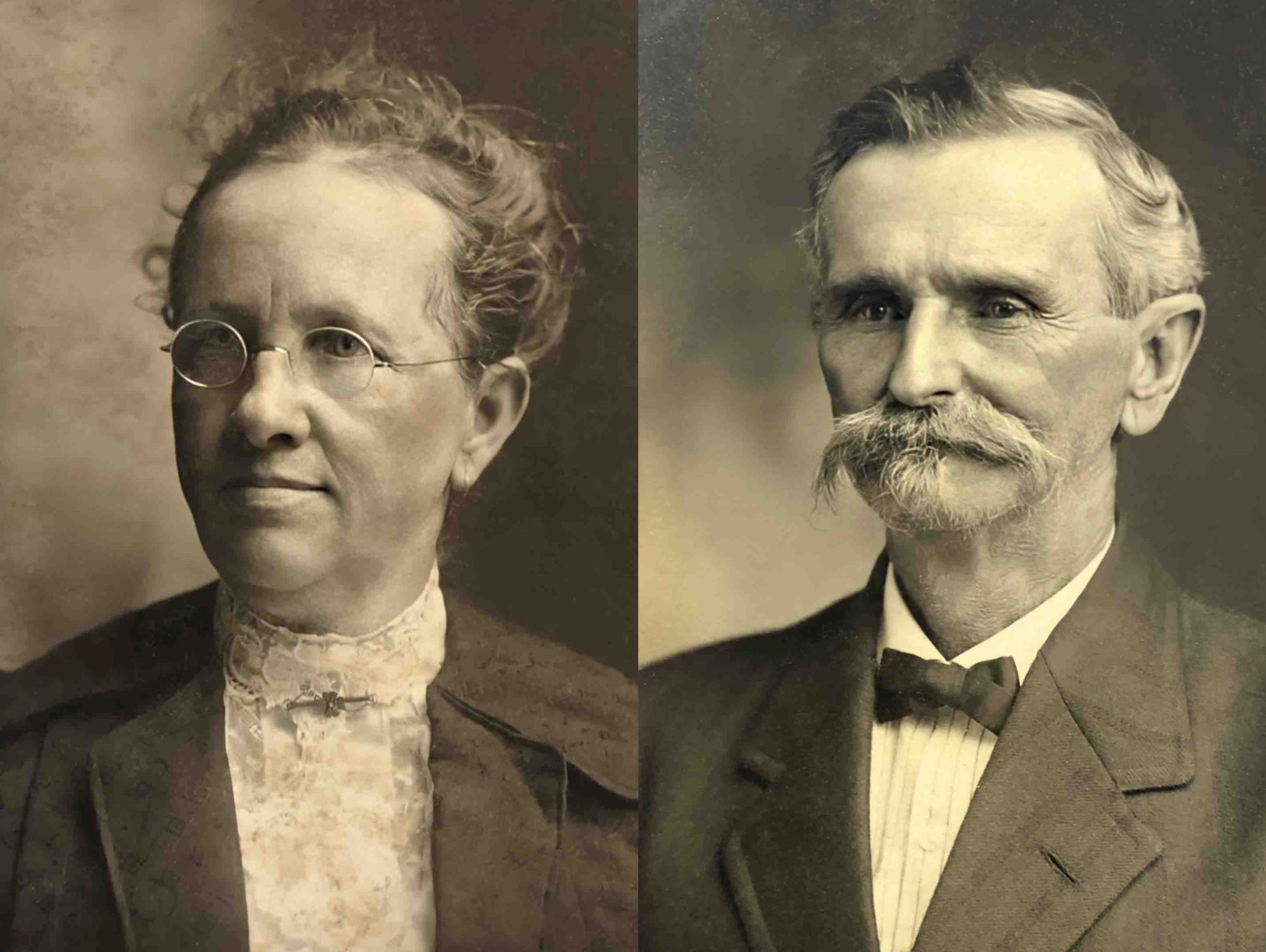
A Patureau Keepsake: The Bed From France

The Patureau family bed has a new home.

I decided to include this post in my Keepsake series, but it is really much, much more than that.  It is the amazing Patureau heirloom that I have hinted at in a few of my previous posts.  It has a long and much-traveled history in my family.  Not that I was aware of any of that history until rather recently.  And I never would have dreamed that I would come to be in possession of such an heirloom. 

There is so much to say about the whole experience of finding out about the bed, being offered the bed, and getting the bed in working order.  And it was definitely not an altogether pleasant experience.  It’s a good thing it has such a powerful story behind it, because I wouldn’t want to go through everything I went through for just any old bed.

And old it is.  This is the bed that Pierre Patureau and Rose Machet brought with them from Riberac, France, when they moved their family to Louisiana in September of 1840.  How is that for pedigree?  It is a bed that my great great great grandparents brought to the United States when they immigrated.  It must have been a treasured item for them to haul this with them across the Atlantic Ocean. 

So when Pierre died on April 21, 1860, at around 1 o’clock a.m., it is likely that he was lying in this bed when he died.  We don’t know that for sure.  I haven’t found any story about that.  But there is some lore that has followed the bed through the years.  It is said that his son Ferdinand died in the bed in 1877 after he had been injured in an accident in his sawmill.  Ferdinand’s widow Emma Landry Patureau died in 1892 in Plaquemine and it is possible that she died in the bed as well.  I’m thinking that at that point the bed was passed down to Ferdinand and Emma’s youngest daughter Victorine Patureau Cropper.  As I have shared with you recently, she had collected a large amount of Patureau photos and other memorabilia.  She and her husband Willie Cropper moved to the Beaumont, Texas, area around 1903 and the bed must have gone there along with them.  It stayed with that family line for the next 100 years or so.

Victorine had an older brother named Max.  He had married Marie Therese Landry in 1888 and by 1903 they had a somewhat large family.  I don’t know if their daughter Erie Patureau knew about that family bed all those years ago when it left her hometown and made its way to Texas.  She grew up and married a Landry of her own – Robert Joseph Landry.  Their third son was known as Bob Landry.  He grew up and did not marry a Landry or a Patureau – he married outside the family!  Their third son was born in 1960.  That would be me, and I was not aware of that bed for most of my life.

But then I heard a hint of it at some time before 2018.  I’m not sure what I heard or who I heard it from, but I was intrigued to see if I could find out more.  In April of 2018 I had a new DNA match at Ancestry.  Her name was Jo Ann and she had a Cropper from Beaumont in her family tree.  I knew immediately that it was a Patureau connection.  I sent her a note saying that I knew who she was and I hoped we could share family information.  The only photo I had (and still have) of Victorine Patureau is an old Xerox copy of a photo.  I was hoping to possibly get a better copy of that photo.  I told her I was willing to share any information or copies of any photo that I have.  I always ask this because you never know who has what out there.  I assumed that I would have more family information and/or memorabilia than she had.  In most cases I would be right.  In this case I was thoroughly and completely wrong.  Wrong, wrong, wrong. 

She wrote back quickly and one of the first things she mentioned was that she had the old Patureau family bed that came from France and Ferdinand had died in.  I was excited to hear about that and wrote to her, “Sometimes my blog post is about keepsakes in the different family lines.  That one would be really amazing.”  So I asked her for a photo of the bed.  That’s all I asked for.  I wanted to write this story about an old Patureau family bed that was still in the family.  She has shared a lot of great old family photos with me since then.  I have shared some of those on different blogs and still have a few more photos to share.  Some of my best photos have come from her.  But she did not send me a photo of the bed … until later.

Fast forward to October 28, 2021.  That week I had been caught in the middle of a discussion between Patureau family members about the Patureau tomb in Plaquemine.  It was getting worked on and some people were not happy with the progress or the steps that were being taken.  From what I saw, they were all coming from a place of concern for the final resting place of their Patureau kin.  So I wrote a post that night called “Passionate for Patureau” and talked about the many people through the years who had an interest in Patureau family history.

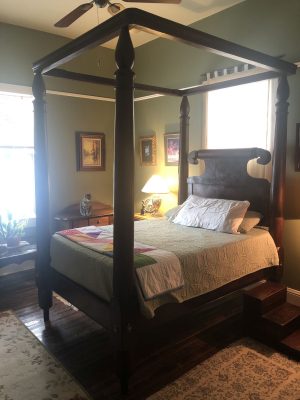
The very next day Jo Ann wrote to me and offered the bed to me.  She said that she didn’t have room for it and no one in her family wanted it.  She wanted to keep it in the family and could tell that I was interested in family history.  She told me that the bed posts were 8 feet tall each.  She didn’t have a mattress, but the bed was not quite full size.  We live in an old house with tall ceilings, so we thought it would work.  We agreed to take the bed sight unseen.   I asked her again about the photo of the bed, and this time she was able to find it and send it to me.  I thought it was very impressive looking.  Come to find out, the bed was in storage in Hammond, which is not that far away.

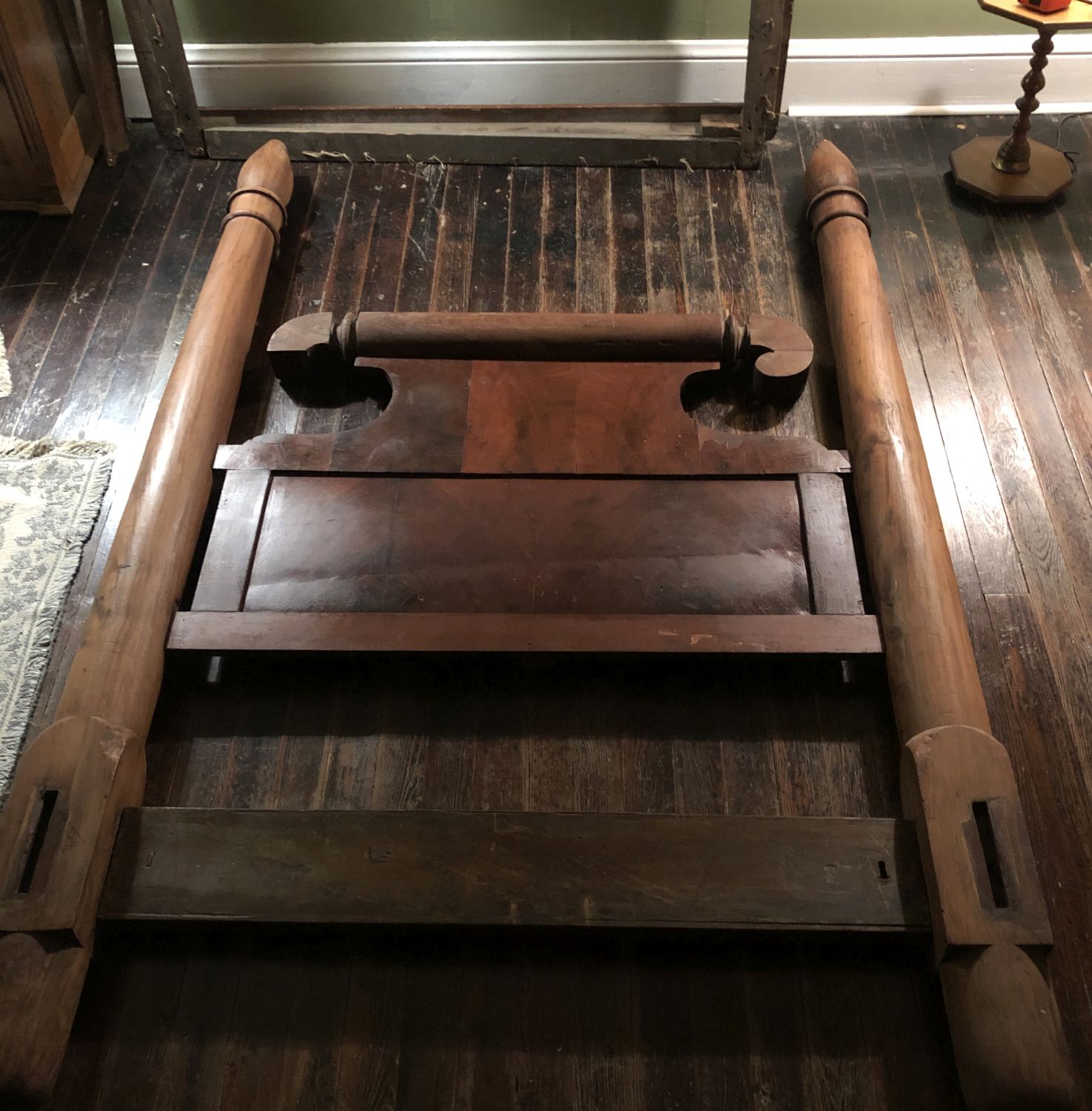
The bed when we first got it to the house. It was missing the pieces to hold it together. It needed some TLC.

So we decided to go get the bed.  We found out that the family members who had the bed were not feeling well so they could possibly have Covid.  That wasn’t going to stop us.  We went to get the bed the day after Christmas.  We also got Covid.  At first I thought it was slowing me down from putting the bed together, but it was a minor delay in what turned into a drawn out effort.

The bed is held together with threaded rods that pass through the bed posts and into the rails that have a connector set into the wood.  The threaded bolts did not come with the bed parts.  Also the top part of the headboard is a separate piece that is called a mattress roller.  It is the rounded piece sitting atop the flat veneered part.  You can see in this photo that part of the scroll is missing on the left side of the mattress roller.  Jo Ann found that piece and sent it to me.  I glued it back together.

I also went to a specialty hardware store and had some bolts cut to size for joining the bed together.  When I tested the different sized bolts to see what size fits, I shouldn’t have been surprised that the size that fit was a metric size M10.  It’s a European sizing system.  That agreed with the story of it coming from France.

After working on getting some of the bed pieced together, we had a Patureau cousin come over to try to get it all put together finally.  Thanks, Byron!  That was toward the end of February.  After scratching a few walls, breaking the fireplace mantel in the room, and almost getting crushed by the massive bedposts, we got the bed put together.  But it was not stable whatsoever.  One of the main problems was that the side rails were warped, so the posts did not stand up straight.  I had noticed that when I had the posts laying on the ground.  Plus some of the connectors would not take the threaded rods and hold together firmly.  It was an accident waiting to happen.  We didn’t want to stand near it, much less try to put a mattress on it. 

So we got professional help.  Mr. L. came and got the bed and brought it to his shop.  All I wanted done was to get the bed stabilized and ready to put a mattress on it.  He pointed out how the side rails were warped and the connectors were stripped.  He said that he’d have to replace them.  He would use new wood on the side rails, but cap it with the old wood that was there previously.  I agreed, because I wanted the bed to be sturdy.  He had asked if I wanted to repair the dings and rough spots on the bed and I said, “No.  I want it to look the same.  It’s an old bed.” 

After a while we got some progress pictures and I was not too happy to see a photo with posts that were sanded and later stained.  Not too happy at all.  But it was already done and the bed was still the bed that my family had brought from France all of those years ago.  Mr. L. said that the bed had probably been a rope bed, which was before box springs came into use.  He estimated the bed to be from around 1800.  So it probably has been in the Patureau family for almost 222 years.  He did a great job of stabilizing the bed and it looks really good.  It is not the way I had wanted it to look, but I can’t always get things my way.  Other people have said it looks so much better.  It is a beautiful bed.

We finally got it back to our house on July 20.  I’m still amazed by the bed.  We measured the bed and had a custom mattress made.  So much for it being a free bed!  While waiting for the mattress, we put a mattress topper on the bed.  I fell asleep on it for a short nap that day.  Last weekend the mattress came in and we were finally able to get the bed made up and ready for guests.  What a piece of history.

And to think:  all I really wanted was to have a photo of the thing!

Another view of the bed.

The Real Photo of Ferdinand Patureau Circa 1875

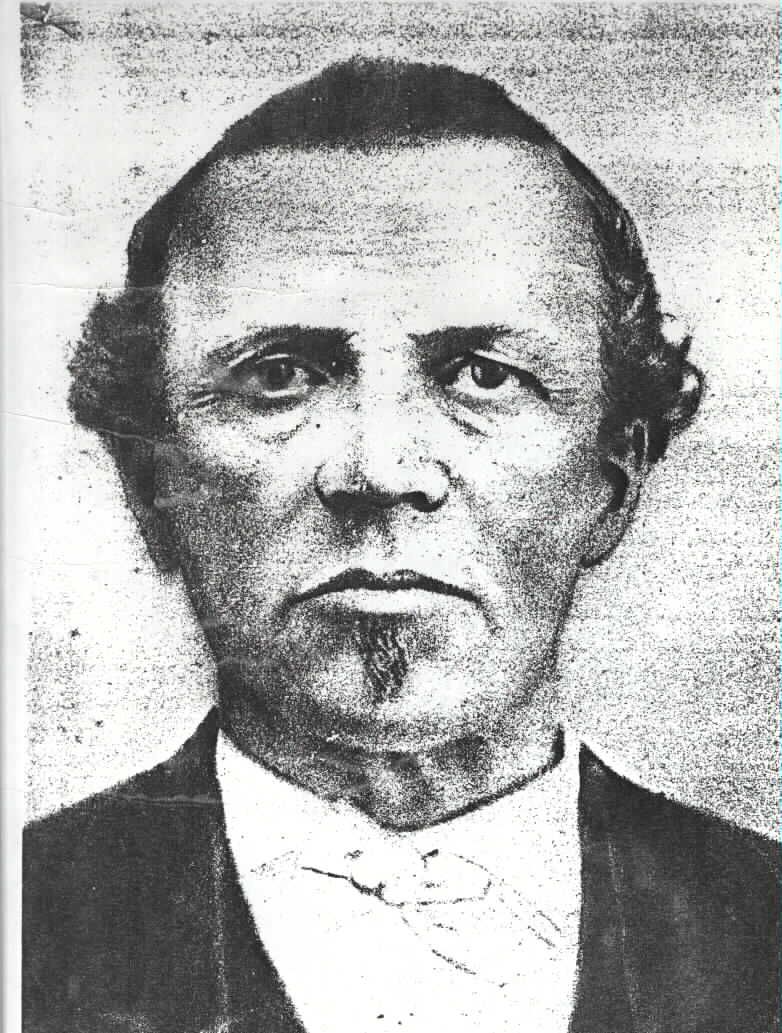
I’m pretty sure this is a drawing of the original photo that was taken around 1875.

For the longest time I’ve been aware of a “photo” of my great great grandfather Ferdinand Pierre Patureau.  A horrible version of the photo was used back in the 1990s as an invitation to Patureau family members to come together for a reunion.  The image was a Xerox copy of a copy of a drawing of a photo.  At least that’s what it looked like to me.  But it didn’t stop people from coming to the reunion and claiming that they were related to old Ferdinand.  The scan of the image I have here is not as bad as the one used for the reunion.  In fact, I cleaned it up and restored it as best I could.  It was better than nothing.

Then a few years ago I got a better copy of the image from my dad’s first cousin Sis of the Patureau line.  I don’t know where she got her version, because it was definitely better than the one I had.  That one had already been edited.  I think some of the programs that restore photos use some type of algorithm that makes an image look more like a photographic image.  I think that’s what happened to this one.  I was thinking that it was a photo.  It was close enough to his likeness that I was able to recognize him in other photos.

Ferdinand Pierre Patureau in a photo from around 1875 in southern Louisiana.

Last November I went to the Pierre Ferdinand Patureau Collection (AC-824) at the Tyrrell Historical Library in Beaumont, Texas.  I’ve shared some of the photos from that collection already.  My favorite photo from that collection is the Patureau family photo from 1864.  There is no question about that.  It is a definite favorite.  It is a photo of Ferdinand Pierre Patureau with his wife Marie Emma Landry Patureau and their children up to that point in time.  Even though it was before my great grandfather Vincent Maximilian Patureau (Grampa Max) had been born, it’s still my favorite.  Then there are runner-ups to that photo.  The real photo of Ferdinand Patureau is one of them.

As you can see in the photo, he looks a bit different.  Yet you can still tell that it is the same person.  He’s got the high forehead, the thin goatee, and the curly hair around his ears.  Another thing that makes me think the other image is a drawing is the detail shown in the clothes.  The lapel of the jacket is outlined, and the white tie outline keeps it from blending in with the shirt he was wearing.  I wondered if it might have been a crayon treatment of an old photo.

Mirror versions of the two sides of Ferdinand’s face. A very different look from one side to the other.

But then I realized what the main difference is.  His face is very asymmetrical in the photo.  Most people have slight differences on the two sides of their faces.  You’ll notice it more when you look at mirrored images.  There is even an app that will show you what you’d look like with one side or the other.  There’s an app for everything!  So it looks like the old drawing was almost an idealized version of the better-looking side of his face.  You’d think that while they were at it, they could have drawn him with a hint of a smile on his face!

I’m not exactly sure of when the photo was taken.  He was born in LaRoche-Chalais, France, on October 27, 1826.  He died in Plaquemine, Louisiana, on February 25, 1877, after having a terrible accident in his sawmill.  He looks older than he did in the 1864 photo, so I estimate that the photo was taken in 1875.  It was probably taken in Plaquemine.

I’m glad this old photo is being preserved in the collection in Beaumont.  Even though it’s not my favorite, it still ranks pretty high.

Our Myrtle the Student: Year One

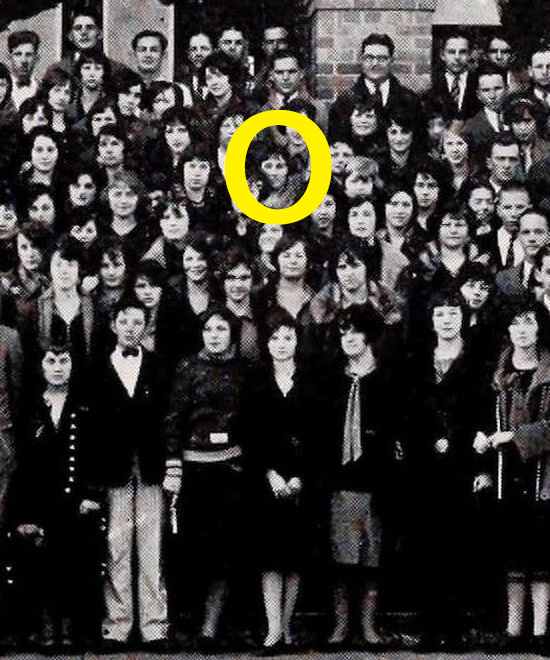
I thought I’d follow up last week’s post about my paternal grandmother in school with the same kind of post about my maternal grandmother.  After I found those photos of my paternal grandmother Erie Patureau at SLI (Southwestern Louisiana Institute in Lafayette), I decided to look for something similar for my maternal grandmother Myrtle Phenice. That’s because I knew that they had both gone to the same school and became teachers after they graduated.  They were not there at the same time, because Erie Patureau was eleven years older than Myrtle Phenice.

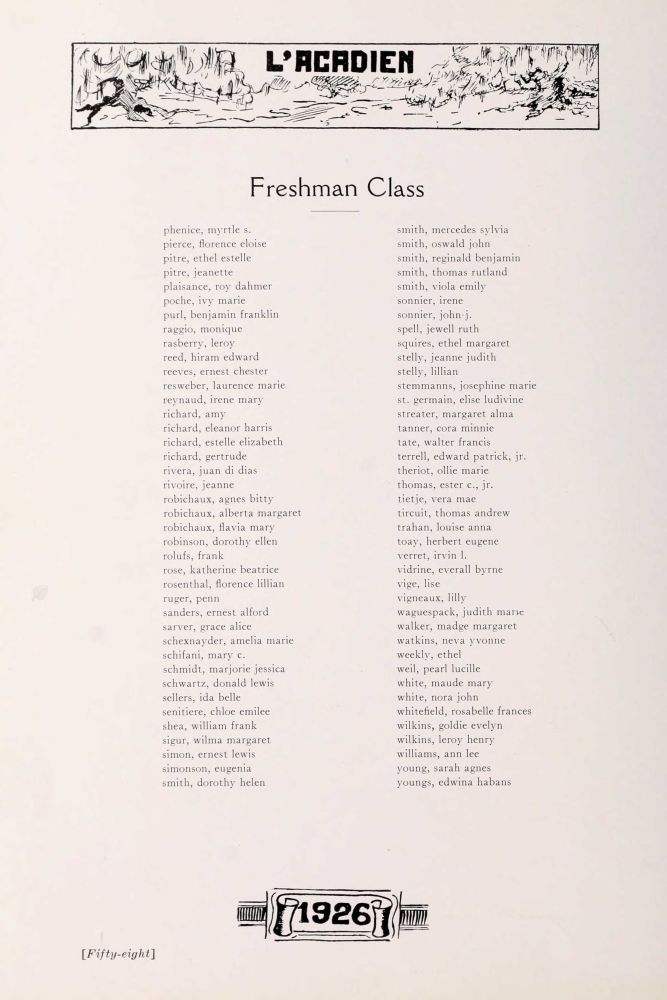
First year class of SLI in 1926 includes my grandmother Myrtle Phenice.

So I looked and I found.  There was a scanned copy of the 1926 yearbook from SLI, or L’Acadien as it was called.  On page 54 of the book was a photo of the first-year class.  I’ve looked through the photo and have not been able to pick her out of the group of students.  The class membership certainly increased since the time that Erie was a student!  I know she is in the class, because she is listed in the class a few pages later. (See update below)

When I was looking through these yearbooks, I found it interesting to see other names that I recognize.   In the first-year class Myrtle Phenice is listed on page 58.  In the same class, but on the previous page, is listed Thornwell Fay Landry.  You probably don’t recognize the name, but I do.  I’ve shared a photo of him before, because he is my father’s first cousin.  Their fathers were brothers (Robert Joseph Landry AKA Pee Paw & Louis Joseph Landry AKA Uncle Louie).  He was also Erie’s half first cousin because their mothers were half-sisters (Marie Therese Landry & Clemence Babin AKA Aunt Clem).

Naomi “Sis” Landry on bottom right.

Too bad they didn’t do individual photos for the freshman class.  I would have been excited to see a photo of my Grandma that I haven’t seen before.  They did have individual photos of the upperclassmen.  And who was in the class above them?  None other than our Landry cousin Sis.  I have mentioned her before.  She made a video about Landry family history with my dad in about 1990.  She identifies a lot of family members in some of those old family photos she had.  But her name in the book is shown as her real name Naomi Landry.  She looks pretty stylish in the photo of her.  Not the much older lady I know from the video.  She was the sister of Thornwell Fay.   So even though they were more than twenty years older than my dad, they were still first cousins.  That’s because Pee Paw was the youngest of all of his siblings.

The other person of interest that I found in the yearbook wasn’t a family member.  That’s not entirely accurate.  The person I’m talking about is Paul Edwin Marionneaux.  He was also in the sophomore class, but more importantly he is my 7th cousin.  While that seems like a pretty distant relative, his daughter is a friend of mine and we have common DNA according to 23andMe.  And even though her father is about the same age as my grandmother, she is younger than I am.

When I was growing up, I never imagined all of the connections that the older generations might have had.  Just this yearbook shows that my grandmother’s path crossed some of my dad’s cousins’ paths.  And one of those distant cousins had a daughter that I am friends with now.  Things like this make you say, “It’s a small world.”  I’m sure I’ll find more connections like this as I continue to explore my family’s history.


August 4, 2024 Update

I did it!  I was finally able to recognize Grandma in that yearbook photo!  How did I not see her earlier?  I have been working on editing some other photos of her from her earlier years, so that probably helped me to notice those distinguishing features of her.  Here is the marked up copy to see where she is located.

Our Erie the Student: Year Three

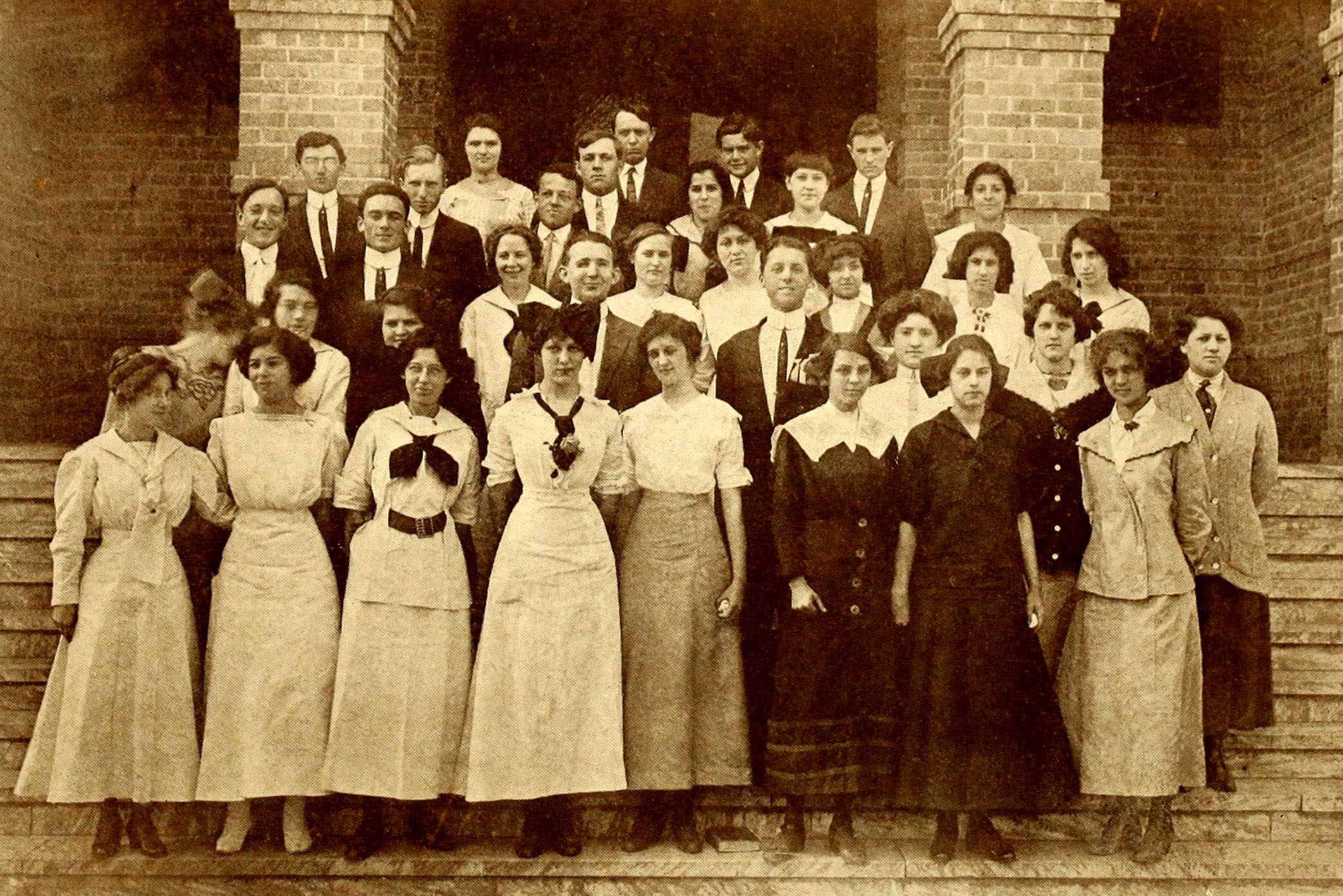
Page 54 of the SLI yearbook from 1913 shows the third year class. My grandmother Germaine Erie Patureau is on the front row, furthest to the right. This was taken in front of the SLI main building in Lafayette, Louisiana.

It’s always exciting to me when I discover another photo of my grandmother that I have never seen before.  This one was taken over 100 years ago, so that makes it even more special.  The grandmother I’m talking about is my dad’s mother.  She was born in Crescent (near Plaquemine), Louisiana, on August 6, 1895.  Her parents were Vincent Maximilian Patureau and Marie Therese Landry.    I knew her as Mee Maw.

I wasn’t planning on writing another post with the title “Our Erie the Student,” because I didn’t know there were any other photos of Mee Maw as a student during her years at SLI in Lafayette.  The first one I posted was just called “Our Erie the Student.”  I thought it was from 1915 because it said that it was a fourth year class photo and that’s the year I thought she graduated.  But the yearbook for her fourth year photo is from 1914.  So, I went back and changed that post to reflect the correct year.  The yearbook also had a better version of the photo for that year.  I’ll have to replace the photo as well.

Page 55 from the 1913 SLI yearbook shows the names of the members of the third year class.

The second post about Mee Maw’s school years was called “Our Erie the Student Revisited.”  Both of those previous posts were written in 2019.  In the revisitation version, the photo was of the graduating class of 1915.  That one is an even better photo, because it came from an original photo that my cousin Tricia has in her Tin Can Collection. 

The photo I’m using this week is definitely the worst quality photo of the three.  But it’s a photo of our dearly beloved Mee Maw from over 100 years ago.  I can’t really complain about that!  And who knows, maybe there is a better copy of it out there that I can discover.  I’m kinda confused at how 1913 could be the photo of her third year class.  But that’s what the information on the next page says and our Erie is on the list of the members.  Other information shows that she finished high school in 1912, so how could she be in the third year already after just one year?

That’s probably because she was so smart.  She was probably one of the smartest people you’d ever likely meet.  She was just Mee Maw to me!

I Say This Is Pierre Patureau

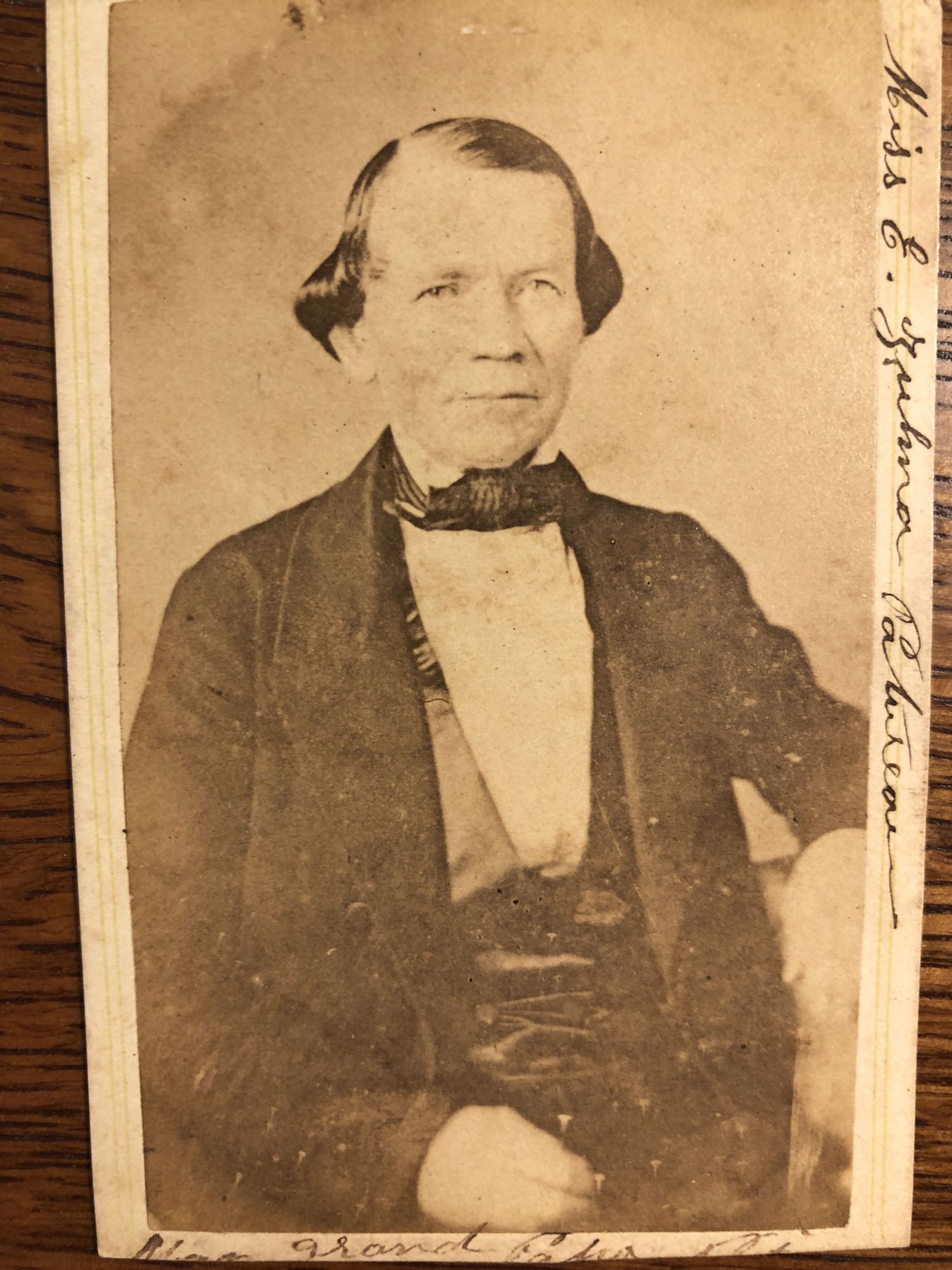
Pierre Ferdinand Patureau circa 1855.  This is an edited and enhanced image that I produced with the use of two other images.

That’s right!  You heard me!  I say this is Pierre Ferdinand Patureau, who was born in France just over 222 years ago.  When he was 40 years old, he and his wife Anne Rose Machet brought their family to America.  The place they chose to settle in was Louisiana.  Maybe that was due to the presence of other French families in the area.  Tragedy struck in 1842 when both Anne Rose and their youngest daughter Elisa died from yellow fever during an epidemic.  Then I’m thinking that around 1855-1858 he decided that he needed to have a portrait of himself made.  But he didn’t want to go with the old traditional painted portrait.  No, sir.  He wanted the newly introduced photographic portrait that was the rage at the time.  So I’m saying that that’s what he did.

But when I first saw a copy of this photo, the person in the photo was identified as Abel Patureau.  Abel was one of the two sons of Pierre Patureau.  I descend from the older brother Ferdinand, as do most of my Patureau cousins.  All of my cousins with the Patureau last name descend from Ferdinand, because Abel was never married and had no children.  There was a sister named Victorine.  Her descendants have the Laulom and Crixell last names.  Of course with all of the daughters born through the years, there are a variety of last names for cousins on both sides.  But since I did not descend from Abel, I was not really that interested in the photo at first.  I think cousin Sis has a copy of the photo and I didn’t even bother to scan it.

Postcard photo from the Pierre Ferdinand Patureau collection in the Tyrrell Historical Library in Beaumont, Texas.

Then I went to the Pierre Ferdinand Patureau collection at the Tyrrell Historical Library in Beaumont, Texas, last November.  As I was furiously taking photos of as many of the documents that I could, I came across the photo again.  It was on card stock and on the back of it is written “This is uncle Able.  Great uncle to us.  Able Patureau from France.”  So again it was identified as Abel Patureau.  There was also some writing on the front of it, but I was rushing through and didn’t really have time to make out what it said.

But after I got home I looked at the writing on many of the photos.  As you can see, along the right edge is written “Miss E. Zulma Patureau.”  That would be Elizabeth Zulma Patureau, who was the oldest child of Ferdinand Pierre Patureau and Marie Emma Landry Patureau.  She wrote her name on many of those old photos.  She would not have been the one who wrote the words on the back of the photo, because Abel Patureau was her uncle.  He was not her grand uncle or great uncle, whichever generation that wrote the identifying info on the back of the photo.

More importantly, along the bottom of this photo is written something like “My grand Pedro” or “My grand Patur…” in the same writing as Zulma’s.  And who was Zulma’s grandfather?  Pierre was.  She was living in Mexico as a 16-year-old girl, so she could have used the Spanish version of the name Pierre on the card – Pedro.  Her grandfather Pierre died in 1860 when Zulma was 12, so she would have known him and knew what he looked like.  He was the only grandfather she knew.  Her other grandfather Elie Onezime Landry died twelve years before she was born.  Photography wasn’t as available in 1837 as it became in the 1850s. 

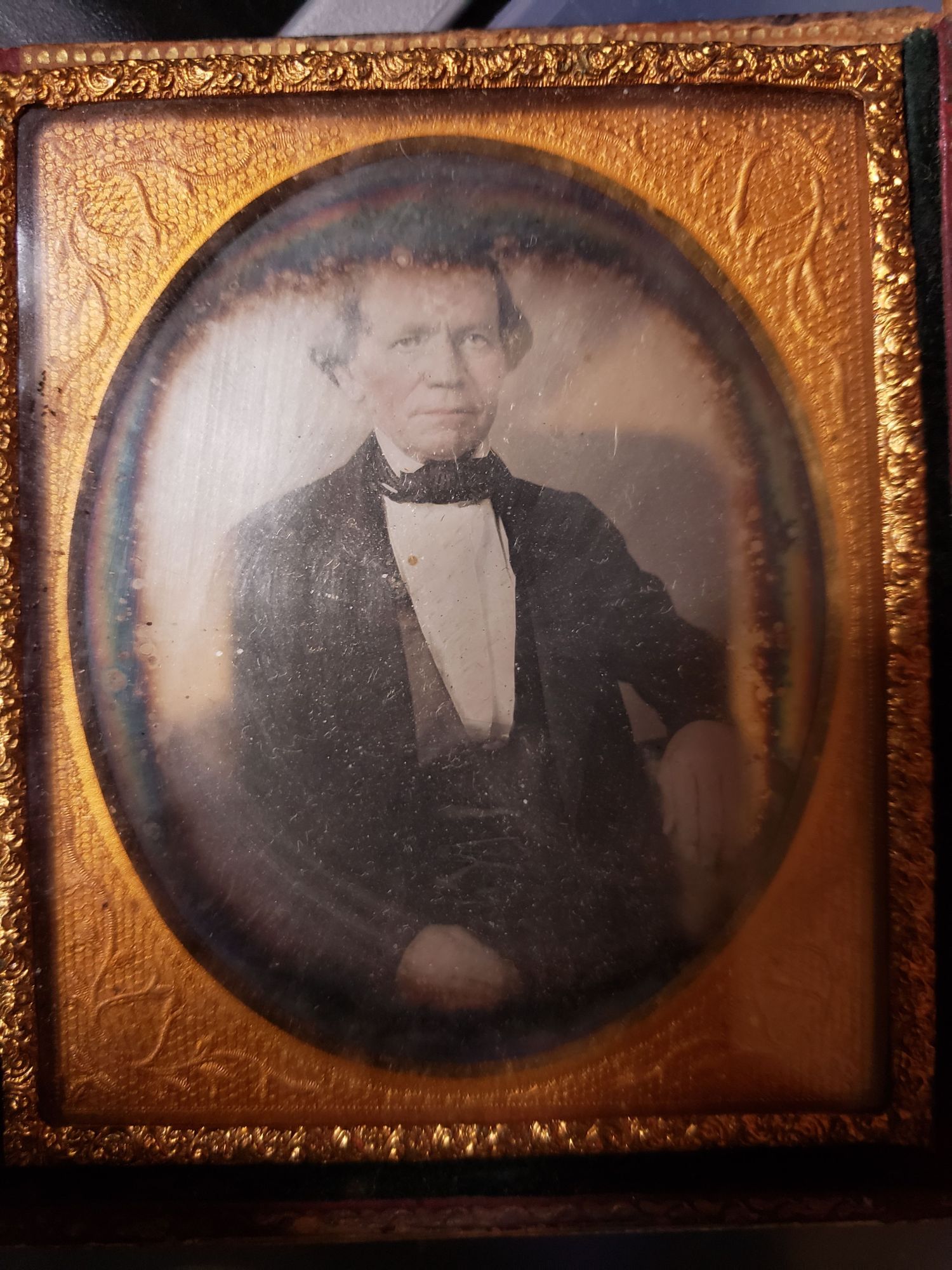
Cased photo from cousin Jo Ann

While the person in the photo looks to be in his late 50s, I wasn’t really sure about the postcard type of photo for this image.  I would have thought that those earlier photos would be in those fancy frames or cases.  So you can imagine my excitement when a Patureau cousin sent me a photo of her version of the photo.  I have to thank Jo Ann for sending me that digital copy of the photo and another photo of Ferdinand I had never seen.  Not only that, but she also gave me an original photo from 1894 of some Patureau family musicians.  She has given me something else really amazing, but I’m not ready to share that yet.  But the original photo she has is a cased photo with velvet and pearl with gold framing.  The face on the photo is really clear.  The cased photo and the clothing in the photo point to a date of the photo around 1857.

I know that Pierre had money to buy such a thing, because at that time he took a trip back to France.  Who knows?  He might have even had the photo taken in France while he was there.  It’s a great old photo that has made its way down to this time in various forms.  That also makes me think that it was Pierre.  Wouldn’t a photo of your ancestor more likely survive throughout a family rather than a photo of an uncle?  I’m glad that I had both photos to work with.  I used the face and the colors from the cased photo, while I used the hairline and the coat features from the card photo.  I am really pleased with the combined photo.

Isn’t this a great image of Pierre Ferdinand Patureau?

Grampa Max’s Brother Uncle Oscar

My great grandfather Max Patureau with some of my grand uncles circa 1920 in Lafayette, Louisiana.

I’ve decided to go ahead and make this a post on its own, even though I’ve shared this photo before.  It’s a Throwback to a Throwback from 2017:  Hats in Hand and a Fob to Boot.  Since I originally posted that photo, I have enhanced it and colorized it.  I think it is nicely improved.  Usually I don’t like colorized photos, but this one still maintains its old timey charm about it even with the color.

But the main reason that I’m doing a whole new post on it is that I misidentified someone in the photo.  How embarrassing is that?  I’ll also post some new photos of family members that led me to the realization that he was incorrectly identified.

So let me identify the men in this photo.  On the left is my great grandfather Max Patureau.  He was born in Mexico in 1865 and was named Vincent Maximilian Patureau.  His daughter was Germaine Erie Patureau, better known by my generation as Mee Maw.  She was married to Robert Joseph Landry, Sr. – Pee Paw to us grandchildren.  They were the parents of my dad Robert Joseph Landry, Jr.  Of those just listed, only Grampa Max is in the photo.  Next to him is his son Romuald Patureau.  He was known as Uncle Rome.  Though his name is spelled like the place in Italy, it rhymes with the word ‘foamy.’  I am always tempted to spell it Romy, but that’s just not the way they did it.

Grampa Max’s older sister Aline Patureau (1849-1926) was married to Omer Hebert (1849-1918).

The next person was known as Uncle Louie.  He was one of Pee Paw’s older brothers and his name was Louis Joseph Peter Landry.  He was married to Clemence Babin.  Aunt Clem was the half-sister of my great grandmother Marie Therese Landry (AKA Mrs. V. M. Patureau).  So that means that Pee Paw’s brother married Mee Maw’s aunt.  (Technically she was Mee Maw’s half aunt, though I doubt my grandmother thought of her that way.)

The person on the right is the one that needs to be identified correctly.  I had him identified as Omer Hebert, but from the photo of Omer Hebert with his wife Aline Patureau, you can see that the two men do not look alike.  The photos of Aline Patureau and her husband Omer Hebert come from the Pierre Ferdinand Patureau collection at the Tyrrell Historical Library in Beaumont, Texas. (Collection AC-824)  So the man in the group photo was not the brother-in-law of Grampa Max.  He was actually Pierre Oscar Patureau, the younger brother of Max.  He must have been called Uncle Oscar. 

Mary Domatille Dupuy married Joseph Oscar Patureau on Sept. 11, 1888, in Plaquemine, Louisiana.

I started questioning his identity when I got several photos from that collection in Beaumont.  Fortunately many of the photos were identified by Max’s older sister Zulma.  I think she may have been the one that pulled a lot of those old Patureau family photos together.  There were a few photos of their brother Pierre Oscar in the collection.  The best one was his wedding photo from 1888.  On September 11 of that year, he married Mary Domatille Dupuy.  They were third cousins through their common Dupuy line.

After working with the photos of Omer Hebert and Oscar Patureau, I began thinking that the man in the group photo was identified incorrectly.  I finally got around to checking into it further this week.  I found the old slide that I had scanned.  On one side I saw it was labeled “Uncle O**r.”  I couldn’t really make out the name, but I was more familiar with the name Omer from the photos I had seen of him.  So I must have gone with Omer.  But when I turned the slide over, there was written clear as day “Uncle Oscar.”  How did I miss that? 

Oh, well, now we know that it was Uncle Oscar Patureau on the right in that group photo.  I’ll change the original post to say the same thing.  I don’t want to perpetuate any false information.  I’m okay with a little embellished information, but false information just will not do.

Claude Roche Was a Frenchman

Last week I told you a story about my great great great grandmother Jeanne Zerbine Dupuy Landry.  I was thinking that I would move on to a post about my mom’s side of the family, but I’ve decided to go further up the line of Zerbine Dupuy.  Mainly because I ended up researching that family line  when I discovered some new sources when looking at last week’s information.

My dad was Robert Joseph Landry, Jr., though most people knew him as Bob, Bobbie, Pluto, Pappy, or Daddy.  His mother was Germaine Erie Patureau Landry.  She was known as Erie, Mama, or Mee Maw.  They spent many years researching their family lines and I have the results of all those years of research.  Mee Maw was the daughter of Vincent Maximilian “Max” Patureau.  My dad knew his Grampa Max, but only until he was about six years old.  Mee Maw didn’t know her grandmother Emma Landry Patureau because she died in 1892, which was a few years before Mee Maw was born.  But just because she didn’t know her grandmother didn’t mean she didn’t know about her.

But it didn’t stop there. She knew a few more generations back.  My dad had the records that Mee Maw kept with her sister Lorena.  So when he put together his book about family history, he marked the profiles of family members with PFR – for Patureau Family Records.  Mee Maw knew about Zerbine, too.  Though I don’t know if she knew the story about Zerbine that I shared with you last week.  That came down another family line.  Mee Maw also knew about Zerbine’s parents Magloire Dupuy and Henriette Serrette, though she had Henriette’s last name as Lerrette.  That’s pretty good.  She knew the names of her great great grandparents.  Most people don’t know that.  And she did that long before computers and the internet help so much in finding information.  She did not have an oracle in her purse like the one I have in my pocket.  So Magloire and Henriette were as far back as she went.

My dad took over the research when my grandmother died in 1973.  He found out that the parents of Henriette were Jean Serrette and Anne Sigur.  They were both from France, but they immigrated to Louisiana and died here.  He also learned that Anne Sigur was the daughter of Pierre Laurent or Lorenzo Sigur and Anne Roche. I recently found an interesting thing about Laurent Sigur.  He once sold some property that is now where the Marigny neighborhood is in New Orleans.  I’ve been there many times and didn’t realize there was any family connection.  But today we are more interested in the Roche line, right?  I did mention that name in the title!

Marriage record from June 16, 1759, in France for Laurent Sigur and Anne Roche. Note all the Roche signatures. This is from Lay St. Christophe, Meurthe-et-Moselle, France.

Daddy didn’t know the names of Anne Roche’s parents, but now we do.  Someone posted a marriage record on WikiTree for Laurent and Anne, and it gave the names of all of their parents.  As you can see in this French record from 1759, Anne’s parents were Claude Roche and Jeanne Guedon.  Claude is described as ‘defunnt,’ which  means deceased.  I was intrigued with the many Roche signatures on the document.  Many documents from this period will have an X for people to mark their approval.  It looks like the Roche family was literate enough to at least write their names.  I’m really interested in the flourishes at the end of J. C. Roche and DRoche’s signatures.  I wonder if there is any significance to that design?

So the person who added this record – I think it was the same person that assisted me in getting Further French Facts for the Patureau family – also provided a link to the original French records from the 1700s.  And it’s free.  How could they do that to me?  Don’t they know that is like dangling a carrot in front of a ravenous rabbit?!  I couldn’t resist.  I wanted to know more about this Claude Roche.  I also wanted to know about Jeanne Guedon, but those flourishes on the Roche name drew me in.  So I started looking…and looking…and looking.  How could they do that to me?

I started at first in 1759 since the link took me to the marriage record.  I found a few Roche family records and I figured they were relatives.  But I wanted to find out when Claude died and I already knew that it was before 1759.  I also had conflicting dates for Anne Roche’s birth.  It was somewhere between 1726 and 1740.  So I decided to start on earlier pages.  The group of records had 771 pages, so I went back to the beginning, which was around 1700 in this case.  Maybe I could find his birth.  So I looked and looked.  Looking through old French records is tiresome.  It made my eyes hurt.  Oh, no.  That was the stye that I had this week.  It also made me sleepy.  Staying up past midnight will do that.

Record of Claude Roche and Jeanne Guedon’s wedding on Nov. 21, 1719, at Lay St. Christophe, France.

But then it’s so exciting when you find something.  I found the marriage record for Claude and Jeanne from November 21, 1719.  This record had the parents of the couples named as well.  Claude was the son of Gaspard Roche and Magdelaine Faure.  Jeanne was the daughter of Jean Guedon and Francoise Thiery.  Once I found their marriage, I figured that children would soon follow.  I found a few births of Roche children, but their father was Dominique.  I thought he might be family and then it was confirmed in a record.  One of the children of Dominique listed Claude as the godfather and he was identified as the uncle.  So Dominique was the older brother of Claude.  Both of them used a dit name of Roxe.  I’m not sure what it means.

I was happy to finally see a daughter of Claude and Jeanne in 1722.  She was given the name Magdelaine.  Sadly, she died just a few months later.  Such a tragedy.  They had a son named Dominique two years later.  Uncle Dominique was the godfather, of course.  In 1726, I found the birth record for Anne Roche, but not our Anne.  This Anne was the daughter of Dominique.  The brothers both had children with the names Claude, Dominique, Jean Claude, Anne, and Francoise.  The families seemed close.  Most of the documents of any family member would usually have the signature of Claude on it.  He must have been respected.

I finally found the birth record of my Anne and it was in 1740.  She was the youngest child of Claude and Jeanne.  At least I didn’t see any more children recorded for Claude and Jeanne.  And like I said, I looked…and looked.  I found weddings and children of other Roche family members – children of Claude and Dominque.  I kept looking because I wanted to find the death record of Claude.  Later in the year of 1740 I found a death record for Francoise Thiery.  It could be our Francoise, and she lived to be about 100 years old.  As I approached the end of the group of 771 pages of records, I started to doubt that his death record would be there.  In a 1751 baptismal record, they name Jeanne Guedon and identify her as the wife of Claude Roche.  I knew he was still alive, because he was not identified as defunct!

Death record for Claude Roche in 1755.

And then, with only two pages remaining, I found it!  There in black and white was the death record for Claude Roche – my ancestor – the Frenchman.  He died on October 15, 1755, in France.  This was about the same time that many of our Acadian ancestors were being rounded up to be Exiled from their homeland.  It is a nice write-up for an official record.  Some other records only showed ‘mort’ or death on the side of the page.  This one says who he was, when he died, and who his wife was.  The most important thing are the last two lines, which read “enterre’ dans l’eglise pres de la chaire”. This translates to “buried in the church near the pulpit.” Wow! That’s a very significant honor.

In the body of the information they give details about when and where he died and how he received the Eucharist and Extreme Unctions.  This is to show that he was a Catholic in good standings and he received the last sacraments.  But even more unusual is that they say that he was ‘honorable et bon et charitable.’  That’s pretty easy to interpret.  They claim that he was an honorable, good, and charitable man.  That’s nice to hear. 

And now that I’ve seen a bit of his history through the records, I know who some of the signatures at the bottom belong to.  J.C. Roche and DRoche must have been his sons Jean Claude and Dominque.  Claude Roche LeJeune was the name his son Claude used to show that he was a junior.  They were paying their respects to their father – an honorable and good and charitable man.  I still want to know what those flourishes were about!

Zerbine Was a Feisty Woman

Jeanne Zerbine Dupuy Landry Comeaux in 1864 in New Orleans, Louisiana. She lived in Brusly at the time.

I know it was just a few weeks ago that I posted this main photo, but I discovered a truly remarkable story about my great great great grandmother as a result of it.  When I post photos and stories on my blog, I am always hopeful that it will stir some memory that someone will share.  I don’t know everything about any of my ancestors – not by a long shot.  So I always welcome comments and reminiscing about the posts that I share.  That’s why I was so excited when the photo and story about Jeanne Zerbine Dupuy Landry unearthed a great treasure.

The family of  one of Zerbine’s brothers passed down a story about her during the Civil War.  But let’s look a little further back.  When Zerbine was born in 1807, there was still a lot of Spanish influence in the area.  The Dupuis family came to Louisiana as a result of Spanish rule inviting the Acadians to this area while providing land to live on.  So when Jeanne Zerbine was named, her name was recorded as Juana Serbine.  Even though I didn’t mention this in the first post about Zerbine, a distant relative found that document and made the connection with a story he had known since childhood.

Zerbine had an older brother by the name of Magloire – he was named after their father.  The sibling born after her was a brother named Edouard.  Zerbine and Edouard both married a Landry with common Hebert ancestors.  Both couples had at least four children, but Zerbine was the only one that survived to the 1860s.  Since the story I discovered was set around 1865, I decided to look to the Censuses to verify that she was indeed alive at the time and living in the same area.

Like I said in the first post, after Elie Onezime died, Zerbine married Valsin Comeaux.  He also did not survive to the 1860s.  But he left his name for Zerbine.  In the 1850 Census she was listed as Z. Comeaux in the household of V. Comeaux in West Baton Rouge Parish.  Also listed are her children Zulma and Pamelia – daughters by Elie Onezime Landry.  There were no Comeaux children listed.  Even though the last name was originally transcribed as Comeana, I found them when I looked up Zulma’s future husband Sosthene Aillet.  They were listed directly under him. 

My great great great grandmother is the first person listed on this page of the 1860 Census.  Listed below her is the household of her niece.

It was equally difficult to find Zerbine in the 1860 Census.  I searched Zerbine Comeaux, Juana Comeaux, and Jeanne Comeaux with no luck.  I went through the West Baton Rouge pages one by one until I found what I was looking for.  After reading through what seemed like a thousand pages, I found the listing for Wdw. Val Comeau.  I know she was the widow of Valsin Comeaux, but couldn’t they put her name for once?  Or at least spell her last name the traditional way?

At least I was able to verify that Zerbine Dupuy AKA Wdw. Val Comeau was alive and well in Brusly, Louisiana, in the 1860s.  Everybody knows that the middle of the 1860s was defined by the Civil War.  I’ve talked about her husband Onezime Landry’s nephews Trasimond and Alcide who fought for the Confederacy during that time.  Brusly was in a state of unrest because the ports of New Orleans and Baton Rouge were controlled by the Union.  During and after the war, Yankees were known to confiscate crops that had been harvested and animals for use as food or service.

Well one day a Yankee man showed up at the home of one Zerbine Comeaux.  That’s right!  Someone was visiting great great great grandma Juana, and it wasn’t a social call.  He intended to make off with a horse from her property.  Well Maman Juana was not going to put up with any more of these Yankee scoundrels running off with her hard-earned belongings.  A horse made a big difference to the lives of people back then!  So she put herself and her shotgun between that Yankee man and her horse.  And I’m sure she had some choice words to say to him.  Not that he would have understood what she was saying.  She was probably speaking French or English with a strong French accent.  But that didn’t keep him from understanding what she was trying to communicate to him.  I suppose her firearm helped out with that!  The Yankee left her property.  The horse didn’t!

So that was the story passed down in the family of Juana/Zerbine’s brother Edouard.  My fourth cousin once removed Edward says that when his sister would let her temper get the best of her, their mother would call her Juana.  If I would have heard that when I was growing up, I would think they were talking about Aunt Wana.  But that wouldn’t make sense because she did not have a temper.  Though the sound of the name is the same, the spelling is different.  Since Edward didn’t have an Aunt Wana, he wanted to know who this Juana was.  Legend has it that the woman that looks so frail and sweet in that old 1864 photo was far from it.  She was a rough lady who didn’t let anyone take advantage of her.  That doesn’t sound like a bad thing at all.  She got to keep her horse.  Unless she got into legal trouble because of it.  But we didn’t hear anything like that passed down.  Yet it was passed down as a type of warning.

Warning or not, I like the story.  Which is why I’m sharing it  today.  If anyone else has any old stories to share, just let me know.  I’m all ears.

Jeanne Zerbine Dupuy Landry Revealed

Photo taken from the Pierre Ferdinand Patureau Collection (AC-824) at the Tyrrell Historical Library in Beaumont, Texas.

I’ve had a hard time getting this post started.  I keep second guessing myself about declaring the identity of the woman in the photo I’m posting.  I’m pretty sure she is my great great great grandmother Jeanne Zerbine Dupuy Landry.  That’s pretty exciting to me, because I haven’t had any other photos of any of my 3X great grandparents.  This is a photo that I copied from the Pierre Ferdinand Patureau Collection at the Tyrrell Historical Library in Beaumont, Texas. (Collection AC-824)  It was in one of the family photo albums in the collection in a prominent place.  Zerbine (pronounced  Zir’bean) Landry was the mother-in-law of Ferdinand Patureau, the patriarch of the Patureau family in southern Louisiana.  But before that, she was Zerbine Dupuy.

Jeanne Zerbine Dupuy was born June 23, 1807, to Magloire Dupuy and Henriette Serrette.  Magloire was the first generation born in America with all Acadian ancestry, while Henriette was first generation born in America with all French ancestry.  By some definitions, they would be considered Creole.  The next generation was a mix of French and Acadian.  I’m not sure how they identified themselves, but they spoke French and were associated and married mostly with people I consider Cajun.

Zerbine was the fourth of eight children.  What’s really interesting is that her grandmother Anne Marie Hebert was alive until the time that Zerbine was almost 18 years old.  Anne Marie was born in Acadie.  She lived with her family there until 1755, when her family and all of the other Acadians were Exiled during the Grand Derangement.  Anne Marie was with her family during twelve years of Exile in Georgetown, Maryland.  The family made their way to Louisiana in 1767.  So when Zerbine was growing up in Brusly, she most likely visited her grandmother in St. Gabriel and heard a few interesting stories from her past.  If only those talking photos really told us things we didn’t already know!!

Zerbine’s grandmother almost lived long enough to make it to her wedding.  Zerbine got married to Elie Onezime Landry on Feb. 7, 1825, in Baton Rouge, Louisiana.  Her grandmother Anne Marie died two days earlier.  Onezime is one of the three sons of Joseph Ignatius Landry that I descend from.  His brother Narcisse Landry was married to Marie Carmelite Hebert.  Marie Carmelite and Zerbine were related, because Carmelite’s grandfather Pierre Paul Hebert was the brother of Zerbine’s grandmother Anne Marie.  But even more interesting, Onezime’s brother Manuel was married to Celeste Bruneteau who was the half-sister of Zerbine’s father.  Celeste was a daughter of Anne Marie.  How did I not realize how closely related these wives were to each other?  These Landry and Hebert families were very enmeshed.

This death notice of Marie Pamelia Landry is part of the Pierre Ferdinand Patureau Collection (AC-824) at the Tyrrell Historical Library in Beaumont, Texas.

Zerbine and Onezime had six children together, including my great great grandmother Marie Emma Landry Patureau.  They only had a dozen years together, because Onezime died in April 1837.  Their sixth child Marie Pamelia actually was born three months after his death.  What a bittersweet occasion that must have been. 

A year later Zerbine married Louis Valsin Comeaux.  I don’t know much about him, so I don’t know if there is a Landry or Hebert connection.  Some family information states that Zerbine and Valsin had three children together.  Yet, in the 1850 Census, the only children in the Comeaux household were Zulma and Pamelia Landry.  No children with the Comeaux last name.  There may have been three Comeaux children for Valsin with a previous marriage, but I’ve never seen any evidence of that.

Zerbin and Valsin only had seventeen years together.  In an odd coincidence, Valsin died in June of 1854 a few days after the death of Marie Pamelia.  So Marie Pamelia’s birth and death are close to the deaths of both of Zerbine’s husbands.

By this time Marie Emma had been married to Ferdinand Patureau for seven years and they had four children.  Their fourth child Marie Valentine was only a year old when she died on August 4, 1854.  It was a rough time for this family, but they carried on.  Marie and Ferdinand had a few more children and in 1864 the family went to New Orleans to have a photograph of the family made.  I know this because I have a copy of that photo and I’ve shared it with everyone.

But I also think that they brought Emma’s mother Zerbine with them and had a portrait made of her as well.  The main photo of this post was taken at the same photo studio around the same time as the 1864 photo.  The name of the studio and the print on the back of the two photos are identical.  A friend of mine who loves the study of Civil War era history and fashions assures me that the photo was taken in the Civil War era.  This is based on the hairstyle and the dress she is wearing.  And as I said earlier, the photo was in a Patureau family photo album in a prominent position.  Who else would it be?  Ferdinand’s mother died in 1842.  Zerbine lived until 1886.  Plus the woman in the photo looks like she could be Emma’s mother.  These were people who saved death notices of their beloved family members, and of course they would want to have a portrait made of their mother.

So yes, I do believe this is a photo of my great great great grandmother Jeanne Zerbine Dupuy Landry.  Try not to be too jealous.


Check out the follow up  to this story:

Zerbine Was a Feisty Woman


Patureau and Landry Musicians Circa 1900

Kelly’s String Band from Plaquemine, Louisiana, circa 1900.

I’ve posted this photo before, but it was a poor quality version of the photo.  Then at the end of last year I was given an original copy of the photo when I went to pick up an amazing Patureau family heirloom.  The photo is a cabinet card from around 1900 in Plaquemine, Louisiana.  It came from a Patureau relative, which makes sense because three of the people in the photo are Patureau relatives.  Even though I still have several photos to edit from the Patureau Collection from Beaumont, I decided to edit this photo anyway.  I even made a colorized version with a new and improved program. I like the results.

When I posted the photo previously, I didn’t know the connection that I had with one of the other band members – Wade Landry.  I found out the connection a while back.  But those two things by themselves wasn’t enough to cause me to write a post about the photo again.  What pushed me over the edge in deciding to write about this topic was something that was shared on Facebook last week.  In the Plaquemine – My Home Town group, B. D. posted a newspaper article that talked about a tragic accident that happened in Plaquemine in 1907.

Before I tell you about that, let me introduce you to everyone.  (Drum roll, please!) In front on the left, playing the trumpet is our very own Joseph Alcide Patureau (1868-1919).  Alcide was three years younger than his brother Max.  Vincent Maximilian Patureau was the father of my paternal grandmother.  I’ve never heard of Grampa Max playing any musical instrument.  Front and center with the banjo is Alcide and Max’s younger brother Abel Omer Patureau (1870-1917).  Also in the front row is another Patureau family member – Joseph Ferdinand Hebert.  His mother was Aline Patureau Hebert – older sister to Alcide, Max, and Omer.  Ferdinand played the mandolin.  In the second row we have Nick Manola on the upright bass.  It looks like he tears up those strings.  One of them looks like it is wrapped around the head of the instrument.  I don’t know of any relation to him.  I know he lived in Plaquemine and later moved to Chicago.  And that leaves us with Wade Landry on guitar.

I’m sure everyone remembers that Grampa Max’s mother was Marie Emma Landry.  If not, then now you know.  Don’t forget it!  His great grandfather was Joseph Ignatius Landry, who just happens to be an ancestor of Wade Landry as well.  Come to find out, Wade’s father Joseph Alcee Landry was a second cousin of Max, Alcide, and Omer.  That would make Wade the third cousin of Ferdinand Hebert.  Both of them were from the next generation.  When I read the newspaper article about the tragedy, I posted a comment about it and shared the old article I have about Kelly’s String Band.  I’m glad I did, because B. D. shared an earlier newspaper article.

In that article from 1895, it talked about Alcee Landry giving an elegant supper at his residence.  I don’t know how many guests he had, but the table was “exquisitely arranged” in their “brilliantly illuminated” dining room.  Omer Patureau was one of the main entertainers for the evening.  He played the banjo!  He recited verse!  He even sang along with his pretty young cousins.  Wade played a “pleasing selection” on the guitar along with his cousin Ferdinand on the mandolin.  His sister Maude played a solo on the mandolin and later joined younger sister Edna and cousin Omer in singing a lively song.  It stated that “all who were present spent a most enjoyable evening. ” 

But alas, things did not remain idyllic for our Wade.  Sure, he got married and they soon had two young children together by 1907.  I’m not sure when that took place.  I haven’t found records for his children, yet.  But the article that I saw was from December 1907.  It talked about a group of six people including Wade Landry who were traveling on Bayou Plaquemine in a “gasoline launch.”  I guess you would now call it a motor boat.  Another boat came along and the two owners decided to test the speed of their boats.  The second boat got in front of the boat with Wade in it and capsized it.  The six people on the boat went in the water.  Only three of them came out alive.  Wade was not one of them.  He was only 30 years old.  It was a tragic day for the community of Plaquemine.

Sometimes it is not so pleasing to know the stories behind the photos.

1 3 4 5 6 7 14