Mamma and Nook in 1890
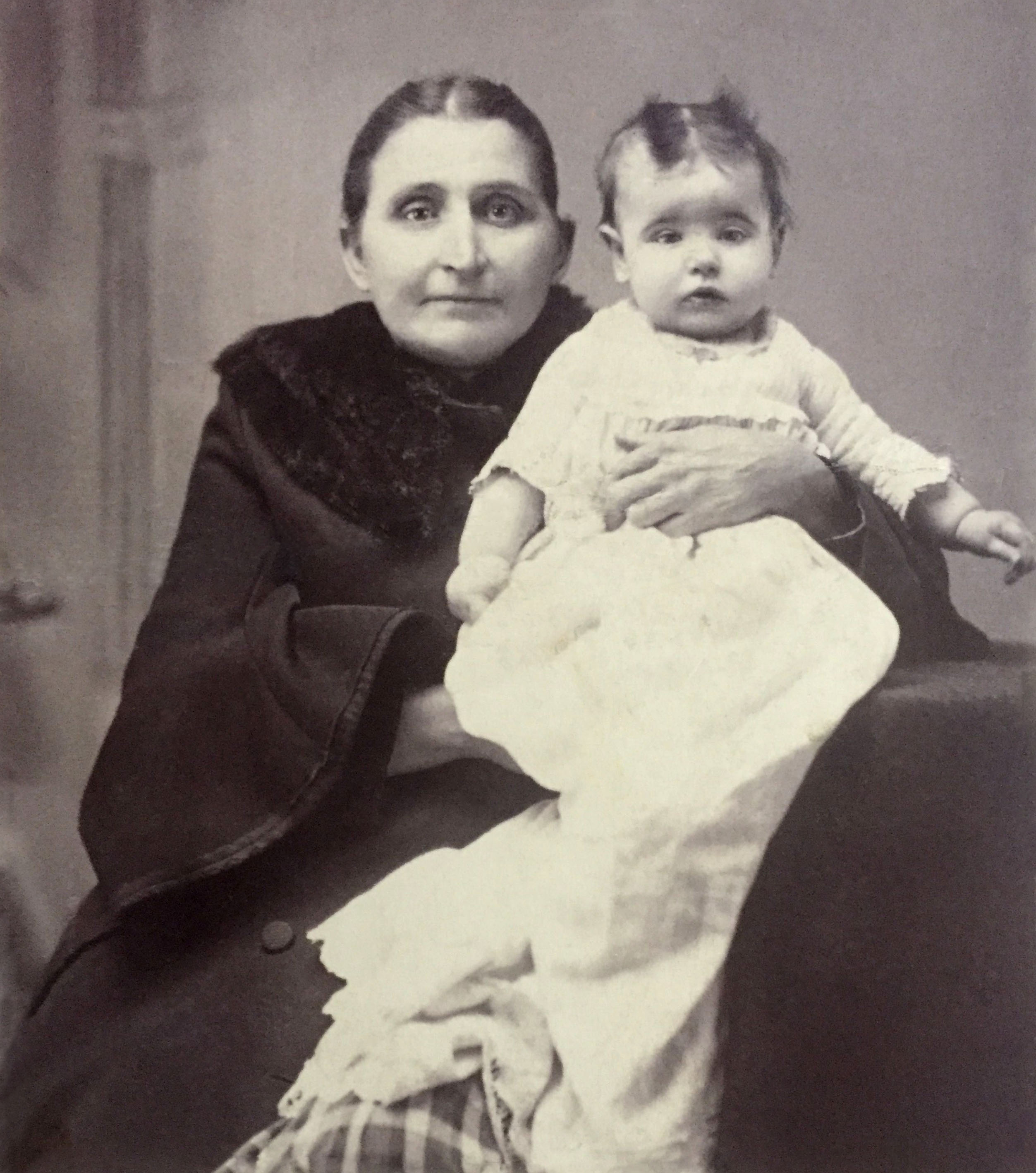
‘Mamma + Nook’ was the inscription written on the border of this photo.  Do you recognize anyone?  Yes? No?

I was so excited when I first saw this photo.  Not only because of the cute little baby who was obviously called Nook.  (Or do I have that wrong?  The little baby could actually be ‘Mamma’ and the older one ‘Nook.’)  I was excited because I recognized my great great grandmother Cathrine Jane Foster Phenice immediately.

Even though the other photos of her that I had seen were from about 20 or 30 years later, she still had that Grandpa Munster look about her.  I shouldn’t say that.  I still feel a little guilty about turning her later years photo into a Grandpa Munster lookalike for Halloween this year. (Animating old photos has helped to change my view of her.)

Cathrine or Kate was the mother of Harry Clifton Phenice.  Harry was the father of Myrtle Sylvia Phenice Bucklin.  Myrtle was the mother of Betty Lou Bucklin Landry.  And everyone knows that Betty Lou was my dear sweet mama.  Kate was also the mother of the little girl in the photo.  Her name was Emma Orra Phenice and she was the grandmother of Mona Quillen, the person who graciously shared this photo with me.  It is part of the collection that I refer to as the Lincoln Collection.

I got this photo earlier this year and fell in love with it.  But I have to take my time in sharing the really good ones since there are a limited number of them.  Consider this a Christmas gift from me.  It’s kind of appropriate because the last time I featured Kate, there was a Christmas theme.  (She had her fire incident on Christmas Eve Eve, remember?)
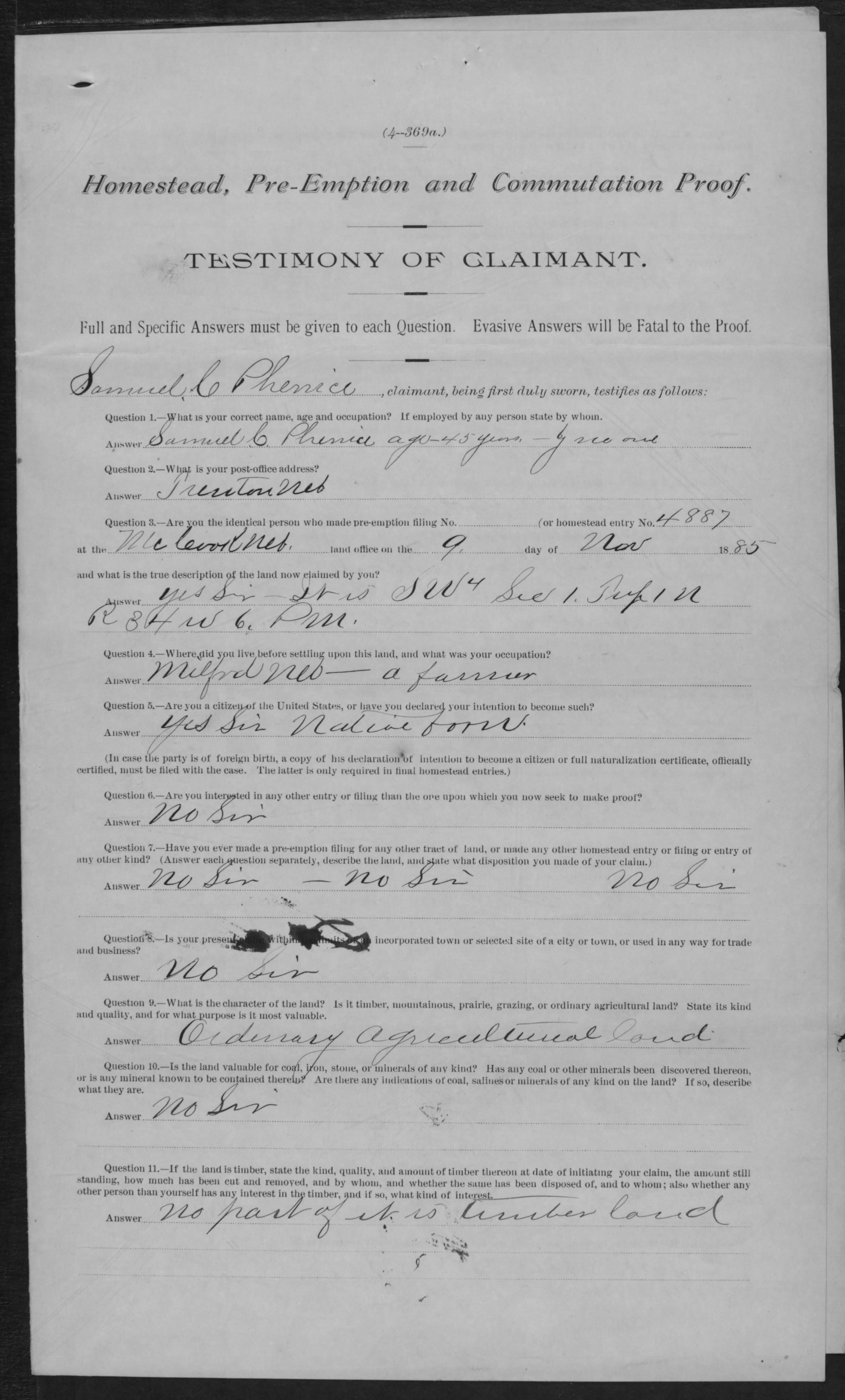
1889 Homestead Testimony Page 1

Since Emma was born in 1889, I’m dating this photo as 1890.  And I happened to run across some other information earlier this year that gives some more glimpses into what was going on with the Phenice family in 1889.  I found a document titled “Homestead, Pre-Emption and Commutation Proof.”  It was for the land homesteaded by Samuel Phenice in McCook County, Nebraska.  He had filed a homestead entry No. 4887 on Nov. 9, 1885.  He moved onto the property on April 1, 1886 and commenced to “building a house worth $12.” (see page 2 of document)

1889 Homestead Testimony Page 2

He stated that his family consists of himself, his wife, and their six children.  This was true for June 8, 1889, which is when the document was written.  Kate had given birth to seven children, but they had lost an infant daughter named Mollie in 1881. So when little Emma was born on June 20, Samuel and Kate would have seven children.  Emma was their last child.

The document states that Kate and the children moved onto the property (and into the $12 house he built) on about June 10, 1886, which was about ten weeks after he started work on the site.  According to page 3, the house was “part dug + part sod house, 22 by 24 feet with an ‘Ell’ 14 by 22 feet in size, has 4 doors and 5 windows worth $200.”

1889 Homestead Testimony Page 3

He goes on to list improvements on the land and their value.  They had a stable worth $20, a granary worth $20, a 155 ft. deep well worth $80, 65 acres of farmed land worth $130, and forest and fruit trees worth $50.  He puts a total value as $500.  He also had farm implements such as two plows, a cultivator, a mower (not a riding one, I’m sure!), a wagon, and a barrow.  All of which he had owned since before moving on to the property.

Aren’t you just loving all of these details?  I am.  It describes so much of what their life would have been like out in the prairie lands in Nebraska where his neighbor (& witness in other documents) lived 3/4 of a mile away.  The neighbor said he visited frequently.

1889 Homestead Testimony Page 4

When the neighbor visited, he probably noticed that there was a horse, five cows, a colt, three hogs, and a mess of chickens.  When he went into the house he would have seen the stove, the two tables, and the ten chairs.  He may or may not have seen the four beds and the bedding.  If he shared a meal with them he would have seen the dishes and cooking utensils.

He would definitely notice those six kids ranging from age three to twenty-one.  (Our H. C. was 15 at the time.)  It’s hard not to notice that many kids running around underfoot.  It also would have been hard not to notice that Kate was soon to be adding a seventh to the group.  Would he have commented on that?  Would that have been frowned upon?  There’s no way to know about that.  That wasn’t included in the document.

One of the other things I like about this document is that it was written by Samuel himself and signed as well.  And his answers to some of the questions are interesting as well – “No Sir” and “I think not.”  Little did they know that we would be looking back at that document and photo almost 130 years later to get a glimpse of their lives.

You may now return to the present.

Christmas Eve Eve 1920

It was getting cold that late December day.  The following day would be the coldest day of the month and would get down to -17 degrees.  That would be a really cold Christmas Eve.  So as they gathered around their trash burner/wood stove, thoughts of the upcoming first Christmas of the 1920s may have been crossing their minds.  Cathrine would be thinking about the many meals that this stove would be used to prepare.  There were many grandchildren who would hopefully enjoy the feast she intended to prepare.

Samuel Charles Phenice with wife Catherine circa 1920 Nebraska

Samuel Charles Phenice with his wife Cathrine Jane Foster Phenice and their two great grandsons Floyd and Elmer Racine (sons of Marie Taylor Racine, grandsons of Anna May Phenice Taylor – listed in Cathrine’s obituary). This was probably in Nebraska circa 1920.

Samuel as well was probably thinking of that feast to come.  Of course, he didn’t have to worry about that overmuch because it was probably his devoted wife of 54 years who would be doing that cooking.  He may have been recounting to his friend Louis the exciting times he had in years past, such as that long ago day at Ford’s Theatre in Washington, DC.  Whatever they were thinking, those thoughts were soon swept from their minds because of what happened next.

Cathrine probably opened the stove to put more wood on the fire as she had done thousands of times during her 72 years on earth.  No big deal, just a part of her ordinary life in her 1920s home in Precept, Nebraska.  But this was no ordinary day.  Either she stood too close to the fire or for some reason there was a particularly strong draft, but something definitely went wrong for her.  Before she knew it, her dress was on fire and evidently it was burning quickly.  When she realized the severity of the situation, she screamed and began to run in a panic.

I’m sure this was a horrific sight for her husband to behold.  Anybody knows how painful it can be to witness a loved one suffer.  So to see his beloved wife being consumed by fire must have been heart-wrenching.  “Who’s going to cook my Christmas feast now?” he wondered in alarm.  I’m sorry.  I was doing so well telling this serious and terrible story without breaking the tension, but then my evil humor took over.  I’m sure that thought was nowhere near his mind.  He sprang into action no matter the consequence to himself.

He got to his wife, caught her, and tried everything he could to extinguish the flames.  In the process he burned his hands terribly.  His friend Louis Adler witnessed what was happening, filled up a container with water, and did what he could to help put out the fire.  The fire had reached her hair, because he poured water over her head to stop the flames.  The fire was put out, but not before burning poor Cathrine so badly that her life ended as a result of it.

She did not die immediately.  It was said that she suffered miserably.  It must have been a very somber Christmas that year for the Phenice family.  Their beloved matriarch suffered with blood poison as a result of the burning.  It sounded like she had severe burns over a large portion of her body.  She was quoted as saying shortly before she died, “I know you if I can’t see you,” which makes me wonder if she was blinded by the fire.  She ended up dying at 3:20 p.m. on January 7, 1921, at the age of 72 years, 3 months, and 22 days.  I like the way in some parts of the country, the age is given like that in obituaries or on headstones.

Even though she suffered for two weeks, the family reported that she was patient all the way.  When writing an obituary, I would think that most people try to make it reflect the person and be true to who they were.  The report of being patient was written two times in that one article.  I suppose they wanted that to be well understood.

Catherine Jane Foster Phenice

Cathrine Jane Foster Phenice circa 1910.

She sounds like a good woman who relied on her faith to see her through.  Generosity to those in need was also attributed to her.  I can believe it because of what she inspired in others.  Her husband risked his own life to attend to her terrible situation.  Then her children lovingly tended to her during her last weeks of suffering before tenderly laying her to rest.


I’ve been wanting to write about Cathrine Jane Foster Phenice for a while now.  Like the first picture above, she was kind of in the shadows.  Her husband was a witness to the assassination of President Lincoln, so he tended to get most of the attention.  It is such an historic event.  But his wife deserved to be the center of attention at least once.  I was planning on writing her life story, but got carried away with the events surrounding her final days.  I will probably write another story about her at a later date.  (See the great photo I found and the post I wrote about it here.)  Maybe I’ll find another photo to post of her as well.  That first photo was another one of the photos that I had taken of my grandmother’s photos back in the 80s and forgotten about until recently.

The portrait of her had been in my mom’s possession for as long as I can remember.  I hate to make fun of her, but she always reminded me of Grandpa from the Munsters.  My mom must have thought similarly, because she wrote, “Isn’t she a cutie?” on the back of the photo.  I may also do a Munsters version of this photo at one point.  All in good fun.  (Here is the result.)

I’m also posting the obituary from their local paper.  I worked for hours cleaning it up so it could be legible.  Most of the details from my story came from that.  I also looked at historical meteorological data and did a search for (vintage) trash burner (/stove).  It answered my question as to why they would have a trash burner inside.  After all these hours spent with these photos and articles, I have grown quite fond of my great great grandmother Cathrine Jane.

Phenice DNA at AncestryDNA

Aunt Loris Bucklin Woolley (my mom’s sister) agreed to submit a saliva sample to AncestryDNA a few months ago. I had myself and my parents tested at 23andMe previous to that, but I wanted to spread my net to the pool of Ancestry.com testers. One of the first DNA matches that I noticed on her results was someone named Henry Oakley Spencer.

I had expected that match because I already knew that he had a good portion of matching DNA with my mom.  I had interacted with him on Ancestry after noticing that his family tree had matching names of Daniel Phenice and Susan Jackson.  Then he had taken a DNA test at AncestryDNA and uploaded his result to GEDmatch.com.  He showed up as having more DNA in common with my mom than anybody else she matched DNA with.  It was actually more than would be expected for 3rd cousins. 

So the match to him was not a surprise.  The surprise that I did find was a DNA match with the Quillen name. My great grandfather Harry Clifton Phenice (grandson of Daniel and Susan) had a sister named Emma Orra that was married to a Quillen, so I assumed that’s how we were related. And sure enough, I was right.  This DNA match was the great granddaughter of Emma Phenice Quillen.  

1921- Catherine Jane Foster Phenice and Samuel Phenice with grandchildren

Circa 1920- Cathrine Jane Foster Phenice and Samuel Phenice with grandchildren (children of Emma Orra Phenice Quillen).  On Cathrine’s lap is Harold, in the middle is Erma, and on Samuel’s lap is Dean.

Actually two Phenice 3rd cousins (to my generation) have tested there and are matches to Aunt Loris. But the best part is that one of them responded to my note to her and ended up sending me a photo of Harry Clifton Phenice’s parents Samuel Charles and Cathrine Jane Foster Phenice with some of their grandchildren!! I love getting new old photos of my ancestors. It’s an exciting reward to the research that I do.

So if you enjoy this photo, you can thank my third cousin Michelle Quillen.

PHLEGMATIC PHENICE PHOTOGRAPHS

I can’t wait til Thursday to post this. I’m too excited about these old photos that I rediscovered, and everyone will be busy on Thanksgiving.

1910 - Samuel Charles and Catherine Jane Foster Phenice

Samuel Charles Phenice and his wife Catherine Jane Foster

This is as far back as we can go with photos of the Phenice line, unless someone has a photo of Daniel Phenice (1809-1880). These are the parents of Harry Clifton Phenice. Samuel Charles Phenice was born in Mercer County, Pennyslvania, on April 19, 1844, and died in Precept, Nebraska on Sept. 15, 1939.  Catherine Jane Foster was born in Mercer County, Pennsylvania, on Sept. 16, 1848, and died in Beaver City, Nebraska, on Jan. 7, 1921.  Don’t their faces have a lot of character! 

1939 - Phenice Samuel Charles Newspaper article about Lincoln Assassination


One of the earliest stories I remember hearing about the family was that my ancestor had been present at the assassination of President Lincoln.The family has this newspaper article that talks about the events, but I would still like to find out a bit more.  Surely they interviewed everyone at that time and kept transcriptions of what was said.  I’d like to see that if it is out there somewhere.  I’ve looked and I will keep looking.

That was always a really interesting thing to be witness to.  Another interesting thing to note is that both newspaper articles are about tragedies.  Which is what led to the title of this post.  I was looking for something that started with ph- and was appropriate.  Phlegmatic is an interesting word.  I had to look it up, but it fit this couple just right.


Jan. 1921 obituary for Catherine Jane Foster Phenice has many details about her life.

Another story that I remember from my childhood.  It was always a lesson about not running if your clothes catch fire.  It is a very sad and touching story.  It also is invaluable in all of the details about her life that are provided.


1 2