Is Erie Engaged in the Chair?

Today we will be discussing my paternal grandmother Germaine Erie Patureau.  I’ll use her maiden name, since I think she was single at the time.  It would be later that she would acquire the last name Landry and then be known as Mama.  A while later on she would be known by us grandkids as Mee Maw.

Poor quality photo of Erie in the chair.

But at the time of this photo she was usually known as Erie.  So that’s what we’ll call her. I had this old, poor quality copy of a photo of Erie sitting in a chair.  I’m not sure where it came from, but I didn’t really care for it.  Other cousins seemed to like it.  Maybe that’s because at least one of them had a much better copy of it!  As you can see I kept it, but I always hoped to get a better copy of it.

In August 2019 some of us cousins got together to share photos and documents.  I’ve told you that before.  But what I didn’t tell you is that we hugged, stood next to each other, and breathed near each other.  Even Shirley!  Those were the good old days.  Now we’re all keeping a distance and hoping the Covid vaccine comes out sooner than later.  But last year we got together and I was able to get this new improved version of the photo.

Erie Patureau circa 1921 probably in Lafayette, Louisiana.

Isn’t this one much better?  It’s so much clearer and it’s not washed out.  You can also see so much more detail on her dress.  Not to mention that you can see her feet.  Of course she was being very proper, because even though the dress ends a bit above her shoes, you still don’t see her ankles.  That would have been scandalous!  I’m surprised she got away with those see-through sleeves she’s wearing.  That seems a little risque!

The other detail I noticed was the Apple watch that she’s wearing.  I wonder if it was keeping track of her daily activities for her?  No, that can’t be an Apple watch.  That was way before any idea of such a thing was in existence.  But I do see a ring on her finger that I wasn’t able to make out in the old fuzzy photo.  And it is on the ring finger of her left hand.  I’m thinking that this must be an engagement photo.  It is a rather formal photographic sitting.

Erie Patureau in July of 1921.

When I compare it to the photos taken in July 1921, it looks like she’s the same age.  Here is a crop of the photo to compare.  I also notice that she was wearing a ring in that photo as well.  Those were the more casual photos that she took when she was engaged.

So I’m saying, “Yes, Erie was engaged,” when these photos were taken.  I guess they are the closest thing that I have to a wedding photo of her.  Why have I never seen a wedding photo of my grandparents?  I’ve shared a photo from her sister’s wedding in 1933.  It looked like a big formal affair that their father (Grampa Max) provided.  There were lots of flowers and lots of photos of a rather large group of family.

Maybe it was a tough time for Grampa Max.  He went into hiding in 1920.  Not really, I just can’t find him on the 1920 Census.  Wait!  There’s another clue I just remembered.  There was a reception after Mee Maw & Pee Paw’s wedding that was attended by family and friends.  I don’t have a photo of the event, but I do have this newspaper article from the Daily Advertiser in Lafayette, Louisiana, from November 12, 1921, the day of their wedding.

Newspaper article from the Daily Advertiser in Lafayette, Louisiana, on Nov. 12, 1921. Germaine Erie Patureau (they spelled her name incorrectly) married Robert Joseph Landry.

Thanksgiving 1959

When I think of Thanksgivings in the past, I think of the times I spent with my Bucklin cousins in Hathaway.  Of course, not many of them were Bucklins because my mom had three sisters (Sylvia, Alma, and Loris) and only one brother (Austin).  So they were gatherings of Bucklins, Landrys, Pilchers, Seals, and Woolleys. 

Thanksgiving 1959 with the Bucklin sisters.

I don’t have many photos of these gatherings.  I guess we were too busy having fun instead of taking photos.  So I found this old photo from 1959 and I have it dated as November 1959.  It shows a fresh crop of Bucklin cousins that were born that year.

From left to right we have my aunt Loris Bucklin Woolley with young Brent who was born in February.  He is being examined by older cousin Lynn Pilcher. (or is it Toni?)  In the middle is my mom Betty Lou Bucklin Landry with young Al who was born in July.  On the right is the oldest sister Sylvia Bucklin Pilcher with the newest member of the family Kevin, who was born in August. 

I was going to say that it wasn’t every year that there were that many new cousins.  But then I thought of the very following year when I was born in October.  Two months later Aunt Loris had Keith, and a month after that Aunt Alma had Rhonda. (Finally another girl!)   I just realized for the first time that there isn’t a photo of us three who were born even closer together!  What’s up with that?  Maybe it was because Brent was Loris’s first child?  That doesn’t seem like a good reason, because Rhonda was Alma’s first.  We were robbed!  We were deprived!

I was going to say that we needed restitution, but that would not be a good example of being thankful.  And that’s what today’s topic is supposed to be about.  Though I am missing some of my family who are no longer here, I am very thankful that I have had such a wonderful family to share Thanksgivings with through the years. 

From Acadian to Cajun: Part 10 – Bourg/Babin/Landry

Finding Home

Magdelena Babin was in charge.  She didn’t necessarily want to be in charge, but she was.  So many others had died.  She had been through it so many times before, even been on the receiving end of it four times.  That’s not nearly as many times as other women in her family.  Back in Acadie it was considered a true blessing to have twelve children.  So she had lots of experience.

But she had a wonderful teacher.  The best.  People from all over Pisiquit would send for her mother any time there was a question or problem related to childbirth.  Marguerite Bourg could tell the sex of the child just by looking at a pregnant woman.  And she always knew the right thing to say to the expectant mom to soothe her worries.  She had a lifetime of experiences.  She was at the birth of at least ten of her younger siblings starting at the age of 7. 

Of course her mom’s Grandmere Bourg had been the midwife then, and little Marguerite became more helpful with each birth.  By the time she was 17 and Grandmere died, she had learned a lot of those skills.  She had a knack for it and loved those little babies.  With her mom’s last two children, there was no need for anyone else but Marguerite.  Little Jean died after just a few months, but it wasn’t due to anything she had done.  Marguerite always said that God must have needed him more than they did.  A few years later Marguerite got married and started having children of her own. Giving birth herself had given her a different view of the whole thing.  It helped her to be more compassionate than she was previously.  It was a calling that she followed happily.  Marguerite always knew what to do in any situation.  If only she was here now.

But she wasn’t.  Magdelena hadn’t seen her since that horrible day that the ships left Home almost twelve years ago.  They hadn’t believed that it would actually happen until that day.  Even with all of the threats they had heard, they didn’t believe it.  “How could they send us away from our homes?” Magdelena asked for the thousandth time, “We didn’t want to leave our homes, so they burned them down!  They slaughtered our livestock and poultry.  We started believing then.  But it wasn’t real until they boarded us on those stinking ships and we left our beautiful harbor.  It’s the last time I ever saw anything beautiful.”

Maryland had been a place of death and despair.  Though she had heard whisperings of worse situations for others from Acadie.  She still had her husband Augustin Landry and their children, so she gave God thanks every day.  But two of his sisters died during that time.  People didn’t die in their thirties and forties back in Acadie.  It was a hard life in Maryland and it changed a person. “None of the Old Ones are around anymore,” Magdelena mused, “Tante Dorothee had been with us in Maryland, but she died in those first years.  She was only 50, but would have been 60 now.  That’s barely old, but she knew some of what Mama knew.  Mama would be 66 now if she was alive.  Oh  my Jesus, let her be alive.  Blessed Virgin, protect her.”  She always thought that the intercessions of the Blessed Virgin were particularly powerful since they were traveling on a ship that bore her name – Virgin.

Yes, they were finally getting away from Maryland and they had hopes for something better in this place they were going called Louisiana.  “Yes, a glimmer of hope if God so wills it.”  Being aboard a ship added further to her predicament.  “Nobody wants to give birth on a ship, yet Teetsy was due any day now.”  Teetsy was the nickname that she and her mother had for Magdelena’s first cousin Theotiste Babin.  Theotiste and her husband Dique were expecting their first child.  They had been trying for a few years and now the time was approaching.  A first child after that situation can be tricky, but on a boat?  Not the best time to be in charge of being the midwife.  Teetsy’s mom Annemarie couldn’t do it.  She was one of Augustin’s sisters that had died in Maryland.  So Teetsy requested Magdelena, and Magdelena accepted.

“Any day now,” Magdelena told Theotiste, “Things are moving along nicely.”  She tried to be as encouraging as she could.  New mothers seemed to worry more than most.  The baby’s head wasn’t quite in the right position.  She had tried to make an adjustment, but the baby did not want to cooperate.  She wasn’t worried.  Not too much, anyway.  She decided to go up top for a breath of fresh air.  It was a bit stuffy down below.  Not like it was on the Dolphin when they came out of Acadie.  “That was the worst,” she thought as she shuddered.  “It wasn’t the temperature like it is on this ship.  It was being crammed into the hold and treated like cargo.  Best not to think of those times.”  She started praying the rosary to take her mind off of those sorrowful times.  “Best to think on God’s Glory.”

On deck things were happening all around.  They had been at shore at St. Domingue now for over a week.  She was hoping that it would be a short stop so Teetsy could have the baby once they arrived in Louisiana.  It didn’t look like that would happen unless they left immediately.  That was something that she was not in charge of.  As she finished the rosary, she continued to worry about delivering that baby aboard ship.  She was the one in charge and the baby wasn’t cooperating. “If only Mama was here.  Dear God, let your will be done.”  As she said that, she noticed a young woman running on the dock.  Something about  her looked familiar.  She ran up to a group of people, including an older woman.  They then disappeared behind a building on the dock. 

Her breath caught.  “Could it really be?” she wondered.  The young woman reminded her of her younger sister Marie.  Marie had been 12 years old the last time she had seen her.  She would be twice that old now – a young woman like the one she saw running.  And she ran to an older woman that reminded her of her mother.  She knew that some of these people on the docks were other people who had been from Acadie.  She never knew where her mother and sister were for all those years.  How could they have made it down to here?  Her father Jean Babin had died before the Terrible Times.  At least he was spared that.  “God forgive me,” she prayed quickly, “I don’t mean to be ungrateful!”

She decided to make her way to where the new passengers were coming onto the ship.  She just had to see one way or another.  She prepared herself for disappointment.  She had become really good at that.  Her legs were shaky as she got closer.  She even saw someone else being greeted by a long lost loved one.  She was happy for them.  “Miracles do happen!” she thought as she let out a long steady breath. 

And then she saw her mother’s face for the first time in twelve long years.  She watched her walking for a while.  Her gait was a little unsteady and she had a slight stoop.  The years had been hard on her.  When their eyes met, tears fell quickly from her eyes.  “Glory to the most loving God,” she heard herself saying, “Thank you, Dearest Virgin, for prayers always answered.”  Her mother had stopped in her tracks when she saw Magdelena.  Marie stopped, saw that her mother was looking at something, and looked to see what it was.  As she saw Magdelena she gave a big toothy grin and shouted, “Hey, Magdelena!”  Magdelena was surprised that she could hear her from that far away with the din of all the people with their arms waving.

“My baby girl,” Marguerite whispered as she greeted Magdelena with a hug and kisses to both cheeks, “Let me look at you.”  They stood and looked at each other a minute.  “Praise God from whom all blessings flow.  I prayed for this day so many times.”

“Me, too,” replied Magdelena, “With hope against hope.  We lost Tante Dorothee in Maryland.  There were so many deaths”

“Yes,” she said as she acknowledged the death of her sister with a sign of the Cross, “So many deaths.  Tante Marie died here in St. Domingue a few years back.”  Marie was her older sister.  They began sharing their stories of their sufferings over the past twelve years.  Magdelena was surprised that her mother had endured so much.  Maryland seemed a bit tame compared to the situation at le Mirebalais in St. Domingue.

Magdelena realized that her mind had been completely taken away from the matters at hand.  “Wait,” she said suddenly, “We’ve got to go check on Teetsy!”

“Teetsy’s here?” asked Marguerite,  “Is she okay?”

“Yes, she’s been with us all along.  The whole family was in Maryland with us.  Tante Annemarie and cousin Dorothee passed away a few years ago.  Teetsy and her husband Dique are expecting their first child any day now.  Everything will be fine now that you’re here.”

“I’ll do what I can do,” Marguerite said, “but God’s will be done.  Is it a boy or a girl?”  When Magdelena indicated that she couldn’t tell, Marguerite gave her a studied look for a while.  “It’s a girl.  As soon as I get that head into position, everything will work out fine.  She’s still got a few days to go.”

Magdelena was stunned, “How could you know that?”

“I feel it in my waters,” was all she replied.

And so it came to pass.  That baby girl was pleased to move her head wherever Marguerite directed it.  The ship pulled out of port and headed to Louisiana.  As the ship made its way into the Mississippi River, the baby girl made its way into the outside world.  She was named Marguerite in honor of her aunt.  As Magdelena held little Marguerite in her arms for the first time, all she could say was, “What a beautiful thing the Lord has made.”


My grandmother Germaine Erie Patureau Landry (my Mee Maw) with her youngest daughter. They descend from the women in this story.

I decided to write this story after I saw how the lives of several of my ancestors came together on the Virgin as it made its way to Louisiana.  But the main impetus was that I found out that the mother of Magdelena Babin Landry had also made it to Louisiana.  And that’s what this series is all about.  I’m trying to put as much information together that I can find from those days of Exile.

In Installment 1 I talked about Augustin Landry and his wife Magdelena Babin.  I didn’t talk about her parents because her father Jean Babin had died in 1751, which is before the Grand Derangement.  He was “spared the Terrible Times” as Magdelena says in the story.  I didn’t really know what happened to Marguerite at that point, so I left her out of the installment.  I didn’t think she had made it to Louisiana.  I didn’t see her name on the Wall in St. Martinville, so I figure she died sometime around 1755.

In Installment 8 I talked about Diego or Dique Hernandez and his wife Theotiste Babin.  She and Magdelena were first cousins, though Magdelena was about 18 years older than her cousin.  I descend from both of them.  Theotiste’s father Joseph Babin made it through the years in Exile and to Louisiana, but his wife Anne Marie Landry died in 1763.  Theotiste and Dique were expecting their first child when they boarded the Virgin in Maryland and had their daughter shortly before arriving in Louisiana.  They named her Marguerite.

Marie Marguerite Bourg Babin is listed as Marie Veuve Babin on the Wall in St. Martinville, Louisiana

When I discovered that Marguerite Bourg Babin had survived the years of Exile and showed up in New Orleans at the same date (July 23, 1767) as her daughter Magdelena, I figured out what had happened.  There was a hint of St. Domingue in one of the sources I found about her.  That tied in with what I had written in Installment 9 about Joseph Dupuis.  He had been in Connecticut and found his way to le Mirebalais, St. Domingue in 1764.  Several of his family members died at that point.  One of Marguerite Bourg’s sisters died at le Mirebalais in 1764 as well. 

I also knew that Joseph Dupuis had joined the Acadians on the Virgin in 1767 and he arrived in New Orleans on the same date as Marguerite Bourg, Magdelena Babin and Augustin Landry & fly., and Theotiste & Diego & little Marguerite who was only a few days old at the time.  So Marguerite Bourg was reunited with her daughter Magdelena either at the port of St. Domingue or in New Orleans.  For the sake of the story, I put it at the port of St. Domingue.  On the August 1767 Census, Magdelena and her family were living next to Marguerite and Marie in St. Gabriel. It appears that Marguerite lived out the rest of her life in St. Gabriel near her family.

I don’t know if Marguerite was a midwife or not.  There is no record of that.  And Marie may not have had a toothy smile!  But with Theotiste giving birth during the voyage, I thought it would be likely that she would turn to an older female family member to be of assistance.  So I wrapped all of these facts up into a story with lots of fictionalizing to season it.

I do know that they were very Catholic, so I added that into their characters.  While a lot of what happened wasn’t real, my main focus was on the fact that a mother and daughter reunited after 12 years of Terrible Times.  So when the two women’s eyes meet, it was my eyes that were shedding tears.  Reuniting with your mother would be like Finding Home.

For other installments of the “From Acadian to Cajun” series, click on the following links:


From Acadian to Cajun: Part 1 – Landry/Babin

From Acadian to Cajun: Part 2 – Breau/Trahan

From Acadian to Cajun: Part 3 – Braud/LeBlanc/Gauterot/Aucoin

From Acadian to Cajun: Part 4 – Hebert/Melanson

From Acadian to Cajun: Part 5 – Bourg/Granger

From Acadian to Cajun: Part 6 – Bujol/LeBlanc

From Acadian to Cajun: Part 7 – Foret/Bujol

From Acadian to Cajun: Part 8 – Hernandez/Babin

From Acadian to Cajun: Part 9 – Dupuis/Dugas

From Acadian to Cajun: Part 11 – The Ones That Didn’t Make It

Grandma Phenice and Her Chickens

I’ve been thinking of writing about this for a while.  I’ve thought about the subject when I wrote other posts about my great grandmother Daisy Keys Phenice (mother of my maternal grandmother Myrtle Phenice Bucklin), but inevitably the posts ran longer than I wanted and there was no room for this topic.  I try to make these posts short and sweet, despite what you may think when you see all the words I sometimes write.

My great grandmother Daisy Keys Phenice with her granddaughter Marilyn Phenice in 1938 in Elton, Louisiana.

So I decided to write about Great Grandma Phenice and her expertise with chickens.  Then I went looking for a photo to go along with it.  This is the photo I first thought of and I think it works, even though it’s not a photo of her with a chicken.  That’s actually her young granddaughter Marilyn Phenice, my mom’s first cousin.  The photo was taken at a Keys family get together.  I posted a photo of the whole group two years ago.

According to Aunt Marguerite in some of her writings (Marge’s Memories), Daisy knew and loved her chickens.  Living out in the country in southern Louisiana in the early 1900s, raising chickens was a necessity.  I doubt that Daisy learned that as a young girl growing up in the city around London, England.  She was busy learning sewing and making things associated with her mother’s dress shop.  But when her mom (Martha Cook Keys) brought the family to Louisiana when Daisy was 11 years old, Daisy and the other children had to learn some new skills.

So as an adult, Daisy had become an expert with her chickens.  She knew when they were ready to set or lay eggs that could be hatched for a new group of chickens.  They wouldn’t set unless they were ready, and Daisy could tell when that was.  Maybe that had to do with the fact that when the family first moved to Louisiana, they had to live in a chicken coop until their house was built!  She was a chicken whisperer.  When she would see a storm coming, she immediately thought about her chickens.  She would run out into the storm to help the chickens into safety at her own risk.

The chickens produced lots of eggs, of course.  They were able to barter the surplus for other staples at the local Piggly Wiggly.  The family ate the eggs and the meat as well.  Like I said, Daisy loved her chickens!  When she was ready to fry some chicken, she gathered up some feed in her apron and went out in the yard.  I remember my mom telling me when I was a kid that her grandmother was the best at wringing a chicken’s neck.  Just a quick turn of the wrist was all it took.  She was quick about it, too.  From the idea of cooking some fried chicken to the point of serving it to the family only took a couple of hours.  Not exactly fast food, but that wasn’t available back then.

Mom’s Memories page 12

According to my mom, her Grandma Phenice’s fried chicken was especially tasty.  It was worth a mention in her memory book that she kept when she was getting older.  So it made it into Marge’s Memories and Mom’s Memories.  That must have been some fried chicken.

As my mom wrote, “It kept us a little warmer on the way home on cold nites.”  I think little Betty Lou loved Daisy’s chickens, too!


Who Is Mrs. P. M. Babin?

Van Landry, a great great grandson of Mrs. P. M. Babin, taking a selfie at the St. John Cemetery in Lafayette, Louisiana, on October 24, 2020.

As you can tell from the photo, it must be a family member.  Otherwise I wouldn’t be taking a photo of myself with her grave.  Right?  I don’t take a selfie with just any old grave!

Maybe you can be like Sis and ask, “Who is Grandma Babin?”  That is a question that she asked my dad many years ago.  Daddy laughed and eventually explained it to her.  I have made references to that question a few times in these blog posts.  I really shouldn’t make fun of Sis, she’s been so good about sharing photos and information with me.  In fact, I’m sharing one of the photos in this post.

St. John Cemetery in Lafayette, Louisiana.

Here are some clues.  This is a photo of the area showing other related graves.  In the foreground is the grave of Wana C. Landry.  Some of you may be familiar with her.  This is not my Aunt Wana.  Everyone knows that she was Wana Lidwin.  Wana C. was a granddaughter of Mrs. P. M. Babin.  She was never married.

Next to Mrs. P. M. Babin is P. M. Babin.  This is her husband.  If you don’t know who Mrs. P. M. Babin, this other grave doesn’t give you any more information.  The next two graves are for for Louis  J. Landry and Mrs. L. J. Landry.  Directly above them in this photo is a whitish grave with a black top.  That grave is for Henry Louis Landry.  He is the brother of Wana C. and they are the children of Mr. and Mrs. Louis J. Landry.

What’s that you say?  Yes, you are right!   Mrs. P. M. Babin is Grandma Belite.  You are so very clever.  For those of you still not sure, Grandma Belite’s full name is Marie Amelie “Belite” Bujol Landry Babin.  Her name is so long because I include the nickname she went by, the last name of her first husband Trasimond Landry, and the last name of her second husband Pierre Magloire Babin.  Mrs. P. M. Babin is such a lacking name for her headstone.  No given name, no nickname, and no maiden name is given.

I didn’t know where her grave was for a while, but then I asked a third cousin Chip.  He was able to provide a photo for me and told me where it was.  So I decided to go find it the other day when we were in Lafayette.  I realized the graveyard was between a friend’s house and the I-10.  I wandered around the cemetery looking for it and eventually found the group of graves.  Grandma Belite’s daughter Clemence is the one named Mrs. Louis J. Landry.  She was my Mee Maw’s (Germaine Erie Patureau) half aunt.  Clemence’s husband Louis was the brother of my Pee Paw (Robert J. Landry Sr.).

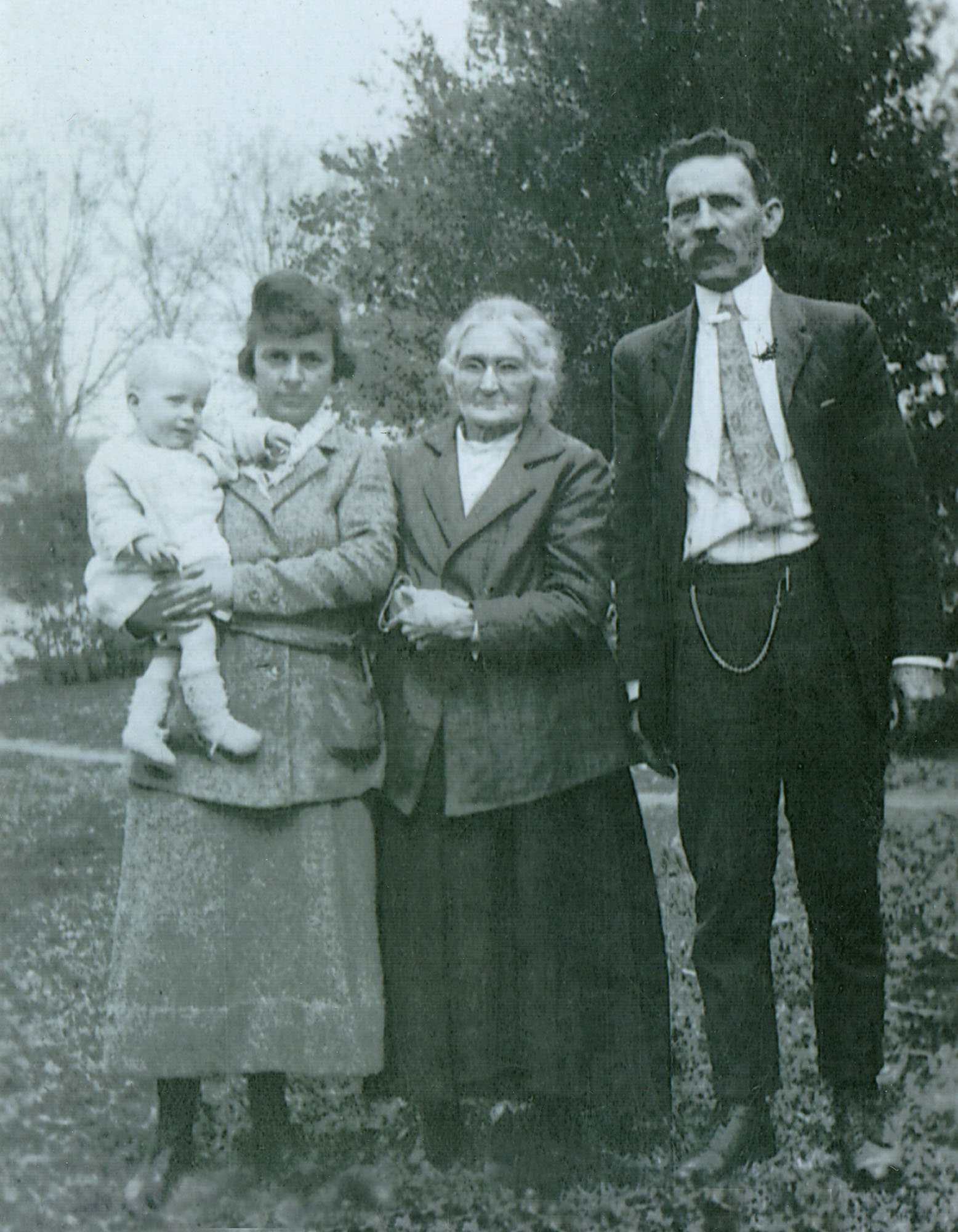
Therese Wynhoven Mouton, Emma Patureau Mouton, Grandma Belite, and Grampa Max in 1921.  This was probably taken in Duson, Louisiana.  (Thanks to Sis for providing the photo.)

Here is a photo of Grandma Belite in 1921.  She is in the middle of the photo and her son-in-law Max Patureau is on the right.  He was married to Belite and Trasimond’s daughter Marie Therese Landry.  She died in 1909.  She and Max Patureau are buried in the Patureau tomb in Plaquemine.  But Max isn’t just Belite’s son-in-law, he’s her half second cousin by their Landry mothers.  Also in the photo are Max’s daughter Emma Patureau Mouton and her firstborn daughter Therese Wynhoven Mouton.  We knew her as Tez.

So there you have it.  Mrs. P. M. Babin with her family, where even her in-laws are related to her.  She was known by those buried by her as Grandma Babin.  But to those who descend from her Landry children, she was known as Grandma Belite.

Betty Lou Visits Arkansas in 1938

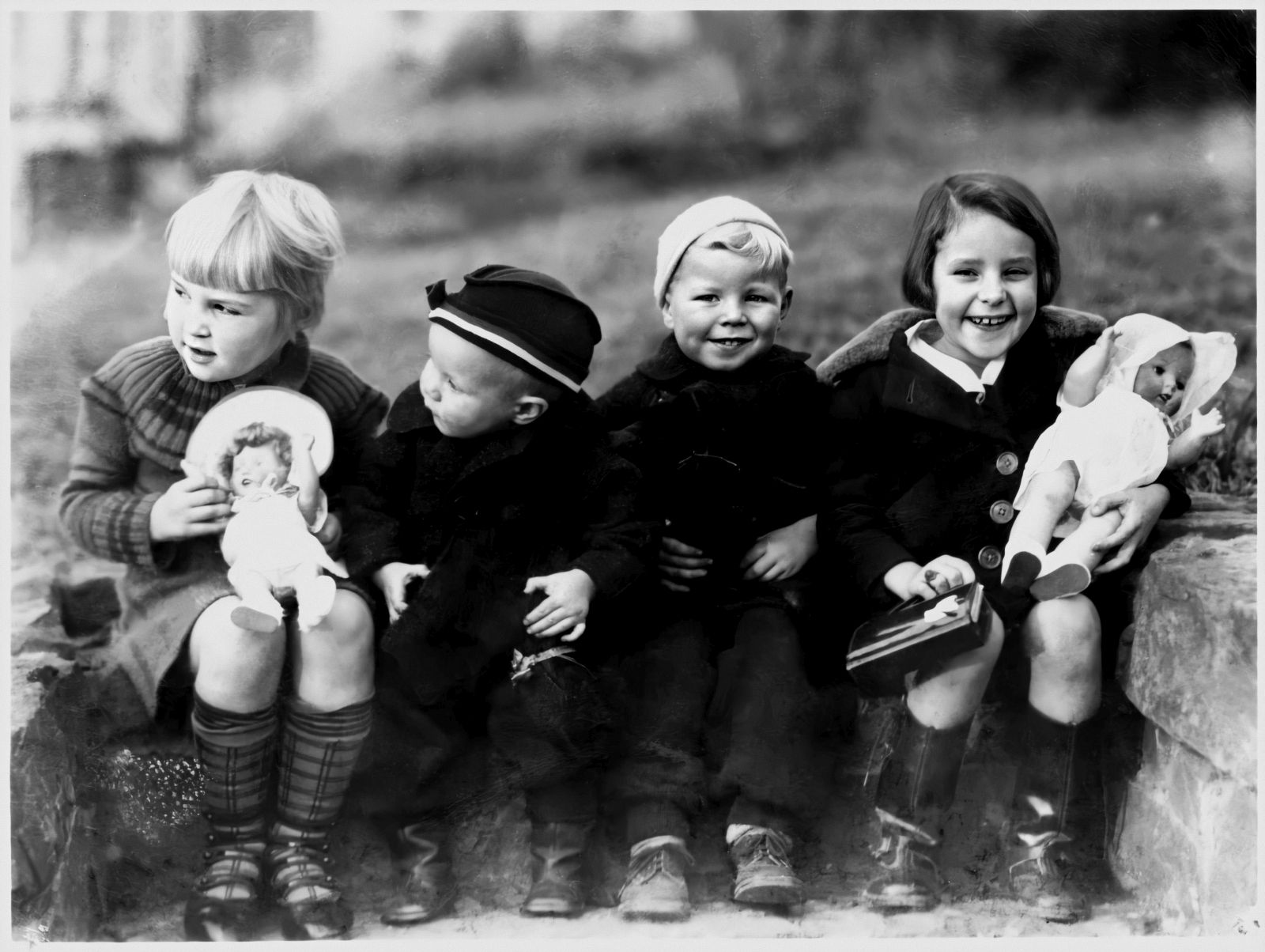
Christmastime in Fayetteville, Arkansas, in 1938.

I wonder if my mom would have remembered this event if she didn’t have the photos to remind her of it for the rest of her life?  It’s amazing what photos do to enhance your memories through the years.  I doubt that I’d remember what I looked like as a little kid if I didn’t have the photos to refer back to.  A picture tells a story – it’s like a thousand words or something.

You may think this photo looks familiar – or not.  Four years ago I posted another photo from the same day.  That photo only had my mom and the other little girl and the two dolls.  That post was about Girls and Their Dolls.  This one is not.  I’m not sure what it’s going to be about, but it’s not about girls and their dolls.  Or maybe it is.  That was the only thing my mom thought about when she talked about the photos from her visit to Fayetteville, Arkansas during the Christmas of 1938.

My mom is the little blonde girl on the left.  She is looking off to the side.  She never mentioned what she might have been looking at.  Like I said, she only talked about the dolls.  Her name was Betty Lou Bucklin and she was born May 20, 1933, in Hathaway, Louisiana.  She lived most of her life not far from there.  Her mother’s name was Myrtle Sylvia Phenice Bucklin.   Myrtle’s older sister Grace was married to a man named Ray Sowder.  Grace and Ray must have decided to take little Betty Lou with them to visit Ray’s family during the Christmastime of 1938, because the rest of the kids in the photo are Sowder relatives.

The two boys in the photo are the sons of Ray’s sister Alice and her husband Raymond Keith.  The little boy next to my mom is 2 1/2-year-old Donnie Keith.  He seems to be distracted by the same thing as my mom.  The other little boy is 4-year-old Paul Keith.  The other little girl is Kara Lee Sowder.  She was the daughter of Ray’s brother Hugh and his wife Bonnie.  But more importantly, she was “The Girl With the Two Dolls.”

And they weren’t just any old dolls.  They were store-bought dolls.  That was significant, because little Betty Lou didn’t have a store-bought doll.  So it was a really big deal to her that she got to play with a real doll and have her photo taken with it.  She cherished those photos for the rest of her life.

Come to think of it, she probably would have remembered that doll even if she didn’t have the photos to show it.  But since she did have those photos, now everyone reading this post can share that joyous experience she had in Arkansas back in 1938.

Bobbie and the Horsey

Bobbie Landry circa 1930.

Now here is an old photo.  I guess it’s not extremely old.  It’s only from 90 years ago.  It’s funny what you consider old when you get to certain ages.  When I saw these photos when I was a kid, they seemed so very ancient.  They were less than 40 years old back then.

This is a photo of my dad Robert Joseph Landry, Jr. when he was about 2 years old.  He was born at the end of January in 1929 and I’m thinking this photo was taken late in 1930.  I know for sure that it was taken in Lake Charles, Louisiana, at the home that he grew up in on Nichols Street.  I’ve seen that house in lots of other photos and it always seems to have a ladder leaning up against it.  What’s up with that?

And then there’s that horsey he’s riding.  Or is it a trike?  It looks like a cross between a rocking horse and a tricycle.  I looked it up online and found several images of this type of contraption.  Most of them are even older than this version.  They were a thing in the mid to late 1800s and some had steel wheels.  Maybe Mee Maw had one (or wished she had one) when she was a child and got one for her kids.

I looked further and thought that I found a name for them – velocipede.  I thought it was an interesting name, because it wasn’t a velociraptor.  It’s a horsey!  But then I saw that the definition of a velocipede is a human-powered land vehicle with one or more wheels.  Come to find out, I had a velocipede when I was a kid.

But it wasn’t a horsey velocipede!  My only consolation is that when I was riding a tricycle, we actually had horses to ride, too.  Yes, I had a pony!

The Cox Family in Boone County

George Henry Hine & Susan G. Stanbrough family in Boone County, Indiana, circa 1892.

I will be talking about the Cox family in Boone County, Indiana, but I don’t have photos of that family from earlier in the 1800s.  This photo is of the George Henry Hine and Susan G. Stanbrough family from 1892.  All of them were born in Indiana, but in Hamilton County.  If you’ve read all of my blog posts carefully, you would know who everyone is in the photo and how they are connected to the Cox family.  Let me go ahead and tell you.  Be prepared for a written test at a later date!

This photo has been posted before by my 2nd cousin Joseph.  He and his mom Louise have generously shared many photos with me and this is one of them.  There is also another photo that I’ve posted of this family from around the same time.  But in the other one, they’re just standing in front of their log cabin home.  This time they fancied it up with a backdrop.  Actually there are two backdrops.  It’s kind of funny because you can see that they just tacked up two blankets behind them and it doesn’t actually hide the exterior wall of the house they were trying to hide.

I edited this photo to clean it up a bit.  I could have cropped it and cloned portions to make the backdrop do what was intended, but that would have taken away from the charm of this photo.  In the back row you see Lonnie, Rowe, Addie (my maternal grandfather’s mother), and Bert.  In the front row are George, Ollie, and Sue.  To the far right is Jim Hine.  Addie was the firstborn with five younger brothers.  They were all about 2 years apart with Addie being born in 1876.

I’m sure you’re wondering why this family moved from Hamilton County to Boone County.  I am, too.  I don’t know the exact reason, but I do know that George’s mother’s family had lived there for about sixty years when this photo was taken.  His mother’s name was Mary Malina Cox and she was the wife of John Peter Hine.  Before that, she was the daughter of Benjamin Cox and Jemima Vestal.

Benjamin Cox married Jemima Vestal some time around 1816 in North Carolina, possibly in Randolph County.  Both of them were born in North Carolina.  Their first child was a son that they named Thomas in 1817.  He was named for Benjamin’s father.  They then had a daughter named Lavina in 1821.  Mary Malina was next in line and she was born in March of 1822.  Following her Asa was born in 1824 and John was born in 1826.  So what do they decide to do three years later?  They decided to make a move with their young family.

Benjamin Cox purchased land in Indiana in 1829.

Transportation in 1829 in North Carolina was difficult within the state.  But Benjamin and Jemima decided that they were going to be settlers in Indiana, which was about 600 miles away!  The only way to get there would be to cross a few states on a covered wagon.  I wish I knew the details of that journey.  Once they arrived it was basically wilderness with a few trading posts around.  Benjamin did get a plot of land on April 3, 1829.  Boone County wasn’t an official county until the following year.

After getting settled in Indiana, the family continued to grow with daughter Amy born in 1833, son William born in 1836, and daughter Mary born in 1838.  According to census records Benjamin was a farmer.  Jemima died in December of 1843 and nine months later Benjamin remarried.  He did not have any children with his second wife.

“The People’s Guide: A Business, Political and Religious Directory of Boone Co., Ind.,” 1874, p. 136

I found an interesting mention of Benjamin Cox in a book about Boone County.  It talks about him being one of the early settlers of the area and how he had to travel a ways to get his milling done during the early years.  He would travel with his mule team over rough roads and it would take more than a week to accomplish his task.  Along the way he’d spend the nights serenaded by bullfrogs.  No running water, no electricity, and no bed to sleep in was standard fare.  

The will of Benjamin Cox from 1877 in Boone County, Indiana.

He was alive when that book was written in 1874, but he died a few years later on July 29, 1877.  I found his will a few years ago and it lists all of his children who were alive at the time.  The youngest daughter Mary had died in 1858 at the age of 19.  Malina Hines is listed as an heir.  Her son George was 30 years old at the time.  Actually, my great grandmother Addie had been born a few months before he died.

What I find really interesting about that last statement is that I was born the month before Addie died.  It’s like we were bookends to her life.  For some reason I feel like I have a personal link to my great great great great grandfather Benjamin Cox who was born in 1796.  Now I too am a part of the Cox family of Boone County.

Landry Grandfathers

The research that I’ve been doing for the “From Acadian to Cajun” blog series has taught me a lot.  I’m working on a follow-up to the posts I’ve written about my Acadian ancestors who came to Louisiana.  That post will be about The Ones That Didn’t Make It.  Some of our ancestors died during the Exile, while others ended up settling somewhere else.  For these ancestors, it was their children that made it to Louisiana.

One example of that is in my Landry line.  The person in question is my 5x great grandfather Pierre Landry.   I’ve talked about him once before in regards to him living long enough to get to know his grandchildren in my line.  That post was four years ago in a post about my great grandfather Alcide.

What I mentioned was that in my line, I descend from the later children in the family.  This leads to grandchildren being born after the passing of their Landry grandfather.  I was born in 1960, which is three years after my Pee Paw (Robert Joseph Landry, Sr.) died.  My dad was born in 1929, which was ten years after Alcide the Great died.  Pee Paw was born in 1893 and his grandfather Narcisse had died in 1876.  Alcide was born in 1845 and his grandfather Joseph Ignatius had died in 1806.  Narcisse was born in 1796 (first generation born in Louisiana) and his grandfather Augustin had died in 1781.

Now here is where there is a difference.  Joseph Ignatius was born around 1753 (the last generation in my Landry line to be born in Acadie) and his grandfather Pierre didn’t die until 1786 at the age of 94 years old.  So he and his grandson Joseph Ignatius were alive at the same time for 33 years.  Going back further, Augustin was born in 1719 and his grandfather Antoine had died in 1710.  Pierre was born in 1690 and his grandfather Rene died two years later.  Most people don’t have memories from before they were two years old.  And they didn’t have photos to show that help to build memories.  Antoine did not know his grandfather, because his father Rene had immigrated to Acadie before Antoine was born.  Nobody knows who the father of Rene was.

So it looks like the only one that would have memories of his Landry grandfather probably didn’t have any.  That’s right.  In the one instance where the grandfather lived long enough, the family was ripped apart by the Grand Derangement in 1755.  So Joseph Ignatius was only two years old when his part of the family was Exiled to Maryland.

I’m not really sure what happened to grandfather Pierre in 1755.  Some Acadians had made their way to Ile St. Jean after the English came back into possession of Acadie.  They didn’t trust the English with their insistence on signing an unconditional oath, so they went to a place still controlled by the French.  Pierre eventually made his way to Maskinonge, Quebec, which is where he died in 1786.  At least two of his sisters had made it to Quebec as well, though they both died about 20 years before he did.  Five of Pierre’s children died before he did as well, though we don’t know if he was aware of that fact.

As we saw in the information about the Dupuis line of the family, people did not get much information about their family members in other countries.  Marie Josephe Dupuis made her declaration at Belle-Ile-en-Mer, France, and she wasn’t aware of the deaths of several of her siblings from a few years previous.  So it’s doubtful that there was much exchange of information between Pierre and Joseph Ignatius over the years that they were both alive.  Probably not even a stinking Christmas Card!

1996

Landry Family in 1996

Grandkids with Grammie in 1986.

So it wasn’t until my niblings’ generation that they were able to get to know their Landry grandfather in any significant way.  My dad’s first grandchild was born in 1981 and my dad passed away in 2017.  My dad had 35 years to enjoy being a grandfather.  And he got to enjoy them with a dozen grandkids when all was said and done.

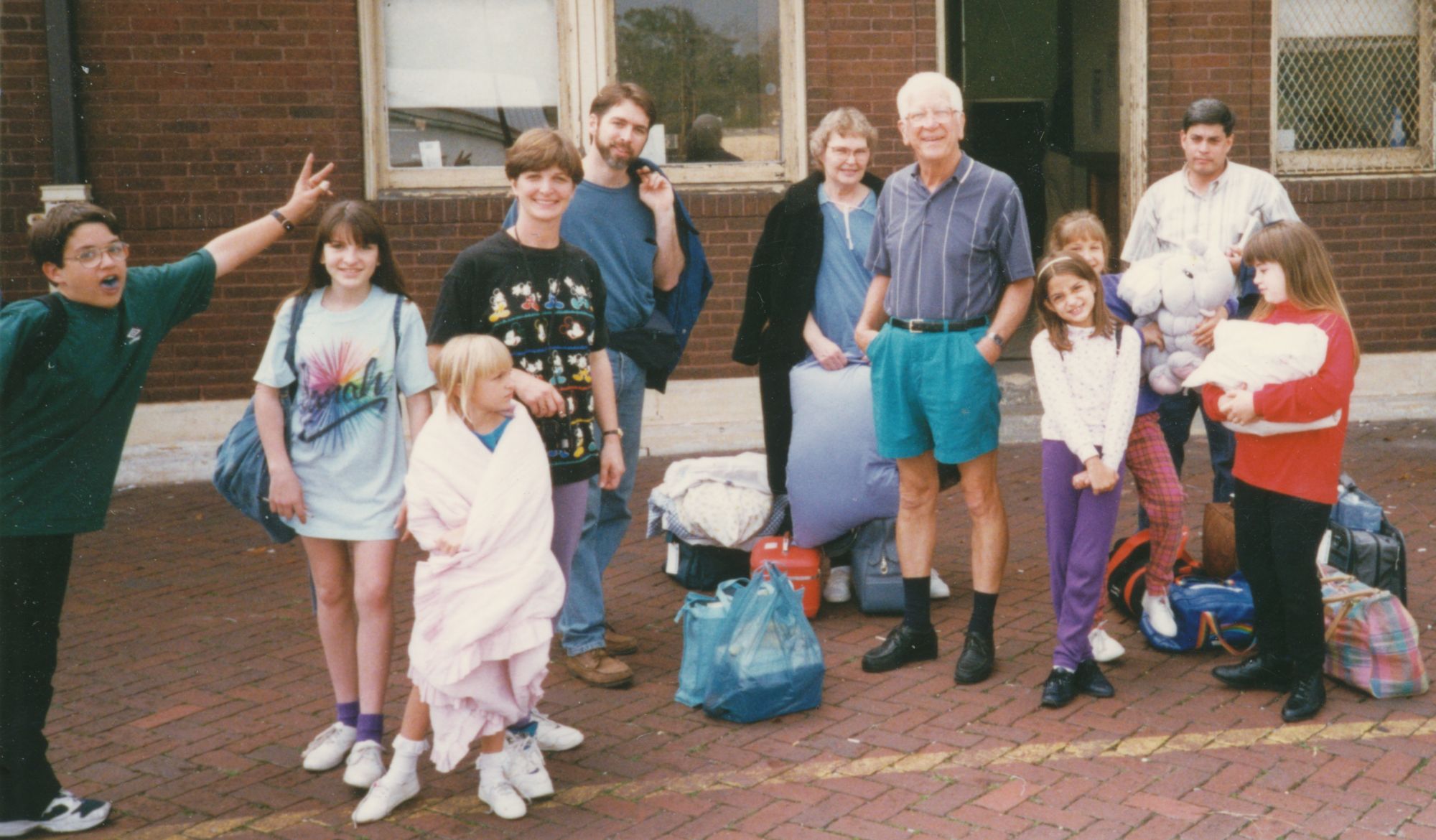
Pappy (Robert Joseph Landry, Jr. or Bob) with his Landry grandchildren in 2007.

But more importantly, my nieces and nephews have lots of great memories of their Landry grandfather.  The same can not be said of any other known generation in my Landry line.  Oh, and by the way, we are definitely of the Landry line.  I had our YDNA tested and it matches other Landry testers.

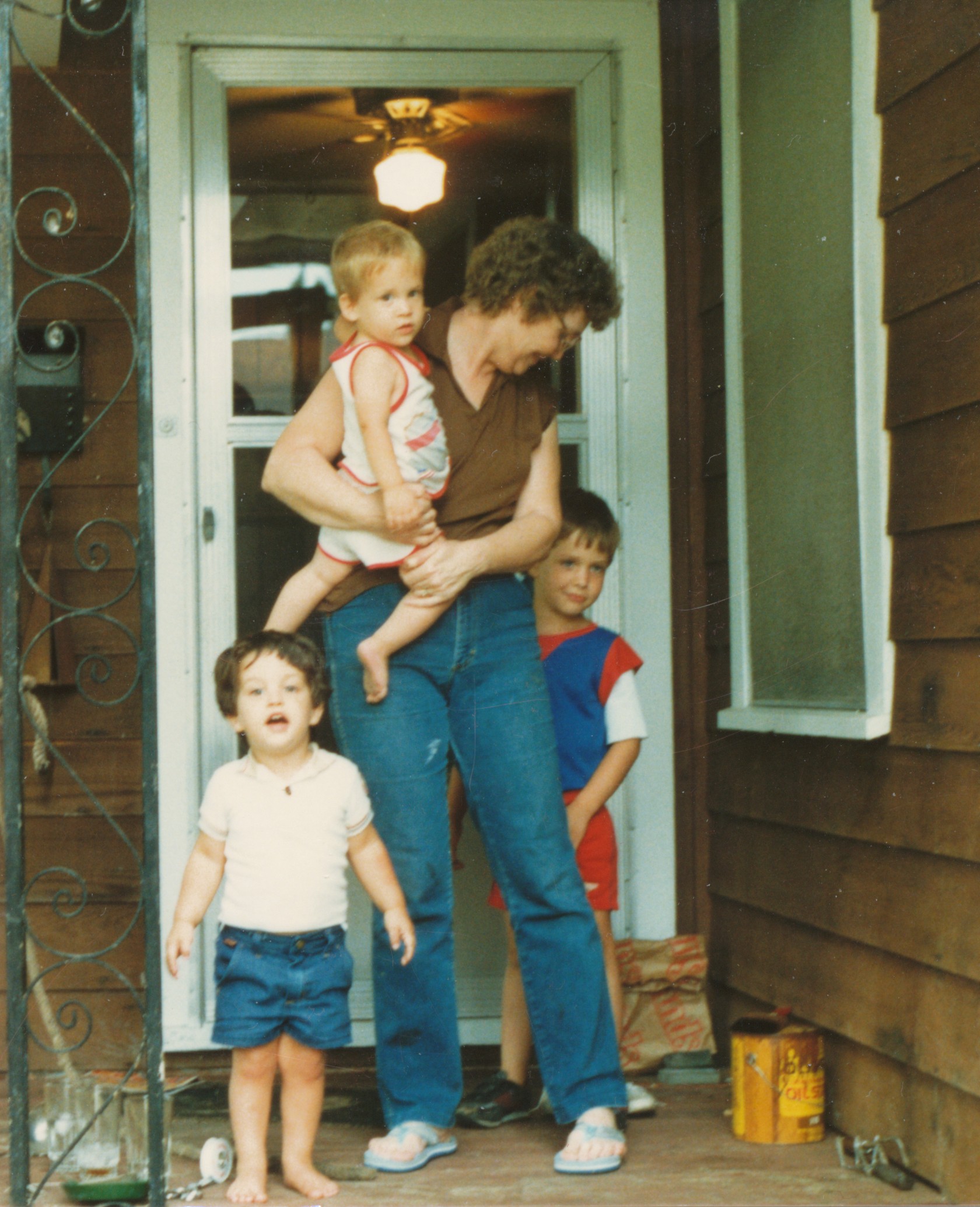
Alex Landry with Pappy (Robert Joseph Landry, Jr.) and Grammie (Betty Lou Bucklin Landry)

And that Landry name is continuing.  Not with me.  I don’t have any children.  My older brother Al has children.  Al was born after Pee Paw died, so he didn’t know our Landry grandfather either.  But his children did know their Pappy Landry, as can be seen in these photos.

Louis Bucklin at 9

I’m being a bit bold with that title.  I’m not really sure how old Louis is in the main photo I’m talking about, but my guess was that he was nine.  So that makes the photo’s date as around 1882.  Louis Charles Bucklin was born April 11, 1873, in Masonville, Iowa, which is in the township of Coffin’s Grove in Delaware County.  His parents were James A. (possibly Austin) Bucklin and Mary Ann McGrath.  The Bucklin family was from Massachusetts and the McGrath family was from Ireland.

O weep not though cruel time, the chain of love has riven. To every link in yonder clime Reunion shall be given.

Rhoda Maria Gove Bucklin died in 1849. This grave was difficult to find since the name is given as Maria R. Bucklin.

James and Mary Ann were married in 1854 in Springfield, Massachusetts.  It was James’ second marriage and Mary Ann’s first.  James had married  Rhoda Maria Gove in 1843 probably in Ludlow, Massachusetts.  They had two children together, then Rhoda died in 1849.  At some time Mary Ann immigrated to the United States with her parents and siblings.  They settled in Palmer, Massachusetts.  Somehow she met widower James Bucklin and they got married.

James and Mary Ann settled in Palmer, Massachusetts, with James’ two children from his first marriage.  Eleven months later their daughter Jennie was born.  Almost six years later they had their first son together.  He was named Joseph C. Bucklin, but everyone knows him as Joe. 

The family then moved to Iowa before the birth of their next son Edd.  He was born March 8, 1864, in Sand Springs, Iowa, which is in Delaware County.  Their last child was Louis.  The spacing of the children seems a little odd.  There are gaps of 6 years, 3 years, and 9 years.  I haven’t found any mention of any children that died, but I wouldn’t be surprised. 

Louis Charles Bucklin circa 1882 probably in Iowa.

It was during the childhood of these family members that photography was getting to be affordable and available to families.  That must have been true for the Bucklin family because there are several old photos of this family.  The sad part of it is that many of the photos are unidentified.  One of the identified photos is this photo of Louis Bucklin.

Like I said at the beginning, he looks to be about nine years old.  In 1882 the family was still living in Coffin’s Grove, Iowa.  They did not move down to Louisiana until 1884.  I have tried to edit this photo in the past and have never liked any of the results, so I’m going ahead and posting it as is.  I like the photo.  He looks like a dignified little man in the photo.  His feelings about photos must have changed at a later date, because there aren’t any photos of him after he was married.

Edd Bucklin circa 1870

I’m going to share a few other photos as well.  The next one is another photo that was identified.  But this one is of Louis’s older brother Edd when he was a child.  He looks to be about six years old, so that would put the photo as being taken around 1870.  This is an enhanced version of the photo.  Of course, the photo of my great uncle looks great with edits.  The original photo is much better.

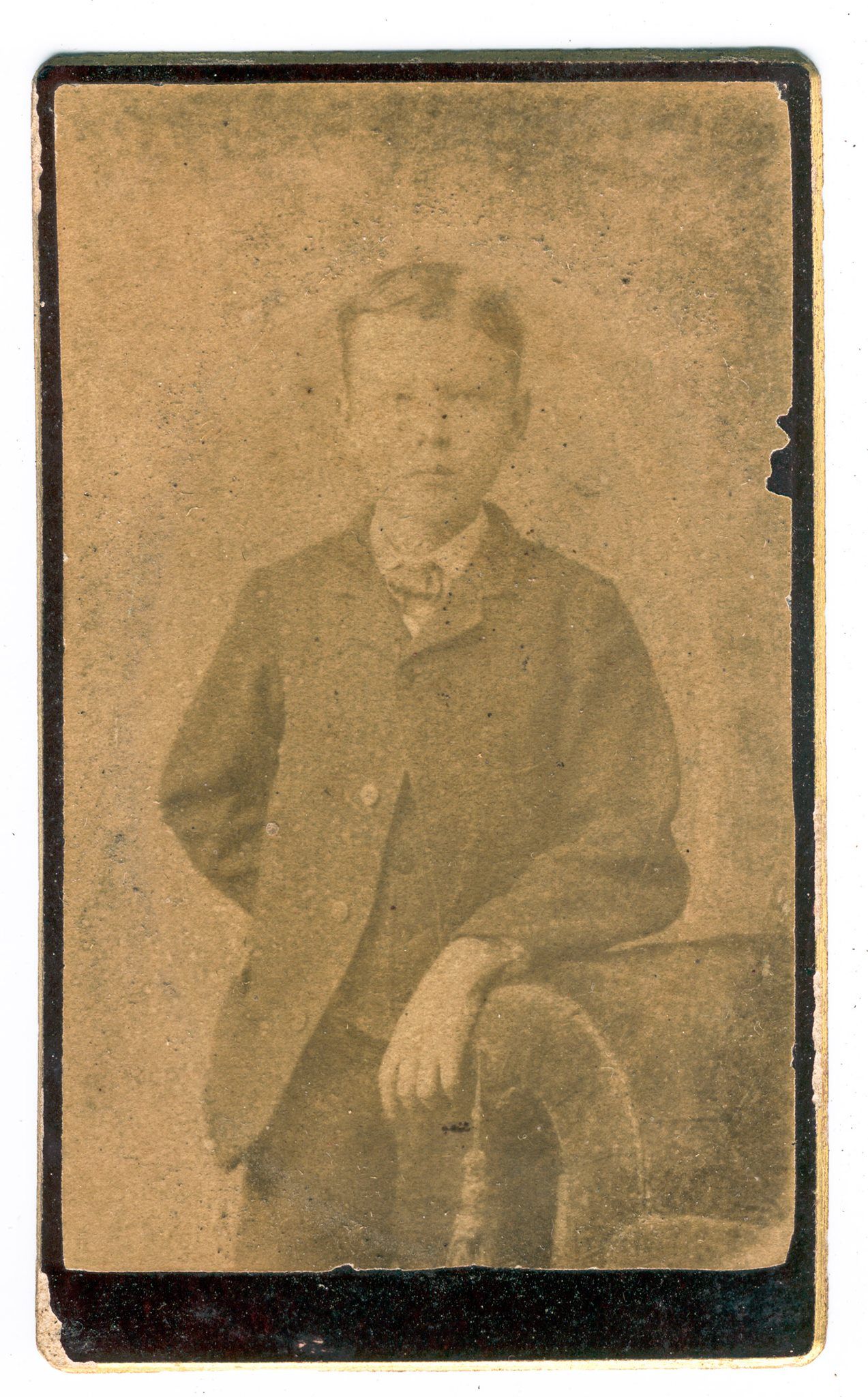
Unidentified boy from late 1800s. Probably a Bucklin child in Delaware County, Iowa.

This next photo is one that was not identified, but I’m starting to think that is was my great grandfather Louis.  I think it may be a little larger photo that looks like a post card.  It’s not like that small one of Edd that looks like a daguerreotype.  Also, this boy doesn’t have the same dour look that Edd has in the photo.  I think it looks like a younger version of Louis.  If it is Louis, it was taken around 1875 or so.  This is an enhanced version of the photo.  Sometimes my photo editing comes out good, but a lot depends on the quality of the original photo.

Tell me what you think.  Could it be Louis?

1 28 29 30 31 32 58