From Acadian to Cajun: Part 8 – Hernandez/Babin

Diego Hernandez and Theotiste Babin are listed under Pierre Paul Hebert and Marguerite LeBlanc. Their children born in Louisiana (Marie Marthe Hernandez and Simon Hebert) would later be married to each other.

This new installment introduces a new surname to the series while it repeats a few others.  The new surname is Hernandez.  While the name looks and sounds Hispanic, I’m pretty sure that it’s not.  Daddy always had him listed in his book as Jacques Diego Hernandez.  I’ve seen him listed with the first name of Denis or Dique and the last name of Arnandez or Arnaudese.  Since he settled in Louisiana while it was under Spanish rule, his name was more consistently written as Hernandez.

The  surname that I’ve written about previously belongs to Diego’s wife Judith Theotiste Babin.  Theotiste was actually a first cousin of Anne Forest from the previous installment.  Theotiste’s father Joseph Babin was the brother of Anne’s mother Madeleine Babin.  Theotiste was also connected to the Landry family from the first installment.  Her mother was Anne Marie Landry, who was the sister of Augustin Landry.  In addition, Augustin’s wife Magdelena Babin was the niece of Joseph Babin.

There are other connections to families that I discussed previously in this series, but I won’t get into all of that.  It is way too confusing.  Acadie was an isolated area for quite a while with a large population growth, so they inevitably had many cousins marrying cousins.  It has happened in many places all over the world.  Speaking of Acadie, let’s go back there to the time before the Grand Derangement and introduce you to the Babin and Landry families.

In 1687 Vincent Joseph Babin married Anne Theriot in Pisiquit, Acadie.  Their first child in 1689 was a boy they named Jean.  Jean would later have a daughter named Magdelena who would marry Augustin Landry.  Vincent and Ann would then have six daughters.  One of them was Madeleine, who would later be the mother of Anne Forest. In 1713 Joseph Babin was born to Vincent and Anne.

While Joseph Babin was one of the younger children of his parents, Anne Marie was one of the older children of hers.  Her parents were Pierre Landry and Marguerite Forest and they were married in 1712.  They lived in Pisiquit, in the parish of La Sainte Famille.   Their first child was a daughter named Marie who was born in 1714.  In 1715 Anne Marie was born.  Augustin was next in line and he was born in 1719.  Pierre and Marguerite also had two more boys and two more girls.

So Joseph Babin and Anne Marie Landry grew up, met, and were married around 1736.  Their first child Dorothee was born around 1737 or 1738.  She was born before the first son Joseph born in 1739.  They then had a daughter named Elizabeth in 1743.  Their next daughter was either Anne or Judith Theotiste who was born in 1744.  The couple would then have two more sons named Etienne and Cyprien.  The last child was born in 1751, just a few years before the Great Upheaval.

On August 10, 1755, the English began rounding up the Acadians so they could be deported from their homeland.  It was the beginning of a great tragedy for many of the Acadian people.  The biggest positive about it is that Joseph and Anne Marie’s family were placed on board the Dolphin along with other family members of the extended Landry and Babin families.  They were Exiled from the land of their birth on October 27 and they reached Upper Marlboro, Mayland, in early December of that year.  This is where they were to spend the next twelve years of their life.  If they survived.

Page 2 of the list of French Neutrals living in Upper Marlboro, Maryland, in July of 1763.

According to the Belle Ile en Mer declaration of Anne Marie’s nephew by her older sister Marie, Anne Marie went into exile with her family.  But she did not live much longer.  She had passed away by the time of the Census of French Neutrals in Upper Marlboro, Maryland, in July of 1763.  Joseph is listed and identified by the French word veuf – which means widower.  Dorothee, Pierre, and Joseph are not listed because they were adults at this point.  The others listed in the household with Joseph are Elizabeth, Etienne, and Cyprien.

Theotiste is not in the household, but she is listed just below them with her husband Diego Hernandez.  His name is specified as Dique Landre in this document.  “Scholars” think that Dique Landre is none other than our Diego Hernandez.  It seems to fit with all the other documents that I’ve seen, such as Baton Rouge Diocese records, St. Gabriel land holdings, and Iberville Parish court archives.  They must have married while in Exile in Maryland.  Yet I don’t know where Diego comes from.  He’s listed in this Census along with Exiled Acadians.  I just realized that both the given names I have for him – Diego and Jacques – are versions of the name James.  So I could be looking for a James or Jacques with the last name of Hernandez, Arnaudese, or Landre/Landry.  I guess I’ll just be on the lookout for a Jacko Landry!
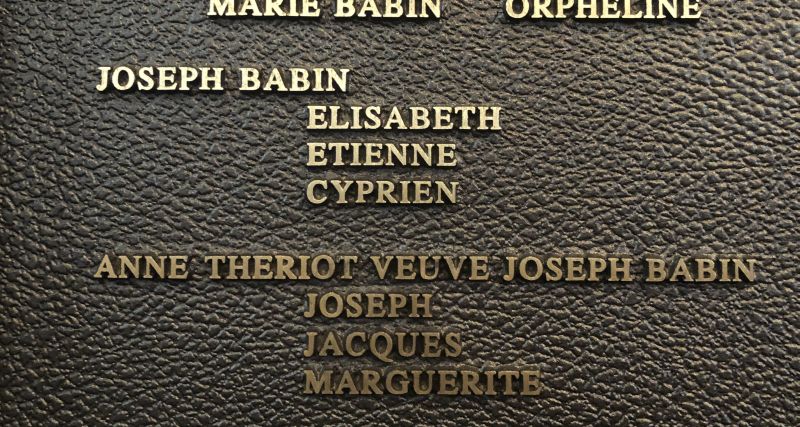
Joseph Babin is listed with his children Elizabeth, Etienne, and Cyprien on the Wall of Acadian Exiles in Louisiana. The Wall is in St. Martinville, Louisiana.

Not much is known about their time in Maryland, as far as personal details about their lives.  We just know that they weren’t really wanted there and were never really part of the community.  Though a few of them did decide to stay in Maryland and they were able to become a part of the society.  None of my ancestors did that.  Joseph, Elizabeth, Etienne, Cyprien, Theotiste, and Diego were part of the Acadians who settled in St. Gabriel, Louisiana.  They arrived in New Orleans on the ship The Virgin on July 12, 1767, and made their way to Fort St. Gabriel.  There was an additional member of the family when they arrived.  Theotiste gave birth to a daughter that they named Marguerite during the voyage.
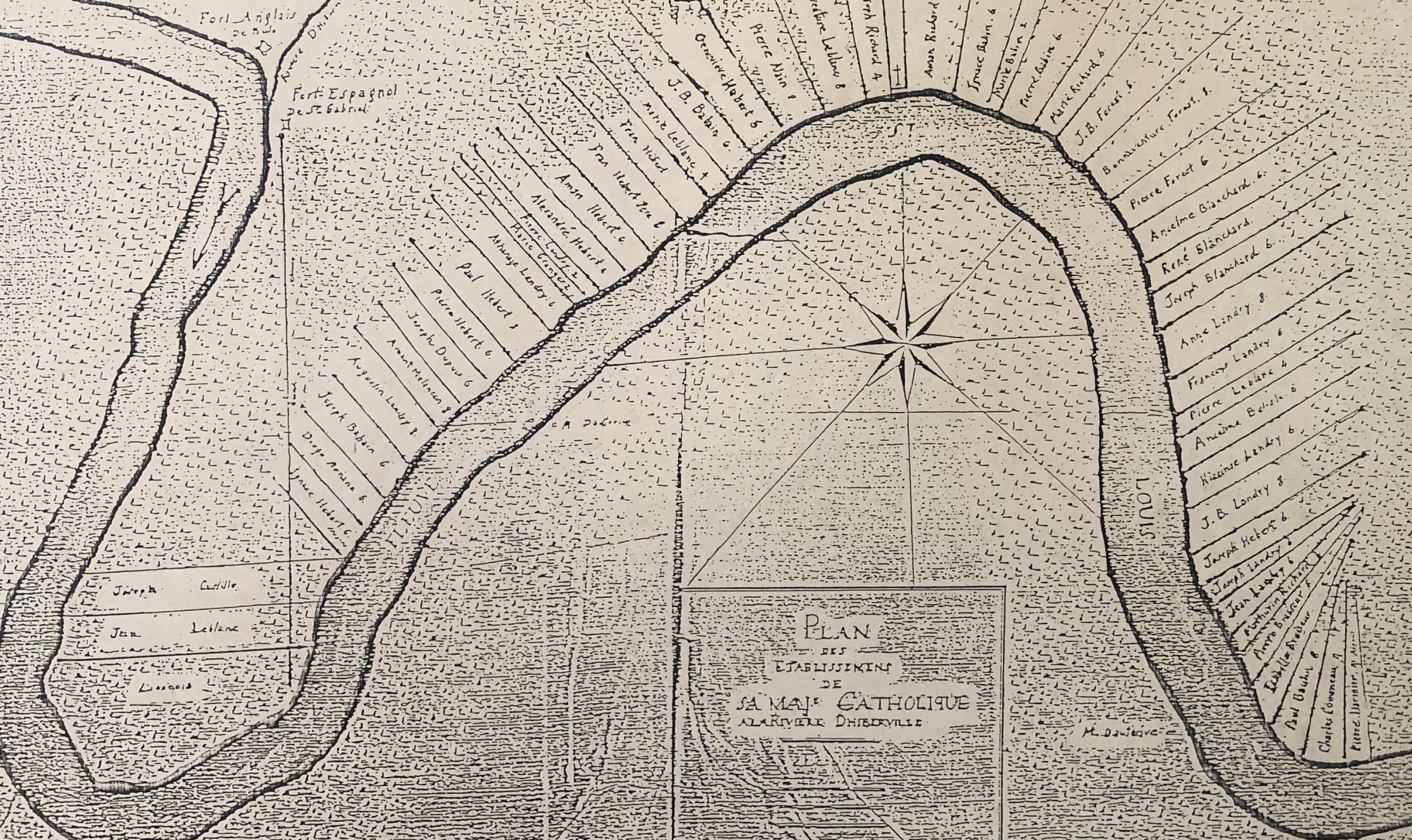
Map of St. Gabriel showing the location of the Acadians who settled there in 1767.

When they arrived in Louisiana, they were given land grants by the Spanish Crown.  As you can see in the photo, Theotiste and Diego were on a plot next to her father Joseph (listed as Diego Arnanz).  On the other side of Joseph is his brother-in-law Augustin Landry.  Two plots down from him is Joseph Dupuis.  I’ll be talking about him in my next installment.  Past him are Pierre Paul Hebert and Paul Gaston Hebert.  We talked about them in the 4th installment. 

This is an early map of St. Gabriel, so it doesn’t show all of the families that I descend from who settled there.  The Antoine Breau family were Exiled in Port Tobacco, Maryland, and they had a two year diversion to Fort Natchez before they made it to St. Gabriel in 1769 or so.  The Honore Braud family spent a much longer time in Exile in France, but they eventually made it to St. Gabriel in 1785.  They were just in time for their eligible daughter Olive Elizabeth to get together with recently widowed Joseph Ignatius Landry, son of Augustin. 

Joseph Ignatius and Olive had a son named Narcisse.  Narcisse would get married to Marie Carmelite Hebert, the daughter of Marie Marthe Hernandez and Simon Hebert.  They would have a son named Trasimond who would marry Belite Bujol.  Belite would bring in the Bujol and Bourg lines that were discussed in previous installments.  Trasimond and Belite had a daughter named Marie Therese who would marry Max Patureau.  Max would bring the Dupuis line into the mix.  He was a descendant of the Joseph Dupuy who was one of those early Acadians who settled in St. Gabriel next to our other ancestors.

Max and Therese had a daughter named Erie.  She would marry Rob Landry.  Rob Landry would not bring any other lines to the mix.  Everyone that was related to Rob was related to Erie.  But these two would bring about someone very special.  That would be their daughter Germaine Erie Landry.  She was a very sweet person and she was my aunt.  She was born on April 6, 1927, and she died yesterday (July 15, 2020) at 6:40 pm.  She was a good older sister to my father.  She was the loving wife of Ross Winn.  She was the caring mother to her three children.  She was a devoted Catholic all her life.  She was a dedicated nurse for many years.

She was such a good person.  She will be missed.

Landry Reunion on June 11, 2016. Here I am with my aunts Frances Landry Raley and Germaine Landry Winn. Frances died in February 2020 and now Germaine has died.


For other installments of the “From Acadian to Cajun” series, click on the following links:

From Acadian to Cajun: Part 1 – Landry/Babin

From Acadian to Cajun: Part 2 – Breau/Trahan

From Acadian to Cajun: Part 3 – Braud/LeBlanc/Gauterot/Aucoin

From Acadian to Cajun: Part 4 – Hebert/Melanson

From Acadian to Cajun: Part 5 – Bourg/Granger

From Acadian to Cajun: Part 6 – Bujol/LeBlanc

From Acadian to Cajun: Part 7 – Foret/Bujol

From Acadian to Cajun: Part 9 – Dupuis/Dugas

From Acadian to Cajun: Part 10 – Bourg/Babin/Landry in a short story called “Finding Home”

From Acadian to Cajun: Part 11 – The Ones That Didn’t Make It

Four Generations of the Hine Family

Addie May Hine Bucklin with some of her descendants in 1959.

This is an unusual title for this photo, considering that no one in the photo was going by the name Hine at the time it was taken.  I could have used the Bucklin name instead, but the matriarch (Addie May Hine Bucklin) in this photo was only married into the Bucklin family. 

I could just as easily have called it the Stanbrough Family since Addie’s mother was Susan G. Stanbrough Hine – you know her – Grandma Sue.  But then I could go ahead and use other names in Addie’s line like Cox, Vestal, Mills, Brown, Hester, or Miller.  Technically I’d be correct, since there are four generations of family members from those lines.  But all of those lines came together to bring us Addie Hine, so it’s her maiden name that I went with.

It’s kind of surprising that I’m using such a blurry photo for this week’s post.  I’ve been working with that new photo-enhancing feature that I mentioned three weeks ago.  It has some limitations, but I’ve gotten some really good results with some old photos.  It helped me to come up with an amazing photo – and I mean amazing – of my grandmother Bucklin (Myrtle Sylvia Phenice Bucklin).  If you happen to stop by my house, I would be willing to give you a preview.  But in the meantime, all I can say is, “Wait for it…”

The photo I’m sharing today was taken around the last quarter of 1959.  The youngest person in the photo is my brother Al and he was born on July 24, 1959.  He doesn’t look very old in this photo.  The oldest person in the photo is my great grandmother Addie and she died on November 25, 1960.  The next oldest person in the photo is her son Fred, who was my maternal grandfather – you know – Grandpa.  On the far left is his daughter Betty Lou, better known to me as Mama.  She’s got Al in her lap.  Next to them is little Karen Jean.  She’s kinda sitting on Grandpa’s lap.  On the other side of Grandpa and Addie is Jodie Lou.  She was the oldest of us kids and she was about six years old in this photo.  Next to her is my oldest brother Rob and our dad Robert Joseph “Bob” Landry, Jr.

So there they are – the four generations of the Hine family.  I sure wish she had lived just a little while longer so I could have had a photo of myself with a four generation span.  Oh, well.  At least I have this photo of my siblings with her.  Though recently I have seen a glimpse of another photo that possibly includes everyone in this photo. 

Photo of Addie Hine Bucklin and her family possibly on her birthday celebration on September 23, 1959.

I took these photos on my phone while watching an old video that my dad made at the birthday of Grandpa’s siblings Ruth and Roy in the late 1980s.  My dad included some shots of old photos and this one caught my eye.  I can make out Addie sitting down in front of everyone and my siblings and dad to the right of the photo.  Now that I look at them together, it looks like it could be from the same day.  This group photo showing everyone around Addie makes me think it could have been a birthday celebration for Addie.  Her birthday was September 23, so that would fit within the time frame I gave for the first photo I discussed. 

If anyone has the original photo, I would love love love to have a good copy or scan of it.  I guess it’s my turn to “wait for it…”


July 10, 2020 – I realized that I had another 4 generation family photo for the Hine family.  It has Addie in it, but it continues on a different line than mine.  It goes through her son Ralph, his daughter Helen Bucklin Taylor, and her son Ronnie.  It also includes Addie’s youngest brother Ollie.  It was taken at an earlier birthday for Addie in 1948.

Four generations of the Hine family in 1948.


Summertime Fun 1963

I thought it was time for something more recent.  And when I say recent, that is a relative term.  After writing about events 100 and 200 years ago about ancestors of mine, I thought I’d share a photo that included me and my siblings. 

So I went looking for a photo.  I was hoping I could find something in color, so I first looked in my folder of photos from the 1970s.  I was also looking at some of the enhanced photos I did, but none of them struck me.  I liked some of them, but mostly they are from Christmases past.  I can’t post a photo of Christmas when it’s 100 degrees outside.  That’s just wrong.

Summertime fun with the Landry family in 1963.

I thought I’d try to find something a little earlier.  When I saw this photo, I knew it was the one.  It’s got all of my siblings in it, plus the addition of my dad.  It’s in color.  Imagine that!  I think it is from an old slide that was taken in August of 1963.  I edited it a bit to clean it up.  But mainly I chose it because it screams, “Summertime!”

When I think of family summer vacations, I always think of Six Flags and Astroworld.  Those were our usual go-to places every summer.  But this photo is from before that era.  We were living in a two story house on LA-26 just north of the I-10 in Jennings.  The house was directly south of a canal that runs through that area.  At night, we could see the spotlight from the Jennings airport from our bedroom on the second floor.

I don’t remember going anywhere else for vacations during this time.  Of course I was a bit young in the photo.  My older brothers might remember more.  Because of this photo, I do know that we went for a swim back then in our trusty plastic pool!  Doesn’t it look delightful?  We all look like we were having fun!  That’s what matters.

Let me identify everyone in the photo.  On the far left is my brother Al.  My dad (Robert Joseph “Bob” or “Pluto” Landry, Jr.) is next and he is holding me.  Then there are Karen, Rob, Jamie, and Jodie.  Mama (Betty Lou Bucklin Landry) must have taken the photo.  It certainly is a blast from the past.

Max Patureau Family Circa 1953

Max Patureau family in Duson in June 1953

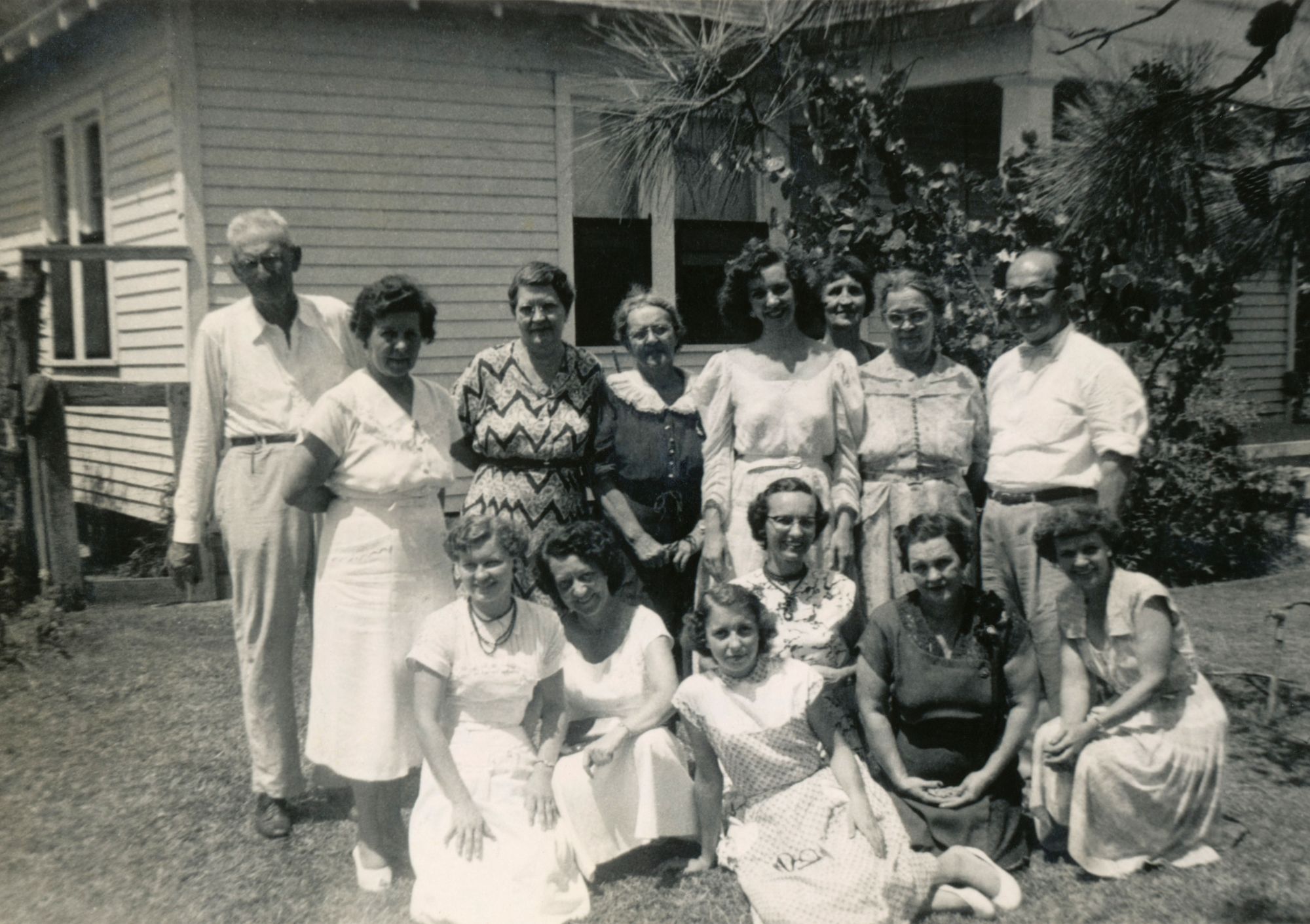
This photo was taken in June of 1953 in Duson, Louisiana.  My Mee Maw is in the photo.  Can you find her?  She was my paternal grandmother and her name was Germaine Erie Patureau Landry.  She was born in Crescent (Plaquemine), Louisiana, to Vincent Maximilian “Max” Patureau and Marie Therese Landry on August 6, 1895.  So she was almost 58 years old in this photo.  Younger than I am now.

I call it the Max Patureau family because that’s what they were referred as in newspaper articles thru the years.  Marie Therese died at the age of 41 in 1909 and I don’t have a lot of information about her.  She wasn’t in a lot of photos and didn’t talk about her activities to newspaper journalists like her husband seems to have done.  She spent a lot of time rearing her nine surviving children (she lost 6 in infancy) in Plaquemine, Louisiana.

But at the time of this photo only seven of those children were still alive.  Like I said, Marie Therese died in 1909.  Then in 1935 Max died.  Two years later Romuald Patureau and Marie Therese “Bee” Patureau Schafer passed away as well.  I don’t know why I never noticed before tonight that Mee Maw had lost two siblings in the same year.  It must have been a hard year for her, though she was quite busy taking care of her own eight young children.

This photo was taken when the family got together for a celebration in honor of Mee Maw’s oldest sibling Emma was honored for writing a book about the history of Duson.  Mee Maw and all of her surviving siblings are in the photo, as well as some of their children.  My dad wasn’t there because he and my mom were in California living on the Air Force base and getting ready to have their first child a few months later.

In the front row from left to right we have Syl Schafer, Therese “Tez” Mouton, Therese “Sis” Schafer (Syl and Sis were the daughters of Marie Therese “Bee” Patureau Schafer and were raised by their Aunt Zita), Dolores Mouton, Sylvie Patureau Marionneaux, and Effie Clements Patureau (wife of Vincent Patureau, Jr.).

In the back row from left to right are Toby Mouton (husband of Emma and father of Tez, Mona Mel, and Dolores), Zita Patureau Schafer, Lydwin “Win” Patureau, Emma Patureau Mouton, Mona Mel Mouton, Lorena Patureau Cary, Mee Maw (Erie Patureau Landry), and Vincent Patureau, Jr. 

A Clearer View of Kate

My inspiration for the post this week came from a website that I use for exploring DNA matches.  The name of the website is MyHeritage.com and it came out with something new recently.  This new thing has nothing to do with DNA.  It really doesn’t even have anything to do with genealogy.  They came out with a photo editing feature.

And you can call me amazed!!!  I don’t normally use three exclamation points at a time, but this time it was appropriate.  I saw a little ad for the feature.  It showed a before and after for an old photo.  I didn’t believe it.  I was like, “There is no way possible for that to be true.  They took a clear photo and blurred it to make it a ‘before’ photo.  Then they used the original photo for the ‘after’ photo.”  I was not believing it.

But I thought I’d try it.  Why not?  I had tried their colorizing feature on some photos, but I didn’t really like the results.  But it was a free trial offer.  So I went on their website and tried it on a few photos.  It’s like magic!!  Even after seeing the results, I find it hard to believe.  It puts back details like strands of hair, eyelashes, and lip texture that look authentic.

Photo that was edited using MyHeritage.com’s Photo Enhancer to clear up the image of my great great grandmother Kate Phenice and her daughter Emma from 1890.

My favorite one is this old photo of my maternal grandmother’s paternal grandmother. (I am the son of Betty Lou Bucklin Landry, who was the daughter of Myrtle Sylvia Phenice Bucklin, who was the daughter of Harry Clifton Phenice, who was the son of Cathrine Jane Foster Phenice.)  So Cathrine or Kate was my great great grandmother.  The photo was taken in 1890 in Hitchcock County, Nebraska.  I estimated this date because her 8th and youngest child Emma Orra is in the photo with her, and she was born June 20, 1889.

Look how much better their faces look!  It really brings the photos to life.  I’ve already spent way too long looking at this photo.  I just can’t get over the details that were recovered.  I thought I’d do the same with the information about Kate’s life.  The details of her life were a mystery for a long time, but last year I figured out who her parents were.  I’ve discovered a few more details in the meantime.

Cathrine Jane Foster was born in Mercer County, Pennsylvania, on Sept. 16, 1848.  We have had that information for quite a while.  Some of it was on her headstone and other parts were in a newspaper article about her death.  There were lots of other details, as well, but nothing was said about parents or siblings.

I now know that she was the daughter of Morris or Moore Foster and Anne Magdaleen Milliron.  When she was born, Morris and Anne had been married for 5 years.  They were married on Aug. 30, 1843.  It was most likely in Mercer County, because that’s where they both were born.  I don’t know much more about Morris’s family, but I do know that the Milliron family had been in Pennsylvania for about 100 years.

Morris and Anne had their first son in 1845 and his name was James.  Their second son was born in 1846 and they called him Emory.  Cathrine was their first daughter and the next to be born.  I’m not sure when she started going by the name Kate, but that seems to be what she was known by most of her life. 

The next source of information for Kate’s life was the 1850 Census.  There are six people living in the household in Cherrytree, Venango, Pennsylvania.  There are 29-year-old Moore Foster, 24-year-old Ann Magdelene Foster, 19-year-old Thomas Foster, 6-year-old James, 4-year-old Emory, and 2-year-old Catharine.  This is a Census, so the names are spelled according to the Census taker.  I’m not sure who Thomas is, but it is likely a family member, such as a brother or nephew of Moore.

The main thing that is different is where they are living.  I have Cherrytree as the birth place for James and Emory.  I’m thinking that Kate must have been born in Cherrytree as well, because in 1852 her younger sister Hannah is born in Cherrytree.  I doubt that the family was moving back and forth from Mercer.  They are about 110 miles apart.  So at some point Moore and Anne moved to Cherrytree and started having children.

Tragedy struck a few months after the birth of Hannah in 1852.  Moore Foster died at the age of 35.  I don’t know how he died, but I’m sure it was a traumatic event in the life of little 4-year-old Kate.  Anne moved her family back to Mercer County.  I suppose she did this to be closer to her Milliron family members.

About a year later Anne Magdaleen Milliron Foster married George Richael.  Over the next five years, Anne and George had three sons.  Their third son Elias was born in 1858 and he only lived for two days.  This was likely another point of sadness in 9-year-old Kate’s life.  Anne and George had two daughters following this.  Then in 1864 they had a son that they named George, Jr.  Sadly, George, Jr. died a couple of days after his first birthday.

So in 1865 the family consisted of her mother Anne and step-father George, as well as her brothers James and Emory and sister Hannah.  There were also two step-brothers and two step-sisters.  It’s hard to know if that was a happy situation or not.  There was no mention of other family members in the article about her death, and some of those step siblings were still alive.  I’m thinking it wasn’t the best situation, since it doesn’t seem like it was talked about.  Otherwise her family wouldn’t have been such a mystery.  Or maybe it was just the forgetfulness of family through the years.

Either way, 17-year-old Kate was not sticking around!  She must have met Samuel Phenice around this time.  He was 21 at this time and had fantastic tales to tell about his soldiering time in the Civil War and his eyewitness testimony for the Lincoln Assassination.  They were married Sept. 27, 1866, in Hendersonville, Pennsylvania.

And the rest, they say, is another post.

Edited version with just Kate in the photo.

From Acadian to Cajun: Part 7 – Foret/Bujol

The Wall of Acadian Exiles in Louisiana in St. Martinville, Louisiana, includes my ancestors brothers Etienne and Joseph Bujol and their families.

It’s time again for another installment of my series about my Acadian ancestors who made their way to Louisiana.  This one is about my Foret (or Forest) line and a continuation of my Bujol line from last time.  Last time we looked at Joseph Bujol and his wife Anne LeBlanc.  They were married in Acadie, spent a dozen years in Oxford, Maryland, and made it to Louisiana in 1766.  Their little nuclear family stayed intact and continued to grow through all of that time.  I also descend from Joseph’s younger brother Etienne.  They were only a year apart.  But Etienne’s young family did not fare as well as his brother’s.

Etienne was born in 1724 in Pisiguit, Acadie.  He was the third of fourteen children.  He and his brother Joseph were both married in 1750 in Acadie.  Etienne was 26 years old and he married 20-year-old Brigitte Chenet.  According to records, they had their first child Mathurin two years later.  That’s unusual.  At that time, it was usual for a first child to be born close to a year later, more of less.   If you look at the Wall, there is a son Francois listed in the family group.  Usually the oldest child is listed first.  I don’t see any records for a Francois.  He is not in the Census records, so I don’t know who he is.

Etienne and Brigitte’s next child was named Pierre and he was born around 1755, which is the year that their lives were thrown in turmoil because of the Grand Derangement.  The family was likely deported from their homeland on the ship called “The Ranger.”  I’m not sure when young Pierre was born, so it could have been in the middle of all of this upheaval.  Either way, it must have been a difficult time for the young Bujol family.

The family was forced onto the ship on October 27, 1755, and they endured a month-long voyage on a cramped vessel full of misery.  They arrived in Annapolis, Maryland, on November 29, 1755, but this young Bujol family were sent further on to Oxford, which was in Talbot County.  Nobody really knows how long it took for these families to adjust to their new situation or overcome the trauma and loss that most of them experienced.

Those first years in Exile were definitely a struggle.  Plus the citizens in the area were not too happy with having these unwelcome foreigners to help care for.  They expressed their disdain for the situation in a letter to the Maryland Gazette in February 1757: 

“That the wretched Acadians … are become a grievance… we are not at present … capable of seconding their own fruitless endeavors to support their numerous families, as a people plundered of their effects.  They cannot find houses, clothing and other comforts… without going from house to house begging, whereby they are become a nuisance…  And it is no easy task for a Christian to withstand the unfortunate cravings of their distressed fellow citizens, those among us who especially possess the greatest degree of humanity, must, of course, be the greatest sufferers.  Their religious principles…render it unsafe to harbor them… We therefore pray that you will use your endeavors in the Assembly to have this pest removed from among us, after the example of the people of Virginia.”

I’m not sure if I agree who the greatest sufferers were, but I’m sure it was difficult for all involved.  I’m glad they didn’t send these pests (my Bujol ancestors) away like they did in Virginia.  My Aucoin ancestors were sent from Virginia and ended up in England, where they died shortly thereafter.

The family of Etienne and Brigitte Bujol (Bigeos) are the third group on the page for the July 1763 Census in Oxford, Maryland.

So Etienne and Brigitte stayed in Talbot County where they were not exactly welcome.  So you can imagine the looks that Brigitte might have gotten when she started to show that a birth was imminent in 1761.  And then she had the audacity to have twins!  Two more mouths to feed!  Yet I’m sure that Marie and Madeleine were joyously welcomed to the family.  The 1763 Census shows the family in the third family group on the page. 

This is the last record that I find for Brigitte Chenet.  She is not listed on the Wall for those that made it to Louisiana.  So when Etienne arrived in Louisiana in late 1766, he was a widower with four (or five) children.  And though I don’t descend from Brigitte, it is sad to know that her early death was key in my family line occurring.  If it hadn’t happened, I wouldn’t be here.  Yet I can’t celebrate it, right?

Let’s go back to Acadie to see about that Foret line I mentioned.  In 1725, a little girl was born to a couple named Pierre Forest and Madeleine Babin.  There is not a lot of information on this family, but I think little Anne was the fifth of six kids.  It’s kind of surprising that she didn’t get married until she was 28 years old.  She married Pierre Babin in 1753 in Pisiguit, Acadie.  He was only 21 years old at the time.  That was not standard practice, either.  To bring things back to normal, they had a child a year later.  His name was Joseph.

Yet we all know that their normal life wasn’t going to continue for much longer.  The Grand Derangement happened in 1755 and the Acadian people were deported to places far and wide.  It was a time of confusion for many people, which is why records are lacking for a lot of people.  So I haven’t been able to find a lot of information about Anne Forest and Pierre Babin.

Anne Forest was the widow of Pierre Babin when she arrived in Louisiana in 1767.

From what I can tell, they were taken to somewhere in Pennsylvania.  They had another son named Charles around 1760 and were in Pennsylvania until about the fall of 1764.  Then they joined other Acadians who went to the French-owned St. Domingue around present day Port au Prince, Haiti.    Pierre died and was buried on Feb. 5, 1766.  This left Anne a widow with two young children during her time in Exile.  They made their way to Louisiana with other Acadian exiles in 1767.

Anne was married later that year in New Orleans.  I’m sure you know who she married.  That’s right, it was none other than Etienne Bujol, widower of Brigitte Chenet.  They were married and set up a household in the Pointe Coupee area where Etienne’s brother Joseph was living.

On October 10, 1768, you would have found this couple and their blended family in St. Francis Church, the Catholic church in the Pointe Coupee area, witnessing the baptism of the newest member of the family – Jean Augustine Gabriel Bujol.  He was the only child that Etienne and Anne had together, and that’s who I descend from.  He is my 5X great grandfather.

He would grow up and marry Marie Josephe Bourg.  Remember her?  In installment No. 5 of this series, her family was exiled to France, which is where she was born.  She was born in France, but she was an Acadian nonetheless.  The Bourg family came to Louisiana in 1785, but in the 1789 Census of Lafourche, Marie Josephe was not present. 

That’s because on Feb. 6, 1786, Marie Josephe married Jean Augustine Gabriel Bujol.  She had only arrived in Louisiana on August 15, 1785, so their courtship couldn’t have been very long. 

It must have been love.


For other installments of the “From Acadian to Cajun” series, click on the following links:

From Acadian to Cajun: Part 1 – Landry/Babin

From Acadian to Cajun: Part 2 – Breau/Trahan

From Acadian to Cajun: Part 3 – Braud/LeBlanc/Gauterot/Aucoin

From Acadian to Cajun: Part 4 – Hebert/Melanson

From Acadian to Cajun: Part 5 – Bourg/Granger

From Acadian to Cajun: Part 6 – Bujol/LeBlanc

From Acadian to Cajun: Part 8 – Hernandez/Babin

From Acadian to Cajun: Part 9 – Dupuis/Dugas

From Acadian to Cajun: Part 10 – Bourg/Babin/Landry

From Acadian to Cajun: Part 11 – The Ones That Didn’t Make It

My Grandfather was a Nurseryman

Fred D. Bucklin circa 1929 around Hathaway, Louisiana

Here is another great old photo of my grandfather Fred D. Bucklin.  I sometimes wonder whether a photo is actually a photo of him.  He had a twin brother, so it’s difficult to tell them apart.  I’m sure if you knew them well at the time you could tell them apart, but this photo was taken over 90 years ago.

But this photo of him was in my mom’s possession ever since I can remember, so I’m pretty sure it is my grandfather.  It was taken around 1929, which is around the time that he began his plant-selling profession.  He and his twin brother Clarence actually were working together at the time.  I’ve shown a picture of their price list previously, as has cousin Joseph.  They were from the early 1930s.

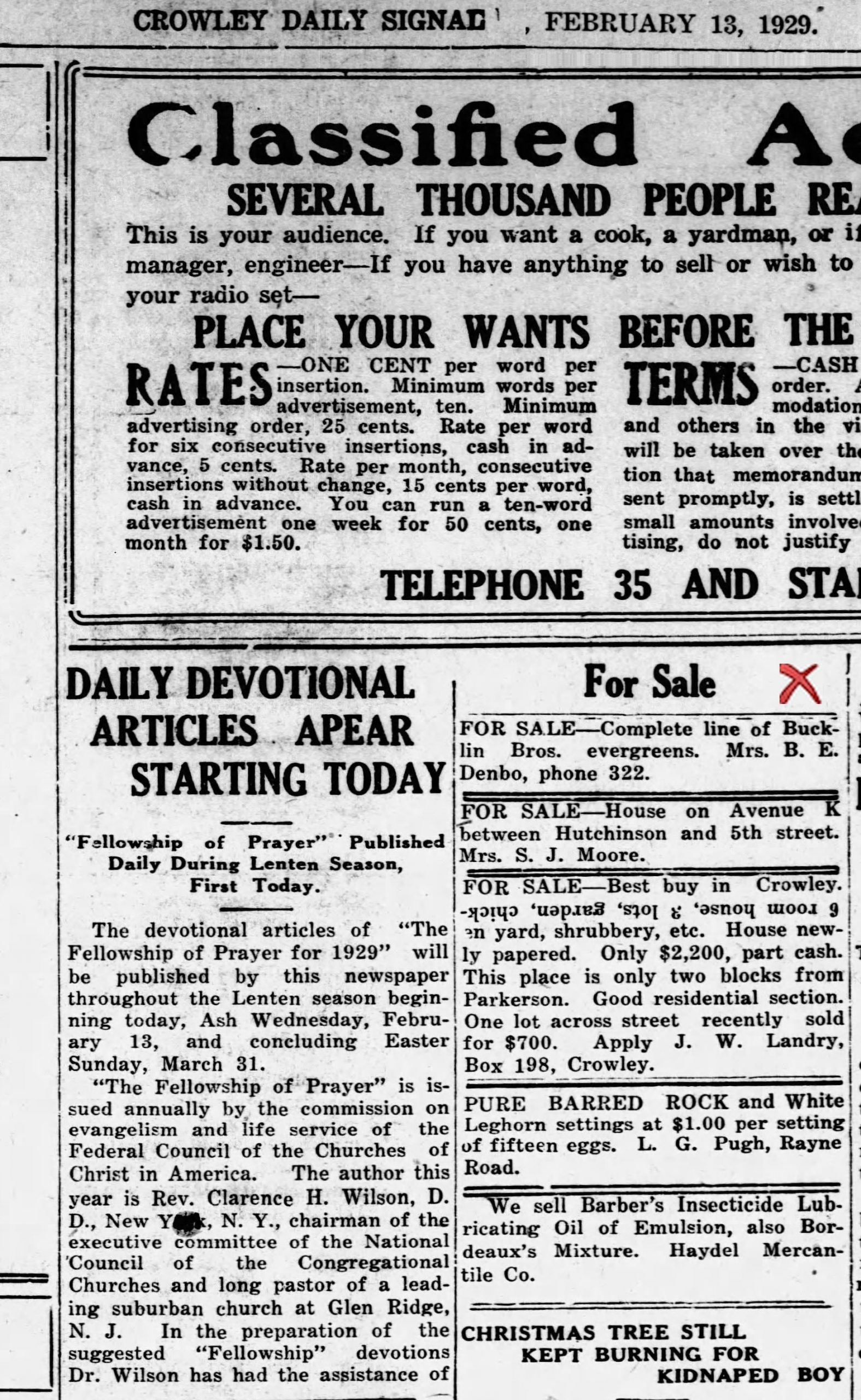
This newspaper ad from the February 13, 1929, edition of the Crowley Daily Signal shows that they had started at least by that point.  The Bucklin Bros. were advertising the sale of evergreens to the surrounding communities.  This seems to coordinate well with the photo of Grandpa in the truck.  If you look at the bed of the truck, you can see several balled and burlapped trees back there.

Like I said, it’s a great old photo.  I just wish I knew where the photo was taken.  The price lists that were printed back then show an address of Elton, Louisiana, but they didn’t live in Elton proper.  They lived in Hathaway.  It’s always a bit confusing to me.  They have so many names for that little area in Jefferson Davis Parish.  We always said that we went out to Hathaway to visit our grandparents, but I think they may actually have lived in China.  Or maybe it was Raymond!  We passed by the Hathaway High School and the Raymond Methodist Church on the way to their house.  If we went a little further down the road we’d be at the China Cemetery.

Whatever you want to call the place, I don’t recall seeing a body of water like you see in this main photo.   Maybe some of my cousins or some residents can help me out with this.  China?  Hathaway? Raymond?  Pine Island?

Tell me what you think.

Pee Paw at Camp Humphreys in August 1918

I have posted a few photos of my paternal grandfather in World War I.  Some of those photos are ones I have seen as far back as I can remember.  My dad had several photos of him and his cohorts from back in the day.  The photos weren’t labeled, so I never knew exactly when they were taken.  I figured they were from some time around 1917 or 1918.

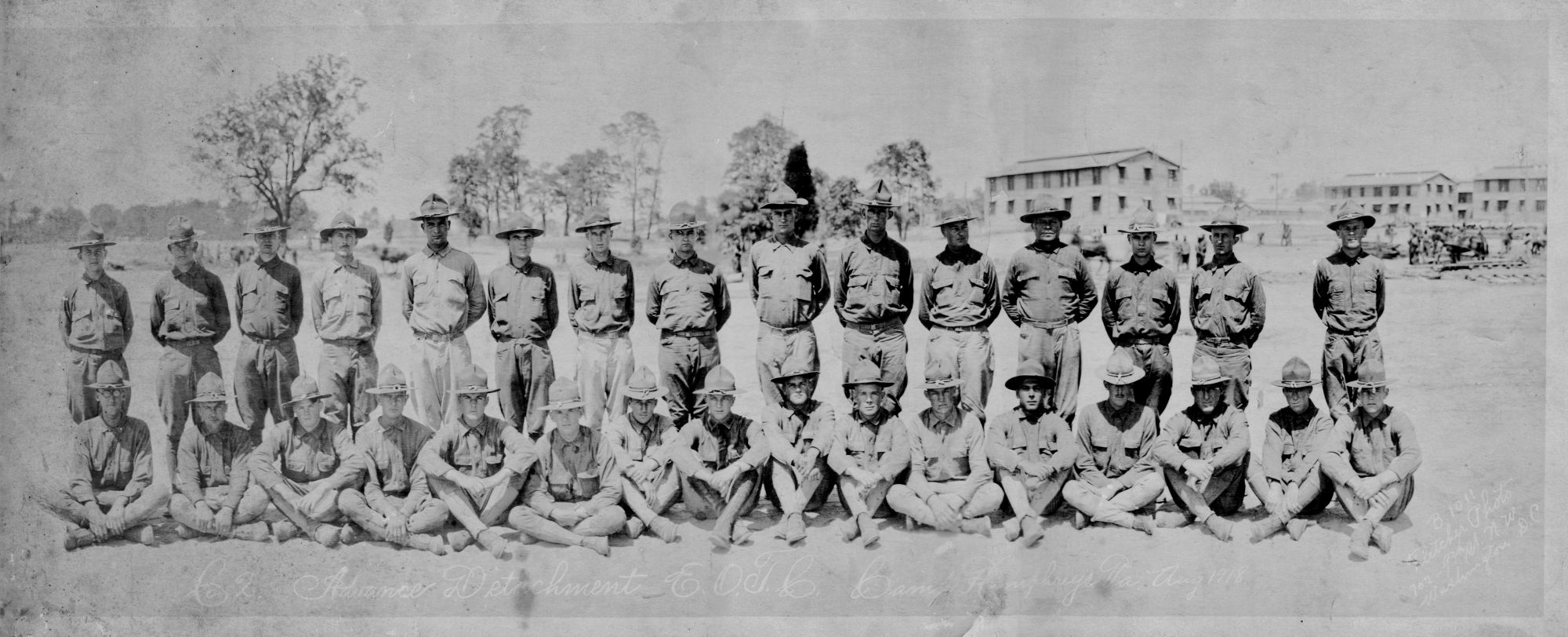
2nd Company Advance Detachment E. O. T. C., Camp Humphreys, Virginia, August 1918. My grandfather Robert Joseph Landry, Sr. is the one directly above the C. in E.O.T.C. He was 25 years old at the time.

This photo is different in many ways – it’s new to me, it’s a large panorama, it’s a large group of service members, and it has identification.  The first time I saw it was last year when I got together with a few cousins to share photos.  It is part of the Duffy Family Tin Can Collection.  My Aunt Wana was married to a Duffy and she somehow came into possession of many old photos.  She had many of them in a tin can in her attic, hence the name Tin Can Collection.  I don’t think this one was in a tin can though.  It is a large panoramic photo that has been rolled up for a long time.

The Keeper of the Collection is my cousin Tricia.  She guards it enthusiastically.  I wasn’t able to take a photo of the panoramic photo roll when we got together since it was so large.  But thankfully, Tricia let her guard down for a moment and allowed me to take it with me so I could scan it.  So we can thank Tricia (and anyone else named Duffy) for this wonderful photo.

The scan was a little tricky since the photo is so large.  I had to scan it in three sections and merge them together.  I notice a bit of ghosting, but it came out pretty good.  There are actually two images on the roll.  This one is a photo of the Company with their hats on.  The other one (which I’m saving for a later date) is one with their hats removed.  The great thing about these photos is the information written (or etched) on them.

The writing identifies the men as the  Company 2 Advance Detachment at Camp Humphreys in Virginia.  And to top it all off, it gives a date of August 1918.  On the right side at the bottom, it looks like some information about the photo for military archives.  I may have to share it on a military website I’ve seen.  Maybe someone else can find a family member from this group. 

I know I was excited to see a photo of my grandfather from a hundred years ago.   I hope you enjoy it, too.

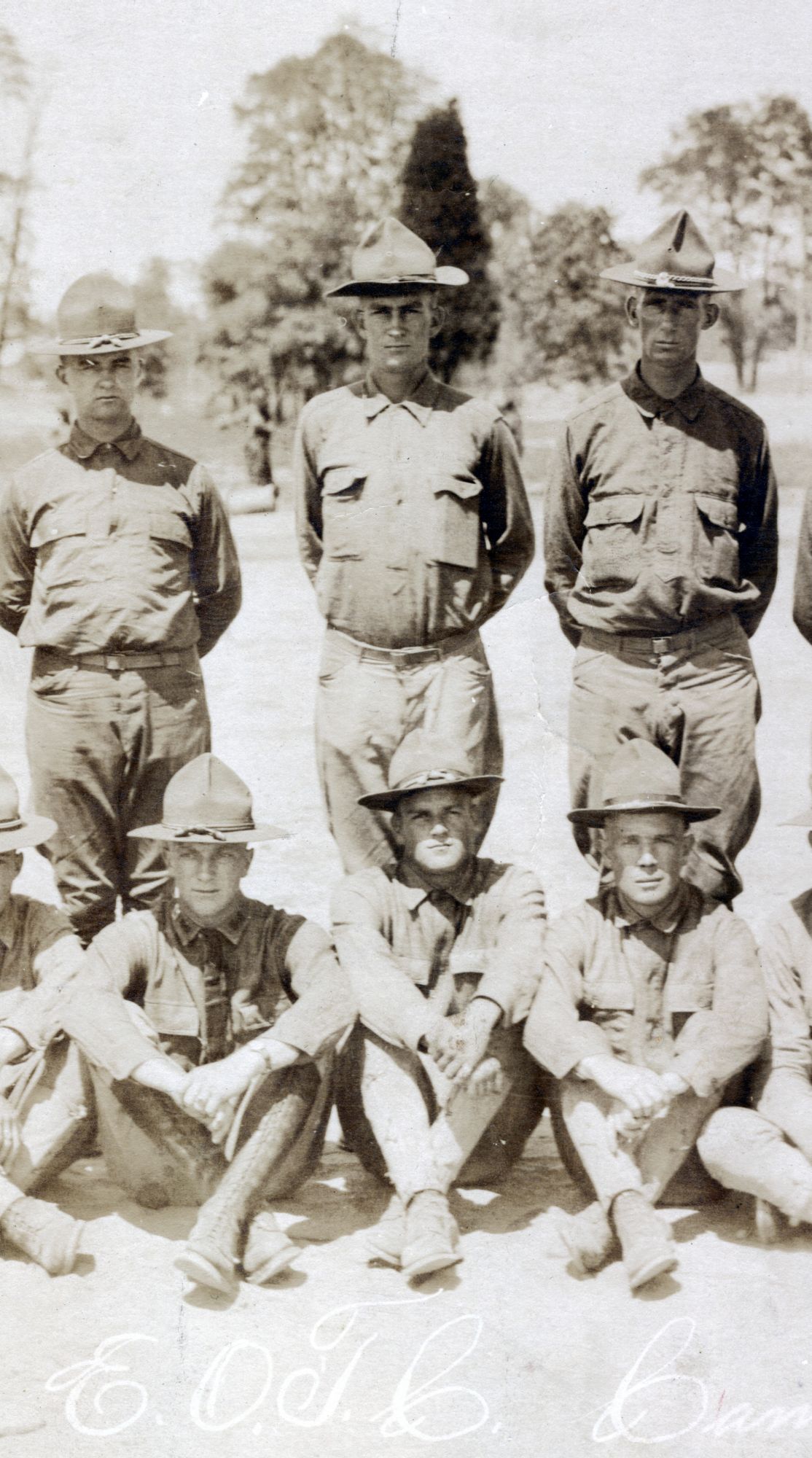
Front and center is my grandfather Robert Joseph Landry, Sr. of Lake Charles, Louisiana

Myrtle Giving Haircut

Myrtle Phenice Bucklin giving haircut to sister-in-law Irma Hetzel Phenice circa 1939

I’ve always liked this photo.  Mainly because it is a photo that includes my Grandma Bucklin in it.  The photo source was not a very high quality.  I think it was a scan of a Xerox of a photo.  There were lots of stripes and graininess in the photo, so I doctored it the best I could.  I like the way it looks, though I wonder what a scan of a good photo would look like.  Maybe one will come my way now that I’m putting this one out there.

Myrtle Sylvia Phenice was born Dec. 19, 1906, somewhere around Hathaway, Louisiana.  She was married to Fred Bucklin on March 12, 1930, at the Raymond Methodist Church in Raymond, Louisiana.  They had five children together, including my mom Betty Lou who was born in 1933.  You can tell from the title that my grandmother is the one giving the haircut.  But you don’t know whose hair she is cutting.  That would be Irma Hetzel Phenice.

At least I think she was a Phenice at the time.  I estimated that date on the photo.  Irma married Myrtle’s younger brother Henry in 1934.  Yes, I think the date is close enough to be sure that Irma is her sister-in-law at the time of the photo.  It seems like homemade haircuts are very common with my family.  I have photos of my other grandmother cutting a grandchild’s hair.  I also have a photo of my dad cutting his brother’s hair.  When we were young, my mom cut our hair most of the time.  I cut my own hair.  It’s a family thing.

But I think it might be a bit more popular now that the coronavirus is keeping people in their houses, and salons & barbershops aren’t open.  I’m here to tell you that you will survive a homemade cutting.  But I’m not trying to “educate” you or convince you to participate.  I just wanted to share an old photo that I like.

I hope you enjoyed it. (If you can see it through that mop of overgrown hair that you have by now!)


July 6, 2020 – Here is the photo enhanced.


Sept. 20, 2020 Addendum – Van Giving Haircut

I finally participated in the Caronavirus Pandemic Home Haircutting Extravaganza!  Cousin Mary came over with her mom Maggie and her children Aiden and Violet.  If you had seen Aiden’s hair, you would think I was talking about him when I wrote the last line of the blog post.  With a lot of coaxing from Mary, he finally decided  to trust me and my scissors.  Like I said before, I’m sure he will survive the homemade haircut!

From Acadian to Cajun: Part 6 – Bujol/LeBlanc

My ancestors Joseph Bujol (Bugeaud) and Anne LeBlanc were among the Acadian Exiles who made their way to Louisiana. These names are on a Memorial Wall in St. Martinville, Louisiana.

Here we are again, looking at another installment of the stories of my Acadian ancestors who were sent into Exile and eventually ended up in Louisiana.  This time we will be looking at the experience of Joseph Bujol and his wife Anne LeBlanc.  We haven’t looked at any of my ancestors with the last name of Bujol yet.  Last time we did look at a Bujol who was married to one of my ancestors, but sadly he died during the turmoil of the Exile. 

We have also looked at an ancestor with the LeBlanc last name previously.  Elizabeth LeBlanc was married to Honore Breaux, and her father Victor was Anne’s second cousin through the Acadian founder Daniel LeBlanc.  There are seven paths from Daniel down to me.  I won’t go over all of that, but I will say that I descend from Daniel’s children Rene, Andre, and Anthony.

But let’s get back to our main subjects.  Joseph Bujol was born in Pisiquit, Acadie, in 1723.  His father was also named Joseph and his mother was Josette Landry.  They lived in a place called  the Village de Abraham Landry.  Abraham Landry was the father of Josette and the grandfather of Joseph the younger.  We have definitely talked about the Landry name in previous posts.

Anne Leblanc’s baptism record

Anne LeBlanc was born February 6, 1732, in Grand Pre, Acadie.  She was the youngest of the nine recorded children of Jean LeBlanc and Jeanne Bourgeois.  They lived in St. Charles aux Mines, Acadie.  Like many young women who are married, she was married in her hometown to a somewhat older husband Joseph Bujol in 1750.  Her father had died in 1747, so she was not given away by her father as many brides are. 

Within a year of their marriage, they had their first child – a daughter that they named Marguerite.  In 1753 they had son by the name of Augustin.  Then in 1755 they had their most important child – a daughter that they named Perpetua (or Perpetue).  I think she’s special because she is my 4X great grandmother.  She was also the last of my ancestors to be born in Acadie.  It was that same year that the Grand Derangement began.

This was the time that the English forced the residents of Acadie from their homes and Exiled them to various places.  Most of their homes and churches were burned, along with many records within them.  They were sent off with not much more than the clothes on their backs.  Many of them died in the process due to shipwrecks, diseases, and malnourishment.

On October 27, 1755, Joseph and Anne, with their three children, were loaded onto the ship “The Ranger” and torn from their homeland.  On November 29th they reached the shores of Annapolis, Maryland.  They did not disembark at that point, because they ended up continuing on to Oxford, Maryland.  This is where they would spend their next 12 years of Exile.

I can’t imagine going through this Great Upheaval like they did with an infant daughter and two other young children.  The danger and uncertainty of it all must have been terrifying.  Their outcome was better than others I have written about.  Other ancestors who had recently been married and with young children didn’t fare so well.  Some of them lost their first spouse and others lost children.  (Another sober nod goes to Magdelene from my last installment.)

They weren’t spared all grief, though.  Anne LeBlanc lost four siblings in the first few years of the Exile.  After recently enduring the death of a second sister, I can’t imagine losing four in such a short time.   I don’t see that Joseph lost any siblings at this point, but his father did die in 1758.  I know many of his siblings ended up in Quebec, so he likely never saw them again. 

The 1763 Census for Oxford, Maryland, of the Acadians in Exile.

Their life continued in Oxford.  If you look at the July 1763 Census from Oxford, Maryland, the sixth household listed begins with Joseph Bigeos.  That’s our Joseph Bujol.   Anne is listed after him, as are their children Marguerite, Augustine, and Perpetue.  And there’s one more.  They had a little girl that they named Anne in 1757 while in Oxford.

That little girl Anne Bujol would later marry a little boy that is listed on this same page.  The third household listed starts with his parents Joseph and Marie Josette (Bourg) Landry and continues on to the son named Joseph.  He would be known as Joseph “dit bel Homme” Landry and he would marry Anne Bujol in Donaldsonville, Louisiana.  They would have over a dozen children and eventually die in Donaldsonville.  There is a huge monument/tomb in the Catholic Cemetery there.  Everyone always asks me if I descend from that well-known Landry.  I say, “No, but we are related.”  When I try to explain how I’m related, their eyes glaze over.  Except for the ones that really do descend from him.  I know some of them.

Joseph Bujol and Anne LeBlanc would have one more child while in Oxford.  Marie Madeline was supposedly born in 1762, yet she didn’t show up in the 1763 Census.  Perhaps the Census was negligent.  It’s been known to happen.  She was not their last child, but their stay in Oxford was coming to an end.  Like the other Acadians I have talked about, they heard about opportunities in Louisiana and decided to take their chances.  In late June of 1766, they joined over 200 other Acadian Exiles and boarded an English chartered ship that departed from Baltimore.

The ship did not head directly to Louisiana.  It reached Belize in September 1766 after making a stop in Cap Francais.  They then continued on to New Orleans.  These new arrivals had not been given permission to emigrate to the now Spanish-owned territory, yet the Spanish authorities were expecting more immigrants.  Because the Exiles “…had arrived in misery and were in great need, they were helped immediately…”  This group was sent to the Acadian Coast and given small lots of land.

In 1769 they were living in the Pointe Coupee area with their family.  The listing is as follows:   #74 Joseph BUJEUX, 46; Anne LEBLANC, wife, 36; Augustin, son, 16; Joseph, son, 3 months;  Margueritte, daughter, 18;  Perpetue, daughter, 14;  Anne, daughter, 12;  Marie, daughter, 8;  Joseph LANDRY, uncle, 65. 

I’ll leave it like that; with the family making a new home in Louisiana and welcoming a new baby boy.  You might as well go ahead and call them Cajuns.


family tree showing the path to ancestors discussed in this blog post

Follow the red Louisiana icons to find Joseph Bujol & Anne LeBlanc


For other installments of this series of blog posts, click on the following links:

From Acadian to Cajun: Part 1 – Landry/Babin

From Acadian to Cajun: Part 2 – Breau/Trahan

From Acadian to Cajun: Part 3 – Braud/LeBlanc/Gauterot/Aucoin

From Acadian to Cajun: Part 4 – Hebert/Melanson

From Acadian to Cajun: Part 5 – Bourg/Granger

From Acadian to Cajun: Part 7 – Foret/Bujol

From Acadian to Cajun: Part 8 – Hernandez/Babin

From Acadian to Cajun: Part 9 – Dupuis/Dugas

From Acadian to Cajun: Part 10 – Bourg/Babin/Landry

From Acadian to Cajun: Part 11 – The Ones That Didn’t Make It

1 30 31 32 33 34 58