Grampa Max’s Store in Plaquemine

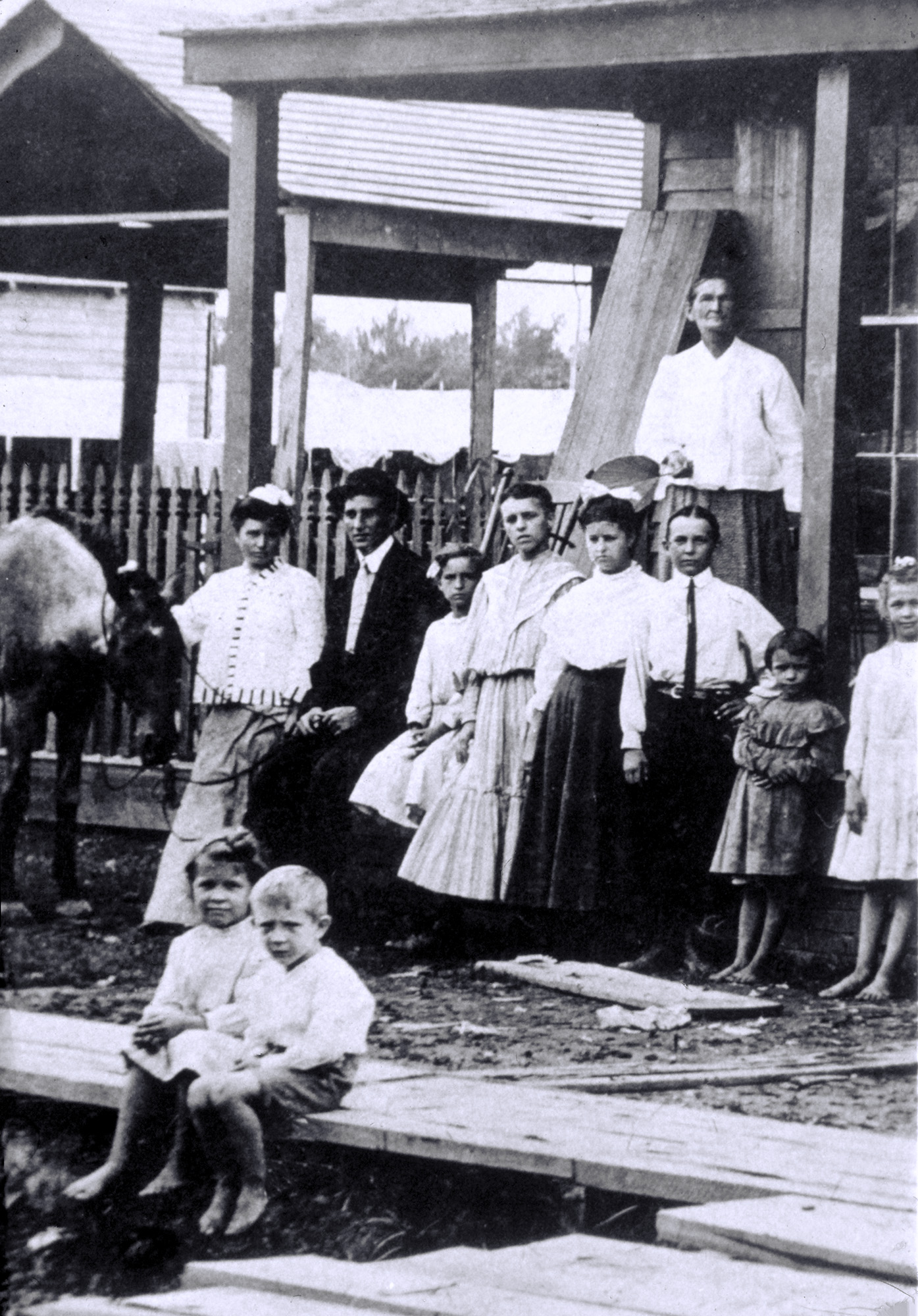
Family store in Plaquemine, Louisiana, circa 1904.

I posted this photo of the family store in Plaquemine, Louisiana, seven years ago.  That was ages ago.  It was before I was doing these weekly posts about family history.  Back then I was just sharing an old photo that I liked.  I think the first time I saw the photo, it was in Tommy Landry’s book about the descendants of Trasimond Landry.

In that book it quoted “Mrs. Naomi Landry Vincent” who was identified as the granddaughter of Trasimond Landry’s widow Marie Amelie “Belite Bujol Landry Babin.  I knew she was a relative back then, but I wasn’t exactly sure how we were related.  But now I know that she was my dad’s first cousin Sis from the Landry side of the family.  Their fathers were brothers.  I’ve talked about his other cousin Sis from the Patureau side.  She is still with us, but all of Daddy’s first cousins on his father’s side have been gone for many years.

But I still was able to get some new information from Cousin Sis from the Landry side.  Daddy made a videotape in 1990 of her talking about the Landry family while viewing various photos.  It is very helpful.  I’m so glad my brother-in-law made a disc for me recently.  (Thanks, Brian!)  I also found myself thanking my dad as I watched it, because he was asking the questions that I wanted to ask.  So now I am able to identify everyone in the photo. 

I identified a few people in the photo before with the help of some writing on the back of my cousin Daphne’s original of this photo.  I also have the photo of the back of someone else’s copy.  So it took a combination of all of that to finally get everyone named.  So let the naming begin!

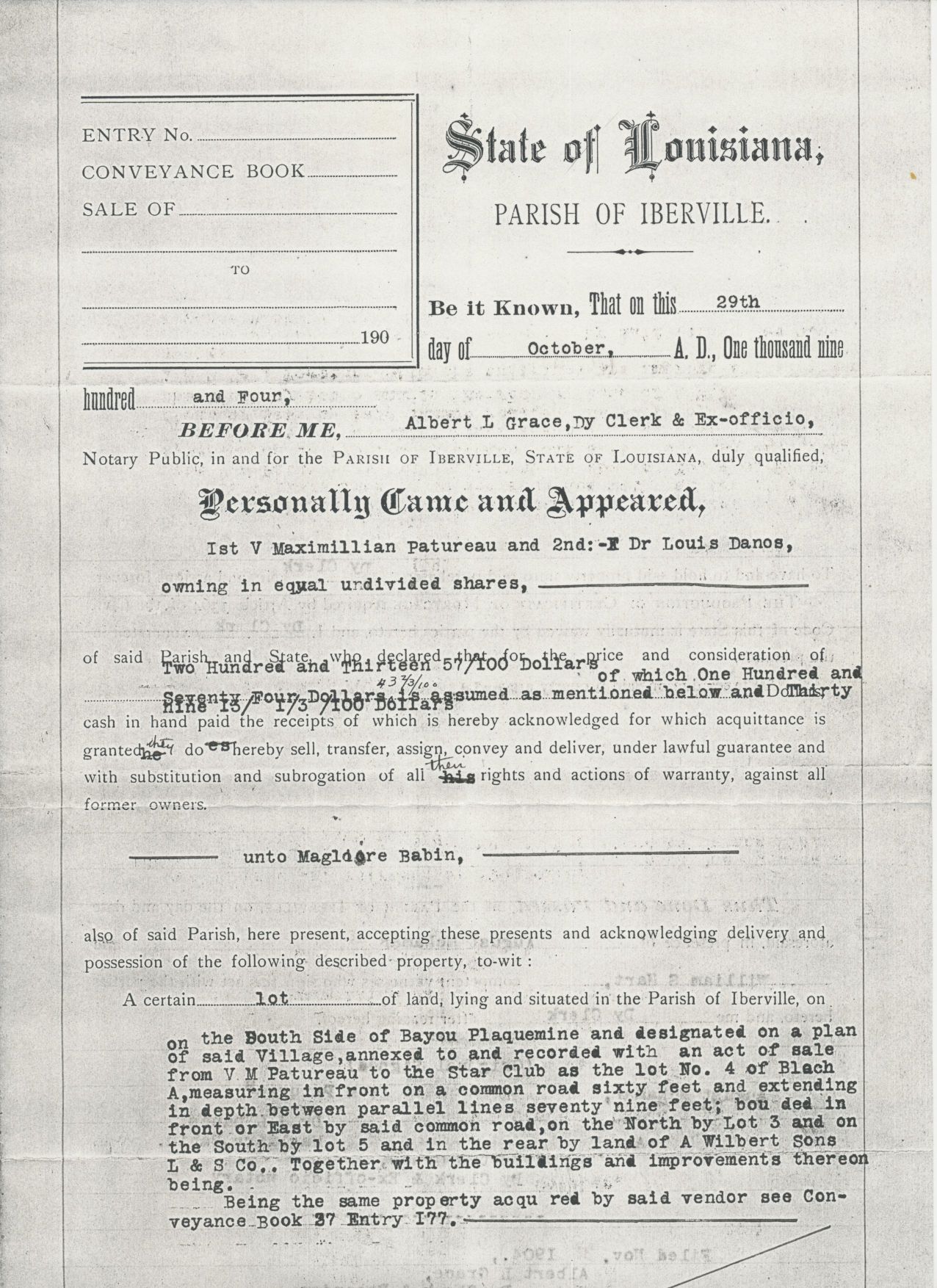
According to the document I found, Vincent “Max” Patureau, Magloire “Mack” Babin, and Dr. Louis Danos had three equal shares in the store.  This was before Grampa Max was a veterinarian.  He was married to Marie Therese Landry, who is not in the photo.  Her mother (Belite – by Belite’s first husband Trasimond Landry), step-father (Mack), husband (Max), half-sister (Clemence), brother-in-law (Louis Landry – also her first cousin), and children are in it.  And now that I look closer, there is an unidentified person in it.  (Lorena was listed twice by my dad and Sis!)

Labels from the back of this photo. Not sure of its origin.

In the front on the wooden “sidewalk” are Zita and Vincent Patureau.  Behind them are Clemence Babin with her hand on the horse and Louis Landry with the reins in his hands.  They would quietly be married at the residence of her parents (Belite and Mack) the following year and then set up residence in Lafayette.  Their oldest daughter would be cousin Sis (the Landry one, of course).  I’m not sure who the next girl is.  She was labeled as Lorena, but so was the girl at the end of this line sitting on the steps.

Cropped version of the photo that I found that has more details in it.

The next person is Emma, the oldest child of Max and Marie Therese.  To the right of her is younger sister Lydwin.  Beside her is their brother Romuald.  Standing behind Romuald is Grandma Belite.  (Landry cousin Sis called her Grandma Babin, which led to a lot of confusion for Patureau cousin Sis before my dad straightened it out for her one day.)  Next to Romuald is little Sylvia, the youngest of the Patureau bunch.  There was some discussion on the video about whether Sylvia is this little girl or the little girl sitting in front.

The next little girl is my favorite.  Her name was Erie.  When she grew up, I knew her as my beloved Mee Maw.  I was her favorite!  Next to little Erie is Marie Therese.  She was known as Bee and when she grew up, she was the mother of Sis and Syl.  (Patureau Sis, not Landry Sis!)  As I said previously, the girl sitting on the steps may be Lorena.

The man sitting on the steps is Mack Babin, who had 1/3 ownership of this store.  He was the second husband of my great great grandmother Belite Bujol.  The man standing behind the horse is my great grandfather Vincent Maximillian Patureau – better known as Grampa Max.  The identity of the last person came from my cousin’s photo.  He is labeled as “Old Uncle Joe.”  Based on the age of the man and the year the photo was taken, I think this must be Grampa Max’s older brother Joseph Alcide Patureau.

So there you go.  That wasn’t too bad, right?  Thanks to those that stuck with me through to the end.  You’re the best!  I hope you enjoy the photo.  I do.

Mom’s Memories Page 6 AKA Flowers for Grandma

Page 6 of my mom’s memory book.

Here is another page from the little memory book that my mom kept when she started to become more forgetful.  She wanted to make sure some of her fond memories would continue.  I thought I would help them along.

My mom’s name was Betty Lou Bucklin Landry (1933-2017) and she grew up in Hathaway, Louisiana.  This is page 6 of her book.  She is in the middle of talking about her paternal grandmother Addie May Hine Bucklin (1876-1960).  She never knew her paternal grandfather Louis Bucklin (1873-1927).  He died before she was born.

She mentions Aunt Dora on this page.  That would be Dora Koll Bucklin (1911-1998).  She was married to Herbert Bucklin (1906-1995), the brother of Betty Lou’s dad Fred (1907-1984).  Herbert and Dora were the grandparents of our Joseph Connors.  Mama always had nice things to say about Aunt Dora and Uncle Herbert.  Why wouldn’t she?  She was a little girl who appreciated someone giving her jewelry and taking her to the Eunice circus!

On page 1 of her memory book she talked about going to Grandma Bucklin’s house for big covered dish dinners where all the family brought their favorite dishes.  She said the food was so good that they were sneaking food all afternoon.  I’m sure she was talking about the old Bucklin family home that had been built in 1888. From what I can tell, it was about a mile north of the house that my mom and her family lived in.  About halfway between those two houses is where Aunt Dora (she of the beautiful wavy hair) and Uncle Herbert lived.

Hathaway circa 1937 – Alma, Betty Lou, and Sylvia Bucklin

Another thing my mom talks about is making May baskets.  She wrote in the plural “we” like I do when talking about my childhood.  I’m sure she was talking about herself and her sisters.  Her brother was younger and probably didn’t participate in this event.  The sisters would make paper flowers and put them in a basket.  One basket was for Grandma Bucklin and one for Aunt Dora.

Then they would go to their door, knock, and run away to hide.  Of course they would be peeking to see the reaction they got.  I’m sure there was a lot of giggling involved as well.  And who wouldn’t be glad to see those three little cheerful girls (later there would be four) bringing them a present?

Like she says, it usually got them invited in for milk and cookies.  The simple pleasures of childhood.

Bitsy: 50 Years Gone

This is a post that I’ve been thinking about writing for a while.  It’s about one of my earliest memories concerning death.   Only recently have I discovered that the subject of this post – David Hotard – was a distant cousin.

I was born in Lake Charles, Louisiana, on the Halloween of 1960.  I was the 5th of 6 children of Bob and Betty Landry.  It was not long after my younger sister was born in 1962 that we moved to Jennings, Louisiana.  The first two years in Jennings we were renting a two story house north of the interstate.  Then we moved into town to the yellow house on Lucy Street.  It was there that we met the Hotards.

Looking at those dates now, I realize that David must have been an infant when we moved next door to them.  He was one of four sons of Mr. and Mrs. Hotard.  My older brother and I were a little older than they were and we played together a lot.  You know, playing games and riding bikes – the things that kids did growing up in the South in the 60s. 

It was a small town, so we always thought it was pretty safe.  And as I remember, David was the nicest of the brothers.  He never hit me over the head with a hammer and didn’t cut my finger with a shovel!  He also had a nickname.  We called him Bitsy.  I’m thinking that Mr. Hotard must have given him that nickname.  He did that with everyone.  I was either “Van the Bomb” or “Ban the Bomb.”  Karen was “The Lucy Street Crier.”

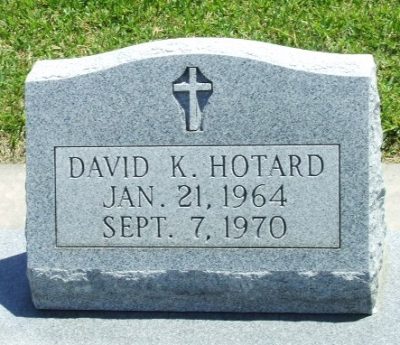
Things changed in September 1970.  It was the year that David started first grade.  As I remember it, he only attended three days of classes.  David decided he wanted to go bike riding.  He came by our house to see if anyone wanted to go with him.  No takers.  He found another neighbor to go with him.  They did not get far.  He was practically in front of his house when a car hit his bike and knocked Bitsy to the street.  He had a severe head injury and as a result he died shortly afterwards.  He died on September 7, 1970.

That day was very memorable, but even more so was the funeral.  It was a few days later.  I know it was a school day, because we missed half a day of school that year.  It was such a sad day.  I remember going to the graveyard and seeing Mrs. Hotard sobbing.  I remember crying along with her and it still chokes me up to think about it.  It must have been at this point that my mom talked about how parents should never have to endure the death of one of their children.  Such a terrible loss.

Earlier this year I wrote a post about my Acadian ancestors and their experiences during the Grand Derangement.  In this particular post I mentioned my Bourg ancestors.  One of the Hotard brothers sent me a note saying that they also descended from the Acadian Bourgs!  Come to find out, little Bitsy had been my 7th cousin twice removed.  His grandmother Hazel Bourg had been my 7th cousin.  She died in 1967, but I don’t recall that happening.  All my life I thought Mrs. Hotard was only Italian.  She was my 7th cousin once removed Sandy Passantino through the Cajun side of her family.  Imagine that!

I recently reread the book about my ancestor Trasimond Landry.  There is a mention of Trasimond going to a funeral of a friend when he was young.  He grew up with Arthur and his twin brother Anatole.  Arthur’s funeral was the first funeral he had attended where he cried.  When Trasimond’s mother Marie Carmelite died a few years later, Anatole was there to share the grief.

When I read that, it made me think about my experience at Bitsy’s funeral all those years ago.  And like Trasimond who had his friend at his mother’s funeral at a later time, my cousin Sandy was at my parents’ wake.  She actually led the rosary that night.  But we didn’t know we were related back then.  We were just sharing grief again over the loss of people we both cared about.

Milliron Reunion in 1885

Daniel C. Milliron and Catherine Cribbs were my 4x great grandparents.  They were married on Feb. 5, 1824, in Hemphill Township, Westmoreland County in Pennsylvania.  They were both born in Westmoreland County, yet after they were  married they settled in Mercer County which is 100 miles away.

They had nine children together.  In 1825 they had Alexander, in 1826 they had Anne Magdaleen (my 3x great grandmother), in 1829 they had John, in 1831 they had Elias, in 1834 they had Cyrus (died as infant), in 1836 they had David, in 1838 they had Luis (died as infant), in 1840 they had Catherine (died as infant), and in 1842 they had Susannah (died at age 9).  As you can see, only 4 sons and 1 daughter grew to adulthood.

Once they grew up and got married, they and their children started spreading across the country.  Those were the times they were living in.  When Anne Magdaleen married Morris Foster on August 30, 1843, the US consisted of only 26 states.  By the time of her death in 1873, 11 more were added.  The Milliron families were setting up homes in some of these new states.

Transcription of May 21, 1885, letter from Milliron brothers to their brother John. The letter was found in an old family Bible.

This led to lots of distance between those siblings.  I discovered this when I found a transcription of a letter from May 21, 1885.  Three of the brothers were having a reunion at the home of the oldest brother Alexander in Wabaunsee County, Kansas.  When they were growing up, he was called Sander.  As he got older, he was known as Mac.  After a few days together at the reunion, they adjusted to calling him his new name.

From what I can tell, Sander (or Mac as we now call him) had last seen Eli in 1857.  Can you imagine not seeing your sibling for 28 years?  The last time Eli had seen Dave was in 1865.   Their time apart was only 20 years.  Sander had last seen Dave in 1870.  They don’t mention how long it had been since the brothers had seen John.  The letter was written to him and it sounds like he may have stayed in Pennsylvania.

One of the things not mentioned was the death of Anne Magdaleen in 1873.  They do talk about being the only four left of their immediate family.  So it’s evident that they did not go to Anne’s funeral.  She lived in Pennsylvania, so the only one that would have possibly made it would have been John.  We don’t hear from him, though.  They do express sorrow that he is not with them and invite him to visit each of them.  I wonder if Cathrine Foster Phenice (daughter of Anne Magdeleen) was invited to this reunion.  She only lived a day or so away, yet she and husband Samuel had six young children to care for.

The three brothers spent a few days reminiscing about old times.  They mention some of their adventures as young men and say that they have tempered themselves as older men.  It’s a little bittersweet.  They mention reading over all the old letters they could find.  Boy, I wish I had some of those!  At least I have this one.  It gives me a bit of a glimpse into the lives of my great great great grandmother’s family.


Harry C. Phenice is my maternal grandmother’s father.


From Acadian to Cajun: Part 9 – Dupuis/Dugas

The Wall of Names of Acadian Exiles in Louisiana in St. Martinville. Joseph Dupuis (2) is my 5X great grandfather. Listed under him are four of his nieces and nephews.

These installments can be pretty tricky to write.  I want to be as accurate as possible, but that is really difficult to do when there is conflicting information out there.  Human memory is very much influenced by belief and the passage of time.  The Grand Derangement happened 265 years ago in another country where a different language was spoken.  A lot of turmoil was going on when it happened.  When the people eventually settled in a place to call home, they just wanted to get their lives together.

What has survived are a few old church documents and some Censuses before and during the Exile.  One of the treasured items from back then are the Declarations of  the Acadians at Belle-Ile-en-Mer in France.  The Acadian Exiles in this area were interviewed and asked to tell about their family histories.  Many of the people were able to give information about their families back to the time of the founders of Acadie in the 1600s.  Of course most of this was based on human memory, so some errors were present in their statements

The Declaration that I was most interested in was that of Marie Josephe Dupuis on February 27, 1767, at the Village of Parlavant.  I don’t descend from her, but I do descend from her younger brother Joseph Dupuis.  He is the main person I’m writing about in this installment.  Marie Josephe was the oldest of eleven children of Antoine Dupuis and Marie Josephe Dugas.  Antoine and Marie Josephe were married around 1719 in Riviere au Canards, Acadie.  Their first child (Marie Josephe) was born in 1721.

Like I said, she was the oldest of eleven children.  They were born over a period of 20-25 years.  That included two sets of twins.  Joseph and his twin brother were one of those sets.  According to their older sister, they were born in 1745.  Their parents Antoine and Marie Josephe died around 1747.  It looks like some of the older children were caring for the younger ones after that time.  Some of them were adults with children of their own.  So when the Grand Derangement happened in 1755, the family was split up even more.

So when Marie Josephe Dupuis (Theriot) made her declaration in 1767, she hadn’t seen some of her siblings for almost twelve years.  Sadly, some of them had passed away.  From what I can tell, six of her siblings had died since their Exile from Acadie, yet she was only aware of one of those deaths.  Marie Josephe and a younger sister named Ozite (and their husbands and children) were originally Exiled to Virginia in 1755.  Like other Exiles sent to Virginia, they were deported the following year to Falmouth, England, where they were treated with neglect.  Many Acadian Exiles died in 1756 from the smallpox, including sister Ozite, Marie’s husband Pierre Theriot, and several other Theriot family members. 

Evidently all that Marie Josephe knew about her other siblings is that they had been “transported to New York.”  There was another sibling (Anne Marie – the twin of Ozite) that “passed with their family to the Mississippi” and was never heard from again.  According to other sources, she died before 1767.  So that would mean that eight siblings were “transported to New York.”  Yet all other sources say that Joseph’s twin brother Jean Baptiste was Exiled with Marie Josephe and Ozite and he ended up in France as well.  Yet Marie Josephe clearly states that Joseph and Jean Baptiste were “transported single” to New York.  If he was with her in France, she would surely know about it.  She may have overlooked Jean Baptiste when talking about the twins.

So that leaves seven siblings that were transported to New York:  Joseph, Magdeliene, Antoine, Simon Pierre, Marguerite, Euphrosine, and Charles.  But they didn’t actually go to New York.  They went to Connecticut.  See how difficult it is to figure out what happened back then?  Even the ones that were living back then didn’t know what was happening.  Of course if those in charge didn’t care if the Acadians lived or died, they certainly weren’t concerned if they knew what was going on with their families.  You can only tell the truth if you know the truth.  So we can forgive Marie Josephe for any errors in her Declaration.  She went through a very traumatic time and she meant well.

So let’s see what happened to Joseph and his siblings (and their families) that were sent to Connecticut.  It looks like at least seven ships left the shore of Acadie with over 1000 individuals who were forcibly removed from their homeland.  They left sometime in late 1755 and arrived during the month of January 1756.  I haven’t seen information about where they stayed or even if they were all in the same place.  What I have found is that his sister Magdeliene died in Connecticut in 1762.  There is no more information on his other older sister Marguerite, so I’m thinking she probably died between 1756 and 1762.  His younger brother Charles survived and somehow he and some of their sisters’ children made it back up north and settled in Quebec.  So that left Joseph with Antoine, Simon Pierre, and Euphrosine.

Toward the end of the Seven Year War (in 1763) French officials were encouraging Exiles to relocate from English colonies to French-owned Sainte Dominque (now Haiti).  There they would be used as laborers on a naval base on the island with the incentive that the Exiles would be given land grants.  Joseph and his other three siblings joined a group of 180 Acadians from New England ports who headed to St. Domingue in August 1764.  It was not the best situation.  The officials sent them to Mirebalais (near Port au Prince) and did not give them the land that was promised.  The Acadians did not fare well and many of them died from malnutrition and tropical diseases.

Joseph had not married yet, nor did he have any children, so we know he survived.  How else would he become my ancestor?  But his siblings were not as fortunate.  Simon Pierre and his two older sons Francois and Firmes died within a month or two of arriving in their tropical environs. (His wife had died in 1760 in Connecticut.)  On January 4, 1765, his younger sister Euphrosine passed away at Mirebalais.  She had become a new, young mother the previous year, but her son had died a month before she did.  Then in August his oldest brother Antoine died as well.  Antoine’s wife and three of his seven children had died in September and October of 1764 in Mirebalais as well.

And then there was Joseph.  When I saw his name on the Wall in St. Martinville where the list of Acadian Exiles in Louisiana is shown, I noticed a few names under his.  I didn’t know who the other people were, but later found out that they were his niece and nephews.  “Hmm,” I thought, “That’s interesting.”  But now that I’ve found out the details of his life in Exile, I have to say that it is more than “interesting.”  It’s very touching.

Joseph was an orphan when the Grand Derangement began, but fortunately he had several older siblings who were willing to help him through those terrible times.  As they went from Acadie, to Connecticut, and then on to Sante Dominge, their numbers were decreasing.  Yet if it weren’t for them, he may not have survived.  So when he found out about a chance for a better life in Louisiana, Joseph Dupuis took action.

There was a ship of Acadian refugees that docked at Cap Francais for over two weeks.  The ship was The Virgin.  It came from  Maryland and it included my Landry ancestors who had spent their exile there.  Joseph made his way across the island to meet up with the ship.  He took along the surviving four children of his brother Antoine.  It’s what family does.
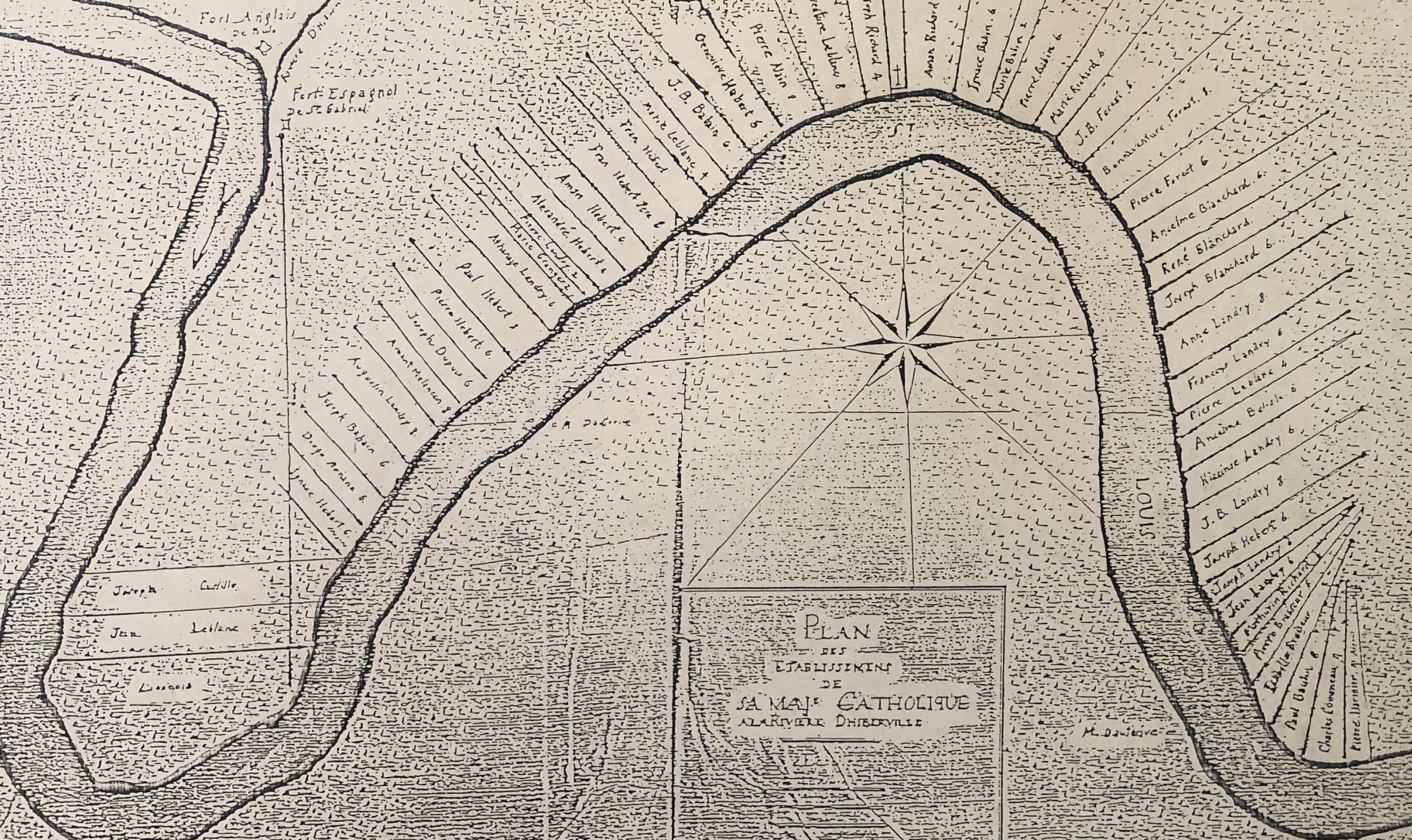
Map of St. Gabriel showing the location of the Acadians who settled there in 1767.

The Virgin arrived in New Orleans on July 23, 1767.  Joseph settled with the other Acadians in St. Gabriel.  At the end of Installment No. 4, I talked about Anne Marie Hebert being at the right age for marrying in 1769.  Her family had settled in St. Gabriel in July 1767 as well.  Her father and her brother owned property next to each other.  And the property next to her brother’s was owned by none other than our Joseph Dupuis.  She evidently came to the conclusion that he was good marriage material, because they were married on March 27, 1769.

In the 1777 St. Gabriel Census, it shows Joseph and his wife Anne Marie with their two young sons.  His nephews Jean Baptiste and Simon lived nearby.


My family tree with path to Joseph Dupuis highlighted.


For other installments of the “From Acadian to Cajun” series, click on the following links:

From Acadian to Cajun: Part 1 – Landry/Babin

From Acadian to Cajun: Part 2 – Breau/Trahan

From Acadian to Cajun: Part 3 – Braud/LeBlanc/Gauterot/Aucoin

From Acadian to Cajun: Part 4 – Hebert/Melanson

From Acadian to Cajun: Part 5 – Bourg/Granger

From Acadian to Cajun: Part 6 – Bujol/LeBlanc

From Acadian to Cajun: Part 7 – Foret/Bujol

From Acadian to Cajun: Part 8 – Hernandez/Babin

From Acadian to Cajun: Part 10 – Bourg/Babin/Landry in a short story called “Finding Home”

From Acadian to Cajun: Part 11 – The Ones That Didn’t Make It

The Swimming Pool Part 2

My maternal grandparents Fred Bucklin and Myrtle Phenice out on the beach with family in southern Louisiana circa 1929.

I’m excited about this photo.  It’s not an enhanced photo and it’s not a photo that I’ve shared before.  I’ve shared another photo from the same day before.  That was the original The Swimming Pool post from over four years ago.

I got this photo from my cousin Carla last year.  I’ve shared a few others that she shared with me and there are more to come in the future.  I was excited to get this one and a few others that were taken on the same day as the original photo I posted.  I wasn’t expecting that.  But it wasn’t until today when I was looking for something to post, that I realized that my grandmother (Myrtle Phenice Bucklin, mother of my mom Betty Lou Bucklin Landry) is in the photo. 

In the other photo it looked like the Bucklin brothers were fighting over a girl.  The girl was in the middle of that photo and she is in the middle of this one also.  She’s facing the camera.  I think she could be Grandma Myrtle’s older sister Grace.  Myrtle was in that original photo too, but she was off to the side looking a bit dejected.  But not in this one.

You can see her in front to the left.  She is facing away from the camera.  I recognized her because of her feminine shoulders and the straps of her swimsuit.  Even from this side view, you can recognize her strong high cheekbones.  Her hair matches the other photo as well.  Maybe she had it pinned up.  And even though you can’t see her face, it seems to me that she is having a better time. 

Did I hear someone say, “Hogwash!”  Well I’ll explain why I say that.  She is reclining on the beach between the cute Bucklin twins (Fred Bucklin was my grandfather and Clarence was the father of cousin Carla).  It looks like she may be sharing a secret behind a large hat with one of them, while the other one is behind her and reaching for her playfully.  I still can’t tell them apart in photos.  That happens when the photo is almost 100 years old and the two that I’m talking about were identical twins.

I’m still not exactly sure what is going on in this photo.  But now that I realize that my grandmother Myrtle is in it, I’m liking it much more.  It looks like they’re having a relaxing and fun time on the beach.

Crop of photo

Do NOT Try This at Home!

Enhanced photo of Alcide Landry circa 1890.

I had decided that I was not going to post this photo this week.  It’s one of the only things I was sure of as far as my blog goes.  I try to plan things out a little, but I’m usually not sure what I’ll exactly say from week to week.  I have been looking for something about my great grandfather Simon Alcide Landry to write about.  He was the husband of Marie Celeste from two weeks ago, but I really didn’t say much about him.  I have lots of photos of Marie Celeste through her years, but only one of Alcide.  I thought I would save this enhanced photo of him for later.  It’s the only photo I have of him.

So that was it.  I was not going to post this photo of him this week.  What I was doing this week was re-reading the book “Tirailleurs” by my 3rd cousin Thomas H. Richey.  It had been a while since I had read it and I thought I might find something regarding family history in it.  It’s mainly about Alcide’s older brother Trasimond’s experiences in the Civil War. 

But sometimes it mentions baby brother Alcide.  I was reading along, minding my own business, when I got to page 123.  It recounted a story about Alcide that I didn’t remember.  I read the book before, but I must have just overlooked it somehow.  I didn’t this time.  I decided then and there that I was going to write my blog this week about the story that was told.  It’s time for something a bit lighthearted.

It was the summer of 1863 in Brusly Landing in southern Louisiana.  On the plantation of Narcisse Landry, his son Alcide Landry was aching to join in on the fighting in the War.  But he wasn’t old enough yet.  He wouldn’t be turning 18 until August 16.  In June they were growing their corn crop, but didn’t dare to harvest it yet because the Yankees would just confiscate it.  There were some skirmishes going on at Port Hudson, so there were many Union soldiers about.

Port Hudson fell to the Union, so things settled down a bit.  Older brother Belisaire decided it was safe to harvest the corn.  Part of that work fell to young Alcide, who was not the least bit thrilled.  His 18th birthday couldn’t come soon enough and it was still a month away.  So he set to work picking up the corn as he rode in his corn wagon.

Don’t ask me what a corn wagon was, because all I can say is that it was probably a wagon for gathering corn!  And all I know about this one is that it had a bench in the front of it, just behind the horse that was pulling it.  Nothing automated in those days!  On this particular corn wagon on July 29, 1863, young 17-year 11-month 13-day-old Alcide Landry was sitting on the bench behind an old mare horse.  It had been a long, hot southern Louisiana day and Alcide was making his way back to the barn.

As they were riding along, Alcide was preoccupied with thoughts of the army.  He would grab an ear of corn, shuck it, and throw the grains of corn on the mare’s back and watch them fall.  Then he’d grab another ear.  As he was going through his repetitive process, he was pulled out of his reverie by a pungent explosion.  That old mare had lifted her tail and let out a stream of obnoxious fumes practically right in his face!  I’m surprised it didn’t knock him off of his bench.  I’m sure he had a few choice words for his horsey friend!

They continued on their way, and as they were approaching the barn, Alcide picked up another ear of corn to shuck.  At this moment, the mare lifted up her tail for another surprise.  Before he realized what he was doing, Alcide has used the ear of corn in his hand to stop up the source of the foul gift.  And before the mare realized what she was doing, she was bucking up her back legs and kicking at the source of whatever it was that was hindering her gassy relief.  “Tonnerre m’ecrase!”

All Alcide could see was the belly of the mare as her back legs rose up and kicked the corn wagon and his ribs.  Fortunately for Alcide it was an old mare after a long day’s work.  Unfortunately for Alcide she was still a pretty powerful animal.  So now, not only did he have to wait until he turned 18, he also had to wait for his ribs to heal.  I’m sure during his time of waiting he must have shaken his head a few times wondering how he could have done such a thing.

What a story!  I wonder if that was a story passed down to some of his children or grandchildren?  I’d never heard it that I recall.  And the French phrase in there means something like, “Thunder crushes me!”  It sounds like an explosive situation all the way around. 

I’m glad I know this story.  I hope you enjoyed it.


Keys Sisters Revisited

Crops taken from the enhanced copy of an old 1894 photo of Ruth, Daisy, and Mabel Keys

My first Keys Sisters post was in December of 2015.  That was a photo of the sisters Daisy, Ruth, and Mabel Keys in around 1894 when they were but young girls.  This was only seven years after the family had immigrated from England.  The Keys Sisters- Part 2 was posted a year and a half later.  That photo was taken around 1951 when the sisters were much more mature.  Fifty-seven years can do that to a person!

Enhanced photo from 1951 of the Keys sisters. From left to right are Ruth Keys Bryan, Daisy Keys Phenice, and Mabel Keys Miller

The connection to me is that Daisy is my great grandmother – my mother’s mother’s mother.  She is the source of my mitochondrial DNA.  Most of my maternal cousins have the same mtDNA since my mom has more sisters than brothers.  Actually it was only one brother, so his children have their mother’s mitochondrial DNA.  She’s from England, so we all have mtDNA straight from across the pond.

Three years have now passed since Part 2, so it’s time for another look at the sisters.  I hope they realize how fortunate they were to have each other for so long.  After recently losing the second of my three sisters, it makes me a little jealous of what they had.  But I won’t dwell on that, I’ll continue to celebrate with them for what they had.  Too bad I don’t have a new photo to share with you.  Like I said in the title, I’m just revisiting.

Enhanced photo from 1894 with Ruth, Daisy, and Mabel Keys

“Here he goes with those enhanced photos again,” you may be saying with frustration.  I agree.  I like to see new photos.  I haven’t found any new photos of the sisters together, but I have improved the ones I have.

The 1894 photo was a really good photo, considering it was just a photo of the original photo sent to me from Aunt Loris.  All three of the faces have enough details that the enhanced photo looks like the person it’s supposed to.  It helps that none of them are smiling with their teeth showing.  The enhancer always seems to give everyone perfect teeth! 

The 1951 photo was very blurry, so I wasn’t sure that it would work well for that photo.  It worked much better than I thought it would, even though there are some blurry parts near the edges of the photo.  It also doesn’t seem to figure out that if one side of a person’s face looks like they’re wearing glasses, the other side should have glasses, too.  Daisy’s teeth were a little too perfect at first.  So I looked at several photos of her and edited the photo to make it look more realistic.  I think it is a good improvement over the original.

Maybe we’ll have another part to this Keys Sisters series.  If so, it will have to be a different photo of the sisters that I don’t know about yet.  Wouldn’t that be grand!

Marie Celeste in Color

I posted a story a while back about a family photo of my mom’s family.  It was a black and white photo that my mom had hand tinted.  I talked about a group on Facebook that provides coloring services for free for black and white photos.  Some of them are really good, but I’m not really much a fan of it.

Then there’s the MyHeritage.com site that I’ve been using a lot to enhance photos.  I’ve shared some of them already.  They also have a coloring feature for the photos, but I don’t usually like the results from that either.  It never really looks realistic or flattering.  I’ve been enhancing a lot of my old photos lately, and occasionally I’ll try the coloring feature just to see what it might look like.

Marie Celeste Leveque circa 1868 (colorized)

When I tried it on this photo on my dad’s maternal grandmother Marie Celeste Leveque Landry, I was pretty excited.  I really liked the colors that it provided.  The shading was a little too severe, but I knew I could fix that.  So that’s what I did.  I think it really brings the photo to life.  What do you think?

I posted the black and white version of the photo of Grandma Celeste almost five years ago.  It is the photo that is on her headstone at her grave in Lake Charles, Louisiana.  But this photo was taken long before then.  It was taken some time around 1868.

I figure it was probably taken around then based on her age in the photo and the fact that she married Simon Alcide Joseph Landry on November 24, 1868, at the age of 21.  The photo looks like an engagement or wedding photo, but I’m not sure if that was done back then.  It’s a nice photo that shows what she looked like as a young adult.  I thought I would give some other details about her life at the time as well.

The best thing to show some detail about her life is the 1870 Census of West Baton Rouge, Louisiana.  This is the first Census after the Civil War and things were decidedly different for Celeste and her family.  The families in the South were having to figure out a new way of doing things.  They were no longer able to use enslaved individuals to do their hard work for their benefit.  And rightfully so!

1870 Census showing Celeste and Alcide’s household in West Baton Rouge, Louisiana

So in 1870 Alcide is shown as a farmer on his piece of land valued at $1000 and Celeste is ‘Keeping house.’  They are also the new parents of 5-month-old Carmelite.  That would be Marie Marguerite Carmelite Landry, who would later be called Lily.

Directly below their household is listed the household of Celeste’s first cousin Marie Amelie “Belite” Bujol Landry.  She was married to Alcide’s brother Trasimond.  Trasimond and Belite were married on November 30, 1867, and they had two children in 1870.  Their oldest daughter Therese was my great grandmother, but she was only two years old at this time.  They also have a 6-month-old daughter named Catherine.  She would be known as Kate.  Also in the household is 75-year-old Narcisse Landry, the father of Trasimond and Alcide.

Like I said, Celeste and Belite were first cousins.  Actually their mothers were sisters with the Landry maiden name.  Their grandfather was Joseph Emanuel Landry, the half-brother of Narcisse.  This means that Celeste and Belite’s children were 1st cousins through their fathers, 2nd cousins through their mothers, and half second cousins since their parents were related.

Yet the two families did not always remain neighbors.  Celeste and Alcide would move to the western part of the state, where their youngest child Rob was born in 1893 in Westlake.  Two-year-old Therese would grow up and marry Max Patureau from Plaquemine.  His mother was Emma Landry, first cousin to Trasimond and Alcide and the Landry sisters who gave birth to Celeste (by Basalite) and Belite (by Adele).  Therese and Max’s daughter Erie was born in Plaquemine in 1895.  Nevertheless, that didn’t stop Erie and Rob from getting together and eventually becoming my grandmother and grandfather.  Even though they were also our first cousin three times removed and second cousin once removed, we just called them Mee Maw and Pee Paw.

Myrtle’s Childhood

Myrtle Sylvia Phenice circa 1930.

A couple of weeks ago I gave everyone a teaser about this photo.  I was so pleased with the look of this photo that I thought it deserved a bit of expectancy.  Now that the time has come, I hope that the photo has lived up to my hype and your expectation.  Or maybe you didn’t know about it and had no expectation at all. 

This is a photo of my maternal grandmother from about 1930.  My mom had this photo in a small frame on her piano for as long as I can remember.  The frame actually held two photos.  One of my grandmother Myrtle Sylvia Phenice and the other of her husband, my grandfather Fred D. Bucklin.  I always thought the photos were from before they were married.  Like they were engagement photos. 

Photos of my grandparents that were on my mom’s piano when I was growing up.

This is what they looked like.  They were small photos and they were a little blurry.  I always hoped that I would find a larger copy of the photo of my grandmother, because I could tell it was a nice photo.  But then I got access to this photo software that enhances and enlarges the photo scans that I have.  Problem solved.  And I love it.

Since it is a photo from before she was married, I thought I’d tell you a little bit about her childhood.  She was born in Hathaway, Louisiana, to Harry Clifton Phenice and Daisy Henrietta Martha Keys on December 19, 1906.  She was their third child and second daughter.  Nine months before she was born, her parents went to Nebraska to celebrate the marriage of Harry Clifton’s (HC) younger sister Myrtle.  It was a productive celebration and my grandmother was named after her recently married aunt.

My great grandmother Daisy had immigrated to the United States from England when she was 11 years old.  I suppose she must have had somewhat of an English accent.  Her mother had been a seamstress and she learned to sew at a young age.  She was also thrifty and made a lot of clothes from feed sacks and such.  These skills have been passed down through the generations.  Why just this week I heard about one of her granddaughters making outfits for her own grandchildren out of bedsheets.

Besides learning to sew at a young age, my grandmother also learned how to sing and play the piano.  Her father HC played the fiddle and the family liked to entertain themselves by playing and singing songs in the evenings. He would also play for the community dances along with other friends and neighbors on the fiddle and banjo.  There would be square dancing and just good old clean fun.  They would have these events a couple of times a month.

June 23, 1916 clipping from the Rice Belt Journal in Welsh, Louisiana

Daisy was a member of the temperance group of the Methodist Church – The Women’s Christian Temperance Union (W.C.T.U.)  Daisy would work at their regular meetings and the children got involved, too.  In this 1916 clipping you can see that Myrtle competed in the singing contest and her older sister Grace competed in the recitation.  They were both winners!  Myrtle was 9 years old and sang “My Temperance Dolly.”

Myrtle’s certification of winning the WCTU contest. This had a very big impact on her life. It inspired her to continue singing, which she did for the rest of her life. This is evidenced by her saving this little memento of her victory and it was mentioned on her memorial at her funeral service.

Myrtle would have started school by this point.  She and her friend Emily Brown would ride the horse and buggy to school some mornings and her brothers would accompany them on horseback.  It was a different time.  They went to school in the Hathaway area.  Many days Myrtle would pack a lunch of an egg sandwich.  And of course it was homemade bread with eggs from the chickens they raised.

When she got home from school, her mom would have a treat for her and her siblings.  Sometimes it was roasted peanuts and other times popcorn or cookies.  On special occasions it would be popcorn balls or bread baked with jelly inside of it.

Grandma went to high school in Hathaway her first two years.  At the beginning of her third year, she went to school in Kinder.  But during the second half of the year, she started attending Jennings High School.  That is where she graduated on May 29, 1925.

After high school she went to Southwestern Louisiana Institute (S.L.I.) to study education.  After two years of study she received her teaching certificate which was good for life.  She taught for two years in the Calcasieu Parish school system.  It was during the end of this time that her relationship with Fred Bucklin became serious.  She decided to quit teaching in the public school system and get married.

So she went to a photographer to document that moment in time.  And that’s what we’re looking at today.

1 29 30 31 32 33 58