1952 Letter From FraMae


Cousins posting family stuff
The Landry family had sad news this week. My dad’s youngest sister Frances Mae Landry Raley died on February 26, 2020. She was born May 6, 1934, to Robert Joseph “Rob” or “Pappy” Landry, Sr. and Germaine Erie (our beloved Mee Maw) Patureau Landry. She was the seventh of eight children. She was the youngest of four girls. And she was a real sweetheart.
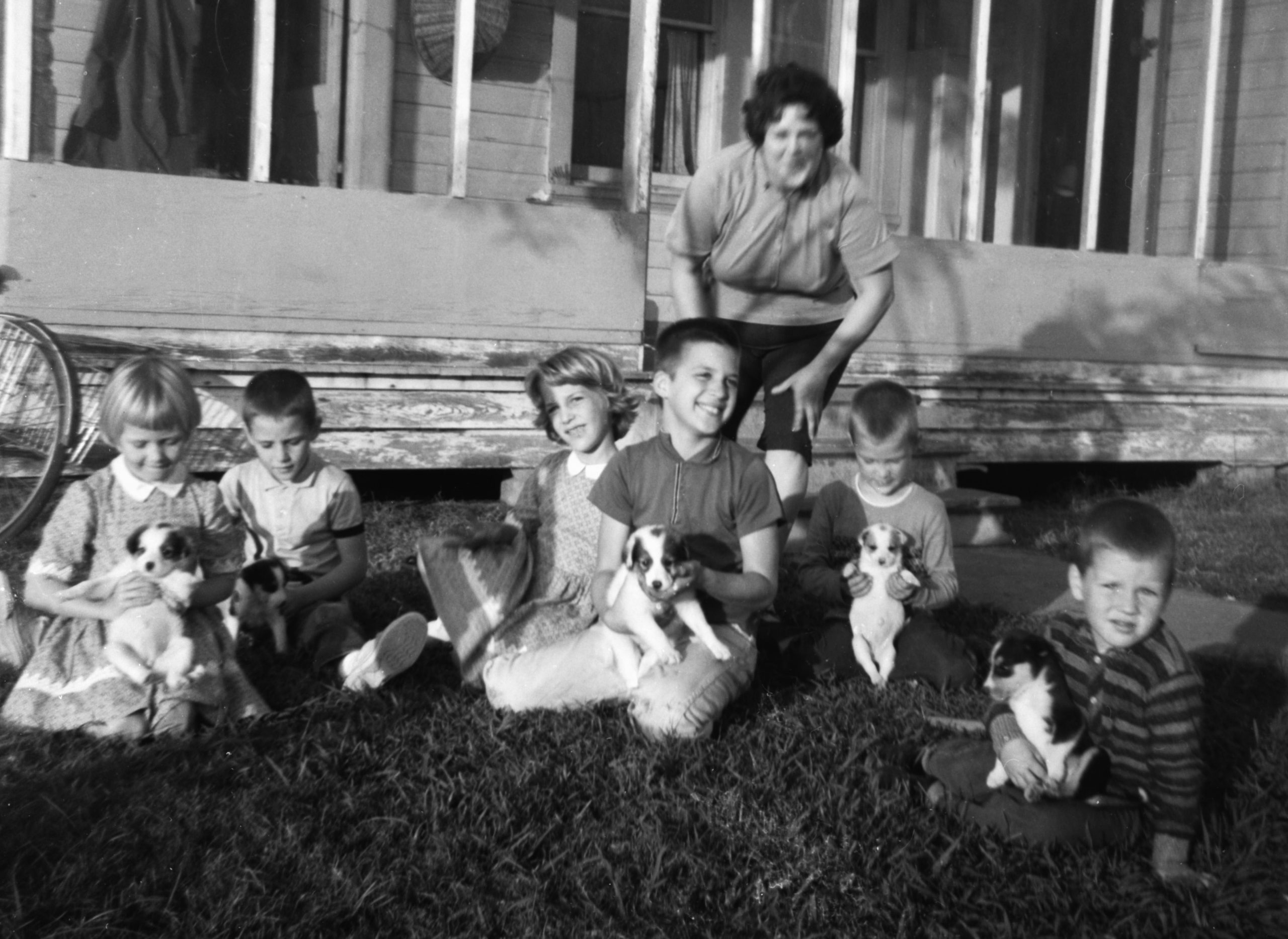
The Landry and Raley cousins visiting in June 1964 in Jennings, Louisiana.
My earliest memories of her were when I was just a kid. Aunt Frances would not be considered a dainty woman at this point. So when she came toward this little 3-year-old boy with her loving heart and big kisses, I was a little bit intimidated! Like in this picture from June of 1964, she is bending down to greet me with a kiss and I am nowhere to be seen!
My dad’s Landry family tradition of kissing one another in greeting was off-putting to my mom’s sensibilities and I probably took after her when I was a kid. But don’t get me wrong. I always liked my Aunt Framay, but I did avoid those kisses from time to time. It wasn’t like with Cousin Tez. We avoided her like the coronavirus. We didn’t want to catch those bumps. There is a huge difference. If you don’t see it, then I didn’t explain it well.
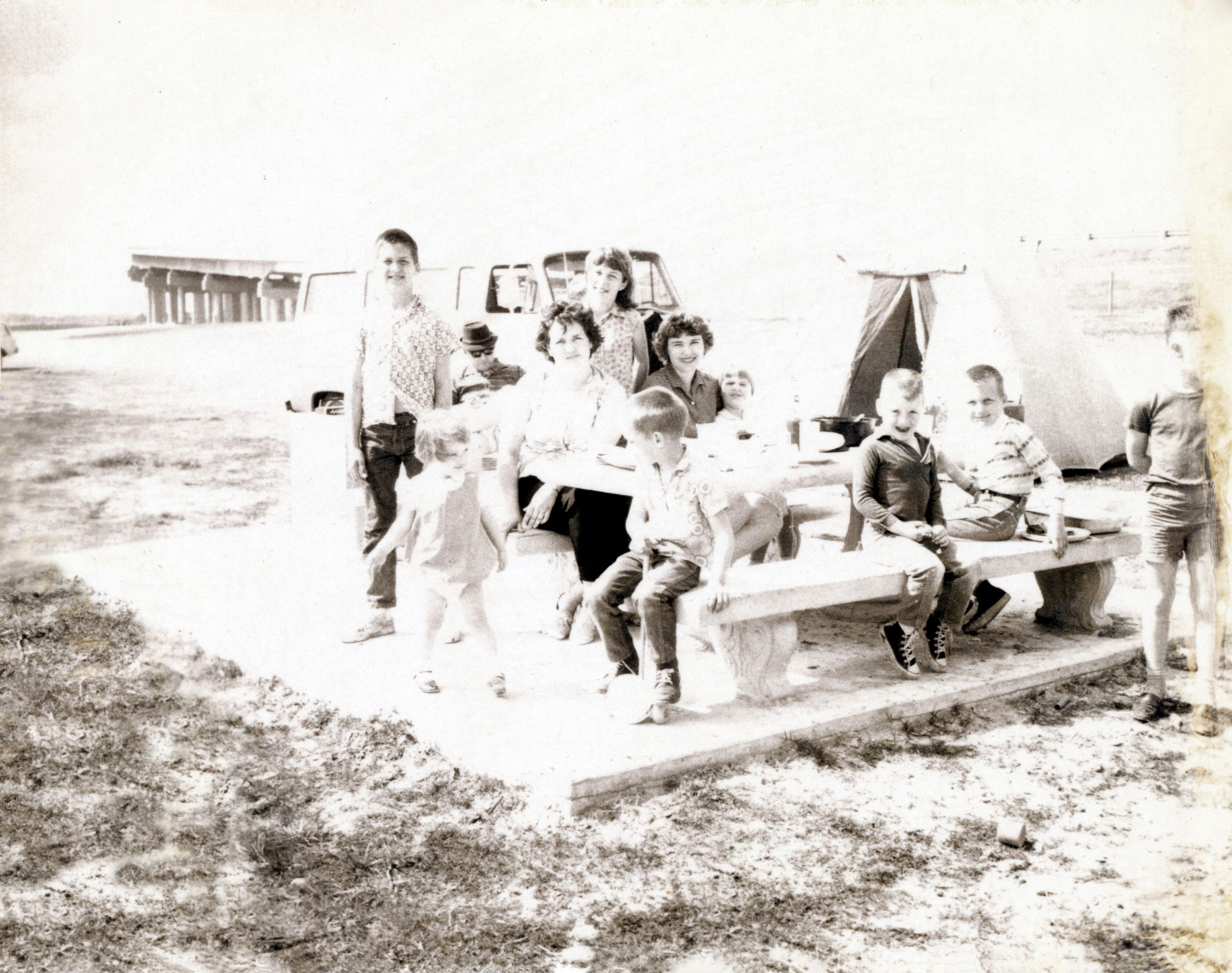
July 4th picnic in Lake Charles circa 1965. Rob Landry, Colleen Raley, Joe & Frances R., Jodie, Van, Betty, and Jamie L., Greg R., Al L., and Scott (I think) R.
This photo is from a year later when the family got together in Lake Charles. I’m sure it was a July 4th get together for the whole Landry family. But this picture again shows mainly the Bob Landry family and the Frances Landry Raley family. I’ve always liked this photo even though it is overexposed.
Mama is smiling nicely in the photo and Aunt Frances is acting all nonchalant like she’s not thinking about sneaking a kiss from me. But as you can see, I’m not buying it for an instant! I’ve got my head turned slightly, just in case she tried a sneak attack. That woman was light on her feet!
I’m sorry. I shouldn’t talk like that, especially since she is recently deceased. But she had a great sense of humor, so I’m sure she’d approve. The only thing I’ve thought about this photo before tonight was that I wished I had been looking at the camera. There were no worries about a sneak attack that I can recall.
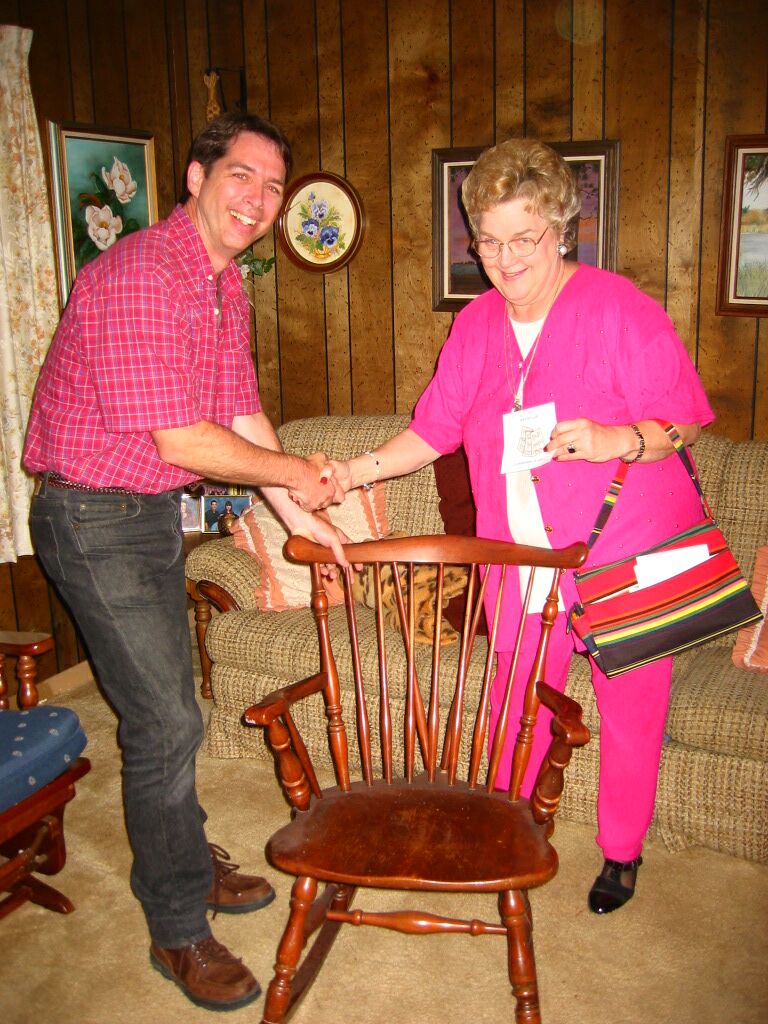
Me with Aunt Frances at my parents’ 50th wedding anniversary in 2002 sharing a laugh.
What I do remember about Aunt Frances was that not only was she very loving, there was a strength about her. Very specifically at two tragic events. The first one was at Mee Maw’s funeral in 1973. It was the first time I remember witnessing my dad crying. I also remember him being comforted by his sisters, particularly by Aunt Frances. She was an emotional rock for the family. The other event was the funeral of my sister Jodie in 1989. My parents were really torn up at the loss of their firstborn child. Aunt Frances’s hugs and kisses were exceptionally comforting on that day. She had a big heart.
I remember her being a comfort to me at my parents’ deaths in 2017, but at that point her superpowers were starting to wane. Not that she was any less loving, that power continued until the end of her life. But her body was giving out slowly as it does with age. There was no more sneaking around with her powerful hugs and kisses. That was a definite shame.
There is a line from one of my favorite movies that goes something like, “I can’t continue being stingy with my loving. Before this I would measure it out and only return what I was given. Now I see that one must get on with one’s loving. Giving love is what matters.” That is the way I saw my Aunt Frances. Always ready to love.
Even silly little boys who didn’t know what love was when it smacked them in the face! 
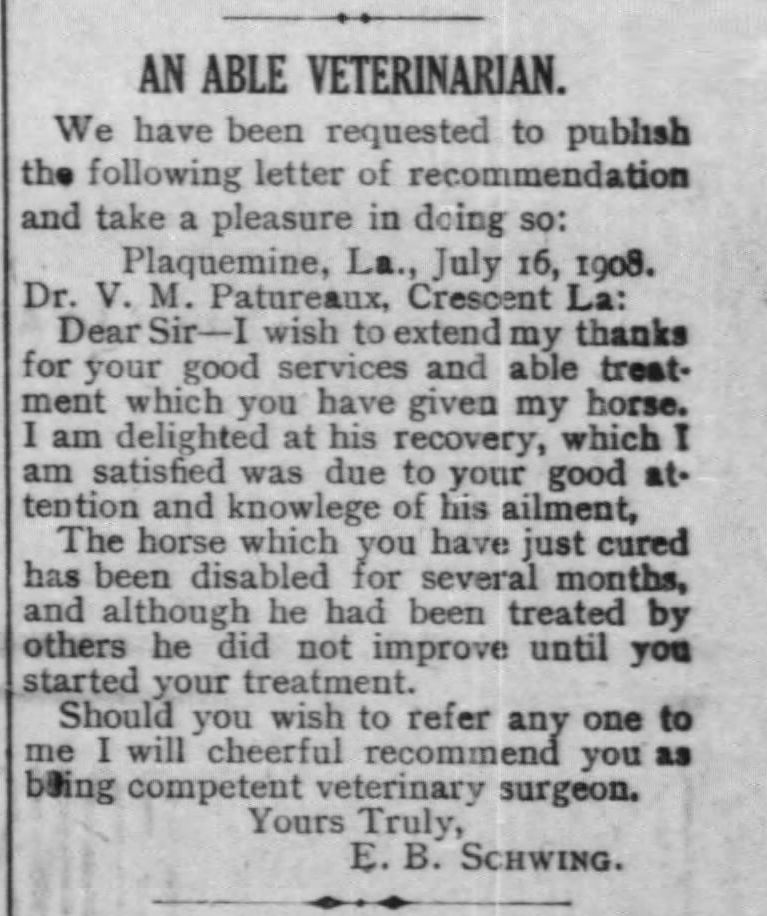
Article from Saturday July 18, 1908, in the Weekly Iberville South in Plaquemine, Louisiana.
My cousin Wade posted a few old newspaper articles about our great grandfather Vincent Maximilian Patureau recently. Those old newspaper articles are great. In small towns they’ll talk about who is visiting who, and in some cases they’ll say how the people are related. Those have been really helpful to me many times in the past. The ones Wade posted were helpful in figuring out when Grampa Max relocated his family to Lafayette (April 1912). I thought I’d post a few newspaper articles talking about his work as a veterinarian.
There are quite a few old articles about Grampa Max, both in Plaquemine and in Lafayette. Either people were interested in what he was doing because he was an influencer in his time, or he was instrumental in getting the articles published. Of course sometimes the two go hand in hand. In fact the first one I have here is a letter that was send to Grampa Max from E. B. Schwing. It looks like he gave the letter to the newspaper for publishing. A rave review indeed.
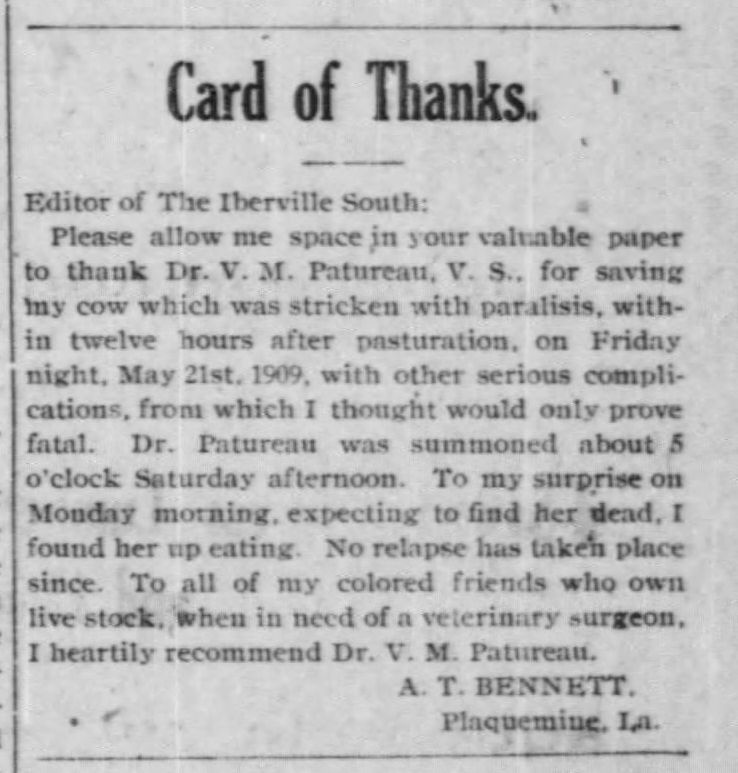
The Weekly Iberville South published this article on June 26, 1909.
I’m glad I found these articles, because before I found them, I questioned his abilities. In a previous blog I pointed out that he was self-taught and hung a shingle calling himself a veterinarian. So I enjoy seeing that he was respected and appreciated for his work in the community. Also in those previous posts I included a photo of a horse and one of a cow. I wonder if those animals were among the ones he saved for his clients?
I just noticed something after I placed the article titled “Card of Thanks.” I didn’t recognize the name A. T. Bennett at all. The Schwing name I have seen in other articles. It seems to be a respected name in the community. I think that maybe Mr. Bennett was African American, since he encouraged his “colored friends” to use the services of Grampa Max. It sounds like he treated all of his clients well. That’s a good thing.
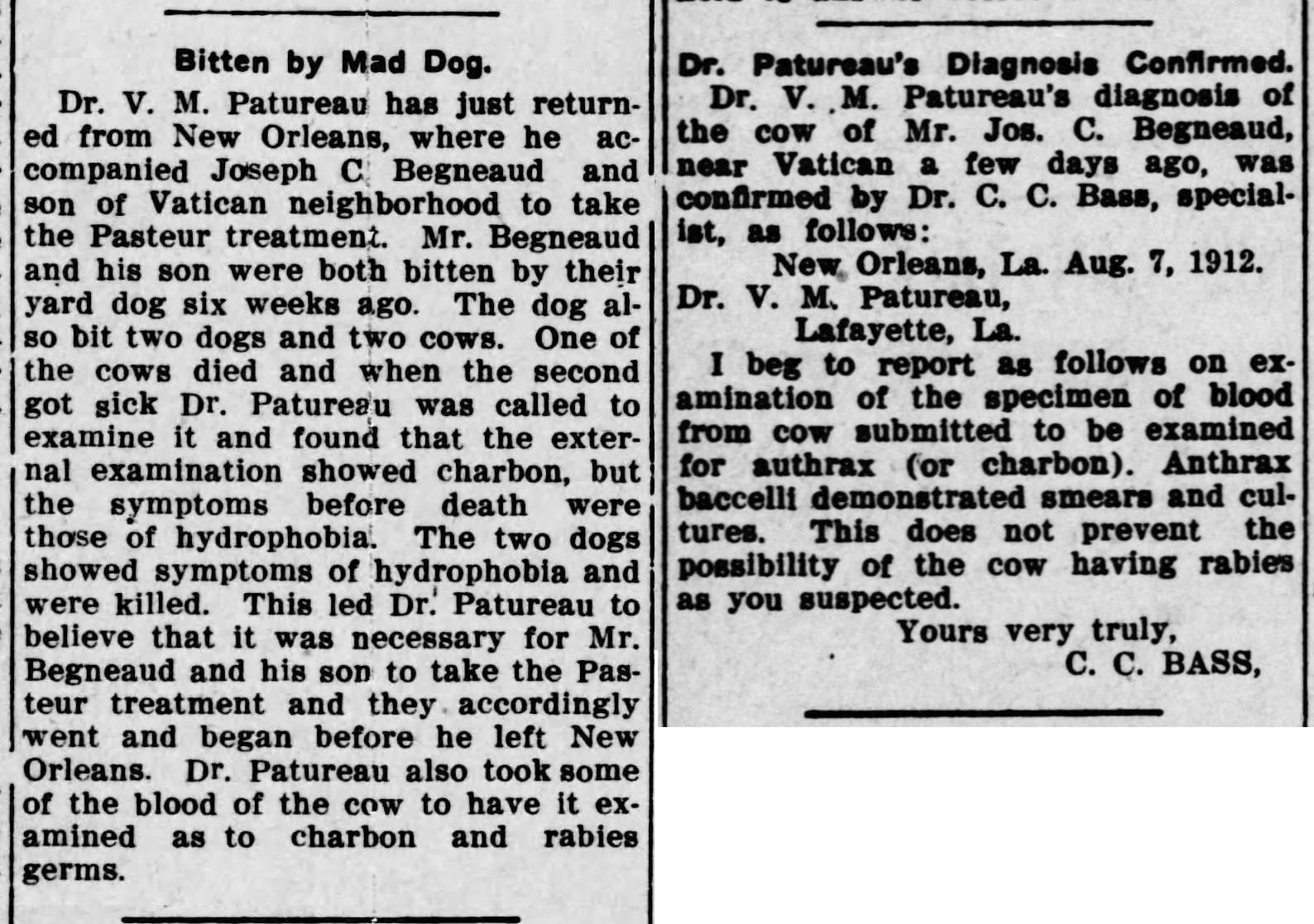
Articles from August 9th and 13th, 1912, in the Lafayette Advertiser
It also looks like Max made sure to look after his human customers as well. A Mr. Begneaud and his son were bitten by their yard dog, which had also bit two other dogs and two cows. When one of the cows died and another one began to show signs of sickness, Grampa Max came to the rescue with his handy bag of verterinarianish tools! When he noticed that the dogs were showing signs of rabies, he used his most lethal tool he carried – his Colt No. 2 derringer. Dr. Patureau strikes again! He did carry that gun around with him on rounds for that very specific purpose. Sometimes you just gotta do what you gotta do! He also made sure that Begneaud & Begneaud received the proper treatment in New Orleans.
Now I’ll say it again – Dr. Patureau strikes again! This time it is in reference to him providing the newspaper with a letter he received showing what a wonderful diagnostician he was. Grampa Max provided the lab in New Orleans with a sample of the infected cow’s blood and it showed the results he had suspected. So it looks like Grampa Max knew what he was doing after all. He deserves a bit more respect. Maybe I should refer to him as Dr. Patureau more often.
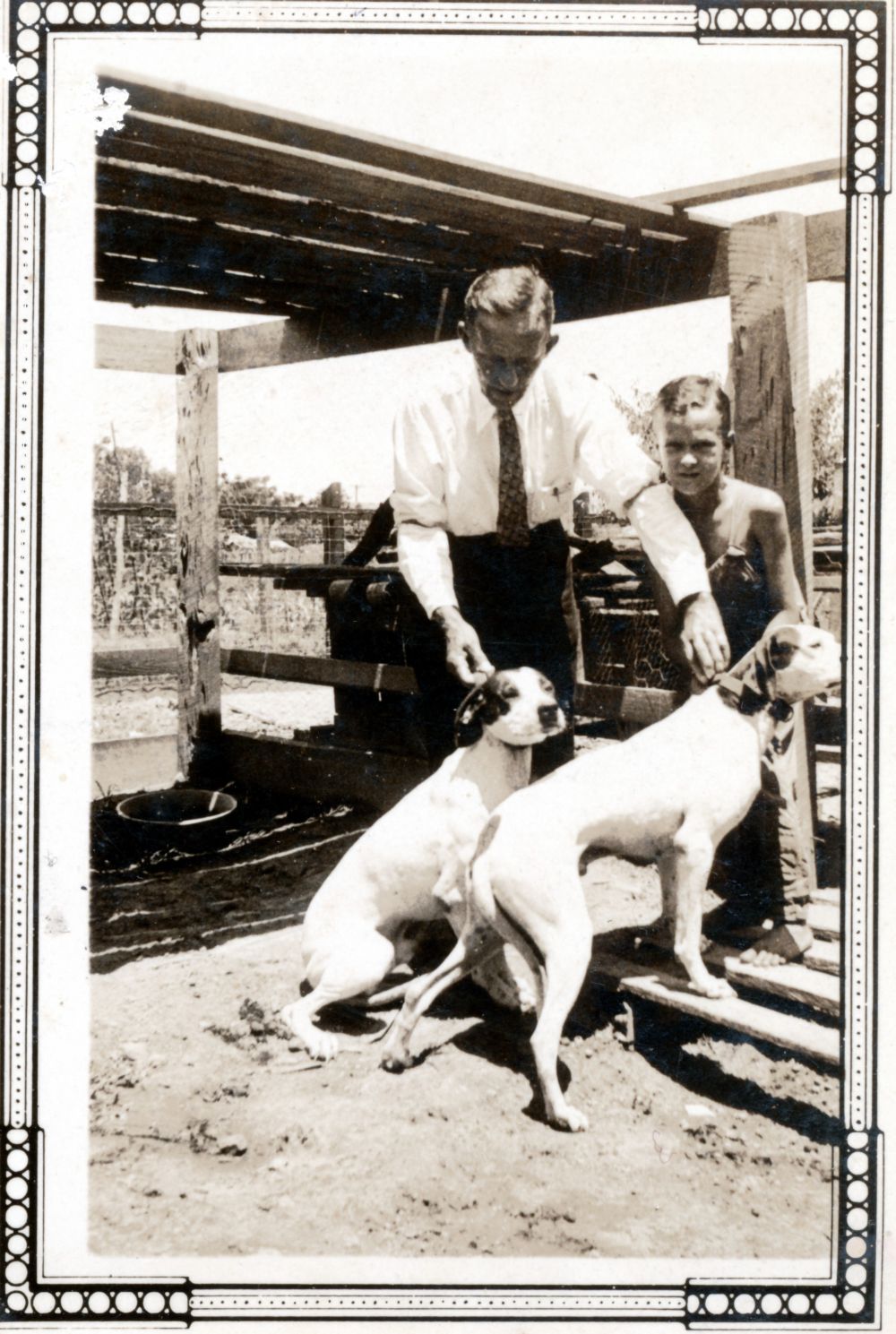
Here is a photo of VMP doing his work in Lafayette around 1912 or so. After reading those newspaper articles, it makes me wonder what Dr. Patureau is going to be doing next.
I got the recording! Whoo hoo! I was thinking that I would go ahead as I usually do and write a post about my dad’s side of the family since I wrote about my mom’s side last week. But I couldn’t get this catchy little tune out of my head. And besides, I didn’t want to keep you waiting when I already had access to the songs I mentioned last week. So I decided to continue from last week’s post.
It really is an amazing recording. Not that the songs all sound wonderful, or it’s a great recording of the songs. It’s just such an historic record of my great grandparents playing music. I recorded just a clip of one of the tracks on my iPhone. It starts off with one of the Phenice family women (if you are able to identify who it is, please let me know) introducing the music by saying, “June the twelfth nineteen hundred and forty-three (1943) will very likely become a memorable day to all the members of this Phenice family, because for the first time we are to have a phonographic record of our family reunion instead of the usual photographic one.” I’m so glad that they said the date.
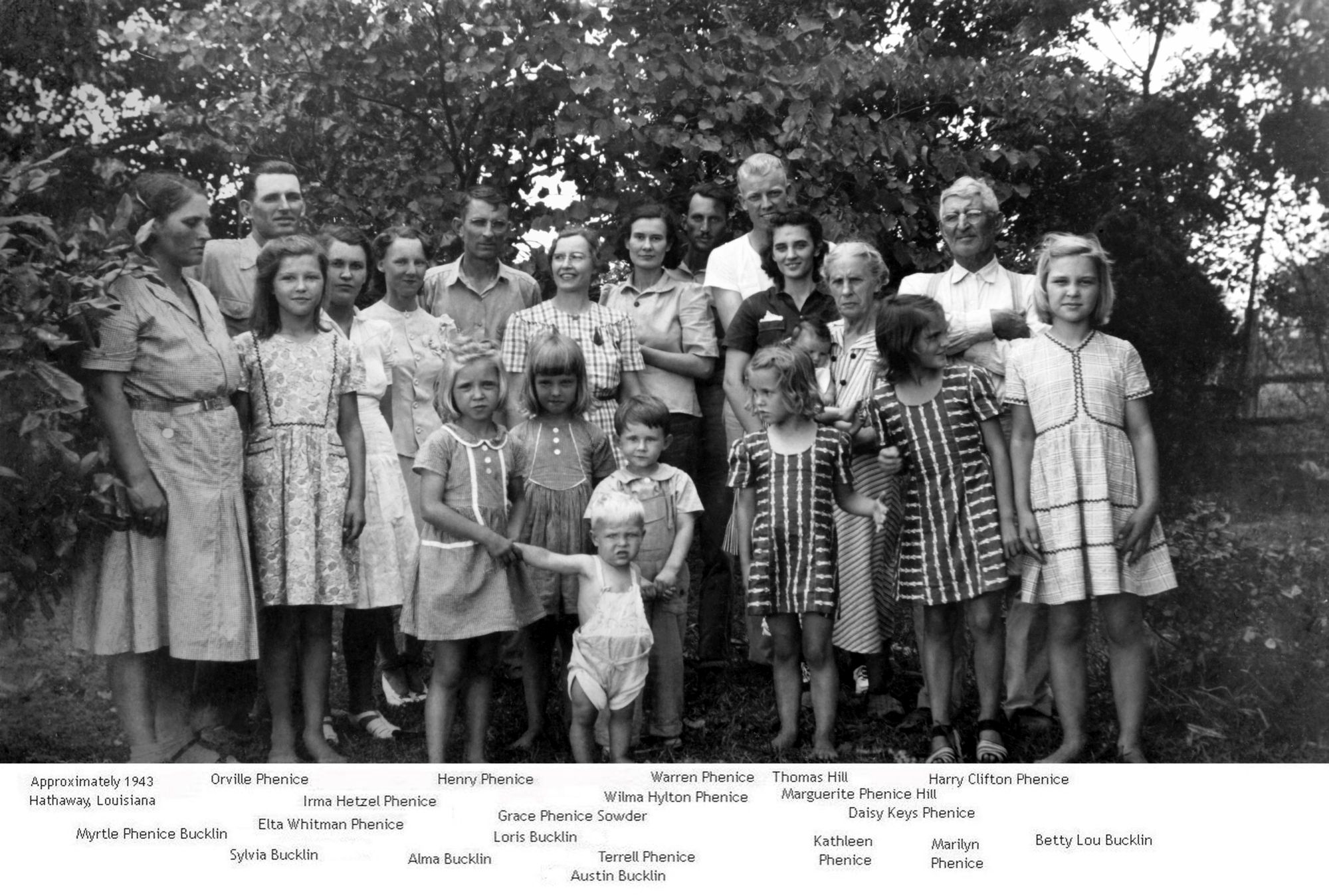 Since they said the date, I thought I’d find a photo from around the same time. So I looked in my Phenice folder and found a good photo. I had posted a version of the photo previously, but in the meantime I have obtained a better quality image. At least I thought I posted it before! I just looked again and can’t find it anywhere. I guess I posted it on Facebook before I actually started this blog over four years ago. My how time flies!
I had estimated the date of the photo as 1943 based on the age of my uncle Austin Bucklin. He is the toddler in the front of the photo. But then when I looked at the photo this time, I realized that Grandma Phenice (my mom’s maternal grandmother Daisy Keys Phenice) was holding a baby. I looked through my family tree information and found that in 1943 Daisy had a new granddaughter named Linda Phenice. She’s the one who got this recording to me! So the photo was taken a few months after March of 1943, which is pretty close to June 12, 1943.
I wonder if the photo was taken on the same day as the songs were recorded? She says on the recording that it was a Phenice family reunion. This photo is a Phenice family group. But in the recording she says that they were making a phonographic record of the family “instead of” a photographic one. So maybe it was on a different day. Or maybe she meant to say “as well as” in her statement and she misspoke. You know how it is when you talk on one of those newfangled recording instruments – you get a little nervous! Then again, Sylvan Phenice is not in the photo and he was the one that made the record. He could have taken the photo, but then his wife Mary would have been in the photo. Oh, well, we know that the sound recording and the photo were taken close to the same time.
The rest of the clip of the recording that I’m sharing this week is a song called “Soldier’s Joy” with Harry Clifton Phenice on the fiddle accompanied by his wife Daisy on the piano. It’s a very old timey sounding fiddling song. I looked it up and it originates from around the mid 1700s and has its roots in Scottish fiddling tradition. There has been some talk that the Phenice family and name may have Scottish origins, so I find that fact fascinating. The song was associated with the Civil War, too. HC’s dad Samuel was a soldier in the Civil War, so I wonder if he thought of his dad when he played it.
The song is not only associated with the Civil War, but the term “soldier’s joy” came to refer to the combination of whiskey, beer, and morphine used by Civil War soldiers. In fact, when talking about it Wikipedia quoted these song lyrics:
Gimme some of that Soldier’s Joy, you know what I mean’
I don’t want to hurt no more my leg is turnin’ green
That kinda made me laugh because Samuel was shot in the leg in the Battle of the Wilderness during the Civil War. While staying in the hospital, skirmishes around the area kept medicine from being delivered and Samuel ended up getting gangrene. I hope he got some morphine eventually! That sounds mighty painful!
So enough talking about the song. It’s time to listen to it. Just click on the link below. And now I can say that I did my part in making June 12, 1943, a memorable day for this Phenice family!
I’ve had some exciting news about the Keys and Phenice family lately. Sometimes I look for things and can’t find them, which can be frustrating. Other times I find hints about them and have to track them down for a while. Sometimes I give up altogether and go searching for something else. Occasionally something that I’ve given up on will fall right into my lap. That’s what happened in the first part of this blog.
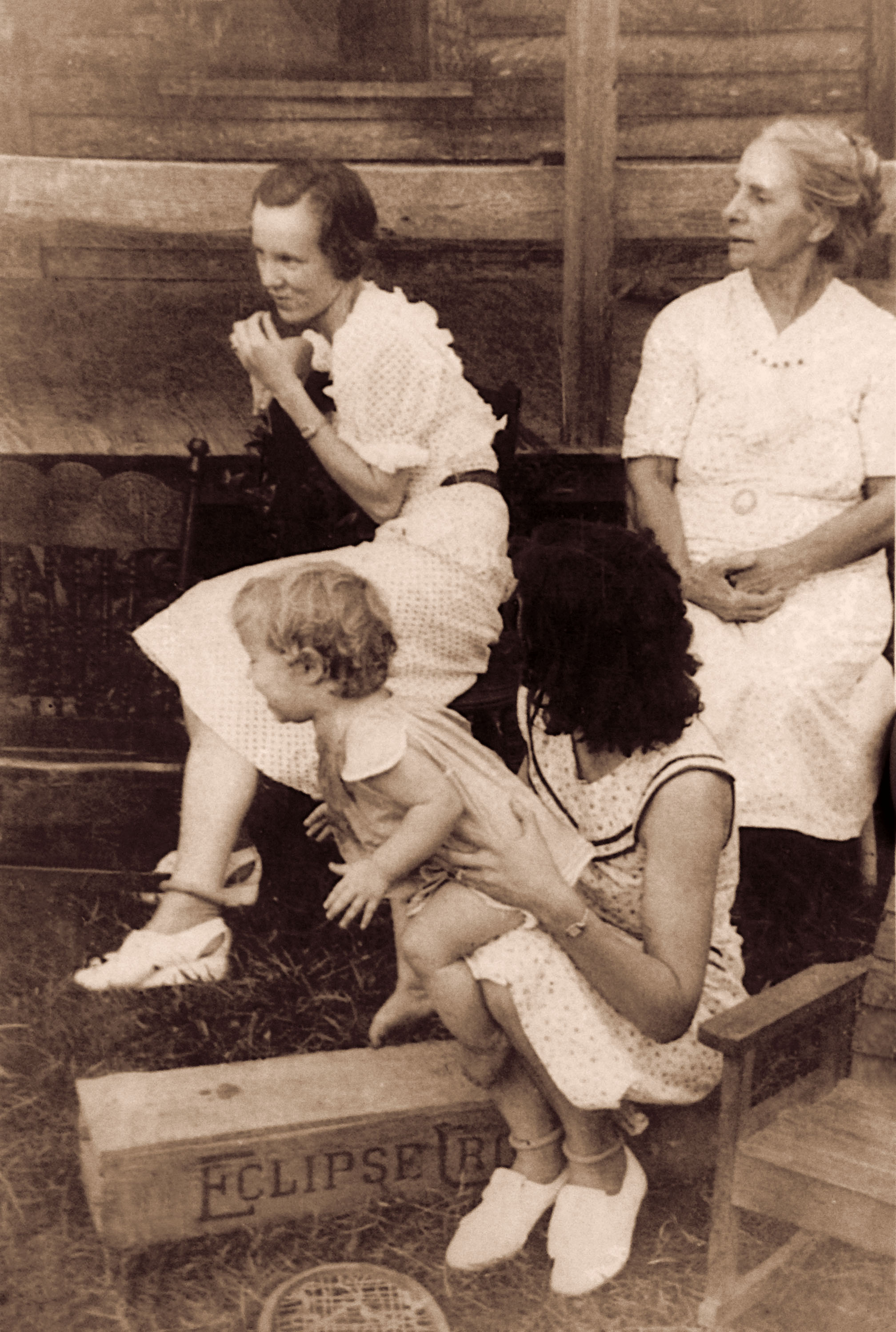
Clockwise from top left: Irma Hetzel Phenice, Daisy Keys Phenice, Marguerite Phenice, and Sylvia Bucklin. This photo was taken around 1932 in Hathaway, Louisiana.
Before I tell you that story, I thought I’d share a related photo. I’ve been thinking of sharing this one for a while. There is an old timey charm about it. I took a photo of a photo at the Keys Family Reunion in 2017. I can’t remember who shared it with me, but I do appreciate it. The older woman on the right is my great grandmother Daisy Keys Phenice. She was my mom’s maternal grandmother.
The younger woman on the left is her future daughter-in-law Irma Hetzel. She would marry Daisy’s son Henry in 1934. The dark-haired girl in the photo (her face can’t be seen) is Daisy’s youngest child Marguerite. Marguerite would marry Thomas Hill in 1943. The youngest person in the photo is my aunt Sylvia Bucklin. She was oldest daughter of Myrtle Phenice Bucklin, who was the middle daughter of Daisy.
I’m not sure what they are doing in the photo, but it looks like they could be listening to music. This brings us back to the story I was wanting to tell. Many years ago, about 1972, my mom somehow got a collection of old records from her Uncle Sylvan. He was a son of Daisy and he was big into sound systems and recordings. He had a company for many years called Sylvan’s Sound Service and one of the things he did was put intercom systems in the schools of Calcasieu and surrounding Parishes back in the day.
So if you are from that area and are old enough, you probably heard your morning news at school through the sound system of old Uncle Sylvan. But the recordings that my mom got were even more special than that. He had some old recordings of family conversations and singalongs from back in the 1940s or so. I’ve shared some of those before. I shared my grandmother Myrtle singing a few songs and my mom’s paternal grandmother Addie telling a story. It’s nice to hear those old voices from the past.
I had some of the recordings, but not all of them. I heard somewhere along the way that there was a recording of my great grandparents Daisy and Harry singing “Daisy Bell (Bicycle Built For Two)” together. There was also a recording of Harry playing a song on the fiddle. Supposedly, a recording was given to my dad and he was going to digitize it for them. So when we were clearing out my parents’ home, I was on the lookout for it. That’s when I found the recordings of Myrtle singing and Addie telling her story. I couldn’t find the recordings of Harry and Daisy. I even went through the archives at my sister and brother-in-law’s house, but it was nowhere to be found. I gave them up for lost. I didn’t tell you all about that, because I don’t like to tell sad stories. (Ha!)
I’m telling you now, because it’s a happy story! One of my mom’s cousins sent me a note that said that she has the recording of Daisy and Harry singing, as well as the recording of Harry playing the fiddle! Whoo hoo! She said the recordings were in bad shape and needed some help. I offered to help. Even if I didn’t know how to do any editing, I would have offered. I would have learned just so I could hear those old wonderful recordings that I had thought were lost forever. Don’t get too excited, because I don’t have them yet. I think they are near and I hope to get them soon. Then I will share them with everyone. Remember, patience is a virtue.
The other news I have is a bit more rewarding. While the other is a preview of something in the future, this is a realized view of something from the past. A couple of years ago when I was looking at the Phenice side of the family, I came across some information about Grandma Myrtle’s first cousin. Her name was Doris Enola Phenice and she lived in Colorado. Like my grandmother she was a schoolteacher for many years. When she was an elderly single woman, she befriended a couple who ended up caring for her at the end of her life. They also put together a book about her life and her family that included photos and such. There was some contact information, so I wrote them a note and said that I’d be interested in seeing that book.
So I waited patiently. I didn’t hear anything back from that first message I sent. I mentioned it to a distant Phenice cousin and she tried contacting them the same way and got a response. She shared the phone number of the couple who put together the book. I tried writing an email again… And waited again. Sometimes I think I confuse forgetfulness with patience.
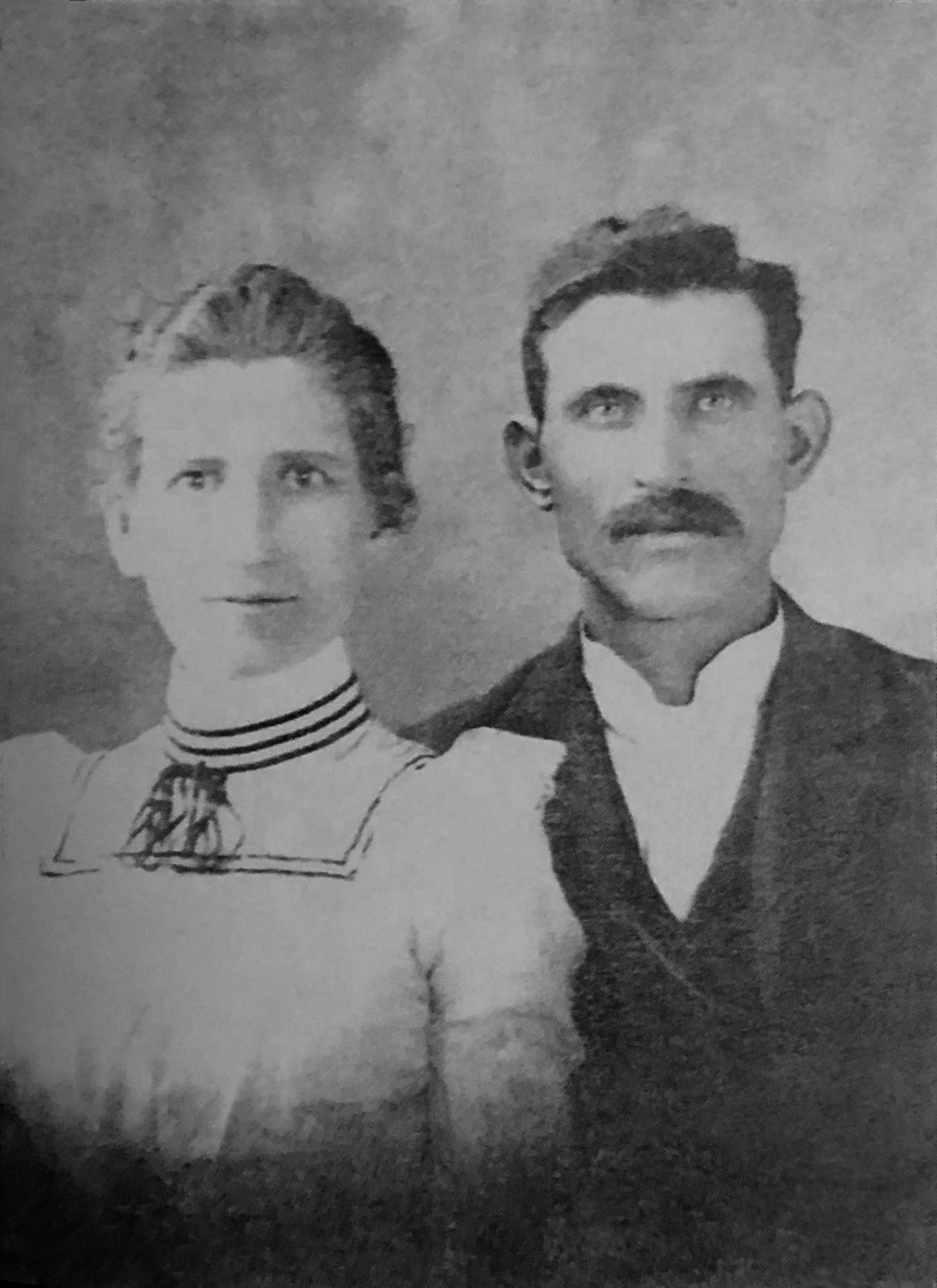
Anna Armina Stockton Phenice and Chauncey Phenice in Victor, Colorado, in 1900.
Then one day recently I was looking for some information about a DNA match. This person was a descendant of Chauncey Phenice. Chauncey was the oldest brother of my great grandfather Harry Phenice and he was the father of Doris Enola. I found the phone number of that couple and decided to call. The woman is still alive, but sadly she recently became a widow. She was very friendly and said that she would be glad to send me a copy of the book that they put together.
She followed through and now I have the book! I found out a few more interesting things about the Phenice family, but the thing I was most excited about was finding a photo of Chauncey. I have several photos of Harry’s sisters and his brother Edd, but I didn’t have any of his brothers Chauncey or William Emory. Now I just need to find one of William Emory!
The picture of him is when he and his wife were living in Victor, Colorado. They went there with Will (William Emory) for a short time to try their hand at gold mining. One of my favorite photos of my great grandfather Harry is one of him in a gold mine. I didn’t realize that gold mining was a family tradition. You can see from the photo that includes Harry and Edd that there is a family resemblance in the three brothers that are in the photos.

1906 in Nebraska. Top row: Daisy Keys Phenice (wife of Harry), Lola Myrtle Phenice, Emma Orra Phenice. Bottom row: Harry Clifton Phenice and James Edmund “Edd” Phenice.

The second installment of this series was about Antoine Breaux and his close family. He was the son of Charles Breaux. This week we are looking at the family of Antoine’s first cousin Honore Breaux – my 4X great grandfather. His father Pierre was the brother of Charles and his mother was Marguerite Gautrot (More commonly seen in southern Louisiana as Gautreaux).
 Honore was born in the small Village of Breau in Pisiquit, Acadie, in 1735. This is where he spent his childhood. He was the second of seven children with a good mix of four boys and three girls. Though there was a war going on between France and England during some of his childhood, it was mostly occurring in the Old World. There were some consequences to Acadie, but his home life was probably undisturbed by it. He was one of the last of the Acadians to have an undisturbed childhood in Acadie.
Honore was 20 years old when the time of the Exile began in the middle of 1755. He was likely living on his own, because he was not rounded up with his immediate family. He was deported to Virginia, while his parents were sent to Maryland with the large group of the Breaux family we talked about last time. That didn’t seem too far from Virginia, right? Maybe he would someday see his parents and siblings again.
Honore’s future wife (and my 4X great grandmother) took a different route to their eventual meeting. Elisabeth LeBlanc was born in 1743 in Beaubassin, Acadie, to Victor LeBlanc and Marie Aucoin. She had an older sister named Marie Marguerite and younger brothers named Pierre, Armand, and Olivier. Before I tell you about their odyssey, let me go back a little further with their family to show just how much an impact the Grand Derangement had on this family.
Victor LeBlanc died before the Exile (in 1750), but his wife Marie Aucoin was alive at the time. Her parents (Elisabeth’s maternal grandparents) were Rene Aucoin & Madeleine Bourg. At the time of the Exile, Rene and Madeleine were deported to Virginia, which was where their granddaughter’s future husband also was sent.
Virginia was not a very welcoming place for the Acadians. By the spring of 1756, Governor Dinwiddie was ready to rid himself of these “internal enemies.” So by May 10th over 1000 Acadians were thrown out of Virginia and sent to England aboard ships Fanny Bovey, Virginia Packet, Bobby Goodridge, and Industry. Rene Aucoin & Madeleine Bourg and Honore Breau were aboard Virginia Packet.
The ships of exiled Acadians began arriving in English ports starting on June 18th. Virginia Packet was in Bristol, England, the following day. The town was unprepared for them because they weren’t told about the departures from North America. For three days they were left at the wharves. They were then housed in old, ruined buildings. Many of the young, old, or weak died of smallpox and exhaustion. Rene (66) and Madeleine (62) were dead before September of that year. Rene’s (Aucoin) family was really hit hard. Within that same year, his sister Agnes and six of her children died from smallpox and neglect. Honore must have been a sturdy 21-year-old, because he made it through this place of disease and death. He and the other surviving Acadians were then moved to Falmouth in October, 1756. He was continually getting further away from his parents, so his chances of reuniting with them were decreasing as time went by.
Meanwhile his future wife Elisabeth LeBlanc avoided that initial round of deportations. Her mother Marie Aucoin had remarried to a man named Gregoire Maillet around 1751 and they relocated to Ile St. Jean. They had a daughter named Marguerite in 1752 and a son named Felix in 1754. Since Ile St. Jean was still under French Rule, they were not Exiled in 1755. It was still an unstable situation with conflicts going on between England and France. In the midst of all of this, Marie and Gregoire welcomed little Madeleine to their family in 1756.
Ile St. Jean did not remain under French control very long. The French stronghold at Fort Louisbourg fell to the English in July of 1758. It was decided that the French inhabitants of Ile St. Jean would be deported to France. Elisabeth and her family were treated as prisoners for a few months. She was able to stay together with her family, except for her older sister Marie Marguerite who had got married earlier that year. Her fate was now connected to her husband. The household of Gregoire Maillet and Marie Aucoin were loaded onto the Tamerlan in late 1758 with a destination of France.
The ship arrived in St. Malo, France, on January 16, 1759. There were many tragedies that occurred on these ships deporting the Acadians to France during a time when winter storms can cause troubles. Though our family were not aboard one of the ships that sank, they still encountered tragedy. During the transport, young Felix and Madeleine died and were buried in the Atlantic Ocean. Poor Marie. I don’t know if she was aware of the deaths of her parents in England, but she was with her two babies when they died on their forced journey. She was keenly aware of those deaths.
As far as the bigger picture was concerned, this was the time of the Seven Year War. I’m sure that’s not what it was called when it began in 1755. The deportation of the Acadians from their homeland continued throughout this time of war. The Treaty of Paris brought the war to an end in February of 1763. During the war Exiles in England and in other places were considered prisoners of war. They were not free to go wherever they chose, nor could they obtain employment. They were to be provided government funds to meet basic needs, but the funds were not provided in a timely manner.
So at the time of the Treaty of Paris, we find Honore still in England. We don’t know if he had heard the news of his father Pierre Breaux’s death that occurred sometime before 1763 in Port Tobacco. Honore was considered a prisoner of war, but now the war was over. He and several other Acadians were put on board the royal frigate La Dorothée and sent to France. They arrived on May 23 in St. Malo. Honore was identified as a 28-year-old single man who was plowman, laborer, and carpenter.
I’m sure you can all guess what happened next. When we last saw Elisabeth LeBlanc, she had reached St. Malo with her mother Marie. Her mother died three months after their arrival in France. Elisabeth was the oldest of the five remaining siblings, so I’m sure she grew up quickly and helped to care for her younger siblings. By the end of the war, she was 23 years old. She met Honore sometime after that, and they were married on Feb. 10, 1766. They lived in St. Servan, France, at this time. Nine months after their marriage their first child Jean Charles was born.

My connection to Olive Elisabeth Breaux and her father Honore is through my paternal line.
The most important event happened in 1769. Olive Elisabeth was born. She is my great great great grandmother. She would later marry Joseph Ignatius Landry, who you heard about in the first two installments of this series. Their third son’s name was Narcisse. His fourth (and youngest) son was Simon Alcide. Simon Alcide’s seventh (and youngest) son was Robert Joseph “Rob” Sr., who was my grandfather. My father was Robert Joseph Jr. or Bob. He was the third of four sons. My name is Van and I’m the third of three sons. There are two other paths from Olive Elisabeth to myself. I’ll post a chart for those two paths at the end of this story.
In 1771 Honore and Elisabeth had a daughter named Marie Madeleine. A year later they had a son named Pierre Paul who died 11 months later. It seemed like they were trying to make a home there. Honore and his family joined other Acadians in an attempt to develop a community on the island of Bouin in Poitou, France, in 1773. They had another son Elie in 1774. The Poitou venture was unsuccessful, so they moved on to Nantes in 1775. Their last four children were born there: Jeanne in 1776, Pierre Paul in 1779, and twins Rose Marie and Charles in 1781. All of their children were born in France.
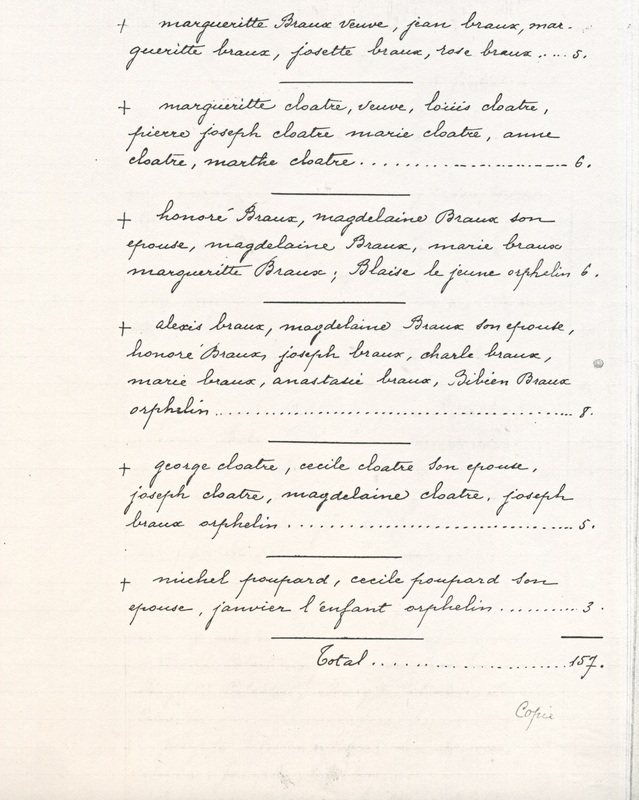
1763 Census of French Neutrals in Port Tobacco, Maryland, includes Marguerite Breaux veuve (widow of Pierre Breaux)
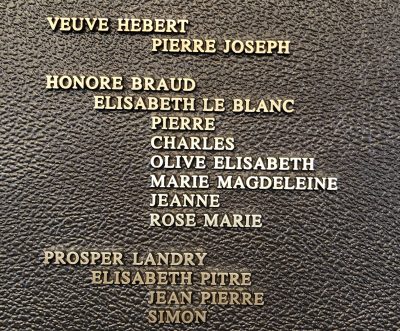
I had mentioned the possibility of Honore reuniting with his parents after being torn from them during the Great Upheaval. That was not to happen. As I mentioned earlier, his father died before 1763. His mother Marguerite Gautrot Breaux had been with the Breaux group that arrived in New Orleans on Feb. 4, 1768 aboard the Ginea. They were sent to Natchez in 1768. She relocated to Ascension Parish in Louisiana and died there in 1773 at the age of 67. So her name made it to the Wall in St. Martinville, as did her son’s, but they were not reunited in Louisiana.

Marguerite Gauterot arrived in New Orleans in 1768. Her husband Pierre Breau died in Exile in Maryland.
Then in 1783 a Frenchman from Poitou developed a project to relocate the Acadians to Louisiana. Even though there wasn’t much work to be found in France and the assistance they were provided was sporadic, the Acadians didn’t know if they should trust this proposal. Other attempts at starting communities had failed and the participants had returned to France. Once the kings of France and Spain had been sold on the idea, the Acadians soon decided to go along with the idea.
On May 12, 1785, the family of Honore and Elisabeth boarded the LaBergere along with their fellow Acadians bound for Louisiana. They arrived in New Orleans on August 15 and settled in St. Gabriel near other Breaux family members who had arrived previously. I don’t know if Honore reunited with any of his siblings or not. It’s possible that two of his younger sisters made it to Louisiana, so it could have happened. It’s hard to imagine living in an unsettled situation for thirty years. That’s a whole generation. Honore started the Exile as a young man, and when the family found their new home, his oldest son was just about the same age. At least he made it. Not all of them did.
In 1787 Olive Elisabeth Breaux married Joseph Ignatius Landry in St. Gabriel. Honore and Elisabeth were there to see their daughter married. They survived long enough to see all of the children of Olive Elisabeth and Joseph Ignatius. In fact, they outlived Joseph Ignatius who died in 1806. At the time of Joseph Ignatius’s death, court documents of August 4, 1806, show that the guardianship of his minor children was proposed to go to their grandfather Honore Breaux.
He accepted that responsibility on the same day.

The second path from Olive Elisabeth to myself goes through my Patureau line. All of the Patureau families originating in Louisiana descend from Honore Breaux.

The third path between Honore and me goes through the Civil War hero from the South – Trasimond Landry.
For other installments of the “From Acadian to Cajun” series, click on the following links:
From Acadian to Cajun: Part 1 – Landry/Babin
From Acadian to Cajun: Part 2 – Breau/Trahan
From Acadian to Cajun: Part 4 – Hebert/Melanson
From Acadian to Cajun: Part 5 – Bourg/Granger
From Acadian to Cajun: Part 6 – Bujol/LeBlanc
From Acadian to Cajun: Part 7 – Foret/Bujol
From Acadian to Cajun: Part 8 – Hernandez/Babin
From Acadian to Cajun: Part 9 – Dupuis/Dugas
From Acadian to Cajun: Part 10 – Bourg/Babin/Landry
From Acadian to Cajun: Part 11 – The Ones That Didn’t Make It
That’s right. I’ve been an orphan for three years now. But don’t feel sorry for me. I had parents for quite a while. They died three years ago after 64 years of marriage. I got to spend 56 of those years with them. That’s a lot of time to have both of your parents. And I had the best!

Betty and Bob taking it easy in 1970 in the den at 758 Lucy Street in Jennings, Louisiana.
I think of my parents often, especially when the anniversary of their deaths come around. My mom was Betty Lou Bucklin Landry. She was born May 20, 1933, and she died January 19, 2017. My dad was Robert Joseph “Bob” Landry, Jr. He was born January 31, 1929, and he died January 24, 2017.
I can’t pass up a Throwback Thursday without having an acknowledgment of the anniversary of their deaths. So when I was trying to decide what to post, I wasn’t sure what I was looking for. So I looked through my old photos and this one stood out for some reason.
I started cleaning it up because it had a bit of scratches and dust on it. As I was doing that, it struck me how calming the photo is (at least to me). Daddy looks like he is just playing a little pool leisurely in the den while Mamma looks on casually. It’s not a spectacular day. Nothing of great importance happened that I can recall. Nothing tragic happened either. It was just a day in their life together.
That’s what I really miss about them being gone. Going for a visit for no reason in particular. Talking about things of no consequence. Just spending a little time with them.
That’s what I really miss.
I’m doing something I’ve never done before on a blog post. I wouldn’t normally do this, but it is a good cause. At least I think so. I guess I should just come right out with it… I’m asking for money. Not for myself, but for a family history cause. It’s all about the Patureau Tomb in Plaquemine. If you’re not familiar with it, it is the old Catholic Cemetery in Plaquemine, Louisiana.
I went and visited that tomb a few months ago. Sad to say, I had to ask for directions. I thought I knew where it was, but I was wrong. When we finally got there, I went to see about something on that family tomb. Don’t tell anyone, but I may have broken something off accidentally. I was nervous that someone might have seen me and tried to hide the evidence! I laugh about it now, but it was in a bit of a state of disrepair. That’s where the request for money comes from. But before I get into those details, I want to tell a story about one of the names on the grave.
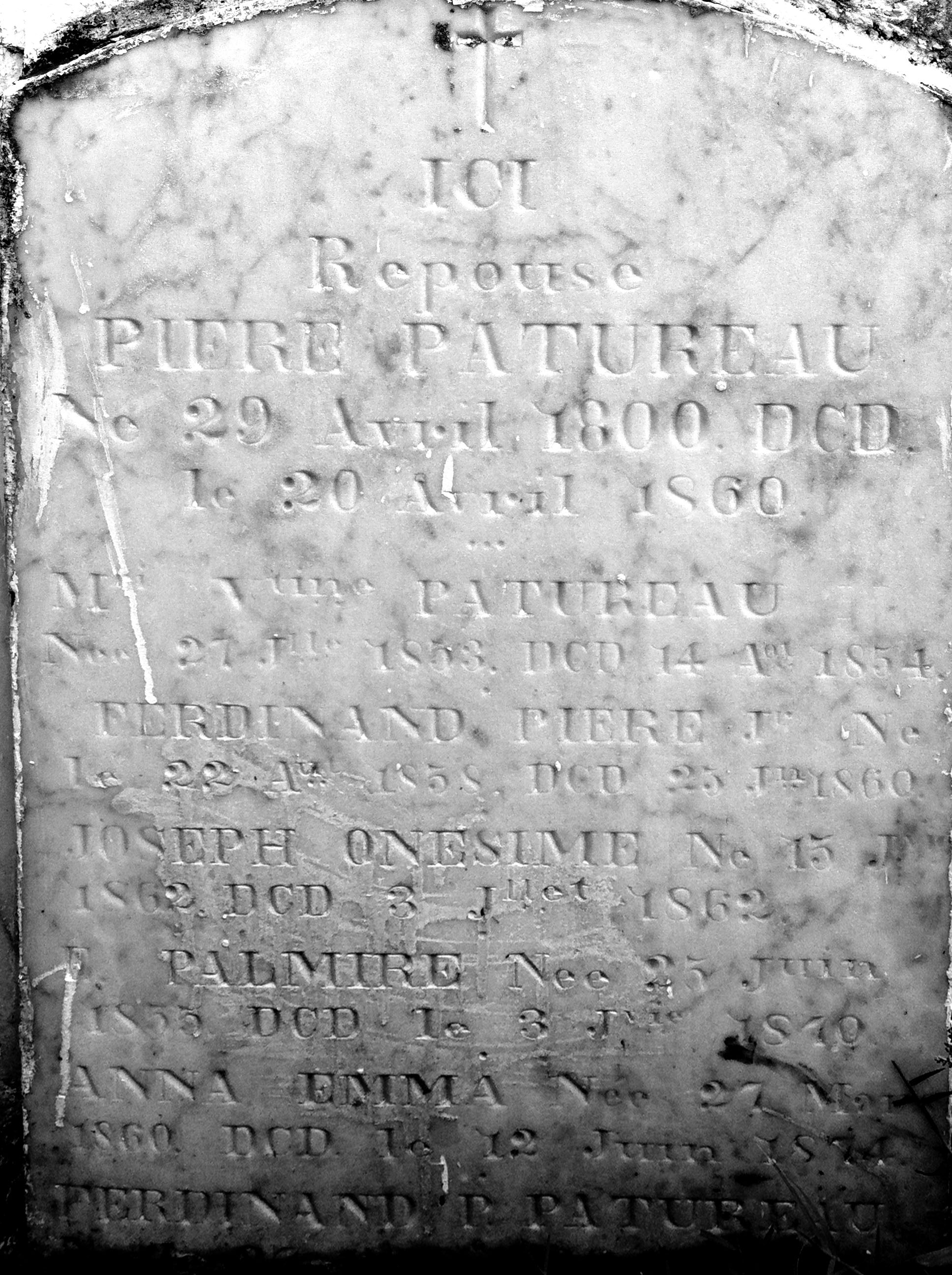
Plaque of names on the Patureau family tomb
On the Patureau tomb there is a large plaque with several names on it. At the top is the name of Piere Patureau who was born in 1800 in France. He was the patriarch of the family that immigrated to Plaquemine, Louisiana in 1840. At the bottom of the plaque is his son Ferdinand Pierre Patureau who is the son that carried on the Patureau name in southern Louisiana and places further afield.
The person that I want to tell the story about is just above Ferdinand. Her name was Anna Emma Patureau and she was the ninth child of Ferdinand and his wife Marie Emma Landry. I had noticed her name a few years ago because she was born in 1860 and she died in 1874. I wondered what had caused her death at such a young age. Grampa Max was only five years younger than her, so her death would have greatly affected him. But he wasn’t around to ask about it and nobody else seemed to have any information about Anna Emma.
Then one day my search on a newspaper website brought something to my attention. It was an old newspaper article written in French in an Opelousas publication in 1874. I don’t know French, but I have been working a bit with French documents enough to recognize some words. I could make out that a daughter of F. P. Patureau in Plaquemine had died at the age of 14. I had found her!
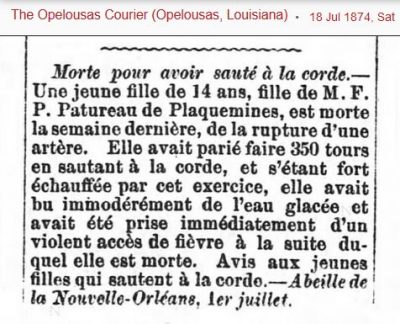 So I used my trusty French translation app on that googly search engine and found out what the article was talking about. Apparently Anna Emma had decided that she wanted to set a world record or something on June the 12th, a day of the year when the average temperature is 90 degrees. The sport she chose was jumping rope. So she started jumping. She made it to 50. Then she made it to 100. Then 200. I wonder if she started feeling bad by the time she reached 300? Because something went terribly wrong when she reached 350. She must have overheated, because she stopped and drank some cold water. It doesn’t say that she stopped to drink the cold water. That was something I surmised.
The article says that drinking the cold water caused her to have a furious fever which led to her death. But it also says that she died from a ruptured artery. Since I am not fluent with French, I may be missing some other meanings to phrases they use in the article. But it sounds like she either died from something like an aneurysm or from heat stroke. Either way, it was a sad day at the Patureau household in Plaquemine, Louisiana. Thanks to Abeille (Bee) in New Orleans for providing that story to the Opelousas Courier.
So you see? Those aren’t just names on a slab of stone. They represent people like Anna Emma who had dreams of something more that being a “Notice for girls who jump rope” as the article states at the conclusion. She died with a dream of accomplishing something. So we want those names to last a while. This takes us back to the reason for the money. Like I said, the family tomb was in disrepair, even though some family members were paying for upkeep. The years take their toll.
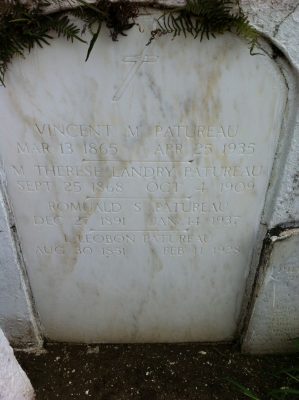
Another plaque on the Patureau tomb show Vincent (Grampa Max) and Leobon, patriarchs of large family groups in southern Louisiana.
For the past several years some of my dad’s first cousins have been paying to provide that service. They are granddaughters of Grampa Max. Sis and Syl are the daughters of Marie Therese Patureau Schafer (and nieces/step daughters of Zita Patureau Schaefer). Maxine and Winona are the daughters of Sylvia Patureau Marionneaux . When they noticed that the whole structure needed to be reconstructed, they researched what was required and found a reputable person to do the work.
The total cost of the work is $5000. Those four women have generously paid $1000 each for this work. I am going to go ahead and pledge $100 to take part in the restoration. I know that a few of my first cousins have done the same. I am hoping that there are enough of you out there that are willing to help so we can reimburse our generous cousins so they don’t have such a large burden to bear. Wouldn’t that be nice?
For many of us, the tomb is a resting place for three generations of our family. This is true for me, since Grampa Max is buried there. It is also true for all of you that descend from Louis Leobon Patureau. You know who you are! Maybe you don’t, but I’m not going to name names. So don’t worry, Byron.
So if you are feeling the desire to help out with this familial endeavor, just send me a note and we can figure out the best way to keep our family history crypt going.
Go, go, Patureau!
It’s time for a break from some serious, sad history stories. Don’t worry! I’ll get back to it soon. In the meantime I thought I’d find a fun photo of my mom’s side of the family to share. My searching led to this photo. I’ve had it for a while and have always liked it. It’s a great photo of my mom and some of her friends in Hathaway, Louisiana, in 1948.

My mom Betty Lou Bucklin (the one in the short shorts) with some of her friends in 1948.
And these girls look like they might have had a little bit of attitude! Not that they’d be unruly or threaten to cut you, but there is a bit of sassiness showing.
On the left is Lela May Jester. She is the least sassy looking. She looks very sweet. Next is my mom, Betty Lou Bucklin. She was 15 years old at the time and a sophomore at high school. Besides being on the basketball team, she was also in band and participated in school plays. She has a very self-assured look on her face.
Standing to the right of my mom is her best friend LaVelle Krumnow. She was the daughter of the minister of the local Methodist church that mom’s family attended. They were friends all through school and mom talked about her often. She doesn’t look quite as brash as some of the other girls in the photos. Next is Claribel Brown. What’s with those names back then? Lela May, Betty Lou, LaVelle, and Claribel? I remember hearing those names when I was a kid and I thought they were a bit country sounding back then. Though I definitely wouldn’t tease Claribel about it. She looks like a tough cookie, as my mom would say!
The girl all in black is Carol Bryan (now Theunissen). When our family first moved to Jennings, she was the mom next door. I don’t remember her looking as sassy as she does in this photo. She was in the same class as my mom, which I didn’t realize back then. I knew they came from the same place, but didn’t know all the connections. She’s in several photos with my mom. Of course, none of the other girls have the attitude of Dot Gary on the far right. She looks kinda tough. I keep looking really close to see if I can see a carton of cigarettes rolled up in her sleeve! But all I really notice is that little bow around her neck. Maybe I’ve read Dorothy all wrong. I still think they were showing some attitude.
They were teenagers after all! They were also high school students at Hathaway High. More specifically, they were part of the Hathaway High Hornets basketball team that had just won state. So there’s a good reason that they were feeling some confidence.
I guess this is evidence of the comment Mama wrote about how they felt after accomplishing big things in basketball: “(We) thought we were hot stuff.”
I decided to go ahead and write another post for this series. Even though it was only last week that I wrote the other one, it was still last year. I’ve also spent a lot of time looking at this part of my family history all week long. And talk about sad! This is a really depressing period in the life of Acadians/Cajuns. I don’t know why I didn’t think it would be so bad, since I have looked at it before and read books about it.
But when I start to look and see what exactly was happening to my ancestors and their families at that time, it’s a bit more personal. And there are some really tragic events that occurred. It sounds kind of morbid, but I am intrigued by sad events that I discover. Mainly because I can write about them and memorialize them in some way. That way we can get to know them a bit and make a bit of a connection. But most of those other events that I discover are tragedies that are a result of illness, sickness, or accidents.
This time it is different. This was intentionally done to my family. Sure, the Acadians were ornery and refused to give an unconditional oath to the king of England. But they were his (somewhat) loyal subjects, being that they were born in an English-ruled area. Like I said last week, they were the third generation born in Acadie. But they were treated like foreign invaders and prisoners of war. It was a travesty!

The Wall of Acadian Exiles in Louisiana in St. Martinville, Louisiana, includes the Breau families.
One of those families that was treated this way was the Breau family of Pisiquit, Acadie. My main focus when I was looking for information on this family was my 5Xgreat grandfather Anthony Breaux. He is also called Antoine in various records and on the Wall in St. Martinville, but I use the name Antoine to designate his grandfather. The last name is also variously spelled Breau, Braud, Brot, and Bro.
So Anthony is on the Wall as Antoine Breau, but then I realized that his parents are listed below him. The listing is for “Claire Trahan veuve Charles Breau,” which designates Claire as the widow of Charles when she came to Louisiana.
But at the time of the Grand Derangement, he was very much alive. He and his wife Claire were 50 years old. They had been married for 26 years, and their family with nine children lived in Pisiquit. I saw in one document that they lived in the Village of Breau. There must have been a lot of Breau families that lived there!
One of those families was the family of their oldest child Anthony and his wife Marguerite. Anthony was 25 years old and Marguerite, who was born a Landry, was 18. They had two young children. The oldest was 3 or 4 year old Scholastique, who was later to be my 4Xgreat grandmother. She had a young brother Joseph just a year old. They were just getting started with their little family in the quiet little hamlet of the Village of Breau.
Then things took a turn. The Great Upheaval happened and things were never the same for these families. These three generations of the Breaux family along with many other families were forcibly removed from their homes. Many homes were burned, as well as churches and church documents. This large Breaux group were made to board the ship The Dolphin on October 27, 1755, and they never saw the land of their birth again.
If you read my post last week, you may remember that this is the same ship that contained my Landry family that was Exiled at the same time. The ship reached Boston on November 5th and Annapolis on the 30th. While the Landry family went to Upper Marlboro, the Breaux group went to Port Tobacco.
 There are a few documents of the time that was spent in Maryland. Claire, the grandmother of my Scholastique, was a seamstress and she was able to make some money from time to time for the officials in the area. She also must have had a green thumb, because at one point she helped Mr. Mundell with his crop. She also grew rye. She and Charles had at least three new grandchildren who were born in Port Tobacco. Anthony and Marguerite had a son named for Charles in 1758, a daughter named Perpetue in 1761, and another daughter named Marie Rose in 1764.
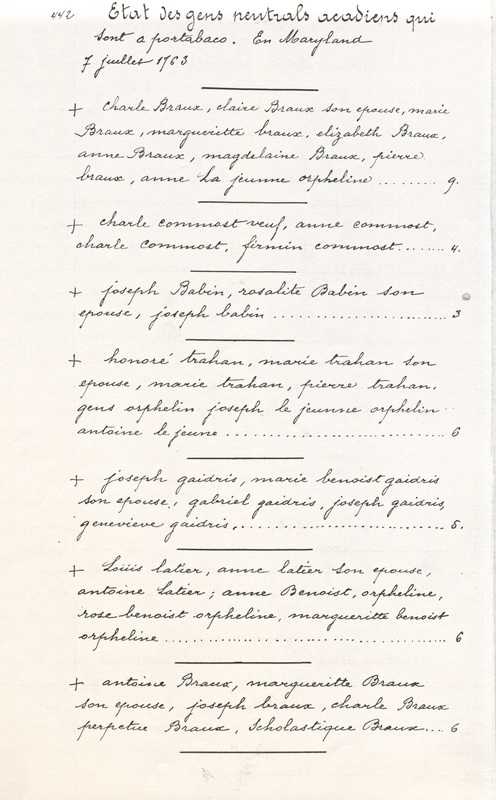
List of the French Neutrals in Port Tobacco, Maryland, in 1763, includes the household of Antoine Breaux. The family is listed at the bottom of the page. His parents are in the first household listed. This is the last record of Charles Breaux being alive.
Those were the highlights of their stay in Maryland. You already know the down side, because Claire was a widow when she made it to Louisiana. I said that from the beginning. Charles died sometime around 1764 or 1765. I hope he made it to at least the birth of little Marie Rose. That would be nice. But we don’t really know. The main clue is a journal entry of a local priest on August 12, 1765, that says, “…my order to Clare Braux Widow for 3 bushels of Rye…” So Charles was probably my age right now when he died (59 years old).
The Breaux family group only stayed in Maryland a few more years. On December 17, 1767, they boarded the ship The Jane bound for Louisiana. They were hoping to join those other Acadians like the Landry family that went to St. Gabriel. But when they reached New Orleans in Feb. 1768, they were brought to Fort St. Luis de Natchez in Mississippi aboard The Guinea. It was here that after a few months Claire Trahan Breaux died. She spent 50 years in her homeland, before spending a dozen long, hard years in Exile in Maryland. She lived less than a year in the South. She was buried on June 7, 1768.
On September 9, 1769, Anthony made his mark on a document giving his unconditional oath of allegiance to Spain. A month later he made a request to abandon the land that was given to him in Natchez in exchange for land nearer to the other Acadians who settled between Baton Rouge and New Orleans. He was granted permission and the family then settled in St. Gabriel, Louisiana.
The 1771 Census shows the family living in St. Gabriel with 3 heads of cattle, 7 hogs, and 3 chickens on a piece of land along the Mississippi with 8 arpents frontage. Just over a year later, another census shows them with seven head of cattle, thirty-seven hogs, and thirteen chickens. They were moving on up!
On February 12, 1776, Scholastique married Joseph Ignatius Landry in St. Gabriel. I mentioned him in the post last week. He spent a dozen years of Exile in Maryland also, but in Marlboro. In 1779, Scholastique’s younger sister Perpetue married Joseph Ignatius’s younger brother Mathurin. That means all of my wonderful cousins descended from Mathurin are actually my double cousins thru this line!
In 1781 Joseph Ignatius & Scholastique’s third child was born. His name was Joseph Emanuel Landry and he is my 3X great grandfather. The path to me goes like this: Emanuel Landry had a daughter named Marguerite or Basilite Landry, Basilite had a daughter named Marie Celeste Leveque, “Granma Celeste” had a son named Rob or “Pappy” Landry, Pappy had a son named Bob, and Bob was my father. But Emanuel was also my 4Xgreat grandfather. That path goes like this: Emanuel had a daughter named Anna Adele Landry, Adele had a daughter named Marie Amelie “Belite” Bujol, Belite had a daughter named Marie Therese Landry, Marie Therese had a daughter named Germaine Erie Patureau, Erie had a son named Bob, and Bob, as you know, was my father.
In 1782 Anthony Breaux died in St. Gabriel at the age of 52. Joseph Ignatius and Scholastique had their fourth and final child in 1783. Scholastique then died in 1785 at the age of 34. After making it through a decidedly turbulent childhood in Exile and reaching the land of milk and honey and meeting the man of her dreams, she died after only eight years of being married. This must have been a tragedy for the whole Breaux and Landry family.
But as you know, people recover and move on. Joseph Ignatius did. I have a total of five paths of lineage from him to me. You will hear about the other three in the next installment. That story entails a longer, more distant, and more tragic period of Exile.
You’ve been warned…

Here is the first path to Scholastique Breaux that I talked about in this post.

This is the second path.
For other installments of the “From Acadian to Cajun” series, click on the following links:
From Acadian to Cajun: Part 1 – Landry/Babin
From Acadian to Cajun: Part 3 – Braud/LeBlanc/Gauterot/Aucoin
From Acadian to Cajun: Part 4 – Hebert/Melanson
From Acadian to Cajun: Part 5 – Bourg/Granger
From Acadian to Cajun: Part 6 – Bujol/LeBlanc
From Acadian to Cajun: Part 7 – Foret/Bujol
From Acadian to Cajun: Part 8 – Hernandez/Babin
From Acadian to Cajun: Part 9 – Dupuis/Dugas
From Acadian to Cajun: Part 10 – Bourg/Babin/Landry
From Acadian to Cajun: Part 11 – The Ones That Didn’t Make It