Gunnysack Dresses

1941-Phenice Family

Front and back of photo from circa 1941. Girls in gunnysack dresses?

Ever since I was a kid I remember my mom talking about how she and her sisters would make their dresses out of old flour sacks.  I felt so sorry for her.  I thought that it must have been really uncomfortable.  And it must have been particularly depressing to go to school like that when there had to have been other kids with store-bought clothes made out of real cloth.  How could we possibly complain about anything when she suffered through such depravity?

Then one day about two or three years ago, she was talking about those dresses made out of flour sacks again.  She was saying how she liked to be the one to ride into ‘town’ and pick out the best prints for the dresses she was thinking about making.  I was like, “What are you talking about?  Flour sacks don’t have prints on them.”  She looked at me like I was crazy.

“Why are you asking about that?” she asked, “I’ve told you about that several times.”  I went on to say that I had heard her before, but I never knew burlap bags ever had any prints on them.  Maybe something like “FLOUR – 40 LBS” or some such label.  Then she knew I was crazy.  “Burlap bags?  How do you get that from flour sacks?” she asked.

I told her that that was what I’ve always pictured when she told us this story.  And it wasn’t just me.  My sisters Karen and Jamie also thought the same thing. (They may deny it now, though!)  We all got a kick out of this misunderstanding.  They both shared an article about the topic a while back on Facebook.  It explained the whole phenomenon and talked about how in the early 40s over three and a half million women and children were wearing garments made from feedsacks.

I’m thinking that the photo I’m posting today may be showing a part of that history.  It’s from the right era.  I’m not really sure, but it looks like a possibility to me.  The dresses all look somewhat simple and each one is made from comfortable looking cloth of a single type of print.  I really didn’t notice the dresses when I first decided on using this photo for my post.  When I was editing the photo, the prints of the dresses caught my attention and reminded me of the discussion with my mom.

I picked the photo out because there is that homespun charm about it.  I’m posting the photo unedited at first and including the back of it.  There’s an oil spot on the front that shows on the back also.  I’m not sure what caused that.  But on the back of the photo a child’s handwriting has labeled everyone in the photo.  Then on the top right corner in my mom’s handwriting, it reads “taken by Betty with 1st camera.”  How sweet is that.  Little Betty Lou taking a photo of her mom’s family with her first camera.  On the far left is my grandmother Myrtle AKA Grandma.

1941-Phenice family

Front: Myrtle, Marguerite, Grace, Daisy, and Harry Phenice Back:Warren, Henry, Sylvan, and Orville

I’m also posting an edited version of the photo.  That’s what I do.  Clean it up a bit.  Remove the scratches.  Remove the dust.  Remove the charm.  Wait, did I say that?  Yes, I did.  That’s why I decided to post both versions.  I think the cleaned up version looks better, but the original has more charm.  I don’t think that’s the case most of the time, but sometimes I do wonder.  Not enough to make me stop though.


Entanglements

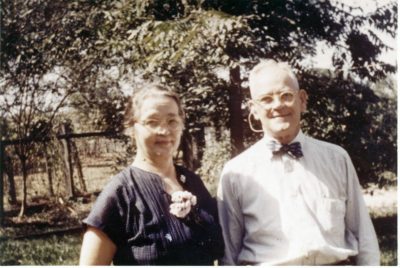
Mee Maw and Pee Paw circa 1956

Mee Maw and Pee Paw circa 1956

I had a realization yesterday.  And it seems like something I should have noticed earlier.  It seems like I talk about it all of the time.  And I’m sure my dad must have talked about it too.  As you all know, my Mee Maw and Pee Paw were related to each other.  They were first cousins once removed.  If you don’t like removing people, Robert Joseph Landry, Sr. married his first cousin’s daughter Germaine Erie Patureau.

“So they were cousins,” you say, “what’s the big deal?”  Maybe that’s not what you’d say, but growing up in our family that seemed to have been the attitude.  People have a different attitude now.  “Cousins who kiss now are parted” is the line from my musing on the situation a few years ago.  But it’s not just that they are related – and here is the big realization – everyone that is/was related to Pee Paw is/was related to Mee Maw.

Think about that.  You have cousins from your mom’s side and from your dad’s side.  Most of the time the two sides are not related to each other.  And if you happened to be married to your 2nd cousin (heaven forbid!) you would share one of your four sets of great grandparents.  That would still leave three quarters of your ancestry different from your partner.

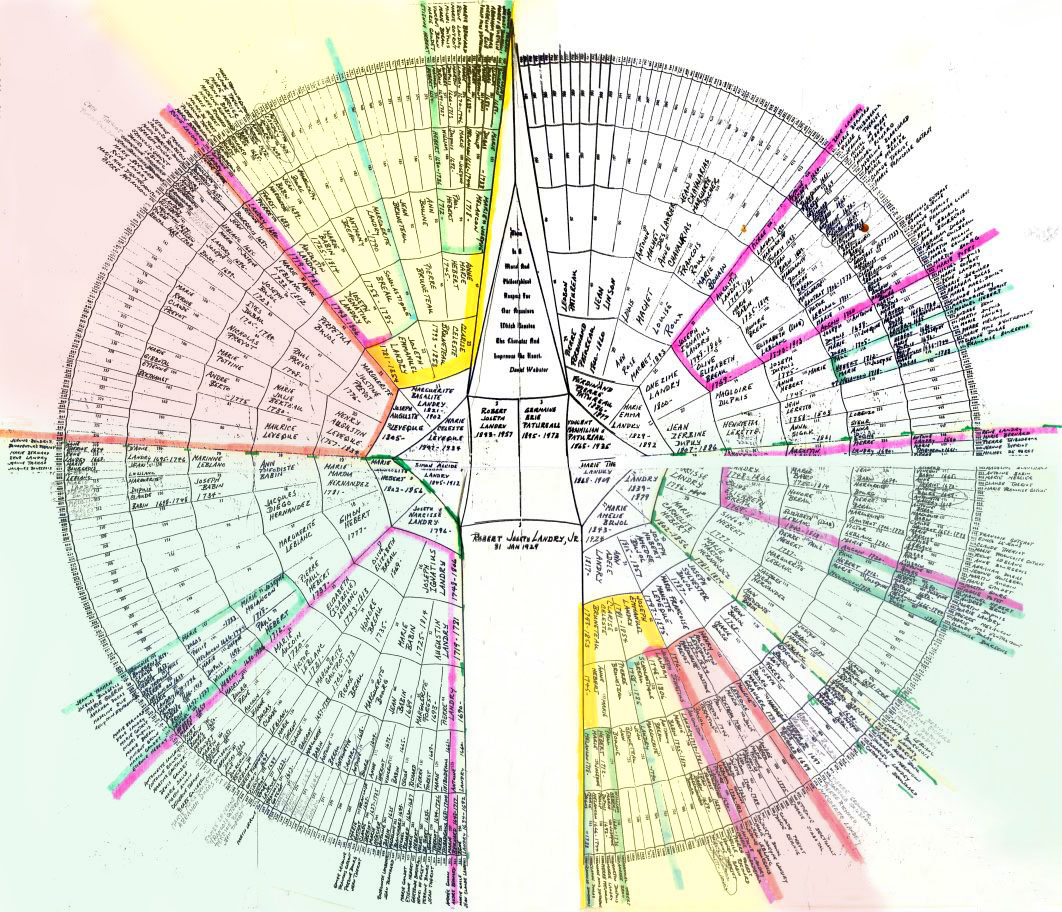
But in my grandparents’ case, it’s a bit more entangled than that.  Pee Paw’s father was the brother of Mee Maw’s grandfather.  So Pee Paw’s paternal grandparents were Mee Maw’s great grandparents.  That takes care of half of Pee Paw’s ancestors- they are also Mee Maw’s ancestors.  With the maternal side of Pee Paw’s family it was a generation further back.  As a tool, I’ll use the chart that my dad made of all of his ancestors in a circular pedigree chart.  Many of you will recognize it from the many times he talked about family history at reunions and get-togethers. Maybe some of you listened more closely and have already heard about this ‘realization’ that I’m trying to explain.
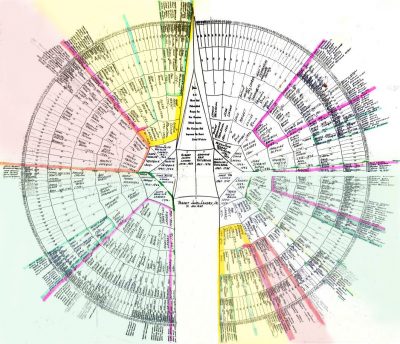
My dad’s genealogy chart.

If you look at the chart with its helpful color coding, you can barely see a dotted green outline on the lower left quadrant (that I shaded green).  That is the ancestry that I was just talking about – ancestors of Simon Alcide Landry.  It matches with the right side (Mee Maw’s side) starting at due east (on the right) down to southeast (shaded green to match).  Those are the ancestors of Jean Trasimond Landry (Alcide’s brother and Mee Maw’s grandfather).  These are the common ancestors that make them first cousins once removed.

Alcide was married to Marie Celeste Leveque, whose parents were Auguste Leveque and Basalite Landry.  Both Auguste and Basalite had a sister that were ancestors of Mee Maw.  Therefore Auguste’s parents and ancestors (shown in the tan color section) are also ancestors on Mee Maw’s side of the family.  You can see the peach section repeated on her side on the lower right side.  This represents the Leveque connection and they were second cousins twice removed due to this connection.  But then Basalite’s parents and ancestors (shown in the yellow sections) are also on both sides of the family.  This is another Landry connection and Mee Maw and Pee Paw were second cousins once removed due to this connection.

So, like I said earlier, all of Pee Paw’s relatives are/were relatives of Mee Maw as well.  The reverse is not true, though.  Mee Maw has a few distinct family lines that are not included on Pee Paw’s side.  Mainly the Patureau line that came from France in the 1840s.  It’s difficult to find someone related through just the Patureau line, because in our family there were three generations in a row that married into the Landry line, which is what brought us to the situation we now have.

The other distinct line leads back to another Landry.  We get our last name from Rene “the younger” Landry and he shows up several times from all of the intermarriages.  But Rene “the older” only shows up once.  His daughter didn’t believe in marrying cousins.  Imagine that!  But alas, Rene “the older” really isn’t the only connection to the Landry line he represents.  There is another member of that Landry line that we descend from – his sister Antoinette.  Somehow that is not surprising.


In the second paragraph of this post I referred to a poem that I wrote a few years ago.  I thought I’d post my whole poem here for the sake of those who had not seen it before. It explains (in a way) how I am my own third cousin once removed. I wrote this on June 24 & 25, 2005 when my obsession at the time was limerick writing.


Me, Myself and I

My third cousin once removed did
Take over my life and then hid.
He’s inside my head
But if he were dead,
It would kill both my ego and id.

You see that third cousin is me.
I’ve climbed around my family tree.
I must be part monkey
Or just info junkie,
I swing through the branches with glee.

Some interesting things I discover.
The lines of descent I recover
Appear more than twice.
Well, isn’t that nice.
At least I am not my own brother.

It seems that my grandfather wed
His first cousin’s daughter and bred.
For they had eight kids
And one of them did
Wed mom and you know where that led.

It must have been Cajun tradition
Or kids with a lot of volition.
Whatever the cause,
It didn’t give pause.
It happened despite admonition.

I am my own fifth cousin too.
And no I don’t live in a zoo.
But all this inbreeding
And some genes repeating,
Should lead to a head number two.

And then I’d have room for my cousins.
I know there’s at least a half dozen.
Though they are all me,
I’d set a few free,
Cause we are not kissin’ but fussin’.

We fight over who gets to drive
Who’s out first when we all arrive.
Who gets the last piece,
Who pays on the lease,
It’s worse than most husbands and wives.

I wonder how all this got started,
Cause cousins who kiss now are parted.
To stop a mutation
Or my situation
Where cousins blame me when they’ve farted.

Of course they have done much worse things,
Like knocking that boy from the swings.
They kicked my dear sister
And stole that transistor.
What mischief these cousins can bring.

But one is the absolute worst
It’s him that I mentioned at first.
I’m sure it was him
That burned down the gym.
When mom asked us why, he just cursed.

I guess he’s the strongest, cause he
Is closest relation to me.
He’s really quite tiring
And gets me perspiring.
I wish he’d get lost in my tree.

Hello, it’s ol’ third cousin here.
I’m here to bring fun and good cheer.
Ignore boring Van.
He’s spineless and bland.
With a “Boo” he just runs off in fear.

He blames me for everything bad.
But accidents happen. So sad.
If I don’t come out
And rampage about,
In a very short time I’ll go mad.

Who cares if I mock the deceased?
Or my share of work is the least?
At times I relent,
But I won’t repent.
I’ll laugh if you call me a beast.

 (Shut up. Now get back in your place.)
Forgive me for that show of face.
He looks just like me
But as you can see,
He’s lacking in wits, style, and grace.

And now I must leave you alone.
A state that I never have known.
So check out your tree,
Particularly
To reveal who’s in your skin and bones.

The Cows All Come a Runnin’ With a Moo!

1949 - Betty Lou charming the cows with Papi

1949 – Betty Lou charming the cows with Papi

For several years now, I’ve been sharing stories of the Adventures of Jacko.  As everyone knows, they are stories about the travels of me and my wonderfully charming sock monkey Jacko.  In the travelling song that Jacko and his mentor/grandfather Papi wrote, it mentions my mom and the fact that she used to play her baritone out in the fields of Hathaway until the cows would come.

I didn’t know that she had a photo of this until quite recently.  She has talked about her serenading activity for as long as I can remember.  I don’t know why she didn’t mention this photo or show it to me.  I mentioned this to Papi and he said he couldn’t imagine why his old Buddiloo never showed me this photo.

“Of course,” he said, “back then we didn’t see photos as soon as we took them.  But I do remember seeing it once.  I titled it ‘Nature Girl.'”

“‘Nature Girl’?” I asked, “Why did you call it that?”

“Well,” he said, “it was around the same time that Nat King Cole’s song ‘Nature Boy’ was playing on the radio.  That was really exciting.  Radio was one of the rare conveniences that we had out in the country.  There certainly wasn’t any air conditioner, so when Buddiloo would practice her horn, she liked to go outside.  She played all kinds of songs, but the one that the cows liked best was ‘Nature Boy.’  And every time they showed up, they said the same thing.”

“Of course they did,” I said.  “Mama always said they would moo at her when they showed up and it made her laugh.”

“Yes, sometimes she could be a silly girl.  It’s what I love the most about her.  But those cows kept trying to tell her something and she never listened.  I, of course, listened to them attentively.  I am a cow whisperer,” he said with more than a little pride.

“So what was it that they said?” I asked. “Were they making requests for different songs?  Or maybe for a different instrument?  Like a trombone?   Surely not a clarinet?!”

“No, no, none of that,” he said with a scowl.  “I see you inherited more than a little bit of silliness from your mom.”

“Whatever,” I said, “Just tell me what the cows said.”

“Okay, but it would be better if I sang it for you.  Since ‘Nature Boy’ was the song that they were drawn to, I decided to put the message into my own words for the song,” he explained.  “I call it ‘Nature Girl,’ hence the title of the photo.  It goes like this.”

He then started singing the song with a haunting melody.  It really was quite moving.  Here are the words:

Nature Girl

There was a girl, a very sweet and charming girl.

She liked to play her baritone all alone in the fields each day.

Her monkey friend would give a grin.

When she’d start to play.

And then one morn, a magic morn she played that horn.

And all the cows they gathered round.  Stood their ground.

This they said to her:

“The greatest thing you’ll ever learn

is grass tastes great, but when brown it can burn.”

After sitting a while stunned by his performance, I shook myself back to alertness and asked,”Wait, does that mean that brown grass burns in the stomach or that it can catch fire?”

“Silly boy,” he said, “what is hay?”

“Oh, yeah,” I said sheepishly.

“If there are still any doubts in your mind about the answer to your question,” he continued, “just mention the words ‘grass fire’ to a herd of cattle.  It’s the quickest way to start a stampede.  When they would say the same thing over and over to Buddiloo, there was always a look of fear in their eyes.

“Now if there are any more questions, they can wait.  Jacko and I are going to the other room to watch a movie.  You can join us if you like…as long as you bring popcorn.”  At that he was off.

So that, my friends, is the story of this week’s photo.  Straight from the monkey’s mouth.

I Was a Little Bit Thin

1921-07- Earnest Cropper, Clifford Clements, Germaine Erie Patureau, Zita Patureau, and H. L. Landry Clean

Summer 1921

Sometimes a photo just compels me.  That’s the situation this week.  I was feeling somewhat ornery and thought I’d do a really good and confusing one about some of the tangled relations on my dad’s side of the family.  I started looking at photos and this one grabbed my attention.  Not because of any intrigue or confusion, just because it is a sweet photo of my grandmother Erie Patureau Landry.

It was taken in the summer of 1921.  “How do you know that?” you ask?  Because that’s what it says on the back of the photo in my Mee Maw’s very own handwriting.  That’s how.  And not only that, she listed everyone in the photo.  Thanks again, Mee Maw!

Standing behind her is her sister Zita Patureau.  The guy standing behind the wooden handrail is their first cousin Earnest Cropper.  (Joseph Earnest Cropper, Sr. born in 1901)  His mother was a Patureau and the sister of Erie and Zita’s father.  The other guy’s name is  Clifford Clements.  No relation that I know of, but one of their other Patureau cousins married a Clements girl who could possibly be related to him.  May be her brother?

1921-07- Earnest Cropper, Clifford Clements, Germaine Erie Patureau, Zita Patureau, and H. L. Landry Back

Writing on the back of the photo

And that leaves us with just the boy’s name not revealed yet.  She has his name listed as H. L. Landry.  I would suppose that this was Henry Louis Landry who was born in 1911.  And that brings a slightly sinister grin to my face.  :9  You see, little H. L. is not only Erie and Zita’s half first cousin, he is also their first cousin once removed.  Because Erie’s maternal grandmother Belite is also H. L.’s maternal grandmother.  Where Erie came about from the union of Belite and Trasimond Landry, H. L. comes from Belite’s 2nd union with Magloire Babin.  That explains the half first cousin part.  In addition H. L. is the (at this point my grin is becoming a scowl – this is confusing me and I have it all clearly displayed on my computer!) grandson of Alcide Joseph Landry who is the brother of Erie’s grandfather Trasimond.  So I was wrong.  He is their half first cousin and their second cousin.  (I wonder if that adds up to a three quarters first cousin?)  Now it’s perfectly clear.  I think it’s clear.  Are we clear?  Similar to what it says on the back of the photo, my confidence in the outcome is “a little bit thin” right now.

A Sad Story

I’m in the mood to tell a sad story.  It’s probably because I’ve been hearing so many this week with the Great Flood of 2016 happening all around me.  Like those stories, it is a true story.  And, alas, it is sad.

I’ve wanted to tell it for a while now.  As I looked through the information about the Bucklin family, little pieces of the story would show up from time to time.  My cousin Joseph Connors posted a prequel to this story a few weeks ago. (Jennie Has Been Very Sick)  He told a part of this tragic tale, but I thought that I’d tell a little more.

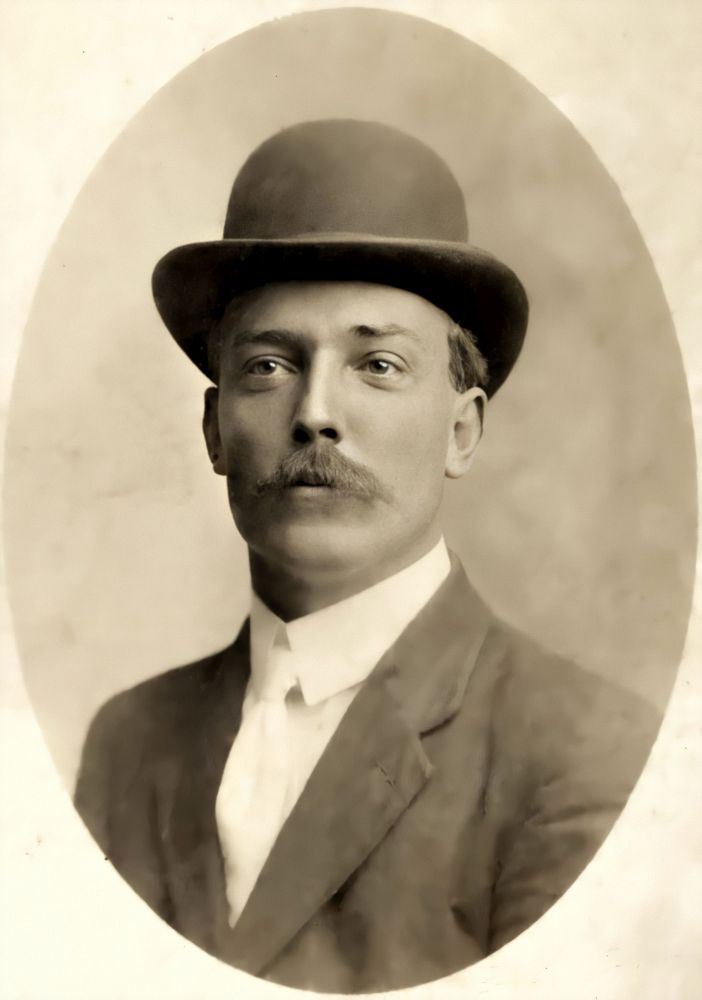
Joe Bucklin in 1909 in Jennings, Louisiana. (photo edited by Van Landry)

His name was Joseph Bucklin.  He was born around 1859 in Massachusetts to James Austin Bucklin of Palmer, Massachusetts, and Mary Ann McGrath Bucklin originally of Ireland.  The family must have moved to Iowa shortly after his birth, because his younger brother Edward was born there in 1864.  Then his youngest brother Louis Charles Bucklin (my great grandfather) was born in Iowa in 1873.  They lived in Coffins Grove, Iowa.  (Cue the ominous music here.)

In 1884 the family moved to southern Louisiana where he, his father, his brother Ed, and his sister Jennie set up homesteads in the Raymond area. (Louis was not old enough to set up his own at that time.)  I’m sure it was a busy time for the family working on developing the land, roads, and bridges in that area.  But still, as things will happen, Joseph got married to Agnes “Aggie” Ausman in 1892.  She was from Canada, had spent time in Iowa at some point, but I’m not sure how they got together.  Let’s hope it was a happy courtship and marriage, because tragedies soon followed.

In 1893, Joseph wrote to Louis in Ohio to tell him about their sister Jennie being sick.  Jennie died sometime after June of 1893.  Around the same time, Joe and Aggie had a little daughter named Leola.  Things were calm for a few years with the birth of Gladys in 1896 and Harold in July 1899.  Shortly after that came more tragedies.  A month after Harold was born, Aggie died.  Then in December Leola died.  Joe must have been having a hard time, because his mother Mary Ann came to stay with him in Jennings.  But to make matters worse, she caught a severe case of the flu and died on April 10, 1900.

I told you it was a sad story.  I feel a reluctance in telling you his story and letting you get to know him a bit, because his story is so sad.  But I wanted to tell it, and that’s what I’m doing.   I’m sorry to tell you this, but there are more tragedies to come for poor Joe.  But not just yet.  As luck would have it (I’m not so sure about that Irish luck at this point!), Aggie had a younger sister of marrying age and Joe did just that.  He married Ida Ausman in November of 1900.  He certainly didn’t waste any time!

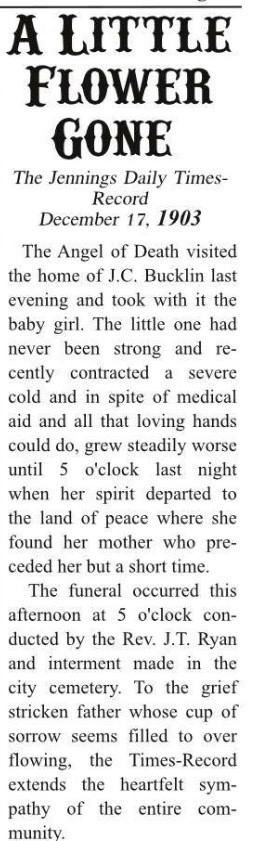
1903 - Little Flower GoneHe and Ida had a daughter named Ida May in 1903.  I’m not sure of the details here, but Joe’s wife Ida died on Sept. 5, 1903.  It could have been from disease or complications from childbirth, but it was a tragedy nonetheless.  Following that, little Ida May died a few months later.  As an article in the Jennings Daily Times states, she had never been strong and died as a result of a severe cold.  The person writing the article must have known the situation, because they talk about “the grief stricken father whose cup of sorrow seems filled to over flowing.”  I agree with that evaluation.

Joe did marry again in 1913, but he didn’t have any more children.  His daughter Gladys died in 1917 in Iowa at the age of 21 while living with her Ausman grandparents.  (There could also be a sad story written about the Ausman family, but I’ll leave that up to someone else.)  Gladys did not have any children.  Then Joe himself died a year later of the flu in the great 1918 flu pandemic while living in Florida.

There are no descendants today of Joe.  His son Harold did get married, but he died at the age of 27 without any children in 1926. He was the last of that family.  I descend from his brother Louis and I have never even attempted to count the number of descendants that he has.  He and Addie had 11 children (including my grandfather Fred) and 19 grandchildren (including my mom Betty Lou).  There were several more great grandchildren (Fred himself added 20 to that count.) and countless great great grandchildren.  The difference is drastic.

And so ends the sad story of Joe.


June 11, 2017 Update

For more information about the connections between the Ausmans and Bucklins, read the later post The Bucklin/Keys/Ausman/MacVey Connections.


Nov. 14, 2019 Update

For newly discovered details about the life of the Ausmans and Joe Bucklin, read this post The Sad History Surrounding Joe Bucklin.

The Man in Black

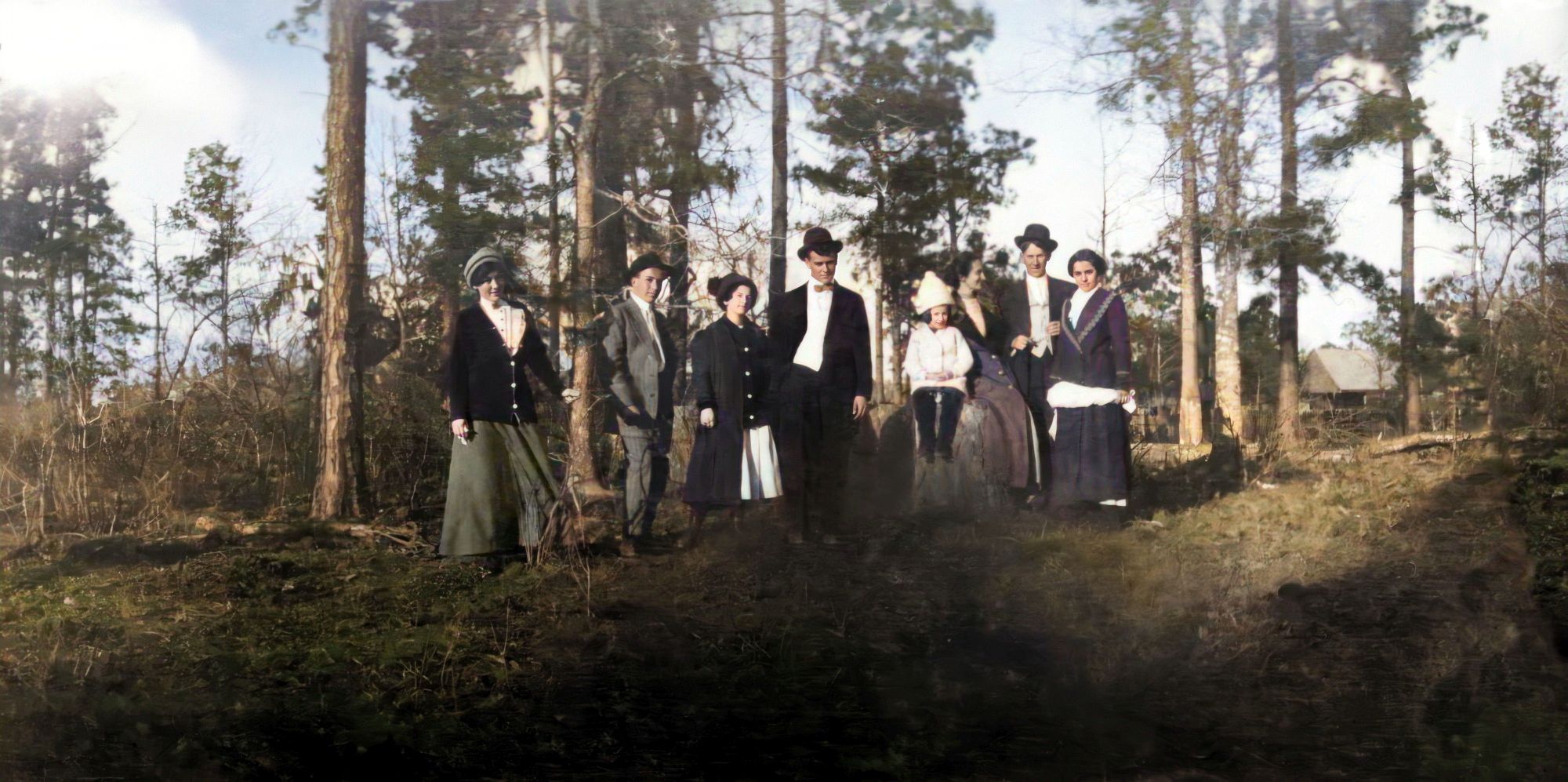
1912-12 Landry Group

Landry family photo from 1912

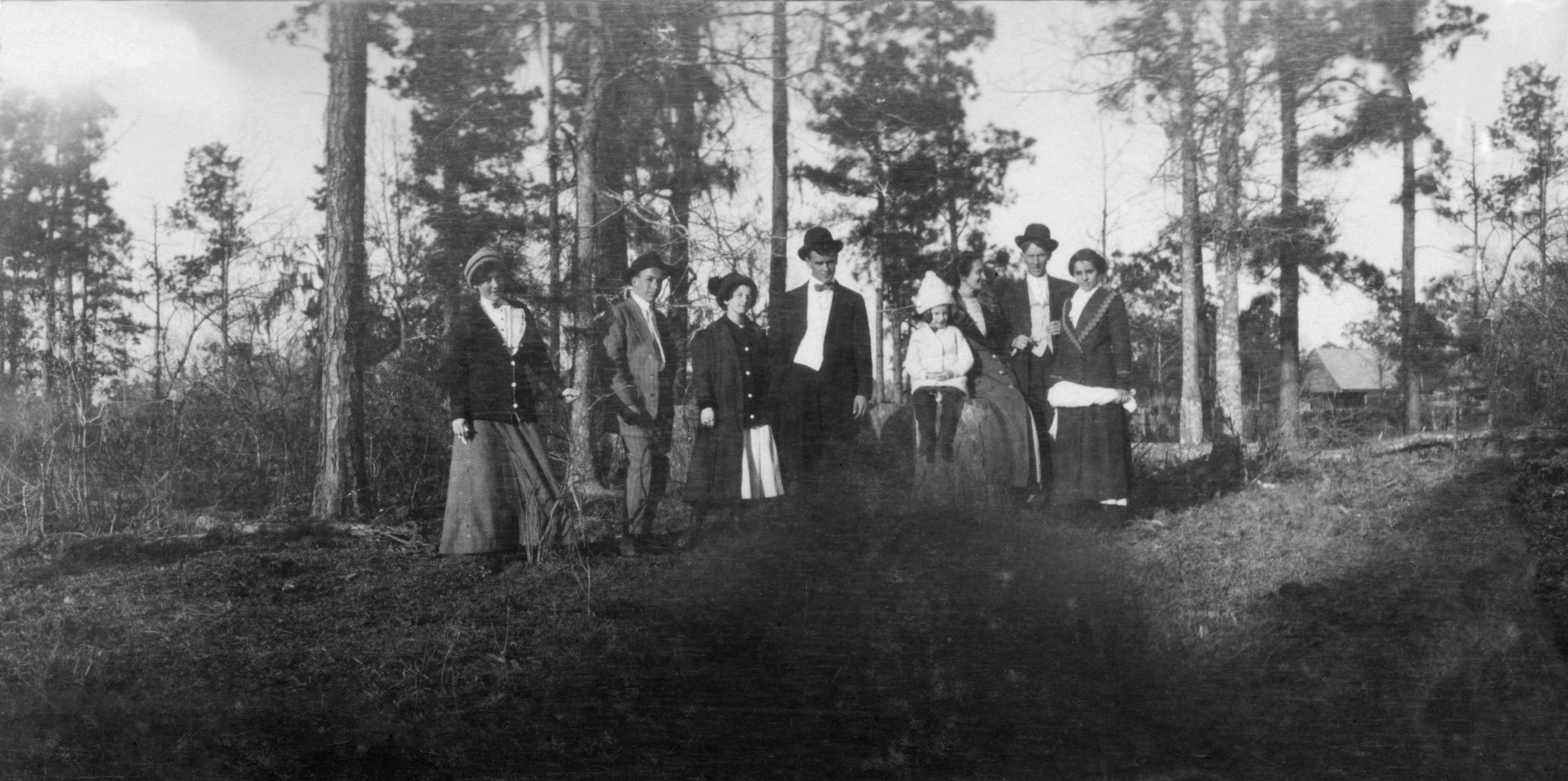
This photo is of a group of family members from my dad’s family.  The center of attention (and the photo) is that man in black.  My eye is always drawn to him.  That is my grandfather Robert Joseph Landry, Sr.  He was known by Rob or Bob and his grandchildren knew him as Pee Paw.  He was born in Westlake, Louisiana, in 1893 and died in Lake Charles in 1957, so I never knew him personally.

This photo was taken in Dec. 1912, so he would be 19 years old.  The girl on the far left is Estelle Myhand Alston.  I don’t know anything about her, but this photo comes from her scrapbook.  She wrote the date on the back of the photo and said something about it being taken on the road from Mrs. Landry’s.  She identifies herself, then Tom Bird next to her.  He is my grandfather’s first cousin.  Their mothers were Leveque half-sisters. (Actually 3/4 sisters because they had the same father and their mothers were sisters.) From what I’ve seen in censuses and graveyards, the Landry, Leveque, Myhand, and Bird families had members that moved from the Brusly area to the Lake Charles area around the same time.  There were a few marriages between the groups, but I don’t know all of  that history.

Next in line is Beulah.  Estelle doesn’t say any more than that because Beulah is probably her sister.  I have another copy of the photo that shows her as Beulah Myhand Koch.  Pee Paw is identified as Bob L.  Next to him is Manette Landry who would later marry Adnes “Bibb” Bouquet. She’s just an eight year old girl in this photo and the young niece (and cousin) of Bob L.  Next in line are Zim and Joe Landry.  Joe is Alcide Joseph Landry, Bob’s older brother.  The last one is their cousin named Emma Patureau.  She would marry Toby Mouton nine years later.  But her biggest claim to fame is that she was the mother of Tez.  This was the calm before the storm.

1912-12 Landry Group

Writing from the back of the photo

I’m also posting the back of the photo because it’s kind of interesting.  That’s where I got the title to the post.  She mentions something about singing “..the Man Dressed in Black.”  I guess I’ll have to look that up and find out what it’s all about.  You can do the same if you are interested.

That’s it for now.  See you next time.


Update for Jan. 24, 2021


I was experimenting with MyHeritage’s photo editing features earlier this week and tried out the colorizing feature on a few photos.  Some of them came out pretty good.  I think they’re improving the feature, because I’m starting to like the results more.  Maybe I’m just getting used to the idea.   But one photo colorization came out really good.  Of course I had to clean it up a bit more after the colorizing, and now I am really pleased with the edited version.  So behold The Man in Black in color:

An edited and colorized version of the December 1912 photo of my grandfather and various friends and family members in Westlake, Louisiana.

A Switch to Hymes from Hine

George and Susan Hine Family circa 1900

George and Susan Hine Family circa 1900

My decision of what to post this week was motivated by two factors:  I made an exciting discovery regarding a last name and I finished working on this photo after working on it off and on for over a year.  Plus, this is a really, really nice family photo from over 100 years ago.  I think it’s from around 1900, which would mean it was taken in Louisiana.

The photo is of the George Henry Hine and Susan Stanbrough Hine family.  In the back row is James, Lonnie, Addie and Bert.  The front row is Rowe, Susan, George, and Ollie.  There are a lot of descendants of this family in southern Louisiana, as well as a few other places.  They were all born in Hamilton County in Indiana in the 1800s.  The family moved to Louisiana in 1894 and the daughter Addie married Louis Charles Bucklin in 1898.  One of their sons was Fred Bucklin, my maternal grandfather.  Now you know where I fit in.

Malina and John P. Hine headstone - courtesy of SunCacher at FindaGrave.com

Malina and John P. Hine headstone

But what you don’t know is the last name of George Henry Hine’s mother.  Some of you might not even know her first name!  So to help you out, I will let you know that his parents’ names were John Peter and Malina Hine.  (Like in the second photo that I’m posting.)  I have been looking for Malina’s last name for a while.

It was not in the census records that I had found from 1860-1900 or other records I could find online.  But then Ancestry added Indiana death certificates to their data sources available to its members.  I didn’t really think about looking for her name when that information first came out.  All I really thought was, “Oh, some more stuff available.”  I deleted the notification and moved on.  I came across her name a few days later and then thought I’d try to find her last name again.  Her death certificate is not included because she died in 1894 and the records start in 1899.  What?  You’ve got to be kidding me?

I was almost forlorn, but then I remembered that George Henry had several siblings that lived out the rest of their lives and died in Indiana.  I wasn’t even sure the siblings I had listed were accurate, but I tried anyway.  So I checked for William Hine and found death certificate that showed his mother’s maiden name!  Yippee!   Then I checked for Benjamin and Thomas and found the same 1917 William Hine death noticething.  They all three had the maiden name of Malina Hine as being Malina Cox.

 

I was still a little unsure because I wasn’t sure that they were all really the siblings of George Henry Hine.  So I was determined to find the 1850 Census that I had been unable to find before.  The children would have been young enough to all be at home still at that time.  They weren’t in the home in the later censuses.  I searched all day for that census!  I looked for the name spelled any way possible:  Hine, Hines, Heinz, Hinds.  But no luck.  I was giving up and decided to see if someone else might have the info on their tree.  I looked at a few trees on Ancestry and found a few with census records.

And that’s when I noticed something.  I already knew that census workers spelled people’s names however they thought was correct.  They did not have the spelling gene from Grandma Myrtle!  But another mistake that I saw was the name transcribed as Him.  In cursive Him and Hine look very similar.  So I went back and searched for John Peter Him.  I didn’t find Him, but I found him.  The family was listed as Hymes in the 1850 Census.  And all of the children were listed.  The ones who had death certificates giving the last name of Malina as Cox.  I am now satisfied that we have at least one line of Cox family in our history.  She was born in North Carolina and I believe that her family may have been Quakers.  Now I want to know more!  The search never ends.

1850 census lists John (Peter) Hymes (Hine), Malina, Benjamin, William, George H(enry), and Allen L(arkin).


Myrtle the Graduate of 1925

1925-05-29 - Myrtle Sylvia Phenice H.S. Graduation

In 1925 Myrtle Phenice graduated from Jennings High School

The woman I knew as “Grandma” was born December 19th, 1906 to Harry Clifton Phenice and Daisy Henrietta Martha Keys Phenice.  She was the third of their seven children and she was named Myrtle Sylvia Phenice.  The family lived in an area known as Hathaway.  I’m not really sure what the ‘borders’ of Hathaway are, but it’s just down the road from China and Raymond.  A few miles to the west is Kinder and a couple of miles to the east is Elton.  And all of those places are about ten miles north of Jennings.

I’m not sure of the details of her early life.  That’s kinda sad now that I think about it.  And there are no early photos of her to give me a clue.  At least none that I know of.  I have photos of her parents from before she and her siblings were born, but then none until this photo.  Maybe they didn’t take many photos during that time.  Maybe my grandmother didn’t like any of the photos of herself as a child and destroyed them.  If anybody knows more about this, please let me know.  (See update.)

This photo is her high school graduation photo.  She graduated from “the Jennings High School, an Authorized State High School” on May 29, 1925.  I think it is a lovely photo of  her.  She continued her education at Southwestern Louisiana Institute in Lafayette and graduated there in 1928.  This all led to a long career as an elementary school teacher at Hathaway High School.

1925 - Myrtle Sylvia Phenice H.S. Diploma

Myrtle Phenice’s diploma

The Uninvited Guest

Nothing could strike fear into my childhood heart like the unexpected and undesired visit from The Uninvited Guest – or as we liked to call it – The UG.  We all acquired a sixth sense that alerted us to the approach of the UG.  As we played our fun little innocent childhood games without a care in the world, something unseen would hit us.  We would all stop at once as if in a trance and chant together in a whispered voice, “Hell – fire! will kill a bug, but nothing stops the bumply UG.”  We all knew what that warning meant.  My younger sister would start crying, so my oldest sister would swoop her up and run as we all scrambled to our favorite hiding places.

But it wasn’t just our family who responded in this way.  The neighborhood kids would scatter in all directions as they ran home to their parents.  Their moms would look out the window, spit out a silent curse in our direction, and withdraw while pulling the shades tight.  It’s like there was a small dark cloud that settled down over our little section of the street.

Yet for some strange reason, the adults in our family were in thrall to this creature.  They went so far as to even allow it to rub its slimy bumply lips on their vulnerable necks.  It still makes me shudder when I picture it. Once this bizarre ritual had been completed, they would go inside and things would settle down a bit.  Then one by one each of us kids would sneak back into the house to see what manner of evil was taking place.  Many times the UG would be ordering my parents around and demanding what kind of feast they were to prepare for its dinnertime.  Thankfully, none of us kids were on the menu for the whims of the vile creature.

Later on in the night as we tried to sleep, I would be overcome by a feeling of dread.  I just knew that something was prowling around our bedroom, hoping to fulfill its desire for an innocent’s blood.  As I lay in bed with my skin crawling with goose bumps – goose bumps, mind you, not bumply bumps – I felt a need to see what was going on.  When I forced myself to pry open one eye, I would see this huge dark hand on the ceiling coming down to get me.  I realized it was the shadow cast by the nightlight of a hand coming toward me.  And not just any hand – it had the bumply bumps of the bumply arms of that bumpfully bumpedy bumply UG.  As I stared in terror I heard it rasp in a gravelly whisper, “Hell – fire! will kill a bug, but nothing stops the bumply UG.”  At that, it turned around and headed out the door snickering its evil little bumply UG snicker.  The end.

I admit.  This is quite a bit different than my usual Throwback Thursday, but I was inspired!  When I say that all of my cousins on the Landry side will know what this story is about, I mean every single one of them!  And probably most of the other relatives on that side of the family.  This story was inspired by and dedicated to Therese Wynhoven Mouton, my dad’s first cousin on the Patureau side of the family.  But everyone knew her by her nickname “Tez.”

She was quite the character, though she was not the detestable creature that I write about in my story.  Like I said, she was just the inspiration.  She did show up at our house unannounced and uninvited, we did run away from her when she showed up trying to kiss everyone, she did like to tell people what to prepare for dinner or what to watch on TV, and she told us scary stories at night.  Oh, yeah, and she did have bumps all over her body.

1970 - Tez Mouton and Erie Patureau Landry travelling

Tez and Mee Maw traveling circa 1970

The poor creature!  She didn’t ask for those bumps and she probably didn’t have slimy lips.  She was just a lonely single woman who was trying to connect with family.  She was very independent too.  She was a school teacher, she enjoyed writing stories and poems, and she liked to travel.  But she also liked to scare little boys who probably gave her bumpy profile a hard stare.  As she brought that shadowy hand down on me from the ceiling, she didn’t say anything about a bumply UG,  she was reading a poem by James Whitcomb Riley, “…and the goblins gonna get you if you don’t watch out.”  And that’s why I’ve been such a good boy ever since!

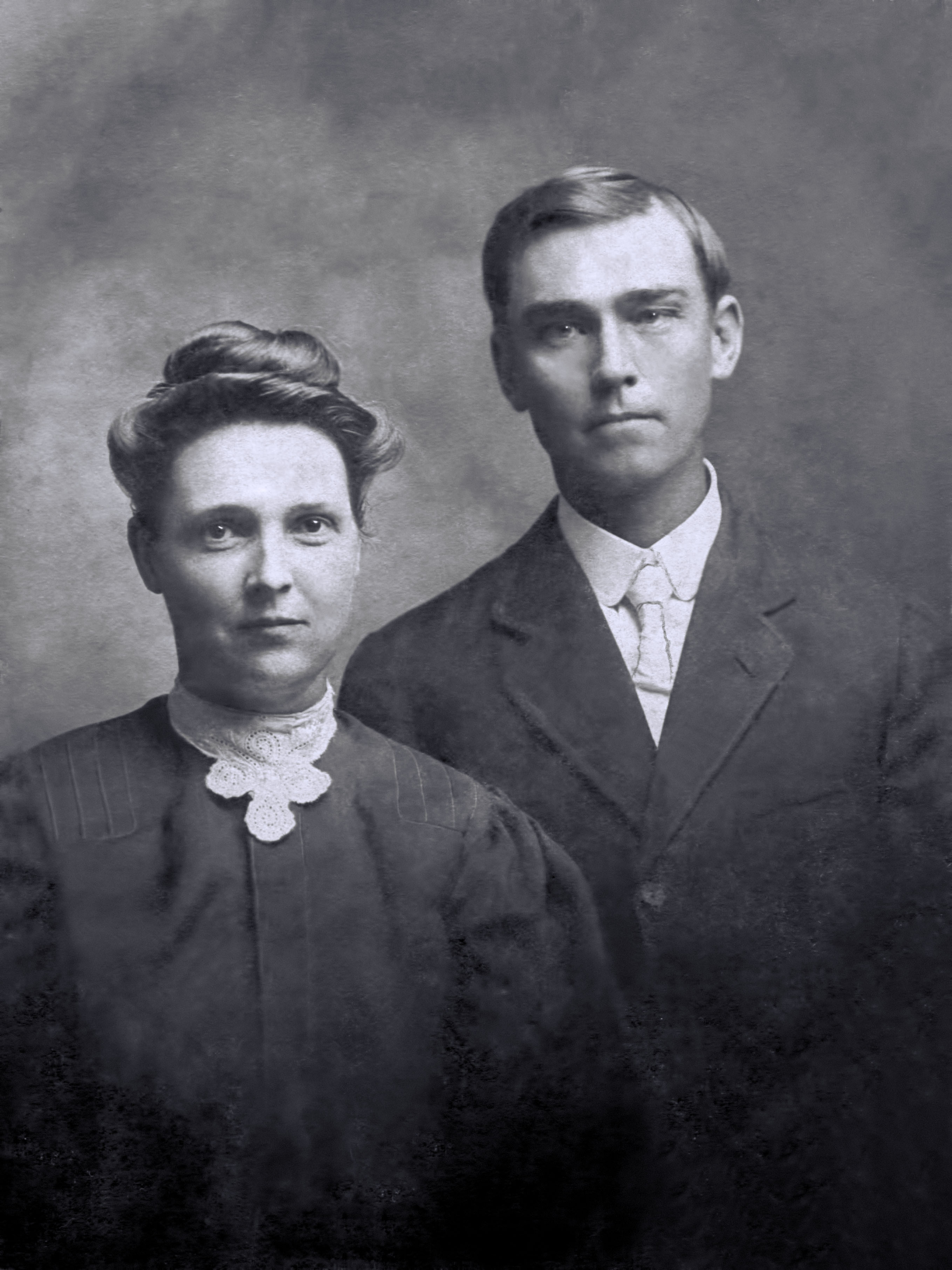
Addie & Lou

1905 - Addie & Lou Bucklin

Addie and Lou Bucklin in 1905

This is a photo of my mom’s paternal grandparents in 1905.  They were married in 1898 and by the time this photo was taken, they already had five children.  But before I finish counting off their children, let me tell you a little bit about the two of them.

Addie May Hine was born in Noblesville, Indiana, on Sept. 23, 1876.  She was the oldest of six children born to George Hine and Susan Stanbrough.  She had five younger brothers and the youngest was only eight years younger than she was.  From the earliest photos of the family, it looks like they lived in a frontier area with a rough wood home.  The family moved to Louisiana in 1894 and settled in the Hathaway area of Jefferson Davis Parish.

Louis Charles Bucklin was born in Masonville, Iowa, on April 11, 1873.  He was the youngest child of James Bucklin and his second wife Mary Ann McGrath.  James was from a family line with a long history in Massachusetts, while Mary Ann was an Irish immigrant.  Louis had five older siblings – a half-sister and half-brother by his father and his first wife Rhoda Marie Gove, plus two brothers and a sister by his parents.  In the 1880 census they were living in Coffin Grove, Iowa, which was a very small community in rural Iowa.  Four years later the family moved to the Jennings, Louisiana, area and acquired homestead property in the Hathaway area.  Louis was too young to stake a claim, but his father, brother and sister were able to.

Louis kept a journal starting in January of 1893 when he went off to school.  He returned home at the death of his sister Jennie in June of 1893.  From that point on his journal was mostly about farming and such.  Except when he occasionally mentions a certain “Miss Hine” or “Addie” who came to help his mother with chores around the house.  I suppose she was worth mentioning because he ended up marrying her in 1898, which brings us back to the top of the story.

Soon after this photo was taken, the three most important Bucklin offspring were sprung!  In 1906 there came Herbert, who is the grandfather of our Joseph.  Then in 1907 there was a double dose of goodness – the identical twins Fred and Clarence.  Fred is my grandfather and Clarence is the father of Carla.  There were a few more after that, but they’re hardly worth mentioning.  I really shouldn’t joke about that because the next one, Edna, is the reason we have so many wonderful photos from way back when.  She collected and protected many photos, though this one was kept by Ruth.  Joseph and Louise visited and scanned numerous photos from both of them.

All in all, Addie and Lou had a nice even dozen children.  Now I’m feeling a little obligated to name them all, so here goes: Leo, Mary, Ralph, Paul, Carl, Herbert, Clarence, Fred, Edna, Robert, Ruth, and Roy.  That’s a lot of names to come up with.  From the look of the photo, they seem like somewhat happy people – salt of the earth.  I’d like to say that they lived long and happy lives, but sadly Lou died at the age of fifty-four.  Addie went on the live into her eighties and died less than a month after I was born.  I don’t have any personal memories of either Addie or Lou, but I do feel like I get to know them a little from the photos and stories that they left behind.  And now, hopefully, you do too.

—–

Update for July 9, 2026 – Added a few slight bits of information for a reissue of this post on Facebook after ten years.  I’m changing all of the older posts to change the spelling of Addie’s middle name to be consistently May.

1 51 52 53 54 55 58