Pluto and Betty Lou: The Prequel

Robert Joseph Landry, Jr. and Betty Lou Bucklin in June of 1952 in Lake Charles, Louisiana.

I had another topic that I was thinking about writing tonight, but when I sat down to start, I changed my mind.  I decided to find something from the time when my parents were together but not married.  There aren’t many photos from that period, because they didn’t have an extended engagement.  Comparing that short time to the 64 years that they spent together explains why most of their photos together were taken after they were married.

Before they were married, my dad was known as Pluto Landry and my mom was known as Betty Lou Bucklin.  But after they were married, it seems that people usually referred to them as Bob and Betty.  Even when referring to each other, my dad would call her Betty and my mom would call him Bob.  Of course when they were talking to each other, they called each other Honey.

So the prequel to Bob and Betty is the story of Pluto and Betty Lou.  I’ve mentioned previously that they first met in 1950 when my mom went to a Solo and Ensemble Music Festival at LSU in Baton Rouge.  She was looking for the right building to go to, and he was a student there in the band and he was more than willing to help that pretty young baritone player from Hathaway find her way.

Daddy was studying music education at LSU, but then McNeese went from a junior college to a four year college.  So he went back to school in his hometown of Lake Charles to get his bachelor’s degree.  He was the first music student to give a senior recital and he was in the first graduating commencement at McNeese State College on May 26, 1952.

But his senior year of college was a special one.  Betty Lou Bucklin graduated from Hathaway High School in 1951 and she decided to attend McNeese as well.  And since both of them were in band and played the baritone, it was inevitable that they would meet.  Of course my dad had seen a list of the new band members and recognized my mom’s name and made sure to speak to her sooner rather than later!  It wasn’t long before they went on their first date.

I found out a few details about that first date after I posted a story a while back.  I mentioned the name of Harvey Prejean, who was a friend of my dad’s from high school.  Come to find out. my mom and dad’s first date was on a double date with Harvey.  It also happened to be the first time both my mom or dad ever ate pizza.  That sounds like such a commonplace food to eat nowadays, but I suppose it wasn’t back then.  Or maybe my parents led incredibly sheltered lives!  They obviously liked pizza, because our family used to sing at a pizza parlor and we’d eat pizza all the time.

But then trouble between Bob and Betty developed.  Not really, they never had a troubled relationship.  My dad was brought up Catholic and he was devoted to that denomination.  When he found out that my mom was a Methodist, he decided to call it off.  According to my mom, he had been burned by some other non-Catholic girl and wasn’t keen on trusting another one.

They went a short time without seeing each other.  Of course they both played baritone in the band and saw each other every day.  My dad soon realized that he did not want to live his life without that sweet girl from the country.  My mom agreed to becoming a Catholic so they could get married in the Catholic Church.  Interestingly, mom’s older sister Sylvia also was seriously dating a Catholic man and she too decided to join the Catholic Church.  They went through the education and rites together.  When it was time for them to choose godparents, they asked if they could be each other’s godmother.  Strangely, it was allowed. 

So my mom became a Catholic and my parents were married on Nov. 1, 1952.  So began the years of Bob and Betty.

Hine Family Reunion 1989

August 12, 1989 – The descendants of George Hine and Susan G. Stanbrough Hine in Jennings, Louisiana.

I’ve been wanting to post these photos for a while, but I was a bit overwhelmed by how many people are in the main photo.  I’m still overwhelmed because I haven’t figured out a way to label everyone in the photo.  I decided to go ahead and post the photos anyway.  If I get some identification on several people, I’ll figure it out then. 

The photos were taken on August 12, 1989, at the Hine family reunion.  I’m pretty sure it took place in Jennings, Louisiana, though it could have been in Elton.  I just don’t remember.  (Yes it was in Jennings.  At the home of Darlene Hine Landry.) When I got this photo a few years ago, I hadn’t even thought of that reunion since it happened.  I don’t have many memories about it.  My memory was somewhat refreshed back in November of 2019 when I wrote about the 30 year anniversary of my sister Jodie’s death.  I shared some of my journal entries from back in 1989, and one of them mentions the Hine Reunion that I attended.  That’s how I knew the date was August 12, 1989, and that I played horseshoes at the event.

August 12, 1989 – The Hine Family Reunion. This group includes the descendants of George and Sue Hine’s oldest child Addie May Hine Bucklin.

Most of my memories from that year are associated with Jodie.  The last time we visited.  The last time we spoke.  Her funeral.  I remember lots of things from that year, but not this reunion.  But I did go.  The pictures prove it.  Since I associated that year with Jodie, I’ll explain our relationship to the people in the photo.  Jodie and I (and our four siblings) were the children of Betty Lou Bucklin Landry and Bob Landry.  My mom is where the connection lies.  Of course it does!  My dad only has French ancestry and Hine is a German name.  My mom’s father was Fred Bucklin and he was the son of Addie May Hine Bucklin.  Addie was the oldest of six children (like Jodie was) of George Henry Hine and Susan G. Stanbrough Hine.  The reunion was for all of the descendants of Grandpa George and Grandma Sue.

August 12, 1989 – Darlene Hine Landry with old family photos.

I went to the reunion with my parents.  I am on the far right in both of the photos.  My mom is sitting on the ground on the far right in the first photo.  In the second photo she is standing next to me on the back row.  My dad is standing next to me on the back row in the first photo.  The first photo is the whole group that attended the reunion.  It includes the descendants of all six of George and Sue Hine’s children.  The second photo only includes the descendants of Addie Hine Bucklin.  I know who some of those people are.  I’ll try to name a few of them. 

On the far left is my mom’s first cousin Jeannette Bucklin.  She and my mom shared a May 20th birthday and she was my teacher at Northside Jr. High.  Her daughter Kristi is three spots over on the back row in a yellow blouse.  In front of her and to the right is Shirley Petree Bruchhaus.  She was my algebra teacher at Jennings High School and she was married to my mom’s first cousin Laurence Bruchhaus.  A few spots over to the right is Uvonne Bruchhaus Domingue holding her infant son Cade.  Next to her is our 2nd cousin Carol Taylor Fraser with her children Julia and Andrew.

I should know the older woman standing in front of my dad, but I’m not sure.  The younger woman in front of my dad is Arlene Keys Ware, my mom’s first cousin.  I’m thinking that her brother might be on the back row, but again I’m not sure.  I am sure that someone will be helping me out with some identifications.

The third photo is of Darlene Hine Landry.  She was my grandfather’s first cousin.  Like my mom, she married a Landry.  I’m not closely related to that Landry, but I think the connection is through the subject of one of my recent posts.  I think he descends from the brother of my Marie Magdeleine Granger.   At the time this photo was taken, I was not that interested in all of those photos she has laid out on the table.  Fortunately family members like Louise and Joseph have made sure the photos have been protected and they share generously.  I recognize all  of those photos because I have digital copies of them.  I also have a copy of that family tree on the board behind Darlene in the photo.  It includes the names of all of those Hine descendants up to that time.

The tree continues to grow.  Why just recently I added a little Jacob to it.  Welcome to the Hine family, Jacob.

Hine Family tree for Susan Stanbrough and George Hine by great grandson Ken Hine in 1989.

Our Patureau Matriarch Was a Landry: Emma’s Death Notice

For some reason I was thinking about these death notices that are keepsakes in my dad’s family.  I’m pretty sure they come from my Mee Maw – my paternal grandmother Germaine Erie Patureau Landry.  I was thinking it was time to share another one.  Plus it was time to write a post about the Patureau line of the family.  And again, a Patureau post ends up being a Landry post as well.  That’s what you get when  you have three generations in a row of a Landry marrying a Patureau.

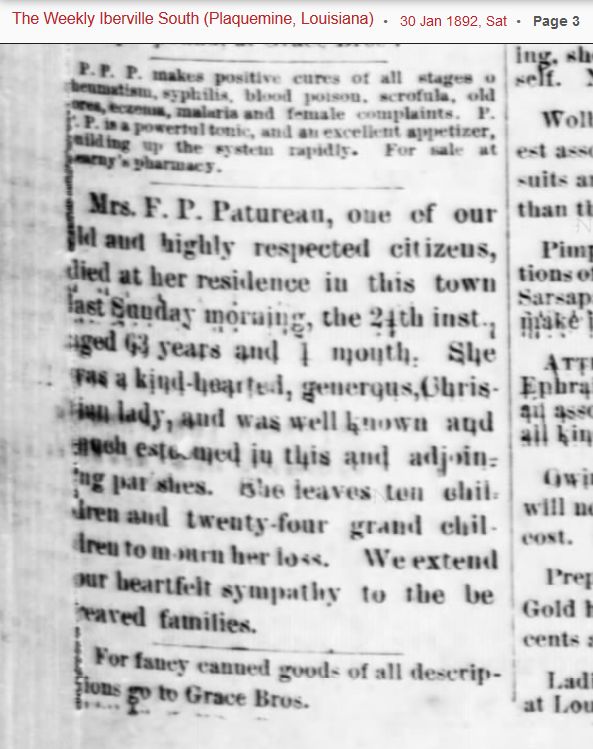
Death notice for Marie Emma Landry Patureau from 1892 in Plaquemine, Louisiana.  (Shared with me by my cousin Daphne AKA the Keeper of the Secret Collection)

I didn’t exactly remember which ancestors I had copies of death notices for.  So when I saw this one, I knew it was the topic for discussion today.  It fit all of the criteria for what I was looking for.  Then I had to decide on a name for the post.  Sometimes I just sit there for several minutes waiting for an interesting name to come to me.  I can’t start writing until I settle on a name for the post.  Mainly because I think the program won’t let me.  And actually I could be wrong about that.  Oh, well.  It is what it is.

My last name is Landry, but one of my posts is titled “I Am a Patureau.”  Now I’d like to remind all of my Patureau kin out there – and there are lots of you – you can also say “I Am a Landry” because our matriarch was a Landry.  Marie Emma Landry was born on November 10, 1829, in St. Gabriel, Louisiana.  She was the daughter of Elie Onezime Landry (1800-1880) and Jeanne Zerbine Dupuy (1807-1886).  Both of those are Cajun/Acadian surnames, but  Emma’s maternal grandmother was from a French line. 

So when Emma married French immigrant Ferdinand Pierre Patureau on February 10, 1847, she wasn’t the first one in her family to marry “outside the family.”  Isn’t that a weird term?  I found myself saying that about cousins in the Landry and Patureau family lines who didn’t marry their cousins.  It seems like that trend has mostly fallen by the wayside.

Anyway, Emma and Ferdinand were married and had a large family.  I spoke about that once before, so I won’t go through all of the names again.  She gave birth to over a dozen children, as did her son Max’s (my great grandfather) Landry wife Marie Therese.  It definitely was a trend in the Patureau family groups.  I know I’ve got over a thousand cousins that I’ve identified from that group.  That is a lot.

The Jan. 8, 1881, Iberville South has an article that mentions Widow F. Patureau.

Ferdinand died in 1877 after an accident that occurred in his sawmill.  According to a newspaper article in 1881, Emma was declared owner of half of the Iberville Saw Mill.  I suppose that was the name of the sawmill that Ferdinand owned.  I find the article confusing because it mentions Widow F. Patureau who I’m pretty sure is Emma Landry Patureau.  But it also mentions L. Patureau and I’m not sure if that’s supposed to be Emma or someone else – most likely a son – Leobon? 

Another article from 1884 thanks Mrs. Patureau for her tasty honey in a comb that came from her apiary in town.  I’m thinking it probably is Emma, though it could be her son Leobon’s wife.  In an earlier article they talk about Emma Patureau by name and talk about her recommending the use of the Howe sewing machine. 

Jan. 12, 1889 article from The Iberville South in Plaquemine, Louisiana.

It wasn’t all sweetness and light for Emma, though.  In the Jan. 12, 1889, article in The Iberville South, there was a report that there was an attempted burglary of her home.  Nothing was taken, so it was supposed that the person or persons were frightened off.  Evidently she was not harmed either, or that would have been noted.  I’m sure it was probably a bit of a scare for her.  Who would do that to our poor old widowed grandmother?  Wait!  She was actually younger than me when that happened to her!  When you’re young, and sometimes still, 60 years old sounds old.  When you make it to that age – if you make it to that age – it doesn’t seem that old.  In this situation, an attempted burglary can be off-putting to anyone at any age.

We all know from the beginning of this article that she didn’t live much longer.  She was only 62 years old when she died.  That seems really young now.  In the newspaper reporting on her death, it said that she was 63 years old and 1 month.  From my calculations, she was 62 years and 2 months.  But more importantly it talks about her being a well respected and loved citizen who will be missed. 

She died at her home at 3:30 in the morning on Sunday January 24, 1892.  To me that implies that someone was with her and knew she was dying.  How else would they know the time of her death?  I’d like to think that it meant she was surrounded by loving family members and/or friends when she died.  The death notice was posted later that day to inform those interested of the time of her funeral.  From the funeral, the procession was to move to St. John’s Church.

St. John’s Church is the Catholic Church in Plaquemine.  The Catholic cemetery is nearby.  I’m sure she was buried in that graveyard, yet there is no evidence of it now.  There is a large Patureau tomb (at least, there usually is – don’t ask) and her name is not on any of the plaques.  Her husband and many of her children have their names engraved on them.  For some reason her name is not.  That may be remedied soon.  She deserves some respect.

Myrtle the Teacher in 1949

Myrtle Sylvia Phenice Bucklin in 1949 at Hathaway High School in Hathaway, Louisiana.

Here is a photo of my maternal grandmother Myrtle Sylvia Phenice Bucklin.  The photo was taken in 1949 when Grandma was a schoolteacher at Hathaway High School during the 1949/1950 school year.  Of course she wasn’t a grandmother back then.  She was just a mom to her five children.  I think her oldest daughter Sylvia had graduated high school the previous school year and was just beginning college at Lafayette.  My mom Betty Lou was starting her junior year of high school.  She would graduate in 1951 and that was the first year that students graduated with 12 years of school instead of 11.

So does that mean that there wasn’t a graduating class of 1950?  I never really thought to ask about that before.  And how long did my mom’s class know that they were going to have to attend 12 years of school instead of 11 before they were able to graduate?  Did they have a freshman, sophomore, junior, and senior years before that?  Whatever it was, it was not the year my mom graduated, even though she was a year behind her sister Sylvia.  My mom would have to go through another school year before she was able to graduate.

By the time her younger sisters Alma and Loris graduated, they were probably used to the idea of graduating in 12 years of school.  Austin was the youngest child and the only boy.  He was around 7 years old at the time this photo was taken.  His only scholarly concern at that time might have been wondering if he was going to have his mother as his teacher for the third grade.  That was mainly what Myrtle taught.  She wanted to get those kids in their formative years and make sure that they learned how to spell correctly!

She started teaching around 1928 after getting her Teaching Certificate.  She stopped when she got married in 1930 to have children and raise a family.  She resumed teaching in 1945 and continued to 23 years or so.  My earliest memories of her were of her being a teacher.  I don’t remember ever going to her classroom like my older sister Karen did.  I might have, but we tend to forget things through the years.  Especially if we don’t have a photo to reinforce the memory.  So that’s why I’m sharing this photo and story today.  So we’ll all remember Mrs. Myrtle Bucklin, the famed 3rd grade teacher from Hathaway High School.

Landry Family in Lafayette, Louisiana

Four generations of Landry family that lived in Lafayette, Louisiana, circa 1930. Sitting in front is my great grandmother Marie Celeste Leveque Landry. Behind her from left to right is her son Louis Joseph Landry and her grandson Thornwell Fay Landry holding twin sons Thornwell Fay, Jr. and Louis.

When I was growing up, I always thought of the Landry family as being from Lake Charles, Louisiana.  That’s where my dad (Robert Joseph Landry, Jr. – Bob – Pluto) was born and where he grew up.  My parents (Bob and Betty Lou Bucklin Landry) settled in Jennings, Louisiana, and that’s where my siblings and I grew up.  Almost all of my Landry cousins lived in Lake Charles, so it made sense to me:  The Landry family was from Lake Charles – always and forever – amen. 

But that wasn’t really true then and it is even less so now.  What I was aware of when I was a kid were my own first cousins.  There were so many of us.  Then there were the Bouquets.  That was a family group from my dad’s first cousin.  They were a big family, too.  I didn’t really know how we were related, but I knew they were cousins.  Trying to explain it now still gets me confused.  There were so many cousin marriages in that part of the family.

When I started collecting photos and exploring family connections, I was surprised at how many cousins lived in Lafayette.  My Mee Maw (paternal grandmother Germaine Erie Patureau Landry) was born in Plaquemine and grew up there, but ended up in Lake Charles after she was married to her mom’s first cousin Robert Joseph Landry, Sr.  I knew she lived in Lafayette for a while, but didn’t know the details.  I found out that her dad (Vincent Maximilian Patureau) had moved to Lafayette in 1912 and started a veterinarian practice there.

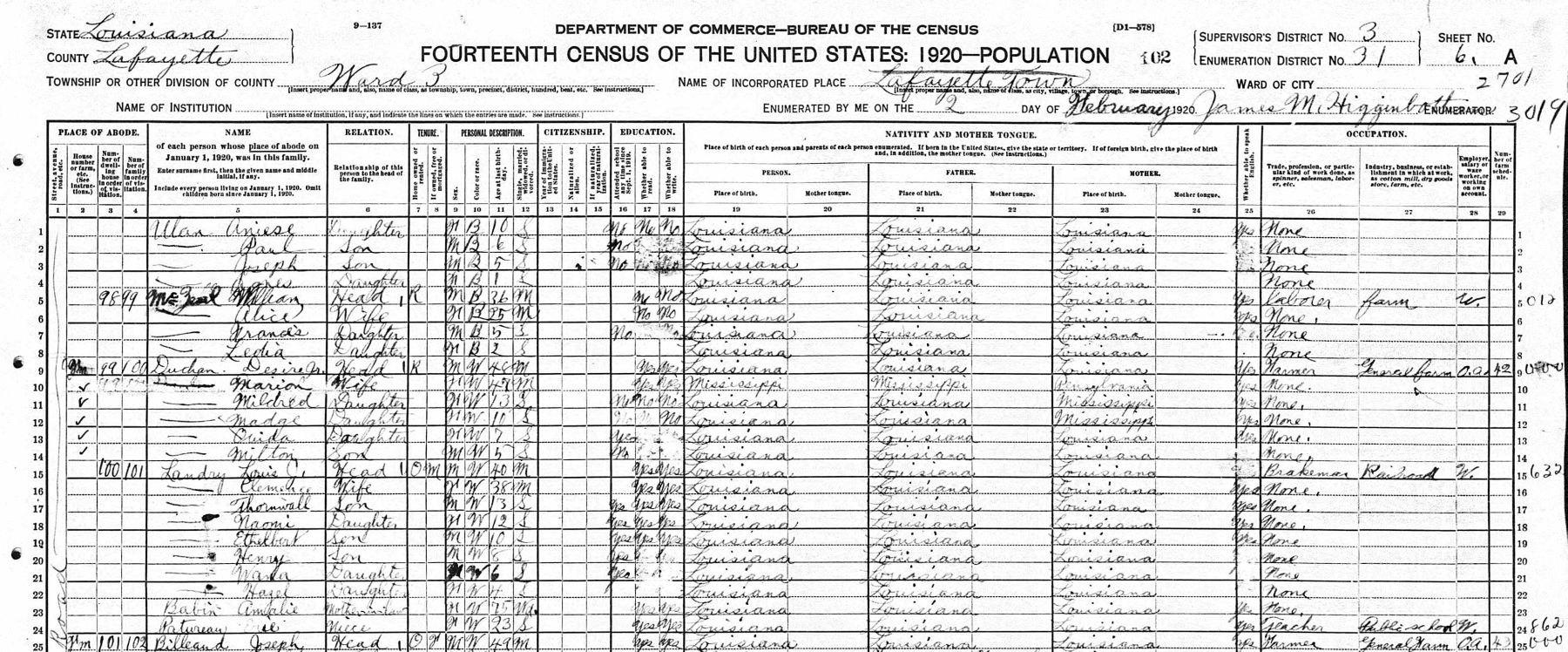
1920 Census in Lafayette showing Louis Joseph Landry’s household, which included his mother-in-law Amalie Babin (my great great grandmother Belite) and niece Erie Patureau (my Mee Maw).

He moved close to where his mother-in-law Mrs. P. M. Babin lived.  You remember her, right?  That was my great great grandmother Marie Amelie “Belite” Bujol Landry Babin.  She was my Mee Maw’s grandmother.  She had moved there a few years earlier with her second husband Magloire Babin (Her first husband was Trasimond Landry).  Mack Babin died in 1919 in Lafayette.  Belite must have decided to move in with other family members at that point, because in the 1920 Census she is in the household of her daughter Clemence Babin Landry.

The topic of this post came about from the first photo that I posted.  It is not a photo of my great great grandmother Belite, it is a photo of my great grandmother Marie Celeste Leveque Landry.  Sorry about the confusion.  They were first cousins by their Landry mothers.  I wish I had a photo of them together, but I don’t think I’ve ever seen one.  So when I was exploring the photo of Grandma Celeste with her Landry offspring, I remembered that she ended up living in Lafayette at some point as well.  I was assuming that I would find her in the household of Louis. 

I did find her in Lafayette in the 1930 Census, but she was in the household of her other son Sebastien Landry.  What was he doing there?  He was the Landry patriarch of the Bouquet family that I mentioned being in Lake Charles.  That just seems wrong, but then I discovered that he moved back to Lake Charles by 1935.  His mother died in 1934 and was buried in Lake Charles.  He probably moved back to be near his daughter and grandchildren.

Since he and his offspring lived in Lake Charles along with my dad and his siblings, those were the family members that we knew.  Louis Joseph and Clemence’s offspring did not live there, so the families lost touch.  It’s what happens when family moves around.  Maybe one day one of my sibling’s grandchildren will wonder,  “Didn’t Grandma (or Grandpa or whatever cool name they came up with) have a brother that did some family research?  I wonder if he ever found anything interesting?”

That grandchild will search for my name, find this story, and say, “Boy, that guy sure does ramble a lot!”

H. C. Sings a Jaunty Tune

Daisy Keys and Harry Clifton Phenice in 1950 at the time of their Golden Anniversary.

Toward the beginning of last year (Feb. 13, 2020), I wrote a post about my great grandfather Harry Clifton Phenice.  He was my mother’s maternal grandfather.  In that post I shared a recording of him playing the song “Soldier’s Joy” on his violin.  The recording was from June 12, 1943, in Hathaway, Louisiana, the hometown of my mom Betty Lou Bucklin Landry.  In the beginning of that recording, a family member gives the date and says that the Phenice family was getting together for the first time to make a phonographic record of their time together.

That tune on the fiddle wasn’t the only music made that day.  Not by far.  One of the songs on the recording really got  my attention.  It was a song that H. C. sang solo.  It was not the best recording, but I thought it was a fun little tune.  I listened to it over and over again to try to figure out the words to the song.  I tried to search for a few song lyrics, but I was never able to find a result.  Then last week I was thinking it was time to share that song with everyone.  So I listened to it again to see if I could determine what song it was.  So I did a search with the precise words that I could make out.  I did a search for “whene’er I meet upon the street” and I got a result.  That’s right.  I got one result.   And it was the song I was looking for.

It was on a website that had Old Time Song Lyrics on it.  I knew that I could now share the song with everyone.  It had a word or two different that I couldn’t make sense of.  Then I found another site that had the sheet music for the song.  That’s right!  The sheet music.  It was the correct lyrics of the song, but it doesn’t match the melody.  The song was by Fred Wilson and it was published in 1865.  That song was as old to my great grandfather as this recording is to us today. 

The name of the song is “The Gal With the Roguish Eye.”  No wonder I couldn’t tell what old H. C. was singing about in that tune!  It starts with

“Oh, I think it very pleasant to promenade the street

and gaze upon the fashion of each pretty girl I meet.

With little hats and bonnets and boots (cost nine or ten),

Which makes her altogether more expensive than the men.”

It’s kind of unusual lyrics for a song.  Most men don’t talk about the fashions of women and talk about their little hats and bonnets!  I’m not really sure what the line about boots costing nine or ten means.  It was over 150 years ago, so it could be referring to boots costing 10 dollars.  I suppose that would be considered expensive in those days.  And then it continues with

“Oh, dear oh, it makes me feel so shy

Whene’er I meet upon the street that gal with a roguish eye.

Oh, dear oh, it makes me feel so shy

Whene’er I meet upon the street that gal with a roguish eye!

I love the words to this song!  H. C. really sounds like a character and I’m sure he was giving a playful smile to his wife Daisy when he sang this song.  The definition for roguish in this context is playfully mischievous in a flirty way.  H.C. was 68 years old when this song was recorded.  My mom would have been 10 years old.  She always said he was a pleasant fellow.  I think it comes through in the song.  What do you think?  Give it a listen.

It’s such a fun song.  I’ve been singing it almost every day over the last week or so.  So I thought I’d sing along with him.  I recorded myself singing the second verse of the song.  It goes like this:

“Among the smiling faces, there’s one above the rest

who dresses with the greatest care and of the very best.

She don’t appear to mind me whene’er she’s passing by

But drops her veil clear o’er her face to hide her roguish eye.

If I knew how to do an edit to make it sound like an old recording, I’d do it.  That would be just the opposite of what I do with the photos all of the time.  The verse sounds okay, but my favorite part is when I’m singing together with my great grandfather!  How fun is that?!  If we’re fortunate, one day my brothers and I will meet up with our great grandfather in a Place Out of Time and sing that old tune together.  In the meantime, you can enjoy this rendition.


Her Name Was Marie Magdeleine Granger

I’ve decided to write about Marie Magdeleine Granger again.  I first wrote about her in my “From Acadian to Cajun” series and she was just one person in family group that I was talking about.  But her story really touched me.  She endured so much tragedy, yet her story was relegated to one paragraph in a longer story about a bigger event.  So when I discovered a couple of other facts about her life at the time, I decided to write again.  I could have just written a short little Follow-Up to my blog, but decided to write a separate post just for her.  I think she deserves it.   Plus the 262nd anniversary of one of those tragedies occurred this week.

Birth record for Marie Magdeleine and Anne Granger in 1731.

Marie Magdeleine Granger was born on May 2, 1731, in Grand Pre, Acadie.  She was baptized the same day.  She had a twin sister named Anne.  They were the 5th and 6th children of Joseph Granger and Anne Richard.  Anne and Marie Magdeleine were right in the middle of the family.  Besides having four older siblings, they had four younger ones as well.  All of them were born in Acadie before the Grand Derangement.  That was the period from 1755 to 1763 when the English were deporting the Acadians and sending them to various ports.

We know the date of Marie Magdeleine’s birth because some records survived.  Besides deporting the Acadians, burning their homes, and slaughtering their livestock, the English also destroyed a lot of the records of the Acadian people.  But somehow some of the Acadians took records from their church with them and hid them from the English.  They made it through twelve years of Exile and ended up in Louisiana.  The St. Gabriel Catholic Church preserved those records, and they are available today.  The marriage entry for Joseph and Anne survived, as did the entries for all ten of their children.

Marie Magdeleine was one of the last generation to spend their whole childhood growing up in Acadie before the Great Upheaval. It wasn’t a completely stress-free time.  They were under English rule and there were many conflicts between England and France. When she was 19 years old, she married Alain Bujol.  In July 1752 they relocated to Ile St. Jean, an island northeast of Acadie which was still under French rule at the time.  The Census of August 1752 in Riviere-du-Moulin-a-Scie on Ile St. Jean shows Marie Magdeleine with husband Alain Bujol (Allain Bugeauld, ploughman) and a nine-month-old son (Simon, born about November 1751).  It reports that they had been on the island for only one month.  Alain Bujol’s parents lived close by with nine of their children.  They had been there for a year.  Marie Magdeleine and Alain must have relocated to Ile St. Jean to be close to them.

While Marie Magdeleine and Alain were trying to find a safe place to raise a family free from conflict, we know that that was not to be.  They had a house and a farm and a little son, but trouble was brewing.  When the deportations began in 1755 in Acadie, those living in Ile St Jean had a period of respite.  During that time, Marie Magdeleine gave birth to her second child – a daughter named Marie Louise born in 1756.  They even had two years at their farm in Ile St. Jean after Marie Louise was born.

And then Tragedy began. For Marie Magdeleine, her year of losses started off with less personal ones such as their home and livestock and progressed to much more personal ones.   It began on July 26, 1758, when Fort Louisbourg fell to the English.  On Aug. 17, 1758, Ile St. Jean capitulated to the English as well.  The English started rounding up the Acadians for deportation.  So two weeks after Ile St. Jean fell, the Acadians were removed from their homes and sent to Fort Louisbourg where they arrived on September 4.  So now Marie Mageleine, Alain, Simon, and Marie Louise were living the life of prisoners.  Other Acadians who had escaped the round up were hunted down “to prevent the vermin from escaping.”

And now it gets more personal.  During their three months as prisoners at Fort Louisbourg, many Acadians were being carried off to England and France on various ships.  Marie Magdeleine’s family was on one of five ships that departed Nov. 25, 1758 and arrived in St. Malo on Jan. 23, 1759.  They were not on the Mary, the Duke William, or the Violet.  The Mary ran into foul conditions and only half of her passengers survived.  The Duke William and the Violet both sank with only four survivors from the Duke William.  It was a terrible time of loss for the Acadians, including Alain Bujol.  Both of his parents and possibly nine of his siblings died when the Duke William went down.  He had another sister who was married that made it onto a ship that made it to France, but she did not survive the journey.  Marie Magdeleine suffered her first major loss on the passage to France.  Her 2-year-old daughter Marie Louise did not survive the journey. 

Once they arrived in St. Malo, France, the Acadians were moved to different locations to settle.  Marie Magdeleine ended up in St. Servan with her husband and son.  Less than a month after arriving in France, 31-year-old Alain Bujol died.  He died on Feb. 19, 1759.  His widow and 8-year-old son Simon buried him the following day.  What a difficult time for Marie Magdeleine.  It was one tragedy after the other.  And it didn’t stop there.  Less than a month after her husband died, Marie Magdeleine was burying Simon as well.  He died and was buried on March 17, 1759.

“Wait!” you’re saying, “but you said she had a year of tragedies and it’s only March.  She still has four months left of her year of losses.  What more could she lose?”

Correct!  You’ve been paying attention.  I mentioned in a follow-up story that Marie Magdeleine found out at some point during her first year in France that her father had died.  That was another loss.  But there was something more I discovered.  I found out that when she and her family were being deported to France, Marie Magdeleine was in the early stages of pregnancy!  I wonder at what point did she become aware of her pregnancy?  Around the time of being loaded into a cramped vessel to take her away from her home?  When Marie Louise died?  When Alain died?  When Simon died?  What a storm of emotions she must have been going through.

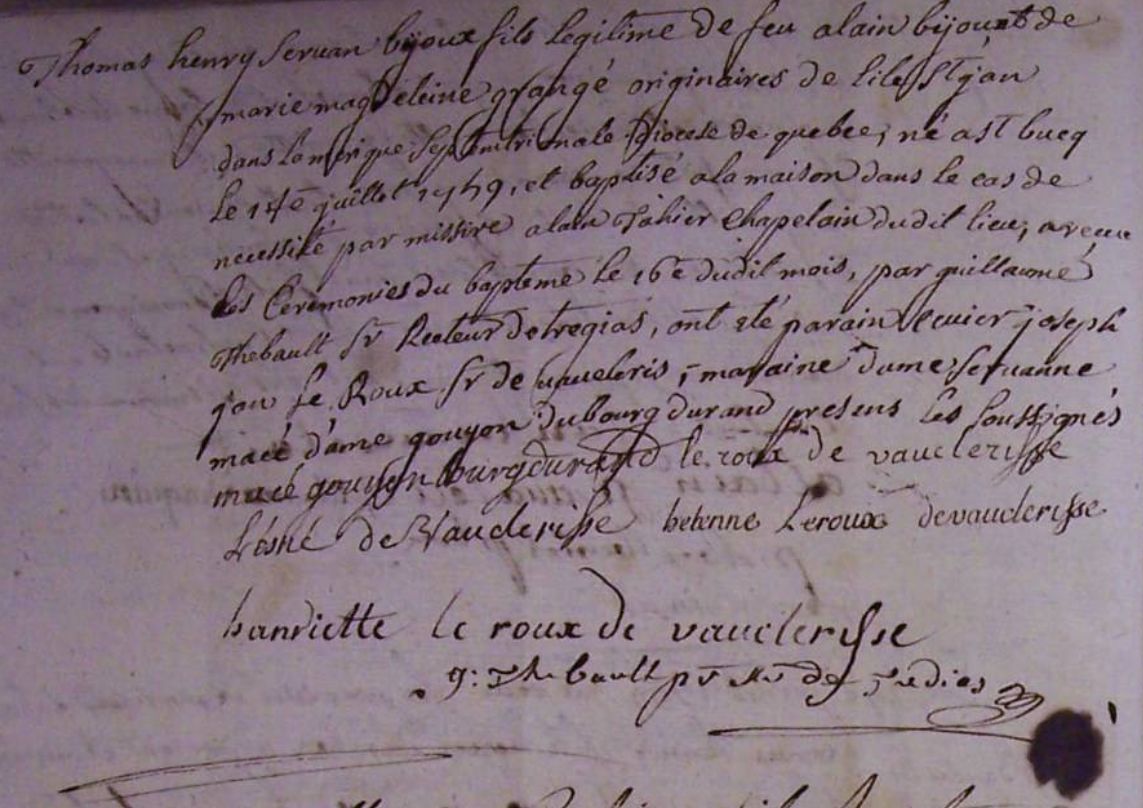
Copy of original birth record of Thomas Henry Servan Bijou in Pleurtuit, France.

Copy of original death record of T. H. S. B. from Pleurtuit, France

And just like you, she might have been holding onto hope that things would get better for her.  But not just yet.  She may have found a glimpse of joy at the birth of her son Thomas Henri Servan Bujol on July 14, 1759.  But she only had him a week.  He died on July 21, 1759.  I wonder if you could see any life in her eyes that day she buried her little newborn son?

Copy of original marriage record for the wedding of Marie Magdeleine Granger and Joseph Bourg.

I don’t know how some people find the strength to carry on from some tragedies.  But she did, thankfully, or I wouldn’t be here.  In June of 1760 she married Pierre Bourg in Pleurtuit, Ile-et-Vilaine, France.  They were 2nd cousins – their maternal grandmothers were Landry sisters.  His first wife had died on the deportation voyage to France.  I descend from the marriage of Marie Magdeleine and Pierre Bourg.  She would give birth to all of their children in France, but later they made their way to Louisiana in 1785.  She died in Louisiana.  I don’t know if there is a headstone anywhere.  There should be.  I want more people to know the name Marie Magdeleine Granger.

Grandpa Bucklin Played Basketball

Basketball players in Elton, Louisiana, in 1925 include my grandfather Fred Bucklin and his twin brother Clarence.

I don’t know what to write about these photos.  I just like them a lot.  I didn’t realize that I was repeating a recent theme until I was well into editing these photos.  It was just this month that I wrote about my Landry grandfather playing a sport and now I’m talking about my Bucklin grandfather doing the same thing.  Well, not quite the same.  Pee Paw Landry was a baseball player and Grandpa Bucklin played basketball.  While Pee Paw was a semi-professional baseball player, I don’t know how serious of a player Grandpa was.  I just have a few photos of him playing basketball and don’t remember any stories about his early years of playing the game.

But who cares how serious of a player he was?  Look at this photo!  It’s an action shot from almost 100 years ago.  That’s pretty cool.  I may have edited this photo a little, but I promise you that I did not add the basketball to the photo.  That would have been just wrong!  It doesn’t even look like the ball is going to make the basket, but that’s not important either.  It’s an action photo of my grandfather as a young man playing basketball with his brother and their friends.  I think it might even be my grandfather who is shooting the ball.  It’s a photo taken by his sister Edna (I think), so she would be focusing on getting photos of her brothers in action.

Player 1, Player 2, Fred Bucklin, Burr Dell Scott, Clarence Bucklin, Player 6 in Elton, Louisiana, in 1925. (Enhanced photo)

My grandfather’s name was Fred D. Bucklin.  He and his identical twin brother Clarence were born on October 2, 1907, in Roanoke, Louisiana.  The family lived in Prairie Grove, Arkansas, a few years and then moved back to Jefferson Davis Parish in Louisiana.  They settled in the Hathaway area.  Fred and Clarence went to school in Elton where they graduated from high school in 1926.

I had two different dates on these photos, though it looks like they could have been taken the same day.  I’m thinking that the 1925 date is probably correct, because it looks like it could be a school basketball team.  Yet schools in Louisiana weren’t integrated until much later, so I question that assumption.  It could be a few years later at some other city team or such.

I need to mention some other family connections in this photo.  The guy standing between the twins is Burr Dell Scott.  Clarence would marry Myrtle Moon in 1928.  Fred would marry his own Myrtle – Myrtle Phenice – in 1930.  She was my grandmother.  Myrtle Moon Bucklin died in 1937.  She and Clarence did not have any children.  Burr Dell married Sadie Manuel around 1942.  They had three children together and then Burr Dell died in 1958.  Then Clarence and Sadie got married around 1960, and they had Carla a few years later.  (Thanks, Carla, for providing these great photos for me to use!)  The interesting thing about that is that Burr Dell was a third cousin of my grandmother Myrtle through her English Horsnell line.

So there you have it.  If you didn’t enjoy the family history tidbit, I hope you enjoyed the photos.  If you didn’t like the photos, maybe I can help out a bit by showing you a colorized version of it.  Here you go:

Colorized version of the old basketball photo.

There.  Everyone should be satisfied now.

My Blue-Eyed Sisters

Jodie and Karen Landry at the Texas Renaissance Festival in Magnolia, Texas, on October 19, 1980.

I thought I would write a post about my two older sisters.  Jodie was the oldest of us six siblings and she died in 1989 at the age of 36.  Karen was the third and she died in April of 2020 at the age of 63.  My brother-in-law Brian (married Karen) shared a photo with us remaining siblings.  It was of Jodie and Karen from back in 1980 when he met Jodie.    It reminded me of some of the photos that I had taken back then and haven’t looked at lately. 

So of course I got my photo album out and decided to scan and work on the photos.  The photos were a little dull and a bit blurry, so I never was very pleased with them.  But 40 years later I can make some changes to those photos that make them much more pleasing.  At least I think so.

The event was the Texas Renaissance Festival and Jodie was selling the pottery that she made.  She had a booth set up and she had her flute with her so she could play a bit while waiting (and to get people’s attention).  So Karen and Brian went to Texas to check it all out.  It was Brian’s first time to meet Jodie and he remembers her playing the flute when they walked up to her booth. I went on the weekend of October 19th with Karen, my younger sister Jamie, and her now husband Allen after getting a glowing report from Karen and Brian.

Leaf vase by Jodie circa 1980

Jodie sold a lot of pottery at that festival.  She had mugs,  plates, bowls, vases, canteens, and some miniature pieces.  I bought this vase with carvings of leaves on it at that festival.  It’s my favorite piece that I have of hers.  I have a few other pieces, but I never did get any of her miniature pieces.  I wish I had a few more of her work, particularly one of those miniature ones.  She had tiny jars with lids that fit on them.  They were so intricate.

One more thing before I close.  I have to say more about those blue eyes.  Karen was sometimes insecure about her appearance.  She was also fond of the color blue.  So she was starting to get a little bit jealous because she thought that Jodie had bluer eyes than she did.  Jodie disagreed with her the first time she said it.  When Karen said it again, Jodie decided to put the statement to the test.  She brought Karen to a mirror where they could sit and compare each other’s eyes to see who had the bluer eyes.  After both of them looked back and forth from their own eyes to the other’s for a few moments, they had to laugh.  There was no distinguishable difference!

I miss those blue eyes.

Another Baseball Photo of Pee Paw

This week I was considering writing about secrets, but I decided that could wait.  But once a secret is told, it can’t be untold, now could it?  And some secrets need to stay secret.  Instead of writing about that, I found this photo that invited me to talk about it.  It might have come from the Secret Collection, but I’m not sure.  I know that it came from one of my cousins and I need to get a better scan or photo of it.  I like the old timey look of the photo and it’s another photo of my grandfather during his baseball days.

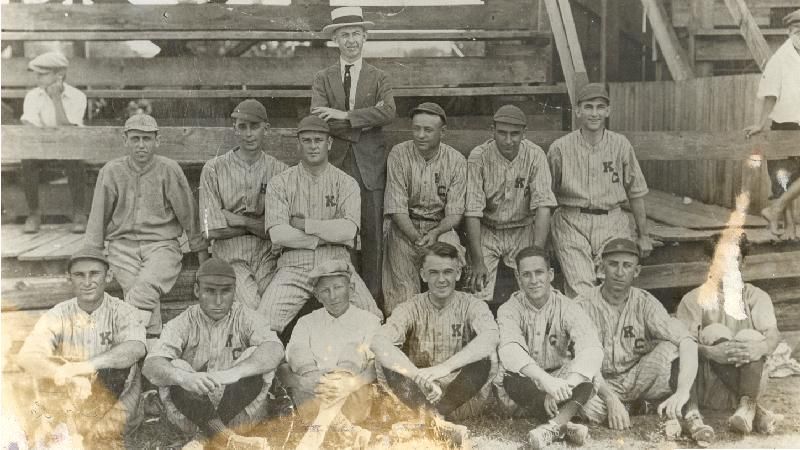
Circa 1920 – My grandfather Robert Joseph Landry, Sr. is the third from the left in the back with his arms folded. I don’t know the team name or the location. He was a semi-pro baseball player.

I was thinking that I didn’t want to overdo it with photos of my grandfather with a baseball.  But when I looked for others that I had shared, I realized that it’s been almost five years since I posted one.  I am definitely not overdoing it!  I posted one of him with a group of players from Beaumont, Texas, and another one of him with fellow soldiers during the Great War (WWI).

I really like those other two photos, but they were more posed or staged.  This one looks a bit more casual.  Just a bunch of guys gathered around the dugout after a game for a quick photo.  There are even a few photo bombers in the background.   It was taken about a hundred years ago, most likely somewhere in Southern Louisiana.  He played semi-pro baseball during that time.

Enhanced view of Pee Paw from the previous photo.

I don’t have many details about exactly when he played or where he would go to play, but thankfully we do have a few photos from back during that time.  I do know that Robert Joseph Landry, Jr. was born in Westlake, Louisiana, on Jan. 9, 1893.  He spent his childhood in Westlake and I’m sure lots of that time was spent playing baseball.  The sport was growing in popularity and by the 1920s it was the national pastime. 

In order that someone becomes a semi-professional in a sport, they had to be really dedicated to it.  He must have loved it and spent a lot of time playing in order to improve his skills.  He was a pitcher and he must have been pretty good at it.  In those days Americans were starting to pay more money to be entertained by athletic contests.  It was the heyday for American baseball and my Pee Paw was in the thick of it.

I have a copy of an interview of him by Bob House of the House of Sports.  I think it was in a newspaper.  It quotes ‘Pappy’ Landry as saying, “Back in those days the boys didn’t mind laying the dough on the line to get a first class pitcher for a Sunday contest and I picked up quite a few dollars until my arm went dead.” He took part in the ‘Sawdust Baseball Circuit’ that thrived during the saw mill era of Southwest Louisiana.  Bob House declared that Pee Paw was “quite a slabster” in his day, even after his arm ‘went dead.’  He played for teams like Oakdale or Lake Charles, anyone willing to ‘lay the dough on the line’ to get him to pitch for them.  I love the old phrases they used! 

But his participation was interrupted by World War I.  That didn’t stop him from playing baseball, though.  He was on a team with his fellow soldiers.  He wasn’t a soldier for very long and didn’t enter any conflicts.  He was still in training when the war ended.  He also suffered from some hearing damage as a result of the military.  He had one last thriller of a game before he decided to marry Erie Patureau in November of 1921.

The Game to End All Games was back in 1920 when the Marksville Independents went to Lake Charles to tackle the potent Lake Charles Athletics.  Pappy Landry was working as a conductor on the street car for Gulf States at the time.  He was minding his business one day when the manager from the Marksville team hopped on his trolley and proceeded to talk him into pitching for his team.  The Marksville team’s pitcher had gotten sick and they were in a pinch.  He had inquired about a local pitcher and was told that Pappy Landry was the man he sought.  And sought him he did.  After a bit of discussion, the terms were agreed upon:  if the team won, Pappy would get 50 bucks; if they lost, he got 25.

The big day was on a Sunday evening.  Pappy had to work that day, but he finished up a 2 p.m.  He decided to stop for a bowl of chili to fuel him for the big game.  He walked into the park with glove and shoes in hand.  The Marksville team manager gave him a uniform for his team that Pappy changed into.  When he came out onto the field, the local fans were not happy to see their Pappy wearing the opposing team’s uniform.  Yet when the game progressed and Pappy was putting his ‘dead arm’ to good use and striking out the Lake Charles team, they started cheering him on!  He ended up winning the big bucks, which was a fitting ending to his days on the Sawdust Circuit.

1 24 25 26 27 28 58