Landrys in Louisiana

Before there were digital cameras or computers; before there were footprints on the moon; before there was FM radio, photography, or Morse Code; before there were cars, dandy horses, or hot air balloons; and before there was a Declaration of Independence; there were Landrys in Louisiana. Or was it Louisianne or Luiciana? Whatever you want to call it and whoever it was owned by, a Landry was there two hundred and fifty years ago.

In St. Martinville, a wall was erected to honor those Acadian Exiles who made it to Louisiana. You can see our ancestors Augustin Landry, Marie Madeleine Babin, and their son Joseph Ignace on the list.

After spending about 100 years in Acadie, which is the area of modern day Nova Scotia, our Landry family was part of the Grand Derangement that was started in 1755.  Thousands of Acadians were driven from their lands by the English.  Even though the Acadians tried to maintain a neutrality in their community in North America, they still fell victim to the ravages of wars between England and France in the 1700s.  After their homes were burned and they were separated from their families, they were boarded onto ships and carried to places where they were mostly not welcome.  Some of them didn’t survive the passage.

Some of those survivors were our Landry family, who at the time consisted of Augustin Landry (b. 1719) and his wife Marie Magdelena Babin (b. 1725).  With them were a daughter named Marie and a son named Joseph Marie from his first marriage, a son named Joseph Ignatius (b. 1748-our ancestor), daughter Marguerite, and a son Mathurin.  There was another child, too. He was either Louis (according to Daddy), or she was Madeleine (according to the Wall).  (I have found further documents that show that there definitely was another daughter named Madeleine.  No Louis, so my dad was incorrect this time.  It happens.)  (2021- Oops.  More investigation shows that there was also a Louis Landry born in 1769.  So there was a Madeleine and a Louis.  Daddy was correct after all!) The family spent some years in Maryland where one or two of the youngest children may have been born.

There were other family members that were exiled in Maryland as well.  I don’t know all of the details, but some of Augustin’s close family were there.  He actually had two sisters (Bridgitte and Anne Marie) that died in Maryland during their time of exile there.  They did not have many fond memories of their stay in Maryland.

Then there was a spark of hope in 1767.  The Spanish crown was in possession of land along the Mississippi River and they were looking for people who were willing to populate the area.  Somehow the Landry family heard this news and it sounded promising.  So they loaded up all of their worldly possessions – two trunks is what they were known to have – and went to Louisiana.  And sure enough, they were given a land grant encompassing 8 arpents frontage along the Mississippi River at St. Gabriel (about 6 miles from where I work).

And now we get to the whole reason I am telling this story!  I found a document the other day that I was very excited to find.  I had read about it on someone’s information about Augustin, but had not seen it.  After Augustin had been in Louisiana a couple of years, the Spanish king must have gotten a little worried about the people he had given land to.  So once they had grown accustomed to having the land and putting much labor into developing it, they were required to swear their allegiance to Spain.  After decades of arguing with the English about oaths of fidelity and trying to maintain neutrality, the only thing it got them was a harsh eviction notice and a dozen years of being nomads.  They were probably read to just sign on the dotted line.

August Landry made his mark to signify his unconditional oath of allegiance to Spain in 1769.

In this case, it was more of an “X marks the spot.”  Obviously Augustin could not read or write.  At least that’s what I infer from someone who cannot write his own name.  Wouldn’t that be the first thing you’d learn to write? Not that I’m implying that there was something wrong with him.  We are all a product of our time and our experience.

And if he couldn’t read or write, it amazes me how people learned the news of their relatives in different places.  There was no TV or telephone, but the Acadians did hear news of their families in Louisiana one way or another.  I suppose those that could write wrote to those that could read.  The news spread, and many more of them came here to start anew.  And the Landrys were among them.

When the cotton gin was invented and made its way to Louisiana, a Landry was there to use it.  When the telegraph came around, I’m sure some of those Landrys could read and write and make use of it.  The same could be said for many more innovations through the years.

In fact one Landry in Louisiana is typing words on a computer this instant and a short time after that quite a few other Landrys and their kin all over the world will have access to those words.  Quite a bit of a difference from the ancestor they will be reading about.

Have read about.


For more information about my Landry family’s Exile experience, check out this post:

From Acadian to Cajun: Part 1 – Landry/Babin

Grandpa Bucklin’s Grandma Sue

George and Susan Hine circa 1890

This post is about my maternal grandfather’s Hine grandparents.  My mom was Betty Lou Bucklin Landry and her father was Fred Bucklin.  He had his maternal grandmother for quite a while, because she died shortly before my mom was born in 1933.  She died on March 29th and mom was born May 20th when grandpa was only 25 years old.  Grandpa’s mother was Addie Hine Bucklin, who was the daughter of George Hine and Susan G. Stanbrough Hine.

This photo is of George and Susan in around 1890.  I’m not really sure of the date, but comparing it to the other photos of this couple, that is the best estimation that I have.  The other photos of them are with children and grandchildren.  This is the only one that I’ve seen of just the two of them.

Transcribed letter of Sue Hine from 1916

The reason I chose this photo and called the post what I did was because of two letters I found recently on Ancestry.  These two letters were written by Susan Stanbrough Hine.  The first one was written in 1916.  It was written to her brother Joseph B. Stanbrough.  It must have been included as a short note with a letter addressed to his granddaughter Eula Stanbro (daughter of Orville C. Stanbrough).  It was written shortly after the death of their brother Nelson, who was the oldest of the eleven siblings in the family.  (There was an older half brother named Albert Stanbrough who died in 1854 and another brother Lucius that died as an infant in 1855.)  Albert was born in 1839, Nelson in 1844, Joseph B. in 1845, and Susan in 1851.

The second letter was written in 1923 after the death of another brother Jim.  He was born the year before Susan and moved to Louisiana with Susan and her family.  In the first letter she mentions him and it seems like he lives with the family.  This letter was written to Eula’s younger sister Nola Stanbro.

Transcribed letter of Sue Hine from 1923

I don’t know the person who posted the letters on Ancestry, and the only thing that was posted were transcripts of the letters.  I sent a request to see the original letters, because I’d like to see the handwriting of my great great grandmother.  The letters seem legitimate, because they talk about the Hine and Bucklin families with details that only family would have known about.  My favorite part of the letters is the way she signed them.  In the first one (directed to her brother), she signs off as Sister Sue.  I always thought of her as Susan because that’s her given name and she always looks a bit stern in the photos.  I wondered if that’s what her family called her, or was it just this one brother.  When I saw the second letter I found my answer.  She signed off on the second letter as Aunt Sue.

So now and forevermore she will be known to me as Grandma Sue.  I like knowing the name that people went by when they were alive.  It’s a little more personal.  It would also be a bit more personal if I had a scan of the actual letters that were written.  But for now all we have are the transcripts, which are great in themselves.  One day I hope that will change and I can share scans of the letters with everyone.

Mom and siblings’ family tree with Stanbrough line highlighted. On the right is a list of the family of Grandma Sue.

Teacher! Teacher! Miss Patureau! Miss Patureau!

Miss Patureau’s class from 1920 at Southside Elementary in Lafayette, Louisiana

A few weeks weeks ago I posted a photo of my maternal grandmother with a class photo from 1945.  This week I’m going back further to around 1920 to my paternal grandmother.  We all know her as Mee Maw, but back then she was just young Erie Patureau from Plaquemine.  But to her students, I’m sure she was known as Miss Patureau.

Erie was born Germaine Erie Patureau in 1895 in Crescent, Louisiana, which is in the Plaquemine area along the Bayou Plaquemine.  Her mother died when Erie was just 14 years old.  She finished high school some time around 1912 and then went to Lafayette to study at Southwest Louisiana Institute, which is the same place that my other grandmother received her education.

She graduated from SLI in 1915 and I assume she studied education, because she began teaching after that.  She wasn’t the only one that was a teacher, though.  Like I said, it runs in the family.  Some of her sisters were teachers in Lafayette as well.

Another Miss Patureau teaching in Lafayette in the 1920s. This time it is Zita Patureau.

This is a photo of another Miss Patureau that was teaching at about the same time.  As you can see, the photo was taken in 1922 at the Lafayette School.  I got this photo from a cousin a while back and she said that it was Mee Maw.  My dad agreed that it was his mom Erie.  But someone else told me different.  Sis and Syl (my dad’s first cousins) assure me that it was their mom Zita in this photo.  After seeing many other photos of Erie and Zita from this time, I have to agree with them.  It’s still a very nice photo to have.

1787 marriage record of Leobon Patureau and Jeanne Lanson. Leobon is identified as a schoolmaster.

While we are talking about Patureau kin in education, I thought I would mention the earliest record I have found in this regard.  I know there have been many educators in the Patureau family in Southern Louisiana in the past 100 years (some were the students’ favorites, others not so much), but I’m talking about those records I found a few weeks ago that are from France.  In the marriage record of 1787, Leobon Patureau is identified as a maître d’école.  In English this translates to schoolmaster.  He was only 20 years old, so I would think that would mean he was a teacher.  About the same age that Erie was when she was a teacher some 133 years later.

I’m sure there must have been others in between.  The abundance of them now makes it seem very likely.

And I’m sure there will be more.


Back to Beginnings

With the anniversary of my dad’s death yesterday and the anniversary of my parents’ joint funeral on the 28th, my mind has still been preoccupied with memories of their last days.  I wrote such a sad post last week, that I fantasized about printing it up, ripping it to shreds, and then burning it.  It will be a while before I want to read it again.  So this week I decided to do something a little lighter. (That should be easy enough to accomplish!)

The subjects of this post will still be my mom and dad.  But instead of writing any more about their endings, I thought I would write about their beginnings.  Not in any detail, I just want to post a few early photos of them that capture a bit of their personality.  The two photos that I picked also happen to be the childhood photos that were included in the slideshow of their lives that was played at their wake and visitation.

Betty Lou Bucklin circa 1939

The first one is this one of my mom.  How can you not smile when you see this photo?  I think it perfectly captures her playfulness that she allowed those close to her to see.  This is young Betty Lou Bucklin when she was around 6 years old or so.  She grew up in Hathaway, Louisiana, during the Great Depression and this left her being satisfied with whatever she had.  She didn’t desire anything grand or fancy.

She was the second of four daughters and they had a younger brother as well.  It was a simple life in the country.  Her grandparents had all come from different parts of the country (and one was from England) to homestead the prairie land in that area, so they didn’t really have much either.  But they had family and they enjoyed getting together and celebrating with music and festivities.

My mom had this photo on her dresser during her last years.  I don’t know of any story associated with it, but it must have been a photo that brought her fond memories of her childhood.  That’s one of the main reasons I like it so much, but it is a cute photo in it’s own right.

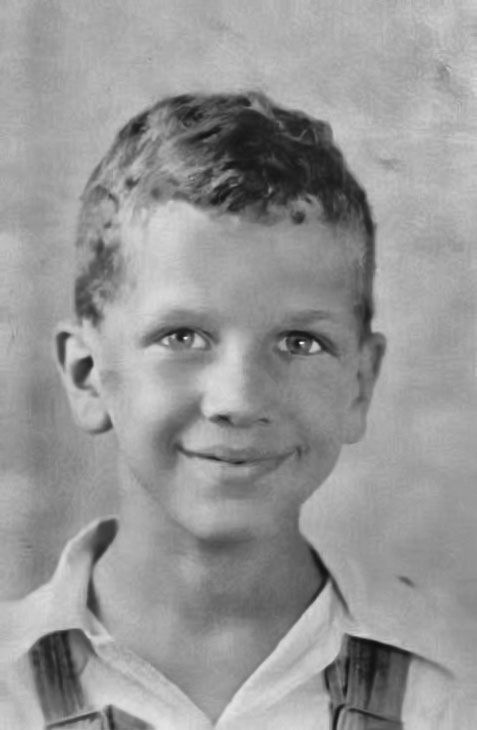
Bobby Landry around 1936

This next photo is one of my dad when he was probably a little bit older.  This is Robert Joseph Landry, Jr. when he was maybe 7 years old or so.  From what I can gather he was mostly called Bobbie at this point.  It’s what his siblings and cousins always called him.  He grew up in Lake Charles, Louisiana, during the Great Depression, but his family was larger with eight children.  He was one of four boys and four girls.

The main thing that strikes me about this photo is the brightness of his eyes.  Too bad it’s not a color photo, because he had pretty blue eyes.  Besides looking a bit inquisitive and intelligent, it also looks like he has a secret.  Usually that secret would be the punch line of his most recently discovered joke.  He always liked a good joke.  And of course they were not suggestive or dirty jokes.  Just something that would make him laugh, and he’d share them with others in hopes that they would enjoy them too.

So there you go.  My recollections of my parents this week.  Something to make you smile.  Though I have to admit that it brought a tear to my eyes writing this, because I do miss her impish smile and his hearty laugh.  Bittersweet is the appropriate word.

The Longest Hallway

“How am I going to do this?” I wondered as I walked down the longest hall I had ever walked, “What am I going to say?”  Those were the thoughts going through my mind last year as I was wondering how to break the news to my dad that his wife of 64 years had passed away.  Those same thoughts crossed my mind the past few days when I was thinking about writing this post.

My mom died on January 19, 2017, at 10:27 am at Lake Charles Memorial Hospital in the presence of my sister Karen and my brother-in-law Brian.  She was 83 years old and had been suffering from Alzheimer’s for a few years, but she died from a stroke.  It has almost been a year now.  Sometimes it seems like it just happened.  Other times it doesn’t, because she had been disappearing for a few years before her death.

One of the last outings I had with my parents was a visit to Hathaway on May 23, 2015. It was just a few months before they moved into assisted living.

We moved my parents into assisted living in August of 2015.  They had been barely holding their own living in the family home in Jennings.  They didn’t want to leave, but things were getting unmanageable.  Broken bones, failing memory, and limited movement continued to worsen.  But when Mom started taking medicine at any time because she had forgotten that she had already taken the daily dosage, Daddy knew that it was getting to be more than he could manage.  He was losing sensations in his hands and feet, so he was starting to need assistance as well.  They were in their 80s after all.

So they moved into Brookdale in Lake Charles in a nice little apartment.  Karen and Brian brought them to church with them on Sundays and afterward they would all have lunch at their home.  My dad can be a particular eater and is not reluctant to let you know how things could be better.   As Mom would say, Karen and Brian earned a lot of “brownie points” with all the help they provided Mom and Dad.

The beginning of the end was in October of 2016.  Mama fell and broke her hip (she had broken the other one a few years before) and shoulder somehow and she had to be taken to the hospital.  My brother Al flew down to help out.  When he and Daddy were getting ready to go to the hospital, Daddy fell.  It wasn’t so much that he broke anything, it was that he didn’t have the strength to keep from falling.

So when Mom was having surgery to repair her hip and shoulder, Dad was being admitted to see what was going on with his health.  We were all a bit baffled about what was going on.  He was diagnosed with congestive heart failure and cirrhosis of the liver.  Cirrhosis of the liver?  He never drank at all his whole life!  We were doubtful of this diagnosis at first, but his condition never really improved much.  He slept a lot and there was minimal interaction with us when we visited.

He was getting much worse in January and on the 18th I got a call from Karen.  She said that Hospice was telling her that Daddy would probably be dying sometime soon.  A sobering call, to say the least.  We all could see it happening.  The grandkids had all come to say their goodbyes and reminisce about times with Grammy and Pappy.  So the call was not a complete shock.

The more shocking call was the one I got later that night.  Actually it was at 2 o’clock on the morning of the 19th.  Mama had fallen and hit her head and the doctors said it could be a “terminal event.”  It seemed like everything that was happening with them could be considered terminal events.  She had fallen before, and when you went to see her she would smile and say, “Hey!”  with a smile as if nothing had happened.  So I went back to sleep.

The news the next morning was that there was no improvement.  It looked like she had had a stroke and fallen as a result.  I decided to go to Lake Charles and thought about letting Karen know I was coming, but to make sure she didn’t let mom “wait” for me.  Not that she would or could, but you hear about people doing this.  I wouldn’t want her to suffer any longer.  She had said she was ready to go.  It was a moot point, because I got notification that she had passed away.  So Chuck and I went to Lake Charles.  Thankfully, Chuck drove.

I was assuming that the hospital called the funeral home and that they would have removed ‘the body’ before we got there.  I talked to Brian and he informed me that the hospital had not called the funeral home.  He asked if I wanted them to wait until I had a chance to visit her.  Of course I wanted them to wait.  I shouldn’t say ‘of course,’ because I remember distinctly that Mama did not want to go see her father’s body after he had died.  He had donated his body to science, so she wouldn’t have a chance to see him at a funeral.  I thought she might want to, but she didn’t.  So I didn’t go see him at the time, even though I wanted to.

So we went to say our goodbyes to Mama in room 208 at Memorial.  I won’t tell you everything about the visit.  Some things were disturbing.  Others were not.  I kept expecting her to breathe.  She didn’t.  It was sad.  It was a relief. Something funny happened.  As we were walking out of the room, I pulled her toe and said, “Bye, Mom.”

We then went downstairs to the emergency room to check on Karen.  She had fallen as she was leaving the hospital room and cut her eyebrow.  They were waiting for her blood pressure to stabilize.  She had been through a lot with everything happening with my parents.  We all decided it was best that she go home and get some rest.  That left me with the task of informing my dad that Mom had died.

That was not something I had ever considered when dealing with my parents’ failing health.  If I ever thought much about it, I would think that if one of them died first, the other one would have been with them when it happened.  With my dad being on his ‘death bed’ and receiving the last rites that morning, he was in no condition to go see what was going on with his wife.  Karen was in need of rest and Jamie wouldn’t get there until later, so it was up to me.

Did I say that it was a long hall?  It really wasn’t.  It just seemed really long at the time.  I stopped at one point because I got choked up.  How was I going to do this?  But I had to do it.  He needed to know and it had to be one of us.  And by that I mean one of his kids.  I have a tendency to speak in the plural when talking about my childhood.  “We played ghost in the graveyard.”  “We ran away from Tez.”  You know, the usual childhood stuff.  So one of us was going to do it and I was there.

I finally made my way into the room and went to his side.  He knew that something was wrong because he had been there when they took her from their room.  I think he was waiting to hear the news, maybe hoping for a “Hey” and a smile as if nothing had happened.  Not this time.  When his eyes locked on mine, I broke down.  I just started crying and so did he.  I think he knew at that point that things were not the same.

I didn’t say anything at first, we just cried together as he held my hands.  I was surprised at how strong his grip was at the time.  He had seemed so weak previously.  He then asked a few questions about what had happened.  I told him that she had had a stroke and had died.  She was no longer suffering and he didn’t need to worry about her any longer.  That is when the wailing and moaning began.  It was heartbreaking.

He and my mom had been happily married for 64 years.  How does someone ever deal with something like that?  Weeping and saying, “I’m going to miss her,” was just the beginning of it.  He did settle down after a while.  He was worn out.  When Jamie and Allen came in later, he went through the same thing with Jamie.  It was heartrendingly touching.  Though he did have her in somewhat of a headlock.  Jamie was surprised by his strength too.  She teasingly reprimanded him by saying, “What do you think this is?  Your birthday or something?”  It was a phrase he always used for our birthday if we were saying or doing something questionable.  It was the last time I heard him laugh.

A little later in the visit, I heard him say, “I’m finished.”  It was the last thing I heard him say.  He died five days later.


Teacher, Teacher, I Declare!

Third grade class of Mrs. Bucklin in 1945. Loris Bucklin is the girl in the middle with the bangs.

There are a lot of teachers in my family.  I just discovered one this week, but that is for another time.  Right now I want to focus once again on my maternal grandmother Myrtle Sylvia Phenice Bucklin.  It seems like most of the people knew her from her days of teaching at Hathaway School in Hathaway, Louisiana.  Either that or from her singing at church.  Or both.

I got this photo from Aunt Loris almost a year ago.  It is her third grade year of school at Hathaway when she had Grandma as her teacher.  I don’t know the names of any of the other kids in the class, but maybe some of you know them.

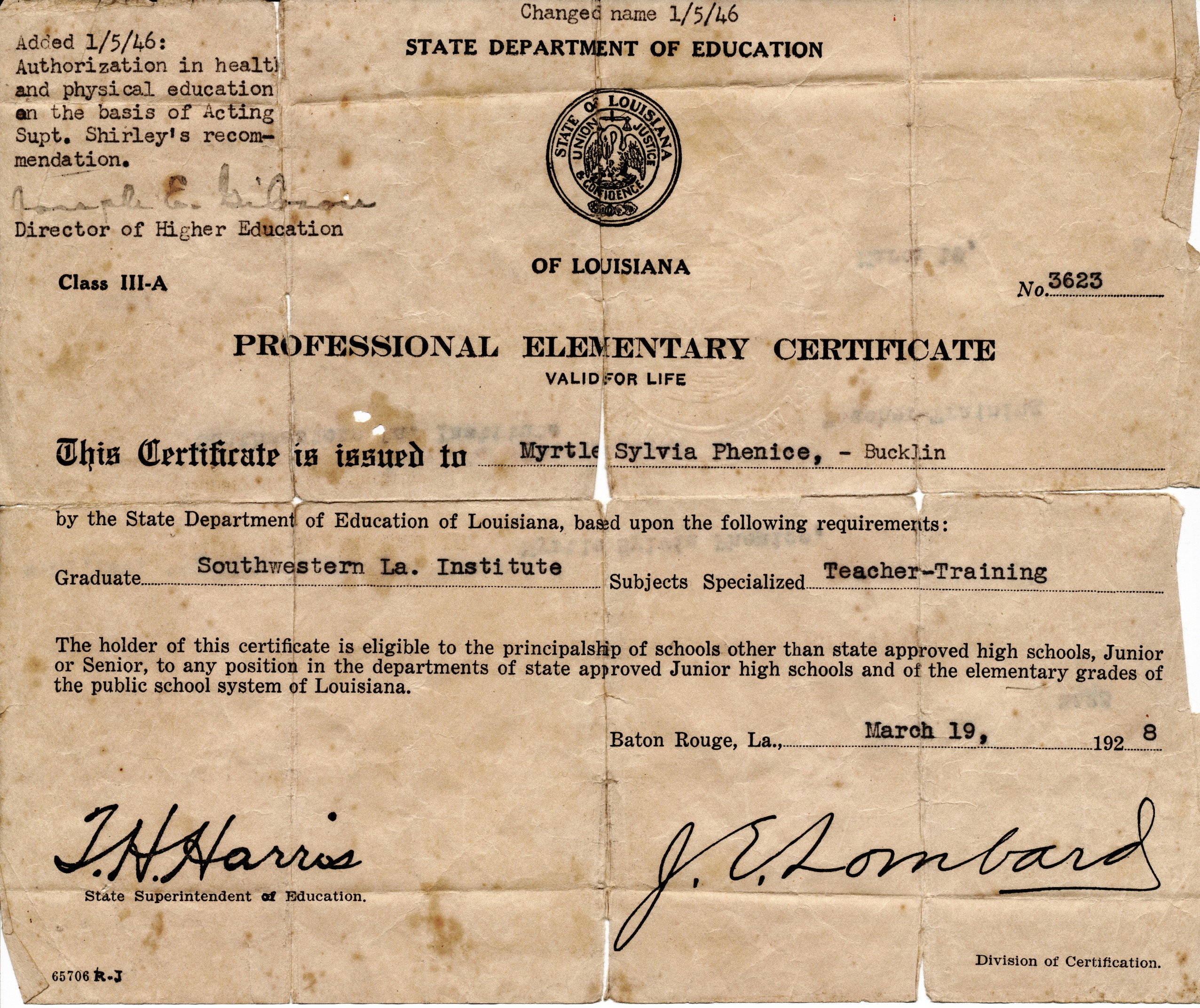
Teaching Certificate from 1928

Grandma got her high school diploma in 1925, then proceeded to continue her education at Southwestern Louisiana Institute in Lafayette.  On March 19, 1928, she received her Professional Elementary Certificate from SLI that was “Valid For Life.”  She was not married at the time, so the name on the certificate was Myrtle Sylvia Phenice.  It looks like she added Bucklin later so she wouldn’t confuse her little third grade children.

She continued to further her education and received her B. A. from McNeese State College in 1957.

She then taught in Calcasieu Parish schools for two years until her marriage in 1930.  She didn’t teach during the time that she was having children and rearing them.  I’m sure she was teaching her children many wonderful things, but she wasn’t teaching in the school system.  She returned to the school system to teach at the Hathaway School in 1945.  The info from her memorial says that she returned in 1946, but it must have meant the school year ending in 1946.  You can see in the photo that it was the third grade class and the school year is 1945-1946.

She got back just in time to be aunt Loris’s teacher.  I wonder how that happened?  Did she prefer third graders?  Did Loris beg her to start teaching and be her teacher?  Why didn’t she teach older students?  Aunt Alma was in the fifth grade, mom was in the 7th, and Sylvia was probably in the 8th.  She could have taught them all if she picked a higher grade.

But third it was.  And that’s how a lot of people knew her – Mrs. Bucklin, the 3rd grade teacher at Hathaway.  She was just Grandma to me.


Follow-up Friday: Further French Facts

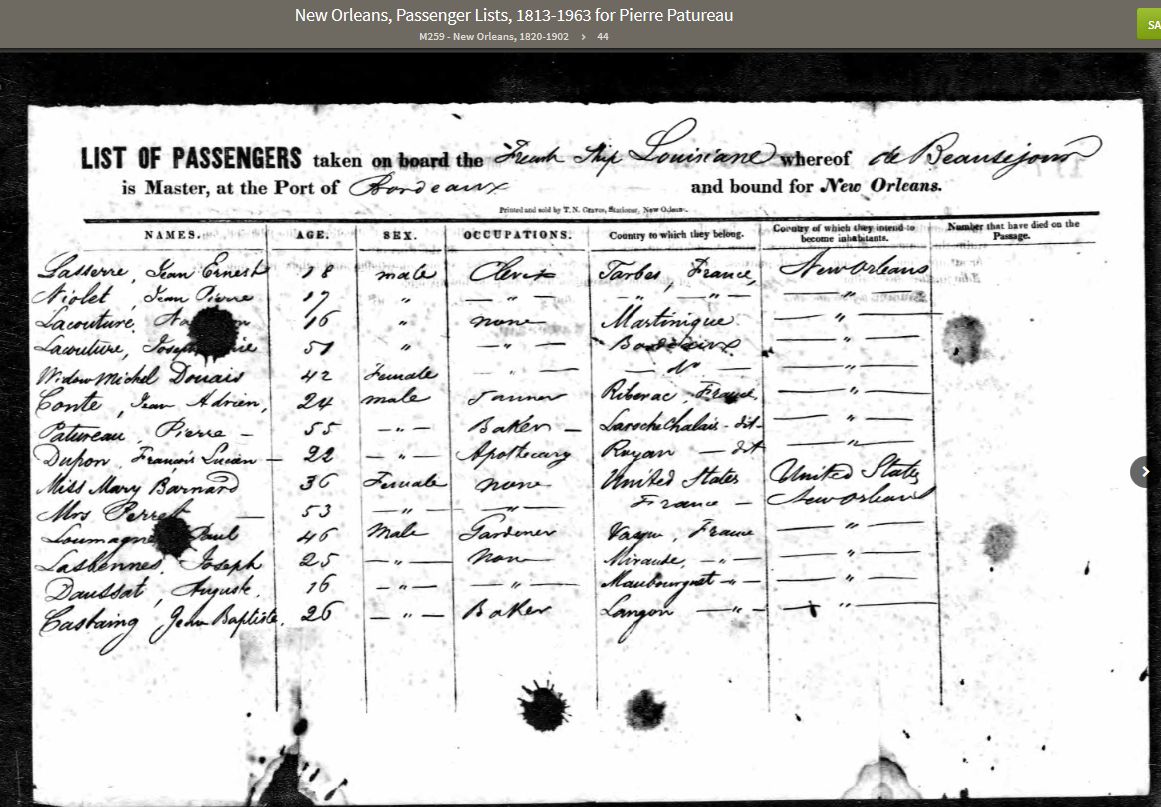
1857 passenger list includes Pierre Patureau, baker.

After I posted my last blog, I realized that I hadn’t posted a photo/scan of the original document that started all of the discoveries this week.  Plus I found another great document as well.  So I thought I’d give an additional bit of information for you all to peruse.  I’m sure everyone was wanting that, but they were a bit too shy to ask.

This first pic is of that document, which is a passenger list for the Louisiane that traveled from the port of Bordeaux in France to New Orleans in 1857.  As you can see, Piere is listed as a baker.  What business does a baker have that requires him to travel to another country in 1857?  Or was he just visiting family?

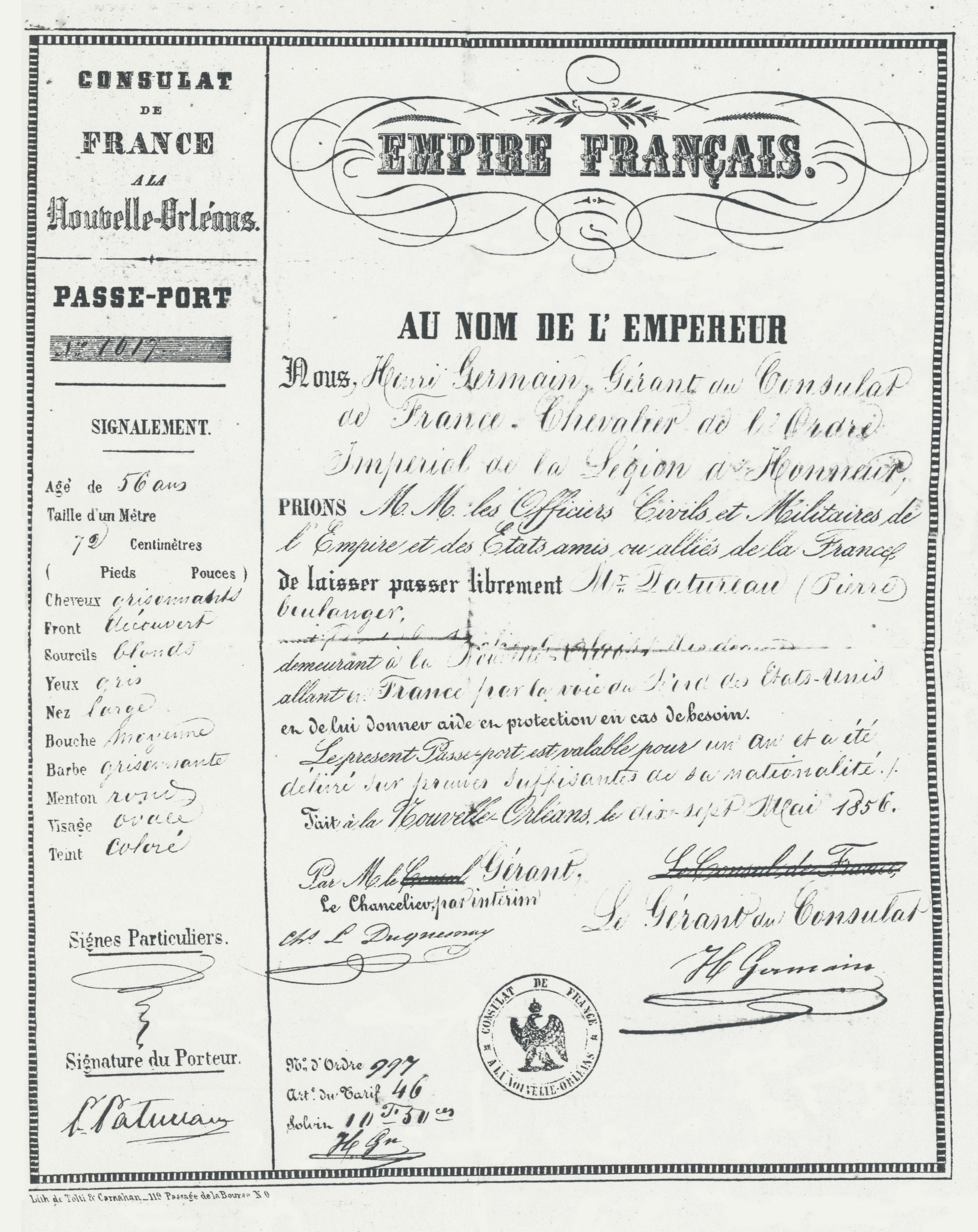
Passport for Piere Patureau from 1856.

I also mentioned the 1856 passport for Piere in the last post and I don’t think I shared it with everyone previously.  So here it is.  Henri Germaine, who was evidently very important because he had been awarded a Legion of Honor title in France, signed this passport that asks that Piere be allowed to pass freely.  This is where Piere is identified as a boulanger, which is French for a baker.  In one place I read, they identified him as a butcher, but that would have been a boucher.  I guess with the old scribbly writing that you can see in these old documents, it could be an honest mistake.

Now for the other document that I found.  I posted the baptismal record for Leobon Patureau.  It was dated Aug. 1, 1768, from Palluaud, Charente, Poitou-Charentes, France, and it listed the parents as Antoine Patureau and Marie Sicaud.  I had found on a distant cousin’s blog that Leobon was the first of six children for Antoine and Marie.

From the research I have done, I notice that in my family the first child is usually born pretty soon after the marriage.  Because that’s what it takes to have a child – a marriage certificate. Mom and dad had Jodie almost a year after they were married.  Mee Maw and Pee Paw had Marie after almost a year and a half.  Grampa Max and Marie Therese had Emma after ten months, and his parents were similar.  It must have been a Patureau tradition.  So I figured that Antoine and Marie probably got married in 1766 or 1767.

The original French record of the 1767 marriage of Antoine Patureau and Marie Sicaud on top. Bottom left is the text version in French. Bottom right is the English translation text.

Since the online collection that had the baptism was from the Palluaud area and it included marriages and deaths, I figured I might as well check for a marriage record.  They could have gotten married in a different place, but I figured it would be worth checking out.  It was a small area, so a year’s worth of documents was only 5 or so pages.  Yes, it was in French and hand written over 250 years ago, but how bad could it be?

It was a bit straining, but the reward was worth it in the end.  Otherwise there wouldn’t be this post that you are reading!  Sure enough, the wedding was recorded on November of 1767, just nine months prior to Leobon being born.  My hunch paid off and now I have the wedding information for my great, great, great, great, great grandparents.  I also found some birth records for their children.  I found a few death records as well.

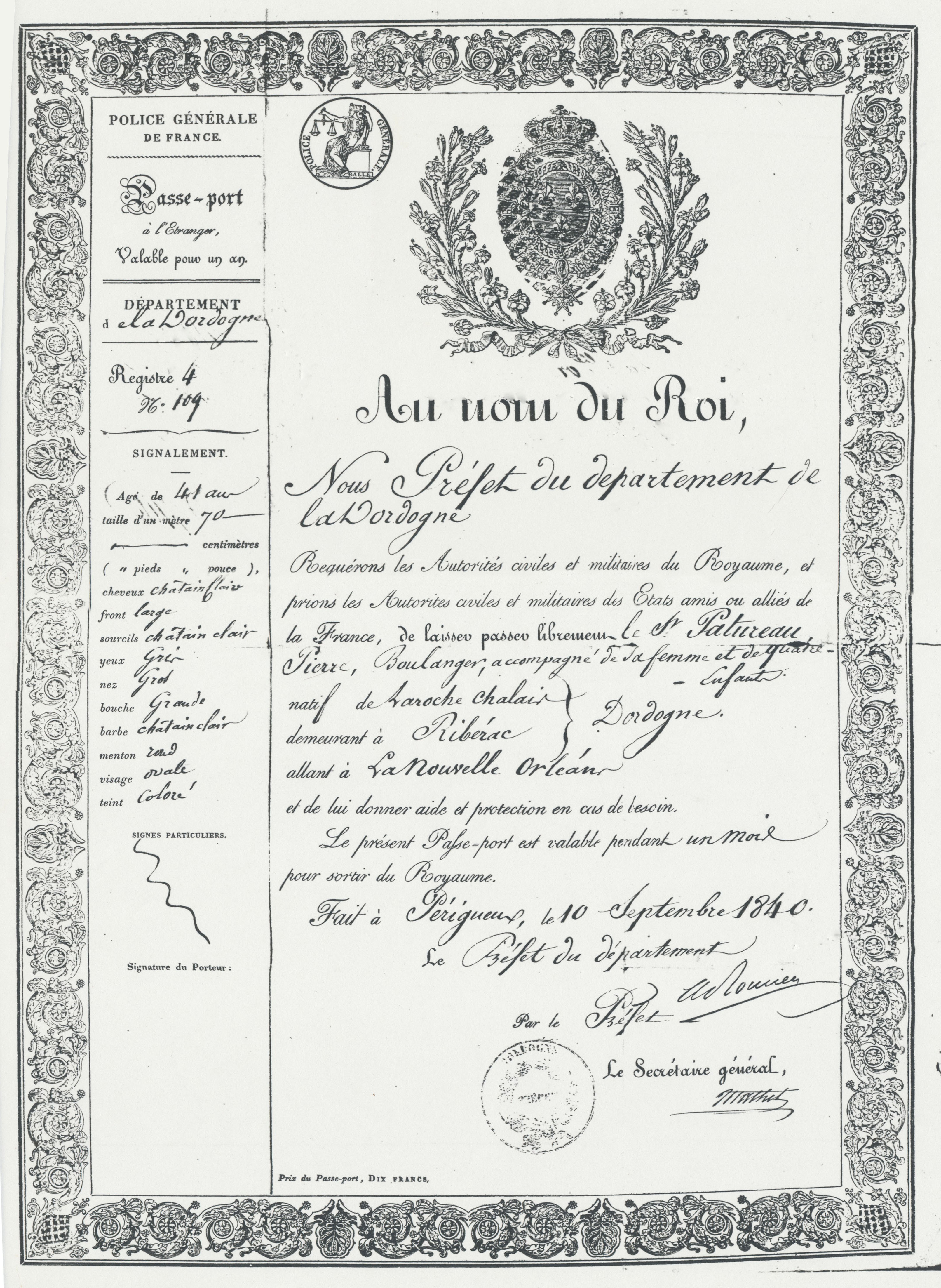
1840 passport for Piere Patureau when he immigrated to the United States with his family.

Now let’s go back to the time of the Patureau family immigrating to the US.  This is the 1840 passport that they had when they came to Louisiana.  The French authorities request in the name of the King that the United States allow Pierre Patureau, his wife, and their four children to enter freely into the country.  Again, Pierre is called a boulanger.

The family settled in Opelousas, where Anne Rose Machet Patureau (Piere’s wife) and their daughter Elise died in 1842 during a yellow fever epidemic.  The family then moved to the Plaquemine area and lived in Turnerville (northeast part of Plaquemine).

I would like to show you more and probably will in the future.  But for now, I think you may have had enough.  My problem is that when I find something exciting like that, I want to find more.  And if I can find that wonderful old French wedding record that is so difficult to read, I can find anything.  At least that’s what I tell myself while I’m going cross-eyed looking at those blurry documents.  Sometimes I just have to tell myself that it’s time to stop.


Follow up to my follow up

The original French record for the 1787 marriage of Leobon Patureau and Jeanne Lanson. The top is the original record, bottom left is the French text, and bottom right is the English translation.

Just found another old document that needs to be shared.  This one is the marriage record for Leobon Patureau and Jeanne Lanson.  They were married on January 16, 1787, in Bors de Montmoreau, Charente, France.  The great thing about this document is that it gives the Jeanne’s father’s name, which is shown as Francois.  It probably has the mother’s name, but I can’t make it our right now.  Perhaps another time…

PS.  I think Jeanne mother’s name was Jeanne Hivain.  I found the death register for Jeanne (mother and daughter) and it was clearer.  So much out there to see!

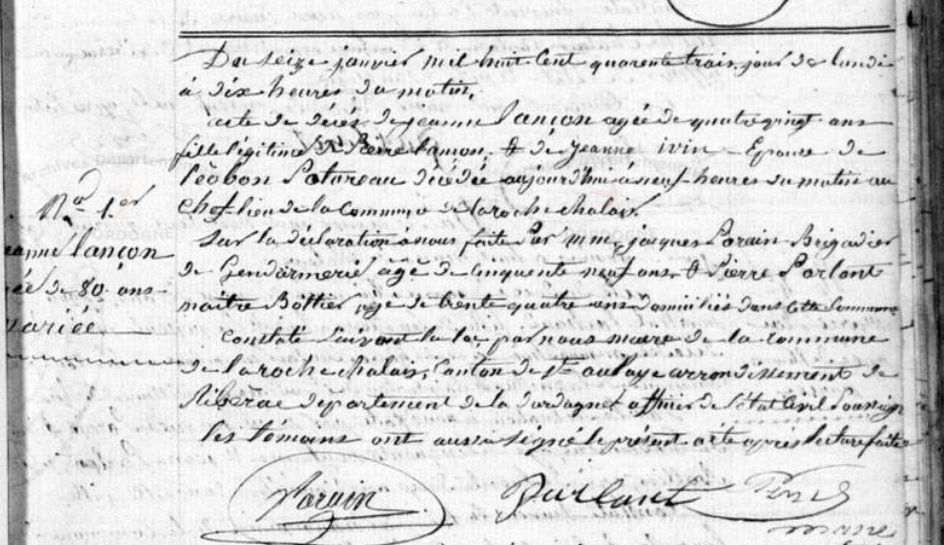
Death record for Jeanne Lanson on Jan. 16, 1843.  It shows that her age at death was 80 years (quatre vingt ans).  This puts her birth around 1763.

Patureau – A Butcher, a Baker, a Beau Chapeau Maker

Mr. and Mrs. Robert Joseph Landry, Jr. with Mrs. Robert Joseph Landry, Sr., informally known as Bob, Betty, and Erie Landry, other wise known as Daddy, Mama, and Mee Maw. This was taken in May of 1971 at my oldest sister Jodie’s high school graduation.

I’ve found some really interesting documents online this week.  I’m sure Daddy and Mee Maw would have been excited to see these old documents as well.  Mee Maw (Germaine Erie Patureau Landry shown here with my mom and dad Betty Lou Bucklin and Robert Joseph Landry, Jr.) started researching the Patureau and Landry family lines back in the 1950s.  Daddy probably got interested around the time of this photo, which was in 1971.  He continued with the research for at least another forty years.

This week’s finds started out when I got a notice about someone adding some additional information to the profile for Leobon Patureau on WIKItree.

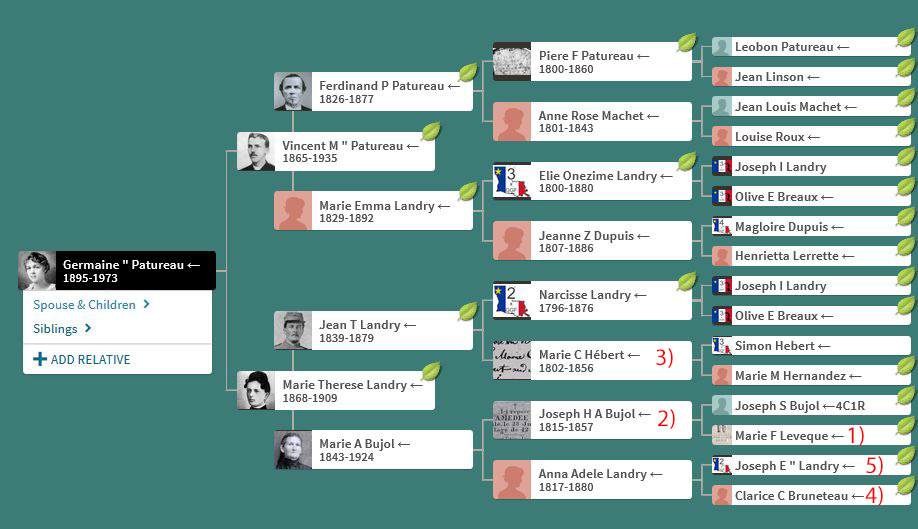
You can see the link to Leobon Patureau on the top of this section of the tree of my grandmother. Piere F. Patureau and his wife and children were the ones who immigrated to the US in 1840.

That is a site that has one world tree that everyone tries to connect to.  It is public and anybody can add to the profiles once you become a member.  The first notice I saw was for a passenger list for Piere Patureau in 1857 on a ship traveling from France to New Orleans.  I have a copy of his passport dated 1856, but didn’t know if he had done any traveling.

Evidently he traveled to France.  And on that passport it lists him as a boulanger.  That is the French word for baker.  I had read somewhere else that he was a butcher, but I’m thinking the baker is more likely since both the passport and passenger list indicate that.

Then original French resources were added for Leobon Patureau, who just happens to be my great, great, great, great grandfather.  I now know that he was born Aug. 1, 1768, in Palluaud, Charente, Poitou-Charentes, France, and he died on Feb. 3, 1851 in LaRoche-Chalais, Dordogne, Aquitaine, France.

Baptism record for Leobon Patureau in 1768 in Palluaud, France.

I didn’t recognize the name of the person adding the information, so I sent him a note of thanks and inquired if we were related.  We’re not related, but he lives in France and he likes to do research.  And research he did!  As you can see from this copy of a document, it is not easy to read, especially if you do not understand French.  I could barely find the name leobon patureau on this page when I was referred to it, and I knew it had to be on that page!  How would you find something like this if you didn’t know when or where he was born in France?  I will definitely be sending another note of thanks to him.

If you haven’t noticed yet, the document also gives the names of Leobon’s parents, which I didn’t have.  They are listed as Antoine Patureau (a surgeon) and Marie Sicaud.  That would make them my 5x great grandparents.  They lived in the mid 1700s in Palluaud, France.

Anne Machet’s birth record from 1801 in Mareuil, France.

It didn’t stop with all of that.  Piere Patureau was married to Anne Rose Machet.  Anne was born in 1801, which is documented in this photo from French archives for births.  We already knew her parents’ names, which were Louis Machet and Louise Roux.  But I don’t remember ever seeing his occupation.  He was a chapelier!  In English we would call him a hatter.  Maybe he made his precious little Anne a beautiful hat (or as he would say, a beau chapeau) for special occasions.

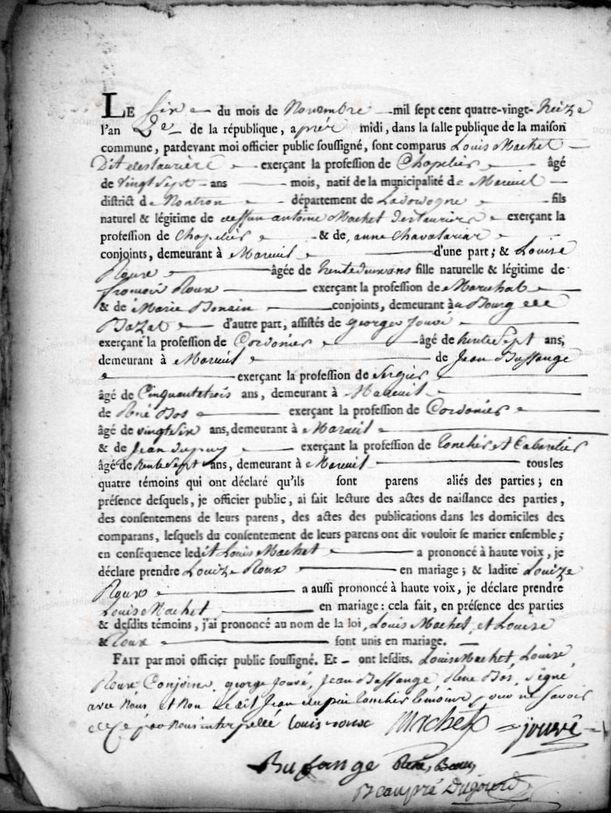
Louis Machet married Louise Roux on Nov. 6, 1793 in Mareuil, France.

We just keep going back further in time!  We can thank our anonymous French researcher for that.  I really like the look of this document.  It is the marriage record for Anne’s parents Louis and Louise.  This one is dated Nov. 6, 1793, and it took place in Mareuil, France.  It lists the parents of Louis as Antoine Machet deslauriers and Anne Chavalarias.  Daddy already had these names from his research, which is amazing to me.  He did a lot of great research that I am grateful for.

One of the interesting things that I learned from this record is that not only was Louis a hatter, but his pater was a hatter.  (Oops, shouldn’t mix Latin with French!)  I’m sure there are other interesting things, but I’ve just started looking at them and haven’t been able to figure out what some of the words are supposed to be or what they would mean.

So if you are able to figure anything out from any of these documents, let me know.  Leave me a comment or send me a note.  I’ll be glad to discuss it.  As you can probably tell by now, I find it all very interesting.


Further French facts

Go Tigers!

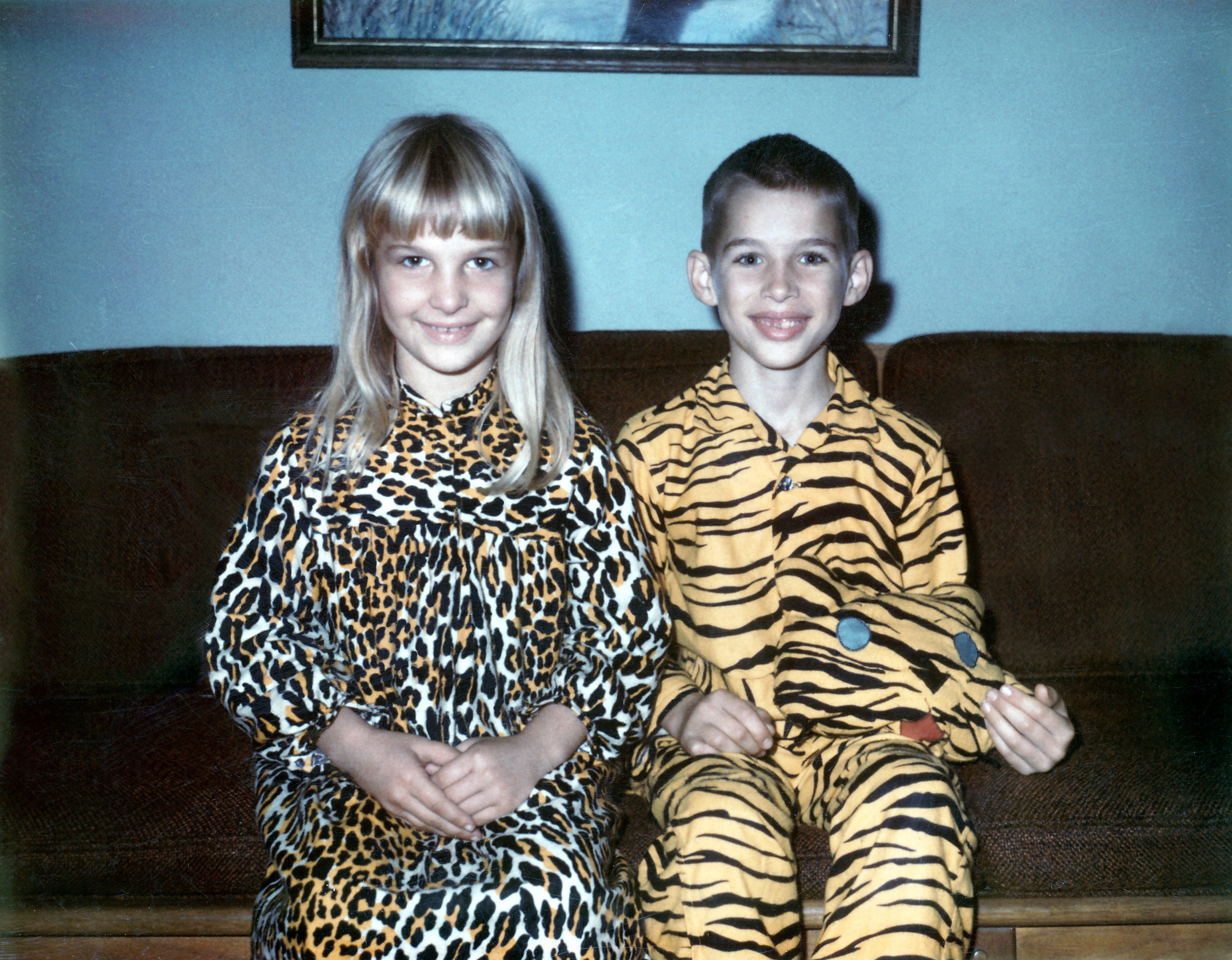
Sorry about that misleading title. I couldn’t resist. I was trying to think of something to get people’s attention that was related to the story I’m going to write. “Go Tigers!” seems to be attention grabbing. But this article is not about LSU tigers. Not that I have anything against LSU tigers, my dad and I both got our graduate degrees at LSU. The tiger in this story is mainly just a tiger head that my mom made for me when I was a kid.

Jamie and Van Landry in early 1970s.

As you can see from this photo, it wasn’t just a tiger head that she made. She also made tiger-print pajamas for me and a leopard-print nightgown for my younger sister Jamie. What made me think of this photo was the cold weather we are having. I’m not much of a fan of cold weather and never really have been.

I don’t remember if it was that cold on the day that we got this sleepwear, but I do remember that it was a surprise when we got home from school.  And it wasn’t a hand-me-down!  Something new and decidedly fun.  Who wouldn’t want tiger-striped pajamas?  Any LSU fan would surely agree.  Of course, I had no awareness of LSU’s mascot at the time.  I just liked my new flannel pajamas with the matching tiger head.  It was warm and cozy and something that our mama had made us.

Another warm memory of my mom was a few years later on.  When I was in junior high, I had a paper route in the neighborhood.  And we were like the post – neither rain, nor sleet, nor blah blah blah could keep us from delivering those newspapers.  So every day after school – while reruns of “Star Trek” were playing mind you (now that’s dedication!) – I would faithfully go out and deliver my paper route.  Sometimes I would even do my brother’s as well if he had something to do!

Betty Lou Bucklin Landry in the 1960s.

During the winter it could get particularly cold riding that old Schwinn bicycle in the elements.  If it was raining, I would really be miserable.  I don’t know how often she would do this, but I remember my mom having a warm blanket to wrap around me when I would finish my paper route.  I’m not sure if she kept the blanket warm in the dryer or just started it running when I got home, but I remember it being nice and toasty and definitely comforting.

I’m sure that my brothers and sisters have warm memories of my mom as well.  It’s not like I was the only one she treated that way.  I think she loved being a mom, taking care of her children and showing them that she loved them.  This carried on to her grandchildren as well.

Though later in life her failing memory caused her to be reticent in dealing with people, sometimes even her children, grandchildren and great grandchildren.  Too bad they weren’t able to experience the full warmth of her love.  It was a wonderful thing.

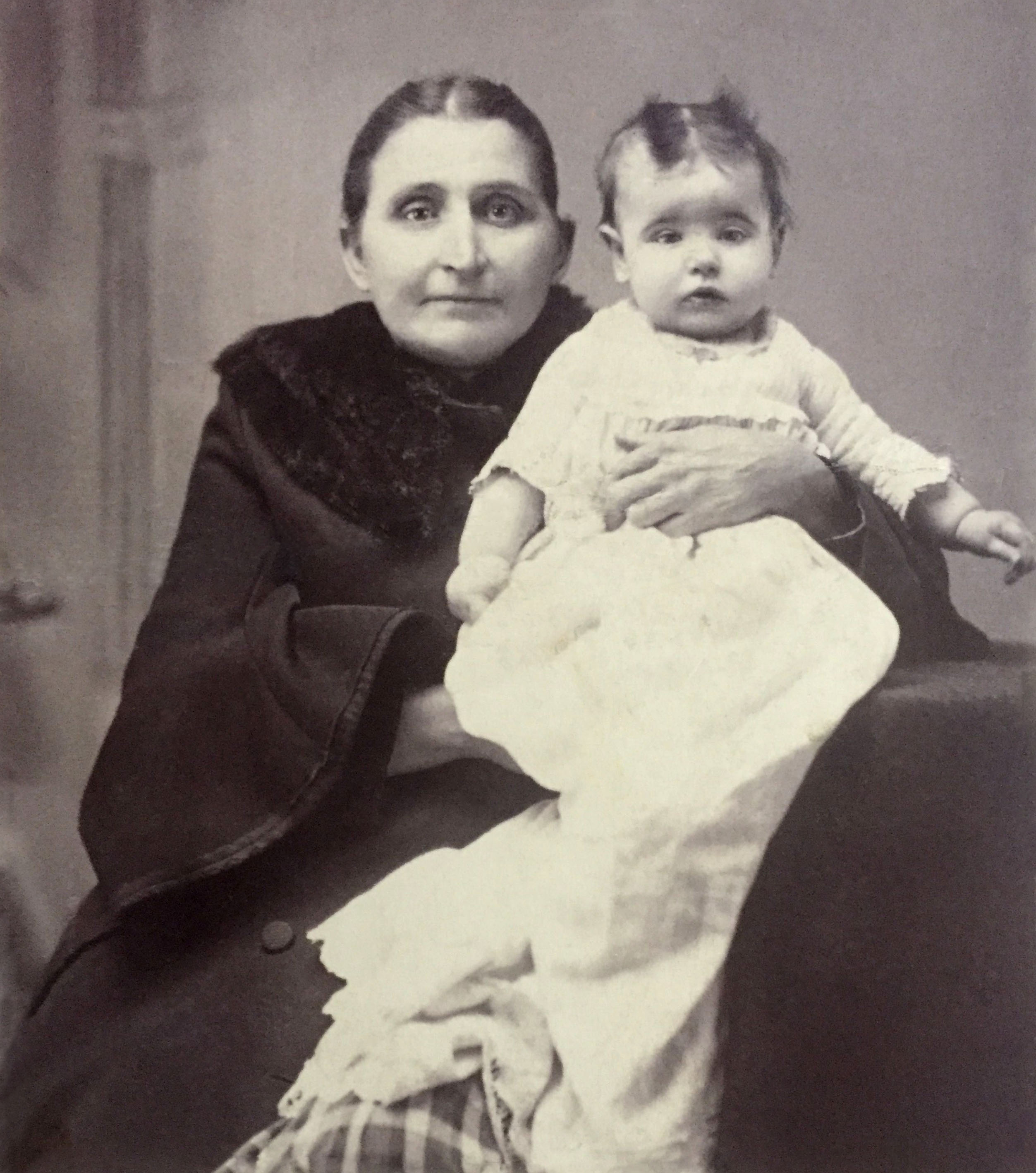
Mamma and Nook in 1890

‘Mamma + Nook’ was the inscription written on the border of this photo.  Do you recognize anyone?  Yes? No?

I was so excited when I first saw this photo.  Not only because of the cute little baby who was obviously called Nook.  (Or do I have that wrong?  The little baby could actually be ‘Mamma’ and the older one ‘Nook.’)  I was excited because I recognized my great great grandmother Cathrine Jane Foster Phenice immediately.

Even though the other photos of her that I had seen were from about 20 or 30 years later, she still had that Grandpa Munster look about her.  I shouldn’t say that.  I still feel a little guilty about turning her later years photo into a Grandpa Munster lookalike for Halloween this year. (Animating old photos has helped to change my view of her.)

Cathrine or Kate was the mother of Harry Clifton Phenice.  Harry was the father of Myrtle Sylvia Phenice Bucklin.  Myrtle was the mother of Betty Lou Bucklin Landry.  And everyone knows that Betty Lou was my dear sweet mama.  Kate was also the mother of the little girl in the photo.  Her name was Emma Orra Phenice and she was the grandmother of Mona Quillen, the person who graciously shared this photo with me.  It is part of the collection that I refer to as the Lincoln Collection.

I got this photo earlier this year and fell in love with it.  But I have to take my time in sharing the really good ones since there are a limited number of them.  Consider this a Christmas gift from me.  It’s kind of appropriate because the last time I featured Kate, there was a Christmas theme.  (She had her fire incident on Christmas Eve Eve, remember?)

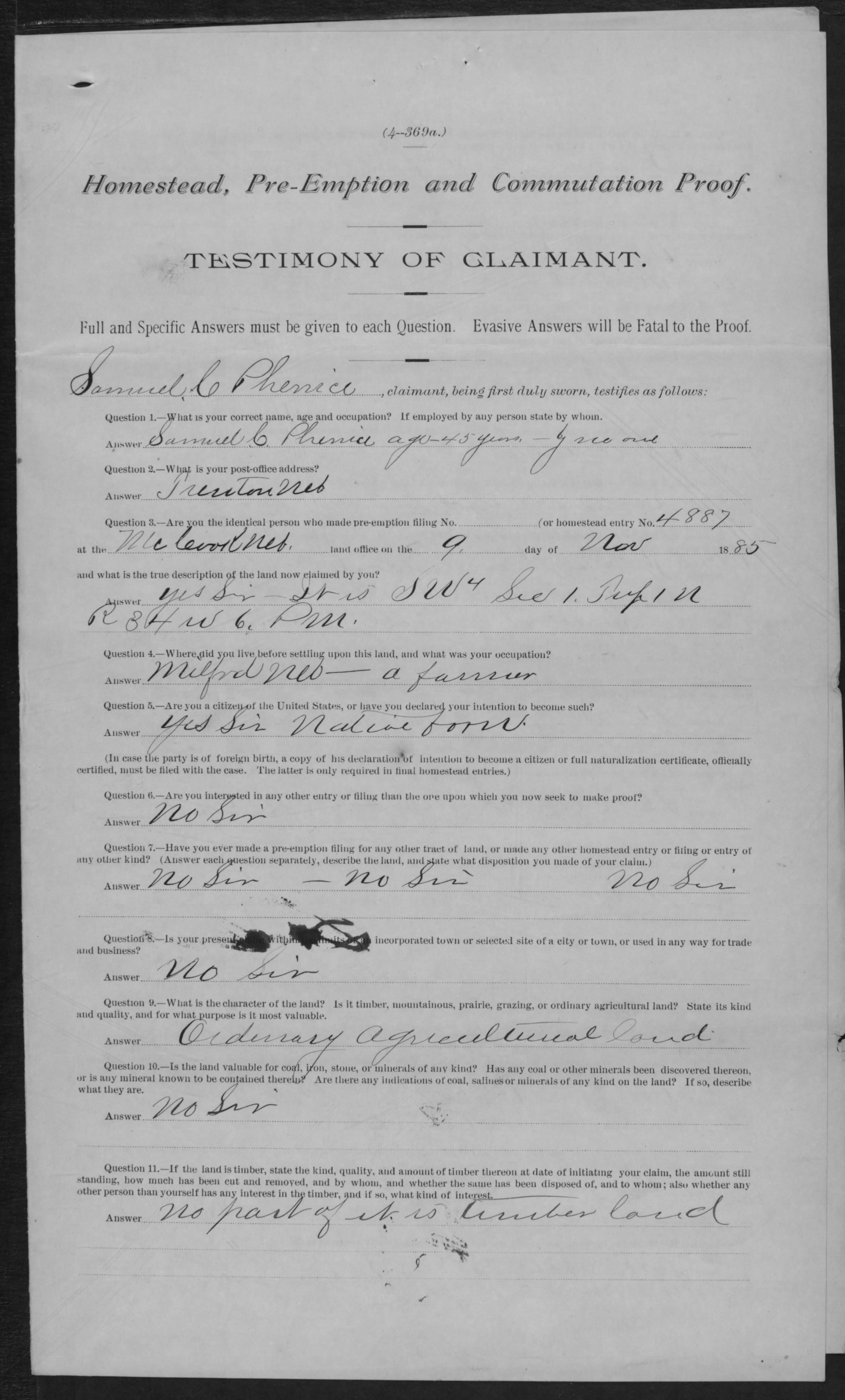
1889 Homestead Testimony Page 1

Since Emma was born in 1889, I’m dating this photo as 1890.  And I happened to run across some other information earlier this year that gives some more glimpses into what was going on with the Phenice family in 1889.  I found a document titled “Homestead, Pre-Emption and Commutation Proof.”  It was for the land homesteaded by Samuel Phenice in McCook County, Nebraska.  He had filed a homestead entry No. 4887 on Nov. 9, 1885.  He moved onto the property on April 1, 1886 and commenced to “building a house worth $12.” (see page 2 of document)

1889 Homestead Testimony Page 2

He stated that his family consists of himself, his wife, and their six children.  This was true for June 8, 1889, which is when the document was written.  Kate had given birth to seven children, but they had lost an infant daughter named Mollie in 1881. So when little Emma was born on June 20, Samuel and Kate would have seven children.  Emma was their last child.

The document states that Kate and the children moved onto the property (and into the $12 house he built) on about June 10, 1886, which was about ten weeks after he started work on the site.  According to page 3, the house was “part dug + part sod house, 22 by 24 feet with an ‘Ell’ 14 by 22 feet in size, has 4 doors and 5 windows worth $200.”

1889 Homestead Testimony Page 3

He goes on to list improvements on the land and their value.  They had a stable worth $20, a granary worth $20, a 155 ft. deep well worth $80, 65 acres of farmed land worth $130, and forest and fruit trees worth $50.  He puts a total value as $500.  He also had farm implements such as two plows, a cultivator, a mower (not a riding one, I’m sure!), a wagon, and a barrow.  All of which he had owned since before moving on to the property.

Aren’t you just loving all of these details?  I am.  It describes so much of what their life would have been like out in the prairie lands in Nebraska where his neighbor (& witness in other documents) lived 3/4 of a mile away.  The neighbor said he visited frequently.

1889 Homestead Testimony Page 4

When the neighbor visited, he probably noticed that there was a horse, five cows, a colt, three hogs, and a mess of chickens.  When he went into the house he would have seen the stove, the two tables, and the ten chairs.  He may or may not have seen the four beds and the bedding.  If he shared a meal with them he would have seen the dishes and cooking utensils.

He would definitely notice those six kids ranging from age three to twenty-one.  (Our H. C. was 15 at the time.)  It’s hard not to notice that many kids running around underfoot.  It also would have been hard not to notice that Kate was soon to be adding a seventh to the group.  Would he have commented on that?  Would that have been frowned upon?  There’s no way to know about that.  That wasn’t included in the document.

One of the other things I like about this document is that it was written by Samuel himself and signed as well.  And his answers to some of the questions are interesting as well – “No Sir” and “I think not.”  Little did they know that we would be looking back at that document and photo almost 130 years later to get a glimpse of their lives.

You may now return to the present.

1 43 44 45 46 47 58