The Five Paths to Joseph Ignatius

For those of you have been reading these blog posts that I write, you’ll have learned about the cousin marriages in my family history. For those that have researched families with Cajun or Acadian ancestry, you’ll know that this was a common practice. Some people are not very comfortable with these marriages, while others don’t seem to have a problem with it at all. It’s just part of history and I owe my life to it all.
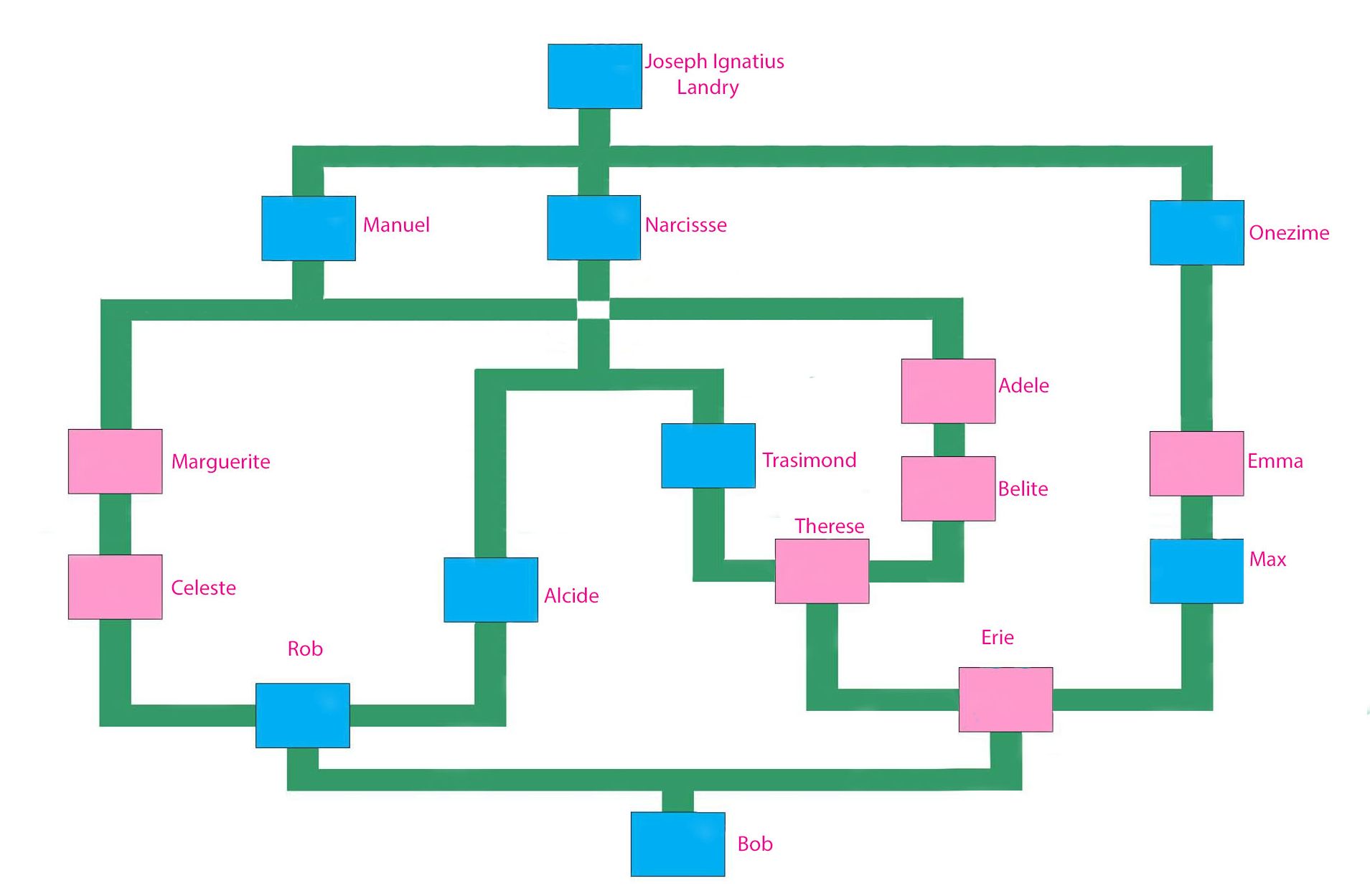
A visual aid to show the paths from my father Bob Landry to his great great grandfather Joseph Ignatius Landry.

In my family, I don’t have to look far to find an example. My grandparents were first cousins once removed. You can see that in the handy diagram that I created for myself to help me keep it all straight in my mind. It can all get a bit confusing sometimes. At the bottom of the diagram is my dad Bob Landry. Following the lines up from him bring you to Rob and Erie. Those are my paternal grandparents Robert Joseph Landry, Sr. and Germaine Erie Patureau. Their grandkids knew them as Pee Paw and Mee Maw.
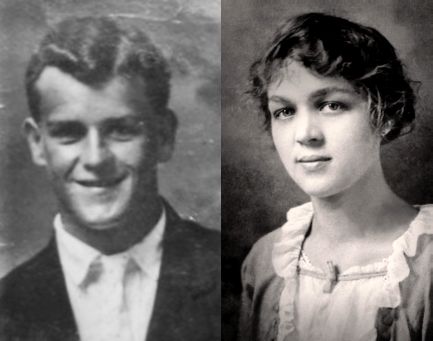
Rob and Erie

If you follow Rob and Erie’s lines up through the middle of the chart, you come to their common ancestor Narcisse Landry. (I normally like to name both parents of individuals when I know them, but in this case I’m just listing those in the line leading to the ultimate common ancestor Joseph Ignatius Landry.) Rob and Erie were first cousins once removed because Narcisse was Rob’s grandfather while he was Erie’s great grandfather. Or put another way, Simon Alcide Landry and Jean Trasimond Landry were the sons of Narcisse. Rob was the son of Alcide and Marie Therese Landry Patureau was the daughter of Trasimond. Rob then married his first cousin Therese’s daughter Erie. Since Narcisse, Alcide, Trasimond, and Therese had all died before 1921, none of them were alive to celebrate Rob and Erie’s union.

But that’s not the only way that they were related, just the closest. That first connection was derived from Rob and his first cousin Therese’s fathers. The next connection we’ll look at the connection through their mothers. Rob’s mother was Marie Celeste Leveque Landry. Celeste’s mother was Marguerite Basalite Landry Leveque. Basalite was the daughter of Joseph Emmanuel Landry.

Now for Therese’s mother’s line. Her mother was Marie Amelie Bujol Landry. Since she had a long life, I have more photos of her and have written a few posts about her. Remember? We call her Belite. (She is also known as Grandma Babin to some of her descendants. Don’t let this throw you.) I’ve also referred to her as one of the beautiful daughters of the Widow Bujol. That would be her mother Anna Adele Landry Bujol. Adele was also the daughter of Joseph Emmanuel “Manuel” Landry. So if you look at the maternal lines to see the connection between Rob and Erie, you find that they were second cousins once removed.
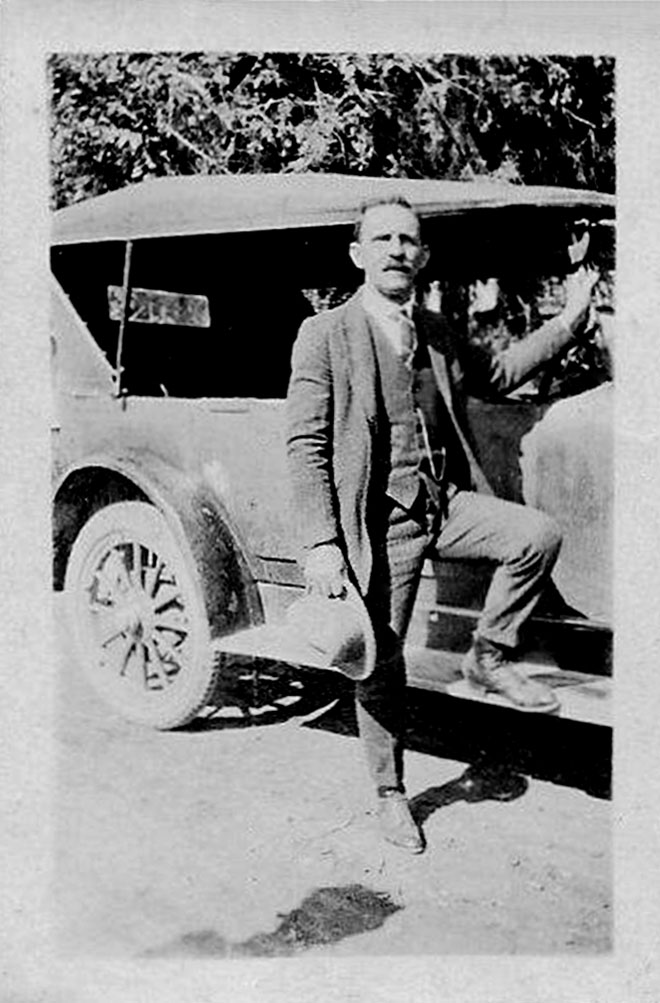
Grampa Max circa 1914

We’ve looked at both sides of Pee Paw’s tree and on both sides of Mee Maw’s mother’s tree. Now it’s time to look at Mee Maw’s father’s line. We all know him as Grampa Max, but his full name was Vincent Maximilian Patureau. I don’t usually think of him as a Landry, but his mother was a Landry. Her name was Marie Emma Landry Patureau. Emma’s father was Elie Onezime Landry. Though both Rob & Erie descend from Narcisse and Manuel, only Erie descends from Onezime.

But there are still more connections, because Narcisse, Manuel, and Onezime were all sons of Joseph Ignatius Landry. Joseph was born in Acadie in 1748. He was only seven years old when the Grand Derangement took place. It was 1755 when the English exiled the French Acadian population. Joseph and his family spent the next 12 years in Exile in Maryland, then settled in Louisiana in 1767. He married Scholastique Breaux in 1776. She was also an Acadian who spent the Exile in Maryland. She happened to be his double third cousin as well. They had four children together including a son named Manuel.

Scholastique died in 1785. Two years later he married Olive Elizabeth Breaux. She was the 2nd cousin of Scholastique and a 3rd cousin of Joseph. They had six children together including Narcisse and Onezime. So Narcisse and Onezime were full brothers and Manuel was their half brother.

So there they are. My paths to Joseph Ignatius. My siblings, nieces, nephews, and first cousins share these common paths. Some of my other cousins share a path or two and have a few of their own twisted paths to Joseph Ignatius. I even know of at least one with seven paths to that illustrious ancestor. I have to admit that fact makes me a little jealous. Is that weird?

Cook-Keys Connections

As you all may recall, my great great grandmother was Martha Ann Cook Keys. She was the brave widow woman who immigrated to America with her five young children in 1887. Her daughter was Daisy Keys who married Harry Clifton Phenice. One of their daughters’ name was Myrtle Phenice and she married Fred Bucklin. Myrtle and Fred’s second daughter was my mother Betty Lou Bucklin Landry. That tells you my connection to the Cook-Keys family, but let’s look a little further back.

Martha was married to Henry Keys in 1869 in Middlesex, England. But they were not the first Cook-Keys couple. Martha’s younger sister Henrietta had married Henry’s younger brother William in 1861 and shortly afterwards started a family. Their children were double first cousins to each other. That meant that they had more DNA in common than most first cousins. This helps us now because it increases the chances that 4th cousins of these couples still share DNA.

And they do. That’s what made me think of this post for this week. I started corresponding with two different descendants of Henrietta and William Keys. And since I always like to see photos of my ancestors, I thought I’d share the ones I have. I thought some of you might like to see some of this information as well.

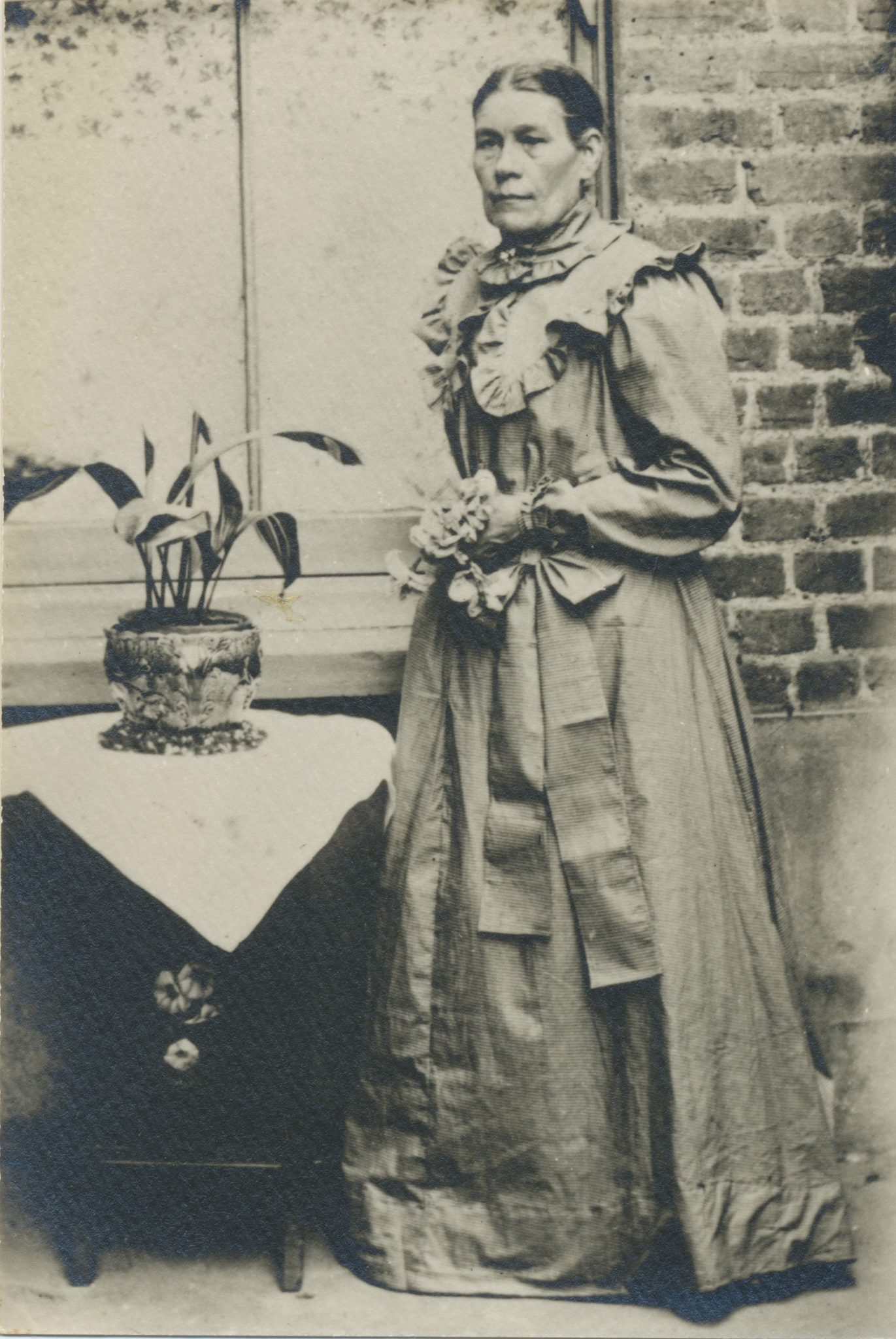
Henrietta Cook Keys

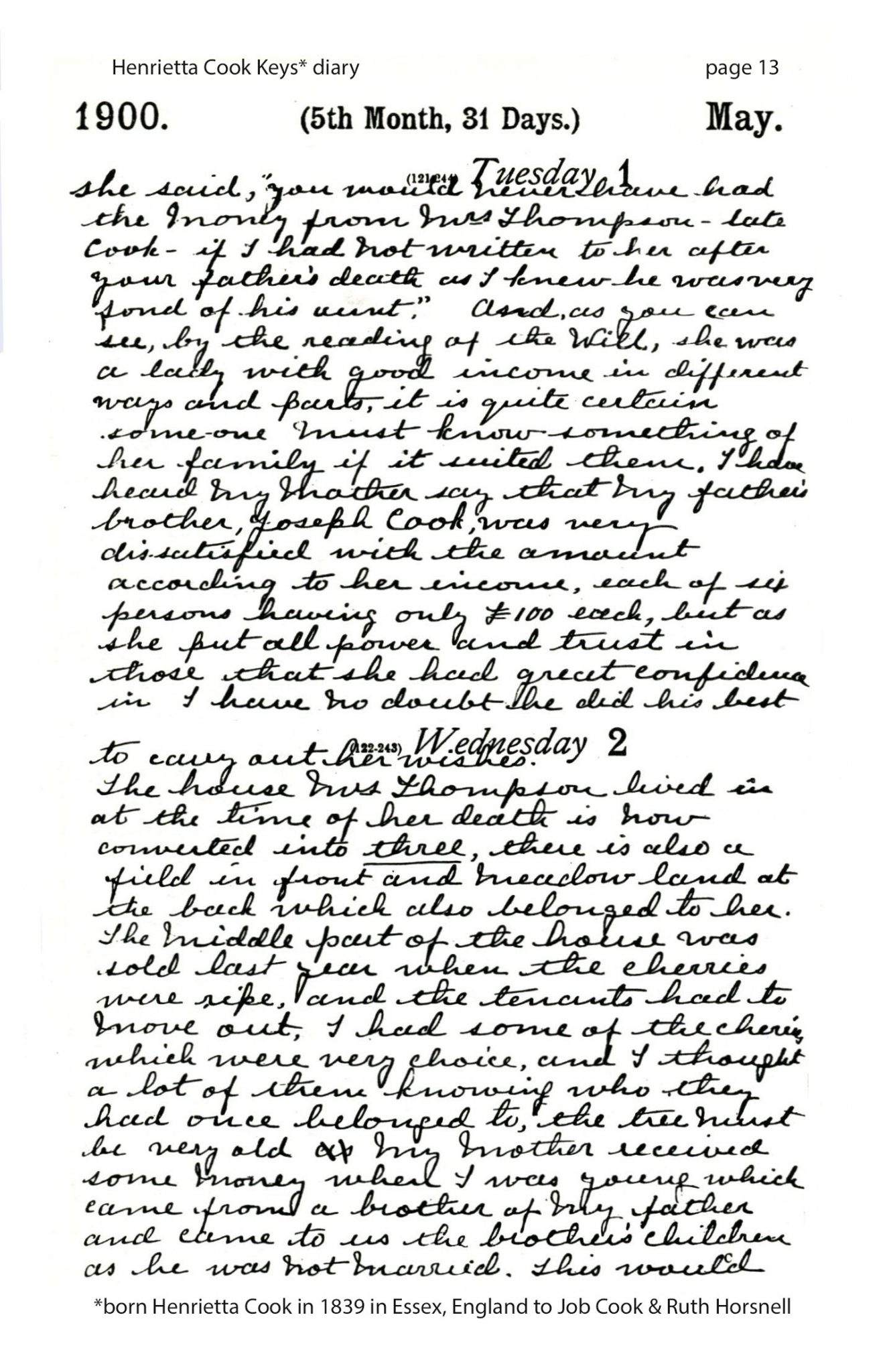
This is a photo of Henrietta Cook Keys. My ancestry program identifies her as my great, great, great aunt. What I really appreciate about her is that she kept a diary and wrote about some of her and Martha’s family history. How cool is that? Too bad they didn’t have blogs back in her day. We might have seen even more information!

She talked about her father Job Cook dying when she was young (less than a year old). He was a sea captain who was “free of the river” and who had traveled the world. He died after voyaging to India. On his way home he was seized with pain in the head. Since they were so close to home, the doctor had already left the ship. The sailors tried to help him by cutting the hair off of the top of his head and applying some type of poultice. His situation only grew worse and he died only an hour after returning to shore. Supposedly if they had applied the ‘blister’ to the back of the head rather than the top of the head, he would have survived.

Henrietta says in her diary that she had in her possession the letter that brought her mother the sad news of her husband’s death. Now that’s a letter I’d like to see! There are other things that she refers to that I wish she had gone into more detail about. She talked about how her mother Ruth Horsnell ran a private school to make money. And it sounds like the dress shop that Martha had was partly run by their mother. Henrietta herself was not put to a business because a family friend had decided that she was “delicate.” She doesn’t look so delicate in this photo, but looks can be deceiving.

Henrietta also identified her paternal grandfather as William Cook and talks about his grave in Walthamstow, England. She was living there when she wrote the journal and she talked about people recognizing her as part of the Cook family. William had also been a seaman and died at a young age. Henrietta was certain that there was a connection between her Cook family and that of the famous sea captain James Cook.

All of this information was in the book that cousin Edith Keys Segraves put together in 1980. She, like Henrietta, was also pretty sure of the connection, though she was never able to find a link. She said that she included the information and the diary in hopes that someone in the family will one day find that link.

The search continues…


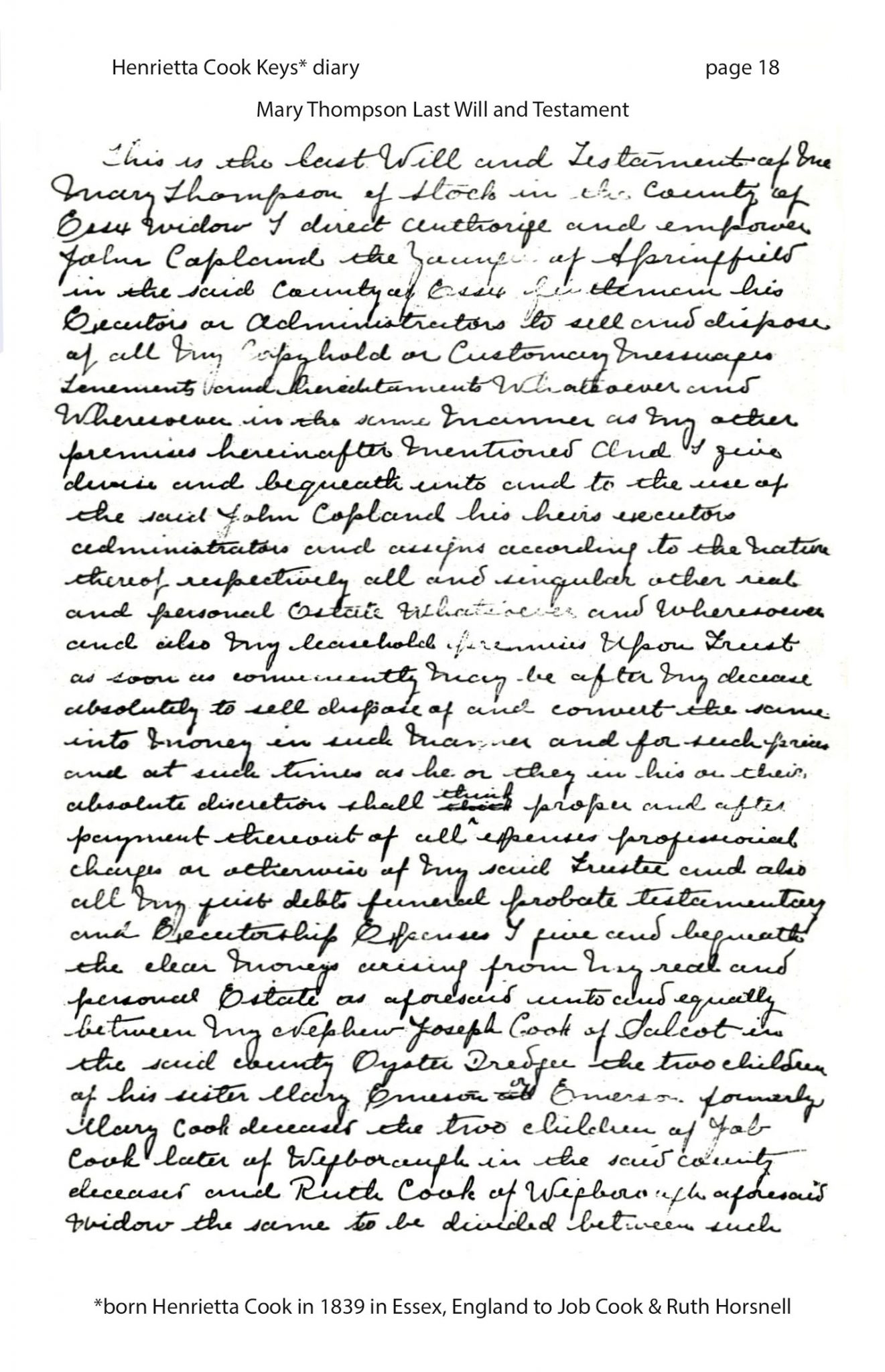
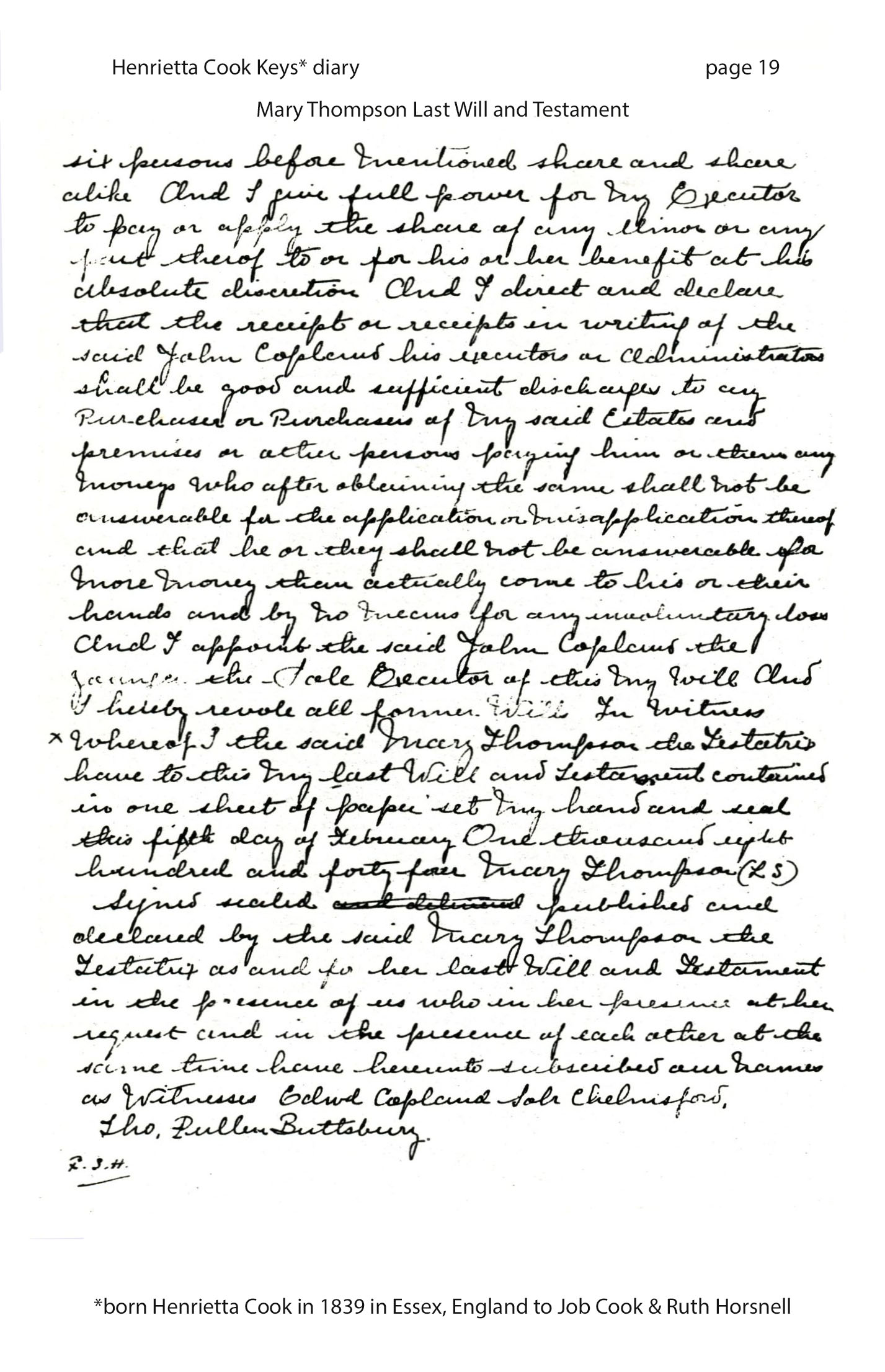
Family tree for Martha and Henrietta Cook. A lot of this information comes from Henrietta’s diary.

To see the diary pages that I have a copy of, see this link.

My Dad’s Mom and Sisters

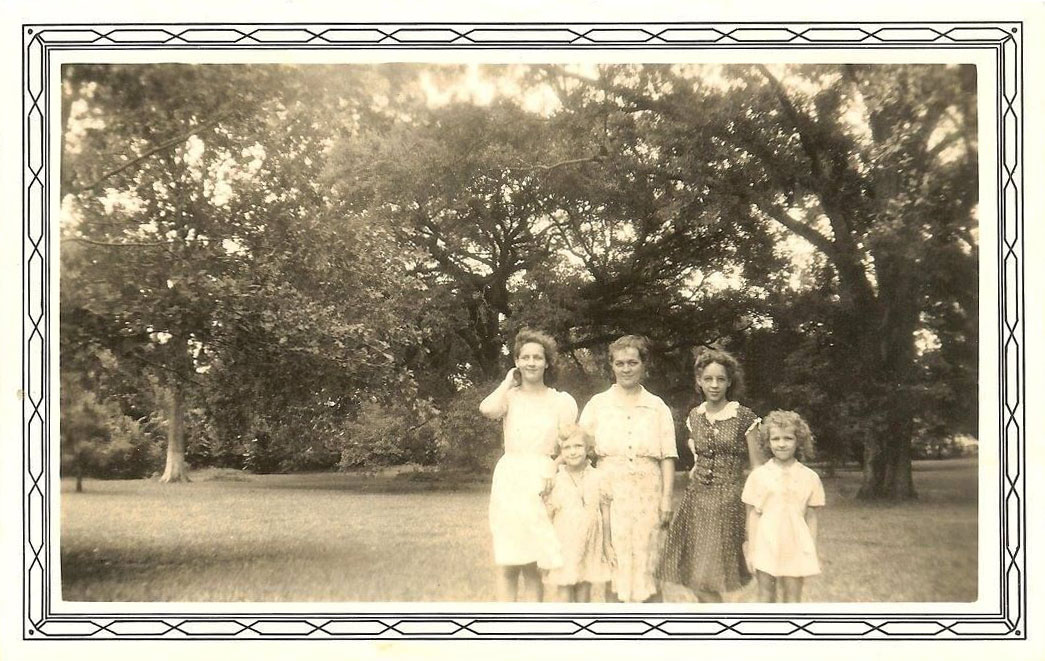
Germaine Erie Patureau Landry stands in the middle of her four daughters circa 1939.

I love this old photo of my grandmother and aunts. It was taken some time around 1939 and it was probably taken in Lake Charles somewhere. The only thing I don’t like about the photo is that their feet don’t show in the photo. I’m not particularly fond of feet. It’s just that if you’re going to take a full length photo of a group of people, get the whole person (or persons) in the photo. This was long before phones with cameras or digital photos with instant results to check, so I guess I’ll have to forgive them. It would also have been nice to see the group centered in the photo. Oh, well, at least they took this wonderful photo.

My dad came from a somewhat large family. There were eight children, with four boys and four girls. I’ve shared a photo of the male members of the family previously. The photos look like they were taken the same day. The background is the same, the lighting looks the same, and the border is the same. But instead of a father with his four sons in the previous photo, this one is of a mother with her four daughters.

But it’s not just any old mother in the photo. This is my beloved paternal grandmother who we all called Mee Maw. Her given name was Germaine Erie Patureau. She married Robert Joseph (Rob or Bob) Landry, Sr. and then went by Erie Landry. The first child of this couple was their oldest daughter Marie Therese Landry. Aunt Marie is shown on the far left in the photo. She would later marry Malloy Reeves, and they had one son named Mark. The next daughter born to Rob and Erie was Germaine Erie. Aunt Germaine can be seen to the right of Mee Maw in the darker dress. She would later marry Ross Winn, and they had three children.

The third daughter of Erie and Rob was Wana Lidwin. She can be seen on the far right in the photo. She would later marry Norman Duffy. Aunt Wana and Uncle Duffy had six children. The youngest of the girls – though not the youngest of the eight – was little Frances Mae. Aunt Frances or Framay would later marry Joseph Raley. Aunt Framay and Uncle Joe had five children.

These lovely ladies and warm, nurturing women are a strong emotional backbone for our family. That stood out particularly clearly to me in regard to the death of my sister Jodie in 1989. These four sisters were not there just for their brother, they were there for all the family. They were such a great example of what family can do for one another. They still are.

Addie’s last birthday bash

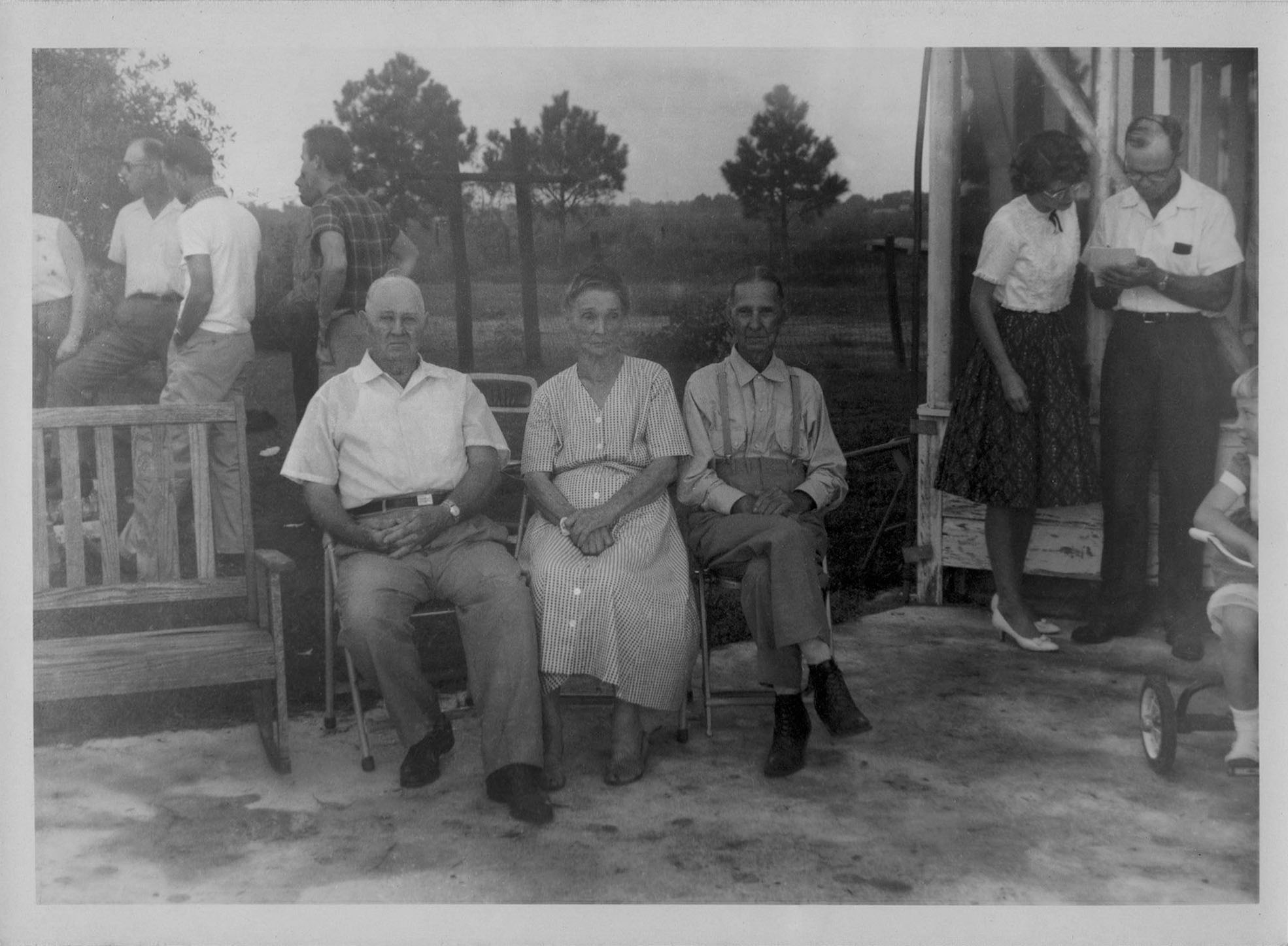
Addie had two of her brothers with her at her last birthday.

Here is a photo from almost 60 years ago. I don’t really know how that could be possible, since I was born just over a month later and I am nowhere near that age! The information on the copy of the photo stated that this photo was taken at the celebration of Addie’s 84th birthday. Since Addie May Hine was born on September 23, 1876, that would put the date of this photo around September 23, 1960.

Addie was the oldest child of George & Sue Hine. She had five younger brothers named Bert, Roe, Lonnie, Jim, and Ollie. Roe died in 1916, Jim died in 1949, and Ollie died in 1954. So at the time of Addie’s last birthday, only Bert and Lonnie were still alive to celebrate with her. She also had her surviving nine children at the event and numerous grandchildren. I know her children were there, because there is another photo from that day.

But in this photo, front and center of the photo is Addie and her two brothers. On the left with the white short-sleeved shirt is brother Bert. On the right with suspenders is brother Lonnie. As you can see from their faces, this was a joyous occasion! I have to admit, Addie does look a bit disinterested, but at least she is not scowling.

I can make out a few other people in the photo. On the left in the background is a man with his body toward the camera but facing to the left. I believe that is Addie’s youngest son Roy. To the right of him is a man wearing a white shirt and a dark checked collar. That’s Addie’s son and my grandfather’s identical twin Clarence. For some reason the way he is standing reminds me of my cousin Brent. And the guy standing to the right of him in a dark plaid shirt reminds me of myself or my brother Rob. Something about the way he is standing. I don’t know who they are, but maybe someone else will know and inform me.

And then there are the man and woman to the right of the Hine siblings. I know that the man is another son of Addie named Herbert. He is the grandfather of Joseph and John Connors. I don’t know who the woman is or what she is telling Uncle Herbert. Hopefully we can find out at least who she is. I doubt that we’ll discover the other information. (The woman in the photo is actually the 14-year-old daughter of Uncle Herbert. Her given name is Mary Louise Bucklin. She is married to Joseph Connors, III, so she is now known by the name Louise Connors.)

There’s one other person in the photo that I just noticed tonight after I picked out this photo to share. On the right edge of the photo is a young girl sitting on a tricycle. It looks to me like it could be my sister Jodie. She was also the first child of six. Though at the time she was only the oldest of four. I was born the following month and my baby sister Jamie was born in July of 1962. Jodie would have been three weeks shy of her 7th birthday. The girl in the photo looks about that age.

From the photos it looks like it was a good turnout for Addie’s birthday bash. And as I said, it was her last birthday. She passed away on Nov. 25, 1960. She looks like she was in pretty good shape at this event. I’ve wondered if she was aware of me or ever saw me. It kind of seems likely. Maybe one of her children told her, “Mama, Betty Lou had another baby today. It’s a boy.” Though she probably didn’t jump for joy, she might have said, “Oh, good,” and sat back in her rocker with a pleasant disposition.

Magloire et Henriette: After the Happily Ever After

This post is a follow-up to a previous post that I wrote. It was titled “Magloire et Henriette” and it was about a love letter that my great great great great grandfather wrote to his future wife. The letter was written in 1799 and the couple was married June 28, 1801, in St. Gabriel, Louisiana. That would have been the beginning of the happily ever after.

When I wrote that previous post, I intentionally left it in an idealized form. The letter was so formally written in fine French penmanship and he was so sincere in expressing his undying devotion to his lovely wife to be. But when I was looking at documents pertaining to their life, there were things that were definitely not ideal. I decided to leave that out of the first introduction to the couple. The letter was romanticized, but we all know that life isn’t always perfect. Just as I would hope that you don’t demonize the couple for what you find out about them, I wouldn’t want to only present an idealized version of them either.

I was thinking about Magloire and Henriette this week for two reasons. The first reason I was thinking of them is because I ran across some documents about their son Magloire, Jr. this week. Magloire and Henriette had eight children. The first two were daughters that married into the LaBauve family. Then Magloire, Jr. came along. He married a LeBlanc. Their fourth child was my great great great grandmother Jeanne Zerbine, who married Elie Onezime Landry. They were the parents of Emma Landry who married French immigrant Ferdinand Patureau. They are the couple that brought forth all of the Patureau cousins in southern Louisiana. After Jeanne came Edouard Dupuy who also married a Landry, though not a close relation to Elie Onezime. The next son was Alphonse Dupuy. The next daughter was Henriette Coralie, who also married into the same LaBauve family. Their last child was Amelia.

The other reason I was thinking of this couple concerns the ‘definitely not ideal’ part of their life: they were slave owners. I went to a genealogy meeting last weekend that concerned documentation of sales and conveyances in Ascension Parish. The focus was on finding slave records and how that was documented to ensure that family members can find clues about their enslaved ancestors. Since the meeting was in West Baton Rouge, I thought that they might discuss documents from that area pertaining to slavery. But they didn’t.

I was more interested in West Baton Rouge Parish because that is where Magloire and Henriette lived after they were married. Some of their first children were born in St. Gabriel, but at some point they moved to Brusly. Then in 1819, Magloire died at the age of 41, less than a year after their last child was born. That’s the reason we have records of all of their belongings, both fixed and moveable. There was a succession performed at Henriette’s request to determine the value of their possessions and to ensure the protection of her minor children.

The handwritten signature of Henriette Serrette Dupuy can be seen on this 1819 document.

The succession information didn’t seem that striking at first. It just gave a description of the property and it introduced the reasons for the succession. A bit of family history information was shown and in a few places I found the handwritten signature of Henriette. I really liked seeing that.

Then it went on to start listing things and the assessed value. A bedstead here, a closet there, nine chairs, a table, and other assorted things for values of a few dollars to around $30. I was starting to think that they didn’t own much. Then I started seeing the names. I really disliked seeing that.

Excerpt from 1819 succession papers for Magloire Dupuy of West Baton Rouge Parish, Louisiana.

There was “a negroe man named Ben, estimated $800.” Then “a negroe man named Noel, estimated $1500.” The one that was really gut-wrenching was the one that said “a negroe wench named Eulalie with four children estimated $1700.” I can’t imagine being a mother (possibly herself born into slavery) in 1819 trying to explain what life was about to her four children born into slavery. Slavery would continue for another 45 years, but they didn’t know that. There was no promised end in sight.

There was a total of eleven enslaved individuals listed. In addition to the ones already listed, there was Marguerite and her two children and another woman named Agnes. It is difficult to find words to talk about this situation. I knew the history of my family and knew that they were involved in the wretched institution of slavery. But seeing the names of individuals makes it more personal. In an institution all about depersonalization, names bring back the personal.

So when I think back on the names of my ancestors Magloire and Henriette, I will be thinking of other names as well. There will be Ben and Noel, Marguerite and her two kids, and Agnes, but mostly I will remember Eulalie and her four children. People with hopes and fears just like you and me.

Betty Lou’s Fishy Valentine Card

A couple of years ago I went through some of my mom’s old belongings.  It was mostly photos, old school programs, and a variety of different cards and such.  I posted one old Valentine’s Day card back then, but she had a few others.  The one I’m posting today is a strange one, so I’m not really sure why I’m sharing it with everyone.  Happy Valentine’s Day!

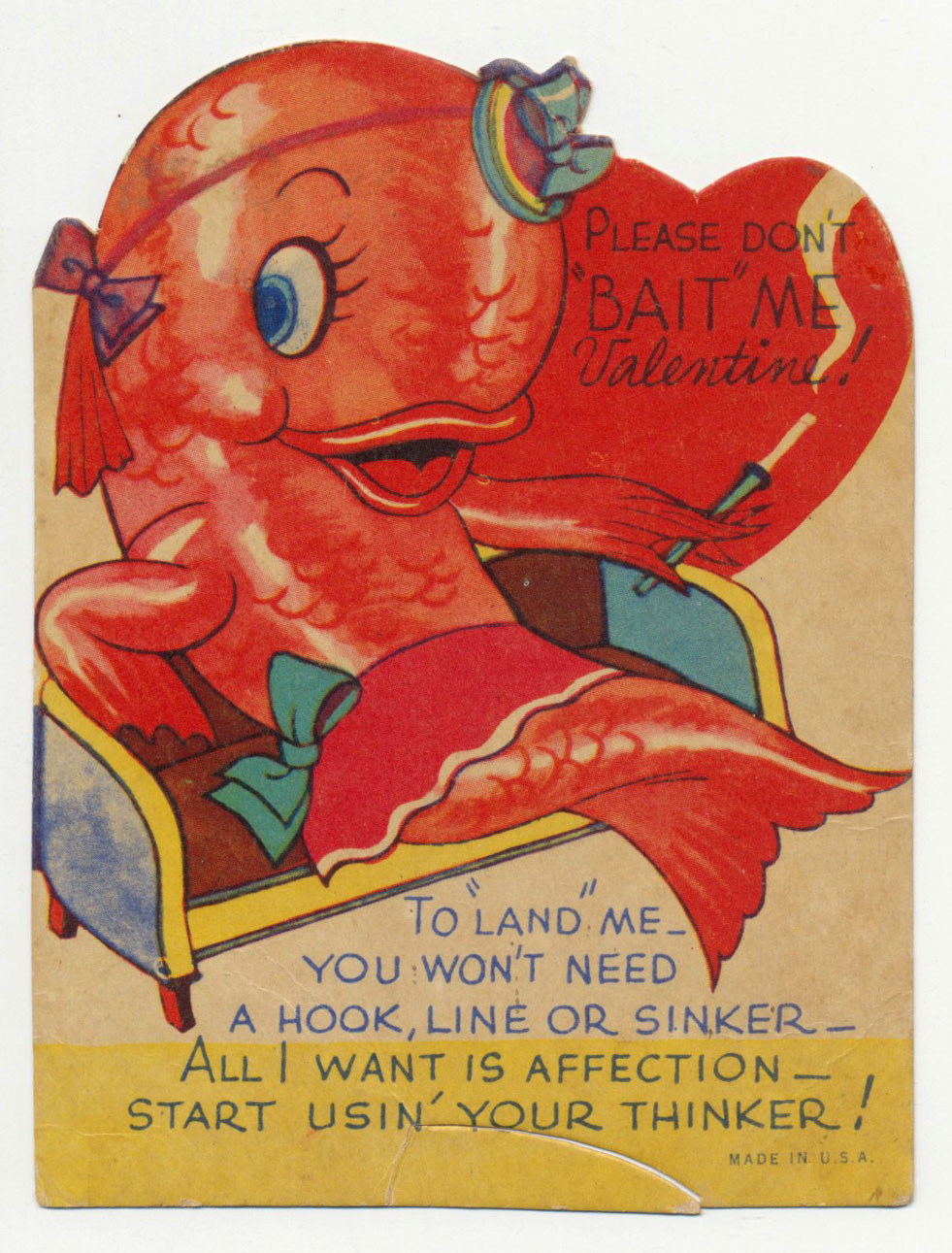
Valentine’s Day card circa 1940.

You see it?!  It must have been given to young Betty Lou Bucklin when she was just a school girl.  On the back of the card it says “To Betty Lou, From Lela.”  I remember when I was in elementary school in Jennings.  It seemed like every year Grandma Bucklin (Myrtle Sylvia Phenice Bucklin) would buy us a box or bag of Valentine cards for us to give to all of our classmates.  She would also buy us those little sweet heart candies.  You know, the ones that say “Be Mine” and “Love” on them.

At school on the day before Valentine’s Day, we’d all make a bag to put out to collect our cards from our classmates.  So the night before, we’d write “To Lori, from Van” on the back of the cards.  Then the next day we’d go to each person’s bag and match up the right card for each one.  My mom must have done the same thing when she was younger, because Lela Mae Jester was a classmate and friend of hers and this was the card she got from her one year.

But why did she save it?  Lots of times she saved things because of their artistic interest.  Maybe she would paint it at a later date.  I don’t recall her ever painting a scaly salmon-colored fish smoking a cigarette!  Or maybe it was because of the poem that was on it?  That’s another questionable motivation.  I’m not really sure what the message is.

So there you have it.  A weird, fishy Valentine’s Day card from the early 1940s.

She saved it.  I shared it.  Enjoy.

Pee Paw and His Boat

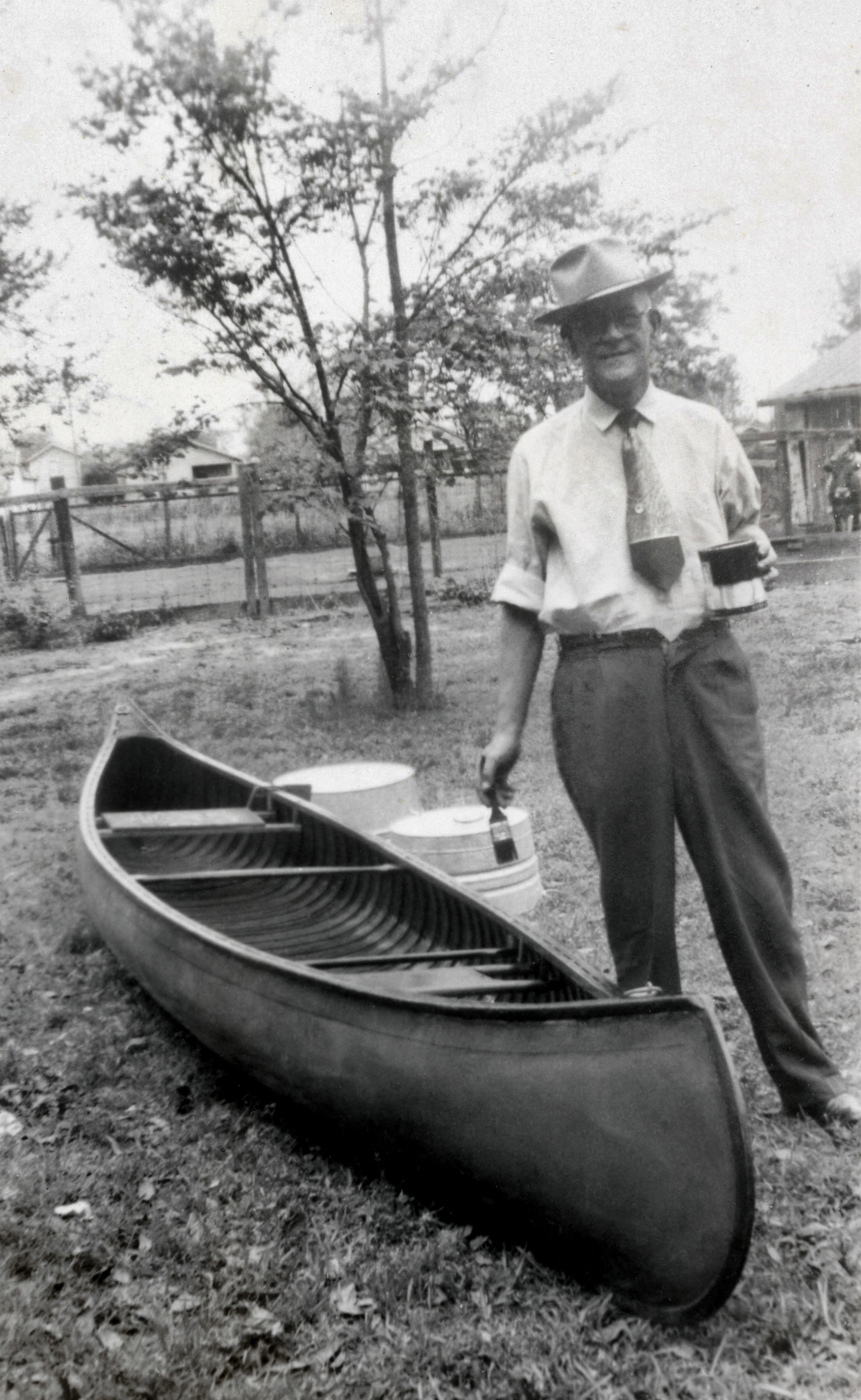
A while back I posted a photo of my paternal grandfather Robert Joseph Landry, Sr. with a picture of a ship behind him. (Pee Paw and the Aquitania)  While we knew the name of the ship, we didn’t know the reason that  he was posing beside a photo of it.  This is a photo of him with a different boat.  We don’t know the name of it (at least I don’t!), but we can be pretty sure why he was posing beside it.

Pee Paw with his fishing boat in 1951.

As you can see by this photo, it is a fishing boat that he likely owned.   He looks like he is working on painting or varnishing the vessel to make it seaworthy.   I know he went fishing quite frequently and made his own flies and rods.  I don’t know if he made his own boats.  If I find out that he did, I will follow up on that with the details.

This photo was taken around 1951.  I know that because of what was written on the back of it.  It says that the photo belonged to my dad’s (Bob Landry) older brother Hubert.  It gives the approximate year and it was based on my cousin Hugh being three years old when this photo was taken.  Hugh is not in the photo (unless he was dressed up as a cow in the background, but most likely not!), so Uncle Hubert must have remembered that fact about this photo.

I wonder how many boats he had over the years?  I posted a photo of Pee Paw and my dad in a boat in 1942.  I suppose it could be the same one.  ( I have been told that it was not.  The earlier one was a flat-bottomed boat and this is a canoe.)  It looks like he takes good care of it, which should make it last a while.  He must have been proud of his handiwork, because he seems to be happy to pose with it.

But my biggest question is this:  Why is he wearing a tie and dress clothes while he is working on his boat?  Didn’t they know about comfy clothes back then?

H. C. and Daisy With the Kids

The Harry Clifton Phenice and Daisy Henrietta Martha Keys Phenice family circa 1934.

Here’s an interesting photo of the Phenice family in the mid 1930s.  At least that’s my estimate of the date that it was taken.  The photo is not the best photo as far as clarity and balance is concerned, but it is almost ninety years old.  The person whose face is the hardest to make out is my grandmother’s, who you can see second from the right in this photo.

When my grandmother was born in 1906, her parents H. C. and Daisy gave her the name Myrtle Sylvia.  In 1930 she married her sweetheart Fred and acquired the last name Bucklin.  If this photo was taken when I estimated, she and Fred would be parents already.  Their first daughter Sylvia Daisy was born in 1931, and in 1933 their second daughter Betty Lou, my mom, was born.  (They would later have Alma, Loris, and Austin.) Now that you know how I connect to this photo, let’s see who everyone else is.

In front and center are my great grandparents Daisy Keys and Harry Clifton Phenice.  Daisy was born in 1876 in Hackney, London, Middlesex, England.  She came to Louisiana with her mom and siblings in 1887.  Harry was born in Butler County in Pennsylvania in 1874.  By the time he was six, his family had moved to Nebraska to homestead.  So Harry grew up on a farm in Nebraska.  When he reached the age of 24, he struck out on his own and arrived in Louisiana in 1898.  He married Daisy in 1900 in Lake Charles, Louisiana, and started a farm and family of his own.

Sylvan Austin was their first child and he was born 11 months after they were married.  You can see him on the far left in the photo.  He  married Mary Bucklin in 1926.  They never had any children.  The next child born to HC and Daisy was Grace Leona, who was born in 1903.  She can be seen standing next to her father.  She had married Ray Sowder in 1929 and they did not have any children at the time of this photo.  They would later have two daughters by the names of Patricia and Flora.

The next child of HC and Daisy was my grandmother Myrtle, who we have already discussed.  My good old Grandma!  After Myrtle came Henry Charles, who was born in 1909.  He was the middle child and he can be seen standing next to his mother.  He was married to Irma Hetzel in November 1934.  They later were the parents of Wayne, Charles, and Diane.  After Henry Charles came Bernard Orville, who was born in 1911.  Orville can be seen second from the left in the photo.  He got married to Elta Whitman in the same year that Henry and Irma were married, but they were married in January of 1934.  They had five children together: Marilyn, Kathleen, Linda, Paul, and Carol.

That leaves two more children of HC and Daisy.  Their youngest son was named Warren Algernon and he was born in 1916.  He is the son in the middle of the photo standing between his parents.  He would get married to Wilma Hylton in 1939 and they had four children.  Their two sons were named Terrell and Kevin, while their daughters were named Julie and Lisa.  The last child of HC and Daisy was Martha Marguerite, who was born in 1918.  She can be seen on the far right.  She was a just a single young adult at the time of this photo.  She would marry Thomas Hill in 1943.  Their children’s names are Shelly, Darla, and Warren.

As I was writing this, I realized that I have a lot of memories of my grandmother’s siblings. I remember seeing Uncle Sylvan, Uncle Henry, Uncle Warren, and Uncle Orville from time to time.  I remember lots of laughs at Grandma’s house when Aunt Grace and Aunt Marguerite would come around.  But I don’t have many memories of Grandpa’s siblings.  I remember hearing about them occasionally, but we didn’t see them much.  My dad’s parents were about a decade older than Grandma and Grandpa, and that made a big difference.  Pee Paw and all of his siblings died before I was even born.  Mee Maw and a few of her siblings were alive when I was a kid.  I have just one memory of any of them.

So I think of the children in this photo as my extra aunts and uncles.  That’s what we called them.  There was no “Great Aunt Marguerite” or “Grand Uncle Orville” when we saw them.  Even though we already had 22 ‘real’ aunts and uncles, I appreciated those extra ones.  I appreciate them even more now that they’re gone.

Times Of Change

Landry Family Band performing at Shakey’s in 1978.

Today is the second anniversary of my dad’s death, so I thought I would write something in his honor.  I was thinking about it this week, and one evening I came across this photo.  It was from a slide that I took on December 23, 1978, at Shakey’s Pizza Parlor in Lake Charles, Louisiana.  I posted a photo from this same evening a while back.  The other photo is a photo of my mom and dad along with me and all of my siblings.  It wasn’t often that all of us were there together, so it’s a special photo.  Any time I mention to someone that my family used to sing together at Shakey’s in the late 70s, I’ll invariably show them that photo.

But this photo is different.  It shows the family members who are no longer with us.  Jodie died in 1989.  It’s hard to believe that it will be 30 years this year.  Then my mom and dad died two years ago within five days of each other from natural causes.  As far as performing at Shakey’s, Mama and Daddy were there more often than the rest of us.  Jodie or Rob were probably there the least.  You can also see my dad’s brother Hubert Landry in the yellow shirt and his wife Mildred Sutherlin Landry next to him.  Uncle Hubert would play the harmonica with us pretty often.  Uncle Hubert and Aunt Mildred are no longer with us as well.  Aunt Mildred died in 1990, less than a year after Jodie, and Uncle Hubert died in 2006.

All of those changes happened after our time at Shakey’s.  We started playing there in June of 1976 and finished up five years later in August of 1981.  Those were times of big changes in the Robert Joseph Landry, Jr./Betty Lou Bucklin Landry family.  In 1976 there were still five of us living at 758 Lucy Street in Jennings.  There was Mama, Daddy, Al, me (Van), and Jamie.  We were the youngest three of the six children and the following school year was the only time that there were three Landry children in high school at the same time.  Al was going to be a senior, I was going to be a sophomore, and Jamie was going to be a freshman.

Also at that time, Jodie was married to her first husband.  They were in Lake Charles at McNeese when they first got married, but later moved to Texas to go to Texas A & M.  They must have moved by this time, otherwise we would have seen them more often at Shakey’s.  Rob was single and in school at Louisiana Tech in Ruston.  Karen was single also, but she was at McNeese.  She was able to be at Shakey’s frequently, too.  In fact she got a job there and worked there during the week as well.

By the time 1981 came around, Mom and Dad had become empty nesters.  Al graduated in 1977 and followed Rob up to Tech.  I graduated in 1979 and went to McNeese.  How could I give up performing at Shakey’s on the weekends?  Jamie graduated in 1980 and also went to McNeese.  I don’t know how Mom and Dad did it.  My mom didn’t work outside of the home and my dad was a band director living on a school teacher’s salary.  I seem to recall there being five of us in college at the same time at one point.  Performing at Shakey’s was a way to make ends meet.  I always just thought of it as fun.

A big change for the family during that time was that Jodie went through a divorce.  In some ways that doesn’t sound like a huge thing.  You see it all of the time.  But it wasn’t something that happened in OUR family.  That’s what other people did.  It wasn’t something Jodie wanted for herself, but it happened.  I know she had a bit of anxiety breaking the news to Mom and Dad.  This photo and the photos from that same evening remind me of that situation.  Seeing how Jodie went through that helped me and probably other siblings in breaking troubling news to our parents.

Rob’s first marriage was in 1980.  (He improved that situation a few years later.)  Karen and Jamie met their future spouses during that time as well.  And eventually, so did Jodie.   She even got married during that time.  Al and I were in college.  I actually missed the last month or so of the family performing at Shakey’s.  I was working at AstroWorld in Houston during the summer of 1981.  I’m not sorry I missed it, because I got to see Jodie more often and see her going through her last few months of pregnancy.  I was going to be an uncle!

So the years 1976 through 1981 saw my mom and dad through the last years with children in the house and then on to empty nesters.  Then the following month they became grandparents when little Christopher Rhodes made his grand entrance into the world.  He was the first of the twelve grandchildren enjoyed by Grammie and Pappy.  It was a start to the last era in their lives.  They had some good years.

1 37 38 39 40 41 58