Our first Koll ancestors in this country, Johann, Dorathea, and two children, arrived at the port of New Orleans on June 13, 1853 on the ship Johann Schmidt after sailing for 72 days. They had uprooted and traveled South from their home in Schleswig to set sail from Hamburg, Germany in the Holstein region.
Johann Rudolf Kohl (John Rudolph Koll) was born March 3, 1817 in Schleswig-Holstein, Germany (then Denmark). He died June 24, 1887 in Preston, Jackson County, Iowa.
Dorathea (Dora) Claudine Mohr was born December 25, 1819 in Kochendorf, Schleswig-Holstein, Germany. She died on July 31, 1890 in Preston, Jackson County, Iowa and was buried August 2. Her death date is “Jun 31” on church records and her gravestone, but there aren’t 31 days in June. Her burial date suggests July is probably correct.
They made the trip with daughters Anna age 8 (or 11) (1842-1925) and Maria (Mary) age 5 (1848-1934). Their nine month old son, Christian, died during the voyage on May 28, 1853.
The passenger list of the ship says they intended to live in Iowa, his occupation was farmer, and they came from Sleswick (Schleswig). John finalized the purchase of 40 acres of Iowa public land from the government in June 1854.
There were two other Kolls listed just below on the passenger list, maybe John Koll’s sister or sister-in-law: Anna Koll who was 20 and baby Dorothea who was under a year old. And there were several Mohrs including Dorathea’s mother, Frederica Juliane Thams that came with them.
The name recorded on the passenger list is Johann Koll and later as John Rudolph Koll on the land record. His gravestone says Johann R. Koll. Our family records say that his son Henry was the one to change the family name from Kohl to Koll as an adult. Those records make me question that, but I have not seen his name in his own handwriting so it’s possible people just kept misspelling his name and it finally stuck in the next generation. John’s daughter Mary was still using Kohl when she got married in 1870.
In Iowa, they had three more children, Dora (1856-1941), Hans Karl (1856-1932), and Henry Fredrick (1861-1937). Dora moved to North Dakota with her husband Henry Brinkman. Anna, Mary, and Hans stayed in Iowa. Henry Fredrick moved to Arkansas and later Jennings with his wife Anna Wulf.
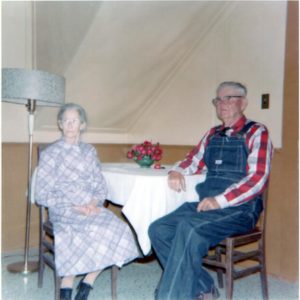
The photo is a Cabinet Card style print with the mark A. Nott, Preston, Iowa. I found photographer Arthur Nott had a studio in Maquoketa, Jackson County, Iowa in the 1870s and 1880s. The features of the card also appear to be from the 1880s meaning they were probably both in their 60s when it was taken.
The variation in place names and countries when researching was confusing me so I had my brother John explain it:
To delve into their Danish (at the time) place of origin and why we and they considered it German we must run through the issues that plagued the people of the area and touched most of the Europe in the 19th Century. Perhaps also giving some insight into possible reasons for their immigration, leaving a conflicted land with more war looming for the promise of America.
First off, their origin is currently in the German State of Schleswig-Holstein the northernmost state bordering Denmark. The area has a long and varied history, comprising the majority of the Duchy of Holstein and the southern part of what was the Duchy of Schleswig (or Sleswick in old English translations). Duchies are similar to Counties or Parishes within the later larger State.
But at the time of their departure, these same lands were under the sovereign rule of the Danish King. For many centuries, the King of Denmark was both a Danish Duke of Schleswig and a Duke of Holstein within the Holy Roman Empire (the larger entity that ruled over Germany at the time).
Which brings us to the daunting Schleswig-Holstein Question which was the name given to the complex issues arising in the 19th century out of this odd regional situation.
With the abolition of the Holy Roman Empire in 1806, Denmark claimed Holstein as part of their kingdom which was unpopular among the majority German population in Holstein and southern Schleswig. In the early steps of unification, Germans felt differently and also claimed the Duchy of Holstein within their new Prussian led German Confederation.
This unpopularity led to strong unification movements and gave a pretext for Prussia to declare war on Denmark in order to seize Schleswig and Holstein, by ‘liberating’ Germans from Danish rule. Though due to alliances, this first 1848 attempt at the liberation ended in a status quo.
Due to unrelated wars, Denmark’s backing had eroded by 1860 and the conflict culminated in Prussia and Austria invading Schleswig on February 1, 1864. After a short campaign, Denmark capitulated whereby Prussia and Austria took over Schleswig and Holstein respectively in October 30, 1864.
The following war between Prussia and Austria in 1866 unified the two duchies now both under Prussian rule along with most of Germany. Finally, Germany was formed as a country after defeating France in yet another war, the Franco-Prussian War, on January 18th, 1871.